


Genesis 16:16
Bible text: King James Version (1769 Blayney text) · Public domain
Bible text: Berean Standard Bible · Public domain
Bible text: American Standard Version (1901) · Public domain
Bible text: World English Bible, Messianic edition · Public domain
Bible text: Geneva Bible (1599) · Public domain
Bible text: Young's Literal Translation · Public domain
- וְאַבְרָםve·'av·Ramand AbramH87Conj-w ¦ N-proper-mNoun Proper MasculineוְandאַבְרָםAbram
- בֶּןben[was] a son ofH1121N-mscNoun Singular Masculine Construct
- שְׁמֹנִיםshe·mo·NimeightyH8084Adj-mpAdjective Numerical Plural Masculine Absolute
- שָׁנָהsha·Nahyear[s]H8141N-fsNoun Singular Feminine Absolute
- וְשֵׁשׁve·Sheshand sixH8337Conj-w ¦ Adj-csAdjective Numerical Singular common gender Absoluteוְandשֵׁשׁsix
- שָׁנִיםsha·NimyearsH8141N-mpNoun Plural Masculine Absolute
- בְּלֶדֶתbe·le·detwhen boreH3205Prep-b ¦ V-Qal-InfVerb Qal Infinitive Constructבְּwhenלֶדֶתbore
- הָגָרha·GarHagarH1904N-proper-fNoun Proper Feminine
- אֶת'et<obj.>H853DirObjMParticle Object Indicator
- יִשְׁמָעֵאלyish·ma·'ElIshmaelH3458N-proper-mNoun Proper Masculine
- לְאַבְרָםle·'av·Ramto AbramH87Prep-l ¦ N-proper-mNoun Proper MasculineלְtoאַבְרָםAbram
English is a literal word-by-word gloss of the Hebrew, not the KJV's wording. Why?
This is the original text the KJV's translators worked from — each Hebrew word with its own literal English meaning in this verse, prepared by scholars at Tyndale House, Cambridge. The KJV translates whole sentences, not word by word, so its wording differs: one Hebrew word can become several English words, and the KJV may choose “the LORD” where the gloss reads “Yahweh”. Both are faithful — they answer different questions. For the KJV's own rendering, switch to the KJV text.
Details
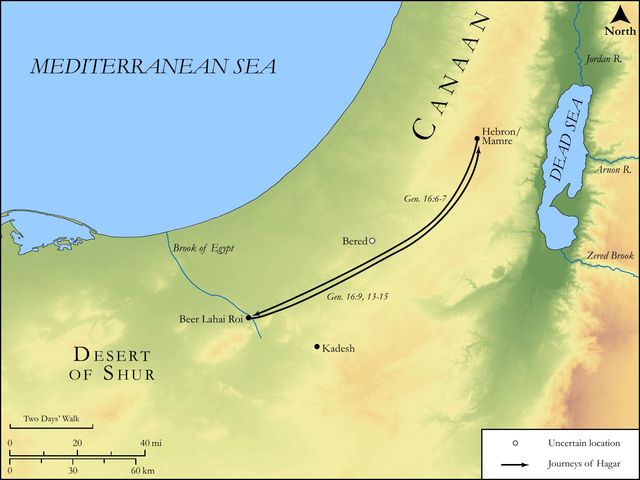
See on the biblical-era maps


Study this verse
Public-domain commentary
Matthew Henry
From his Commentary on the Whole Bible. Henry comments on passages, not single verses — this entry covers Genesis 16:15–16.
It is here taken for granted, though not expressly recorded, that Hagar did as the angel commanded her, returning to here mistress and submitting herself; and then, in the fulness of time, she brought forth her son. Note, Those who obey divine precepts shall have the comfort of divine promises. This was the son of the bond-woman that was born after the flesh (Gal 4:23), representing the unbelieving Jews, v. 25. Note, 1. Many who can call Abraham father are yet born after the flesh, Mat 3:9. 2. The carnal seed in the church are sooner brought forth than the spiritual. It is an easier thing to persuade men to assume the form of godliness than to submit to the power of godliness.
Historical interpretation
Historical reception
1 surviving comment on this verse from the historical church.
It is plausible to say that it was to establish the fact that Hagar was a serious woman and Ishmael an authentic son of Abraham that Scripture went out of its way to remark that Hagar bore a son “to Abram.” What follows is clear as to the literal sense, but let us examine too the anagogical [mystical] sense. When the person who is making progress gives birth according to the goal assigned by the master, the child he bears is not to be despised. The verse then applies the metaphorical notion of generation to the master who correctly teaches and who thus provides profitable seed. This is why it is said, “Hagar bore to Abram.” The proof that the meaning is indeed what I have indicated according to the terms of Scripture is that, in the following phrase, “And Abram called the name of his son,” the Word adds, “whom Hagar bore him.” If an idea (like the one I suggested) were not in the background here, the text would simply have said, “And Abram named his son,” without adding “whom she bore him.”
Continue studying Genesis 16:16 across the web’s major study libraries — every link below opens this exact verse, chapter, or book on the destination site.
Read & Compare
 BibleGatewayThis verse in more than 200 translations and 70 languages.
 Bible.comThe YouVersion reader — hundreds of translations, reading plans, and highlights.
 ESV.orgCrossway's official English Standard Version reader.
 NET BibleThe NET translation with 60,000+ translators' notes on every rendering decision.
 STEP BibleTyndale House's free study tool — original text, vocabulary, and scholarly resources.
 BibliaLogos Bible Software's free web reader.
 USCCBThe New American Bible (Revised Edition) with the U.S. bishops' study notes.
Commentaries
 BibleHub CommentariesDozens of classic commentaries on this verse, gathered on one page.
 StudyLightMore than 100 commentary sets — the largest collection on the web.
 BibleRefPlain-English commentary on what this verse means, verse by verse.
 Enduring WordDavid Guzik's free commentary on this chapter, widely used by Bible teachers.
 Bible Study ToolsVerse commentary alongside Greek and Hebrew study aids.
Original Language & Research
- BibleHub InterlinearThe verse word by word — original language, transliteration, and English.
- BibleHub LexiconEvery word's original-language definition and Strong's entry.
 Blue Letter BibleDeep-study tools — Strong's numbers, concordance, and word studies.
 SefariaThe Hebrew text with Rashi and centuries of Jewish commentary.
Sermons, Hymns & Audio


TrulyRandomVerse is not affiliated with these sites and doesn’t control their content. They’re linked because they’re genuinely useful.
Summary
Genesis 16:16 meticulously records Abram's age as eighty-six years old at the birth of Ishmael, marking a pivotal moment in the patriarchal narrative. This verse signifies the culmination of Sarai's human-devised plan to secure an heir, born of Hagar, her Egyptian servant, rather than patiently waiting for God's divinely promised son, thereby highlighting the immediate outcome of human intervention in the unfolding of God's perfect timing and covenantal promises.
Context
ShowHideLiterary Context
This verse is situated within the broader narrative of God's covenant with Abram, particularly following the repeated promises of a vast lineage and a specific heir, as articulated in Genesis 12:2-3 and emphatically reaffirmed in Genesis 15:4-5. Despite these divine assurances, a decade had passed since Abram's call, and Sarai remained barren. Driven by cultural pressures and a perceived need to "help" God fulfill His promise, Sarai proposed that Abram take Hagar as a concubine to bear a child on her behalf, as detailed in Genesis 16:1-3. The birth of Ishmael, therefore, is the direct consequence of this human initiative, preceding God's explicit clarification that the covenant heir would come through Sarai herself, as later revealed in Genesis 17:15-19.
Historical & Cultural Context
The practice of a barren wife giving her maidservant to her husband to bear children was a recognized custom among the patriarchs, as when Rachel gave her handmaid Bilhah to Jacob. Children born of such unions were legally considered the offspring of the wife. Sarai's action, while culturally acceptable, reveals a lack of faith in God's supernatural ability to fulfill His promise through her own aged body. The naming of Ishmael, meaning "God hears," reflects Hagar's personal experience of God's attentiveness to her distress, as described in Genesis 16:11-13. This cultural backdrop underscores the human attempt to navigate divine promises through conventional means, rather than relying on an unconventional, miraculous intervention.
Key Themes
ShowHideGenesis 16:16 contributes significantly to several overarching themes within the book of Genesis and the broader biblical narrative. It powerfully illustrates the theme of human impatience versus divine timing, showing the consequences of attempting to force God's hand rather than waiting in faith. It highlights the nature of God's covenant, emphasizing that His promises are fulfilled according to His sovereign will and method, not human ingenuity. Furthermore, it introduces the theme of conflict arising from human disobedience, as Ishmael's birth ultimately leads to significant domestic strife within Abram's household, foreshadowing future tensions between the descendants of Ishmael and Isaac, a theme that reverberates throughout Genesis 21.
Exposition and Analysis
ShowHideThe King James Version text of Genesis 16:16 states, "And Abram [was] fourscore and six years old, when Hagar bare Ishmael to Abram." This precise chronological detail is not merely incidental but serves to underscore a critical juncture in the biblical narrative of God's covenant with Abram.
Key Word Analysis
ShowHideMeaning "high father." This name, later changed to Abraham ("father of a multitude") in Genesis 17:5, signifies his foundational role as the patriarch through whom God's covenant promises would flow. At this point, he is still Abram, emphasizing the early stage of his faith journey and the ongoing development of God's plan.
Of uncertain (perhaps foreign) derivation; Hagar, the mother of Ishmael. Her identity as an Egyptian servant is crucial, as her origins contrast with the divine promise of an heir through Sarai, the covenant wife. Her role here highlights the human attempt to fulfill divine promises through conventional, rather than miraculous, means.
Meaning "God will hear." This name, given by the Angel of the Lord in Genesis 16:11, encapsulates a profound theological truth: God hears the cries of the afflicted, even those caught in the consequences of human error. Though not the covenant heir, Ishmael's name affirms God's compassion and future blessing upon him.
Verse Breakdown
ShowHide"And Abram [was] fourscore and six years old,"
This clause provides the precise age of Abram (86 years old, "fourscore" meaning eighty, plus six) at the time of Ishmael's birth. This chronological marker is highly significant, indicating that eleven years had passed since God first called Abram from Haran when he was seventy-five (Genesis 12:4). The extended waiting period underscores the growing impatience and doubt that likely led Sarai and Abram to take matters into their own hands, rather than patiently trusting God's timing for a miraculous birth.
"when Hagar bare Ishmael to Abram."
This phrase describes the pivotal event of Ishmael's birth. The verb "bare" (Hebrew: yâlad) indicates the act of giving birth, emphasizing Hagar's role as the biological mother. The phrase "to Abram" confirms Ishmael's legal paternity and his status as Abram's son, recognized within the cultural customs of the time. However, the subsequent narrative will clarify that despite this legitimate birth, Ishmael was not the "son of promise" through whom the Abrahamic covenant would be fully established.
Literary Devices
ShowHideThe verse employs Chronological Precision, providing Abram's exact age, which serves to ground the narrative in a specific timeline and highlight the passage of time since God's initial promise. This precision also sets up a Contrast with Abram's age when Isaac, the true son of promise, would be born fourteen years later, at 100 years old (Genesis 21:5). Furthermore, the event itself functions as a form of Foreshadowing, hinting at the future domestic strife and the complex relationship between the descendants of Ishmael and Isaac, which would have long-lasting implications for the covenant people.
Theological and Thematic Connections
ShowHideGenesis 16:16 serves as a stark reminder of the tension between human effort and divine promise. The birth of Ishmael, while a legitimate son in the eyes of the law, represents a detour from God's intended path, born of impatience and a lack of faith in God's supernatural ability to fulfill His word. This narrative underscores that God's covenant promises are not contingent on human ingenuity or striving, but on His sovereign power and perfect timing. Despite this human misstep, God's faithfulness is evident in His subsequent care for Hagar and Ishmael, demonstrating His compassion even outside the direct line of covenantal promise. The distinction between the "son of the flesh" (Ishmael) and the "son of promise" (Isaac) becomes a foundational theological concept, illustrating the difference between works-based attempts to secure blessing and grace-based reception of God's unmerited favor.
Reflection and Application
ShowHideGenesis 16:16 offers profound lessons for believers navigating life's uncertainties and the sometimes-long waits for God's promises to materialize. The impatience of Abram and Sarai, leading to the birth of Ishmael, serves as a cautionary tale: when we attempt to "help" God or force His hand through our own wisdom and efforts, we often create complications and unintended consequences that can reverberate for generations. This verse calls us to cultivate a deeper trust in God's perfect timing and His ability to accomplish His will in ways that defy human logic. It challenges us to surrender our timelines and methods to His sovereign plan, remembering that His ways are higher than our ways. True faith is not merely believing God can do something, but trusting that He will do it in His perfect way and time, even when circumstances seem to contradict His promises. Our spiritual growth is often forged in the crucible of waiting, as we learn to rest in God's faithfulness rather than relying on our own striving.
Questions for Reflection
ShowHideFAQ
ShowHideWhy is Abram's age precisely noted in this verse?
ShowHideThe precise mention of Abram's age, 86 years, is highly significant. It underscores the substantial passage of time—eleven years—since God first called Abram and promised him a son when he was 75 (Genesis 12:4). This long wait highlights the growing impatience and human reasoning that led Sarai and Abram to devise their own solution through Hagar. The exact age emphasizes the historical accuracy of the narrative and sets up a profound contrast with Abram's age (100) when Isaac, the true son of promise, was miraculously born (Genesis 21:5), fourteen years later.
Was Ishmael the son God promised to Abram?
ShowHideNo, Ishmael was not the promised son through whom God's covenant would be established. While Ishmael was indeed Abram's biological son and legitimate in the cultural context, God later clarified that the covenant heir would come specifically through Sarai, and his name would be Isaac (Genesis 17:19). Ishmael's birth was a result of human initiative and a lack of faith in God's timing, though God did graciously bless Ishmael and promise to make him the father of a great nation (Genesis 21:13).
What does "fourscore and six years old" mean?
ShowHide"Fourscore and six years old" is an archaic English phrase from the King James Version. "Fourscore" means four times twenty, or eighty. Therefore, "fourscore and six years old" means 86 years old. This precise detail contributes to the chronological and historical grounding of the biblical narrative, emphasizing the specific moment in Abram's life when this pivotal event occurred.
Christ-Centered Fulfillment
ShowHideThe narrative of Ishmael's birth in Genesis 16:16, born of human striving and impatience, serves as a profound Old Testament type that foreshadows the New Testament distinction between salvation by works and salvation by grace through faith. Just as Ishmael was born "according to the flesh" (Galatians 4:23), a product of human effort to secure a promised blessing, so too does humanity often attempt to achieve righteousness or favor with God through self-effort and adherence to law. However, the true "son of promise," Isaac, born miraculously when human ability had ceased, points directly to Jesus Christ. Christ is the ultimate fulfillment of God's promise to Abraham, the "Seed" through whom all nations would be blessed (Galatians 3:16). Our spiritual inheritance and adoption into God's family are not achieved by our own works or lineage, but by God's sovereign, unmerited grace through faith in Christ, the one who brings life from spiritual barrenness (Ephesians 2:8-9). In Christ, God's promises are perfectly fulfilled, not through human striving, but through the divine provision of the perfect Son, who offers eternal life and true spiritual freedom to all who believe (John 3:16).