


Genesis 21:13
Bible text: King James Version (1769 Blayney text) · Public domain
Bible text: Berean Standard Bible · Public domain
Bible text: American Standard Version (1901) · Public domain
Bible text: World English Bible, Messianic edition · Public domain
Bible text: Geneva Bible (1599) · Public domain
Bible text: Young's Literal Translation · Public domain
- וְגַםve·Gamand alsoH1571Conj-w ¦ AdvAdverbוְandגַםalso
- אֶת'et<obj.>H853DirObjMParticle Object Indicator
- בֶּןben[the] son ofH1121N-mscNoun Singular Masculine Construct
- הָאָמָהha·'a·Mahthe slave womanH519Art ¦ N-fsNoun Singular Feminine Absoluteהָtheאָמָהslave woman
- לְגוֹיle·Goyinto a nationH1471Prep-l ¦ N-msNoun Singular Masculine Absoluteלְintoגוֹיa nation
- אֲשִׂימֶנּוּ'a·si·Me·nuI will make himH7760V-Qal-Imperf-1cs ¦ 3msVerb Qal Imperfect 1st Singular common genderאֲשִׂימֶI will makeנּוּhim
- כִּיkiforH3588PrtParticle Conditional
- זַרְעֲךָzar·'a·Kha[is] your offspringH2233N-msc ¦ 2msNoun Singular Masculine Constructזַרְעֲ[is] offspringךָyour
- הוּאHu'heH1931Pro-3msPronoun Personal 3rd Singular Masculine
English is a literal word-by-word gloss of the Hebrew, not the KJV's wording. Why?
This is the original text the KJV's translators worked from — each Hebrew word with its own literal English meaning in this verse, prepared by scholars at Tyndale House, Cambridge. The KJV translates whole sentences, not word by word, so its wording differs: one Hebrew word can become several English words, and the KJV may choose “the LORD” where the gloss reads “Yahweh”. Both are faithful — they answer different questions. For the KJV's own rendering, switch to the KJV text.
Details
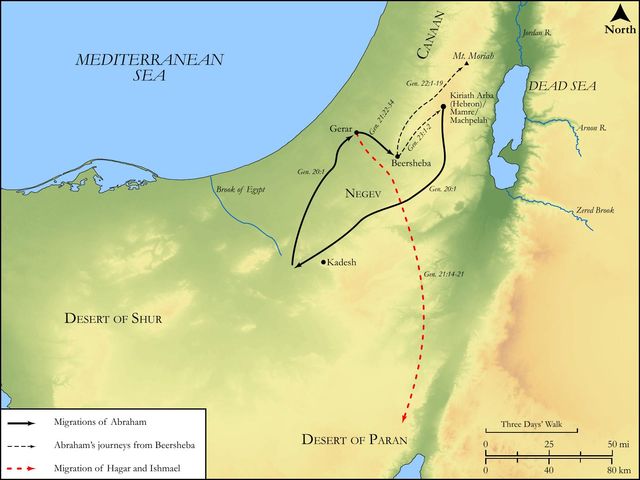
See on the biblical-era maps


Study this verse
Public-domain commentary
Matthew Henry
From his Commentary on the Whole Bible. Henry comments on passages, not single verses — this entry covers Genesis 21:9–13. His three-level outline is real structure in the source text, so it is rendered as structure.
The casting out of Ishmael is here considered of, and resolved on.
I.Ishmael himself gave the occasion by some affronts he gave to Isaac his little brother, some think on the day that Abraham made the feast for joy that Isaac was safely weaned, which the Jews say was not till he was three years old, others say five. Sarah herself was an eye-witness of the abuse: she saw the son of the Egyptian mocking (Gen 21:9), mocking Isaac, no doubt, for it is said, with reference to this (Gal 4:29), that he that was born after the flesh persecuted him that was born after the Spirit. Ishmael is here called the son of the Egyptian, because, as some think, the 400 years' affliction of the seed of Abraham by the Egyptians began now, and was to be dated hence, Gen 15:13. She saw him playing with Isaac, so the Septuagint, and, in play, mocking him. Ishmael was fourteen years older than Isaac; and, when children are together, the elder should be careful and tender of the younger: but it argued a very base and sordid disposition in Ishmael to be abusive to a child that was no way a match for him. Note,
1.God takes notice of what children say and do in their play, and will reckon with them if they say or do amiss, though their parents do not.
2.Mocking is a great sin, and very provoking to God.
3.There is a rooted remaining enmity in the seed of the serpent against the seed of the woman. The children of promise must expect to be mocked. This is persecution, which those that will live godly must count upon.
4.None are rejected and cast out from God but those who have first deserved it. Ishmael is continued in Abraham's family till he becomes a disturbance, grief, and scandal to it.
II.Sarah made the motion:
Cast out this bond-woman, Gen 21:10. This seems to be spoken in some heat, yet it is quoted (Gal 4:30) as if it had been spoken by a spirit of prophecy; and it is the sentence passed on all hypocrites and carnal people, though they have a place and a name in the visible church. All that are born after the flesh and not born again, that rest in the law and reject the gospel promise, shall certainly be cast out. It is made to point particularly at the rejection of the unbelieving Jews, who, though they were the seed of Abraham, yet, because they submitted not to the gospel covenant, were unchurched and disfranchised: and that which, above any thing, provoked God to cast them off was their mocking and persecuting the gospel church, God's Isaac, in its infancy, Th1 2:16, Note, There are many who are familiarly conversant with the children of God in this world, and yet shall not partake with them in the inheritance of sons. Ishmael might be Isaac's play-fellow and school-fellow, yet not his fellow-heir.
III.Abraham was averse to it: The thing was very grievous in Abraham's sight, Gen 21:11.
1.It grieved him that Ishmael had given such a provocation. Note, Children ought to consider that the more their parents love them the more they are grieved at their misconduct, and particularly at their quarrels among themselves.
2.It grieved him that Sarah insisted upon such a punishment. "Might it not suffice to correct him? would nothing less serve than to expel him?" Note, Even the needful extremities which must be used with wicked and incorrigible children are very grievous to tender parents, who cannot thus afflict willingly.
IV.God determined it, Gen 21:12, Gen 21:13.
We may well suppose Abraham to be greatly agitated about this matter, loth to displease Sarah, and yet loth to expel Ishmael; in this difficulty God tells him what his will is, and then he is satisfied. Note, A good man desires no more in doubtful cases than to know his duty, and what God would have him do; and, when he is clear in this, he is, or should be, easy. To make Abraham so, God sets this matter before him in a true light, and shows him,
1.That the casting out of Ishmael was necessary to the establishment of Isaac in the rights and privileges of the covenant: In Isaac shall thy seed be called. Both Christ and the church must descend from Abraham through the loins of Isaac; this is the entail of the promise upon Isaac, and is quoted by the apostle (Rom 9:7) to show that not all who come from Abraham's loins were the heirs of Abraham's covenant. Isaac, the promised son, must be the father of the promised seed; therefore, "Away with Ishmael, send him far enough, lest he corrupt the manners or attempt to invade the rights of Isaac." It will be his security to have his rival banished. The covenant seed of Abraham must be a peculiar people, a people by themselves, from the very first, distinguished, not mingled with those that were out of covenant; for this reason Ishmael must be separated. Abraham was called alone, and so must Isaac be. See Isa 51:2. It is probable that Sarah little thought of this (Joh 11:51), but God took what she said, and turned it into an oracle, as afterwards, Gen 27:10.
2.That the casting out of Ishmael should not be his ruin, Gen 21:13. He shall be a nation, because he is thy seed. We are not sure that it was his eternal ruin. It is presumption to say that all those who are left out of the external dispensation from all his mercies: those may be saved who are not thus honoured. However, we are sure it was not his temporal ruin. Though he was chased out of the church, he was not chased out of the world. I will make him a nation. Note,
(1.)Nations are of God's making: he founds them, he forms them, he fixes them.
(2.)Many are full of the blessings of God's providence that are strangers to the blessings of his covenant.
(3.)The children of this world often fare the better, as to outward things, for their relation to the children of God.
Continue studying Genesis 21:13 across the web’s major study libraries — every link below opens this exact verse, chapter, or book on the destination site.
Read & Compare
 BibleGatewayThis verse in more than 200 translations and 70 languages.
 Bible.comThe YouVersion reader — hundreds of translations, reading plans, and highlights.
 ESV.orgCrossway's official English Standard Version reader.
 NET BibleThe NET translation with 60,000+ translators' notes on every rendering decision.
 STEP BibleTyndale House's free study tool — original text, vocabulary, and scholarly resources.
 BibliaLogos Bible Software's free web reader.
 USCCBThe New American Bible (Revised Edition) with the U.S. bishops' study notes.
Commentaries
 BibleHub CommentariesDozens of classic commentaries on this verse, gathered on one page.
 StudyLightMore than 100 commentary sets — the largest collection on the web.
 BibleRefPlain-English commentary on what this verse means, verse by verse.
 Enduring WordDavid Guzik's free commentary on this chapter, widely used by Bible teachers.
 Bible Study ToolsVerse commentary alongside Greek and Hebrew study aids.
Original Language & Research
- BibleHub InterlinearThe verse word by word — original language, transliteration, and English.
- BibleHub LexiconEvery word's original-language definition and Strong's entry.
 Blue Letter BibleDeep-study tools — Strong's numbers, concordance, and word studies.
 SefariaThe Hebrew text with Rashi and centuries of Jewish commentary.
Sermons, Hymns & Audio


TrulyRandomVerse is not affiliated with these sites and doesn’t control their content. They’re linked because they’re genuinely useful.
Summary
Genesis 21:13 unveils God's profound and expansive providence, assuring Abraham that despite the painful command to send away Hagar and Ishmael, He would still make a great nation of the son of the bondwoman. This divine declaration highlights God's unwavering faithfulness to His prior promises concerning Ishmael's future and His sovereign care extending beyond the specific covenant lineage established through Isaac, demonstrating an encompassing mercy that governs the destinies of all peoples.
Context
ShowHideLiterary Context
This verse is a direct divine response to a deeply distressing situation for Abraham. Immediately preceding it, Sarah, having given birth to Isaac, observes Ishmael mocking her son and demands that Abraham cast out Hagar and Ishmael, stating, "Cast out this bondwoman and her son: for the son of this bondwoman shall not be heir with my son, even with Isaac" Genesis 21:10. This demand was "very grievous in Abraham's sight because of his son" Genesis 21:11. God then intervenes, instructing Abraham to obey Sarah, clarifying that the covenant promises would be established exclusively through Isaac, yet simultaneously offering comfort regarding Ishmael's future: "for in Isaac shall thy seed be called. And also of the son of the bondwoman will I make a nation, because he is thy seed" Genesis 21:12-13. This sequence underscores God's meticulous orchestration of His covenant plan while demonstrating His compassionate oversight of all individuals.
Historical & Cultural Context
In the households of the patriarchs, the status of a son born to a bondwoman (concubine) was complex. While such a son could be recognized as legitimate and inherit, the arrival of a son from the primary wife, especially one born miraculously, often altered the inheritance dynamic. Sarah's demand for Ishmael's expulsion aligns with the practice of ensuring the sole inheritance for the son of the principal wife, preventing disputes. However, God's promise to make Ishmael a "nation" (גּוֹי, gôwy) was extraordinary. This term often referred to foreign, non-Israelite peoples, signifying a distinct and significant lineage. The emphasis on "thy seed" (זֶרַע, zeraʻ) acknowledges the biological reality of Ishmael's paternity, which, in a patriarchal society, carried significant weight regarding identity and future. God's intervention here demonstrates a divine override of typical human social structures, ensuring a future for Ishmael despite his expulsion.
Key Themes
ShowHideGenesis 21:13 contributes significantly to several overarching themes in the book of Genesis and the broader biblical narrative. Firstly, it highlights Divine Sovereignty and Providence, demonstrating God's absolute control over human destinies, even those seemingly outside the primary covenant line. God's plan is comprehensive, encompassing all peoples. Secondly, it illustrates the distinction between Covenantal Blessing and General Blessing. While the specific redemptive covenant flows through Isaac (as seen in Genesis 17:19), God's general benevolence and faithfulness extend to Ishmael due to his direct biological connection to Abraham, fulfilling earlier promises made to Hagar and Abraham concerning Ishmael's numerous descendants (e.g., Genesis 16:10 and Genesis 17:20). This verse also subtly introduces the theme of God's Care for the Vulnerable and Outcast, as Hagar and Ishmael are sent into the wilderness, yet God ensures their survival and future.
Exposition and Analysis
ShowHideGenesis 21:13 is a pivotal declaration of divine compassion and sovereign intent, immediately following God's instruction to Abraham concerning Hagar and Ishmael's departure. The verse reads, "And also of the son of the bondwoman will I make a nation, because he [is] thy seed." This statement serves as a divine comfort to Abraham, who was distressed by Sarah's demand and the impending separation from Ishmael.
Key Word Analysis
ShowHideMeaning "a son (as a builder of the family name), in the widest sense (of literal and figurative relationship, including grandson, subject, nation, quality or condition, etc., (like father or brother), etc.)." Here, it specifically refers to Ishmael, emphasizing his direct biological lineage from Abraham, which carries the weight of paternal connection despite his mother's status.
Meaning "a maidservant or female slave; (hand-) bondmaid(-woman), maid(-servant)." This term clearly identifies Hagar, Ishmael's mother, and highlights her social status, which contrasts with Sarah's as the free wife, underscoring the legal and social distinction between the two sons.
Meaning "to put (used in a great variety of applications, literal, figurative, inferentially, and elliptically); [idiom] any wise, appoint, bring, call (a name), care, cast in, change, charge, commit, consider, convey, determine, [phrase] disguise, dispose, do, get, give, heap up, hold, impute, lay (down, up), leave, look, make (out), mark, [phrase] name, [idiom] on, ordain, order, [phrase] paint, place, preserve, purpose, put (on), [phrase] regard, rehearse, reward, (cause to) set (on, up), shew, [phrase] stedfastly, take, [idiom] tell, [phrase] tread down, (over-)turn, [idiom] wholly, work." This verb emphasizes God's active, deliberate, and sovereign role in bringing about Ishmael's future as a nation, indicating divine purpose and power.
Meaning "a foreign nation; hence, a Gentile; also (figuratively) a troop of animals, or a flight of locusts; Gentile, heathen, nation, people." This term signifies that Ishmael would become the progenitor of a distinct and significant people group, fulfilling God's earlier promises and establishing his lineage as separate from but parallel to the covenant line of Israel.
Meaning "seed; figuratively, fruit, plant, sowing-time, posterity; [idiom] carnally, child, fruitful, seed(-time), sowing-time." This crucial term underscores the biological connection between Ishmael and Abraham, serving as the divine rationale for God's continued blessing and promise to Ishmael, even though he is not the covenantal "seed" through whom the messianic line would come.
Verse Breakdown
ShowHide"And also of the son of the bondwoman"
This phrase explicitly identifies Ishmael, the son of Hagar, the "bondwoman," as the subject of God's promise. It immediately follows God's instruction to Abraham regarding Isaac, highlighting that while Isaac is the covenant heir, Ishmael is not forgotten. The inclusion of "also" signifies an additional, distinct promise beyond the primary covenant.
"will I make a nation"
This is a powerful divine declaration. The verb "make" (H7760, sûwm) emphasizes God's active, sovereign role in establishing Ishmael's descendants as a significant people group. The term "nation" (H1471, gôwy) indicates a distinct and numerous people, fulfilling earlier divine promises made to Hagar and Abraham about Ishmael's future. This demonstrates God's power to raise up and multiply peoples according to His will, even outside the specific line of covenant blessing.
"because he is thy seed"
This crucial clause provides the divine rationale for God's continued blessing upon Ishmael. The Hebrew term "seed" (H2233, zeraʻ) emphasizes Ishmael's direct biological connection to Abraham. While the primary covenant of grace and the messianic line would proceed through Isaac, God honors the natural lineage. This highlights a distinction in God's dealings: specific covenant promises are particular, but His general providence and blessing can extend more broadly, acknowledging natural relationships and prior declarations. God's commitment to Abraham extended to all his biological offspring, albeit with different forms of blessing and purpose. This particular promise ensures Ishmael's survival and flourishing, preventing his complete disappearance from history and affirming God's comprehensive oversight of humanity.
Literary Devices
ShowHideGenesis 21:13 employs several literary devices that enhance its theological impact. The most prominent is Divine Speech, as God directly addresses Abraham, providing comfort and instruction. This direct address underscores the authority and certainty of the promise. There is also clear Contrast between the primary covenant line through Isaac and the separate, though blessed, lineage of Ishmael, highlighting God's multifaceted plan. The promise to "make a nation" for Ishmael serves as Foreshadowing, pointing to the future proliferation of the Ishmaelite peoples, which is later recounted in the biblical narrative. Finally, the verse offers Assurance to Abraham, alleviating his distress over sending away his son, demonstrating God's compassionate understanding of human emotion even within His sovereign decrees.
Theological and Thematic Connections
ShowHideGenesis 21:13 profoundly illustrates the breadth of God's compassion and the comprehensive nature of His sovereign plan. While God's covenant of redemption is particular, focused on a chosen lineage through Isaac, His mercy and faithfulness extend beyond this exclusive channel. He honors His prior declarations concerning Ishmael, ensuring his future as a distinct nation, thereby demonstrating that His purposes are not limited to one specific line but encompass all humanity. This verse teaches that God's providence is expansive, orchestrating the destinies of all peoples, even those not directly involved in the messianic covenant, revealing His character as a God who remembers His word and cares for all His creatures.
Reflection and Application
ShowHideGenesis 21:13 offers profound reassurance that God's care is expansive and comprehensive, extending even to those in challenging or seemingly rejected circumstances. It reminds believers that God sees and cares for all, even when life's paths diverge from expected or desired outcomes. Just as He provided for Hagar and Ishmael in the wilderness, attentive to their needs and futures, He is equally attentive to the needs and futures of all people, including those who may feel overlooked or outside the main stream of blessing. This verse encourages a deep trust in God's goodness and sovereign plan, even when it involves difficult decisions or seemingly unfair situations, knowing that His character is always just, merciful, and faithful to His word, ensuring that His purposes for all humanity will ultimately prevail. It challenges us to look beyond our immediate circumstances and trust in God's overarching design, which often includes blessings and provisions we might not initially perceive.
Questions for Reflection
ShowHideFAQ
ShowHideWhy did God command Abraham to send Ishmael away if He still cared for him?
ShowHideGod commanded Abraham to send Ishmael away not out of a lack of care, but to ensure the purity and distinctness of the covenant line through Isaac, as Sarah had requested and God affirmed in Genesis 21:12. The presence of Ishmael, the son of the bondwoman, could have complicated the inheritance and the fulfillment of the specific promise made to Isaac, which was crucial for the unfolding of God's redemptive plan. God's command, though painful for Abraham, was necessary for His unique covenant purposes, yet His compassion ensured Ishmael's future blessing as a separate nation, demonstrating His ability to work through difficult circumstances for both specific and general good.
What is the significance of the phrase "because he is thy seed"?
ShowHideThe phrase "because he is thy seed" emphasizes Ishmael's direct biological lineage from Abraham, which God honors with a distinct blessing, even though Ishmael is not the son of the covenant promise through whom the messianic line would come. It highlights God's faithfulness to His broader promises to Abraham, who was to be the "father of many nations" Genesis 17:4, and distinguishes between the specific spiritual inheritance through Isaac and the general blessing of descendants. This distinction underscores that while God has a particular plan for a chosen people, His benevolent care and promises extend to all who are connected to His chosen, demonstrating His comprehensive sovereignty over all humanity.
Christ-Centered Fulfillment
ShowHideWhile Genesis 21:13 is not a direct messianic prophecy, it beautifully foreshadows the expansive and inclusive nature of God's redemptive plan in Christ. Just as God's compassion extended to Ishmael, a son outside the direct covenant line of promise, so too does Christ's salvation extend beyond the lineage of Abraham and Israel to encompass all nations. The promise to make Ishmael a "nation" (a gôwy, often referring to Gentiles) points to God's universal sovereignty and His intention to bless all peoples, a theme fully realized in the New Testament where the Gospel is proclaimed to every tribe, tongue, people, and nation Revelation 7:9. Ultimately, the "seed" through whom all nations would be blessed is not merely Isaac, but Christ Himself, as explicitly stated in Galatians 3:16. This demonstrates that God's faithfulness to a specific covenant culminates in a global salvation, inviting all, regardless of their lineage, into His family through faith in the ultimate Son, Jesus Christ John 1:12-13.