


Genesis 25:12
Bible text: King James Version (1769 Blayney text) · Public domain
Bible text: Berean Standard Bible · Public domain
Bible text: American Standard Version (1901) · Public domain
Bible text: World English Bible, Messianic edition · Public domain
Bible text: Geneva Bible (1599) · Public domain
Bible text: Young's Literal Translation · Public domain
- וְאֵלֶּהve·'E·lehand theseH428Conj-w ¦ PrtParticle Demonstrativeוְandאֵלֶּהthese
- תֹּלְדֹתto·le·Dot[are] [the] accounts ofH8435N-fpcNoun Plural Feminine Construct
- יִשְׁמָעֵאלyish·ma·'ElIshmaelH3458N-proper-mNoun Proper Masculine
- בֶּןben[the] son ofH1121N-mscNoun Singular Masculine Construct
- אַבְרָהָם'av·ra·HamAbrahamH85N-proper-mNoun Proper Masculine
- אֲשֶׁר'a·SherwhomH834RelParticle Relative
- יָלְדָהyal·Dahshe boreH3205V-Qal-Perf-3fsVerb Qal Perfect 3rd Singular Feminine
- הָגָרha·GarHagarH1904N-proper-fNoun Proper Feminine
- הַמִּצְרִיתha·mitz·Ritthe EgyptianH4713Art ¦ N-fsNoun Gentilic Singular Feminine AbsoluteהַtheמִּצְרִיתEgyptian
- שִׁפְחַתshif·Chat[the] maidservant ofH8198N-fscNoun Singular Feminine Construct
- שָׂרָהsa·RahSarahH8283N-proper-fNoun Proper Feminine
- לְאַבְרָהָםle·'av·ra·Hamto AbrahamH85Prep-l ¦ N-proper-mNoun Proper MasculineלְtoאַבְרָהָםAbraham
English is a literal word-by-word gloss of the Hebrew, not the KJV's wording. Why?
This is the original text the KJV's translators worked from — each Hebrew word with its own literal English meaning in this verse, prepared by scholars at Tyndale House, Cambridge. The KJV translates whole sentences, not word by word, so its wording differs: one Hebrew word can become several English words, and the KJV may choose “the LORD” where the gloss reads “Yahweh”. Both are faithful — they answer different questions. For the KJV's own rendering, switch to the KJV text.
Details
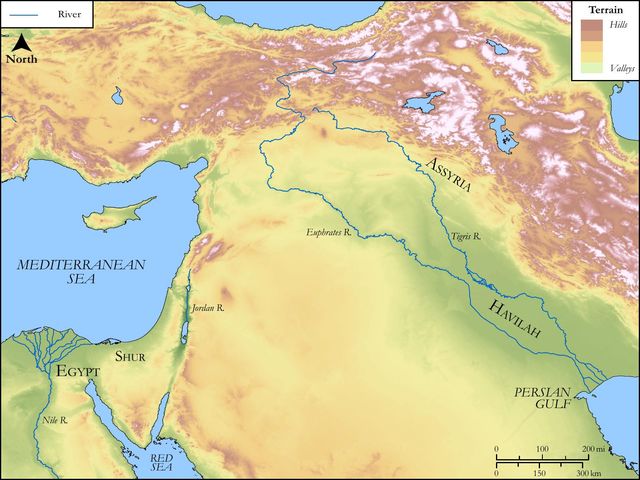
See on the biblical-era maps


Study this verse
Public-domain commentary
Matthew Henry
From his Commentary on the Whole Bible. Henry comments on passages, not single verses — this entry covers Genesis 25:11–18.
Immediately after the account of Abraham's death, Moses begins the story of Isaac (Gen 25:11), and tells us where he dwelt and how remarkably God blessed him. Note, The blessing of Abraham did not die with him, but survived to all the children of the promise. But he presently digresses from the story of Isaac, to give a short account of Ishmael, forasmuch as he also was a son of Abraham, and God had made some promises concerning him, which it was requisite we should know the accomplishment of. Observe here what is said, 1. Concerning his children. He had twelve sons, twelve princes they are called (Gen 25:16), heads of families, which in process of time became nations, distinct tribes, numerous and very considerable. They peopled a very large continent, that lay between Egypt and Assyria, called Arabia. The names of his twelve sons are recorded. Midian and Kedar we often read of in scripture. And some very good expositors have taken notice of the signification of those three names which are put together (Gen 25:14), as containing good advice to us all, Mishma, Dumah, and Massa, that is, hear, keep silence, and bear; we have them together in the same order, Jam 1:19, Be swift to hear, slow to speak, slow to wrath. The posterity of Ishmael had not only tents in the fields, wherein they grew rich in times of peace; but they had towns and castles (Gen 25:16), wherein they fortified themselves in time of war. Now the number and strength of this family were the fruit of the promise made to Hagar concerning Ishmael (Gen 16:10), and to Abraham, Gen 17:20 and Gen 21:13. Note, Many that are strangers to the covenants of promise are yet blessed with outward prosperity for the sake of their godly ancestors. Wealth and riches shall be in their house. 2. Concerning himself. Here is an account of his age: He lived 137 years (Gen 25:17) which is recorded to show the efficacy of Abraham's prayer for him (Gen 17:18), O that Ishmael might live before thee! Here is also an account of his death; he too was gathered to his people; but it is not said that he was full of days, though he lived to so great an age: he was not so weary of the world, nor so willing to leave it, as his good father was. Those words, he fell in the presence of all his brethren, whether they mean, as we take them, he died, or, as others, his lot fell, are designed to show the fulfilling of that word to Hagar (Gen 16:12), He shall dwell in the presence of all his brethren, that is, he shall flourish and be eminent among them, and shall hold his own to the last. Or he died with his friends about him, which is comfortable.
Continue studying Genesis 25:12 across the web’s major study libraries — every link below opens this exact verse, chapter, or book on the destination site.
Read & Compare
 BibleGatewayThis verse in more than 200 translations and 70 languages.
 Bible.comThe YouVersion reader — hundreds of translations, reading plans, and highlights.
 ESV.orgCrossway's official English Standard Version reader.
 NET BibleThe NET translation with 60,000+ translators' notes on every rendering decision.
 STEP BibleTyndale House's free study tool — original text, vocabulary, and scholarly resources.
 BibliaLogos Bible Software's free web reader.
 USCCBThe New American Bible (Revised Edition) with the U.S. bishops' study notes.
Commentaries
 BibleHub CommentariesDozens of classic commentaries on this verse, gathered on one page.
 StudyLightMore than 100 commentary sets — the largest collection on the web.
 BibleRefPlain-English commentary on what this verse means, verse by verse.
 Enduring WordDavid Guzik's free commentary on this chapter, widely used by Bible teachers.
 Bible Study ToolsVerse commentary alongside Greek and Hebrew study aids.
Original Language & Research
- BibleHub InterlinearThe verse word by word — original language, transliteration, and English.
- BibleHub LexiconEvery word's original-language definition and Strong's entry.
 Blue Letter BibleDeep-study tools — Strong's numbers, concordance, and word studies.
 SefariaThe Hebrew text with Rashi and centuries of Jewish commentary.
Sermons, Hymns & Audio


TrulyRandomVerse is not affiliated with these sites and doesn’t control their content. They’re linked because they’re genuinely useful.
Summary
Genesis 25:12 serves as a pivotal genealogical marker, introducing the "generations" of Ishmael, Abraham's firstborn son through Hagar, Sarah's Egyptian handmaid. This verse initiates a distinct section documenting Ishmael's descendants, thereby affirming God's unwavering faithfulness in fulfilling His specific promises concerning Ishmael, even as the primary covenant line continues to unfold through Isaac.
Context
ShowHideLiterary Context
Genesis 25:12 immediately follows the detailed account of Abraham's death, burial, and the enumeration of his sons by Keturah in Genesis 25:1-11. The phrase "these are the generations" (Hebrew: toledoth) is a hallmark structural device in Genesis, signaling a new narrative segment focused on a particular individual or family's lineage and history. Its placement here indicates a deliberate shift in focus, momentarily pausing the primary narrative of the covenant line (Isaac) to ensure the reader understands the fulfillment of God's promises to Ishmael before returning to Isaac's story in Genesis 25:19. This literary pattern underscores the comprehensive nature of God's plan, acknowledging all branches of Abraham's family.
Historical & Cultural Context
The practice of a barren wife giving her handmaid to her husband to bear children was a recognized custom in the households of the patriarchs, as when Rachel gave Bilhah and Leah gave Zilpah to Jacob. This cultural practice explains Sarah's actions in Genesis 16:1-4, though it ultimately led to significant familial strife. Hagar's identity as an "Egyptian" handmaid highlights the diverse origins within Abraham's household. The subsequent enumeration of Ishmael's twelve sons in Genesis 25:13-16 reflects the tribal structures common in the region, where a patriarch's descendants would form distinct clans or nations. This verse sets the stage for understanding the origins of various peoples in the broader biblical narrative.
Key Themes
ShowHideThis verse contributes to several overarching themes in Genesis. Foremost is the theme of Divine Faithfulness, demonstrating that God fulfills all His promises, not just those directly related to the covenant line. Despite Ishmael's birth stemming from human impatience and a lack of faith, God had explicitly promised Abraham that Ishmael would become the father of a great nation and twelve princes (Genesis 17:20; Genesis 21:13). The inclusion of Ishmael's genealogy here serves as concrete evidence of this faithfulness. It also reinforces the theme of God's Sovereignty, showing His control over all human destinies, even those outside the immediate focus of the covenant. Finally, it highlights the Comprehensive Scope of God's Plan, encompassing the origins and destinies of various peoples, not solely the chosen lineage.
Exposition and Analysis
ShowHideKey Word Analysis
ShowHideFrom the root yâlad (to bear young), this plural noun (H8435) signifies "descent" or "family history." It functions as a crucial structural marker throughout Genesis, introducing a new section detailing the lineage, history, or "begettings" of a particular individual or family. Its use here signals the commencement of Ishmael's specific genealogical account, distinct yet intrinsically linked to Abraham's broader legacy.
Derived from Hebrew words meaning "God will hear" (from shama "to hear" and el "God"). This name was given by the angel of the Lord to Hagar before his birth (Genesis 16:11), signifying God's attentiveness to Hagar's distress. His name prophetically encapsulates God's compassionate response to those in need, even in challenging circumstances.
A primitive root meaning "to bear young" or "to beget." This verb emphasizes the act of giving birth, firmly establishing Ishmael's biological origin from Hagar and Abraham. It underscores the physical reality of his existence and lineage, which is foundational to the subsequent enumeration of his descendants.
Verse Breakdown
ShowHide"Now these [are] the generations of Ishmael"
This opening phrase, employing the significant Hebrew term toledoth, acts as a formal heading. It signals to the reader a shift in focus from Abraham's immediate story to the detailed account of Ishmael's descendants, emphasizing the importance of documenting this particular branch of Abraham's family.
"Abraham's son"
This clause firmly establishes Ishmael's paternity, linking him directly to the patriarch Abraham. This connection is crucial for understanding God's promises to Abraham that extended to Ishmael, even though Ishmael was not the son of the primary covenant.
"whom Hagar the Egyptian, Sarah's handmaid, bare unto Abraham"
This detailed identification provides the full context of Ishmael's birth. It recalls the circumstances of his conception, involving Hagar, an Egyptian slave, who was Sarah's personal attendant. This precise description serves to remind the reader of the human circumstances surrounding Ishmael's birth, which resulted from Sarah's attempt to secure an heir through unconventional means, as recorded in Genesis 16. It also highlights the complex family dynamics within Abraham's household.
Literary Devices
ShowHideThe verse employs several literary devices. Genealogy is the most prominent, as the toledoth formula explicitly introduces a lineage, serving as a structural marker throughout Genesis to organize the narrative flow and trace the unfolding of God's plan through various family lines. The precise identification of Ishmael's parents ("Abraham's son, whom Hagar the Egyptian, Sarah's handmaid, bare unto Abraham") is a form of Repetition with Variation or Emphasis, reiterating his lineage with specific details that recall the dramatic circumstances of his birth. This detailed naming also functions as Characterization by Association, immediately bringing to mind the narrative of Hagar and Sarah's conflict, and the divine promises made concerning Ishmael. The inclusion of "the Egyptian" and "Sarah's handmaid" provides Specific Detail, grounding the narrative in historical and cultural reality while also subtly hinting at the complex origins and relationships within Abraham's extended family.
Theological and Thematic Connections
ShowHideGenesis 25:12 profoundly underscores God's unwavering faithfulness to His word, even concerning those outside the direct, primary covenant line of promise that leads to the Messiah. The meticulous recording of Ishmael's descendants serves as tangible proof that God remembers every promise He makes, fulfilling His declared intentions regardless of human missteps or the passage of time. This demonstrates a comprehensive divine oversight, where God's purposes extend beyond a single chosen lineage to encompass the origins and destinies of all peoples. It highlights that God's grace and benevolence are vast, reaching even into situations born from human impatience, affirming His universal sovereignty.
Reflection and Application
ShowHideThis verse offers a profound lesson in the breadth of God's faithfulness and the comprehensive nature of His plans. It reminds us that God's purposes are vast, often extending beyond our immediate understanding or expectations, encompassing even those branches of humanity that may seem peripheral to our central narrative. We are encouraged to trust in God's overarching sovereignty, recognizing that He remembers every promise and works out His will in His own perfect timing, even through complex family histories and unexpected turns of events. This should foster a deeper appreciation for God's meticulous care and His commitment to His word, even when human actions introduce complications. It also challenges us to consider how God's grace might extend to those we perceive as "outside" our immediate spiritual or familial circles, prompting us to embrace a more expansive view of His redemptive work in the world.
Questions for Reflection
ShowHideFAQ
ShowHideWhy is Ishmael's lineage included in the book of Genesis?
ShowHideIshmael's lineage is included in Genesis 25:12-18 primarily to demonstrate God's unwavering faithfulness to all His promises. Although Ishmael was not the son of the covenant through whom the messianic line would pass, God had explicitly promised Abraham that Ishmael would also be blessed and become a great nation (Genesis 17:20). This section serves as a fulfillment of that divine word, highlighting the comprehensive nature of God's narrative, which acknowledges the origins and destinies of various peoples beyond the direct line of salvation.
What is the significance of the Hebrew word toledoth in this verse?
ShowHideToledoth (תּוֹלְדֹת), translated as "generations" or "account of," is a crucial structural marker in the book of Genesis. It functions as a heading that introduces a new section detailing the history, lineage, or "begettings" of a particular individual or family. Its use in Genesis 25:12 signals the beginning of Ishmael's specific genealogical account, emphasizing its distinct yet related place within the broader patriarchal narratives and underscoring the orderly progression of God's historical record.
Does God bless those outside the direct covenant line?
ShowHideYes, Genesis 25:12 and the subsequent verses clearly demonstrate that God extends blessings even to those outside the direct covenant line through whom the Messiah would come. While the specific covenant promises of salvation and land were uniquely passed through Isaac, God showed grace and fulfilled His promises of prosperity and nationhood to Ishmael. This illustrates God's universal sovereignty and benevolence, proving that His care and blessings are not exclusively confined to one lineage but extend to all whom He purposes to bless, as seen in His relationship with Abraham, the father of many nations.
Christ-Centered Fulfillment
ShowHideWhile Ishmael's lineage does not directly lead to the Messiah, its inclusion in the sacred text profoundly highlights God's unwavering faithfulness to all His promises, serving as a crucial backdrop for the ultimate and perfect fulfillment found in Jesus Christ. The meticulous recording of generations, whether of the covenant line through Isaac or a related branch through Ishmael, points forward to the ultimate "book of the genealogy of Jesus Christ, the son of David, the son of Abraham" (Matthew 1:1). Jesus, as the true heir of all promises made to Abraham, transcends specific lineages to embrace all who believe. God's faithfulness in blessing Ishmael, despite his birth outside the divine timing for the covenant son, underscores His greater, perfect faithfulness in sending His Son, who fulfills the deepest longings and promises of God, extending salvation and blessing to "all the families of the earth" (Genesis 12:3). Through Christ, the ultimate "seed" of Abraham (Galatians 3:16), God's covenant blessings are made available to Jews and Gentiles alike, demonstrating the boundless reach of His redemptive plan (Ephesians 2:11-22).