


Psalms 83:6
Bible text: King James Version (1769 Blayney text) · Public domain
Bible text: King James Version with Strong's numbers · Public domain
Bible text: Berean Standard Bible · Public domain
Bible text: American Standard Version (1901) · Public domain
Bible text: World English Bible, Messianic edition · Public domain
Bible text: Geneva Bible (1599) · Public domain
Bible text: Young's Literal Translation · Public domain
- אָהֳלֵי'o·ho·Lei[the] tents ofH168N-mpcNoun Plural Masculine Construct
- אֱדוֹם'E·domEdomH123N-proper-mNoun Proper Masculine
- וְיִשְׁמְעֵאלִיםve·yish·me·'e·Limand [the] IshmaelitesH3459Conj-w ¦ N-mpNoun Gentilic Plural Masculine Absoluteוְandיִשְׁמְעֵאלִים[the] Ishmaelites
- מוֹאָבmo·'AvMoabH4124N-properNoun Proper Location
- וְהַגְרִיםve·hag·Rimand [the] HagritesH1905Conj-w ¦ N-mpNoun Gentilic Plural Masculine Absoluteוְandהַגְרִים[the] Hagrites
English is a literal word-by-word gloss of the Hebrew, not the KJV's wording. Why?
This is the original text the KJV's translators worked from — each Hebrew word with its own literal English meaning in this verse, prepared by scholars at Tyndale House, Cambridge. The KJV translates whole sentences, not word by word, so its wording differs: one Hebrew word can become several English words, and the KJV may choose “the LORD” where the gloss reads “Yahweh”. Both are faithful — they answer different questions. For the KJV's own rendering, switch to the KJV text.
Details
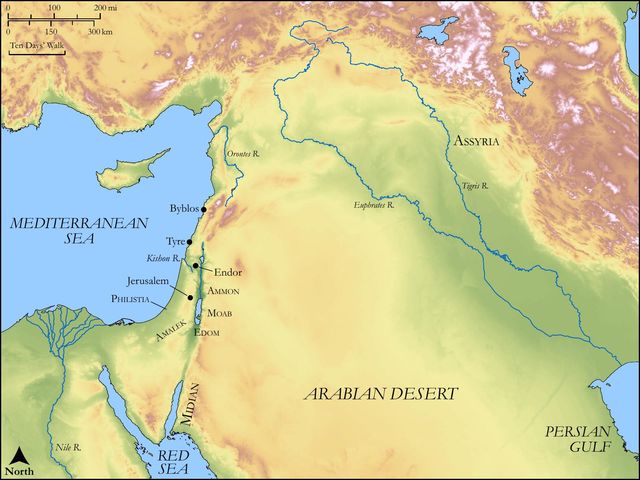
See on the biblical-era map
Study this verse
Public-domain commentary
Matthew Henry
From his Commentary on the Whole Bible. Henry comments on passages, not single verses — this entry covers Psalms 83:1–8. His three-level outline is real structure in the source text, so it is rendered as structure.
The Israel of God were now in danger, and fear, and great distress, and yet their prayer is called, A song or psalm; for singing psalms is not unseasonable, no, not when the harps are hung upon the willow-trees.
I.The psalmist here begs of God to appear on the behalf of his injured threatened people (Psa 83:1):
"Keep not thou silence, O God! but give judgment for us against those that do us an apparent wrong." Thus Jehoshaphat prayed upon occasion of that invasion (Ch2 20:11), Behold, how they reward us, to come to cast us out of thy possession. Sometimes God seems to connive at the unjust treatment which is given to his people; he keeps silence, as one that either did not observe it or did not concern himself in it; he holds his peace, as if he would observe an exact neutrality, and let them fight it out; he is still, and gives not the enemies of his people any disturbance or opposition, but seems to sit by as a man astonished, or as a mighty man that cannot save. Then he gives us leave to call upon him, as here, "Keep not thou silence, O God! Lord, speak to us by the prophets for our encouragement against our fears" (as he did in reference to that invasion, Ch2 20:14, etc.); "Lord, speak for us by the providence and speak against our enemies; speak deliverance to us and disappointment to them." God's speaking is his acting; for with him saying and doing are the same thing.
II.He here gives an account of the grand alliance of the neighbouring nations against Israel, which he begs of God to break, and blast the projects of. Now observe here,
1.Against whom this confederacy is formed; it is against the Israel of God, and so, in effect, against the God of Israel. Thus the psalmist takes care to interest God in their cause, not doubting but that, if it appeared that they were for God, God would make it to appear that he was for them, and then they might set all their enemies at defiance; for whom then could be against them? "Lord," says he, "they are thy enemies, and they hate thee." All wicked people are God's enemies (the carnal mind is enmity against God), but especially wicked persecutors; they hated the religious worshippers of God, because they hated God's holy religion and the worship of him. This was that which made God's people so zealous against them - that they fought against God: They are confederate against thee, Psa 83:5. Were our interest only concerned, we could the better bear it; but, when God himself is struck at, it is time to cry, Help, Lord. Keep not thou silence, O God! He proves that they are confederate against God, for they are so against the people of God, who are near and dear to him, his son, his first-born, his portion, and the lot of his inheritance; he may truly be said to fight against me that endeavours to destroy my children, to root out my family, and to ruin my estate. "Lord," says the psalmist, "they are thy enemies, for they consult against thy hidden ones." Note, God's people are his hidden ones, hidden,
(1.)In respect of secresy. Their life is hid with Christ in God; the world knows them not; if they knew them, they would not hate them as they do.
(2.)In respect of safety. God takes them under his special protection, hides them in the hollow of his hand; and yet, in defiance of God and his power and promise to secure his people, they will consult to ruin them and cast them down from their excellency (Psa 62:4), and to make a prey of those whom the Lord has set apart for himself, Psa 4:3. They resolve to destroy those whom God resolves to preserve.
2.How this confederacy is managed. The devil is at the bottom of it, and therefore it is carried on,
(1.)With a great deal of heat and violence: Thy enemies make a tumult, Psa 83:2. The heathen rage, Psa 2:1. The nations are angry, Rev 11:18. They are noisy in their clamours against the people whom they hope to run down with their loud calumnies. This comes in as a reason why God should not keep silence: "The enemies talk big and talk much; Lord, let them not talk all, but do thou speak to them in thy wrath," Psa 2:5.
(2.)With a great deal of pride and insolence: They have lifted up the head. In confidence of their success, they are so elevated as if they could over-top the Most High and overpower the Almighty.
(3.)With a great deal of art and policy: They have taken crafty counsel, Psa 83:3. The subtlety of the old serpent appears in their management, and they contrive by all possible means, though ever so base, ever so bad, to gain their point. They areprofound to make slaughter (Hos 5:2), as if they could outwit Infinite Wisdom.
(4.)With a great deal of unanimity. Whatever separate clashing interest they have among themselves, against the people of God they consult with one consent (Psa 83:5), nor is Satan's kingdom divided against itself. To push on this unholy war, they lay their heads together, and their horns, and their hearts too. Fas est et ab hoste doceri - Even an enemy may instruct. Do the enemies of the church act with one consent to destroy it? Are the kings of the earth of one mind to give their power and honour to the beast? And shall not the church's friends be unanimous in serving her interests? If Herod and Pilate are made friends, that they may join in crucifying Christ, surely Paul and Barnabas, Paul and Peter, will soon be made friends, that they may join in preaching Christ.
3.What it is that is aimed at in this confederacy. They consult not like the Gibeonites to make a league with Israel, that they might strengthen themselves by such a desirable alliance, which would have been their wisdom. They consult, not only to clip the wings of Israel, to recover their new conquests, and check the progress of their victorious arms, not only to keep the balance even between them and Israel, and to prevent their power from growing exorbitant; this will not serve. It is no less than the utter ruin and extirpation of Israel that they design (Psa 83:4): "Come, let us cut them off from being a nation, as they cut off the seven nations of Canaan; let us leave them neither root nor branch, but lay their country so perfectly waste that the name of Israel may be no more in remembrance, no, not in history;" for with them they would destroy their Bibles and burn all their records. Such is the enmity of the serpent's seed against the seed of the woman. It is the secret wish of many wicked men that the church of God might not have a being in the world, that there might be no such thing as religion among mankind. Having banished the sense of it out of their own hearts, they would gladly see the whole earth as well rid of it, all its laws and ordinances abolished, all its restraints and obligations shaken off, and all that preach, profess, or practise it cut off. This they would bring it to if it were in their power; but he that sits in heaven shall laugh at them.
4.Who they are that are drawn into this confederacy. The nations that entered into this alliance are here mentioned (Psa 83:6-8); the Edomites and Ishmaelites, both descendants from Abraham, lead the van; for apostates from the church have been its most bitter and spiteful enemies, witness Julian. These were allied to Israel in blood and yet in alliance against Israel. There are no bonds of nature so strong but the spirit of persecution has broken through them. The brother shall betray the brother to death. Moab and Ammon were the children of righteous Lot; but, as an incestuous, so a degenerate race. The Philistines were long a thorn in Israel's side, and very vexatious. How the inhabitants of Tyre, who in David's time were Israel's firm allies, come in among their enemies, I know not; but that Assur (that is, the Assyrian) also is joined with them is not strange, or that (as the word is) they were an arm to the children of Lot. See how numerous the enemies of God's church have always been. Lord, how are those increased that trouble it! God's heritage was as a speckled bird; all the birds round about were against her (Jer 12:9), which highly magnifies the power of God in preserving to himself a church in the world, in spite of the combined force of earth and hell.
Continue studying Psalms 83:6 across the web’s major study libraries — every link below opens this exact verse, chapter, or book on the destination site.
Read & Compare
 BibleGatewayThis verse in more than 200 translations and 70 languages.
 Bible.comThe YouVersion reader — hundreds of translations, reading plans, and highlights.
 ESV.orgCrossway's official English Standard Version reader.
 NET BibleThe NET translation with 60,000+ translators' notes on every rendering decision.
 STEP BibleTyndale House's free study tool — original text, vocabulary, and scholarly resources.
 BibliaLogos Bible Software's free web reader.
 USCCBThe New American Bible (Revised Edition) with the U.S. bishops' study notes.
Commentaries
 BibleHub CommentariesDozens of classic commentaries on this verse, gathered on one page.
 StudyLightMore than 100 commentary sets — the largest collection on the web.
 BibleRefPlain-English commentary on what this verse means, verse by verse.
 Enduring WordDavid Guzik's free commentary on this chapter, widely used by Bible teachers.
 Bible Study ToolsVerse commentary alongside Greek and Hebrew study aids.
Original Language & Research
- BibleHub InterlinearThe verse word by word — original language, transliteration, and English.
- BibleHub LexiconEvery word's original-language definition and Strong's entry.
 Blue Letter BibleDeep-study tools — Strong's numbers, concordance, and word studies.
 SefariaThe Hebrew text with Rashi and centuries of Jewish commentary.
Sermons, Hymns & Audio


TrulyRandomVerse is not affiliated with these sites and doesn’t control their content. They’re linked because they’re genuinely useful.
Summary
Psalms 83:6 meticulously lists a significant portion of a formidable confederacy of nations that have united with malicious intent against Israel. This verse, embedded within a communal lament by the psalmist Asaph, specifies Edom, the Ishmaelites, Moab, and the Hagarenes as key members of this hostile alliance, vividly underscoring the widespread and existential threat faced by God's chosen people. It serves as a stark reminder of the persistent opposition to Israel throughout its history, emphasizing that the battle against God's people is ultimately a spiritual confrontation against God Himself and His redemptive purposes.
Context
ShowHideLiterary Context
Psalms 83 is a communal lament, an imprecatory psalm, where the psalmist Asaph urgently cries out to God to break His silence and intervene against a formidable confederacy of nations threatening to annihilate Israel. The psalm opens with an impassioned plea for divine action (verses 1-2), followed by a detailed description of the enemies' malicious intent to destroy God's people and erase His name from memory (verses 3-5). Verse 6 initiates a comprehensive enumeration of these hostile nations, which continues through verse 8. This detailed listing serves to emphasize the comprehensive and widespread nature of the threat, highlighting the overwhelming odds faced by Israel and setting the stage for the psalmist's subsequent prayer for God's judgment and vindication (verses 9-18), ultimately seeking to magnify God's sovereignty over all the earth. The specific mention of "tabernacles" here highlights the collective presence and unified purpose of these diverse groups, signifying their active mobilization against Israel.
Historical & Cultural Context
The precise historical setting for Psalm 83 remains a subject of scholarly debate, with suggestions ranging from the early monarchy (e.g., the time of Jehoshaphat, as described in 2 Chronicles 20) to the post-exilic period. Regardless of the specific date, the psalm reflects a recurring pattern in Israel's history: facing existential threats from surrounding nations. The peoples listed in verse 6—Edom, Ishmaelites, Moab, and Hagarenes—represent a complex mix of traditional adversaries and nomadic groups. Edom and Moab, descendants of Esau and Lot respectively, shared ancient, often contentious, kinship ties with Israel (see Genesis 36 for Edom and Genesis 19:37 for Moab). The Ishmaelites, descendants of Abraham through Hagar (as seen in Genesis 16:12), were nomadic tribes often associated with the Arabian desert. The Hagarenes, likely another nomadic tribe from the Arabian Peninsula, are often linked to the Ishmaelites due to their shared ancestry through Hagar. Culturally, the term "tabernacles" (tents) points to the nomadic or semi-nomadic lifestyle of some of these groups, signifying their mobile military presence and the widespread nature of their territorial claims or incursions against Israel.
Key Themes
ShowHidePsalms 83:6 contributes significantly to several overarching themes within the psalm and the broader biblical narrative. Firstly, it underscores the theme of Confederacy Against God's People, illustrating how diverse nations, often with their own historical grievances, can unite with a singular, malevolent purpose: to eradicate Israel and, by extension, to defy God Himself (as stated in Psalms 83:4). Secondly, it highlights the theme of Historical Enmity, showcasing the long-standing and often deeply rooted animosity between Israel and its neighbors, stemming from ancestral, territorial, and religious conflicts that span generations (e.g., Edom's consistent hostility, as seen in Numbers 20:14-21). Finally, despite the overwhelming threat, the very act of listing these enemies in a prayer demonstrates the psalmist's appeal to Divine Sovereignty and Protection. The psalm ultimately relies on God's power to defend His covenant people, emphasizing that the ultimate battle is not merely political or military, but a spiritual conflict in which God's honor and name are at stake (a theme powerfully echoed in Psalms 46:1-3).
Exposition and Analysis
ShowHideKey Word Analysis
ShowHideFrom the root אָהַל, this word denotes "a tent" or "dwelling," specifically one that is "clearly conspicuous from a distance." While literally referring to physical encampments, especially for nomadic or semi-nomadic peoples like the Ishmaelites and Hagarenes, it functions metonymically here. It represents not just their physical dwellings but the people themselves, their families, their armies, or even their entire nations and territories. Thus, "the tabernacles of Edom" refers to the entire nation of Edom and its military might, signifying their collective presence and hostile intent within the confederacy.
Derived from אָדֹם, meaning "red" (referencing Esau's birth, Genesis 25:25), Edom refers to the elder twin-brother of Jacob, and subsequently, the region (Idumaea) occupied by his descendants. Situated southeast of the Dead Sea, Edom had a long and consistent history of animosity towards Israel, frequently refusing passage or actively opposing them, as seen during the Exodus (e.g., Numbers 20:14-21). Their inclusion underscores a deep-seated, familial yet bitter, opposition, reflecting generations of conflict.
This term refers to a member of a certain Arabian clan, perhaps patronymically from הָגָר (Hagar). These were a nomadic people likely from the Arabian desert, often associated with or perhaps a specific clan within the broader group of Ishmaelites, given their name's derivation from Hagar. Their mention alongside the Ishmaelites emphasizes the extensive reach of the confederacy and the involvement of various desert tribes in the plot against Israel, highlighting the diverse and widespread nature of the threat.
Verse Breakdown
ShowHide"The tabernacles of Edom"
This phrase identifies the nation of Edom as a primary participant in the hostile alliance. The use of "tabernacles" (tents) for Edom, a nation that also had settled cities, emphasizes their military encampments or perhaps highlights the nomadic elements within their broader population, signifying their active mobilization and presence in the confederacy. It immediately brings to mind their historical enmity and deep-seated animosity towards Israel, stemming from their ancestral connection as descendants of Esau.
"and the Ishmaelites"
This specifies the descendants of Ishmael, Abraham's son through Hagar. These were nomadic tribes inhabiting the Arabian desert, known for their raiding activities and often hostile posture towards settled communities. Their inclusion points to the broad geographical scope of the threat and the involvement of desert peoples who, while related to Israel through Abraham, were frequently hostile and posed a significant danger due to their mobility and martial prowess.
"of Moab"
This refers to the nation of Moab, descendants of Lot, Abraham's nephew. Their territory lay east of the Dead Sea. Moab had a long and complex history with Israel, marked by both periods of interaction (e.g., Ruth) and frequent conflict, including attempts to curse Israel through Balaam (e.g., Numbers 22) and acts of idolatry. Their presence in the confederacy signifies a recurring, often religiously motivated, opposition, rooted in ancient grievances.
"and the Hagarenes"
This identifies another nomadic group, likely from the Arabian desert, whose name connects them directly to Hagar, Ishmael's mother. Their mention alongside the Ishmaelites suggests either a close association, a specific tribal distinction, or an emphasis on the full extent of Hagar's descendants participating in the alliance. It reinforces the idea of a comprehensive and diverse coalition of enemies, encompassing both settled nations and mobile desert tribes, all united against Israel.
Literary Devices
ShowHidePsalms 83:6 employs several effective literary devices to convey the magnitude of the threat against Israel. The most prominent is Enumeration, as the psalmist meticulously lists the various nations involved in the conspiracy. This detailed cataloging serves to emphasize the overwhelming nature of the threat and the widespread opposition against Israel, creating a sense of dire urgency. Another device at play is Metonymy, particularly evident in the phrase "the tabernacles of Edom." Here, "tabernacles" (tents) stands in for the entire nation or its military forces, highlighting their active presence and participation in the alliance. This allows for a concise yet powerful representation of the enemy's collective might and unified purpose. Furthermore, there is an implied Hyperbole in the sheer number and diversity of the listed enemies, underscoring the seemingly insurmountable odds faced by Israel and intensifying the psalmist's desperate plea for divine intervention. This extensive listing also generates a sense of Climax as the psalm builds towards a full revelation of the enemy's comprehensive plot.
Theological and Thematic Connections
ShowHidePsalms 83:6, by listing a specific segment of the confederacy against Israel, powerfully illustrates the recurring biblical theme of relentless opposition to God's people. This opposition is not merely geopolitical or territorial; it is fundamentally a spiritual battle against God Himself and His redemptive purposes for humanity. The diverse origins of these nations—some kin, some distant, some nomadic, some settled—underscore that hostility towards God's chosen nation can arise from various sources, driven by envy, territorial ambition, historical grievances, or spiritual darkness. The psalmist's detailed enumeration of enemies serves to highlight the magnitude of the threat, yet simultaneously sets the stage for God's ultimate vindication and demonstration of His sovereignty over all nations. This verse implicitly affirms God's covenant faithfulness to Israel, as the psalmist appeals to God to defend His people and His name, reminding us that God's commitment to His promises extends even in the face of overwhelming odds, ensuring that those who bless Israel will be blessed, and those who curse will be cursed.
Reflection and Application
ShowHidePsalms 83:6, though describing an ancient conflict, resonates deeply with the spiritual realities faced by believers today. Just as ancient Israel confronted a visible, organized confederacy, followers of Christ are called to be acutely aware of the spiritual forces that align against God's kingdom and His people. This verse reminds us that opposition to God's purposes is often multi-faceted and relentless, drawing from various sources—whether overt persecution, subtle cultural pressures, or internal spiritual battles—and manifesting in diverse forms. Our response, like the psalmist's, should not be despair or passive resignation but fervent, specific prayer, acknowledging God's absolute sovereignty and appealing to His power to intervene. It encourages us to trust that even when surrounded by seemingly overwhelming forces, God remains our ultimate refuge and strength, capable of scattering His enemies and upholding His people. This passage calls us to vigilance, prayer, and unwavering faith in God's protective hand, knowing that the ultimate battle belongs to the Lord, and His victory is assured.
Questions for Reflection
ShowHideFAQ
ShowHideWhy are these specific nations listed in Psalms 83:6?
ShowHideThe nations listed—Edom, Ishmaelites, Moab, and Hagarenes—represent a significant portion of Israel's traditional adversaries and surrounding nomadic tribes. Their inclusion highlights the widespread nature of the confederacy and the deep-seated historical, territorial, and often ancestral animosity they held towards Israel. Edom and Moab were descendants of Esau and Lot, respectively, making them distant kin but frequent enemies who often sought to undermine Israel's existence (e.g., Numbers 22 for Moab). The Ishmaelites and Hagarenes were nomadic desert tribes, descendants of Hagar, who posed a constant threat through raiding and territorial disputes. Their combined presence signifies a comprehensive plot to eradicate Israel, uniting diverse groups under a common goal of eliminating God's chosen people and, by extension, God's name from the earth.
What does "tabernacles" mean in this context?
ShowHideThe Hebrew word for "tabernacles" ('ohel') literally means "tent" or "dwelling." While it refers to the physical tents and encampments of nomadic peoples like the Ishmaelites and Hagarenes, in this context, it also functions as a metonymy. It represents the entire people, their armies, their territories, and their collective power. So, "the tabernacles of Edom" means the nation of Edom and its military might, signifying their active presence and unified intent within the hostile confederacy. It emphasizes the active mobilization and collective nature of the threat against Israel, highlighting that these are not merely scattered individuals but organized entities arrayed for war.
Christ-Centered Fulfillment
ShowHidePsalms 83:6, with its vivid depiction of a confederacy of nations arrayed against Israel, finds its ultimate fulfillment in the ongoing spiritual battle against Christ and His church. Just as ancient Israel faced a coalition of earthly enemies, the New Testament reveals that the true adversary is not merely flesh and blood but spiritual forces of evil, against whom believers must stand firm (as seen in Ephesians 6:12). The enemies listed in Psalms 83 foreshadow the "world system" and the spiritual powers that continually oppose God's redemptive plan throughout history. However, in Christ, the ultimate victory over all hostile powers has been decisively secured. His crucifixion and resurrection were a triumphant disarming of principalities and powers, making a public spectacle of them and triumphing over them by the cross (as powerfully declared in Colossians 2:15). The church, as the new Israel, continues to face opposition, but Jesus Himself promised that the gates of Hades would not prevail against His church (a foundational and comforting promise in Matthew 16:18). Ultimately, the confederacy of nations in Psalms 83 points to the final, universal rebellion against God and His Anointed One, which will be decisively crushed by the returning Christ, the true King of Kings and Lord of Lords, who will strike down the nations with justice and righteousness (a glorious vision of His ultimate triumph in Revelation 19:11-16). Thus, the ancient plea for deliverance in Psalms 83 is answered in the person and work of Jesus Christ, who guarantees the ultimate triumph of God's people over every spiritual and earthly foe.