


Revelation 12:17
Bible text: King James Version (1769 Blayney text) · Public domain
Bible text: King James Version with Strong's numbers · Public domain
Bible text: Berean Standard Bible · Public domain
Bible text: American Standard Version (1901) · Public domain
Bible text: World English Bible, Messianic edition · Public domain
Bible text: Geneva Bible (1599) · Public domain
Bible text: Young's Literal Translation · Public domain
- καὶkaiAndG2532CONJConjunction
- ὠργίσθηōrgisthēwas angryG3710V-API-3SVerb Aorist Passive Indicative 3rd Singular
- ὁhotheG3588T-NSMDefinite article Nominative Singular Masculine
- δράκωνdrakōndragonG1404N-NSMNoun Nominative Singular Masculine
- ἐπὶepiwithG1909PREPPreposition
- τῇtēatheG3588T-DSFDefinite article Dative Singular Feminine
- γυναικὶgunaikiwomanG1135N-DSFNoun Dative Singular Feminine
- καὶkaiandG2532CONJConjunction
- ἀπῆλθενapēlthenwentG565V-2AAI-3SVerb 2nd Aorist Active Indicative 3rd Singular
- ποιῆσαιpoiēsaito makeG4160V-AANVerb Aorist Active Infinitive
- πόλεμονpolemonwarG4171N-ASMNoun Accusative Singular Masculine
- μετὰmetawithG3326PREPPreposition
- τῶνtōntheG3588T-GPMDefinite article Genitive Plural Masculine
- λοιπῶνloipōnrestG3062A-GPMAdjective Genitive Plural Masculine
- τοῦtouof theG3588T-GSNDefinite article Genitive Singular Neuter
- σπέρματοςspermatoschildrenG4690N-GSNNoun Genitive Singular Neuter
- αὐτῆςautēsof herG846P-GSFPersonal pronoun Genitive Singular Feminine
- τῶνtōnwhoG3588T-GPMDefinite article Genitive Plural Masculine
- τηρούντωνtērountōnare keepingG5083V-PAP-GPMVerb Present Active Participle Genitive Plural Masculine
- τὰςtastheG3588T-APFDefinite article Accusative Plural Feminine
- ἐντολὰςentolascommandmentsG1785N-APFNoun Accusative Plural Feminine
- τοῦtou<the>G3588T-GSMDefinite article Genitive Singular Masculine
- θεοῦtheouof GodG2316N-GSM-TNoun Genitive Singular Masculine Title
- καὶkaiandG2532CONJConjunction
- ἐχόντωνechontōnholdingG2192V-PAP-GPMVerb Present Active Participle Genitive Plural Masculine
- τὴνtēntheG3588T-ASFDefinite article Accusative Singular Feminine
- μαρτυρίανmarturiantestimonyG3141N-ASFNoun Accusative Singular Feminine
- τοῦtou<the>G3588T-GSMDefinite article Genitive Singular Masculine
- ἸησοῦIēsouof JesusG2424N-GSM-PNoun Genitive Singular Masculine Individual
- ΧριστοῦChristouChristG5547N-GSM-TNoun Genitive Singular Masculine Title
English is a literal word-by-word gloss of the Greek, not the KJV's wording. Why?
This is the original text the KJV's translators worked from — each Greek word with its own literal English meaning in this verse, prepared by scholars at Tyndale House, Cambridge. The KJV translates whole sentences, not word by word, so its wording differs: one Greek word can become several English words, and the KJV may choose “charity” where the gloss reads “love”. Both are faithful — they answer different questions. For the KJV's own rendering, switch to the KJV text.
Details
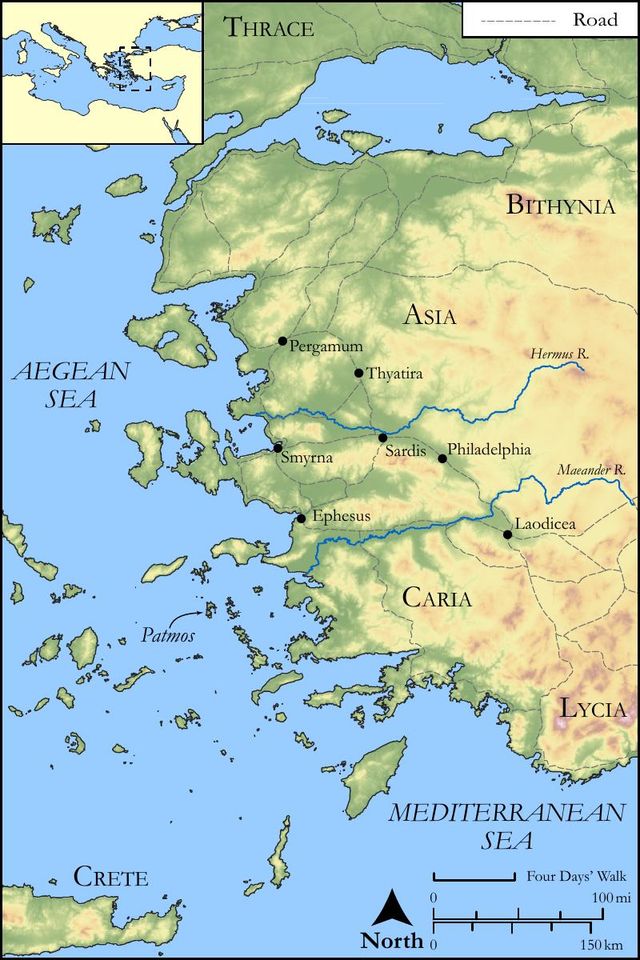
See on the biblical-era maps

Study this verse
Public-domain commentary
Matthew Henry
From his Commentary on the Whole Bible. Henry comments on passages, not single verses — this entry covers Revelation 12:12–17. His two-level outline is real structure in the source text, so it is rendered as structure.
We have here an account of this war, so happily finished in heaven, or in the church, as it was again renewed and carried on in the wilderness, the place to which the church had fled, and where she had been for some time secured by the special care of her God and Saviour. Observe,
I.The warning given of the distress and calamity that should fall upon the inhabitants of the world in general, through the wrath and rage of the devil. For, though his malice is chiefly bent against the servants of God, yet he is an enemy and hater of mankind as such; and, being defeated in his designs against the church, he is resolved to give all the disturbance he can to the world in general: Woe to the inhabitants of the earth, and the sea, Rev 12:12. The rage of Satan grows so much the greater as he is limited both in place and time; when he was confined to the wilderness, and had but a short time to reign there, he comes with the greater wrath.
II.His second attempt upon the church now in the wilderness: He persecuted the woman who brought forth the man-child, Rev 12:13. Observe,
1.The care that God had taken of his church. He had conveyed her as on eagles' wings, into a place of safety provided for her, where she was to continue for a certain space of time, couched in prophetic characters, taken from Dan 7:25.
2.The continual malice of the dragon against the church. Her obscurity could not altogether protect her; the old subtle serpent, which at first lurked in paradise, now follows the church into the wilderness, and casts out a flood of water after her, to carry her away. This is thought to be meant of a flood of error and heresy, which was breathed by Arius, Nestorius, Pelagius, and many more, by which the church of God was in danger of being overwhelmed and carried away. The church of God is in more danger from heretics than from persecutors; and heresies are as certainly from the devil as open force and violence.
3.The seasonable help provided for the church in this dangerous juncture: The earth helped the woman, and opened her mouth, and swallowed up the flood, Rev 12:16. Some think we are to understand the swarms of Goths and Vandals that invaded the Roman empire, and found work for the Arian rulers, who otherwise would have been as furious persecutors as the pagan had been, and had exercised great cruelties already; but God opened a breach of war, and the flood was in a manner swallowed up thereby, and the church enjoyed some respite. God often sends the sword to avenge the quarrel of his covenant; and, when men choose new gods, then there is danger of war in the gates; intestine broils and contentions often end in the invasions of a common enemy.
4.The devil, being thus defeated in his designs upon the universal church, now turns his rage against particular persons and places; his malice against the woman pushes him on to make war with the remnant of her seed. Some think hereby are meant the Albigenses, who were first by Dioclesian driven up into barren and mountainous places, and afterwards cruelly murdered by popish rage and power, for several generations; and for no other reason than because they kept the commandments of God and held the testimony of Jesus Christ. Their fidelity to God and Christ, in doctrine, worship, and practice, was that which exposed them to the rage of Satan and his instruments; and such fidelity will expose men still, less or more, to the end of the world, when the last enemy shall be destroyed.
Historical interpretation
Three Centuries of Reception
4 surviving comments on this verse. Each one is dated, so this reads as a timeline rather than a list.
Select a marker to jump to its quote. Markers stagger vertically where authors wrote within a few decades of each other.
And the dragon was angry with the woman, etc. Seeing that the persecutions could not continue because they were averted by the mouth of the holy earth, he armed himself even more to persist in the mystery of iniquity, so that he could continually lie in wait.
And he stood on the sand of the sea. That is, over the multitude of the people, whom the wind drives away from the face of the earth. Without a doubt, it is the same enemy who is accustomed to devouring the enemy's schemes, now intending to stir up snares and wars.
Who keep the commandments of God, etc. To keep the commandments of God in the faith of Jesus Christ is to fight with the dragon and provoke him to battle. And thanks be to God, who has nullified the attempts of the savage dragon. For behold, having tried to destroy the Lord born in the flesh, he is frustrated by His resurrection. Then, laboring to break the confidence of the apostles in teaching, he strove to remove the woman, that is, the whole Church, from human affairs. But having failed in this, he now attacks individual ages of the faithful everywhere. Hence it follows:
For he says that they were persecuted because they were the offspring of the woman; for the faithful are sons and brothers of the Lord according to the Scripture: "I will proclaim your name to my brothers," (Ps. 22:22; Heb. 2:12) and again, "Here I am, and the children God has given me." (Isa. 8:18; Heb. 2:13)
So then, did he also make war against the offspring of their own mother, pursuing and plotting against them, killing through the tyrants and rulers of the land, since they testified that the One born of the Virgin was God?
Continue studying Revelation 12:17 across the web’s major study libraries — every link below opens this exact verse, chapter, or book on the destination site.
Read & Compare
 BibleGatewayThis verse in more than 200 translations and 70 languages.
 Bible.comThe YouVersion reader — hundreds of translations, reading plans, and highlights.
 ESV.orgCrossway's official English Standard Version reader.
 NET BibleThe NET translation with 60,000+ translators' notes on every rendering decision.
 STEP BibleTyndale House's free study tool — original text, vocabulary, and scholarly resources.
 BibliaLogos Bible Software's free web reader.
 USCCBThe New American Bible (Revised Edition) with the U.S. bishops' study notes.
Commentaries
 BibleHub CommentariesDozens of classic commentaries on this verse, gathered on one page.
 StudyLightMore than 100 commentary sets — the largest collection on the web.
 BibleRefPlain-English commentary on what this verse means, verse by verse.
 Enduring WordDavid Guzik's free commentary on this chapter, widely used by Bible teachers.
 Bible Study ToolsVerse commentary alongside Greek and Hebrew study aids.
Original Language & Research
- BibleHub InterlinearThe verse word by word — original language, transliteration, and English.
- BibleHub LexiconEvery word's original-language definition and Strong's entry.
 Blue Letter BibleDeep-study tools — Strong's numbers, concordance, and word studies.
 CNTR CollationThe earliest Greek manuscripts of this verse, collated letter by letter.
Sermons, Hymns & Audio


TrulyRandomVerse is not affiliated with these sites and doesn’t control their content. They’re linked because they’re genuinely useful.
Summary
Revelation 12:17 powerfully depicts the intensified spiritual conflict following Satan's (the dragon's) expulsion from heaven and his failed attempts to destroy the Messiah and the collective body of God's people. Frustrated and enraged, the dragon redirects his unyielding wrath and warfare against the faithful remnant of believers on earth, identifying them by their steadfast obedience to God's commandments and their unwavering witness to Jesus Christ. This verse serves as a pivotal point, shifting the prophetic narrative to the ongoing persecution faced by those who genuinely follow Christ in the present age.
Context
ShowHideLiterary Context
Revelation 12:17 concludes a dramatic and highly symbolic chapter that provides an overview of the spiritual battle between God and Satan, specifically concerning the lineage of the Messiah and the people of God. The chapter begins with the "woman" (symbolizing God's people, often understood as Israel, from whom the Messiah came) giving birth to the "male child" (Jesus Christ), who is then "caught up to God and to His throne" Revelation 12:5. This is followed by the "dragon" (identified as Satan or the Devil Revelation 12:9) being cast out of heaven to the earth after a war with Michael and his angels Revelation 12:7-9. Enraged by his defeat and expulsion, the dragon pursues the woman, but she is supernaturally protected and nourished in the wilderness for a period Revelation 12:13-14. Unable to reach the woman directly, the dragon's wrath culminates in this verse, where he turns his focus to her "remnant seed" on earth, signifying a shift from a broad, historical conflict to the specific persecution of individual believers in the end times.
Historical & Cultural Context
The book of Revelation was written during a period of intense persecution of Christians under the Roman Empire, likely during the reign of Emperor Domitian (late 1st century AD). Early Christians faced immense pressure to conform to Roman imperial cult worship, which involved venerating the emperor as a god. Refusal often led to social ostracism, economic hardship, imprisonment, and even martyrdom. John's apocalyptic vision, therefore, served as a message of encouragement and warning to these suffering believers, assuring them of God's ultimate sovereignty and the eventual defeat of their persecutors. The concept of a "remnant" was deeply rooted in Old Testament prophetic tradition, referring to a faithful core group of God's people who remained true to Him amidst apostasy or judgment (e.g., Isaiah 10:20-22). This idea would have resonated strongly with Jewish Christians who understood themselves as the continuation of God's faithful lineage.
Key Themes
ShowHideRevelation 12:17 contributes significantly to several overarching themes within the book of Revelation and biblical theology. Firstly, it underscores the unrelenting enmity of Satan against God and His people, revealing his persistent, though ultimately futile, attempts to thwart God's redemptive plan. Having failed to destroy Christ or the broader body of believers, his fury is now directed at those who embody Christ's truth. Secondly, the verse highlights the identity and characteristics of true believers in the face of this opposition: they are defined by their active obedience to God's commands and their steadfast witness to Jesus Christ. This emphasizes that genuine faith is not passive but manifests in both moral conduct and courageous proclamation. Finally, it powerfully portrays the reality of spiritual warfare on earth, demonstrating that the conflict has tangible manifestations in the lives of believers through persecution and opposition, echoing broader New Testament teachings on spiritual struggle, such as those found in Ephesians 6:12.
Exposition and Analysis
ShowHideKey Word Analysis
ShowHideThis term (G1404) refers to a fabulous kind of serpent, often associated with fascination or a powerful, mythical beast. In Revelation, it is explicitly identified as "that ancient serpent, who is the Devil and Satan" Revelation 12:9. It symbolizes the ultimate embodiment of evil, the adversary of God and humanity, characterized by immense power, deception, and destructive intent. Its "wrath" here is a furious, targeted aggression born of defeat.
This word (G4690) literally means "something sown" or "offspring." In this context, "remnant of her seed" refers to the spiritual descendants of the "woman" (God's people). It signifies those who share the faith and spiritual lineage of the collective body of believers, implying a continuation of God's covenant people, specifically those who are faithful in the end times. The term suggests a continuity of lineage and purpose.
This noun (G3141) means "evidence given," "report," or "witness." In the phrase "testimony of Jesus Christ," it carries profound theological weight. It refers to the witness about Jesus (proclaiming His person and work) and/or the witness from Jesus (the truth He reveals and inspires). In Revelation, this "testimony" is intrinsically linked to prophecy and the Spirit's work Revelation 19:10. It is the core message and mission of the faithful remnant, making them targets of the dragon's wrath.
Verse Breakdown
ShowHide"And the dragon was wroth with the woman"
This clause establishes the dragon's intense, furious anger (G3710, orgízō) directed at the "woman" (G1135, gynḗ), who symbolizes God's people. This wrath is a direct consequence of his failed attempts to destroy the male child (Christ) and his subsequent expulsion from heaven. It signifies his deep-seated hatred for God's redemptive plan and those who are part of it.
"and went to make war with the remnant of her seed"
Having failed to overcome the woman (God's collective people) directly, the dragon shifts his strategy. He "went" (G565, apérchomai) to "make war" (G4160 poiéō and G4171 pólemos) with a specific group: "the remnant" (G3062, loipoí) of her "seed" (G4690, spérma). This indicates a targeted, ongoing conflict against individual believers who remain faithful, distinguishing them from the broader, protected "woman." The war encompasses persecution, deception, and spiritual attacks.
"which keep the commandments of God"
This phrase identifies the first defining characteristic of the faithful remnant. They are those who "keep" (G5083, tēréō, meaning to guard or observe carefully) the "commandments" (G1785, entolḗ, authoritative prescriptions) "of God" (G2316, theós). This signifies active, practical obedience to divine law and living in accordance with God's revealed will, demonstrating genuine devotion and moral integrity.
"and have the testimony of Jesus Christ."
This is the second crucial identifier of the remnant. They "have" (G2192, échō, to hold or possess) the "testimony" (G3141, martyría) "of Jesus Christ" (G2424, Iēsoûs G5547, Christós). This refers to their unwavering allegiance to Jesus, their proclamation of His truth, and their Spirit-inspired witness to His person and work. It implies both a personal conviction and a public declaration of faith, which is a powerful weapon against the enemy but also makes them targets.
Literary Devices
ShowHideRevelation 12:17 is rich in Symbolism, a hallmark of apocalyptic literature. The "dragon" is a clear symbol for Satan, embodying evil and opposition to God. The "woman" symbolizes God's people, encompassing both Old Testament Israel and the New Testament church, from whom the Messiah came. Her "seed" represents individual believers who continue her spiritual lineage. The "war" is not merely physical but represents the multifaceted spiritual conflict, including persecution, deception, and spiritual attacks, waged by Satan against the faithful. The phrase "keep the commandments of God and have the testimony of Jesus Christ" employs Parallelism, presenting two defining characteristics of the remnant side-by-side, emphasizing both their ethical conduct and their prophetic witness. This verse also utilizes Personification, attributing human emotions like "wrath" and actions like "making war" to the dragon, making the spiritual adversary feel tangible and menacing. The dramatic shift in the dragon's target from the "woman" to her "remnant seed" serves as a form of Foreshadowing, setting the stage for the intense persecution and spiritual battles described in subsequent chapters of Revelation.
Theological and Thematic Connections
ShowHideRevelation 12:17 profoundly articulates the ongoing reality of spiritual warfare for believers, highlighting that Satan's hatred for God is directly extended to those who bear God's image and Christ's testimony. It asserts that genuine faith is active, marked by both obedience to divine commands and a courageous witness to Jesus. This verse connects the struggle to the lived experience of believers, affirming that persecution is not an anomaly but an expected consequence of living faithfully in a fallen world. It also underscores the enduring nature of God's covenant people, represented by the "remnant," who persevere through tribulation by clinging to God's truth and proclaiming Christ.
Reflection and Application
ShowHideRevelation 12:17 serves as a stark yet encouraging reminder for believers today. It clarifies that spiritual opposition is not a sign of God's disfavor, but often a direct consequence of our faithfulness. When we strive to obey God's commands and boldly share the truth of Jesus Christ, we inevitably become targets of the enemy's wrath. This understanding should not lead to fear, but to vigilance and a deeper reliance on God's strength. It calls us to examine our lives: are we truly "keeping the commandments of God" by living in practical righteousness and love? Are we "having the testimony of Jesus Christ" by proclaiming His gospel and living as His witnesses in our words and deeds? This verse challenges us to embrace our identity as the faithful remnant, recognizing that our perseverance in faith and witness is a powerful act of defiance against the defeated, yet still raging, adversary. It encourages us to stand firm, knowing that the one who is in us is greater than the one who is in the world, and that our ultimate victory is assured in Christ.
Questions for Reflection
ShowHideFAQ
ShowHideWhat is the "woman" in Revelation 12, and who is her "seed"?
ShowHideIn Revelation 12, the "woman" is a highly symbolic figure. Most commonly, she is understood to represent God's people throughout salvation history, encompassing Old Testament Israel (from whom the Messiah, the "male child," came) and, by extension, the New Testament church. She is depicted as giving birth to the Messiah and being protected by God. Her "seed" or "offspring" in Revelation 12:17 refers to individual believers who are spiritually descended from her, those who follow Christ and embody the characteristics of faithfulness: keeping God's commandments and having the testimony of Jesus Christ. They are the continuation of God's faithful lineage on earth.
What does "keeping the commandments of God" mean in this context?
ShowHide"Keeping the commandments of God" (G1785, entolḗ) in Revelation 12:17 refers to active obedience to God's revealed will and moral law. It signifies a life lived in alignment with divine principles, demonstrating practical righteousness, devotion, and love for God and neighbor. In the New Testament, Jesus Himself emphasized the importance of obedience, stating, "If you love me, keep my commandments" John 14:15. This characteristic distinguishes genuine believers from those who merely profess faith but do not live it out.
What is the "testimony of Jesus Christ"?
ShowHideThe "testimony of Jesus Christ" (G3141, martyría) is a crucial identifying mark of the faithful remnant. It can be understood in two primary ways, both of which are likely intended: (1) The testimony about Jesus Christ: proclaiming the truth of who He is, what He has done, and His saving work. This is the content of the gospel message. (2) The testimony from Jesus Christ: the prophetic revelation and truth that Jesus Himself gives and inspires through the Holy Spirit. Revelation 19:10 states, "For the testimony of Jesus is the spirit of prophecy," indicating that a Spirit-inspired declaration of Christ's person and work is at the heart of this testimony. It is the core message and mission of the church, and it is precisely this witness that provokes the dragon's wrath.
Christ-Centered Fulfillment
ShowHideRevelation 12:17, while depicting the dragon's wrath against the faithful, finds its profound Christ-centered fulfillment in the person and work of Jesus Christ. The "male child" born to the woman, who was "caught up to God and to His throne" Revelation 12:5, is Jesus Himself. His ascension signifies His ultimate victory over Satan, who is then cast down from heaven Revelation 12:9. The dragon's subsequent war against the "remnant of her seed" is a direct consequence of his defeat by Christ. This means that the persecution faced by believers is not a sign of Christ's weakness, but rather a testament to His triumph and the enemy's impotent rage. The "remnant" is defined by "having the testimony of Jesus Christ," highlighting that their very identity and mission are centered on Him. Their perseverance in "keeping the commandments of God" is empowered by Christ's indwelling Spirit, enabling them to live out the righteousness that He perfectly fulfilled. Ultimately, the "war" waged by the dragon against the saints is a futile attempt to undermine the kingdom established by Christ's death and resurrection. Believers overcome "by the blood of the Lamb and by the word of their testimony" Revelation 12:11, demonstrating that Christ's finished work is the source of their strength and the guarantee of their ultimate victory, even amidst tribulation. The conflict in Revelation 12:17 thus points forward to the Lamb's ultimate triumph, when He will finally crush the dragon underfoot Romans 16:20.