


Revelation 6:9
Bible text: King James Version (1769 Blayney text) · Public domain
Bible text: King James Version with Strong's numbers · Public domain
Bible text: Berean Standard Bible · Public domain
Bible text: American Standard Version (1901) · Public domain
Bible text: World English Bible, Messianic edition · Public domain
Bible text: Geneva Bible (1599) · Public domain
Bible text: Young's Literal Translation · Public domain
- ΚαὶKaiAndG2532CONJConjunction
- ὅτεhotewhenG3753CONJConjunction
- ἤνοιξενēnoixenHe openedG455V-2AAI-3SVerb 2nd Aorist Active Indicative 3rd Singular
- τὴνtēntheG3588T-ASFDefinite article Accusative Singular Feminine
- πέμπτηνpemptēnfifthG3991A-ASFAdjective Accusative Singular Feminine
- σφραγῖδαsphragidasealG4973N-ASFNoun Accusative Singular Feminine
- εἶδονeidonI sawG1492V-2AAI-1SVerb 2nd Aorist Active Indicative 1st Singular
- ὑποκάτωhupokatōunderG5270PREPPreposition
- τοῦtoutheG3588T-GSNDefinite article Genitive Singular Neuter
- θυσιαστηρίουthusiastērioualtarG2379N-GSNNoun Genitive Singular Neuter
- τὰςtastheG3588T-APFDefinite article Accusative Plural Feminine
- ψυχὰςpsuchassoulsG5590N-APFNoun Accusative Plural Feminine
- τῶνtōnof thoseG3588T-GPMDefinite article Genitive Plural Masculine
- ἐσφαγμένωνesphagmenōnslainG4969V-RPP-GPMVerb Perfect Passive Participle Genitive Plural Masculine
- διὰdiabecause ofG1223PREPPreposition
- τὸνtontheG3588T-ASMDefinite article Accusative Singular Masculine
- λόγονlogonwordG3056N-ASMNoun Accusative Singular Masculine
- τοῦtou<the>G3588T-GSMDefinite article Genitive Singular Masculine
- θεοῦtheouof GodG2316N-GSM-TNoun Genitive Singular Masculine Title
- καὶkaiandG2532CONJConjunction
- διὰdiabecause ofG1223PREPPreposition
- τὴνtēntheG3588T-ASFDefinite article Accusative Singular Feminine
- μαρτυρίανmarturiantestimonyG3141N-ASFNoun Accusative Singular Feminine
- ἣνhēnwhichG3739R-ASFRelative pronoun Accusative Singular Feminine
- εἶχονeichonthey were upholdingG2192V-IAI-3PVerb Imperfect Active Indicative 3rd Plural
English is a literal word-by-word gloss of the Greek, not the KJV's wording. Why?
This is the original text the KJV's translators worked from — each Greek word with its own literal English meaning in this verse, prepared by scholars at Tyndale House, Cambridge. The KJV translates whole sentences, not word by word, so its wording differs: one Greek word can become several English words, and the KJV may choose “charity” where the gloss reads “love”. Both are faithful — they answer different questions. For the KJV's own rendering, switch to the KJV text.
Details
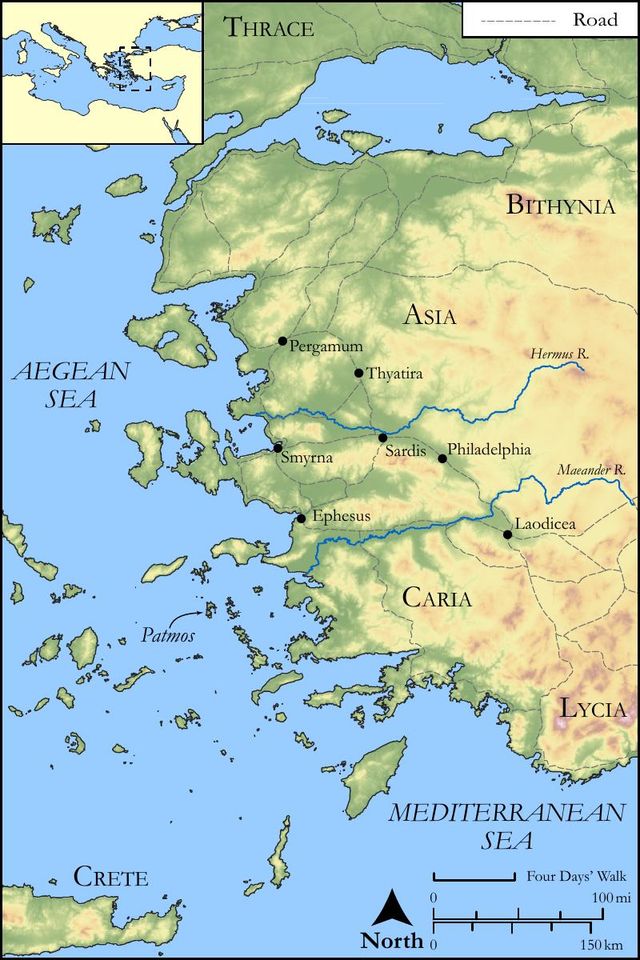
See on the biblical-era maps

Study this verse
Public-domain commentary
Matthew Henry
From his Commentary on the Whole Bible. Henry comments on passages, not single verses — this entry covers Revelation 6:9–17. His four-level outline is real structure in the source text, so it is rendered as structure.
In the remaining part of this chapter we have the opening of the fifth and the sixth seals.
I.The fifth seal.
Here is no mention made of any one who called the apostle to make his observation, probably because the decorum of the vision was to be observed, and each of the four living creatures had discharged its duty of a monitor before, or because the events here opened lay out of the sight, and beyond the time, of the present ministers of the church; or because it does not contain a new prophecy of any future events, but rather opens a spring of support and consolation to those who had been and still were under great tribulation for the sake of Christ and the gospel. Here observe,
1.The sight this apostle saw at the opening of the fifth seal; it was a very affecting sight (Rev 6:9): I saw under the altar the souls of those that were slain for the word of God, and for the testimony which they held. He saw the souls of the martyrs. Here observe,
(1.)Where he saw them - under the altar; at the foot of the altar of incense, in the most holy place; he saw them in heaven, at the foot of Christ. Hence note,
[1.]Persecutors can only kill the body, and after that there is no more that they can do; their souls live.
[2.]God has provided a good place in the better world for those who are faithful to death and are not allowed a place any longer on earth.
[3.]Holy martyrs are very near to Christ in heaven, they have the highest place there.
[4.]It is not their own death, but the sacrifice of Christ, that gives them a reception into heaven and a reward there; they do not wash their robes in their own blood, but in the blood of the Lamb.
(2.)What was the cause in which they suffered - the word of God and the testimony which they held, for believing the word of God, and attesting or confessing the truth of it; this profession of their faith they held fast without wavering, even though they died for it. A noble cause, the best that any man can lay down his life for - faith in God's word and a confession of that faith.
2.The cry he heard; it was a loud cry, and contained a humble expostulation about the long delay of avenging justice against their enemies: How long, O Lord, holy and true, dost thou not judge and avenge our blood on those that dwell on the earth? Rev 6:10. Observe,
(1.)Even the spirits of just men made perfect retain a proper resentment of the wrong they have sustained by their cruel enemies; and though they die in charity, praying, as Christ did, that God would forgive them, yet they are desirous that, for the honour of God, and Christ, and the gospel, and for the terror and conviction of others, God will take a just revenge upon the sin of persecution, even while he pardons and saves the persecutors.
(2.)They commit their cause to him to whom vengeance belongeth, and leave it in his hand; they are not for avenging themselves, but leave all to God.
(3.)There will be joy in heaven at the destruction of the implacable enemies of Christ and Christianity, as well as at the conversion of other sinners. When Babylon falls, it will be said, Rejoice over her, O thou heaven, and you holy apostles and prophets, for God hath avenged you on her, Rev 18:20.
3.He observed the kind return that was made to this cry (Rev 6:11), both what was given to them and what was said to them.
(1.)What was given to them - white robes, the robes of victory and of honour; their present happiness was an abundant recompence of their past sufferings.
(2.)What was said to them - that they should be satisfied, and easy in themselves, for it would not be long ere the number of their fellow-sufferers would be fulfilled. This is a language rather suited to the imperfect state of the saints in this world than to the perfection of their state in heaven; there is no impatience, no uneasiness, no need of admonition; but in this world there is great need of patience. Observe,
[1.]There is a number of Christians, known to God, who are appointed as sheep for the slaughter, set apart to be God's witnesses.
[2.]As the measure of the sin of persecutors is filling up, so is the number of the persecuted martyred servants of Christ.
[3.]When this number is fulfilled, God will take a just and glorious revenge upon their cruel persecutors; he will recompense tribulation to those who trouble them, and to those that are troubled full and uninterrupted rest.
II.We have here the sixth seal opened, Rev 6:12.
Some refer this to the great revolutions in the empire at Constantine's time, the downfall of paganism; others, with great probability, to the destruction of Jerusalem, as an emblem of the general judgment, and destruction of the wicked, at the end of the world; and, indeed, the awful characters of this event are so much the same with those signs mentioned by our Saviour as foreboding the destruction of Jerusalem, as hardly to leave any room for doubting but that the same thing is meant in both places, though some think that event was past already. See Mat 24:29, Mat 24:30. Here observe,
1.The tremendous events that were hastening; and here are several occurrences that contribute to make that day and dispensation very dreadful: - (1.) There was a great earthquake. This may be taken in a political sense; the very foundations of the Jewish church and state would be terribly shaken, though they seemed to be as stable as the earth itself. (2.) The sun became black as sackcloth of hair, either naturally, by a total eclipse, or politically, by the fall of the chief rulers and governors of the land. (3.) The moon should become as blood; the inferior officers, or their military men, should be all wallowing in their own blood. (4.) The stars of heaven shall fall to the earth (Rev 6:13), and that as a fig-tree casteth her untimely figs, when she is shaken of a mighty wind. The stars may signify all the men of note and influence among them, though in lower spheres of activity; there should be a general desolation. (5.) The heaven should depart as a scroll when it is rolled together. This may signify that their ecclesiastical state should perish and be laid aside for ever. (6.) Every mountain and island shall be moved out of its place. The destruction of the Jewish nation should affect and affright all the nations round about, those who were highest in honour and those who seemed to be best secured; it would be a judgment that should astonish all the world. This leads to,
2.The dread and terror that would seize upon all sorts of men in that great and awful day, Rev 6:15. No authority, nor grandeur, nor riches, nor valour, nor strength, would be able to support men at that time; yea, the very poor slaves, who, one would think, had nothing to fear, because they had nothing to lose, would be all in amazement at that day. Here observe,
(1.)The degree of their terror and astonishment: it should prevail so far as to make them, like distracted desperate men, call to the mountains to fall upon them, and to the hills to cover them; they would be glad to be no more seen; yea, to have no longer any being.
(2.)The cause of their terror, namely, the angry countenance of him that sits on the throne, and the wrath of the Lamb. Observe,
[1.]That which is matter of displeasure to Christ is so to God; they are so entirely one that what pleases or displeases the one pleases or displeases the other.
[2.]Though God be invisible, he can make the inhabitants of this world sensible of his awful frowns.
[3.]Though Christ be a lamb, yet he can be angry, even to wrath, and the wrath of the Lamb is exceedingly dreadful; for if the Redeemer, that appeases the wrath of God, himself be our wrathful enemy, where shall we have a friend to plead for us? Those perish without remedy who perish by the wrath of the Redeemer.
[4.]As men have their day of opportunity, and their seasons of grace, so God has his day of righteous wrath; and, when that day shall come, the most stout-hearted sinners will not be able to stand before him: all these terrors actually fell upon the sinners in Judea and Jerusalem in the day of their destruction, and they will all, in the utmost degree, fall upon impenitent sinners, at the general judgment of the last day.
Historical interpretation
Eight Centuries of Reception
15 surviving comments on this verse. Each one is dated, so this reads as a timeline rather than a list.
Select a marker to jump to its quote. Markers stagger vertically where authors wrote within a few decades of each other.
It says also, "I saw the souls of those that had witnessed, beneath the altar, and there was given to each a white robe."
Thus John, being "in the Spirit" of God, beheld plainly the souls of the martyrs.
For unquestionably he, who has exhibited to our sight the martyrs' hitherto disembodied souls resting under the altar, was quite able to display them before our eyes rising without a body of flesh.
Who, pray, are these so blessed conquerors, but martyrs in the strict sense of the word? For indeed theirs are the victories whose also are the fights; theirs, however, are the fights whose also is the blood. But the souls of the martyrs both peacefully rest in the meantime under the altar, and support their patience by the assured hope of revenge; and, clothed in their robes, wear the dazzling halo of brightness, until others also may fully share in their glory.
The fact that the soul is invisible flows from the nature of its corporeal substance and is determined by its own nature. Besides, of its very nature it is destined to be invisible to certain things.… And so, an object may be invisible to one being and quite clearly seen by another without any prejudice to the corporeality of the object itself that is seen by one and not by the other. The sun is a bodily substance, being made of fire. The eagle gazes at it steadily, but it is invisible to the owl, but the owl does not deny the object seen by the eagle. In such fashion, the bodily substance of the soul may generally be invisible to the eye of flesh, but it is clearly perceived by the spirit. Thus John “in the spirit” saw “the souls of them that were slain for the word of God.”
In the Revelation of John, again, the order of these times is spread out to view, which "the souls of the martyrs" are taught to wait for beneath the altar, whilst they earnestly pray to be avenged and judged: (taught, I say, to wait), in order that the world may first drink to the dregs the plagues that await it out of the vials of the angels, and that the city of fornication may receive from the ten kings its deserved doom, and that the beast Antichrist with his false prophet may wage war on the Church of God; and that, after the casting of the devil into the bottomless pit for a while, the blessed prerogative of the first resurrection may be ordained from the thrones; and then again, after the consignment of him to the fire, that the judgment of the final and universal resurrection may be determined out of the books.
How is it that the region of paradise, which was revealed in the spirit through John as being “under the altar,” contains no other souls but those of the martyrs? How is it that Perpetua, that bravest martyr of Christ, on the day of her death saw only the souls of the martyrs in paradise, unless it be that the sword that guarded the entrance allowed none to pass save those that had died in Christ and not in Adam? Those who die this new death for God, and violently as Christ did, are welcomed into a special abode. Here, then, is the difference between pagan and Christian in death: If you lay down your life for God as the Paraclete recommends, then it will not be of some gentle fever in a soft bed but in the torture of martyrdom. You must take up your cross and follow him, according to the precept of Christ. The only key that unlocks the gates of paradise is your own blood.
But since I know, beloved brethren, that very many are eager, either on account of the burden or the pain of smarting wrongs, to be quickly avenged of those who act harshly and rage against them, we must not withhold the fact in the furthest particular, that placed as we are in the midst of these storms of a jarring world, and, moreover, the persecutions both of Jews or Gentiles, and heretics, we may patiently wait for the day of (God's) vengeance, and not hurry to revenge our suffering with a querulous haste, since it is written, "Wait ye upon me, saith the Lord, in the day of my rising up for a testimony; for my judgment is to the congregations of the nations, that I may take hold on the kings, and pour out upon them my fury." The Lord commands us to wait, and to bear with brave patience the day of future vengeance; and He also speaks in the Apocalypse, saying, "Seal not the sayings of the prophecy of this book: for now the time is at hand for them that persevere in injuring to injure, and for him that is filthy to be filthy still; but for him that is righteous to do things still more righteous, and likewise for him that is holy to do things still more holy. Behold, I come quickly; and my reward is with me, to render to every man according to his deeds." Whence also the martyrs, crying out and hastening with grief breaking forth to their revenge, are bidden still to wait, and to give patience for the times to be fulfilled and the martyrs to be completed. "And when He had opened," says he, "the fifth seal, I saw under the altar of God the souls of them that were slain for the word of God, and for their testimony; and they cried with a loud voice, saying, How long, O Lord, holy and true, dost Thou not judge and avenge our blood on them that dwell on the earth? And there were given to them each white robes; and it was said unto them that they should rest yet for a little season, until the number of their fellow-servants and brethren is fulfilled, who afterwards shall be slain after their example."
Therefore, beloved brethren, although this is altogether of the Lord's promise and gift, and although it is given from on high, and is not received except by His will, and moreover, can neither be expressed in words nor described by speech, nor can be satisfied by any kind of powers of eloquence, still such will be your benevolence, such will be your charity and love, as to be mindful of me when the Lord shall begin to glorify martyrdom in your experience. That holy altar encloses you within itself, that great dwelling-place of the venerable Name encloses you within itself, as if in the folds of a heart's embrace: the powers of the everlasting age sustain you, and that by which you shall ever reign and shall ever conquer. O blessed ones! and such as truly have your sins remitted, if, however, you who are Christ's peers ever have sinned! O blessed ones! whom the blood of the Lord has dyed from the beginning of the world, and whom such a brightness of snowy clothing has deservedly invested, and the whiteness of the enfolding robe has adorned! Finally, I myself seem to myself to behold already, and, as far as is possible to the mind of man, that divine and illustrious thing occurs to my eyes and view. I seem, I say to myself, already to behold, that that truly noble army accompanies the glory and the path of their Christ. The blessed band of victors will go before His face; and as the crowds become denser, the whole army, illuminated as it were by the rising of the sun, will ascribe to Him the power. And would that it might be the lot of such a poor creature as myself to see that sight! But the Lord can do what He is believed not to deny to your petitions.
Of the benefits of martyrdom. In the Proverbs of Solomon: "The faithful martyr delivers his soul from evils." Also in the same place: "Then shall the righteous stand in great boldness against them who have afflicted them, and who took away their labours. When they see them, they shall be disturbed with a horrible fear; and they shall wonder at the suddenness of their unhoped-for salvation, saying among themselves, repenting and groaning with distress of spirit, These are they whom some time we had in derision, and in the likeness of a proverb; we fools counted their life madness, and their end without honour. How are they reckoned among the children of God, and their lot among the saints! Therefore we have wandered from the way of truth, and the light of righteousness has not shined upon us, and the sun has not risen upon us. We have been wearied in the way of iniquity and of perdition, and we have walked through difficult solitudes; but we have not known the way of the Lord. What hath pride profited us? or what hath the boasting of riches brought to us? All these things have passed away as a shadow." Of this same thing in the cxvth Psalm: "Precious in the sight of the Lord is the death of His saints." Also in the cxxvth Psalm: "They who sow in tears shall reap in joy. Walking they walked, and wept as they cast their seeds; but coming they shall come in joy, raising up their laps." Of this same thing in the Gospel according to John: "He who loveth his life shall lose it; and he that hateth his life in this world shall find it to life eternal." Also in the same place: "But when they shall deliver you up, take no thought what ye shall speak; for it is not ye who speak, but the Spirit of your Father which speaketh in you." Also in the same place: "The hour shall come, that every one that killeth you shall think he doeth service to God l but they shall do this also because they have not known the Father nor me." Of this same matter, according to Matthew: "Blessed are they which shall suffer persecution for righteousness' sake; for theirs is the kingdom of heaven." Also in the same place: "Fear not them which kill the body, but are not able to kill the soul; but rather fear Him which is able to kill the soul and body in Gehenna." Also in the same place: "Whosoever shall confess me before men, him also will I confess before my Father which is in heaven; but he who shall deny me before men, him also will I deny before my Father which is in heaven. And he that shall endure to the end, the same shall be saved." Of this same thing, according to Luke: "Blessed shall ye be when men shall hate you, and shall separate you (from their company), and shall drive you out, and shall speak evil of your name, as wicked, for the Son of man's sake. Rejoice in that day, and exult; for, lo, your reward is great in heaven." Also in the same place: "Verily I say unto you, There is no man that leaveth house, or parents, or brethren, or wife, or children, for the sake of the kingdom of God, and does not receive seven times as much in this present time, but in the world to come life everlasting." Of this same thing in the Apocalypse: "And when he had opened the fifth seal, I saw under the altar of God the souls of them that were slain on account of the word of God and His testimony. And they cried with a loud voice, saying, How long, O Lord, holy and true, dost Thou not judge and avenge our blood on them that dwell on the earth? And unto every one of them were given white robes; and it was said to them, that they should rest still for a short time, until the number of their fellow-servants, and of their brethren, should be fulfilled, and they who shall afterwards be slain, after their example." Also in the same place: "After these things I saw a great crowd, which no one among them could number, from every nation, and from every tribe, and from every people and tongue, standing before the throne and before the Lamb; and they were clothed with white robes, and palms were in their hands. And they said with a loud voice, Salvation to our God, that sitteth upon the throne, and to the Lamb. And one of the elders answered and said to me, What are these which are clothed with white robes? who are they, and whence have they come? And I said unto him, My lord, thou knowest. And he said unto me, These are they who have come out of great tribulation, and have washed their robes, and made them white in the blood of the Lamb. Therefore they are before the throne of God, and serve Him day and night in His temple; and He who sitteth upon the throne shall dwell among them. They shall neither hunger nor thirst ever; and neither shall the sun fall upon them, nor shall they suffer any heat: for the Lamb who is in the midst of the throne shall protect them, and shall lead them to the fountains of the waters of life; and God shall wipe away every tear from their eyes." Also in the same place: "He who shall overcome I will give him to eat of the tree of life, which as in the paradise of my God." Also in the same place: "Be thou faithful even unto death, and I will give thee a crown of life." Also in the same place: "Blessed shall they be who shall watch, and shall keep their garments, lest they walk naked, and they see their shame." Of this same thing, Paul in the second Epistle to Timothy: "I am now offered up, and the time of my assumption is at hand. I have fought a good fight, I have finished my course, I have kept the faith. There now remains for me a crown of righteousness, which the Lord, the righteous Judge, will give me in that day; and not only to me, but to all also who love His appearing." Of this same thing to the Romans: "We are the sons of God: but if sons and heirs of God, we are also joint-heirs with Christ; if we suffer together, that we may also be magnified together." Of this same thing in the cxviiith Psalm: "Blessed are they who are undefiled in the way, and walk in the law of the Lord. Blessed are they who search into His testimonies."
"And when He had opened the fifth seal, I saw under the altar the souls of them that were slain." He relates that he saw under the altar of God, that is, under the earth, the souls of them that were slain. For both heaven and earth are called God's altar, as saith the law, commanding in the symbolical form of the truth two altars to be made,-a golden one within, and a brazen one without. But we perceive that the golden altar is thus called heaven, by the testimony that our Lord bears to it; for He says, "When thou bringest thy gift to the altar" (assuredly our gifts are the prayers which we offer), "and there rememberest that thy brother hath ought against thee, leave there thy gift before the altar." Assuredly prayers ascend to heaven. Therefore heaven is understood to be the golden altar which was within; for the priests also were accustomed to enter once in the year-as they who had the anointing-to the golden altar, the Holy Spirit signifying that Christ should do this once for all. As the golden altar is acknowledged to be heaven, so also by the brazen altar is understood the earth, under which is the Hades,-a region withdrawn from punishments and fires, and a place of repose for the saints, wherein indeed the righteous are seen and heard by the wicked, but they cannot be carried across to them. He who sees all things would have us to know that these saints, therefore-that is, the souls of the slain-are asking for vengeance for their blood, that is, of their body, from those that dwell upon the earth; but because in the last time, moreover, the reward of the saints will be perpetual, and the condemnation of the wicked shall come, it was told them to wait. And for a solace to their body, there were given unto each of them white robes. They received, says he, white robes, that is, the gift of the Holy Spirit.
And when he had opened the fifth seal, etc. Because he had said that the Church is greatly afflicted in the present, he also speaks of the glory of souls after the punishment of bodies. I saw, he says, them under the altar, that is, in the sanctuary of eternal praise. For the golden altar, placed inside and near the ark of the Lord's body, does not offer flesh and blood, but only the incense of praise to the Lord. And those who now present their bodies as a living sacrifice will then, with the bonds of the flesh broken, sacrifice the sacrifice of praise to Him (Ps. 116). It can also be through a hyperbaton, that he saw not under the altar but those killed under the altar, that is, under the testimony of Christ's name, as it is said of the Maccabees: They fell under the covenant of God (2 Macc. 7).
QUESTION: What is meant by I saw under the altar the souls of them that were slain for the word of God? ANSWER: He who had said that the Church was manifoldly afflicted in the present, also mentions the glory of souls after the suffering of bodies. He says, I saw them under the altar, that is, in the secret place of eternal praise; for the golden altar that is inside and near the coffer of the Lord's body, does not offer the Lord flesh and blood like an exterior altar, but only the incense of praise; and those who now present their bodies as a living sacrifice, [Rom. 12:1] will then, when the bonds of their flesh are broken, sacrifice to him the sacrifice of praise. [Cf. Ps. 115:16-17] However, there could also be a hyperbaton, so that he would not have seen them under the altar, but slain under the altar, that is, under the testification of the name of Christ, in the same way as it is said about the Maccabees, They fell under the covenant of God. [2 Macc. 7:36 acc. to LXX] Now, my dearest son, [...]
And when he had opened the fifth seal, I saw under the altar of God the souls of them that were slain for the word of God, and for the testimony which they held. By the souls of the slain we understand the souls of all the elect, who are oppressed with either physical or spiritual attacks from the reprobates; for there are two kinds of martyrs: one apparent, the other hidden. By the altar we understand Christ: we offer on him our sacrifices to God the Father when, imitating his only begotten Son, we appear in his sight as a living sacrifice. Therefore the souls of the slain are under the altar because they are under our Mediator; but if by the altar we understand the elect themselves, they are under themselves, because they have not yet been clothed in immortality of the body.
Therefore, the fifth salvation of the Lord was granted to humanity, which opened the fifth seal of the Lord and brought us liberation from sins and reconciliation with God. The bonds and wounds, by which the Lord was bound and brought before Pilate, and which He suffered from Pilate who had a half-hearted reverence (see Matt. 27), were therefore overcome. Regarding these matters, Isaiah spoke of the plagues, saying that when the Lord was asked by the divine angels, "What are these wounds in the midst of your hands?" He replied, "Those with which I was wounded in the house of my beloved." (Zech. 13:6) For these wounds healed our wounds, which we received when we were going down from Jerusalem to Jericho, and fell among robbers, who bound us and wounded us, leaving us half dead, according to the parable of Luke. (Luke 10:30) But He has also loosened our bonds, the cords of sin by which we were bound; for the prophet says that "the cords of sinners were entangled around me." (Ps. 118:61) Therefore, the Devil, acting wickedly on his own accord, was unaware, and in the Lord's rebukes, he thrust the sword against himself and fell from his poorly established authority.
When this happened, since previously the saints who had testified in the old days had not yet experienced such things against Christ; although He was spat upon, struck, and slapped, these acts were done in secret, in the unlawful council of the high priests, with only the servants and those summoned to the council as witnesses, and they still remained silent, remembering no one but themselves; but when they saw the Lord bound, scourged publicly by Pilate, and before all the Jewish people, they then rose up together, and having become witnesses against their master, they also remembered themselves.
For he said, I saw under the altar the souls of those who had been slain because of the word of God and because of the testimony they had maintained. He said, I saw the souls of the martyrs who held the highest place; for they were above the heavenly altar. Then he also says by which martyrs, having been slain, he speaks on behalf of the devotion of the ancient word and of the church, or rather the synagogue, which they had. For not only do the martyrs die for themselves, but they make the benefit common; for their courage becomes an encouragement to the rest, and the knowledge of God was built up by the blood of the saints.
Continue studying Revelation 6:9 across the web’s major study libraries — every link below opens this exact verse, chapter, or book on the destination site.
Read & Compare
 BibleGatewayThis verse in more than 200 translations and 70 languages.
 Bible.comThe YouVersion reader — hundreds of translations, reading plans, and highlights.
 ESV.orgCrossway's official English Standard Version reader.
 NET BibleThe NET translation with 60,000+ translators' notes on every rendering decision.
 STEP BibleTyndale House's free study tool — original text, vocabulary, and scholarly resources.
 BibliaLogos Bible Software's free web reader.
 USCCBThe New American Bible (Revised Edition) with the U.S. bishops' study notes.
Commentaries
 BibleHub CommentariesDozens of classic commentaries on this verse, gathered on one page.
 StudyLightMore than 100 commentary sets — the largest collection on the web.
 BibleRefPlain-English commentary on what this verse means, verse by verse.
 Enduring WordDavid Guzik's free commentary on this chapter, widely used by Bible teachers.
 Bible Study ToolsVerse commentary alongside Greek and Hebrew study aids.
Original Language & Research
- BibleHub InterlinearThe verse word by word — original language, transliteration, and English.
- BibleHub LexiconEvery word's original-language definition and Strong's entry.
 Blue Letter BibleDeep-study tools — Strong's numbers, concordance, and word studies.
 CNTR CollationThe earliest Greek manuscripts of this verse, collated letter by letter.
Sermons, Hymns & Audio


TrulyRandomVerse is not affiliated with these sites and doesn’t control their content. They’re linked because they’re genuinely useful.
Summary
Revelation 6:9 marks a pivotal moment in John's apocalyptic vision, shifting focus from the judgments upon the earth to the profound suffering of God's faithful. As the Lamb breaks the fifth seal, John witnesses a poignant scene: "under the altar," he sees the disembodied souls of those who have been violently killed for their unwavering commitment to God's revealed truth and their steadfast witness to Jesus Christ. This vision powerfully underscores the cost of discipleship, the divine awareness of martyrdom, and the anticipation of ultimate justice for those who lay down their lives for the Gospel.
Context
ShowHideLiterary Context
Revelation 6:9 immediately follows the opening of the first four seals, which unleashed a series of escalating judgments upon the earth: conquest, war, famine, and death, often symbolized by the four horsemen. These initial seals depict widespread global calamities affecting humanity broadly. The fifth seal, however, narrows the focus dramatically, introducing a specific group—martyred believers—and shifting the narrative from general judgment to the specific plight and vindication of the persecuted church. This transition highlights that amidst the judgments poured out upon the earth, God is intimately concerned with the suffering of His saints, setting the stage for the subsequent cry for justice in Revelation 6:10 and the eventual vindication of the saints in later chapters, such as the great multitude in Revelation 7:9-17.
Historical & Cultural Context
The Book of Revelation was written during a period of intense persecution for early Christians, likely under the Roman Emperor Domitian (c. AD 90s). Christians faced social ostracism, economic hardship, and often death for refusing to participate in emperor worship or other pagan rituals, which were seen as acts of loyalty to the state. The imagery of being "slain" for the "word of God" and "testimony" would have resonated deeply with a community experiencing such pressures. The concept of an "altar" would have been familiar from Old Testament sacrificial practices, where blood was poured out at the base of the altar, symbolizing a life offered to God. This cultural understanding imbues the vision of souls "under the altar" with profound theological significance, presenting the martyrs' lives as a holy and acceptable sacrifice to God.
Key Themes
ShowHideRevelation 6:9 contributes significantly to several overarching themes within the Book of Revelation. Foremost is the theme of Martyrdom and Persecution, emphasizing that faithfulness to Christ can come at the ultimate cost, yet such sacrifice is seen and honored by God. This verse also reinforces the Sovereignty of God amidst suffering, demonstrating that even in their deaths, these believers are in God's presence, awaiting His just intervention. The phrase "for the word of God, and for the testimony which they held" underscores the Centrality of God's Word and Witness as the core reason for their persecution and the foundation of their identity. This aligns with the broader emphasis in Revelation on the enduring power of the divine message and the unwavering witness of believers, as seen in Revelation 1:2 where John himself testifies to the "word of God, and for the testimony of Jesus Christ."
Exposition and Analysis
ShowHideKey Word Analysis
ShowHideA primary verb meaning "to butcher (especially an animal for food or in sacrifice) or (generally) to slaughter, or (specially), to maim (violently)." This word powerfully conveys the brutal and violent nature of the martyrs' deaths, often implying a sacrificial connotation. It emphasizes that their lives were taken in a manner akin to a ritual offering, highlighting the sacredness and significance of their sacrifice in God's eyes.
Meaning "a place of sacrifice, i.e. an altar (special or genitive case, literal or figurative)." The presence of the souls "under the altar" is highly symbolic, evoking the Old Testament practice of pouring the blood of sacrifices at the base of the altar. This imagery suggests that the martyrs' lives, shed as a testament to their faith, are considered a holy and acceptable offering to God, placed in a consecrated space before Him.
Meaning "evidence given (judicially or genitive case):--record, report, testimony, witness." This term is crucial as it directly links to the Greek word martys, from which we derive "martyr." Their death was not random but a direct consequence of their unwavering "testimony" or witness to Jesus Christ and the truth of the Gospel. It signifies that their lives and deaths served as powerful evidence of their faith.
Verse Breakdown
ShowHide"And when he had opened the fifth seal,"
This clause marks the continuation of the Lamb's unfolding of God's judgment and revelation. The opening of each seal signifies a new stage in the divine plan, revealing another facet of the tribulation and God's response to human sin and suffering. The transition from the previous four seals, which brought general calamities, to this fifth seal, which focuses on martyred saints, signals a shift in emphasis to the human cost of faithfulness.
"I saw under the altar"
John's vision is precise in its location. The "altar" here is likely the heavenly altar, symbolizing God's presence and the place where prayers and sacrifices are offered. To be "under" it suggests a place of refuge, honor, and proximity to God, much like the blood of sacrifices was poured out at the base of the earthly altar. It signifies that these souls are in a sacred, consecrated space, awaiting divine action.
"the souls of them that were slain"
This refers to the disembodied spirits of those who have suffered violent death. The term "slain" (Greek sphazō) emphasizes the brutal and sacrificial nature of their deaths. It highlights that their lives were taken specifically because of their faith, distinguishing them from those who died from natural causes or other calamities. Their presence as "souls" underscores their continued existence and consciousness in the afterlife, even after their physical bodies have perished.
"for the word of God, and for the testimony which they held:"
This crucial phrase specifies the reason for their martyrdom. They were killed "for" (Greek dia, denoting the channel or cause) their allegiance to "the word of God" (God's revealed truth, the Gospel) and "for the testimony which they held" (their steadfast witness to Jesus Christ). This identifies them as true martyrs, whose suffering and death were a direct consequence of their unwavering proclamation and embodiment of divine truth, even unto death.
Literary Devices
ShowHideRevelation 6:9 is rich in Symbolism. The "altar" symbolizes a sacred space of sacrifice and divine presence, indicating that the martyrs' deaths are viewed by God as a holy offering. The "souls" represent the enduring spiritual essence of the faithful, emphasizing that death does not extinguish their identity or their relationship with God. The "word of God" and "testimony" are symbolic of divine truth and the unwavering witness to Christ, which are the very causes of their persecution. The entire scene is a vivid Imagery that evokes both the brutality of persecution and the sanctity of martyrdom. The act of seeing "under the altar" creates a powerful visual, suggesting a hidden reality known only to God and revealed to His prophet. This vision also contains an Allusion to Old Testament sacrificial practices, where the blood of sacrifices was poured out at the base of the altar, thereby connecting the martyrs' shed blood to the sacred offerings of the covenant.
Theological and Thematic Connections
ShowHideRevelation 6:9 provides profound theological insights into the nature of Christian suffering and divine justice. It assures believers that their suffering for Christ is not overlooked but is intimately known and valued by God. The location "under the altar" signifies their honored status in God's presence, presenting their lives as a holy sacrifice. This verse establishes a foundational theme of martyrdom as a direct consequence of upholding God's truth and bearing witness to Jesus, reinforcing that genuine faith often comes with a cost. It also sets the stage for the martyrs' cry for justice in the subsequent verse, affirming God's ultimate commitment to vindicate His persecuted saints and execute righteous judgment upon their oppressors.
Reflection and Application
ShowHideRevelation 6:9 serves as a powerful and sobering reminder for believers across all generations and contexts. It challenges us to consider the depth of our commitment to "the word of God" and "the testimony which we hold." In a world where faith can be overlooked, ridiculed, or even violently opposed, this verse calls us to a steadfast perseverance, knowing that our allegiance to Christ may indeed come with a cost. It offers immense comfort to those who are suffering persecution, assuring them that their sacrifices are not in vain but are seen, remembered, and honored by God Himself. For those living in contexts of relative peace, it fosters empathy and prayer for the persecuted church worldwide, and it instills courage to stand firm in our convictions, recognizing that our ultimate vindication rests with the righteous Judge. This passage encourages us to live lives worthy of the Gospel, prepared to bear witness to Christ regardless of the opposition, trusting in God's ultimate justice and eternal reward.
Questions for Reflection
ShowHideFAQ
ShowHideWhat does "under the altar" signify in this verse?
ShowHide"Under the altar" is a highly symbolic phrase. It primarily signifies a place of sacrifice and divine presence. In Old Testament sacrificial rituals, the blood of the sacrificed animal was often poured out at the base of the altar, symbolizing the offering of life to God. By depicting the souls of the martyrs "under the altar," Revelation 6:9 suggests that their lives, violently taken for their faith, are considered a holy and acceptable offering to God. It also implies that they are in a place of honor, safety, and proximity to God, awaiting His divine justice and vindication. It underscores that their deaths are not forgotten but are deeply significant in God's sight.
Who are "them that were slain for the word of God, and for the testimony which they held"?
ShowHideThis phrase refers to Christian martyrs—believers who have been violently killed because of their unwavering commitment to God's revealed truth (the "word of God") and their steadfast witness to Jesus Christ (their "testimony"). This includes those who have died throughout history for proclaiming the Gospel, refusing to compromise their faith, or living out their Christian convictions in hostile environments. Their deaths are directly attributed to their faithfulness to Christ and His message, making them true martyrs in the biblical sense. This group is distinct from those who die from other causes, emphasizing the specific nature of their sacrifice.
Christ-Centered Fulfillment
ShowHideRevelation 6:9 finds its ultimate Christ-centered fulfillment in the person and work of Jesus Himself. The souls "under the altar" were "slain for the word of God, and for the testimony which they held," a clear echo of Christ, who is the very Word of God incarnate and the faithful and true witness. Jesus is the archetypal martyr, whose blood was poured out as the ultimate sacrifice on the "altar" of the cross, not just for a testimony, but to take away the sin of the world (John 1:29). The suffering and death of these martyrs are thus a participation in the suffering of Christ (Philippians 3:10), and their vindication is guaranteed by His resurrection and ascension. He, as the Lamb who was slain (Revelation 5:6), is the one who opens the seals and hears their cry, assuring them that their lives are precious in His sight and that He will bring about perfect justice. Their future resurrection and eternal glory are secured by His victory over death, demonstrating that their faithful witness, even unto death, is an extension of His own triumphant testimony.