


Revelation 6:8
Bible text: King James Version (1769 Blayney text) · Public domain
Bible text: King James Version with Strong's numbers · Public domain
Bible text: Berean Standard Bible · Public domain
Bible text: American Standard Version (1901) · Public domain
Bible text: World English Bible, Messianic edition · Public domain
Bible text: Geneva Bible (1599) · Public domain
Bible text: Young's Literal Translation · Public domain
- καὶkaiAndG2532CONJConjunction
- εἶδονeidonI lookedG1492V-2AAI-1SVerb 2nd Aorist Active Indicative 1st Singular
- καὶkaiandG2532CONJConjunction
- ἰδοὺidoubeholdG2400INJInterjection
- ἵπποςipposa horseG2462N-NSMNoun Nominative Singular Masculine
- χλωρὸςchlōrospaleG5515A-NSMAdjective Nominative Singular Masculine
- καὶkaiandG2532CONJConjunction
- ὁhothe [one]G3588T-NSMDefinite article Nominative Singular Masculine
- καθήμενοςkathēmenossittingG2521V-PNP-NSMVerb Present Middle Or Passive Deponent Participle Nominative Singular Masculine
- ἐπάνωepanōonG1883PREPPreposition
- αὐτοῦautouitG846P-GSMPersonal pronoun Genitive Singular Masculine
- ὄνομαonoma[the] nameG3686N-NSNNoun Nominative Singular Neuter
- αὐτῷautōof him [was]G846P-DSMPersonal pronoun Dative Singular Masculine
- ὁho<the>G3588T-NSMDefinite article Nominative Singular Masculine
- θάνατοςthanatosDeathG2288N-NSMNoun Nominative Singular Masculine
- καὶkaiandG2532CONJConjunction
- ὁho<the>G3588T-NSMDefinite article Nominative Singular Masculine
- ᾅδηςhadēsHadesG86N-NSMNoun Nominative Singular Masculine
- ἠκολούθειēkoloutheiwas followingG190V-IAI-3SVerb Imperfect Active Indicative 3rd Singular
- μετ᾽met᾽withG3326PREPPreposition
- αὐτοῦautouhimG846P-GSMPersonal pronoun Genitive Singular Masculine
- καὶkaiandG2532CONJConjunction
- ἐδόθηedothēwas givenG1325V-API-3SVerb Aorist Passive Indicative 3rd Singular
- αὐτοῖςautoisto themG846P-DPMPersonal pronoun Dative Plural Masculine
- ἐξουσίαexousiaauthorityG1849N-NSFNoun Nominative Singular Feminine
- ἐπὶepioverG1909PREPPreposition
- τὸtotheG3588T-ASNDefinite article Accusative Singular Neuter
- τέταρτονtetartonfourthG5067A-ASNAdjective Accusative Singular Neuter
- τῆςtēsof theG3588T-GSFDefinite article Genitive Singular Feminine
- γῆςgēsearthG1093N-GSFNoun Genitive Singular Feminine
- ἀποκτεῖναιapokteinaito killG615V-AANVerb Aorist Active Infinitive
- ἐνenwithG1722PREPPreposition
- ῥομφαίᾳrhomphaiaswordG4501N-DSFNoun Dative Singular Feminine
- καὶkaiandG2532CONJConjunction
- ἐνenwithG1722PREPPreposition
- λιμῷlimōfamineG3042N-DSMNoun Dative Singular Masculine
- καὶkaiandG2532CONJConjunction
- ἐνenwithG1722PREPPreposition
- θανάτῳthanatōplagueG2288N-DSMNoun Dative Singular Masculine
- καὶkaiandG2532CONJConjunction
- ὑπὸhupobyG5259PREPPreposition
- τῶνtōntheG3588T-GPNDefinite article Genitive Plural Neuter
- θηρίωνthēriōnbeastsG2342N-GPNNoun Genitive Plural Neuter
- τῆςtēsof theG3588T-GSFDefinite article Genitive Singular Feminine
- γῆςgēsearthG1093N-GSFNoun Genitive Singular Feminine
English is a literal word-by-word gloss of the Greek, not the KJV's wording. Why?
This is the original text the KJV's translators worked from — each Greek word with its own literal English meaning in this verse, prepared by scholars at Tyndale House, Cambridge. The KJV translates whole sentences, not word by word, so its wording differs: one Greek word can become several English words, and the KJV may choose “charity” where the gloss reads “love”. Both are faithful — they answer different questions. For the KJV's own rendering, switch to the KJV text.
Details
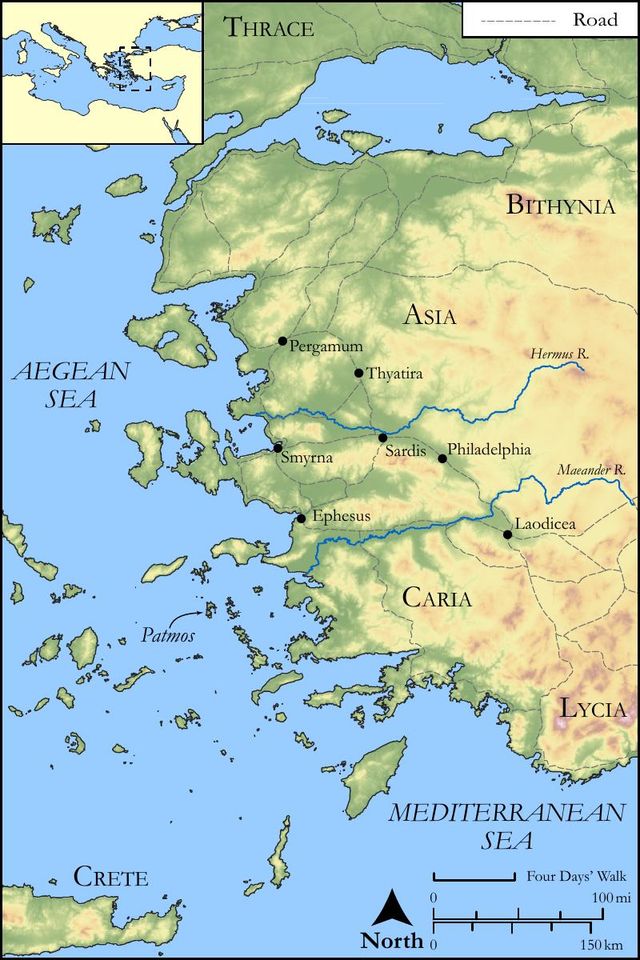
See on the biblical-era maps

Study this verse
Public-domain commentary
Matthew Henry
From his Commentary on the Whole Bible. Henry comments on passages, not single verses — this entry covers Revelation 6:3–8. His three-level outline is real structure in the source text, so it is rendered as structure.
The next three seals give us a sad prospect of great and desolating judgments with which God punishes those who either refuse or abuse the everlasting gospel. Though some understand them of the persecutions that befell the church of Christ, and others of the destruction of the Jews, they rather seem more generally to represent God's terrible judgments, by which he avenges the quarrel of his covenant upon those who make light of it.
I.Upon opening the second seal, to which John was called to attend, another horse appears, of a different colour from the former, a red horse, Rev 6:4. This signifies the desolating judgment of war; he that sat upon this red horse had power to take peace from the earth, and that the inhabitants of the earth should kill one another. Who this was that sat upon the red horse, whether Christ himself, as Lord of hosts, or the instruments that he raised up to conduct the war, is not clear; but this is certain,
1.That those who will not submit to the bow of the gospel must expect to be cut in sunder by the sword of divine justice.
2.That Jesus Christ rules and commands, not only in the kingdom of grace, but of providence. And,
3.That the sword of war is a dreadful judgment; it takes away peace from the earth, one of the greatest blessings, and it puts men upon killing one another. Men, who should love one another and help one another, are, in a state of war, set upon killing one another.
II.Upon opening the third seal, which John was directed to observe, another horse appears, different from the former, a black horse, signifying famine, that terrible judgment; and he that sat on the horse had a pair of balances in his hand (Rev 6:5), signifying that men must now eat their bread by weight, as was threatened (Lev 26:26), They shall deliver your bread to you by weight. That which follows in Rev 6:6, of the voice that cried, A measure of wheat for a penny, and three measures of barley for a penny, and see thou hurt not the oil and the wine, has made some expositors think this was not a vision of famine, but of plenty; but if we consider the quantity of their measure, and the value of their penny, at the time of this prophecy, the objection will be removed; their measure was but a single quart, and their penny was our sevenpence-halfpenny, and that is a large sum to give for a quart of wheat. However, it seems this famine, as all others, fell most severely upon the poor; whereas the oil and the wine, which were dainties of the rich, were not hurt; but if bread, the staff of life, be broken, dainties will not supply the place of it. Here observe,
1.When a people loathe their spiritual food, God may justly deprive them of their daily bread.
2.One judgment seldom comes alone; the judgment of war naturally draws after it that of famine; and those who will not humble themselves under one judgment must expect another and yet greater, for when God contends he will prevail. The famine of bread is a terrible judgment; but the famine of the word is more so, though careless sinners are not sensible of it.
III.Upon opening the fourth seal, which John is commanded to observe, there appears another horse, of a pale colour. Here observe,
1.The name of the rider - Death, the king of terrors; the pestilence, which is death in its empire, death reigning over a place or nation, death on horseback, marching about, and making fresh conquests every hour.
2.The attendants or followers of this king of terrors - hell, a state of eternal misery to all those who die in their sins; and, in times of such a general destruction, multitudes go down unprepared into the valley of destruction. It is an awful thought, and enough to make the whole world to tremble, that eternal damnation immediately follows upon the death of an impenitent sinner. Observe,
(1.)There is a natural as well as judicial connection between one judgment and another: war is a wasting calamity, and draws scarcity and famine after it; and famine, not allowing men proper sustenance, and forcing them to take that which is unwholesome, often draws the pestilence after it.
(2.)God's quiver is full of arrows; he is never at a loss for ways and means to punish a wicked people.
(3.)In the book of God's counsels he has prepared judgments for scorners as well as mercy for returning sinners.
(4.)In the book of the scriptures God has published threatenings against the wicked as well as promises to the righteous; and it is our duty to observe and believe the threatenings as well as the promises.
IV.After the opening of these seals of approaching judgments, and the distinct account of them, we have this general observation, that God gave power to them over the fourth part of the earth, to kill with the sword, and with hunger, and with death, and with the beasts of the earth, Rev 6:8. He gave them power, that is, those instruments of his anger, or those judgments themselves; he who holds the winds in his hand has all public calamities at his command, and they can only go when he sends them and no further than he permits. To the three great judgments of war, famine, and pestilence, is here added the beasts of the earth, another of God's sore judgments, mentioned Eze 14:21, and mentioned here the last, because, when a nation is depopulated by the sword, famine, and pestilence, the small remnant that continue in a waste and howling wilderness encourage the wild beasts to make head against them, and they become easy prey. Others, by the beasts of the field, understand brutish, cruel, savage men, who, having divested themselves of all humanity, delight to be the instruments of the destruction of others.
Historical interpretation
Seven Centuries of Reception
8 surviving comments on this verse. Each one is dated, so this reads as a timeline rather than a list.
Select a marker to jump to its quote. Markers stagger vertically where authors wrote within a few decades of each other.
"And when He had opened the fourth seal, I heard the fourth living creature saying, Come and see. And, lo, a pale horse; and he who sate upon him was named Death." For the pale horse and he who sate upon him bore the name of Death. These same things also the Lord had promised among the rest of the coming destructions-great pestilences and deaths; since, moreover, he says:-
"And hell followed him." That is, it was waiting for the devouring of many unrighteous souls. This is the pale horse.
There are two parts in the world, that which belongs to God and that of the devil. That which belongs to the devil is further divided into three parts, which are both within and outside [the church]. These are the Gentiles, false brothers and those separated by open error or schism. And these three parts are those that war against the one. This one is said to consist of three fourths, either because it believes in the threefold unity or because it is distinguished into orders by the goodly variation of three vocations, that of the virgins, of the widows and of the married. He says that now power is given in these three fourths. He speaks of the church which is one, and because the threefold vocation relates to one head, it consists from the three fourths in the stability of a square. As it says, “built upon the foundation of the apostles and the prophets, Christ Jesus himself being the chief cornerstone.” He foretells that the church will be placed into stress by the attacks of evil people, from the Gentiles, from false brothers and by heretical depravity. And this is also to be recognized in the number of the messengers, that the very same good would oppose three evil enemies—the red horse with the sword, the second, black horse with the balance, and the third, pale horse with the sign of death, for the sword signifies war, the black horse famine and the pale horse death. And since he mentions the plagues one by one, he foretells all the future outbreaks of plagues by enumerating them in or through the third, the names of the beasts being added. We may remain undecided whether the speech is literal or figurative. For a visible sword is commonly used against the body, while a spiritual sword is used against the soul. Similarly concerning famine, it can mean here either a famine of the Word of God or a famine that affects the body. And likewise concerning death, it can here mean either eternal death that affects souls or that temporal death that concerns bodies. Nonetheless, it is clear that the fourth good part, which is opposed by the three evils, is made to struggle in time by all of these visible persecutions. For those who are called according to the purpose of the will of God shall remain in the perfect number of the elect, especially those whom he wills to be preserved by the inviolate sacraments of the wine and oil. For when he said, “Do not harm the wine and oil,” he was indicating the price of redemption in the wine and the anointing of baptism in the oil. Indeed, the Lord clearly said in the Gospel, “Father, those whom you have given to me, I have guarded, and none of them is lost but the son of perdition.”
In the pale horse we perceive evil people who never cease to incite persecutions. And these three horses are one, who came out after the white horse and against it. And they have as their rider the devil, who is death. And so, the three horses are interpreted to be war, famine, and pestilence. For in the Gospel, the Lord foretold of these things, and they have already occurred, and as the day of judgment draws nearer will occur even more.
This sequence of events has happened before and reflects also contemporary occurrences. For as Eusebius says in the eighth chapter of the ninth book of his Ecclesiastical History, at the height of the persecution, when Maximinus was Roman emperor, both famine and pestilence along with other things fell upon them, so that such an innumerable multitude perished that they could not be buried. At that time indeed the Christians zealously undertook the task of burying the dead and by their love of humanity led those who had been deceived to the recognition of the truth. Moreover, the Armenians resisted the Romans, he says, so that many were killed with the sword and the bodies of the dead were eaten by dogs. Finally, those left alive began to kill the dogs, fearing that they themselves might die and that the living would become their tombs. For it was not impossible that even wild animals shared the same meal with dogs on account of the abundance of food. We know that even in our own times similar things have happened.
And behold, a pale horse, etc. Heretics who mask themselves as Catholics, worthy of the inhabiting death, drag after them a host of the lost. For the devil and his ministers are metaphorically called death and hell, as they are the cause of death and hell for many. It can also be simply understood that here the spiritually dead, there eternal punishment follows.
And power was given to him over a fourth of the earth. Behold, the madness of Arius, born in Alexandria, reached as far as the Gallic Ocean, not only persecuting the pious bestially with famine of the word of God but also with physical sword. Another version translates it as a fourth part, because the three evil horses, relying on the devil as their leader, ride against the fourth cavalry of the Church.
And when he had opened the fourth seal, I heard the voice of the fourth living creature, saying: Come, and see. And behold a pale horse, and he that sat upon him, his name was Death, and hell followed him. The people represented by the pale horse are the same as those represented by the red horse, their spiritual death being now symbolized by the pallor of the horse. It is right to say that death, that is the Devil intending to fight against the living, sits on them, because he seeks to extinguish the lives of the elect by the agency of those he has already killed spiritually. Hell means those in whom death dwells. Therefore hell follows death, because the wicked imitate the Devil. We may also understand by the pale horse the heretics specifically. And power was given to him over the four parts of the earth, to kill with sword, with famine, and with death, and with the beasts of the earth. There are two parts in this world, namely Christ's and the Devil's; but Christ's part is not divided, according to this: One is my dove; [Song 6:8] whereas the Devil's part is divided into four parts: pagans, Jews, heretics, and bad Catholics. Therefore there are as many plagues as there are parts of the Devil. It has already been explained how he kills with sword, with famine, and with death. As for the beasts, by them are represented ungoverned pulsions. So our enemy kills the souls of the reprobates with beasts because when fleshly pulsions are not restrained by the cages of the divine commandments, they are made wild, so to speak, by the impulse of diabolic incitement, and hurl the lives of the wretched down every precipice.
It is the breaking of the fourth seal and the beginning of the release from the sin of Adam's transgression. For this release is the indicator of reconciliation with God. For if "our sins separate us from God", as Isaiah says (Isa. 59:2), then their removal brings us back into fellowship. But what is the remedy? The wounds of Christ, through which we have been freed (see 1 Peter 2:24; Isa. 53:5). For since we were condemned by the pleasure of tasting, we have been healed by its opposites. Opposite to pleasure are the wounds, which bear the painful sensation, all of which Christ endured on our behalf, through which we were led to the corruption of death, but He endured it through opposites: through obedience, disobedience (see Rom. 5:19); through painful submission, pleasure; through the brave placing of His hands upon the cross, which had rashly touched the forbidden tree.
Of which it is said to have occurred, by the command of the fourth living creature saying, "Come." I looked, and behold, a pale horse; and the one sitting on it was named Death, and Hades followed with him. And they were given authority over a fourth of the earth. The pale horse is a symbol of wrath; for the bile is pale green, and so it is called by physicians.
Death and Hades were indeed sent forth spiritually to overthrow the deceitful demons and to exact justice for the destruction of humanity. However, since the saving work of Christ's passion had not yet been accomplished through the Revelation, by which He atoned all the sins committed against us, the complete destruction of the demons had not yet occurred; rather, only a quarter part had been destroyed.
This destruction is metaphorically called a slaughter and famine by those who long ago worshipped them; and death, the end of their tyranny, is brought about through death itself, and their annihilation by the beasts of the earth;
beasts of the earth being the passions of pride and vanity in the demons. Though these demons are earthly by nature, as they delight in the earthly passions that afflict those on earth, even though they have a spiritual nature, they are weakened and consumed as they are cast out from their dominion over humanity.
Continue studying Revelation 6:8 across the web’s major study libraries — every link below opens this exact verse, chapter, or book on the destination site.
Read & Compare
 BibleGatewayThis verse in more than 200 translations and 70 languages.
 Bible.comThe YouVersion reader — hundreds of translations, reading plans, and highlights.
 ESV.orgCrossway's official English Standard Version reader.
 NET BibleThe NET translation with 60,000+ translators' notes on every rendering decision.
 STEP BibleTyndale House's free study tool — original text, vocabulary, and scholarly resources.
 BibliaLogos Bible Software's free web reader.
 USCCBThe New American Bible (Revised Edition) with the U.S. bishops' study notes.
Commentaries
 BibleHub CommentariesDozens of classic commentaries on this verse, gathered on one page.
 StudyLightMore than 100 commentary sets — the largest collection on the web.
 BibleRefPlain-English commentary on what this verse means, verse by verse.
 Enduring WordDavid Guzik's free commentary on this chapter, widely used by Bible teachers.
 Bible Study ToolsVerse commentary alongside Greek and Hebrew study aids.
Original Language & Research
- BibleHub InterlinearThe verse word by word — original language, transliteration, and English.
- BibleHub LexiconEvery word's original-language definition and Strong's entry.
 Blue Letter BibleDeep-study tools — Strong's numbers, concordance, and word studies.
 CNTR CollationThe earliest Greek manuscripts of this verse, collated letter by letter.
Sermons, Hymns & Audio


TrulyRandomVerse is not affiliated with these sites and doesn’t control their content. They’re linked because they’re genuinely useful.
Summary
Revelation 6:8 unveils the fourth of the four horsemen, a chilling vision of divine judgment. A pale horse emerges, ridden by Death, with Hades (Hell) following close behind. This duo is granted authority over a quarter of the earth, empowered to inflict widespread mortality through various devastating means: war, famine, pestilence, and wild beasts. The verse vividly portrays the severe consequences of sin and rebellion, emphasizing God's sovereign control even amidst global tribulation and the inexorable march of death.
Context
ShowHideLiterary Context
Revelation 6:8 is the culmination of the opening of the first four seals by the Lamb, each revealing a distinct horseman. The white horse (conquest), red horse (war), and black horse (famine) precede the pale horse. This progression demonstrates an escalating intensity of judgment, with the pale horse representing the ultimate consequence: widespread death resulting from the preceding woes. The vision serves as a prelude to the more intense judgments that follow, such as the trumpet and bowl judgments, establishing a pattern of divine wrath unfolding upon the earth. It is intricately linked to the broader apocalyptic narrative of God's righteous judgment and ultimate triumph.
Historical & Cultural Context
The imagery of horsemen as agents of divine judgment has roots in Old Testament prophetic literature, particularly Zechariah 6:1-8 and Ezekiel 14:12-21. In the Roman world, horses were symbols of power and military might, and the color "pale" (chloros) would have evoked images of sickness, decay, and death, a common sight in times of plague or famine. The methods of killing—sword, hunger, death (often understood as pestilence), and wild beasts—were recognized ancient scourges, representing the most common and devastating forms of mortality that could afflict a population. The concept of "Hades" (Hell) as the realm of the dead was a concept widely understood among the Greeks and the Jews, reinforcing the finality of the rider's work.
Key Themes
ShowHideThis verse powerfully contributes to several overarching themes in Revelation and biblical theology. Foremost is the theme of Divine Sovereignty and Judgment, as the power granted to Death and Hades underscores that these catastrophic events are not random but are divinely permitted and controlled judgments, part of God's righteous response to human sin and rebellion (Revelation 1:18). It also highlights the theme of Consequences of Sin, showing how human choices and societal structures (war, injustice leading to famine) ultimately invite divine retribution. The Reality of Death and Hades is starkly presented, reminding humanity of its mortality and the ultimate destination of the unsaved. Furthermore, the "fourth part of the earth" introduces the theme of Limited but Widespread Tribulation, indicating a severe but not total global devastation, a recurring motif in Revelation's escalating judgments (e.g., Revelation 8:7-12).
Exposition and Analysis
ShowHideKey Word Analysis
ShowHideMeaning "greenish, i.e. verdant, dun-colored." This word is crucial as it describes the horse's color, which is not merely "pale" in the sense of light, but rather a sickly, yellowish-green hue, reminiscent of a decaying corpse or a plant withered by disease. This color choice powerfully evokes the themes of sickness, putrefaction, and the pallor of death, directly aligning with the rider's identity.
Referring to "death (literally or figuratively)." Here, "Death" is personified as the rider, an active agent of destruction. This personification elevates death from a mere event to a powerful, terrifying entity, underscoring its pervasive and inescapable nature as a consequence of the judgments unleashed.
Meaning "privilege, i.e. (subjectively) force, capacity, competency, freedom, or (objectively) mastery... delegated influence." The phrase "power was given unto them" is profoundly significant. It emphasizes that Death and Hades do not operate autonomously but are under divine authority. Their destructive capacity is not inherent but a delegated permission from God, highlighting His ultimate sovereignty even over forces of destruction and mortality.
Verse Breakdown
ShowHide"And I looked, and behold a pale horse:"
John's vision continues, immediately drawing attention to the fourth horse. The command "behold" (G2400 idoú) underscores the dramatic and significant nature of what is about to be revealed. The "pale" (G5515 chlōrós) color of the horse is not a vibrant hue but a sickly, ashen, or greenish-yellow, immediately signaling decay, disease, and the presence of death itself. This visual is designed to evoke a sense of dread and impending doom.
"and his name that sat on him was Death,"
The identity of the rider is explicitly revealed as "Death" (G2288 thánatos), personified as an active agent. This is not merely a symbolic representation of death, but Death itself, given authority to execute judgment. The naming of the rider makes the horror tangible and direct.
"and Hell followed with him."
"Hell" is the Greek Hades (G86 háidēs), the realm of the dead or the grave. Hades is depicted as accompanying Death, an inseparable duo. This signifies that Death's work is to bring souls to Hades; wherever Death strikes, Hades is there to receive the deceased. It emphasizes the comprehensive nature of the judgment, affecting both the physical body and the immediate post-mortem state.
"And power was given unto them over the fourth part of the earth,"
This crucial clause highlights divine authorization. The "power" (G1849 exousía) is not seized but "given" (G1325 dídōmi) by God, underscoring His ultimate control and sovereignty over these judgments. The scope is specified as "over the fourth part of the earth" (G1093 gē), indicating a widespread, global impact, yet one that is limited in its extent, suggesting a severe tribulation that falls short of total annihilation.
"to kill with sword, and with hunger, and with death, and with the beasts of the earth."
The methods of destruction are enumerated, reflecting the common scourges of every age. "Sword" (G4501 rhomphaía) refers to war and violent conflict. "Hunger" (G3042 limós) signifies famine. "Death" (G2288 thánatos) here is often interpreted as pestilence or plague, distinct from the personified rider, representing widespread disease. Finally, "beasts of the earth" (G2342 thēríon) refers to wild animals, which, in times of societal collapse due to war, famine, and disease, could become a significant threat to human life. These four methods represent a comprehensive array of calamities leading to mass mortality.
Literary Devices
ShowHideRevelation 6:8 is rich in Symbolism and Personification. The "pale horse" itself is a powerful symbol, its sickly color (chloros) immediately evoking images of decay, disease, and the pallor of a corpse, thus directly symbolizing the death and sickness it brings. The most striking device is the Personification of "Death" as the rider and "Hades" (Hell) as his inseparable companion. By naming Death as a character and depicting Hades following him, John transforms abstract concepts into active, terrifying agents of divine judgment. This personification makes the reality of widespread mortality more vivid and impactful. The enumeration of the means of death ("sword, and with hunger, and with death, and with the beasts of the earth") is a form of Merism, where a comprehensive reality (all forms of mass mortality) is conveyed by listing its constituent parts, emphasizing the totality and variety of the devastation. The entire scene is a vivid Apocalyptic Imagery, designed to convey profound theological truths through dramatic, often terrifying, visions.
Theological and Thematic Connections
ShowHideRevelation 6:8 powerfully reinforces the biblical truth of God's absolute sovereignty, even over the most terrifying manifestations of judgment. The repeated phrase "power was given unto them" underscores that Death and Hades, though formidable, are not independent forces but instruments in God's hand. This vision serves as a stark reminder of the consequences of sin and humanity's rebellion against God, demonstrating that divine judgment is a real and inevitable aspect of God's righteous character. While terrifying, it also implicitly points to the ultimate hope: if God controls even these destructive forces, then His redemptive plan for His people is equally, if not more, certain. The scene also highlights the fragility of human life and the universal reality of death, prompting a sober reflection on eternal matters.
Reflection and Application
ShowHideRevelation 6:8 presents a sobering reality that compels us to reflect deeply on the nature of life, death, and divine sovereignty. In a world that often seeks to deny or sanitize death, this verse confronts us with its raw, inescapable power. For believers, it serves as a powerful reminder that God remains in control, even when the world seems to descend into chaos. The "power was given" clause is a profound theological anchor, assuring us that no calamity, no matter how devastating, occurs outside of God's ultimate permission and purpose. This understanding should cultivate a deep sense of trust in His wisdom and justice, even when His ways are beyond our comprehension. It also calls us to a posture of humility and repentance, recognizing the gravity of sin and the righteousness of God's judgments.
Questions for Reflection
ShowHideFAQ
ShowHideWhat does the "pale horse" specifically symbolize?
ShowHideThe "pale horse" (Greek: chlōrós) symbolizes decay, sickness, and death. The color is not merely light or faded, but a sickly, yellowish-green, like a decaying corpse or a diseased plant. This visual imagery perfectly aligns with the rider, Death, and the widespread mortality he brings, encompassing pestilence, famine, and the general pallor associated with severe illness and the aftermath of great suffering.
Who are "Death" and "Hell" and what is their relationship?
ShowHide"Death" (Greek: Thánatos) is the personified rider of the pale horse, representing the literal cessation of life. "Hell" (Greek: Hades) is the realm of the dead, the grave, or the underworld, which is depicted as following Death. Their relationship is one of cause and effect: Death brings about the physical demise, and Hades receives the departed souls. They are an inseparable duo, emphasizing the comprehensive nature of the judgment, impacting both the physical body and the immediate post-mortem state. This highlights the ultimate consequence of the judgments unleashed by the pale horse.
Why is power "given" to them, and what does "over the fourth part of the earth" mean?
ShowHideThe phrase "power was given unto them" is crucial because it emphasizes God's ultimate sovereignty. Death and Hades do not act independently but are instruments of divine judgment, operating under God's explicit permission and control. This underscores that even the most devastating calamities are part of God's righteous plan, not random chaos. "Over the fourth part of the earth" indicates a widespread but not total global impact. It signifies a significant, terrifying, and extensive tribulation affecting a large portion of humanity, but it also implies a limit to the destruction, suggesting that God's judgments, while severe, are measured and purposeful, not absolute annihilation (Revelation 9:18).
Christ-Centered Fulfillment
ShowHideWhile Revelation 6:8 vividly portrays the terrifying reality of death and divine judgment, its ultimate fulfillment and hope are profoundly centered in Christ. The very Lamb who opens these seals (Revelation 5:5) is the one who has conquered Death and Hades. Jesus declared, "I am He who lives, and was dead, and behold, I am alive forevermore. Amen. And I have the keys of Hades and of Death" (Revelation 1:18). This means that the formidable powers of Death and Hades, which are unleashed in Revelation 6:8, are ultimately subject to Christ's authority. His death and resurrection disarmed these spiritual principalities, offering victory to all who believe in Him (Colossians 2:15). The pale horse signifies a judgment that will befall the unredeemed world, but for those united with Christ, death has lost its sting (1 Corinthians 15:55-57). The vision of the pale horse, therefore, serves not only as a warning of impending judgment but also as a powerful backdrop against which the glorious, life-giving triumph of Jesus Christ over sin, death, and the grave shines even brighter.