


Revelation 1:9
Bible text: King James Version (1769 Blayney text) · Public domain
Bible text: King James Version with Strong's numbers · Public domain
Bible text: Berean Standard Bible · Public domain
Bible text: American Standard Version (1901) · Public domain
Bible text: World English Bible, Messianic edition · Public domain
Bible text: Geneva Bible (1599) · Public domain
Bible text: Young's Literal Translation · Public domain
- ἘγὼEgōI myselfG1473P-1NSPersonal pronoun Nominative 1st Singular
- ἸωάννηςIōannēsJohnG2491N-NSM-PNoun Nominative Singular Masculine Individual
- ὁho<the>G3588T-NSMDefinite article Nominative Singular Masculine
- καὶkaialsoG2532CONJConjunction
- ἀδελφὸςadelphosbrotherG80N-NSMNoun Nominative Singular Masculine
- ὑμῶνhumōnof youG4771P-2GPPersonal pronoun Genitive 2nd Plural
- καὶkaiandG2532CONJConjunction
- συγκοινωνὸςsugkoinōnosfellow-partakerG4791N-NSMNoun Nominative Singular Masculine
- ἐνeninG1722PREPPreposition
- τῇtēatheG3588T-DSFDefinite article Dative Singular Feminine
- θλίψειthlipseitribulationG2347N-DSFNoun Dative Singular Feminine
- καὶkaiandG2532CONJConjunction
- ἐνeninG1722PREPPreposition
- τῇtēa<the>G3588T-DSFDefinite article Dative Singular Feminine
- βασιλείᾳbasileiakingdomG932N-DSFNoun Dative Singular Feminine
- καὶkaiandG2532CONJConjunction
- ὑπομονῇhupomonēain enduranceG5281N-DSFNoun Dative Singular Feminine
- ἸησοῦIēsouJesusG2424N-DSM-PNoun Dative Singular Masculine Individual
- ΧριστῷChristōChristG5547N-DSM-TNoun Dative Singular Masculine Title
- ἐγενόμηνegenomēnwasG1096V-2ADI-1SVerb 2nd Aorist Middle Deponent Indicative 1st Singular
- ἐνeninG1722PREPPreposition
- τῇtēatheG3588T-DSFDefinite article Dative Singular Feminine
- νήσῳnēsōislandG3520N-DSFNoun Dative Singular Feminine
- τῇtēawhichG3588T-DSFDefinite article Dative Singular Feminine
- καλουμένῃkaloumenēis being calledG2564V-PPP-DSFVerb Present Passive Participle Dative Singular Feminine
- ΠάτμῳPatmōPatmosG3963N-DSF-LNoun Dative Singular Feminine Location
- διὰdiaon account ofG1223PREPPreposition
- τὸνtontheG3588T-ASMDefinite article Accusative Singular Masculine
- λόγονlogonwordG3056N-ASMNoun Accusative Singular Masculine
- τοῦtou<the>G3588T-GSMDefinite article Genitive Singular Masculine
- θεοῦtheouof GodG2316N-GSM-TNoun Genitive Singular Masculine Title
- καὶkaiandG2532CONJConjunction
- διὰdiathroughG1223PREPPreposition
- τὴνtēntheG3588T-ASFDefinite article Accusative Singular Feminine
- μαρτυρίανmarturiantestimonyG3141N-ASFNoun Accusative Singular Feminine
- ἸησοῦIēsouof JesusG2424N-GSM-PNoun Genitive Singular Masculine Individual
- ΧριστοῦChristouChristG5547N-GSM-TNoun Genitive Singular Masculine Title
English is a literal word-by-word gloss of the Greek, not the KJV's wording. Why?
This is the original text the KJV's translators worked from — each Greek word with its own literal English meaning in this verse, prepared by scholars at Tyndale House, Cambridge. The KJV translates whole sentences, not word by word, so its wording differs: one Greek word can become several English words, and the KJV may choose “charity” where the gloss reads “love”. Both are faithful — they answer different questions. For the KJV's own rendering, switch to the KJV text.
Details
See on the biblical-era maps

Study this verse
Public-domain commentary
Matthew Henry
From his Commentary on the Whole Bible. Henry comments on passages, not single verses — this entry covers Revelation 1:9–20. His four-level outline is real structure in the source text, so it is rendered as structure.
We have now come to that glorious vision which the apostle had of the Lord Jesus Christ, when he came to deliver this revelation to him, where observe,
I.The account given of the person who was favoured with this vision. He describes himself,
1.By his present state and condition. He was the brother and companion of these churches in tribulation, and in the kingdom and patience of Christ. He was, at their time, as the rest of true Christians were, a persecuted man, banished, and perhaps imprisoned, for his adherence to Christ. He was their brother, though an apostle; he seems to value himself upon his relation to the church, rather than his authority in it: Judas Iscariot may be an apostle, but not a brother in the family of God. He was their companion: the children of God should choose communion and society with each other. He was their companion in tribulation: the persecuted servants of God did not suffer alone, the same trials are accomplished in others. He was their companion in patience, not only a sharer with them in suffering circumstances, but in suffering graces: if we have the patience of the saints, we should not grudge to meet with their trials. He was their brother and companion in the patience of the kingdom of Christ, a sufferer for Christ's cause, for asserting his kingly power over the church and the world, and for adhering to it against all who would usurp upon it. By this account he gives of his present state, he acknowledges his engagements to sympathize with them, and to endeavour to give them counsel and comfort, and bespeaks their more careful attention to what he had to say to them from Christ their common Lord.
2.By the place where he was when he was favoured with this vision: he was in the isle Patmos. He does not say who banished him thither. It becomes Christians to speak sparingly and modestly of their own sufferings. Patmos is said to be an island in the Aegean Sea, One of those called Cyclades, and was about thirty-five miles in compass; but under this confinement it was the apostle's comfort that he did not suffer as an evil-doer, but that it was for the testimony of Jesus, for bearing witness to Christ as the Immanuel, the Saviour. This was a cause worth suffering for; and the Spirit of glory and of God rested upon this persecuted apostle.
3.The day and time in which he had this vision: it was the Lord's day, the day which Christ had separated and set apart for himself, as the eucharist is called the Lord's supper. Surely this can be no other than the Christian sabbath, the first day of the week, to be observed in remembrance of the resurrection of Christ. Let us who call him our Lord honour him on his own day, the day which the Lord hath made and in which we ought to rejoice.
4.The frame that his soul was in at this time: He was in the Spirit. He was not only in a rapture when he received the vision, but before he received it; he was in a serious, heavenly, spiritual frame, under the blessed gracious influences of the Spirit of God. God usually prepares the souls of his people for uncommon manifestations of himself, by the quickening sanctifying influences of his good Spirit. Those who would enjoy communion with God on the Lord's day must endeavour to abstract their thoughts and affections from flesh and fleshly things, and be wholly taken up with things of a spiritual nature.
II.The apostle gives an account of what he heard when thus in the Spirit.
An alarm was given as with the sound of a trumpet, and then he heard a voice, the voice of Christ applying to himself the character before given, the first and the last, and commanding the apostle to commit to writing the things that were now to be revealed to him, and to send it immediately to the seven Asian churches, whose names are mentioned. Thus our Lord Jesus, the captain of our salvation, gave the apostle notice of his glorious appearance, as with the sound of a trumpet.
III.We have also an account of what he saw.
He turned to see the voice, whose it was and whence it came; and then a wonderful scene of vision opened itself to him.
1.He saw a representation of the church under the emblem of seven golden candlesticks, as it is explained in the last verse of the chapter. The churches are compared to candlesticks, because they hold forth the light of the gospel to advantage. The churches are not candles: Christ only is our light, and his gospel our lamp; but they receive their light from Christ and the gospel, and hold it forth to others. They are golden candlesticks, for they should be precious and pure, comparable to fine gold; not only the ministers, but the members of the churches ought to be such; their light should so shine before men as to engage others to give glory to God.
2.He saw a representation of the Lord Jesus Christ in the midst of the golden candlesticks; for he has promised to be with his churches always to the end of the world, filling them with light, and life, and love, for he is the very animating informing soul of the church. And here we observe,
(1.)The glorious form in which Christ appeared in several particulars.
[1.]He was clothed with a garment down to the foot, a princely and priestly robe, denoting righteousness and honour.
[2.]He was girt about with a golden girdle, the breast-plate of the high priest, on which the names of his people are engraven; he was ready girt to do all the work of a Redeemer.
[3.]His head and hairs were white like wool or snow. He was the Ancient of days; his hoary head was no sign of decay, but was indeed a crown of glory.
[4.]His eyes were as a flame of fire, piercing and penetrating into the very hearts and reins of men, scattering terrors among his adversaries.
[5.]His feet were like unto fine burning brass, strong and stedfast, supporting his own interest, subduing his enemies, treading them to powder.
[6.]His voice was as the sound of many waters, of many rivers falling in together. He can and will make himself heard to those who are afar off as well as to those who are near. His gospel is a profluent and mighty stream, fed by the upper springs of infinite wisdom and knowledge.
[7.]He had in his right hand seven stars, that is, the ministers of the seven churches, who are under his direction, have all their light and influence from him, and are secured and preserved by him.
[8.]Out of his mouth went a two-edged sword, his word, which both wounds and heals, strikes at sin on the right hand and on the left,
[9.]His countenance was as the sun shining, its strength too bright and dazzling for mortal eyes to behold.
(2.)The impression this appearance of Christ made upon the apostle John (Rev 1:17): He fell at the feet of Christ as dead; he was overpowered with the greatness of the lustre and glory in which Christ appeared, though he had been so familiar with him before. How well is it for us that God speaks to us by men like ourselves, whose terrors shall not make us afraid, for none can see the face of God and live!
(3.)The condescending goodness of the Lord Jesus to his disciple: He laid his hand upon him, Rev 1:17. He raised him up; he did not plead against him with his great power, but he put strength into him, he spoke kind words to him.
[1.]Words of comfort and encouragement: Fear not. He commanded away the slavish fears of his disciple.
[2.]Words of instruction, telling him particularly who he was that thus appeared to him. And here he acquaints him, First, with his divine nature: The first and the last. Secondly, With his former sufferings: I was dead; the very same that his disciples saw upon the cross dying for the sins of men. Thirdly, With his resurrection and life: "I live, and am alive for evermore, have conquered death and opened the grave, and am partaker of an endless life." Fourthly, With his office and authority: I have the keys of hell and of death, a sovereign dominion in and over the invisible world, opening and none can shut, shutting so that none can open, opening the gates of death when he pleases and the gates of the eternal world, of happiness or misery, as the Judge of all, from whose sentence there lies no appeal. Fifthly, With his will and pleasure: Write the things which thou hast seen, and the things which are, and which shall be hereafter. Sixthly, With the meaning of the seven stars, that they are the ministers of the churches; and of the seven candlesticks, that they are the seven churches, to whom Christ would now send by him particular and proper messages.
Historical interpretation
Seven Centuries of Reception
6 surviving comments on this verse. Each one is dated, so this reads as a timeline rather than a list.
Select a marker to jump to its quote. Markers stagger vertically where authors wrote within a few decades of each other.
This other author, on the contrary, did not even deem it sufficient to name himself once, and then to proceed with his narrative; but he takes up his name again, and says: "I John, who also am your brother and companion in tribulation, and in the kingdom and patience of Jesus Christ, was in the isle that is called Patmos for the Word of God, and for the testimony of Jesus Christ." And likewise toward the end he speaks thus: "Blessed is he that keepeth the sayings of the prophecy of this book; and I John who saw these things and heard them." That it is a John, then, that writes these things we must believe, for he himself tells us.
The ecclesiastical writers have taught that at the time of Claudius Caesar, when that famine which the prophet Agabus had announced in the Acts of the Apostles would come in ten years time was at its height, that during that difficulty this same Caesar, impelled by his usual vanity, had instituted a persecution of the churches. It was during this time that he ordered John, the apostle of our Lord, Jesus Christ, to be transported into exile, and he was taken to the island of Patmos, and while there confirmed this writing. That he might present the trials of suffering which he was bearing at that time, he recalls that he was a participant in suffering, and then he adds the kingdom to the suffering of tribulation, and because of the kingdom to be received he further adds the patient endurance which he bore for the sake of Jesus.
I, John, etc. He hints at the person, place, time, and cause of the vision. He testifies that he saw it also in the Spirit, lest he be thought deluded by a fleshly apparition.
Was in the island, etc. The story is known, that John was banished to this island by Caesar Domitian because of the gospel, to whom it was fittingly given to penetrate the secrets of heaven when he was forbidden to exceed certain earthly spaces.
I John, your brother and your partner in tribulation, and in the kingdom, and patience in Christ Jesus, was in the island, which is called Patmos, for the word of God, and for the testimony of Jesus. In this place John represents both his own person specifically and that of the Church generally. It is also to be noted that the kingdom pertains to the Head, tribulation to the limbs, and patience to both, and all this can be found in Jesus alone. Indeed, the Head was suffering tribulation with the limbs when he said, Saul, Saul, why persecutest thou me? [Acts 9:4]. The kingdom is in the Head, as in Come, ye blessed of my Father, possess you the kingdom prepared for you from the foundation of the world, [Matt. 25:34] which is like saying clearly, “Come, ye limbs, reign with the Head, because I am the kingdom.” For he will grant himself to his people, as it is written: The oath, which he swore to Abraham our father, that he would grant (himself) to us [Luke 1:73]. Patience awaits us, according to this: Knowest thou not, that the benignity of God leadeth thee to patience? [Variant of Rom. 2:4], and we, in our patience, shall possess our souls. [Cf. Luke 21:19] By the island of Patmos, which translates to “strait,” in which John was in exile, are represented the persecutions and hardships suffered by John and the Church (that is, a species and a genus) but for the Word of God, not for their own bad actions, according to this saying of the apostle Peter: Let none of you suffer as a thief, [1 Pet. 4:15] but as a disciple of Christ.
John wrote to the faithful according to the message and preaching of Christ, that they suffer much from those who persecute the godly; therefore, John considers himself a "companion in the sufferings" and "endurance," and likewise "in the kingdom" of God. Here, those to be a "companion in the sufferings" for the sake of the message are called to share in it with Jesus.
John says it is because "of Jesus"; for this is what the one in Jesus means.
And "because of His word and the testimony" which I bore by proclaiming His Gospel, John says, I became exiled "on the island of Patmos." Eusebius records that this happened to John in the Chronological Canon during the reign of Emperor Domitian. Then he says, while living on the aforementioned island,
Continue studying Revelation 1:9 across the web’s major study libraries — every link below opens this exact verse, chapter, or book on the destination site.
Read & Compare
 BibleGatewayThis verse in more than 200 translations and 70 languages.
 Bible.comThe YouVersion reader — hundreds of translations, reading plans, and highlights.
 ESV.orgCrossway's official English Standard Version reader.
 NET BibleThe NET translation with 60,000+ translators' notes on every rendering decision.
 STEP BibleTyndale House's free study tool — original text, vocabulary, and scholarly resources.
 BibliaLogos Bible Software's free web reader.
 USCCBThe New American Bible (Revised Edition) with the U.S. bishops' study notes.
Commentaries
 BibleHub CommentariesDozens of classic commentaries on this verse, gathered on one page.
 StudyLightMore than 100 commentary sets — the largest collection on the web.
 BibleRefPlain-English commentary on what this verse means, verse by verse.
 Enduring WordDavid Guzik's free commentary on this chapter, widely used by Bible teachers.
 Bible Study ToolsVerse commentary alongside Greek and Hebrew study aids.
Original Language & Research
- BibleHub InterlinearThe verse word by word — original language, transliteration, and English.
- BibleHub LexiconEvery word's original-language definition and Strong's entry.
 Blue Letter BibleDeep-study tools — Strong's numbers, concordance, and word studies.
 CNTR CollationThe earliest Greek manuscripts of this verse, collated letter by letter.
Sermons, Hymns & Audio


TrulyRandomVerse is not affiliated with these sites and doesn’t control their content. They’re linked because they’re genuinely useful.
Summary
Revelation 1:9 introduces the Apostle John, the author of this prophetic book, by establishing his profound solidarity with his audience. He identifies himself not as a distant authority but as a fellow "brother" and "companion" in the shared experiences of tribulation, the present reality of God's kingdom, and the patient endurance found in Jesus Christ. The verse also reveals his geographical location, the island of Patmos, and the divine reason for his exile: his unwavering commitment to proclaiming "the word of God" and bearing "the testimony of Jesus Christ." This sets a foundational tone for the book, emphasizing that divine revelation often comes amidst suffering for the Gospel.
Context
ShowHideLiterary Context
Revelation 1:9 immediately follows the opening salutation and doxology of the book, which blesses those who read, hear, and keep its prophetic words (Revelation 1:3). After establishing the divine authority and purpose of the revelation, John shifts to his personal circumstances, grounding the otherworldly visions that follow in a tangible, relatable human experience. This verse serves as a bridge, connecting the heavenly source of the prophecy to its earthly recipient and the community for whom it is intended. It personalizes the message, showing that the one receiving these profound truths is himself undergoing hardship for his faith, thereby lending credibility and empathy to his subsequent prophetic declarations.
Historical & Cultural Context
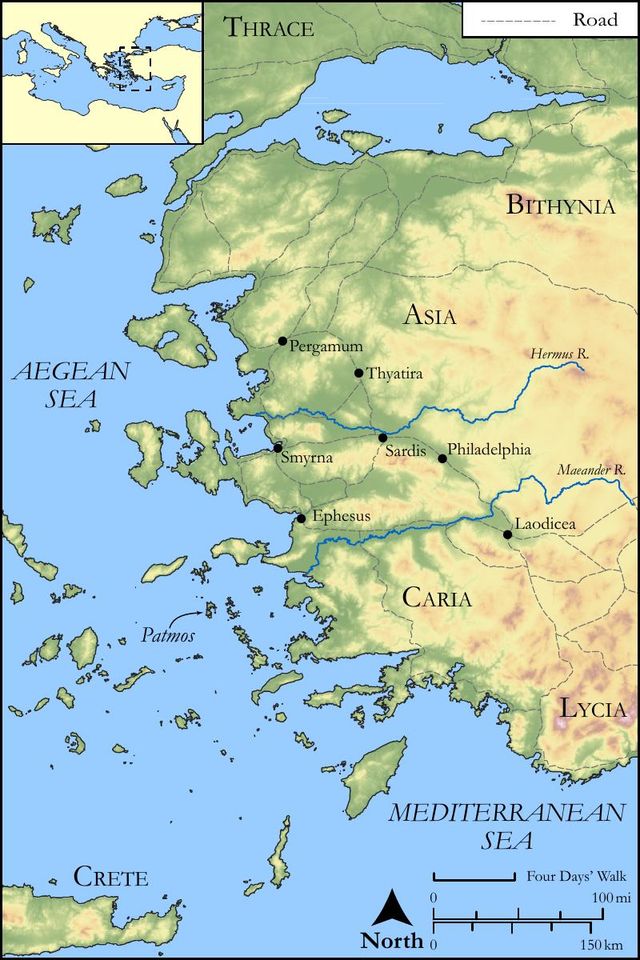
The Apostle John's exile to Patmos is widely believed to have occurred during the reign of the Roman Emperor Domitian (c. AD 81-96), who initiated a period of intense persecution against Christians for their refusal to participate in emperor worship. Patmos, a small, rocky island in the Aegean Sea, approximately 60 miles southwest of Ephesus, served as a Roman penal colony. It was a place of forced labor and isolation, where political prisoners and other offenders were banished. John's presence there "for the word of God, and for the testimony of Jesus Christ" clearly indicates that his banishment was a direct consequence of his evangelistic and prophetic activities, highlighting the severe cost of Christian discipleship in the Roman Empire. This historical backdrop underscores the real-world dangers faced by early believers and provides a poignant setting for a book that speaks so powerfully about suffering, perseverance, and divine judgment.
Key Themes
ShowHideThis verse introduces several crucial themes that permeate the book of Revelation. Firstly, the theme of shared suffering and solidarity is paramount, as John identifies with his readers in their "tribulation" (Revelation 1:9). This establishes a bond of empathy, assuring believers that their hardships are understood and shared by their spiritual leader. Secondly, the verse highlights the present reality of the kingdom of God, indicating that believers are already participants "in the kingdom" even amidst earthly trials, a concept further developed in passages like Revelation 5:10. Thirdly, patient endurance (patience of Jesus Christ) is emphasized as a necessary virtue for navigating persecution, a call to steadfastness echoed throughout Revelation, particularly in the exhortations to those who "keep the commandments of God and the faith of Jesus" (Revelation 14:12). Finally, the verse underscores the centrality of God's Word and the testimony of Jesus Christ as the very reason for John's suffering and the foundation for the entire prophetic revelation that follows, linking directly to the "spirit of prophecy" being the "testimony of Jesus" (Revelation 19:10).
Exposition and Analysis
ShowHideKey Word Analysis
ShowHideThis term (G4791) literally means "a co-participant" or "fellow partaker." It emphasizes a deep, shared involvement and fellowship. John uses this word to convey that he is not merely an observer or a detached leader, but one who actively shares in the experiences, struggles, and blessings of his Christian brethren. It signifies a profound bond of solidarity and mutual participation in the Christian journey.
Derived from a word meaning "to press" or "to crush," this term (G2347) denotes pressure, distress, affliction, or persecution. In the New Testament, it frequently refers to the hardships and sufferings experienced by believers due to their faith. John's use of this word indicates that he, like his audience, is undergoing severe external pressure and persecution, highlighting the common experience of suffering for Christ in the early church.
This word (G5281) signifies more than passive waiting; it denotes "cheerful (or hopeful) endurance" and "constancy." It describes an active, steadfast perseverance in the face of adversity, not giving in to despair but maintaining faith and hope. John links this patience directly to Jesus Christ, implying that the endurance required of believers is modeled after and empowered by Christ's own steadfastness through His suffering and ministry.
Verse Breakdown
ShowHide"I John, who also am your brother, and companion in tribulation"
John immediately establishes his identity and relationship with his readers. He is "John," the known Apostle, but he presents himself humbly as a "brother," emphasizing familial spiritual ties, and a "companion" (co-participant), indicating shared experience, especially in "tribulation" or suffering. This opening fosters empathy and solidarity, assuring his audience that he understands their struggles.
"and in the kingdom and patience of Jesus Christ"
This phrase further defines the shared reality of John and his readers. They are companions not only in suffering but also in the present spiritual "kingdom" of God, which is a reality even amidst earthly persecution. This kingdom is intrinsically linked with "patience" (endurance), which is specifically identified as belonging "of Jesus Christ," meaning it is either Christ's own endurance that they share, or the endurance that is empowered by Him and characteristic of His followers.
"was in the isle that is called Patmos"
This clause provides the specific geographical context for John's revelation. Patmos, a small, desolate Aegean island, was a place of Roman penal exile. John's physical location underscores his suffering and isolation, setting the stage for the dramatic visions he is about to receive in this challenging environment.
"for the word of God, and for the testimony of Jesus Christ"
This final clause reveals the divine purpose and reason for John's exile. He was banished not for a crime, but "for" (Greek: diá, G1223, meaning "because of" or "on account of") his faithful proclamation of "the word of God" (the divine message) and his unwavering "testimony of Jesus Christ" (his witness to Christ's life, death, and resurrection). This highlights the cost of discipleship and the centrality of evangelism and prophetic witness.
Literary Devices
ShowHideThe verse employs several significant literary devices. Identification is prominent as John immediately establishes his personal connection to the audience, using "brother" and "companion" to forge a bond of solidarity. This creates a sense of shared destiny and experience, crucial for a book that will call for immense perseverance. The phrase "in tribulation, and in the kingdom and patience of Jesus Christ" utilizes juxtaposition, placing the harsh reality of suffering alongside the spiritual reality of God's reign and divine endurance. This highlights the paradox of Christian existence: suffering within the context of God's present rule. Furthermore, Metonymy is evident in "the word of God" and "the testimony of Jesus Christ," where these phrases stand for the entire message and witness of the Gospel, for which John suffered. The mention of Patmos serves as a powerful symbol of exile and suffering for the faith, yet paradoxically, it becomes the very place of profound divine revelation.
Theological and Thematic Connections
ShowHideRevelation 1:9 profoundly shapes our understanding of Christian identity and mission. John's self-identification as a "brother" and "companion" in tribulation, kingdom, and patience underscores the communal nature of faith. It teaches that suffering for Christ is not an isolated experience but a shared reality among believers, uniting them in a common journey. This solidarity is rooted in their participation in the present, though not yet fully realized, kingdom of God, and empowered by the very endurance of Jesus Christ Himself. John's exile "for the word of God, and for the testimony of Jesus Christ" elevates the act of bearing witness to Christ as a central, even costly, aspect of discipleship, affirming that faithfulness to divine truth often invites opposition. This verse sets the stage for the entire book of Revelation, which will explore the conflict between God's kingdom and the forces of evil, and the ultimate triumph of those who persevere in their testimony.
Reflection and Application
ShowHideRevelation 1:9 offers a powerful reminder that the Christian life, while filled with the promises of God's kingdom, is also often marked by tribulation. John's experience on Patmos teaches us that faithfulness to "the word of God, and for the testimony of Jesus Christ" can lead to hardship, isolation, or persecution. Yet, even in such circumstances, God is present, revealing His truth and purpose. This verse challenges believers to embrace a posture of patient endurance, recognizing that our suffering is not meaningless but is shared with Christ and fellow believers, and it contributes to our participation in His kingdom. It calls us to cultivate a deep solidarity with other Christians, especially those facing persecution, and to remain steadfast in our witness, regardless of the cost. John's example encourages us to view challenging circumstances not as obstacles to God's work, but as potential crucibles where divine revelation and spiritual growth can occur, strengthening our resolve to proclaim Christ boldly.
Questions for Reflection
ShowHideFAQ
ShowHideWhy was John exiled to Patmos, and what was Patmos like?
ShowHideJohn was exiled to the island of Patmos "for the word of God, and for the testimony of Jesus Christ," meaning his banishment was a direct consequence of his faithful proclamation of the Gospel and his witness to Jesus. This likely occurred during the reign of the Roman Emperor Domitian, who severely persecuted Christians for their refusal to worship him as divine. Patmos was a small, rocky, and desolate island in the Aegean Sea, used by the Roman Empire as a penal colony. It was a place of forced labor and isolation, designed to punish and silence those deemed a threat to Roman authority. Despite its harshness, Patmos became the sacred ground where John received the profound visions recorded in the book of Revelation, demonstrating that God can reveal His truth even in the most challenging and isolated circumstances, as seen in Revelation 1:10-11.
Christ-Centered Fulfillment
ShowHideRevelation 1:9, while detailing John's personal experience, is deeply Christ-centered, revealing how John's suffering and steadfastness mirror and participate in the life of Jesus. John's identity as a "companion in tribulation" directly connects him to Christ, who Himself endured immense suffering and persecution, culminating in His crucifixion, as prophesied in Isaiah 53:3. The "kingdom" John shares is the very kingdom inaugurated by Jesus through His death and resurrection, a spiritual reign that transcends earthly powers and invites believers into its present reality, even amidst opposition, as Jesus declared, "My kingdom is not of this world" (John 18:36). Furthermore, the "patience of Jesus Christ" is central; it is His own steadfast endurance through His earthly ministry and ultimate sacrifice that provides the pattern and power for believers to persevere. John's exile "for the word of God, and for the testimony of Jesus Christ" underscores that his suffering is not arbitrary but a direct consequence of bearing witness to the incarnate Word, Jesus, who is "the faithful witness" (Revelation 1:5). Thus, John's experience on Patmos is a profound echo of Christ's own journey of suffering, faithfulness, and ultimate triumph, inviting all believers to share in this cruciform path that leads to glory.