


Revelation 13:1
- καὶkaiAndG2532CONJConjunction
- ἐστάθηestathēhe stoodG2476V-API-3SVerb Aorist Passive Indicative 3rd Singular
- ἐπὶepiuponG1909PREPPreposition
- τὴνtēntheG3588T-ASFDefinite article Accusative Singular Feminine
- ἄμμονammonsandG285N-ASFNoun Accusative Singular Feminine
- τῆςtēsof theG3588T-GSFDefinite article Genitive Singular Feminine
- θαλάσσηςthalassēsseaG2281N-GSFNoun Genitive Singular Feminine
- ΚαὶKaiAndG2532CONJConjunction
- εἶδονeidonI sawG1492V-2AAI-1SVerb 2nd Aorist Active Indicative 1st Singular
- ἐκekout ofG1537PREPPreposition
- τῆςtēstheG3588T-GSFDefinite article Genitive Singular Feminine
- θαλάσσηςthalassēsseaG2281N-GSFNoun Genitive Singular Feminine
- θηρίονthēriona beastG2342N-ASNNoun Accusative Singular Neuter
- ἀναβαῖνονanabainonrisingG305V-PAP-ASNVerb Present Active Participle Accusative Singular Neuter
- ἔχονechonhavingG2192V-PAP-ASNVerb Present Active Participle Accusative Singular Neuter
- κέραταkeratahornsG2768N-APNNoun Accusative Plural Neuter
- δέκαdekatenG1176A-NUIAdjective
- καὶkaiandG2532CONJConjunction
- κεφαλὰςkephalasheadsG2776N-APFNoun Accusative Plural Feminine
- ἑπτὰheptasevenG2033A-NUIAdjective
- καὶkaiandG2532CONJConjunction
- ἐπὶepionG1909PREPPreposition
- τῶνtōntheG3588T-GPNDefinite article Genitive Plural Neuter
- κεράτωνkeratōnhornsG2768N-GPNNoun Genitive Plural Neuter
- αὐτοῦautouof itG846P-GSNPersonal pronoun Genitive Singular Neuter
- δέκαdekatenG1176A-NUIAdjective
- διαδήματαdiadēmataroyal crownsG1238N-APNNoun Accusative Plural Neuter
- καὶkaiandG2532CONJConjunction
- ἐπὶepiuponG1909PREPPreposition
- τὰςtastheG3588T-APFDefinite article Accusative Plural Feminine
- κεφαλὰςkephalasheadsG2776N-APFNoun Accusative Plural Feminine
- αὐτοῦautouof itG846P-GSNPersonal pronoun Genitive Singular Neuter
- ὀνόματαonomatanamesG3686N-APNNoun Accusative Plural Neuter
- βλασφημίαςblasphēmiasof blasphemyG988N-GSFNoun Genitive Singular Feminine
English is a literal word-by-word gloss of the Greek, not the KJV's wording. Why?
This is the original text the KJV's translators worked from — each Greek word with its own literal English meaning in this verse, prepared by scholars at Tyndale House, Cambridge. The KJV translates whole sentences, not word by word, so its wording differs: one Greek word can become several English words, and the KJV may choose “charity” where the gloss reads “love”. Both are faithful — they answer different questions. For the KJV's own rendering, switch to the KJV text.
Details
See on the biblical-era map
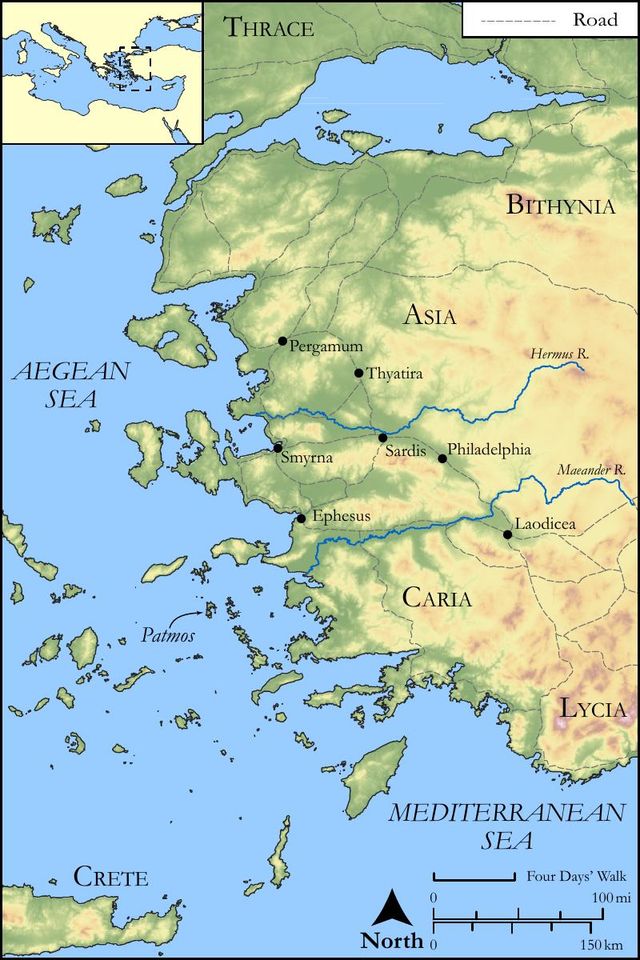

Study this verse
Public-domain commentary
Matthew Henry
From his Commentary on the Whole Bible. Henry comments on passages, not single verses — this entry covers Revelation 13:1–10.
We have here an account of the rise, figure, and progress of the first beast; and observe, 1. From what situation the apostle saw this monster. He seemed to himself to stand upon the sea-shore, though it is probable he was still in a rapture; but he took himself to be in the island Patmos, but whether in the body or out of the body he could not tell. 2. Whence this beast came - out of the sea; and yet, by the description of it, it would seem more likely to be a land-monster; but the more monstrous every thing about it was the more proper an emblem it would be to set forth the mystery of iniquity and tyranny. 3. What was the form and shape of this beast. It was for the most part like a leopard, but its feet were like the feet of a bear and its mouth as the mouth of a lion; it had seven heads, and ten horns, and upon its heads the name of blasphemy: the most horrid and hideous monster! In some part of this description here seems to be an allusion to Daniel's vision of the four beasts, which represented the four monarchies, Dan 7:1-3, etc. One of these beasts was like a lion, another like a bear, and another like a leopard; this beast was a sort of composition of those three, with the fierceness, strength, and swiftness, of them all; the seven heads and the ten horns seem to design its several powers; the ten crowns, its tributary princes; the word blasphemy on its forehead proclaims its direct enmity and opposition to the glory of God, by promoting idolatry. 4. The source and spring of his authority - the dragon; he gave him his power, and seat, and great authority. He was set up by the devil, and supported by him to do his work and promote his interest; and the devil lent him all the assistance he could. 5. A dangerous wound given him, and yet unexpectedly healed, Rev 13:3. Some think that by this wounded head we are to understand the abolishing of pagan idolatry; and by the healing of the wound the introducing of the popish idolatry, the same in substance with the former, only in a new dress, and which as effectually answers the devil's design as that did. 6. The honour and worship paid to this infernal monster: All the world wondered after the beast; they all admired his power, and policy, and success, and they worshipped the dragon that gave power to the beast, and they worshipped the beast; they paid honour and subjection to the devil and his instruments, and thought there was no power able to withstand them: so great were the darkness, degeneracy, and madness of the world! 7. How he exercised his infernal power and policy: He had a mouth, speaking great things, and blasphemies; he blasphemed God, the name of God, the tabernacle of God, and all those that dwell in heaven; and he made war with the saints, and overcame them, and gained a sort of universal empire in the world. His malice was principally levelled at the God of heaven, and his heavenly attendants - at God, in making images of him that is invisible, and in worshipping them; - at the tabernacle of God, that is, say some, at the human nature of the Lord Jesus Christ, in which God dwells as in a tabernacle; this is dishonoured by their doctrine of transubstantiation, which will not suffer his body to be a true body, and will put it into the power of every priest to prepare a body for Christ; - and against those that dwell in heaven, the glorified saints, by putting them into the place of the pagan demons, and praying to them, which they are so far from being pleased with that they truly judge themselves wronged and dishonoured by it. Thus the malice of the devil shows itself against heaven and the blessed inhabitants of heaven. These are above the reach of his power. All he can do is to blaspheme them; but the saints on earth are more exposed to his cruelty, and he sometimes is permitted to triumph over them and trample upon them. 8. The limitation of the devil's power and success, and that both as to time and persons. He is limited in point of time; his reign is to continue forty-and-two months (Rev 13:5), suitable to the other prophetical characters of the reign of antichrist. He is also limited as to the persons and people that he shall entirely subject his will and power; it will be only those whose names are not written in the Lamb's book of life. Christ had a chosen remnant, redeemed by his blood, recorded in his book, sealed by his Spirit; and though the devil and antichrist might overcome their bodily strength, and take away their natural life, they could never conquer their souls, nor prevail with them to forsake their Saviour and revolt to his enemies. 9. Here is a demand of attention to what is here discovered of the great sufferings and troubles of the church, and an assurance given that when God has accomplished his work on mount Zion, his refining work, then he will turn his hand against the enemies of his people, and those who have killed with the sword shall themselves fall by the sword (Rev 13:10), and those who led the people of God into captivity shall themselves be made captives. Here now is that which will be proper exercise for the patience and faith of the saints - patience under the prospect of such great sufferings, and faith in the prospect of so glorious a deliverance.
Historical interpretation
Eight Centuries of Reception
9 surviving comments on this verse. Each one is dated, so this reads as a timeline rather than a list.
Select a marker to jump to its quote. Markers stagger vertically where authors wrote within a few decades of each other.
Since then in this world some persons come to the light, and by faith unite themselves to the light and by faith unite themselves with God, but others shun the light and separate themselves from God, the Word of God comes preparing a fit habitation for both. For those indeed who are in the light, that they may derive enjoyment from it and from the good things contained in it; but for those in darkness, that they may partake in its calamities.… For this reason the apostle says, “Because they did not receive the love of God, that they might be saved, therefore God shall also send them the operation of error, that they may believe a lie, that they all may be judged who have not believed the truth, but consented to unrighteousness.” For when [antichrist] arrives, and of his own accord concentrates in his own person the apostasy, and accomplishes whatever he shall do according to his own will and choice, sitting also in the temple of God, his dupes will adore him as the Christ. Therefore he shall deservedly “be cast into the lake of fire,” [and this will happen according to divine appointment], God by his prescience, foreseeing all this at the proper time sending such a man, “that they may believe a lie, that they all may be judged who did not believe the truth, but consented to unrighteousness.”
"And I saw a beast rising up from the sea, like unto a leopard." This signifies the kingdom of that time of Antichrist, and the people mingled with the variety of nations.
Here a “sea” is mentioned, which above was called a “bottomless pit” from which this beast would ascend. In both instances a people is indicated. Indeed, he sees a people arising from a people, namely, a beast coming forth from a people. Normally “beast” is a designation of that which is hostile to the Lamb, but in a narrative one must determine from passage to passage what aspect of the beast is signified. For sometimes the devil is the beast, elsewhere the beast is his body or one of the heads of that beast such as the one which rises up although he seemed wounded unto death, which is a false imitation of the true faith. In other passages the beast might signify only the leaders. In this present passage the beast that rises from the sea refers to the body of the devil, which has ten horns and seven heads and diadems upon its horns and a blasphemous name upon its heads. And rightly is he said to be named with a name of blasphemy, since he desires to be regarded as God.
“I saw a beast rising out of the sea,” that is, out of an evil people. That he was “rising out” means that he was coming into existence, even as the blooming flower comes forth from the root of Jesse. In the beast coming forth from the sea he signifies all impious who are the body of the devil.
Some have interpreted this beast to be a certain power, a leader of the other demons, who is second to Satan, and that after this beast the antichrist arises from the earth. However, according to holy Methodius and holy Hippolytus and others this beast is to be interpreted as the antichrist who comes from the tumultuous and rough sea of this life. The ten horns with the diadems and the seven heads signify the unity that the devil has with him—for these characteristics were interpreted above as also belonging to him. The ten horns and seven heads also signify the division of the earthly government at the end of time into ten, and the earthly government corresponds to this world, which is calculated as consisting of seven days and is divided into seven successive kingdoms. For this reason, Satan, who operates in him, is called “the ruler of this age.” “A blasphemous name is upon its heads” clearly refers to his supporters. For from the beginning these never ceased from blaspheming Christ until the accession of Constantine. But after him, [the emperors] Julian and Valens again slandered against Christ.
Having seven heads and ten horns, etc. He shows that the seven heads are the same as the ten horns. For he had said that the dragon carried seven diadems on its seven heads; now he says the beast carries ten diadems on its ten horns. For seven and ten are the same as receiving a sevenfold in this age. And another evangelist says a hundredfold (Matthew XIX).
And I saw a beast rising up out of the sea. The beast has various interpretations according to the locations. Here, it signifies the body of the devil arising from the people of the impious. This sea is understood to be the abyss mentioned above. Hence, the dragon is called the king of all that are in the waters, and whose heads are broken in the sea, according to David.
And on its heads names of blasphemy. For they call their kings gods, both dead and supposedly translated to heaven among the gods, and also on earth as Augusti, which is a name of divinity as they will it. Elsewhere, he says the whole beast is full of names of blasphemy.
In the vision before this, the prophetic evangelist saw a sign in heaven, and behold he says a red Dragon (Rev. 12:3). Now he tells us he saw coming up out of the sea a beast like a leopard. Then in the vision that follows he again sees another beast rising out of the earth (Rev. 13:11), having two horns like a lamb. So, therefore, he saw three beasts in all: the first in heaven, the second out of the sea, and the third out of the earth. But the first and the third are apparent to all; for the first is the ancient evil Dragon, the apostate and adversary of God the Almighty, Satan, and the third is the Antichrist. This middle beast, which now lies before us for observation, what is it? I think it comes after the apostate Dragon, Satan, and it holds the leading position among the rest of the demons; for many fell together. And it is clear from that passage that the divine Scripture declares the ruler of all the demons has been bound to the sea and to Tartarus, as was shown above (Rev. 9:14); perhaps metaphorically thus naming the commotion and disturbance that accompany them, indicating from what things and to where they have fallen, and that they are reserved for the judgment of the great day according to what is written (Jude 6).
For if this were not so, but it was perceptible in the sea and in Tartarus, how is it that before this it is recorded in the account that, having devised many schemes, he acted against the Lord and against his mother? Except that according to the literal historical sense, which must not be disregarded even itself, he has been assigned to Tartarus and the abyss.
This beast, then, is the second one. The one now before us has been introduced in the book of Job, engaging in dialogue with God, accusing Job, subjecting him to countless trials, yet saying that he has "walked before the face of heaven." (Job 1:7) And not only does the book of Job record him, but the Lord has made mention of him to John when addressing the Jews: "You are of your father the Devil, and you desire to do the desires of your father." (Jn. 8:44) That one was a murderer from the beginning, and in the truth he did not stand, because there is no truth in him. When he speaks a lie, he speaks from his own, for he is a liar and the father of it, the one who is now presented to us for viewing, the apostate Dragon, become their leader and ringleader of the revolt; just as the holy Abraham is proclaimed father of nations, having been made beforehand the source of their faith according to what was said to him, "I have made you the father of many nations." (Gen. 17:5) With these matters therefore clarified according to my view, let us return to the passage in question.
He says, I saw a beast rising out of the sea, having ten horns and seven heads, and on his horns ten crowns. He sees him coming up from the sea; for his rise and, as it were, his elevation are from the disturbed and unstable life of men, who have chosen him as their tyrant; and the ten horns plainly indicate to him a great dominion, just as the seven heads signify certain ploys and principles of deceit and constructions; for the numbers ten and seven are perfect numbers.
And there were crowns about his horns, showing him as ruler risen up against mankind, because we through deceit had voluntarily delivered ourselves to him.
And upon his head he says names of blasphemy. Properly said, upon his head; for he raves to himself and, as his own head, mocking God, stealing reverence from God and assigning it to himself.
Continue studying Revelation 13:1 across the web’s major study libraries — every link below opens this exact verse, chapter, or book on the destination site.
Read & Compare
 BibleGatewayThis verse in more than 200 translations and 70 languages.
 Bible.comThe YouVersion reader — hundreds of translations, reading plans, and highlights.
 ESV.orgCrossway's official English Standard Version reader.
 NET BibleThe NET translation with 60,000+ translators' notes on every rendering decision.
 STEP BibleTyndale House's free study tool — original text, vocabulary, and scholarly resources.
 BibliaLogos Bible Software's free web reader.
 USCCBThe New American Bible (Revised Edition) with the U.S. bishops' study notes.
Commentaries
 BibleHub CommentariesDozens of classic commentaries on this verse, gathered on one page.
 StudyLightMore than 100 commentary sets — the largest collection on the web.
 BibleRefPlain-English commentary on what this verse means, verse by verse.
 Enduring WordDavid Guzik's free commentary on this chapter, widely used by Bible teachers.
 Bible Study ToolsVerse commentary alongside Greek and Hebrew study aids.
Original Language & Research
- BibleHub InterlinearThe verse word by word — original language, transliteration, and English.
- BibleHub LexiconEvery word's original-language definition and Strong's entry.
 Blue Letter BibleDeep-study tools — Strong's numbers, concordance, and word studies.
 CNTR CollationThe earliest Greek manuscripts of this verse, collated letter by letter.
Sermons, Hymns & Audio


TrulyRandomVerse is not affiliated with these sites and doesn’t control their content. They’re linked because they’re genuinely useful.
Summary
Revelation 13:1 introduces a pivotal and terrifying vision of a composite beast emerging from the sea, a powerful symbol of an oppressive, anti-God political and spiritual force. John's detailed description of its seven heads, ten horns, and ten crowns, along with the "name of blasphemy" upon its heads, immediately signals its immense worldly authority and its inherent rebellion against the divine. This passage sets the stage for the beast's subsequent actions, revealing its role as a primary agent of evil in the eschatological drama, empowered by the dragon and demanding universal allegiance.
Context
ShowHideLiterary Context
Revelation 13:1 follows directly from the cosmic conflict depicted in Revelation 12. In the preceding chapter, Satan, symbolized as the great red dragon, is cast down to earth and, filled with fury, pursues the woman (representing God's people) and her offspring. The dragon's inability to fully conquer God's people on earth leads directly to his empowerment of the beast, which becomes his primary instrument of persecution and deception. The phrase "And I stood upon the sand of the sea" (though some manuscripts read "he stood," referring to the dragon) serves as a dramatic transition, positioning the observer (John) or the dragon at the threshold from which this new, formidable antagonist arises, signifying a new phase in the spiritual warfare. This beast is the dragon's earthly proxy, embodying his power and blasphemous agenda.
Historical & Cultural Context
The imagery of beasts emerging from the sea is deeply rooted in Old Testament apocalyptic literature, particularly Daniel 7. For John's original audience, likely facing persecution under the Roman Empire, the "beast" would have resonated with the imperial cult and the demand for emperor worship. Rome, with its vast dominion and claims of divine authority for its emperors, embodied a power that often blasphemed God by usurping His prerogatives. The "sea" (Greek: thalassa) in ancient thought often represented the chaotic, restless Gentile nations, or the abyss from which evil forces could emerge. This vision would have provided a framework for understanding the nature of oppressive worldly powers and their inherent opposition to God, offering both warning and encouragement to steadfast believers.
Key Themes
ShowHideThis verse introduces several crucial themes that permeate the book of Revelation. Foremost is the theme of Satanic Empowerment and Earthly Opposition, as the beast clearly operates under the dragon's authority, serving as a political and religious force that opposes God and His people. The description of the beast's characteristics, especially the "seven heads and ten horns," contributes to the theme of Symbolic Representation of Worldly Power, which is further elaborated in Revelation 17:9-12. The "ten crowns" on the horns emphasize the Usurped Authority and Dominion that this beastly power wields over earthly kingdoms. Finally, the "name of blasphemy" highlights the central theme of Rebellion Against God and Idolatry, signifying the beast's inherent nature to defy God, claim divine honor for itself, and lead humanity into false worship, a stark contrast to the worship of the Lamb of God.
Exposition and Analysis
ShowHideKey Word Analysis
ShowHideThis word refers to a dangerous or wild animal. Its use here emphasizes the fierce, untamed, and destructive nature of the power represented by this entity. It is not merely a political power but one that is savage, predatory, and hostile to humanity and God.
This term denotes the sea. In apocalyptic literature, the "sea" often symbolizes the chaotic masses of humanity, the restless nations, or the abyss from which evil originates. The beast's emergence from the sea thus signifies its origin from the tumultuous, godless world of humanity, rather than from a divine source.
This word means vilification, especially against God. It signifies impious speech, slander, or speaking evil against God or sacred things. The "name of blasphemy" on the beast's heads indicates that its very identity, authority, and actions are characterized by open defiance and contempt for God, claiming divine prerogatives for itself or its human leaders.
Verse Breakdown
ShowHide"And I stood upon the sand of the sea"
This sets the scene for John's vision, placing him at the threshold between the stable land and the tumultuous sea. It highlights his role as an observer of these unfolding cosmic events, emphasizing the dramatic nature of what is about to appear.
"and saw a beast rise up out of the sea"
This is the central action of the verse. The beast's emergence from the "sea" signifies its origin from the chaotic, ungodly nations of the world, rather than from a divine or heavenly source. Its "rising up" indicates its ascent to power and prominence.
"having seven heads and ten horns"
These are key symbolic features. The "seven heads" typically represent complete power, a series of ruling entities (kingdoms or kings), or perhaps a comprehensive authority. The "ten horns" symbolize ten kings or kingdoms, indicating a fragmented yet unified power structure that will wield authority. This imagery directly echoes the prophetic visions in Daniel 7.
"and upon his horns ten crowns"
The presence of "ten crowns" on the horns, rather than the heads, emphasizes that the royal authority and dominion are granted to these ten entities or kings. This signifies their temporal power and their role in the beast's overall dominion.
"and upon his heads the name of blasphemy"
This is the most damning characteristic. The "name of blasphemy" on the heads signifies that the very essence, identity, and authority of this beastly power are fundamentally opposed to God. It claims divine prerogatives, speaks contemptuously of God, or promotes the worship of itself or its leaders in defiance of the Creator, embodying a direct affront to God's holiness and sovereignty.
Literary Devices
ShowHideRevelation 13:1 is rich in Symbolism, a hallmark of apocalyptic literature. The "beast" itself is a complex symbol, representing a formidable political and spiritual power. Its emergence "out of the sea" symbolizes its origin from the chaotic, ungodly nations of the world. The "seven heads" and "ten horns" are potent symbols of comprehensive and fragmented authority, respectively, while the "ten crowns" denote royal dominion. The "name of blasphemy" vividly symbolizes the beast's inherent anti-God nature and its usurpation of divine honor. The passage also employs Allusion, specifically to the visions of Daniel, particularly Daniel 7:3-8, where various beasts represent successive empires. This intertextual connection enriches the meaning, drawing on established prophetic understanding. Finally, the description of the beast, though representing a political entity, is imbued with characteristics of a living, malevolent entity, demonstrating Personification, giving it agency and a distinct, evil personality.
Theological and Thematic Connections
ShowHideRevelation 13:1 introduces a profound theological statement about the nature of evil and its manifestation in the world. It reveals that behind oppressive earthly powers lies a spiritual force, ultimately orchestrated by Satan, that seeks to usurp God's authority and divert worship from the Creator to the creature. The beast's characteristics underscore the pervasive nature of sin and rebellion, which not only corrupt human hearts but also permeate political systems and cultural ideologies. This passage serves as a stark reminder that God's people will face formidable opposition from forces that openly defy Him and demand ultimate allegiance, setting the stage for the ultimate cosmic battle between God's kingdom and the kingdom of darkness. It highlights the importance of discerning the spiritual realities behind worldly powers and remaining steadfast in allegiance to Christ, even when faced with overwhelming pressure to conform to blasphemous systems.
Reflection and Application
ShowHideRevelation 13:1 calls believers to a profound level of spiritual discernment and unwavering loyalty to Christ in a world often hostile to God. The beast's rise from the "sea" reminds us that oppressive, anti-God systems can emerge from the very fabric of human society, whether through political structures, economic systems, or cultural ideologies that seek to displace God. We are challenged to recognize the "name of blasphemy" not just in overt persecution but also in subtle attempts to redefine truth, morality, or ultimate authority apart from God. This passage encourages us to critically evaluate the claims of worldly powers and to resist any demand for allegiance that would compromise our devotion to the one true God. In an age where information is abundant and ideologies compete for our loyalty, the vision of the beast compels us to anchor our faith firmly in Christ, understanding that His kingdom is not of this world, and His victory over all opposing powers is assured. Our application involves prayerful vigilance, courageous witness, and steadfast refusal to participate in or endorse systems that blaspheme God, even if it means facing societal pressure or opposition.
Questions for Reflection
ShowHideFAQ
ShowHideWhat does the "beast" in Revelation 13:1 symbolize?
ShowHideThe "beast" in Revelation 13:1 is a complex symbol representing a powerful, oppressive, and anti-God political and spiritual force that emerges from the tumultuous nations of the world. It is empowered by Satan (the dragon in Revelation 12) and embodies the spirit of rebellion against God, demanding worship for itself and persecuting God's people. While interpretations vary, it generally points to a final, comprehensive system of world authority that directly opposes Christ.
What do the "seven heads and ten horns" signify?
ShowHideThe "seven heads and ten horns" are rich in symbolism, drawing heavily from Old Testament prophecy, particularly Daniel 7. The "seven heads" can symbolize either a succession of world empires, a complete or comprehensive form of power, or specific kings/kingdoms as further explained in Revelation 17:9-10. The "ten horns" typically represent ten kings or kingdoms that will arise, signifying a fragmented yet unified power structure that will wield authority alongside or under the beast. The "ten crowns" on the horns indicate that these ten entities possess royal authority and dominion.
What is the significance of "the name of blasphemy" upon its heads?
ShowHideThe "name of blasphemy" upon the beast's heads is a crucial characteristic, indicating that the very essence and identity of this power are inherently opposed to God. It signifies that this entity, whether a political system, a leader, or an ideology, will openly defy God, claim divine prerogatives for itself, or promote the worship of itself rather than the Creator. This directly contrasts with the worship of God and the Lamb, highlighting the beast's ultimate rebellion and its attempt to usurp God's rightful place in the world.
Christ-Centered Fulfillment
ShowHideRevelation 13:1, with its depiction of a blasphemous beast rising to power, ultimately points to the supreme authority and ultimate victory of Jesus Christ. The beast's counterfeit authority, symbolized by its crowns and dominion, stands in stark contrast to the true and eternal kingship of Christ, who is the King of kings and Lord of lords. While the beast emerges from the chaotic "sea" of humanity, Christ's origin is heavenly, as the Word made flesh, eternally seated at the right hand of God. The beast's "name of blasphemy" directly opposes Christ, who is the image of the invisible God and the very radiance of God's glory. The beast seeks worship for itself, but only Christ is truly worthy, as the Lamb who was slain. This passage, therefore, underscores the necessity of discerning between the fleeting, blasphemous powers of this world and the eternal, righteous reign of Christ, upon whom all true authority rests and to whom all true worship belongs. Ultimately, the beast and its followers will be cast into the lake of fire, while Christ's kingdom will endure forever, a testament to His sovereign power and final triumph over all evil.