


Revelation 12:6
Bible text: King James Version (1769 Blayney text) · Public domain
Bible text: King James Version with Strong's numbers · Public domain
Bible text: Berean Standard Bible · Public domain
Bible text: American Standard Version (1901) · Public domain
Bible text: World English Bible, Messianic edition · Public domain
Bible text: Geneva Bible (1599) · Public domain
Bible text: Young's Literal Translation · Public domain
- καὶkaiAndG2532CONJConjunction
- ἡhētheG3588T-NSFDefinite article Nominative Singular Feminine
- γυνὴgunēwomanG1135N-NSFNoun Nominative Singular Feminine
- ἔφυγενephugenfledG5343V-2AAI-3SVerb 2nd Aorist Active Indicative 3rd Singular
- εἰςeisintoG1519PREPPreposition
- τὴνtēntheG3588T-ASFDefinite article Accusative Singular Feminine
- ἔρημονerēmonwildernessG2048A-ASFAdjective Accusative Singular Feminine
- ὅπουhopouwhereG3699PREPPreposition
- ἔχειecheishe hasG2192V-PAI-3SVerb Present Active Indicative 3rd Singular
- ἐκεῖekeithereG1563ADVAdverb
- τόπονtopona placeG5117N-ASMNoun Accusative Singular Masculine
- ἡτοιμασμένονhētoimasmenonpreparedG2090V-RPP-ASMVerb Perfect Passive Participle Accusative Singular Masculine
- ἀπὸapobyG575PREPPreposition
- τοῦtou<the>G3588T-GSMDefinite article Genitive Singular Masculine
- θεοῦtheouGodG2316N-GSM-TNoun Genitive Singular Masculine Title
- ἵναinaso thatG2443CONJConjunction
- ἐκεῖekeithereG1563ADVAdverb
- τρέφωσινtrephōsinthey may feedG5142V-PAS-3PVerb Present Active Subjunctive 3rd Plural
- αὐτὴνautēnherG846P-ASFPersonal pronoun Accusative Singular Feminine
- ἡμέραςhēmerasdaysG2250N-APFNoun Accusative Plural Feminine
- χιλίαςchiliasone thousandG5507A-APFAdjective Accusative Plural Feminine
- διακοσίαςdiakosiastwo hundredG1250A-APFAdjective Accusative Plural Feminine
- ἑξήκονταhexēkontasixtyG1835A-NUIAdjective
English is a literal word-by-word gloss of the Greek, not the KJV's wording. Why?
This is the original text the KJV's translators worked from — each Greek word with its own literal English meaning in this verse, prepared by scholars at Tyndale House, Cambridge. The KJV translates whole sentences, not word by word, so its wording differs: one Greek word can become several English words, and the KJV may choose “charity” where the gloss reads “love”. Both are faithful — they answer different questions. For the KJV's own rendering, switch to the KJV text.
Details
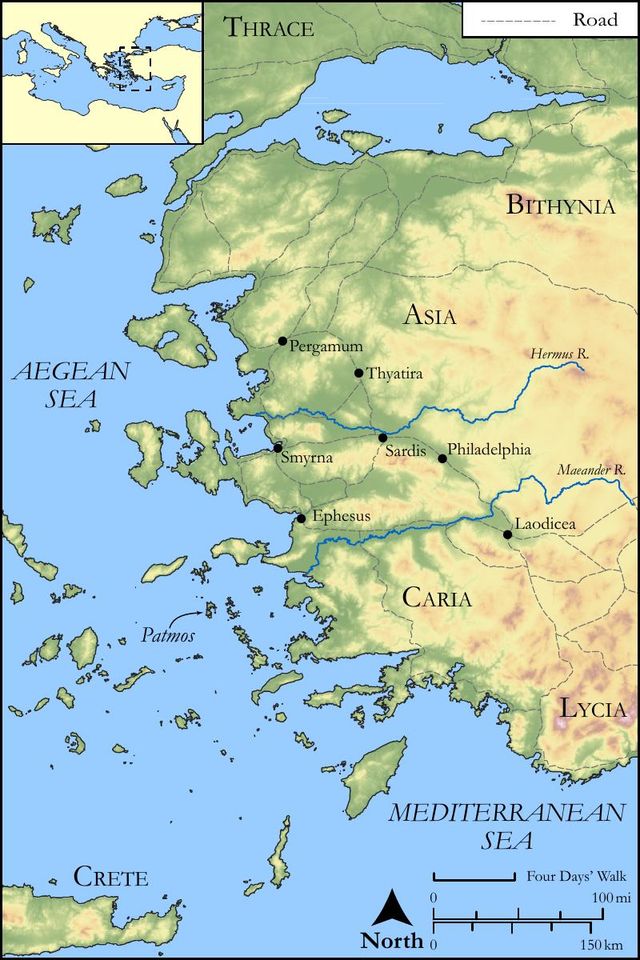
See on the biblical-era maps

Study this verse
Public-domain commentary
Matthew Henry
From his Commentary on the Whole Bible. Henry comments on passages, not single verses — this entry covers Revelation 12:1–11. His four-level outline is real structure in the source text, so it is rendered as structure.
Here we see that early prophecy eminently fulfilled in which God said he would put enmity between the seed of the woman and the seed of the serpent, Gen 3:15. You will observe,
I.The attempts of Satan and his agents to prevent the increase of the church, by devouring her offspring as soon as it was born; of this we have a very lively description in the most proper images.
1.We see how the church is represented in this vision.
(1.)As a woman, the weaker part of the world, but the spouse of Christ, and the mother of the saints.
(2.)As clothed with the sun, the imputed righteousness of the Lord Jesus Christ. Having put on Christ, who is the Sun of righteousness, she, by her relation to Christ, is invested with honourable rights and privileges, and shines in his rays.
(3.)As having the moon under her feet (that is, the world); she stands upon it, but lives above it; her heart and hope are not set upon sublunary things, but on the things that are in heaven, where her head is.
(4.)As having on her head a crown of twelve stars, that is, the doctrine of the gospel preached by the twelve apostles, which is a crown of glory to all true believers.
(5.)As in travail, crying out, and pained to be delivered. She was pregnant, and now in pain to bring forth a holy progeny to Christ, desirous that what was begun in the conviction of sinners might end in their conversion, that when the children were brought to the birth there might be strength to bring forth, and that she might see of the travail of her soul.
2.How the grand enemy of the church is represented.
(1.)As a great red dragon - a dragon for strength and terror - a red dragon for fierceness and cruelty.
(2.)As having seven heads, that is, placed on seven hills, as Rome was; and therefore it is probable that pagan Rome is here meant.
(3.)As having ten horns, divided into ten provinces, as the Roman empire was by Augustus Caesar.
(4.)As having seven crowns upon his head, which is afterwards expounded to be seven kings, Rev 17:10.
(5.)As drawing with his tail a third part of the stars in heaven, and casting them down to the earth, turning the ministers and professors of the Christian religion out of their places and privileges and making them as weak and useless as he could.
(6.)As standing before the woman, to devour her child as soon as it should be born, very vigilant to crush the Christian religion in its birth and entirely to prevent the growth and continuance of it in the world.
II.The unsuccessfulness of these attempts against the church; for,
1.She was safely delivered of a man-child (Rev 12:5), by which some understand Christ, others Constantine, but others, with greater propriety, a race of true believers, strong and united, resembling Christ, and designed, under him, to rule the nations with a rod of iron; that is, to judge the world by their doctrine and lives now, and as assessors with Christ at the great day.
2.Care was taken of this child: it was caught up to God, and to his throne; that is, taken into his special, powerful, and immediate protection. The Christian religion has been from its infancy the special care of the great God and our Saviour Jesus Christ.
3.Care was taken of the mother as well as of the child, Rev 12:6. She fled into the wilderness, a place prepared both for her safety and her sustenance. The church was in an obscure state, dispersed; and this proved her security, through the care of divine Providence. This her obscure and private state was for a limited time, not to continue always.
III.The attempts of the dragon not only proved unsuccessful against the church, but fatal to his own interests; for, upon his endeavour to devour the man-child, he engaged all the powers of heaven against him (Rev 12:7): There was war in heaven. Heaven will espouse the quarrel of the church. Here observe,
1.The seat of this war - in heaven, in the church, which is the kingdom of heaven on earth, under the care of heaven and in the same interest.
2.The parties - Michael and his angels on one side, and the dragon and his angels on the other: Christ, the great Angel of the covenant, and his faithful followers; and Satan and all his instruments. This latter party would be much superior in number and outward strength to the other; but the strength of the church lies in having the Lord Jesus for the captain of their salvation.
3.The success of the battle: The dragon and his angels fought and prevailed not; there was a great struggle on both sides, but the victory fell to Christ and his church, and the dragon and his angels were not only conquered, but cast out; the pagan idolatry, which was a worshipping of devils, was extirpated out of the empire in the time of Constantine.
4.The triumphant song that was composed and used on this occasion, Rev 12:10, Rev 12:11. Here observe,
(1.)How the conqueror is adored: Now have come salvation, strength, and the kingdom of our God, and the power of his Christ. Now God has shown himself to be a mighty God; now Christ has shown himself to be a strong and mighty Saviour; his own arm has brought salvation, and now his kingdom will be greatly enlarged and established. The salvation and strength of the church are all to be ascribed to the king and head of the church.
(2.)How the conquered enemy is described.
[1.]By his malice; he was the accuser of the brethren, and accused them before their God night and day; he appeared before God as an adversary to the church, continually bringing in indictments and accusations against them, whether true or false; thus he accused Job, and thus he accused Joshua the high priest, Zac 3:1. Though he hates the presence of God, yet he is willing to appear there to accuse the people of God. Let us therefore take heed that we give him no cause of accusation against us; and that, when we have sinned, we presently go in before the Lord, and accuse and condemn ourselves, and commit our cause to Christ as our Advocate.
[2.]By his disappointment and defeat: he and all his accusations are cast out, the indictments quashed, and the accuser turned out of the court with just indignation.
(3.)How the victory was gained. The servants of God overcame Satan,
[1.]By the blood of the Lamb, as the meritorious cause. Christ by dying destroyed him that hath the power of death, that is, the devil.
[2.]By the word of their testimony, as the great instrument of war, the sword of the Spirit, which is the word of God, - by a resolute powerful preaching of the everlasting gospel, which is mighty, through God, to pull down strongholds, - and by their courage and patience in sufferings; they loved not their lives unto the death, when the love of life stood in competition with their loyalty to Christ; they loved not their lives so well but they could give them up to death, could lay them down in Christ's cause; their love to their own lives was overcome by stronger affections of another nature; and this their courage and zeal helped to confound their enemies, to convince many of the spectators, to confirm the souls of the faithful, and so contributed greatly to this victory.
Historical interpretation
Seven Centuries of Reception
9 surviving comments on this verse. Each one is dated, so this reads as a timeline rather than a list.
Select a marker to jump to its quote. Markers stagger vertically where authors wrote within a few decades of each other.
"But the woman fled into the wilderness, and there were given to her two great eagle's wings." The aid of the great eagle's wings-to wit, the gift of prophets-was given to that Catholic Church, whence in the last times a hundred and forty-four thousands of men should believe on the preaching of Elias; but, moreover, he here says that the rest of the people should be found alive on the coming of the Lord. And the Lord says in the Gospel: "Then let them which are in Judea flee to the mountains; " that is, as many as should be gathered together in Judea, let them go to that place which they have ready, and let them be supported there for three years and six months from the presence of the devil.
“The woman fled into the wilderness, where she has a place prepared by God where she might be nourished.” … It says “into the wilderness,” for in the apostles the church has received authority to walk among scorpions, serpents and every power of Satan. The Lord said to the apostles, “Behold, I have given you authority to tread upon serpents and scorpions and over all the power of the enemy.” As a figure of the whole church, the people of Israel were fed and led in the desert among the serpents of this world. “All these things happened as a figure for us upon whom the ends of the ages have come.” Furthermore, as a figure of the church sings and says, “[Those] whom he has redeemed from the hands of their enemies he has gathered from the lands, from the east and from the west, from the north and from the sea. They wandered in the desert and dry places.” To be sure, he is describing Israel in the wilderness, for she was not gathered from those places mentioned but from the stock of Abraham, who was in Mesopotamia.
We understand the wilderness to be this world where Christ feeds and leads the church unto the end. In this world the church herself tramples under foot through the help of Christ haughty and impious persons as though they were scorpions and vipers and all the power of Satan.
When the devil through the antichrist in whom he works arrays himself for battle against the church, those in the church who are elect and preeminent will spit upon the tumults of life and the desires of the world and flee into that desert devoid of every evil, that life which bears every virtue, as Methodius says, and these escape the assaults of people and demons who war against them. It is likely that the physical desert will also save those who flee from the plot of the apostate to the mountains and caves and holes in the earth, as was recently the case with the witnesses, for in the three and a half years are reckoned the 1, days during which the apostasy will rage. During this time the great judge will not think to tempt us beyond what we are able to bear, but freeing us will present to us a strong mind free from any weakness against the onslaughts upon it. And so we, fighting against the principalities and powers of darkness, may be decorated with the crown of righteousness and receive the rewards of victory. For to him who through those who are weak puts to flight the mighty principalities of the air, it is proper to ascribe victory and might, together with the Father and the life-giving Spirit forever and ever. Amen.
And the woman fled into the wilderness. The Church, living under the hope of eternal things, rejoices in the pilgrimage of the present wilderness, having received the power to tread on serpents and scorpions, and over all the power of the red dragon, like the Israelite people, who, fed with heavenly bread in the wilderness, by the sight of the bronze serpent, conquered the fiery serpents.
Where she has a place prepared by God. Be to me, he says, a God of protection, and a place of refuge to save me.
That they should feed her there one thousand two hundred and sixty days. This number of days, which makes three and a half years, encompasses all times of Christianity, because Christ, whose body this is, preached for that time in the flesh.
And the woman shall flee into the wilderness, where she hath a place prepared by God, that there they should feed her a thousand two hundred sixty days. The woman's fleeing into the wilderness means the same as her son's being taken up to God; for the Church flees, not in a physical ascent, but in a spiritual one. The wilderness is the secret of the mind; for, in order to escape the serpent's venom, holy men make themselves a desert by contemning all transitory and fleshly desires. Note also that it is the duty of preachers to feed this woman. As for the place where she is fed, it is he to whom it is said, Be thou unto me a protective God, and a place of refuge. [Variant of Ps. 30:3] He is also the food she is fed with, he who says, I am the living bread. [John 6:51] The number of days mentioned here signifies the times of the Antichrist, but while still also including the whole time of this life from the preaching and Passion of Christ. Indeed evangelical preaching was performed by the Lord during the same number of days as it will be finished in the end by the last preachers.
And the woman fled into the wilderness, where God had prepared a place for her, so that there she might be nourished for one thousand two hundred and sixty days. Therefore, was the child saved from the Dragon's plot, while the woman was given over to destruction? Not only that, but she herself was also saved by fleeing into Egypt, which was a deserted place and free from Herod's plotting. And there she is said to have lived and wandered for one thousand two hundred and sixty days, which amount to about three and a half years, with a few days less. For it was probably this length of time that the Mother of God spent in Egypt, until the death of Herod, after which an angel's message again led them back to Judea.
Continue studying Revelation 12:6 across the web’s major study libraries — every link below opens this exact verse, chapter, or book on the destination site.
Read & Compare
 BibleGatewayThis verse in more than 200 translations and 70 languages.
 Bible.comThe YouVersion reader — hundreds of translations, reading plans, and highlights.
 ESV.orgCrossway's official English Standard Version reader.
 NET BibleThe NET translation with 60,000+ translators' notes on every rendering decision.
 STEP BibleTyndale House's free study tool — original text, vocabulary, and scholarly resources.
 BibliaLogos Bible Software's free web reader.
 USCCBThe New American Bible (Revised Edition) with the U.S. bishops' study notes.
Commentaries
 BibleHub CommentariesDozens of classic commentaries on this verse, gathered on one page.
 StudyLightMore than 100 commentary sets — the largest collection on the web.
 BibleRefPlain-English commentary on what this verse means, verse by verse.
 Enduring WordDavid Guzik's free commentary on this chapter, widely used by Bible teachers.
 Bible Study ToolsVerse commentary alongside Greek and Hebrew study aids.
Original Language & Research
- BibleHub InterlinearThe verse word by word — original language, transliteration, and English.
- BibleHub LexiconEvery word's original-language definition and Strong's entry.
 Blue Letter BibleDeep-study tools — Strong's numbers, concordance, and word studies.
 CNTR CollationThe earliest Greek manuscripts of this verse, collated letter by letter.
Sermons, Hymns & Audio


TrulyRandomVerse is not affiliated with these sites and doesn’t control their content. They’re linked because they’re genuinely useful.
Summary
Revelation 12:6 depicts the divine preservation of God's people, symbolized by a woman, who flees into a divinely prepared wilderness refuge to escape the persecution of the dragon, Satan. This flight signifies a period of intense spiritual conflict and vulnerability, during which God faithfully provides sustenance and protection for a specific prophetic duration of 1,260 days, underscoring His sovereign care amidst spiritual warfare.
Context
ShowHideLiterary Context
This verse is a crucial turning point within the dramatic twelfth chapter of Revelation, which presents a struggle between the forces of good and evil. Immediately preceding Revelation 12:6 is the birth of the male child (Christ) from the woman (God's people, likely Israel or the church) and His ascension to God's throne, followed by Satan's failed attempt to devour Him. The subsequent war in heaven, culminating in Satan's expulsion to earth in Revelation 12:9, intensifies the conflict. Upon his defeat in heaven, the dragon directs his wrath toward the woman, making her flight into the wilderness a direct consequence of this battle and a necessary act of divine preservation. The verse sets the stage for the subsequent persecution of the saints and God's continued protection throughout the tribulation period.
Historical & Cultural Context
While Revelation is primarily apocalyptic and symbolic, its imagery draws from Old Testament narratives and Jewish apocalyptic traditions. The "wilderness" often carries significant theological weight, recalling Israel's forty years in the desert where God miraculously provided for them (e.g., manna, water from the rock, as seen in Exodus 16). This historical precedent would have resonated deeply with John's original audience, many of whom were facing persecution under the Roman Empire. The concept of a "place prepared of God" evokes divine sanctuary and protection, similar to how God sheltered His people in times of distress. The numerical period of "a thousand two hundred and threescore days" (1260 days, or 3.5 years) is a specific prophetic timeframe, echoing similar periods in Daniel's prophecies (e.g., "a time, times, and half a time" in Daniel 7:25) and later in Revelation itself (Revelation 11:3). This suggests a divinely appointed, finite period of tribulation and divine care.
Key Themes
ShowHideRevelation 12:6 powerfully contributes to several overarching themes in Revelation and biblical theology. The most prominent is Divine Protection and Providence, showcasing God's unwavering commitment to preserving His chosen people even in the face of overwhelming evil. The "place prepared of God" highlights His active, sovereign involvement in their safety and sustenance. This theme is intricately linked with Spiritual Warfare, as the woman's flight is a direct response to the dragon's relentless persecution, emphasizing the ongoing battle between Satan and God's kingdom. Furthermore, the specific duration of "a thousand two hundred and threescore days" introduces the theme of Prophetic Timeframes, indicating that the period of tribulation and divine preservation is divinely ordained and limited, not an indefinite struggle. Finally, the imagery of the "wilderness" reinforces the theme of Refuge and Sustenance, recalling God's historical care for His people in desolate places, as seen in the narratives of Exodus and Elijah's flight.
Exposition and Analysis
ShowHideKey Word Analysis
ShowHideThis term, G1135, refers to a female, or specifically a wife. In the context of Revelation 12, the "woman" is a profound symbol representing God's people throughout history, encompassing faithful Israel from whom the Messiah came, and by extension, the church. Her identity is tied to the lineage that produced the "male child" (Christ), and her subsequent persecution by the dragon signifies the ongoing spiritual warfare against those who bear witness to God.
Meaning lonesome, waste, or desolate. While literally a barren place, biblically, the "wilderness" is often a place of divine encounter, testing, and miraculous provision. It is a place of isolation from worldly systems and threats, where God can uniquely sustain His people, as He did for Israel after the Exodus. This emphasizes not abandonment, but a specific, divinely appointed sanctuary.
Meaning to prepare or make ready. The passive voice ("prepared of God") highlights that this refuge is not accidental or self-contrived by the woman, but is a deliberate, pre-ordained act of God's sovereign will and foresight. It underscores God's active involvement in the protection and provision for His people, demonstrating His meticulous planning and care.
Verse Breakdown
ShowHide"And the woman fled into the wilderness"
This clause describes the immediate and urgent action taken by the woman in response to the dragon's renewed aggression following his expulsion from heaven. Her "flight" (Greek: pheúgō) signifies an escape from imminent danger, a necessary retreat from direct confrontation. The destination, "the wilderness," is not merely a geographical location but a symbolic place of refuge and divine isolation, where she is removed from the direct reach of her persecutor.
"where she hath a place prepared of God"
This crucial phrase reveals the divine agency behind the woman's refuge. The wilderness is not a random hiding spot but a specific "place" (Greek: tópos) that has been "prepared" (Greek: hetoimázō) by God Himself. This emphasizes God's sovereign foresight and active provision for His people. It signifies that their safety and sustenance are not dependent on human ingenuity or strength, but on God's deliberate and powerful intervention.
"that they should feed her there a thousand two hundred and threescore days"
This final clause specifies the purpose of the divine provision and its duration. The phrase "that they should feed her" (Greek: tréphō) indicates ongoing sustenance and nourishment, ensuring the woman's survival. The "thousand two hundred and threescore days" (1260 days, equivalent to 42 months or 3.5 years) is a precise prophetic timeframe, indicating a divinely appointed, finite period of tribulation during which God's people will be sustained and protected. This period is a recurring motif in apocalyptic literature, signifying a time of intense but limited persecution.
Literary Devices
ShowHideRevelation 12:6 is rich with Symbolism and Apocalyptic Imagery. The "woman" is a profound symbol, often interpreted as representing God's faithful people throughout redemptive history—from Israel, who gave birth to the Messiah, to the Church, which continues His mission. Her "flight into the wilderness" is symbolic of divine protection and refuge from persecution, echoing Old Testament narratives where God preserved His people in desolate places. The "wilderness" itself is a symbol not of abandonment, but of a place of divine provision and intimacy, where God sustains His chosen ones. The "dragon" is an explicit symbol for Satan, the ultimate persecutor. The precise timeframe of "a thousand two hundred and threescore days" is a symbolic prophetic duration, signifying a specific, limited period of tribulation and divine care, rather than an indefinite struggle. This use of symbolic numbers is characteristic of apocalyptic literature, conveying theological truths through numerical patterns. The entire scene is presented through vivid Apocalyptic Imagery, designed to convey spiritual realities and the war in heaven in a dramatic, visionary manner, rather than a literal historical account. This imagery serves to reveal God's ultimate sovereignty and His protection over His people amidst the forces of evil.
Theological and Thematic Connections
ShowHideRevelation 12:6 profoundly underscores the theological truth of God's unwavering faithfulness and sovereign care for His people, even in the midst of intense spiritual warfare and tribulation. The "place prepared of God" highlights divine providence, demonstrating that God actively plans and provides for the protection and sustenance of His chosen ones. This is not a passive observation of their plight but an active intervention, ensuring their survival through a divinely appointed period of persecution. It speaks to the enduring covenant relationship between God and His people, affirming His commitment to preserve a remnant through every trial, ultimately leading to His final victory over evil.
Reflection and Application
ShowHideRevelation 12:6 offers profound comfort and a call to unwavering trust for believers navigating a world often hostile to faith. It assures us that even when the forces of evil seem overwhelming and persecution is intense, God has a sovereign plan for our protection and sustenance. The "wilderness" experience, whether literal or figurative, is not a sign of abandonment but a divinely appointed space where God's provision becomes uniquely evident. This verse encourages us to find our refuge not in worldly systems or our own strength, but in the "place prepared of God," trusting in His faithful care for the duration of our trials. It reminds us that our spiritual battles are part of a larger drama, and that God's ultimate victory guarantees the preservation of His saints. Therefore, we are called to endure with patience, knowing that our times are in His hands and His provision is sure.
Questions for Reflection
ShowHideFAQ
ShowHideWho is the "woman" in Revelation 12:6, and what does her flight symbolize?
ShowHideThe "woman" in Revelation 12 is a symbolic figure, broadly interpreted as representing God's faithful people throughout redemptive history. This includes faithful Israel, from whom the Messiah (the "male child") came, and by extension, the Church, which is the spiritual offspring of Christ. Her flight into the "wilderness" symbolizes a period of divine protection and refuge from the intense persecution of the "dragon" (Satan). It signifies God's sovereign act of preserving a remnant of His people during times of great tribulation, much like He protected Israel in the literal wilderness after their exodus from Egypt, providing for their every need (see Exodus 16). This flight is not an act of defeat but a divinely orchestrated preservation.
Christ-Centered Fulfillment
ShowHideRevelation 12:6, while depicting the protection of God's people, finds its ultimate and most profound fulfillment in the person and work of Jesus Christ. The "male child" born of the woman, who is "caught up to God and to his throne" (Revelation 12:5), is unequivocally Jesus Christ. His ascension signifies His ultimate victory over Satan and His enthronement as King. The subsequent persecution of the woman by the dragon and her divine preservation in the wilderness foreshadows Christ's ongoing work in protecting His Church, His spiritual body, from the relentless attacks of the enemy. Just as God prepared a place and sustained the woman, Christ Himself is the ultimate refuge and provider for His followers. He promised, "I will build my church, and the gates of hell shall not prevail against it" (Matthew 16:18). Through His atoning work on the cross and His resurrection, Christ disarmed principalities and powers (Colossians 2:15), ensuring that though His people may face tribulation in the world, He has overcome the world (John 16:33). The divine feeding of the woman for 1,260 days points to Christ as the "Bread of Life" (John 6:35) who continually nourishes and sustains His Church, providing all that is needed for their perseverance until His glorious return.