


Revelation 13:5
Bible text: King James Version (1769 Blayney text) · Public domain
Bible text: King James Version with Strong's numbers · Public domain
Bible text: Berean Standard Bible · Public domain
Bible text: American Standard Version (1901) · Public domain
Bible text: World English Bible, Messianic edition · Public domain
Bible text: Geneva Bible (1599) · Public domain
Bible text: Young's Literal Translation · Public domain
- καὶkaiAndG2532CONJConjunction
- ἐδόθηedothēwas givenG1325V-API-3SVerb Aorist Passive Indicative 3rd Singular
- αὐτῷautōto itG846P-DSNPersonal pronoun Dative Singular Neuter
- στόμαstomaa mouthG4750N-NSNNoun Nominative Singular Neuter
- λαλοῦνlalounspeakingG2980V-PAP-NSNVerb Present Active Participle Nominative Singular Neuter
- μεγάλαmegalagreat thingsG3173A-APNAdjective Accusative Plural Neuter
- καὶkaiandG2532CONJConjunction
- βλασφημίαςblasphēmiasblasphemiesG988N-APFNoun Accusative Plural Feminine
- καὶkaiandG2532CONJConjunction
- ἐδόθηedothēwas givenG1325V-API-3SVerb Aorist Passive Indicative 3rd Singular
- αὐτῷautōto itG846P-DSNPersonal pronoun Dative Singular Neuter
- ἐξουσίαexousiaauthorityG1849N-NSFNoun Nominative Singular Feminine
- ποιῆσαιpoiēsaito actG4160V-AANVerb Aorist Active Infinitive
- μῆναςmēnasmonthsG3376N-APMNoun Accusative Plural Masculine
- τεσσεράκονταtesserakontafortyG5062A-NUIAdjective
- δύοduotwoG1417A-NUIAdjective
English is a literal word-by-word gloss of the Greek, not the KJV's wording. Why?
This is the original text the KJV's translators worked from — each Greek word with its own literal English meaning in this verse, prepared by scholars at Tyndale House, Cambridge. The KJV translates whole sentences, not word by word, so its wording differs: one Greek word can become several English words, and the KJV may choose “charity” where the gloss reads “love”. Both are faithful — they answer different questions. For the KJV's own rendering, switch to the KJV text.
Details
See on the biblical-era maps
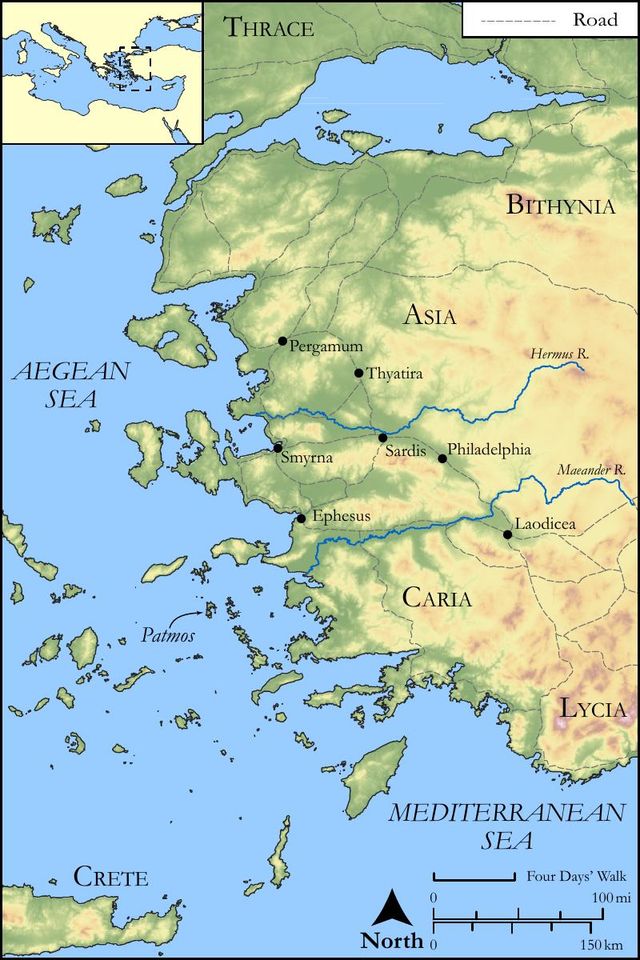

Study this verse
Public-domain commentary
Matthew Henry
From his Commentary on the Whole Bible. Henry comments on passages, not single verses — this entry covers Revelation 13:1–10.
We have here an account of the rise, figure, and progress of the first beast; and observe, 1. From what situation the apostle saw this monster. He seemed to himself to stand upon the sea-shore, though it is probable he was still in a rapture; but he took himself to be in the island Patmos, but whether in the body or out of the body he could not tell. 2. Whence this beast came - out of the sea; and yet, by the description of it, it would seem more likely to be a land-monster; but the more monstrous every thing about it was the more proper an emblem it would be to set forth the mystery of iniquity and tyranny. 3. What was the form and shape of this beast. It was for the most part like a leopard, but its feet were like the feet of a bear and its mouth as the mouth of a lion; it had seven heads, and ten horns, and upon its heads the name of blasphemy: the most horrid and hideous monster! In some part of this description here seems to be an allusion to Daniel's vision of the four beasts, which represented the four monarchies, Dan 7:1-3, etc. One of these beasts was like a lion, another like a bear, and another like a leopard; this beast was a sort of composition of those three, with the fierceness, strength, and swiftness, of them all; the seven heads and the ten horns seem to design its several powers; the ten crowns, its tributary princes; the word blasphemy on its forehead proclaims its direct enmity and opposition to the glory of God, by promoting idolatry. 4. The source and spring of his authority - the dragon; he gave him his power, and seat, and great authority. He was set up by the devil, and supported by him to do his work and promote his interest; and the devil lent him all the assistance he could. 5. A dangerous wound given him, and yet unexpectedly healed, Rev 13:3. Some think that by this wounded head we are to understand the abolishing of pagan idolatry; and by the healing of the wound the introducing of the popish idolatry, the same in substance with the former, only in a new dress, and which as effectually answers the devil's design as that did. 6. The honour and worship paid to this infernal monster: All the world wondered after the beast; they all admired his power, and policy, and success, and they worshipped the dragon that gave power to the beast, and they worshipped the beast; they paid honour and subjection to the devil and his instruments, and thought there was no power able to withstand them: so great were the darkness, degeneracy, and madness of the world! 7. How he exercised his infernal power and policy: He had a mouth, speaking great things, and blasphemies; he blasphemed God, the name of God, the tabernacle of God, and all those that dwell in heaven; and he made war with the saints, and overcame them, and gained a sort of universal empire in the world. His malice was principally levelled at the God of heaven, and his heavenly attendants - at God, in making images of him that is invisible, and in worshipping them; - at the tabernacle of God, that is, say some, at the human nature of the Lord Jesus Christ, in which God dwells as in a tabernacle; this is dishonoured by their doctrine of transubstantiation, which will not suffer his body to be a true body, and will put it into the power of every priest to prepare a body for Christ; - and against those that dwell in heaven, the glorified saints, by putting them into the place of the pagan demons, and praying to them, which they are so far from being pleased with that they truly judge themselves wronged and dishonoured by it. Thus the malice of the devil shows itself against heaven and the blessed inhabitants of heaven. These are above the reach of his power. All he can do is to blaspheme them; but the saints on earth are more exposed to his cruelty, and he sometimes is permitted to triumph over them and trample upon them. 8. The limitation of the devil's power and success, and that both as to time and persons. He is limited in point of time; his reign is to continue forty-and-two months (Rev 13:5), suitable to the other prophetical characters of the reign of antichrist. He is also limited as to the persons and people that he shall entirely subject his will and power; it will be only those whose names are not written in the Lamb's book of life. Christ had a chosen remnant, redeemed by his blood, recorded in his book, sealed by his Spirit; and though the devil and antichrist might overcome their bodily strength, and take away their natural life, they could never conquer their souls, nor prevail with them to forsake their Saviour and revolt to his enemies. 9. Here is a demand of attention to what is here discovered of the great sufferings and troubles of the church, and an assurance given that when God has accomplished his work on mount Zion, his refining work, then he will turn his hand against the enemies of his people, and those who have killed with the sword shall themselves fall by the sword (Rev 13:10), and those who led the people of God into captivity shall themselves be made captives. Here now is that which will be proper exercise for the patience and faith of the saints - patience under the prospect of such great sufferings, and faith in the prospect of so glorious a deliverance.
Historical interpretation
Seven Centuries of Reception
7 surviving comments on this verse. Each one is dated, so this reads as a timeline rather than a list.
Select a marker to jump to its quote. Markers stagger vertically where authors wrote within a few decades of each other.
And in like manner it is revealed to John; "For there was given to him," he says, "a mouth speaking great things and blasphemy; and there was given unto him authority and forty and two months." It is wonderful that both of these things occurred under Valerian; and it is the more remarkable in this case when we consider his previous conduct, for he had been mild and friendly toward the men of God, for none of the emperors before him had treated them so kindly and favorably.
The forty-two months are to be interpreted as the time of the last persecution. “It opened its mouth to blaspheme against God.” It is clear that this refers to those who have left the catholic church, for while earlier they seemed to be within the church as though they held the right faith, in time of persecution they openly blaspheme God with the mouth. [The dwelling of God] is the saints who are contained within the church, which is called “heaven,” for they are the habitation of God.
With these months there is completed the three years and six months, which above were understood to refer to the quality of the present age. However, here the severity of the final persecution is especially foretold. For were one to consider the four familiar directions of the earth and multiply four times the ten sayings of the law, which is the symbol of perfection, one would have forty. Were the performance of the two commandments of love added to this, the number forty-two would be completed. That which is commanded in words achieves no favor if it is not perfected by works. And the church is said to be protected by these [commandments] as though by the wings of an eagle, and she flees from the treachery of the dragon into the wilderness to be nourished there for 1, days, which is equal to the forty-two months, so that the calculation of the same number may not render a useless meaning.… [The beast blasphemed] against God and the church, which dwells in heaven, because “our citizenship is in heaven,” and “now you are not in the flesh.” I think that here the temple might also signify the glorified trophy of the body of Christ against whom the antichrist is said then to blaspheme, when he has dared assign to himself that honor which is especially due to [Christ]. Concerning this the Lord said in the Gospel, “That they might lead astray, if possible, even the elect,” and just earlier, “But for the elect those days will be shortened.”
With the allowance of God, it says, he will have authority for three and a half years to blaspheme against God and to harm the saints. The “dwelling of God” is the dwelling of the Word in the flesh, that is, his incarnation, as well as his repose among the saints, against whom, as also against the holy angels, he will fully direct his blasphemy.
And he was given authority to act for forty-two months, etc. For the first three and a half years, he does not openly blaspheme but acts in the mystery of iniquity, which, after the dissension and the revelation of the man of sin, will be exposed. Then he will say: I am Christ (Matthew XXIV); now, however: Behold, here is Christ, and there (Ibid.). By against God, it signifies against God.
And there was given to him a mouth speaking great things and blasphemies. He exalts himself above all that is called God or that is worshipped (2 Thessalonians II).
He says that all have been defeated and fallen under his feet, and there was given unto him a mouth speaking great things and blasphemy. Was it given by someone? It was given by those deceived and having worshiped him; for to boast arrogantly is pride. For what is greater than this? To say, "I will ascend into heaven; I will set my throne above the stars of heaven." (Isa. 14:13) And just a little after that, he says, "I will be like the Most High," (Isa. 14:14) as Isaiah mocks him, for these are indeed blasphemies against God.
And it is said that power was given unto him to continue for forty-two months. In previous comments, the forty-two months we understood it as a brief time. For all time is brief, even if it seems to be very long, when compared to the unending ages.
Continue studying Revelation 13:5 across the web’s major study libraries — every link below opens this exact verse, chapter, or book on the destination site.
Read & Compare
 BibleGatewayThis verse in more than 200 translations and 70 languages.
 Bible.comThe YouVersion reader — hundreds of translations, reading plans, and highlights.
 ESV.orgCrossway's official English Standard Version reader.
 NET BibleThe NET translation with 60,000+ translators' notes on every rendering decision.
 STEP BibleTyndale House's free study tool — original text, vocabulary, and scholarly resources.
 BibliaLogos Bible Software's free web reader.
 USCCBThe New American Bible (Revised Edition) with the U.S. bishops' study notes.
Commentaries
 BibleHub CommentariesDozens of classic commentaries on this verse, gathered on one page.
 StudyLightMore than 100 commentary sets — the largest collection on the web.
 BibleRefPlain-English commentary on what this verse means, verse by verse.
 Enduring WordDavid Guzik's free commentary on this chapter, widely used by Bible teachers.
 Bible Study ToolsVerse commentary alongside Greek and Hebrew study aids.
Original Language & Research
- BibleHub InterlinearThe verse word by word — original language, transliteration, and English.
- BibleHub LexiconEvery word's original-language definition and Strong's entry.
 Blue Letter BibleDeep-study tools — Strong's numbers, concordance, and word studies.
 CNTR CollationThe earliest Greek manuscripts of this verse, collated letter by letter.
Sermons, Hymns & Audio


TrulyRandomVerse is not affiliated with these sites and doesn’t control their content. They’re linked because they’re genuinely useful.
Summary
Revelation 13:5 vividly portrays the character and limited duration of the beast from the sea, a symbolic entity representing a powerful, blasphemous, and oppressive worldly authority that opposes God and His people. This verse reveals that the beast is granted a voice to utter arrogant boasts and direct insults against God, and is also given a specific, finite period of power lasting forty-two months. It underscores the beast's delegated authority and the divine sovereignty that ultimately controls the extent and duration of even evil's reign.
Context
ShowHideLiterary Context
Revelation 13:5 is situated within John's vision of the two beasts, immediately following the introduction of the beast from the sea in Revelation 13:1-4. This first beast, rising from the sea with multiple heads and horns, embodies a composite of historical oppressive empires, drawing its power and authority from the dragon, identified as Satan in Revelation 12:9. Verse 5 specifically elaborates on the beast's modus operandi and the divinely permitted scope of its activity, serving as a bridge to its actions described in subsequent verses, such as making war on the saints and receiving worship from the earth's inhabitants in Revelation 13:6-8. This verse sets the stage for understanding the beast's destructive nature and the ultimate limitations placed upon it.
Historical & Cultural Context
The Book of Revelation was written during a period of intense persecution for early Christians, likely under the Roman Emperor Domitian, who demanded emperor worship. John's audience would have been intimately familiar with the oppressive nature of imperial power and the blasphemous claims of divinity made by Roman emperors. The imagery of a beast rising from the sea resonates with Old Testament prophetic traditions, particularly those in Daniel 7, where beasts symbolize powerful, often tyrannical, empires. The concept of "blasphemy" would have been understood as a direct affront to God's unique sovereignty, especially in a monotheistic Jewish and Christian context where only God was worthy of worship. The "forty-two months" also carries significant historical and prophetic weight, often linked to periods of tribulation for God's people, such as the persecution under Antiochus IV Epiphanes.
Key Themes
ShowHideRevelation 13:5 contributes significantly to several overarching themes in the book. Firstly, it highlights the theme of Sovereignty and Delegated Authority, emphasizing that even the most formidable evil powers do not operate outside of God's ultimate control; the beast's power is "given unto him," not inherently possessed. Secondly, the verse underscores the theme of Blasphemy and Anti-God Rebellion, depicting the beast's core character as one of open defiance and usurpation of divine prerogatives, a stark contrast to the worship of God described in Revelation 4. Thirdly, it reinforces the theme of Limited Duration of Evil, providing comfort and assurance to persecuted believers that the reign of oppressive forces is temporary and divinely appointed, as seen in other prophetic timeframes like the "1,260 days" in Revelation 11:3 and Revelation 12:6.
Exposition and Analysis
ShowHideKey Word Analysis
ShowHideThis word, used twice in the verse, signifies that the beast's mouth and power are not inherent but are bestowed upon it. It highlights the concept of delegated authority or permission. The beast does not seize this power; it receives it, ultimately from the dragon (Revelation 13:2) and, in a broader sense, within God's permissive will. This underscores God's ultimate sovereignty, even over the forces of evil.
Beyond its literal meaning, "mouth" here symbolizes the beast's utterances, pronouncements, and decrees. It represents its capacity for communication, propaganda, and the promulgation of its ideology. The fact that it is "speaking great things and blasphemies" indicates that its primary mode of operation involves verbal and ideological assault against God and His truth.
This term denotes authority, jurisdiction, or liberty, specifically a delegated or permitted power, rather than raw strength or might (for which dynamis would be used). The beast's exousía confirms that its dominion is not absolute or self-derived but is granted for a specific purpose and duration, reinforcing the theme of divine control over its activities.
Verse Breakdown
ShowHide"And there was given unto him a mouth speaking great things and blasphemies"
This clause reveals the primary characteristic and method of the beast: its speech. The "mouth" signifies its public voice and declarations. "Great things" (μεγάλα) implies arrogant boasts, pompous claims, and self-exaltation, often in a way that challenges divine prerogatives. "Blasphemies" (βλασφημίας) refers to direct insults, slanders, and vilification against God, His name, His tabernacle, and those who dwell in heaven (Revelation 13:6). This indicates a profound spiritual rebellion and a usurpation of divine honor, potentially even claiming divine status for itself.
"and power was given unto him to continue forty [and] two months"
This second clause specifies the duration and nature of the beast's authority. Again, the emphasis is on "power was given," highlighting its delegated and limited nature. The period of "forty and two months" (equivalent to 3.5 years or 1,260 days) is a significant prophetic timeframe found elsewhere in Revelation and Daniel, consistently associated with a period of intense tribulation and persecution for God's people. This precise duration underscores that the beast's reign, though terrible, is finite and strictly controlled by God's sovereign plan, offering a message of hope and reassurance that evil's dominion is temporary.
Literary Devices
ShowHideRevelation 13:5 employs several potent Literary Devices. Symbolism is paramount, with "the beast" representing an oppressive, anti-God political or religious power, and "mouth" symbolizing its public pronouncements and ideological warfare. The "forty-two months" is a key Prophetic Number, not necessarily to be taken literally as a calendar period, but as a symbolic representation of a divinely appointed, limited time of tribulation, often understood as "a time, times, and half a time" from Daniel. The phrase "speaking great things and blasphemies" uses Hyperbole to emphasize the extreme arrogance and defiance of this power, portraying its speech as not merely offensive but profoundly sacrilegious and self-exalting. The repeated phrase "was given unto him" functions as a form of Anaphora (though not strictly consecutive, it reinforces the theme of delegated authority) and highlights the beast's lack of intrinsic power, emphasizing God's ultimate Sovereignty even over evil.
Theological and Thematic Connections
ShowHideRevelation 13:5 is a profound theological statement on the nature of evil and God's sovereignty. It reveals that even the most formidable forces of opposition to God do not operate autonomously but are permitted within the divine plan. The beast's blasphemous speech and delegated authority underscore the spiritual battle between the worship of God and the idolatry of worldly power. The finite duration of its reign provides a crucial theological anchor, assuring believers that suffering and oppression are temporary, and God's ultimate victory is certain. This passage invites a deeper reflection on how God uses even wicked entities to accomplish His purposes, ultimately leading to the vindication of His people and the establishment of His eternal kingdom.
Reflection and Application
ShowHideRevelation 13:5 offers a sobering yet ultimately hopeful message for believers across all generations. It warns us to be vigilant against systems and ideologies that elevate themselves against God, whether through overt blasphemy or subtle claims of ultimate authority. The beast's "mouth speaking great things and blasphemies" reminds us that spiritual warfare often involves a battle of narratives and truth claims. We are called to discern the spirit of antichrist in the world, recognizing that any power that demands absolute allegiance or denigrates God is an enemy of truth. However, the crucial detail that "power was given unto him to continue forty and two months" provides immense comfort. It assures us that no matter how overwhelming or terrifying the forces of evil appear, their power is limited, their time is finite, and they operate only within the bounds of God's sovereign permission. This understanding should cultivate patient endurance and unwavering faith in the face of tribulation, knowing that God has set an end to all evil. Our hope is not in the cessation of evil, but in the certain triumph of Christ.
Questions for Reflection
ShowHideFAQ
ShowHideWhat does "forty and two months" signify in Revelation 13:5?
ShowHideThe phrase "forty and two months" is a significant prophetic timeframe in the Book of Revelation, equivalent to 3.5 years or 1,260 days. It is a symbolic period, not necessarily a literal calendar duration, representing a divinely appointed, limited time of intense tribulation and persecution for God's people. This same period appears in various forms throughout prophetic literature, such as "a time, times, and half a time" in Daniel 7:25 and Daniel 12:7, and is also mentioned in Revelation 11:2-3 and Revelation 12:6. Its primary theological purpose is to assure believers that even though evil may seem to triumph for a season, its dominion is strictly limited by God's sovereign plan and will ultimately come to an end.
Christ-Centered Fulfillment
ShowHideRevelation 13:5, while describing the anti-Christ beast, implicitly points to Christ by contrasting the beast's blasphemous claims and temporary reign with the eternal, divine authority of Jesus. The beast's "mouth speaking great things and blasphemies" stands in stark opposition to Christ, who is the Word of God incarnate, speaking truth and grace, and whose words are spirit and life. While the beast receives "power" that is "given unto him" and is limited in duration, Jesus Christ possesses all authority in heaven and on earth, an authority that is inherent, eternal, and divinely bestowed by the Father, not merely delegated for a finite period. The beast's temporary reign of terror foreshadows the ultimate, decisive victory of the Lamb of God over all His enemies, culminating in His eternal kingdom where every knee will bow and every tongue confess that Jesus Christ is Lord, to the glory of God the Father. Thus, the beast's limited power and blasphemy serve as a dark backdrop against which the supreme, limitless, and righteous reign of Christ shines even more brightly.