


Daniel 7:8
- מִשְׂתַּכַּלmis·ta·KalconsideringH7920V-Hitpaal-Prtcpl-msVerb Hitpaal Participle Singular Masculine Absolute
- הֲוֵיתha·VeitI wasH1934V-Peal-Perf-1csVerb Peal Perfect 1st Singular common gender
- בְּקַרְנַיָּאbe·kar·nai·Ya'<in> horns theH7162Prep-b ¦ N-mp ¦ ArtNoun Plural Masculine Definiteבְּ<in>קַרְנַיָּhornsאthe
- וַאֲלוּVa·'a·luand lo!H431Conj-w ¦ PrtParticle Interjectionוַandאֲלוּlo!
- קֶרֶןKe·rena hornH7162N-csNoun Singular common gender Absolute
- אָחֳרִי'o·cho·RianotherH317Adj-csAdjective Singular common gender Absolute
- זְעֵירָהze·'ei·RahsmallH2192Adj-fsAdjective Singular Feminine Absolute
- סִלְקָתsil·Katit came upH5559V-Peal-Perf-3fsVerb Peal Perfect 3rd Singular Feminine
- בֵּינֵיהֵןbei·nei·honbetween themH997N-mpc ¦ 3fpNoun Plural Masculine Constructבֵּינֵיbetweenהֵןthem
- וּתְלָתu·te·Latand threeH8532Conj-w ¦ Adj-csAdjective Numerical Singular common gender Absoluteוּandתְלָתthree
- מִןminofH4481PrepPreposition
- קַרְנַיָּאkar·nai·Ya'horns theH7162N-mp ¦ ArtNoun Plural Masculine Definiteקַרְנַיָּhornsאthe
- קַדְמָיָתָאkad·Ma·ya·Ta'<the> formerH6933Adj-fp ¦ ArtAdjective Numerical Position Plural Feminine Definiteקַדְמָיָתָ<the>אformer
- אֶתְעֲקַרָה'et·'a·ka·ruthey were uprootedH6132V-Hitpeel-Perf-3fpVerb Hitpeel Perfect 3rd Plural Feminine
- מִןminfromH4481PrepPreposition
- קֳדָמַהּko·da·mai·yahbefore itH6925N-csc ¦ 3fsNoun Singular common gender Constructקֳדָמַbeforeהּit
- וַאֲלוּva·'a·Luand lo!H431Conj-w ¦ PrtParticle Interjectionוַandאֲלוּlo!
- עַיְנִין'ay·NineyesH5870N-mpNoun Plural Masculine Absolute
- כְּעַיְנֵיke·'ay·Neilike [the] eyes ofH5870Prep-k ¦ N-mpcNoun Plural Masculine Constructכְּlikeעַיְנֵי[the] eyes of
- אֲנָשָׁא'a·na·Sha'<the> humankindH606N-cs ¦ ArtNoun Singular common gender Definiteאֲנָשָׁ<the>אhumankind
- בְּקַרְנָאbe·kar·na-'[were] on horn theH7162Prep-b ¦ N-cs ¦ ArtNoun Singular common gender Definiteבְּ[were] onקַרְנָhornאthe
- דָאDa'thisH1668PrtParticle Demonstrative
- וּפֻםu·Fumand a mouthH6433Conj-w ¦ N-csNoun Singular common gender Absoluteוּandפֻםa mouth
- מְמַלִּלme·ma·Lil[was] speakingH4449V-Pael-Prtcpl-msVerb Pael Participle Singular Masculine Absolute
- רַבְרְבָןrav·re·Vangreat [things]H7260Adj-fpAdjective Plural Feminine Absolute
English is a literal word-by-word gloss of the Hebrew, not the KJV's wording. Why?
This is the original text the KJV's translators worked from — each Hebrew word with its own literal English meaning in this verse, prepared by scholars at Tyndale House, Cambridge. The KJV translates whole sentences, not word by word, so its wording differs: one Hebrew word can become several English words, and the KJV may choose “the LORD” where the gloss reads “Yahweh”. Both are faithful — they answer different questions. For the KJV's own rendering, switch to the KJV text.
Details
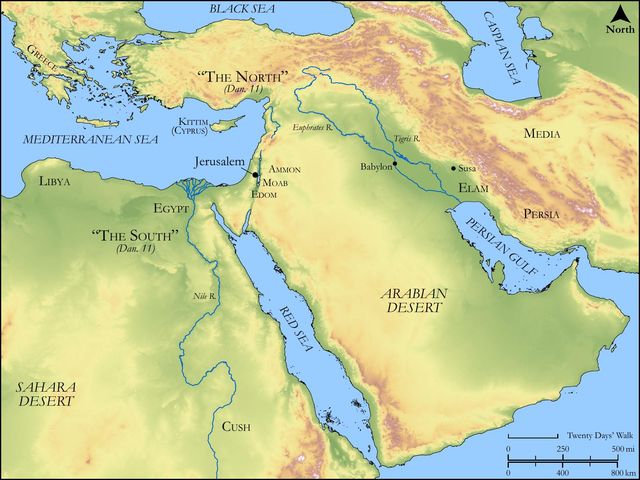
See on the biblical-era map
Study this verse
Public-domain commentary
Matthew Henry
From his Commentary on the Whole Bible. Henry comments on passages, not single verses — this entry covers Daniel 7:1–8. His three-level outline is real structure in the source text, so it is rendered as structure.
The date of this chapter places it before ch. 5, which was in the last year of Belshazzar, and ch. 6, which was in the first of Darius; for Daniel had those visions in the first year of Belshazzar, when the captivity of the Jews in Babylon was drawing near a period. Belshazzar's name here is, in the original, spelt differently from what it used to be; before it was Bel-she-azar - Bel is he that treasures up riches. But this is Bel-eshe-zar - Bel is on fire by the enemy. Bel was the god of the Chaldeans; he had prospered, but is now to be consumed.
We have, in these verses, Daniel's vision of the four monarchies that were oppressive to the Jews. Observe,
I.The circumstances of this vision.
Daniel had interpreted Nebuchadnezzar's dream, and now he is himself honoured with similar divine discoveries (Dan 7:1): He had visions of his head upon his bed, when he was asleep; so God sometimes revealed himself and his mind to the children of men, when deep sleep fell upon them (Job 33:15); for when we are most retired from the world, and taken off from the things of sense, we are most fit for communion with God. But when he was awake he wrote the dream for his own use, lest he should forget it as a dream which passes away; and he told the sum of the matters to his brethren the Jews for their use, and gave it to them in writing, that it might be communicated to those at a distance and preserved for their children after them, who shall see these things accomplished. The Jews, misunderstanding some of the prophecies of Jeremiah and Ezekiel, flattered themselves with hopes that, after their return to their own land, they should enjoy a complete and uninterrupted tranquility; but that they might not so deceive themselves, and their calamities be made doubly grievous by the disappointment, God by this prophet lets them know that they shall have tribulation: those promises of their prosperity were to be accomplished in the spiritual blessings of the kingdom of grace; as Christ has told his disciples they must expect persecution, and the promises they depend upon will be accomplished in the eternal blessings of the kingdom of glory. Daniel both wrote these things and spoke them, to intimate that the church should be taught both by the scriptures and by ministers' preaching, both by the written word and by word of mouth; and ministers in their preaching are to tell the sum of the matters that are written.
II.The vision itself, which foretels the revolutions of government in those nations which the church of the Jews, for the following ages, was to be under the influence of.
1.He observed the four winds to strive upon the great sea, Dan 7:2. They strove which should blow strongest, and, at length, blow alone. This represents the contests among princes for empire, and the shakings of the nations by these contests, to which those mighty monarchies, which he was now to have a prospect of, owed their rise. One wind from any point of the compass, if it blow hard, will cause a great commotion in the sea; but what a tumult must needs be raised when the four winds strive for mastery! This is it which the kings of the nations are contending for in their wars, which are as noisy and violent as the battle of the winds; but how is the poor sea tossed and torn, how terrible are its concussions, and how violent its convulsions, while the winds are at strife which shall have the sole power of troubling it! Note, This world is like a stormy tempestuous sea; thanks to the proud ambitious winds that vex it.
2.He saw four great beasts come up from the sea, from the troubled waters, in which aspiring minds love to fish. The monarchs and monarchies are represented by beasts, because too often it is by brutish rage and tyranny that they are raised and supported. These beasts were diverse one from another (Dan 7:3), of different shapes, to denote the different genius and complexion of the nations in whose hands they were lodged.
(1.)The first beast was like a lion, Dan 7:4. This was the Chaldean monarchy, that was fierce and strong, and made the kings absolute. This lion had eagle's wings, with which to fly upon the prey, denoting the wonderful speed that Nebuchadnezzar made in his conquest of kingdoms. But Daniel soon sees the wings plucked, a full stop put to the career of their victorious arms. Divers countries that had been tributaries to them revolt from them, and make head against them; so that this monstrous animal, this winged lion, is made to stand upon the feet as a man, and a man's heart is given to it. It has lost the heart of a lion, which it had been famous for (one of our English kings was called Caeur de Lion - Lion-heart), has lost its courage and become feeble and faint, dreading every thing and daring nothing; they are put in fear, and made to know themselves to be but men. Sometimes the valour of a nation strangely sinks, and it becomes cowardly and effeminate, so that what was the head of the nations in an age or two becomes the tail.
(2.)The second beast was like a bear, Dan 7:5. This was the Persian monarchy, less strong and generous than the former, but no less ravenous. This bear raised up itself on one side against the lion, and soon mastered it. It raised up one dominion; so some read it. Persia and Media, which in Nebuchadnezzar's image were the two arms in one breast, now set up a joint government. This bear had three ribs in the mouth of it between the teeth, the remains of those nations it had devoured, which were the marks of its voraciousness, and yet an indication that though it had devoured much it could not devour all; some ribs still stuck in the teeth of it, which it could not conquer. Whereupon it was said to it, "Arise, devour much flesh; let alone the bones, the ribs, that cannot be conquered, and set upon that which will be an easier prey." The princes will stir up both the kings and the people to push on their conquests, and let nothing stand before them. Note, Conquests, unjustly made, are but like those of the beasts of prey, and in this much worse, that the beasts prey not upon those of their own kind, as wicked and unreasonable men do.
(3.)The third beast was like a leopard, Dan 7:6. This was the Grecian monarchy, founded by Alexander the Great, active, crafty, and cruel, like a leopard. He had four wings of a fowl; the lion seems to have had but two wings; but the leopard had four, for though Nebuchadnezzar made great despatch in his conquests Alexander made much greater. In six years' time he gained the whole empire of Persia, a great part besides of Asia, made himself master of Syria, Egypt, India, and other nations. This beast had four heads; upon Alexander's death his conquests were divided among his four chief captains; Seleucus Nicanor had Asia the Great; Perdiccas, and after him Antigonus, had Asia the Less; Cassander had Macedonia; and Ptolemeus had Egypt. Dominion was given to this beast; it was given of God, from whom alone promotion comes.
(4.)The fourth beast was more fierce, and formidable, and mischievous, than any of them, unlike any of the other, nor is there any among the beasts of prey to which it might be compared, Dan 7:7. The learned are not agreed concerning this anonymous beast; some make it to be the Roman empire, which, when it was in its glory, comprehended ten kingdoms, Italy, France, Spain, Germany, Britain, Sarmatia, Pannonia, Asia, Greece, and Egypt; and then the little horn which rose by the fall of three of the other horns (Dan 7:8) they make to be the Turkish empire, which rose in the room of Asia, Greece, and Egypt. Others make this fourth beast to be the kingdom of Syria, the family of the Seleucidae, which was very cruel and oppressive to the people of the Jews, as we find in Josephus and the history of the Maccabees. And herein that empire was diverse from those which went before, that none of the preceding powers compelled the Jews to renounce their religion, but the kings of Syria did, and used them barbarously. Their armies and commanders were the great iron teeth with which they devoured and broke in pieces the people of God, and they trampled upon the residue of them. The ten horns are then supposed to be ten kings that reigned successively in Syria; and then the little horn is Antiochus Epiphanes, the last of the ten, who by one means or other undermined three of the kings, and got the government. He was a man of great ingenuity, and therefore is said to have eyes like the eyes of a man; and he was very bold and daring, had a mouth speaking great things. We shall meet with him again in these prophecies.
Historical interpretation
Two Centuries of Reception
7 surviving comments on this verse. Each one is dated, so this reads as a timeline rather than a list.
Select a marker to jump to its quote. Markers stagger vertically where authors wrote within a few decades of each other.
1. In speaking of a "lioness from the sea," he meant the rising of the kingdom of Babylon, and that this was the "golden head of the image." And in speaking of its "eagle wings," be meant that king Nebuchadnezzar was exalted and that his glory was lifted up against God. Then he says "its wings were plucked off," i.e., that his glory was destroyed; for he was driven out of his kingdom. And the words, "A man's heart was given it, and it was made stand upon the feet of a man," mean that he came to himself again, and recognised that he was but a man, and gave the glory to God. Then after the lioness he sees a second beast, "like a bear," which signified the Persians. For after the Babylonians the Persians obtained the power. And in saying that "it had three ribs in its mouth," he pointed to the three nations, Persians, Medes, and Babylonians, which were expressed in the image by the silver after the gold. Then comes the third beast, "a leopard," which means the Greeks; for after the Persians, Alexander of Macedon had the power, when Darius was overthrown, which was also indicated by the brass in the image. And in saying that the beast "had four wings of a fowl, and four heads," he showed most clearly how the kingdom of Alexander was parted into four divisions. For in speaking of four heads, he meant the four kings that arose out of it. For Alexander, when dying, divided his kingdom into four parts. Then he says, "The fourth beast (was) dreadful and terrible: it had iron teeth, and claws of brass." Who, then, are meant by this but the Romans, whose kingdom, the kingdom that still stands, is expressed by the iron? "for," says he, "its legs are of iron."
2. After this, then, what remains, beloved, but the toes of the feet of the image, in which "part shall be of iron and part of clay mixed together? "By the toes of the feet he meant, mystically, the ten kings that rise out of that kingdom. As Daniel says, "I considered the beast; and, lo, (there were) ten horns behind, among which shall come up another little horn springing from them; "by which none other is meant than the antichrist that is to rise; and he shall set up the kingdom of Judah. And in saying that "three horns" were "plucked up by the roots" by this one, he indicates the three kings of Egypt, Libya, and Ethiopia, whom this one will slay in the array of war. And when he has conquered all, he will prove himself a terrible and savage tyrant, and will cause tribulation and persecution to the saints, exalting himself against them. And after him, it remains that "the stone" shall come from heaven which "smote the image" and shivered it, and subverted all the kingdoms, and gave the kingdom to the saints of the Most High. This "became a great mountain, and filled the whole earth."
3. As these things, then, are destined to come to pass, and as the toes of the image turn out to be democracies, and the ten horns of the beast are distributed among ten kings, let us look at what is before us more carefully, and scan it, as it were, with open eye. The "golden head of the image" is identical with the "lioness," by which the Babylonians were represented. "The golden shoulders and the arms of silver" are the same with the "bear," by which the Persians and Medes are meant. "The belly and thighs of brass" are the "leopard," by which the Greeks who ruled from Alexander onwards are intended. The "legs of iron" are the "dreadful and terrible beast," by which the Romans who hold the empire now are meant. The "toes of clay and iron" are the "ten horns" which are to be. The "one other little horn springing up in their midst" is the "antichrist." The stone that "smites the image and breaks it in pieces," and that filled the whole earth, is Christ, who comes from heaven and brings judgment on the world.
4. But that we may not leave our subject at this point undemonstrated, we are obliged to discuss the matter of the times, of which a man should not speak hastily, because they are a light to him. For as the times are noted from the foundation of the world, and reckoned from Adam, they set clearly before us the matter with which our inquiry deals. For the first appearance of our Lord in the flesh took place in Bethlehem, under Augustus, in the year 5500; and He suffered in the thirty-third year. And 6,000 years must needs be accomplished, in order that the Sabbath may come, the rest, the holy day "on which God rested from all His works." For the Sabbath is the type and emblem of the future kingdom of the saints, when they "shall reign with Christ," when He comes from heaven, as John says in his Apocalypse: for "a day with the Lord is as a thousand years." Since, then, in six days God made all things, it follows that 6,000 years must be fulfilled. And they are not yet fulfilled, as John says: "five are fallen; one is," that is, the sixth; "the other is not yet come."
5. In mentioning the "other," moreover, he specifies the seventh, in which there is rest. But some one may be ready to say, How will you prove to me that the Saviour was born in the year 5500? Learn that easily, O man; for the things that took place of old in the wilderness, under Moses, in the case of the tabernacle, were constituted types and emblems of spiritual mysteries, in order that, when the truth came in Christ in these last days, you might be able to perceive that these things were fulfilled. For He says to him, "And thou shalt make the ark of imperishable wood, and shalt overlay it with pure gold within and without; and thou shalt make the length of it two cubits and a half, and the breadth thereof one cubit and a half, and a cubit and a half the height;" which measures, when summed up together, make five cubits and a half, so that the 5500 years might be signified thereby.
6. At that time, then, the Saviour appeared and showed His own body to the world, (born) of the Virgin, who was the "ark overlaid with pure gold," with the Word within and the Holy Spirit without; so that the truth is demonstrated, and the "ark" made manifest. From the birth of Christ, then, we must reckon the 500 years that remain to make up the 6000, and thus the end shall be. And that the Saviour appeared in the world, bearing the imperishable ark, His own body, at a time which was the fifth and half, John declares: "Now it was the sixth hour," he says, intimating by that, one-half of the day. But a day with the Lord is 10000 years; and the half of that, therefore, is 500 years. For it was not meet that He should appear earlier, for the burden of the law still endured, nor yet when the sixth day was fulfilled (for the baptism is changed), but on the fifth and half, in order that in the remaining half time the gospel might be preached to the whole world, and that when the sixth day was completed He might end the present life.
7. Since, then, the Persians held the mastery for 330 years, and after them the Greeks, who were yet more glorious, held it for 300 years, of necessity the fourth beast, as being strong and mightier than all that were before it, will reign 500 years. When the times are fulfilled, and the ten horns spring from the beast in the last (times), then Antichrist will appear among them. When he makes war against the saints, and persecutes them, then may we expect the manifestation of the Lord from heaven.
8. The prophet having thus instructed us with all exactness as to the certainty of the things that are to be, broke off from his present subject, and passed again to the kingdom of the Persians and Greeks, recounting to us another vision which took place, and was fulfilled in its proper time; in order that, by establishing our belief in this, he might be able to present us to God as readier believers in the things that are to be. Accordingly, what he had narrated in the first vision, he again recounts in detail for the edification of the faithful. For by the "ram pushing westward, and northward, and southward," he means Darius, the king of the Persians, who overcame all the nations; "for," says he, "these beasts shall not stand before him." And by the "he-goat that came from the west," he means Alexander the Macedonian, the king of the Greeks; and in that he "came against that very ram, and was moved with choler, and smote him upon the face, and shivered him, and cast him upon the ground, and stamped upon him," this expresses just what has happened.
9. For Alexander waged war against Darius, and overcame him, and made himself master of the whole sovereignty, after routing and destroying his camp. Then, after the exaltation of the he-goat, his horn-the great one, namely-was broken; and there arose four horns under it, toward the four winds of heaven. For, when Alexander had made himself master of all the land of Persia, and had reduced its people into subjection, he thereupon died, after dividing his kingdom into four principalities, as has been shown above. And from that time "one horn was exalted, and waxed great, even to the power of heaven; and by him the sacrifice," he says, "was disturbed, and righteousness cast down to the ground."
10. For Antiochus arose, surnamed Epiphanes, who was of the line of Alexander. And after he had reigned in Syria, and brought under him all Egypt, he went up to Jerusalem, and entered the sanctuary, and seized all the treasures in the house of the Lord, and the golden candlestick, and the table, and the altar, and made a great slaughter in the land; even as it is written: "And the sanctuary shall be trodden under foot, unto evening and unto morning, a thousand and three hundred days." For it happened that the sanctuary remained desolate during that period, three years and a half, that the thousand and three hundred days might be fulfilled; until Judas Maccabaeus arose after the death of his father Matthias, and withstood him, and destroyed the encampment of Antiochus, and delivered the city, and recovered the sanctuary, and restored it in strict accordance with the law.
11. Since, then, the angel Gabriel also recounted these things to the prophet, as they have been understood by us, as they have also taken place, and as they have been all clearly described in the books of the Maccabees, let us see further what he says on the other weeks. For when he read the book of Jeremiah the prophet, in which it was written that the sanctuary would be desolate seventy years, he made confession with fastings and supplications, and prayed that the people might return sooner from their captivity to the city Jerusalem. Thus, then, he speaks in his account: "In the first year of Darius the son of Ahasuerus, of the seed of the Medes, who was king over the realm of the Chaldeans, I Daniel understood in the books the number of the years, as the word of the Lord had come to Jeremiah the prophet, for the accomplishment of the desolation of Jerusalem in seventy years," etc.
12. After his confession and supplication, the angel says to him, "Thou art a man greatly beloved: "for thou desirest to see things of which thou shalt be informed by me; and in their own time these things will be fulfilled; and he touched me, saying, "Seventy weeks are determined upon thy people, and upon the holy city, to seal up sins and to blot out transgressions, and to seal up vision and prophet, and to anoint the Most Holy; and thou shalt know and understand, that from the going forth of words for the answer, and for the building of Jerusalem, unto Christ the Prince, shall be seven weeks, and threescore and two weeks."
13. Having mentioned therefore seventy weeks, and having divided them into two parts, in order that what was spoken by him to the prophet might be better understood, he proceeds thus, "Unto Christ the Prince shall be seven weeks," which make forty-nine years. It was in the twenty-first year that Daniel saw these things in Babylon. Hence, the forty-nine years added to the twenty-one, make up the seventy years, of which the blessed Jeremiah spake: "The sanctuary shall be desolate seventy years from the captivity that befell them under Nebuchadnezzar; and after these things the people will return, and sacrifice and offering will be presented, when Christ is their Prince."
14. Now of what Christ does he speak, but of Jesus the son of Josedech, who returned at that time along with the people, and offered sacrifice according to the law, in the seventieth year, when the sanctuary was built? For all the kings and priests were styled Christs, because they were anointed with the holy oil, which Moses of old prepared. These, then, bore the name of the Lord in their own persons, showing aforetime the type, and presenting the image until the perfect King and Priest appeared from heaven, who alone did the will of the Father; as also it is written in Kings: "And I will raise me up a faithful priest, that shall do all things according to my heart."
15. In order, then, to show the time when He is to come whom the blessed Daniel desired to see, he says, "And after seven weeks there are other threescore and two weeks," which period embraces the space of 434 years. For after the return of the people from Babylon under the leadership of Jesus the son of Josedech, and Ezra the scribe, and Zerubbabel the son of Salathiel, of the tribe of David, there were 434 years unto the coming of Christ, in order that the Priest of priests might be manifested in the world, and that He who taketh away the sins of the world might be evidently set forth, as John speaks concerning Him: "Behold the Lamb of God, that taketh away the sin of the world!" And in like manner Gabriel says: "To blot out transgressions, and make reconciliation for sins." But who has blotted out our transgressions? Paul the apostle teaches us, saying, "He is our peace who made both one;" and then, "Blotting out the handwriting of sins that was against us."
16. That transgressions, therefore, are blotted out, and that reconciliation is made for sins, is shown by this. But who are they who have reconciliation made for their sins, but they who believe on His name, and propitiate His countenance by good works? And that after the return of the people from Babylon there was a space of 434 years, until the time of the birth of Christ, may be easily understood. For, since the first covenant was given to the children of Israel after a period of 434 years, it follows that the second covenant also should be defined by the same space of time, in order that it might be expected by the people and easily recognised by the faithful.
17. And for this reason Gabriel says: "And to anoint the Most Holy." And the Most Holy is none else but the Son of God alone, who, when He came and manifested Himself, said to them, "The Spirit of the Lord is upon me, because He has anointed me; " and so forth. Whosoever, therefore, believed on the heavenly Priest, were cleansed by that same Priest, and their sins were blotted out. And whosoever believe it not on Him, despising Him as a man, had their sins sealed, as those which could not be taken away; whence the angel, foreseeing that not all should believe on Him, said, "To finish sins, and to seal up sins." For as many as continued to disbelieve Him, even to the end, had their sins not finished, but sealed to be kept for judgment. But as many as will believe on Him as One able to remit sins, have their sins blotted out. Wherefore he says: "And to seal up vision and prophet."
18. For when He came who is the fulfilling of the law and of the prophets (for the law and the prophets were till John), it was necessary that the things spoken by them should be confirmed (sealed), in order that at the coming of the Lord all things loosed should be brought to light, and that things bound of old should now be loosed by Him, as the Lord said Himself to the rulers of the people, when they were indignant at the cure on the Sabbath-day: "Ye hypocrites, doth not each one of you loose his ox or his ass from the stall, and lead him away to watering? and ought not this woman, being a daughter of Abraham, whom Satan hath bound these eighteen years, be loosed on the Sabbath-day? " Whomsoever, therefore, Satan bound in chains, these did the Lord on His coming loose from the bonds of death, having bound our strong adversary and delivered humanity. As also Isaiah says: "Then will He say to those in chains, Go forth; and to them that are in darkness, Show yourselves."
19. And that the things spoken of old by the law and the prophets were all sealed, and that they were unknown to men, Isaiah declares when he says: "And they will deliver the book that is sealed to one that is learned, and will say to him, Read this; and he will say, I cannot read it, for it is sealed." It was meet and necessary that the things spoken of old by the prophets should be sealed to the unbelieving Pharisees, who thought that they understood the letter of the law, and be opened to the believing. The things, therefore, which of old were sealed, are now by the grace of God the Lord all open to the saints.
20. For He was Himself the perfect Seal, and the Church is the key: "He who openeth, and no man shutteth; and shutteth, and no man openeth," as John says. And again, the same says: "And I saw, on the right hand of Him that sat on the throne, a book written within and without, sealed with seven seals; and I saw an angel proclaiming with a loud voice, Who is worthy to open the book, and to loose the seals thereof? "and so forth. "And I beheld in the midst of the throne, and of the four beasts, a Lamb standing slain, having seven horns, and seven eyes, which are the seven Spirits of God sent forth into all the earth. And He came and took the book out of the right hand of Him that sat upon the throne. And when He had taken the book, the four beasts and four-and-twenty elders fell down before the Lamb, having harps and golden vials full of incense, which is the prayers of the saints. And they sing a new song, saying, Thou art worthy to take the book, and to open the seals thereof: for Thou wast slain, and hast redeemed us to God by Thy blood." He took the book, therefore, and loosed it, in order that the things spoken concerning Him of old in secret, might now be proclaimed with boldness upon the house-tops.
21. For this reason, then, the angel says to Daniel, "Seal the words, for the vision is until the end of the time." But to Christ it was not said "seal," but "loose" the things bound of old; in order that, by His grace, we might know the will of the Father, and believe upon Him whom He has sent for the salvation of men, Jesus our Lord. He says, therefore, "They shall return, and the street shall be built, and the wall; "which in reality took place. For the people returned and built the city, and the temple, and the wall round about. Then he says: "After threescore and two weeks the times will be fulfilled, and one week will make a covenant with many; and in the midst (half) of the week sacrifice and oblation will be removed, and in the temple will be the abomination of desolations."
22. For when the threescore and two weeks are fulfilled, and Christ is come, and the Gospel is preached in every place, the times being then accomplished, there will remain only one week, the last, in which Elias will appear, and Enoch, and in the midst of it the abomination of desolation will be manifested, viz., Antichrist, announcing desolation to the world. And when he comes, the sacrifice and oblation will be removed, which now are offered to God in every place by the nations. These things being thus recounted, the prophet again describes another vision to us. For he had no other care save to be accurately instructed in all things that are to be, and to prove himself an instructor in such.
23. He says then: "In the third year of Cyrus king of Persia, a word was revealed unto Daniel, whose name was Belshazzar; and the word was true, and great power and understanding were given him in the vision. In those days I Daniel was mourning three weeks of days. I ate no pleasant bread, neither came flesh nor wine into my mouth, neither did I anoint myself at all, till three weeks of days were fulfilled. On the fourth day of the first month I humbled myself," says he, "one and twenty days," praying to the living God, and asking of Him the revelation of the mystery. And the Father in truth heard me, and sent His own Word, to show what should happen by Him. And that took place, indeed, by the great river. For it was meet that the Son should be manifested there, where also He was to remove sins.
24. "And I lifted up mine eyes," he says, "and, behold, a man clothed in linen." In the first vision he says, "Behold, the angel Gabriel (was) sent." Here, however, it is not so; but he sees the Lord, not yet indeed as perfect man, but with the appearance and form of man, as he says: "And, behold, a man clothed in linen." For in being clothed in a various-coloured coat, he indicated mystically the variety of the graces of our calling. For the priestly coat was made up of different colours, as various nations waited for Christ's coming, in order that we might be made up (as one body) of many colours. "And his loins were girded with the gold of Ophaz."
25. Now the word "Ophaz," which is a word transferred from Hebrew to Greek, denotes pure gold. With a pure girdle, therefore, he was girded round the loins. For the Word was to bear us all, binding us like a girdle round His body, in His own love. The complete body was His, but we are members in His body, united together, and sustained by the Word Himself. "And his body was like Tharses." Now "Tharses," by interpretation, is "Ethiopians." For that it would be difficult to recognise Him, the prophet had thus already announced beforehand, intimating that He would be manifested in the flesh in the world, but that many would find it difficult to recognise Him. "And his face as lightning, and his eyes as lamps of fire; "for it was meet that the fiery and judicial power of the Word should be signified aforetime, in the exercise of which He will cause the fire (of His judgment) to light with justice upon the impious, and consume them.
26. He added also these words: "And his arms and his feet like polished brass; "to denote the first calling of men, and the second calling like unto it, viz. of the Gentiles. "For the last shall be as the first; for I will set thy rulers as at the beginning, and thy leaders as before. And His voice was as the voice of a great multitude." For all we who believe on Him in these days utter things oracular, as speaking by His mouth the things appointed by Him.
27. And after a little He says to him: "Knowest thou wherefore I come unto thee? And now will I return to fight with the prince of Persia. But I will show thee that which is noted in the Scripture of truth: and there is none that holdeth with me in these things but Michael your prince, and I left him there. For from the day that thou didst give thy countenance to be afflicted before the Lord thy God, thy prayer was heard, and I was sent to fight with the prince of Persia: "for a certain counsel was formed not to send the people away: "that therefore thy prayer might be speedily granted, I withstood him, and left Michael there."
28. And who was he that spake, but the angel who was given to the people, as he says in the law of Moses: "I will not go with you, because the people is stiff-necked; but my angel shall go before along with you? " This (angel) withstood Moses at the inn, when he was bringing the child uncircumcised into Egypt. For it was not allowed Moses, who was the eider (or legate) and mediator of the law, and who proclaimed the covenant of the fathers, to introduce a child uncircumcised, lest he should be deemed a false prophet and deceiver by the people. "And now," says he, "will I show the truth to thee." Could the Truth have shown anything else but the truth?
29. He says therefore to him: "Behold, there shall stand up three kings in Persia: and the fourth shall be far richer than they all; and when he has got possession of his riches, he shall stand up against all the realms of Grecia. And a mighty king shall stand up, and shall rule with great dominion, and do according to his will; and when his kingdom stands, it shall be broken, and shall be divided toward the four winds of heaven." These things we have already discussed above, when we discoursed upon the four beasts. But since Scripture now again sets them forth explicitly, we must also discourse upon them a second time, that we may not leave Scripture unused and unexplained.
30. "There shall stand up yet three kings," he says, "in Persia; and the fourth shall be far richer than they all." This has been fulfilled. For after Cyrus arose Darius, and then Artaxerxes. These were the three kings; (and) the Scripture is fulfilled. "And the fourth shall be far richer than they all." Who is that but Darius, who reigned and made himself glorious,-who was rich, and assailed all the realms of Greece? Against him rose Alexander of Macedon, who destroyed his kingdom; and after he had reduced the Persians, his own kingdom was divided toward the four winds of heaven. For Alexander at his death divided his kingdom into four principalities. "And a king shall stand up, and shall enter into the fortress of the king of Egypt."
31. For Antiochus became king of Syria. He held the sovereignty in the 107th year of the kingdom of the Greeks. And in those same times indeed he made war against Ptolemy king of Egypt, and conquered him, and won the power. On returning from Egypt he went up to Jerusalem, in the 103d year, and carrying off with him all the treasures of the Lord's house, he marched to Antioch. And after two years of days the king sent his raiser of taxes into the cities of Judea, to compel the Jews to forsake the laws of their fathers, and submit to the decrees of the king. And he came, and tried to compel them, saying, "Come forth, and do the commandment of the king, and ye shall live."
32. But they said, "We will not come forth: neither will we do the king's commandment; we will die in our innocency: and he slew of them a thousand souls." The things, therefore, which were spoken to the blessed Daniel are fulfilled: "And my servants shall be afflicted, and shall fall by famine, and by sword, and by captivity." Daniel, however, adds: "And they shall be holpen with a little help." For at that time Matthias arose, and Judas Maccabaeus, and helped them, and delivered them from the hand of the Greeks.
33. That therefore was fulfilled which was spoken in the Scripture. He proceeds then thus: "And the (king's) daughter of the South shall come to the king of the North to make an agreement with him; and the arms of him that bringeth her shall not stand; and she, too, shall be smitten, and shall fall, and he that bringeth her." For this was a certain Ptolemais queen of Egypt. At that time indeed she went forth with her two sons, Ptolemy and Philometor, to make an agreement with Antiochus king of Syria; and when she came to Scythopolis, she was slain there. For he who brought her betrayed her. At that same time, the two brothers made war against each other, and Philometor was slain, and Ptolemy gained the power.
34. War, then, was again made by Ptolemy against Antiochus, (and) Antiochus met him. For thus saith the Scripture: "And the king of the South shall stand up against the king of the North, and her seed shall stand up against him." And what seed but Ptolemy, who made war with Antiochus? And Antiochus having gone forth against him, and having failed to overcome him, had to flee, and returned to Antioch, and collected a larger host. Ptolemy accordingly took his whole equipment, and carried it into Egypt. And the Scripture is fulfilled, as Daniel says: And he shall carry off into Egypt their gods, and their cast-works, and all their precious (vessels of) gold.
35. And after these things Antiochus went forth a second time to make war against him, and overcome Ptolemy. And after these events Antiochus commenced hostilities again against the children of Israel, and despatched one Nicanor with a large army to subdue the Jews, at the time when Judas, after the death of Matthias, ruled the people; and so forth, as is written in the Maccabees. These events having taken place, the Scripture says again: "And there shall stand up another king, and he shall prevail upon the earth; and the king of the South shall stand up, and he shall obtain his daughter to wife."
36. For it happened that there arose a certain Alexander, son of Philip. He withstood Antiochus at that time, and made war upon him, and cut him off, and gained possession of the kingdom. Then he sent to Ptolemy king of Egypt, saying, Give me thy daughter Cleopatra to wife. And he gave her to Alexander to wife. And thus the Scripture is fulfilled, when it says: "And he shall obtain his daughter to wife." And it says further: "And he shall corrupt her, and she shall not be his wife." This also has been truly fulfilled. For after Ptolemy had given him his daughter, he returned, and saw the mighty and glorious kingdom of Alexander. And coveting its possession, he spoke falsely to Alexander, as the Scripture says: "And the two kings shall speak lies at (one) table." And, in sooth, Ptolemy betook himself to Egypt, and collected a great army, and attacked the city at the time when Alexander had marched into Cilicia.
37. Ptolemy then invaded the country, and established garrisons throughout the cities; and on making himself master of Judea, set out for his daughter, and sent letters to Demetrius in the islands, saying, Come and meet me here, and I will give thee my daughter Cleopatra to wife, for Alexander has sought to kill me. Demetrius came accordingly, and Ptolemy received him, and gave him her who had been destined for Alexander. Thus is fulfilled that which is written: "And he shall corrupt her, and she shall not be his wife." Alexander was slain. Then Ptolemy wore two crowns, that of Syria and that of Egypt, and died the third day after he had assumed them. Thus is fulfilled that which is written in Scripture: "And they shall not give him the glory of the kingdom." For he died, and received not honour from all as king.
38. The prophet then, after thus recounting the things which have taken place already, and been fulfilled in their times, declares yet another mystery to us, while he points out the last times. For he says: "And there shall rise up another shameless king; and he shall exalt himself above every god, and shall magnify himself, and shall speak marvellous things, and shall prosper till the indignation be accomplished; "anti so forth. "And these shall escape out of his hand, Edom, and Moab, and the chief (or principality) of the children of Ammon. And he shall stretch forth his hand upon the land; and the land of Egypt shall not escape. And he shall have power over the secret treasures of gold and silver, and over all the precious things of Egypt and of the Libyans, and the Ethiopians in their strongholds."
39. Thus, then, does the prophet set forth these things concerning the Antichrist, who shall be shameless, a war-maker, and despot, who, exalting himself above all kings and above every god, shall build the city of Jerusalem, and restore the sanctuary. Him the impious will worship as God, and will bend to him the knee, thinking him to be the Christ. He shall cut off the two witnesses and forerunners of Christ, who proclaim His glorious kingdom from heaven, as it is said: "And I will give (power) unto my two witnesses, and they shall prophesy a thousand two hundred and threescore days, clothed in sackcloth." As also it was announced to Daniel: "And one week shall confirm a covenant with many; and in the midst of the week it shall be that the sacrifice and oblation shall be removed"-that the one week might be shown to be divided into two. The two witnesses, then, shall preach three years and a half; and Antichrist shall make war upon the saints during the test of the week, and desolate the world, that what is written may be fulfilled: "And they shall make the abomination of desolation for a thousand two hundred and ninety days."
40. Daniel has spoken, therefore, of two abominations; the one of destruction, and the other of desolation. What is that of destruction, but that which Antiochus established there at the time? And what is that of desolation, but that which shall be universal when Antichrist comes? "And there shall escape out of his hand, Edom, and Moab, and the chief of the children of Ammon." For these are they who ally themselves with him on account of their kinship, and first address him as king. Those of Edom are the sons of Esau, who inhabit Mount Seir. And Moab and Ammon are they who are descended from his two daughters, as Isaiah also says: "And they shall fly (extend themselves) in the ships of strangers, and they shall also plunder the sea; and those from the east, and from the west, and the north, shall give them honour: and the children of Ammon shall first obey them." He shall be proclaimed king by them, and shall be magnified by all, and shall prove himself an abomination of desolation to the world, and shall reign for a thousand two hundred and ninety days. "Blessed is he that waiteth, and cometh to the thousand three hundred and five and thirty days; "for when the abomination cometh and makes war upon the saints, whosoever shall survive his days, and reach the forty-five days, while the other period of fifty days advances, to him the kingdom of heaven comes. Antichrist, indeed, enters even into part of the fifty days, but the saints shall inherit the kingdom along with Christ.
41. These things being thus narrated, Daniel proceeds: "And, behold, there stood two men, the one on this side of the bank of the river, and the other on that side; and they made answer to the man that stood upon the bank of the river, and said to him, How long shall it be to the end of these wonderful words which thou hast spoken? And I heard the man clothed in linen, who was upon the water of the river; and he lifted up his right hand and his left hand unto heaven, and sware by Him that liveth for ever, that it shall be for a time, times, and an half; and they shall know all these things when the dispersion is accomplished,"
42. Who, then, were the two men who stood on the bank of the river, but the law and the prophets? And who was he who stood upon the water, but He concerning whom they prophesied of old, who in the last times was to be borne witness to by the Father at the Jordan, and to be declared to the people boldly by John, "who wore the casty of the scribe about his loins, and was clothed with a linen coat of various colours? "These, therefore, interrogate Him, knowing that to Him were given all government and power, in order to learn accurately of Him when He will bring the judgment on the world, and when the things spoken by Him will be fulfilled. And He, desiring by all means to convince them, lifted His right hand and His left hand to heaven, and sware by Him that liveth for ever. Who is He that swore, and by whom sware He? Manifestly the Son by the Father, saying, The Father liveth for ever, but in a time, and times, and an half, when the dispersion is accomplished, they shall know all these things.
43. By the stretching forth of His two hands He signified His passion; and by mentioning "a time, and times, and an half, when the dispersion is accomplished," He indicated the three years and a half of Antichrist. For by "a time" He means a year, and by "times" two years, and by an "half time" half a year. These are the thousand two hundred and ninety days of which Daniel prophesied for the finishing of the passion, and the accomplishment of the dispersion when Antichrist comes. In those days they shall know all these things. And from the time of the removal of the continuous sacrifice there are also reckoned one thousand two hundred and ninety days. (Then) iniquity shall abound, as the Lord also says: "Because iniquity shall abound, the love of many shall wax cold."
44. And that divisions will arise when the falling away takes place, is without doubt. And when divisions arise, love is chilled. The words, "Blessed is he that waiteth and cometh to the thousand three hundred and five and thirty days," have also their value, as the Lord said: "But he that shall endure unto the end, the same shall be saved." Wherefore let us by no means admit the falling away, lest iniquity abound, and the abomination of desolation-that is, the adversary-overtake us. And He said to him, "unto evening"-that is, unto the consummation" and morning." What is "morning? "The day of resurrection. For that is the beginning of another age, as the morning is the beginning of the day. And the thousand and four hundred days are the light of the world. For on the appearing of the light in the world (as He says, "I am the light of the world"), the sanctuary shall be purged, as he said, (of) the adversary. For it cannot by any means be purged but by his destruction.
"I considered the horns." That is to say, I looked intently at the beast, and was astonished at everything about it, but especially at the number of the horns. For the appearance of this beast differed from that of the other beasts in kind.
This is Antiochus, the persecutor of the Jews, who sprang up in the midst of the ten kings and grew up. And this last horn, he says, “after three of the earlier horns were plucked by the roots, spoke arrogantly.” Since there is here a hint of the fall of the previous three horns, it must be referred to the grandchildren and successors of the three past kings. Indeed the arrogant words, which this small horn spoke, are the insults and blasphemies thrown against God.
Who are the ten kings? What is the little horn? I say that the antichrist will appear among a certain number of kings. “And in that horn were eyes like the eyes of a human and a mouth boasting great things.” What greater boast can be said with that mouth than this thing that is said, “He will place himself above everything that is called God or divine, so much so that he will sit in the temple of God”? Do not marvel if he has the eyes of a human, even if he speaks such things. He is a person. Why does the horn appear to be little and not big in the beginning? It will grow after this time and will rule certain kingdoms. Why? No kingdom will conquer this king, but God will abolish and destroy him.
When scripture wishes to expound on the kingdoms, it uses the metaphor of beasts. A kingdom is an incorporeal object; therefore, some type of body has to be ascribed to it. And was it not fitting to describe kingdoms as beasts? Most certainly. For since the qualities of those kingdoms exist chiefly in those beasts, so he found them useful. He wished to show fierce arrogance and luxury, and he made use of a lioness. He wished to show slowness, and he made use of a bear. He wished to show speed and briskness and such as would overthrow all empires by its wars; thus he introduced a leopard. Look how earlier he had seen a beautiful sea, which represented the whole earth. For the world is filled with so many tumults and is stirred up in the same way that the sea is stirred up, although the sea is filled with fish, not humans. Christ even declares this to be the case, namely, that the present life is the sea, when he says, “The kingdom of heaven is like a dragnet thrown into the sea, which brings together fish of every kind.” “And behold,” Daniel says, “the four winds of the heavens rushed on the great sea.” He declares that those beasts then went forth from there, and so he shows the swiftness of divine providence. For when we talk about speed, we introduce the figure of the winds. Daniel says that the winds rushed on the sea and the beasts emerged from the sea, for our leaders partake of our nature. So he often calls a king “a lion,” wishing to show its royal dignity and yet its feral nature. Or he does so because that wind is an easterly one, this wind is a northerly one, and yet another is a southerly one. It is as if someone had said, “He overturns the sea; the winds from the sky have stirred it up.”
Verse 8. "I was looking at the horns, and behold, another small horn rose up out of the midst of them, and three of the earlier horns were torn away before it. And behold, there were in that horn eyes like unto human eyes, and a mouth uttering overweening boasts." Porphyry vainly surmises that the little horn which rose up after the ten horns is Antiochus Epiphanes, and that the three uprooted horns out of the ten are Ptolemy VI (surnamed Philometer), Ptolemy VII (Euergetes), and Artaraxias, King of Armenia. The first two of these kings died long before Antiochus was born. Against Artarxias, to be sure, we know that Antiochus indeed waged war, but also we know that Artarxias remained in possession of his original kingly authority. We should therefore concur with the traditional interpretation of all the commentators of the Christian Church, that at the end of the world, when the Roman Empire is to be destroyed, there shall be ten kings who will partition the Roman world amongst themselves. Then an insignificant eleventh king will arise, who will overcome three of the ten kings, that is, the king of Egypt, the king of Africa, and the king of Ethiopia, as we shall show more clearly in our later discussion. Then after they have been slain, the seven other kings also will bow their necks to the victor. "And behold," he continues, "there were eyes like unto human eyes in that horn." Let us not follow the opinion of some commentators and suppose him to be either the Devil or some demon, but rather, one of the human race, in whom Satan will wholly take up his residence in bodily form. "...and a mouth uttering overweening boasts..." For this is the man of sin, the son of perdition, and that too to such a degree that he dares to sit in the temple of God, making himself out to be like God (2 Thessalonians 2:3-4).
Here he alludes to the antichrist, who arises among the ten horns, and he states that the antichrist will pluck out root and all three horns before himself. This means that he will overpower three kings of the ten who would reign at that time. And he calls it a “little” horn, as it was born from the little tribe of the Jews. However, he also calls it “eminent” since he would be noble. By its “eyes” he refers to its prudence and astuteness, by which he will deceive many. And yet he speaks of its “mouth speaking great things,” which refers to its arrogance and haughtiness.
Continue studying Daniel 7:8 across the web’s major study libraries — every link below opens this exact verse, chapter, or book on the destination site.
Read & Compare
 BibleGatewayThis verse in more than 200 translations and 70 languages.
 Bible.comThe YouVersion reader — hundreds of translations, reading plans, and highlights.
 ESV.orgCrossway's official English Standard Version reader.
 NET BibleThe NET translation with 60,000+ translators' notes on every rendering decision.
 STEP BibleTyndale House's free study tool — original text, vocabulary, and scholarly resources.
 BibliaLogos Bible Software's free web reader.
 USCCBThe New American Bible (Revised Edition) with the U.S. bishops' study notes.
Commentaries
 BibleHub CommentariesDozens of classic commentaries on this verse, gathered on one page.
 StudyLightMore than 100 commentary sets — the largest collection on the web.
 BibleRefPlain-English commentary on what this verse means, verse by verse.
 Enduring WordDavid Guzik's free commentary on this chapter, widely used by Bible teachers.
 Bible Study ToolsVerse commentary alongside Greek and Hebrew study aids.
Original Language & Research
- BibleHub InterlinearThe verse word by word — original language, transliteration, and English.
- BibleHub LexiconEvery word's original-language definition and Strong's entry.
 Blue Letter BibleDeep-study tools — Strong's numbers, concordance, and word studies.
 SefariaThe Hebrew text with Rashi and centuries of Jewish commentary.
Sermons, Hymns & Audio


TrulyRandomVerse is not affiliated with these sites and doesn’t control their content. They’re linked because they’re genuinely useful.
Summary
Daniel 7:8 vividly portrays a crucial development within Daniel's vision of the four great beasts, specifically focusing on the fourth, terrifying beast. This verse describes the unexpected emergence of a "little horn" from among the ten horns already present on this beast. Initially appearing insignificant, this "little horn" rapidly asserts its dominance by violently uprooting three of the preceding horns, signifying its aggressive and usurping nature. The text further characterizes this emergent power with anthropomorphic details: "eyes like the eyes of man," indicating keen intellect and cunning, and "a mouth speaking great things," denoting extreme arrogance, boastfulness, and ultimately, blasphemous defiance against divine authority. This vision serves as a profound prophetic insight into the nature of anti-God power that rises in history, highlighting its deceptive beginnings and its ultimate trajectory of self-exaltation and opposition to God.
Context
ShowHideLiterary Context
Daniel 7:8 is a pivotal moment within Daniel's inaugural prophetic vision, presented in Daniel 7, which parallels and elaborates upon Nebuchadnezzar's dream of the statue in Daniel 2. This vision, received during the reign of Belshazzar, details a succession of world empires depicted as fearsome beasts. The preceding verses (Daniel 7:1-7) introduce the four beasts, with the fourth being exceptionally dreadful and powerful, possessing ten horns. Verse 8 then zeroes in on a dramatic internal shift within this fourth empire: the emergence of a new, distinct horn. This development sets the stage for the subsequent divine interpretation by an angelic being in Daniel 7:15-27, where the "little horn" is explicitly identified as a king who will speak against the Most High, persecute the saints, and attempt to change times and laws. The specific details of the little horn's rise and characteristics in verse 8 are crucial for understanding its role as the primary antagonist in the eschatological drama of the chapter.
Historical & Cultural Context
Daniel's prophecies were given during the Babylonian exile, a period when the Jewish people were under the oppressive dominion of powerful Gentile empires. The imagery of monstrous beasts rising from the sea was a common motif in ancient Near Eastern mythology, often symbolizing chaotic forces or formidable kingdoms, a concept Daniel appropriates and reinterprets with divine authority. In biblical and ancient Near Eastern literature, "horns" frequently symbolized power, kings, or kingdoms, as seen in passages like Zechariah 1:18-21. The Aramaic language, in which Daniel 2-7 is written, was the lingua franca of the Persian Empire, underscoring the universal scope and relevance of these prophecies to the dominant powers of the ancient world. The concept of a smaller, initially unassuming power rising to challenge and even overthrow established empires would have resonated with the geopolitical realities of the ancient world, where such shifts in power were not uncommon. This vision offers Daniel and his audience a divine perspective on these earthly struggles, assuring them of God's ultimate sovereignty over the rise and fall of nations.
Key Themes
ShowHideDaniel 7:8 significantly contributes to several overarching themes woven throughout the book of Daniel. Firstly, it powerfully reinforces the theme of Divine Sovereignty, demonstrating that God is not merely an observer but the orchestrator of human history, revealing and directing the succession of world empires, even those characterized by profound evil. Secondly, the emergence and actions of the "little horn" vividly illustrate the Nature of Evil and Oppression, personifying a concentrated form of anti-God power through its aggressive usurpation ("plucked up by the roots") and its arrogant, blasphemous speech ("speaking great things"). This figure represents the epitome of human rebellion against divine authority. Thirdly, this verse introduces and develops the crucial theme of Eschatological Conflict, as the "little horn" is presented as a key antagonist in the end-time scenario, setting itself directly against God and His people. This conflict is further elaborated in Daniel 7:21-25. Finally, by contrasting the temporary and destructive reign of this oppressive power with the ultimate, eternal, and righteous kingdom of the Son of Man in Daniel 7:13-14, the verse implicitly but powerfully reinforces the theme of God's Ultimate Triumph over all earthly opposition and evil.
Exposition and Analysis
ShowHideKey Word Analysis
ShowHideThis Aramaic term, corresponding to the Hebrew זְעֵיר, carries the meaning of "small" or "little." Its application to the horn is profoundly significant, as it emphasizes the initially unassuming or seemingly insignificant appearance of this emerging power. This "littleness" is, however, deceptively potent, as its subsequent actions—uprooting three other horns—demonstrate its immense and destructive capability. This highlights a common biblical motif where seemingly small or humble beginnings can lead to great, often unexpected, and in this case, malevolent outcomes.
Corresponding to the Hebrew עַיִן, this word refers to an "eye." The description "eyes like the eyes of man" is a crucial anthropomorphic detail. It suggests not merely the faculty of sight, but rather human-like intelligence, keen discernment, cunning, and a calculating, watchful nature. Unlike the brute, instinctual power often associated with the other beastly horns, this detail points to a more sophisticated, rational, and potentially deceptive form of evil, indicating a mind capable of strategic planning and manipulation.
The Aramaic verb mᵉlal means "to speak" or "to say," while rabrab signifies "huge (in size)" or, more pertinently here, "domineering (in character)," thus conveying the idea of "very great things." This phrase denotes extreme arrogance, boastfulness, and audacious self-exaltation. In the context of Daniel's prophecies, and as explicitly confirmed in Daniel 7:25, it specifically refers to blasphemous speech directed against God and His authority, a defining characteristic and hallmark of this anti-divine power.
Verse Breakdown
ShowHide"I considered the horns"
Daniel, as the visionary, is intently observing the intricate details of the fourth beast, specifically focusing on its ten horns. His act of "considering" (Aramaic sᵉkal, H7920, meaning "to be circumspect and intelligent") underscores the profound significance and complexity of the vision he is witnessing, indicating a careful, discerning gaze upon these symbols of power.
"and, behold, there came up among them another little horn"
This phrase marks the sudden, unexpected, and distinct emergence of a new power. The term "little" (Aramaic zᵉʻêyr, H2192) highlights its initial appearance as perhaps unassuming or less imposing than the established ten horns. Yet, its very emergence "among them" signifies its organic connection to, and derivation from, the preceding power structure of the fourth beast.
"before whom there were three of the first horns plucked up by the roots"
This describes a violent, decisive, and complete act of usurpation. The phrase "plucked up by the roots" (Aramaic ʻăqar, H6132) indicates a total and forceful overthrow or elimination of three of the initial ten powers. This action immediately reveals the little horn's aggressive nature, its capacity for ruthless dominance, and its method of consolidating power through the destruction of rivals, demonstrating its formidable and destructive capability despite its initial "littleness."
"and, behold, in this horn [were] eyes like the eyes of man"
This anthropomorphic detail is profoundly significant. Unlike the blind, brute, and instinctual force often associated with wild beasts, these "eyes of man" suggest a highly intelligent, perceptive, and cunning entity. It implies a rational, calculating mind behind its actions, indicating a sophisticated and potentially deceptive or manipulative intellect that sets it apart from the other horns.
"and a mouth speaking great things"
This final characteristic reveals the horn's core nature. A "mouth" signifies communication, authority, and the power of proclamation. However, "speaking great things" (Aramaic mᵉlal rabrab, H4449, H7260) denotes extreme arrogance, boastfulness, and audacious self-exaltation. In the prophetic context, this is consistently interpreted as blasphemous speech against God, a direct challenge to divine authority, and an attempt to exalt itself above all that is called God.
Literary Devices
ShowHideDaniel 7:8 is rich in Symbolism, a primary literary device throughout apocalyptic literature. The "horns" are a classic biblical symbol representing power, kings, or kingdoms, while the "beast" itself symbolizes a powerful, oppressive empire. The "little horn" specifically symbolizes a distinct, initially unassuming but ultimately dominant and malevolent power that emerges from within the fourth empire. The "eyes like the eyes of man" are symbolic of keen intellect, cunning, and a deceptive human-like intelligence, sharply contrasting with the purely animalistic nature of the beast, suggesting a more calculated form of evil. The "mouth speaking great things" powerfully symbolizes extreme arrogance, boastfulness, and, most significantly, Blasphemy against God and His divine authority. The phrase "plucked up by the roots" employs vivid Metaphor to describe the complete and violent overthrow and eradication of the three horns, emphasizing the decisive and destructive nature of the little horn's rise to power. The entire vision serves as powerful Foreshadowing, pointing to future historical and eschatological events, particularly the rise of an anti-God power that will challenge divine sovereignty and persecute the saints.
Theological and Thematic Connections
ShowHideDaniel 7:8 serves as a profound theological statement on the nature of evil power in human history and its inevitable confrontation with divine sovereignty. The emergence of the "little horn" with its cunning intellect and blasphemous speech highlights a recurring biblical theme: that human arrogance, self-exaltation, and defiance inevitably lead to direct opposition against God and His people. This passage underscores that even seemingly insignificant powers can grow to become formidable adversaries of God's truth and His kingdom. It prefigures the rise of an ultimate anti-God figure, often identified as the Antichrist, whose characteristics of intellectual deception and vocal defiance are strikingly outlined here. Despite the terrifying nature of this power and its destructive actions, the vision implicitly reassures believers of God's ultimate control, as this horn's reign is finite and subject to divine judgment, setting the stage for the coming of the Son of Man.
Reflection and Application
ShowHideDaniel 7:8 calls us to a profound spiritual discernment regarding the powers that rise and fall in our world. The "little horn" reminds us that oppressive and anti-God forces often begin subtly, appearing insignificant or even benign, before consolidating power through cunning, violence, and deceptive rhetoric. We are challenged to be vigilant against ideologies, movements, and leaders who exhibit arrogance, self-exaltation, and a blatant disregard for divine truth and justice, recognizing that such characteristics are hallmarks of opposition to God. This verse encourages us not to be intimidated by the boastful claims or temporary successes of those who defy God, but rather to anchor our hope firmly in His ultimate sovereignty and the certainty of His kingdom's triumph. It prompts us to pray for wisdom and discernment, to stand firm in our faith amidst worldly pressures and deceptions, and to remember that every earthly kingdom, no matter how powerful or seemingly invincible, is ultimately subject to the judgment and eternal reign of God.
Questions for Reflection
ShowHideFAQ
ShowHideWhat is the significance of the "little horn" in Daniel 7:8?
ShowHideThe "little horn" is a highly significant symbolic figure in Daniel's prophecy, representing a distinct, initially unassuming but ultimately powerful and malevolent ruler or kingdom that emerges from the fourth beast empire. Its "littleness" is deceptive, as it demonstrates immense power by violently overthrowing three other "horns" (kings/kingdoms) and is characterized by human-like intelligence ("eyes like the eyes of man") and extreme arrogance and blasphemy ("a mouth speaking great things"). Theologically, it prefigures an anti-God power that will arise in the end times, often associated with the Antichrist, who will oppose God and persecute His people, as further described in Daniel 7:25. This figure embodies the culmination of human rebellion against divine authority.
What do the "eyes like the eyes of man" and "a mouth speaking great things" symbolize?
ShowHideThese are crucial symbolic details that describe the character and modus operandi of the "little horn." The "eyes like the eyes of man" symbolize keen human intelligence, cunning, and a calculating or deceptive nature. Unlike the brute, instinctual power of the other beasts, this horn possesses a sophisticated and rational intellect, indicating a strategic and manipulative mind. The "mouth speaking great things" signifies extreme arrogance, boastfulness, and self-exaltation. In the context of Daniel's prophecies, and confirmed in Daniel 7:25, this specifically refers to audacious and blasphemous pronouncements against God and His authority, demonstrating a defiant opposition to the divine. This characteristic is powerfully echoed in the description of the beast in Revelation 13:5-6, which is given "a mouth speaking great things and blasphemies."
Christ-Centered Fulfillment
ShowHideWhile Daniel 7:8 vividly portrays the rise of a formidable, anti-God power, its ultimate Christ-centered fulfillment lies in the stark and glorious contrast between this temporary, arrogant dominion and the eternal, righteous reign of Jesus Christ. The "little horn" represents the pinnacle of human rebellion, self-exaltation, and opposition to God, a power ultimately destined for utter destruction. In direct opposition to this destructive force, Daniel's vision immediately pivots to the coming of "one like the Son of Man" (Daniel 7:13), a figure whom the New Testament unequivocally identifies as Jesus Christ. To Him is given "dominion and glory and a kingdom, that all peoples, nations, and languages should serve Him; His dominion is an everlasting dominion, which shall not pass away, and His kingdom the one which shall not be destroyed" (Daniel 7:14). Jesus Christ, the true King, is the antithesis of the little horn: He did not rise through violence or arrogant usurpation but through profound humility and self-sacrifice, even to the point of death on a cross (Philippians 2:5-8). His "mouth" speaks words of truth, grace, and eternal life (John 6:68), not blasphemy. The ultimate triumph over all the beastly kingdoms and the power represented by the little horn is achieved through Christ's decisive victory on the cross (Colossians 2:15) and will be fully realized at His glorious second coming, when He will put an end to all earthly opposition and establish His kingdom forever, reigning as King of kings and Lord of lords (Revelation 19:11-21). Thus, Daniel 7:8, in its portrayal of the epitome of human rebellion, serves to magnify the absolute necessity and glorious reality of Christ's sovereign and eternal rule.