


Daniel 6:25
- בֵּאדַיִןbe·Da·yin<in> thenH116Prep-b ¦ AdvAdverbבֵּ<in>אדַיִןthen
- דָּרְיָוֶשׁda·re·Ya·veshDariusH1868N-proper-mNoun Proper Masculine
- מַלְכָּאmal·Ka'king theH4430N-cs ¦ ArtNoun Singular common gender Definiteמַלְכָּkingאthe
- כְּתַבKe·tavhe wroteH3790V-Peal-Perf-3msVerb Peal Perfect 3rd Singular Masculine
- לְכָלle·kholto allH3606Prep-l ¦ N-cscNoun Singular common gender Constructלְtoכָלall
- עַמְמַיָּא'a·mai·Ya'peoples theH5972N-mp ¦ ArtNoun Plural Masculine Definiteעַמְמַיָּpeoplesאthe
- אֻמַיָּא'u·mai·Ya'nations theH524N-mp ¦ ArtNoun Plural Masculine Definiteאֻמַיָּnationsאthe
- וְלִשָּׁנַיָּאve·li·sha·nai·Ya'and languages theH3961Conj-w ¦ N-mp ¦ ArtNoun Plural Masculine Definiteוְandלִשָּׁנַיָּlanguagesאthe
- דִּיdiwhichH1768ConjConjunction
- דָיְרִיןda·'a·rin[were] dwellingH1753V-Peal-Prtcpl-mpVerb Peal Participle Plural Masculine Absolute
- בְּכָלbe·kholin allH3606Prep-b ¦ N-cscNoun Singular common gender Constructבְּinכָלall
- אַרְעָא'ar·'A'earth theH772N-cs ¦ ArtNoun Singular common gender Definiteאַרְעָearthאthe
- שְׁלָמְכוֹןshe·la·me·Khonyour peaceH8001N-csc ¦ 2mpNoun Singular common gender Constructשְׁלָמְpeaceכוֹןyour
- יִשְׂגֵּאyis·Ge'may it increaseH7680V-Peal-Imperf-3msVerb Peal Imperfect 3rd Singular Masculine
English is a literal word-by-word gloss of the Hebrew, not the KJV's wording. Why?
This is the original text the KJV's translators worked from — each Hebrew word with its own literal English meaning in this verse, prepared by scholars at Tyndale House, Cambridge. The KJV translates whole sentences, not word by word, so its wording differs: one Hebrew word can become several English words, and the KJV may choose “the LORD” where the gloss reads “Yahweh”. Both are faithful — they answer different questions. For the KJV's own rendering, switch to the KJV text.
Details
See on the biblical-era map
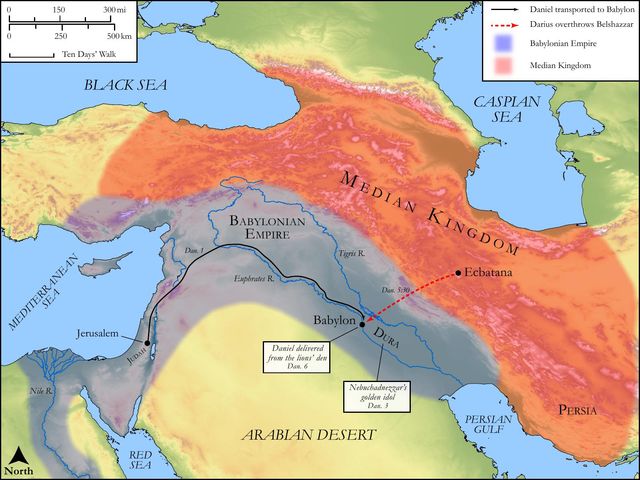
Study this verse
Public-domain commentary
Matthew Henry
From his Commentary on the Whole Bible. Henry comments on passages, not single verses — this entry covers Daniel 6:25–28. His two-level outline is real structure in the source text, so it is rendered as structure.
Darius here studies to make some amends for the dishonour he had done both to God and Daniel, in casting Daniel into the lions' den, by doing honour to both.
I.He gives honour to God by a decree published to all nations, by which they are required to fear before him.
And this is a decree which is indeed fit to be made unalterable, according to the laws of the Medes and Persians, for it is the everlasting gospel, preached to those that dwell on the earth, Rev 14:7. Fear God, and give glory to him. Observe,
1.To whom he sends this decree - to all people, nations and languages, that dwell in all the earth, Dan 6:25. These are great words, and it is true that all the inhabitants of the earth are obliged to that which is here decreed; but here they mean no more than every dominion of his kingdom, which, though it contained many nations, did not contain all nations; but so it is, those that have much are ready to think they have all.
2.What the matter of the decree is - that men tremble and fear before the God of Daniel. This goes further than Nebuchadnezzar's decree upon a similar occasion, for that only restrained people from speaking amiss of this God, but this requires them to fear before him, to keep up and express awful reverent thoughts of him. And well might this decree he prefaced, as it is, with Peace be multiplied unto you, for the only foundation of true and abundant peace is laid in the fear of God, for that is true wisdom. If we live in the fear of God, and walk according to that rule, peace shall be upon us, peace shall be multiplied to us. But, though this decree goes far, it does not go far enough; had he done right, and come up to his present convictions, he would have commanded all men not only to tremble and fear before this God, but to love him and trust in him, to forsake the service of their idols, and to worship him only, and call upon him as Daniel did. But idolatry had been so long and so deeply rooted that it was not to be extirpated by the edicts of princes, nor by any power less than that which went along with the glorious gospel of Christ.
3.What are the causes and considerations moving him to make this decree. They are sufficient to have justified a decree for the total suppression of idolatry, much more will they serve to support this. There is good reason why all men should fear before this God, for, (1.) His being is transcendent. "He is the living God, lives as a God, whereas the gods we worship are dead things, have not so much as an animal life." (2.) His government is incontestable. He has a kingdom, and a dominion; he not only lives, but reigns as an absolute sovereign. (3.) Both his being and his government are unchangeable. He is himself stedfast for ever, and with him is no shadow of turning. And his kingdom too is that which shall not be destroyed by any external force, nor has his dominion any thing in itself that threatens a decay or tends towards it, and therefore it shall be even to the end. (4.) He has an ability sufficient to support such an authority, Dan 6:27. He delivers his faithful servants from trouble and rescues them out of trouble; he works signs and wonders, quite above the utmost power of nature to effect, both in heaven and on earth, by which it appears that he is sovereign Lord of both. (5.) He has given a fresh proof of all this in delivering his servant Daniel from the power of the lions. This miracle, and that of the delivering of the three children, were wrought in the eyes of the world, were seen, published, and attested by two of the greatest monarchs that ever were, and were illustrious confirmations of the first principles of religion, abstracted from the narrow scheme of Judaism, effectual confutations of all the errors of heathenism, and very proper preparations for pure catholic Christianity.
II.He puts honour upon Daniel (Dan 6:28):
So this Daniel prospered. See how God brought to him good out of evil. This bold stroke which his enemies made at his life was a happy occasion of taking them off, and their children too, who otherwise would still have stood in the way of his preferment, and have been upon all occasions vexatious to him; and now he prospered more than ever, was more in favour with his prince and in reputation with the people, which gave him a great opportunity of doing good to his brethren. Thus out of the eater (and that was a lion too) comes forth meat, and out of the strong sweetness.
Historical interpretation
Historical reception
1 surviving comment on this verse from the historical church.
Verses 25-27. "Then king Darius wrote unto all the peoples, tribes and language-groups who dwelt in all the earth, saying: 'Your peace be multiplied! I have enacted a decree that in all my empire and kingdom men are to dread and tremble before the God of Daniel. For it is He who is the living God and the One who abides forever, and His rule shall not be overthown, and His power shall eternally endure. It is He who is the Deliverer and Savior, who performs signs and wonders in heaven and on earth, and who has delivered Daniel from the pit of lions.'" Just as in the case of Nebuchadnezzar's writing unto the language-groups and nations one authority has interpreted them to signify hostile powers, so also this same man interprets the action of Darius, on the ground that he summons them all to repentance. And he poses the question as to whether this will take place in this world or in the other world, or even after other worlds have intervened. We deem these speculations to be absurd and account them as empty fables, and make this single observation: that the reason why signs are performed amid barbarian peoples through the agency of God's servants is that the worship and religion of the only God may be proclaimed.
Continue studying Daniel 6:25 across the web’s major study libraries — every link below opens this exact verse, chapter, or book on the destination site.
Read & Compare
 BibleGatewayThis verse in more than 200 translations and 70 languages.
 Bible.comThe YouVersion reader — hundreds of translations, reading plans, and highlights.
 ESV.orgCrossway's official English Standard Version reader.
 NET BibleThe NET translation with 60,000+ translators' notes on every rendering decision.
 STEP BibleTyndale House's free study tool — original text, vocabulary, and scholarly resources.
 BibliaLogos Bible Software's free web reader.
 USCCBThe New American Bible (Revised Edition) with the U.S. bishops' study notes.
Commentaries
 BibleHub CommentariesDozens of classic commentaries on this verse, gathered on one page.
 StudyLightMore than 100 commentary sets — the largest collection on the web.
 BibleRefPlain-English commentary on what this verse means, verse by verse.
 Enduring WordDavid Guzik's free commentary on this chapter, widely used by Bible teachers.
 Bible Study ToolsVerse commentary alongside Greek and Hebrew study aids.
Original Language & Research
- BibleHub InterlinearThe verse word by word — original language, transliteration, and English.
- BibleHub LexiconEvery word's original-language definition and Strong's entry.
 Blue Letter BibleDeep-study tools — Strong's numbers, concordance, and word studies.
 SefariaThe Hebrew text with Rashi and centuries of Jewish commentary.
Sermons, Hymns & Audio


TrulyRandomVerse is not affiliated with these sites and doesn’t control their content. They’re linked because they’re genuinely useful.
Summary
Following the miraculous deliverance of Daniel from the lion's den, King Darius issues a sweeping decree to all peoples within his vast empire, acknowledging the living God and commanding reverence for Him. This proclamation, born out of awe and conviction, serves as a powerful testament to God's sovereign power and His ability to vindicate His faithful servants, extending a wish for abundant peace to all who receive it.
Context
ShowHideLiterary Context
Daniel 6:25 immediately follows the dramatic climax of Daniel's ordeal in the lion's den. Having reluctantly cast Daniel into the den (Daniel 6:16) and spent a night of anxious fasting (Daniel 6:18), King Darius rushes to the den at dawn to find Daniel miraculously unharmed (Daniel 6:19-23). Overwhelmed with joy and profound revelation, Darius orders Daniel's accusers and their families to be thrown into the den, where they are immediately devoured (Daniel 6:24). This verse, Daniel 6:25, marks the king's official, public response to this extraordinary display of divine power, mirroring earlier instances in the book where pagan monarchs, such as Nebuchadnezzar, issued decrees of praise to the God of Israel after witnessing His mighty acts, as seen in Daniel 3:28-29 and Daniel 4:1-3. The decree in Daniel 6:26-27 further elaborates on the king's command for reverence.
Historical & Cultural Context
King Darius, likely Darius the Mede (though his exact historical identity is debated among scholars, he functions as a Persian monarch in the narrative), ruled over a vast, multi-ethnic empire. Royal decrees in ancient Near Eastern empires were authoritative and far-reaching, often inscribed on public monuments or circulated throughout the provinces. For a pagan king to issue a decree acknowledging the God of a conquered people, and furthermore, to command reverence for Him across his entire domain, was highly unusual and significant. It speaks to the profound impact of Daniel's faithfulness and God's intervention. The phrase "all people, nations, and languages" reflects the diverse demographic composition of the Persian Empire, emphasizing the universal reach of Darius's authority and, by extension, the universal scope of the God he now acknowledged.
Key Themes
ShowHideThis verse powerfully contributes to several overarching themes in the book of Daniel. Firstly, it underscores the sovereignty of God over earthly rulers and kingdoms, demonstrating that even the most powerful human decrees can be overturned or repurposed by divine will. Darius, initially manipulated by envious officials, becomes an instrument for God's universal proclamation. Secondly, it highlights the vindication of the righteous, as Daniel's unwavering faithfulness is not only rewarded with deliverance but also leads to a worldwide testimony for his God. This echoes the protection of Shadrach, Meshach, and Abednego in Daniel 3. Thirdly, the decree's universal address ("all people, nations, and languages") emphasizes the universal scope of God's witness and authority, indicating that the God of Israel is not a tribal deity but the God of all the earth. Finally, the concluding wish for "Peace be multiplied unto you" introduces the theme of true peace and well-being as a divine blessing, contrasting with the turmoil and injustice that preceded it.
Exposition and Analysis
ShowHideKey Word Analysis
ShowHideThis Aramaic verb (H3790) signifies the act of inscribing or composing official documents. In the context of a royal decree, it implies a formal, authoritative, and widely disseminated communication. Darius's act of "writing" is not merely a personal reflection but a public, binding declaration, underscoring the weight and importance of his message.
This term (H5972) refers to a congregated unit or community of persons, often with a shared identity. In conjunction with "nations" and "languages," it emphasizes the diverse ethnic and social groups within the Persian Empire. The use of this collective term highlights the comprehensive reach of the king's decree, extending to every segment of society.
Corresponding to the Hebrew shalom, this Aramaic word (H8001) encompasses far more than the mere absence of conflict. It denotes holistic well-being, prosperity, completeness, harmony, and a state of flourishing. Darius's wish for "peace" is a desire for comprehensive blessing and welfare for his subjects, implicitly linking it to the God who demonstrated such power and brought peace to Daniel.
Verse Breakdown
ShowHide"¶ Then king Darius wrote unto all people, nations, and languages, that dwell in all the earth;"
This initial clause establishes the immediate consequence of Daniel's deliverance and Darius's profound realization. The king, now convinced of God's supremacy, uses his imperial authority to issue a universal decree. The comprehensive scope—"all people, nations, and languages, that dwell in all the earth"—is a hyperbolic expression characteristic of royal proclamations, signifying the decree's intended reach throughout the vast Persian Empire. It underscores the global impact of God's act through Daniel.
"Peace be multiplied unto you."
This concluding phrase functions as a royal blessing or benediction. The Aramaic word for "peace" (shᵉlâm) signifies holistic well-being, prosperity, and harmony. The verb "multiplied" (sᵉgâʼ) emphasizes an abundant, overflowing bestowal of this peace. It is a wish for comprehensive flourishing, reflecting Darius's awe at the God who brought such complete deliverance and restoration to Daniel, and perhaps a recognition that true peace comes from acknowledging such a powerful and just deity.
Literary Devices
ShowHideDaniel 6:25 employs several significant literary devices. The most prominent is Royal Edict/Proclamation, a common form in ancient Near Eastern literature, which lends authority and solemnity to the king's words. The phrase "all people, nations, and languages, that dwell in all the earth" is an example of Hyperbole, a deliberate exaggeration used to emphasize the universal and far-reaching nature of Darius's empire and, consequently, the intended scope of his decree. This also functions as Inclusio with earlier similar phrases in the book (e.g., Daniel 3:4), reinforcing the theme of God's universal revelation. There is also a strong element of Contrast in this verse, as Darius's new decree of reverence and peace stands in stark opposition to his previous, misguided decree that led to Daniel's unjust condemnation. This reversal highlights the transformative power of God's intervention.
Theological and Thematic Connections
ShowHideDaniel 6:25 stands as a powerful testament to the God who exercises ultimate sovereignty over all earthly powers. Darius's decree, born not of political maneuvering but of genuine awe at divine intervention, demonstrates that God can use even pagan rulers to declare His glory and truth to the world. It underscores the biblical truth that God's kingdom is not confined by national borders or human decrees, but extends to "all people, nations, and languages." The wish for "peace" (shalom) is deeply theological, pointing to the holistic well-being and flourishing that ultimately flows from acknowledging and honoring the one true God, a peace that transcends mere political tranquility. This divine peace is a hallmark of God's reign and a blessing He desires for all humanity.
Reflection and Application
ShowHideDaniel 6:25 offers profound encouragement for believers today. It reminds us that our faithfulness, even in the face of severe persecution or unjust practices, can become a powerful witness that transcends our immediate circumstances and impacts those in positions of authority. Just as God used Daniel's integrity to transform a king's heart and inspire a universal proclamation, so too can our consistent walk with God, marked by prayer and obedience, lead to unexpected opportunities for His glory. This verse challenges us to live lives that compel even those outside the faith to acknowledge the reality and power of God, and to be conduits of His peace in a chaotic world. It prompts us to consider: how might our steadfastness in trials be used by God to impact our communities or even broader spheres of influence?
Questions for Reflection
ShowHideFAQ
ShowHideWhy is King Darius's decree in Daniel 6:25 so significant?
ShowHideKing Darius's decree is highly significant because it represents a pagan monarch, ruling over a vast empire, publicly acknowledging and commanding reverence for the God of Israel. This is a direct result of God's miraculous deliverance of Daniel from the lion's den, demonstrating God's supreme power over earthly rulers and His ability to turn even hostile situations into opportunities for His glory. It underscores the universal scope of God's authority and the profound impact of one faithful individual's witness. This proclamation echoes similar acknowledgments from King Nebuchadnezzar in earlier chapters of Daniel, such as his praise for God after the fiery furnace incident in Daniel 3:28-29.
What does "Peace be multiplied unto you" truly mean in this context?
ShowHideThe phrase "Peace be multiplied unto you" is a profound blessing. The Aramaic word for "peace" is shᵉlâm (related to the Hebrew shalom), which means far more than just the absence of conflict. It encompasses holistic well-being, completeness, prosperity, health, harmony, and flourishing in every aspect of life. The term "multiplied" (from the Aramaic sᵉgâʼ) indicates an abundant, overflowing, and comprehensive bestowal of this peace. In this context, it signifies Darius's desire for his subjects to experience the kind of comprehensive divine blessing and security that he witnessed God bestow upon Daniel, suggesting that true peace is found in acknowledging the God who delivers and sustains.
How does Daniel 6:25 relate to the broader themes of the book of Daniel?
ShowHideDaniel 6:25 is central to several key themes in the book of Daniel. Firstly, it powerfully illustrates God's sovereignty over human kingdoms and rulers, showing that even the most powerful earthly authority is subject to His will. Secondly, it highlights the vindication and protection of the righteous, as Daniel's faithfulness is publicly honored and God's power is displayed on his behalf. Thirdly, the decree's universal address to "all people, nations, and languages" reinforces the theme of God's universal witness and authority, demonstrating that the God of Israel is the God of all the earth, not just a local deity. This aligns with the book's overarching message that God's kingdom is eternal and will ultimately triumph over all earthly empires, as seen in the prophecies of Daniel 2 and Daniel 7.
Christ-Centered Fulfillment
ShowHideKing Darius's universal decree in Daniel 6:25, commanding reverence for the living God and wishing for multiplied peace, serves as a remarkable Old Testament foreshadowing of the ultimate, universal reign of Jesus Christ. While Darius's authority was vast, it was still limited to an earthly empire. In contrast, Jesus declared, "All authority in heaven and on earth has been given to me" in Matthew 28:18. Darius's proclamation was a response to a singular, miraculous deliverance; Christ's reign is founded upon His definitive victory over sin and death through His atoning work on the cross and His resurrection, triumphing over all principalities and powers as described in Colossians 2:15. The "peace" Darius wished upon his subjects, though comprehensive, was still an earthly peace. Jesus, however, is the very embodiment of true, spiritual peace, breaking down the dividing wall of hostility and reconciling humanity to God and to one another, as detailed in Ephesians 2:14-16. His gospel is the ultimate universal decree, to be proclaimed to "all nations" through the Great Commission, offering not just multiplied peace, but eternal life and reconciliation through His blood, as affirmed in Colossians 1:20. Thus, Daniel 6:25 points to the greater King, Jesus, whose kingdom is truly universal and whose peace is eternal and all-encompassing.