


Ezra 4:17
Bible text: King James Version (1769 Blayney text) · Public domain
Bible text: King James Version with Strong's numbers · Public domain
Bible text: Berean Standard Bible · Public domain
Bible text: American Standard Version (1901) · Public domain
Bible text: World English Bible, Messianic edition · Public domain
Bible text: Geneva Bible (1599) · Public domain
Bible text: Young's Literal Translation · Public domain
- פִּתְגָמָאpit·ga·Ma'word theH6600N-cs ¦ ArtNoun Singular common gender Definiteפִּתְגָמָwordאthe
- שְׁלַחshe·Lachhe sentH7972V-Peal-Perf-3msVerb Peal Perfect 3rd Singular Masculine
- מַלְכָּאmal·Ka'king theH4430N-cs ¦ ArtNoun Singular common gender Definiteמַלְכָּkingאthe
- עַל'altoH5922PrepPreposition
- רְחוּםre·ChumRehumH7348N-proper-mNoun Proper Masculine
- בְּעֵלbe·'ellord ofH1169N-cscNoun Singular common gender Construct
- טְעֵםte·'EmcommandH2942N-csNoun Singular common gender Absolute
- וְשִׁמְשַׁיve·shim·Shaiand ShimshaiH8124Conj-w ¦ N-proper-mNoun Proper MasculineוְandשִׁמְשַׁיShimshai
- סָפְרָאsa·fe·Ra'scribe theH5613N-cs ¦ ArtNoun Singular common gender Definiteסָפְרָscribeאthe
- וּשְׁאָרu·she·'Arand [the] rest ofH7606Conj-w ¦ N-cscNoun Singular common gender Constructוּandשְׁאָר[the] rest of
- כְּנָוָתְהוֹןke·na·Va·te·Hontheir associatesH3675N-fpc ¦ 3mpNoun Plural Feminine Constructכְּנָוָתְassociatesהוֹןtheir
- דִּיdiwhoH1768ConjConjunction
- יָתְבִיןya·te·Vin[were] dwellingH3488V-Peal-Prtcpl-mpVerb Peal Participle Plural Masculine Absolute
- בְּשָׁמְרָיִןbe·sha·me·Ra·yinin SamariaH8115Prep-b ¦ N-properNoun Proper LocationבְּinשָׁמְרָיִןSamaria
- וּשְׁאָרu·she·'Arand [the] rest ofH7606Conj-w ¦ N-cscNoun Singular common gender Constructוּandשְׁאָר[the] rest of
- עֲבַר'a·var[the] region beyondH5675N-cscNoun Singular common gender Construct
- נַהֲרָהna·ha·Rah'river theH5103N-cs ¦ ArtNoun Singular common gender Definiteנַהֲרָriverהthe
- שְׁלָםshe·LampeaceH8001N-csNoun Singular common gender Absolute
- וּכְעֶתu·khe·'Etand nowH3706Conj-w ¦ AdvAdverbוּandכְעֶתnow
English is a literal word-by-word gloss of the Hebrew, not the KJV's wording. Why?
This is the original text the KJV's translators worked from — each Hebrew word with its own literal English meaning in this verse, prepared by scholars at Tyndale House, Cambridge. The KJV translates whole sentences, not word by word, so its wording differs: one Hebrew word can become several English words, and the KJV may choose “the LORD” where the gloss reads “Yahweh”. Both are faithful — they answer different questions. For the KJV's own rendering, switch to the KJV text.
Details
See on the biblical-era map
Study this verse
Public-domain commentary
Matthew Henry
From his Commentary on the Whole Bible. Henry comments on passages, not single verses — this entry covers Ezra 4:17–24. His two-level outline is real structure in the source text, so it is rendered as structure.
Here we have,
I.The orders which the king of Persia gave, in answer to the information sent him by the Samaritans against the Jews.
He suffered himself to be imposed upon by their fraud and falsehood, took no care to examine the allegations of their petition concerning that which the Jews were now doing, but took it for granted that the charge was true, and was very willing to gratify them with an order of council to stay proceedings.
1.He consulted the records concerning Jerusalem, and found that it had indeed rebelled against the king of Babylon, and therefore that it was, as they called it, a bad city (Ezr 4:19), and withal that in times past kings had reigned there, to whom all the countries on that side the river had been tributaries (Ezr 4:20), and that therefore there was danger that if ever they were able (which they were never likely to be) they would claim them again. Thus he says as they said, and pretends to give a reason for so doing. See the hard fate of princes, who must see and hear with other men's eyes and ears, and give judgment upon things as they are represented to them, though often represented falsely. God's judgment is always just because he sees things as they are, and it is according to truth.
2.He appointed these Samaritans to stop the building of the city immediately, till further orders should be given about it, Ezr 4:21, Ezr 4:22. Neither they, in their letter, nor he, in his order, make any mention of the temple, and the building of that, because both they and he knew that they had not only a permission, but a command, from Cyrus to rebuild that, which even these Samaritans had not the confidence to move for the repeal of. They spoke only of the city: "Let not that be built," that is, as a city with walls and gates; "whatever you do, prevent that, lest damage grow to the hurt of the kings:" he would not that the crown should lose by his wearing it.
II.The use which the enemies of the Jews made of these orders, so fraudulently obtained; upon the receipt of them they went up in haste to Jerusalem, Ezr 4:23. Their feet ran to evil, Pro 1:16. They were impatient till the builders were served with this prohibition, which they produced as their warrant to make them cease by force and power. As they abused the king in obtaining this order by their mis-informations, so they abused him in the execution of it; for the order was only to prevent the walling of the city, but, having force and power on their side, they construed it as relating to the temple, for it was that to which they had an ill will, and which they only wanted some colour to hinder the building of. There was indeed a general clause in the order, to cause these men to cease, which had reference to their complaint about building the walls; but they applied it to the building of the temple. See what need we have to pray, not only for kings, but for all in authority under them, and the governors sent by them, because the quietness and peaceableness of our lives, in all godliness and honesty, depend very much upon the integrity and wisdom of inferior magistrates, as well as the supreme. The consequence was that the work of the house of God ceased for a time, through the power and insolence of its enemies; and so, through the coldness and indifference of its friends, it stood still till the second year of Darius Hystaspes, for to me it seems clear by the thread of this sacred history that it was that Darius, Ezr 4:24. Though now a stop was put to it by the violence of the Samaritans, yet that they might soon after have gone on by connivance, if they had had a due affection to the work, appears by this, that before they had that express warrant from the king for doing it (ch. 6) they were reproved by the prophets for not doing it, Ezr 5:1, compared with Hag 1:1, etc. If they had taken due care to inform Cambyses of the truth of this case, perhaps he would have recalled his order; but, for aught I know, some of the builders were almost as willing it should cease as the adversaries themselves were. At some periods the church has suffered more by the coldness of its friends than by the heat of its enemies; but both together commonly make church-work slow work.
Historical interpretation
Historical reception
2 surviving comments on this verse. Each one is dated, so this reads as a timeline rather than a list.
The Jews said, “This temple was built in forty-six years, and you will raise it up in three days?” They answered as they understood. But lest we too should perceive our Lord’s spiritual word in a carnal way, the Evangelist subsequently explained what temple it was of which he was speaking. As for their stating that the temple was built in forty-six years, they meant not its first but its second building. For Solomon, the first [builder], finished the temple very rapidly within seven years, during a time of great peace in his kingdom. It was destroyed by the Chaldeans, but after seventy years it began to be rebuilt, at the bidding of Cyrus the Persian, when the captivity was lightened. But the descendants of those who were deported were unable to finish the work that they were doing under the rulers Zerubbabel and Jeshua before forty-six years had passed, on account of the resistance of the neighboring nations.This number [forty-six] of years is also most apt for the perfecting of our Lord’s physical body. Writers on natural history tell us that the form of the human body is completed within this number of days. During the first six days after conception it has a likeness to milk; during the following nine days it is changed into blood; next, in twelve days, it becomes solid; during the remaining eighteen days it is formed into the perfect features of all its members; and after this, during the time remaining until birth, it increases in size. Six plus nine plus twelve plus eighteen makes forty-five. If to this we add one, that is, the day on which the body, divided into its separate members, begins to grow, we find the same number of days in the building up of our Lord’s body as there were years in the construction of the temple.
The king sent word to Rehum the commander and to Shimshai the scribe, etc. The sense of the letter is clear, and so is the allegory; because the profane king, namely the ancient adversary, most gladly supports the wishes of those who persecute the Church, and prohibit it from being built. But the enemies of Jerusalem dwell in Samaria, which is interpreted as guardian; not because they can in any way keep the precepts of faith and truth, who are proven by obstinate mind to oppose the true vision of peace, but because they themselves boast that the custody of virtues remains with them when they fight against the walls of peace through heresy.
Continue studying Ezra 4:17 across the web’s major study libraries — every link below opens this exact verse, chapter, or book on the destination site.
Read & Compare
 BibleGatewayThis verse in more than 200 translations and 70 languages.
 Bible.comThe YouVersion reader — hundreds of translations, reading plans, and highlights.
 ESV.orgCrossway's official English Standard Version reader.
 NET BibleThe NET translation with 60,000+ translators' notes on every rendering decision.
 STEP BibleTyndale House's free study tool — original text, vocabulary, and scholarly resources.
 BibliaLogos Bible Software's free web reader.
 USCCBThe New American Bible (Revised Edition) with the U.S. bishops' study notes.
Commentaries
 BibleHub CommentariesDozens of classic commentaries on this verse, gathered on one page.
 StudyLightMore than 100 commentary sets — the largest collection on the web.
 BibleRefPlain-English commentary on what this verse means, verse by verse.
 Enduring WordDavid Guzik's free commentary on this chapter, widely used by Bible teachers.
 Bible Study ToolsVerse commentary alongside Greek and Hebrew study aids.
Original Language & Research
- BibleHub InterlinearThe verse word by word — original language, transliteration, and English.
- BibleHub LexiconEvery word's original-language definition and Strong's entry.
 Blue Letter BibleDeep-study tools — Strong's numbers, concordance, and word studies.
 SefariaThe Hebrew text with Rashi and centuries of Jewish commentary.
Sermons, Hymns & Audio


TrulyRandomVerse is not affiliated with these sites and doesn’t control their content. They’re linked because they’re genuinely useful.
Summary
Ezra 4:17 records the official and authoritative reply from King Artaxerxes of Persia to the deceptive letter submitted by the Samaritan officials, Rehum the chancellor and Shimshai the scribe. This royal communication acknowledges the adversaries' accusations against the Jewish people's efforts to rebuild the temple in Jerusalem and serves as the precursor to the king's subsequent decree to halt the construction work. The verse highlights the significant influence wielded by the opposition within the Persian administrative system and marks a critical turning point in the narrative of the temple's restoration.
Context
ShowHideLiterary Context
Ezra 4:17 is a crucial verse within the Aramaic section of Ezra (Ezra 4:8-6:18), which interrupts the chronological flow of the temple rebuilding to detail the persistent and varied opposition faced by the returned exiles. It immediately follows the adversaries' cunning and accusatory letter to King Artaxerxes (Ezra 4:11-16), a document that falsely portrayed the Jews as rebellious and their rebuilding efforts as a direct threat to Persian imperial authority and revenue. This verse initiates the king's formal reply, which will culminate in a decree to cease the building work (Ezra 4:18-22). The narrative structure here emphasizes a direct cause-and-effect relationship: the adversaries' petition directly elicits this royal response, leading to a significant setback for the Jewish community's sacred mission to restore God's house. The placement of this Aramaic interlude, covering events under later kings (Ahasuerus/Xerxes and Artaxerxes), underscores the enduring nature of the opposition, which spanned multiple reigns and tactics.
Historical & Cultural Context
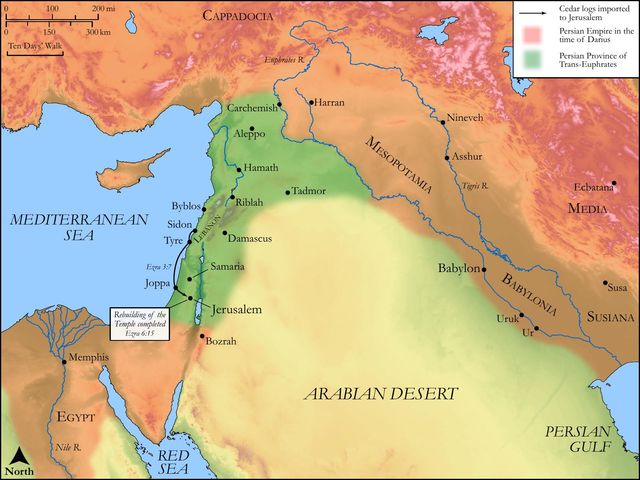
The setting is the vast Persian Empire, a highly centralized and bureaucratic entity where communication and administration were meticulously formalized. The phrase "beyond the river" refers to the satrapy (province) of Trans-Euphrates, a vital administrative region that encompassed Judah and Samaria. Rehum and Shimshai were high-ranking officials within this imperial structure—a "chancellor" (or commissioner) and a "scribe"—indicating their direct access to royal authority and their capacity to influence policy. The historical animosity between the Jews and the Samaritans, rooted in the Assyrian resettlement of Samaria after the fall of the Northern Kingdom, provided a deep-seated motivation for the opposition. Persian kings, including Artaxerxes I (Longimanus, 465-424 BC), were pragmatic rulers primarily concerned with maintaining order, collecting taxes, and preventing rebellion. This made them susceptible to accusations that framed the Jews' activities as a threat to imperial stability, as seen in the adversaries' detailed claims in Ezra 4:13-16.
Key Themes
ShowHideThis verse powerfully illustrates the theme of opposition to God's work. Even when God's people are engaged in a divinely ordained task, they encounter significant resistance, often from powerful and politically astute adversaries who operate through official channels. It also highlights the authority of earthly rulers and the intricate workings of imperial bureaucracy. While the king's decision appears to be a setback, the broader narrative of Ezra underscores God's ultimate sovereignty over human rulers and circumstances, demonstrating that His purposes will ultimately prevail, even if delayed. The theme of false accusation and deception is also prominent, as the adversaries' letter was built on lies designed to manipulate royal authority, a tactic that sadly succeeds in the short term. The formal nature of the communication also speaks to the importance of official records and decrees within the Persian system, which would later prove crucial for the reversal of this very decree, as seen in Ezra 6:1-12. The narrative arc, from opposition to eventual triumph, mirrors the journey of faith for God's people.
Exposition and Analysis
ShowHideKey Word Analysis
ShowHideThis term refers to the monarch, Artaxerxes, who holds ultimate authority within the Persian Empire. The use of this Aramaic term emphasizes the imperial context and the absolute power vested in the ruler. His "sending an answer" signifies a formal, binding decree that carries the weight of the empire.
This compound term describes Rehum's high-ranking position. The first part, bᵉʻêl (H1169), means "master" or "lord," indicating authority. The second part, ṭᵉʻêm (H2942), refers to "judgment," "command," or "account." Together, they denote an official with significant administrative, judicial, and advisory power, responsible for issuing decrees and overseeing provincial affairs. Rehum's title underscores his formidable influence and direct access to royal decision-making.
This is a formal, administrative salutation found in royal correspondence. While shᵉlâm (H8001) means "prosperity" or "peace," the addition of kᵉʻeneth (H3706), meaning "thus" or "at such a time," transforms it from a personal greeting into a curt, official acknowledgment of receipt. It signals that the king has processed the communication and is now ready to issue a command or disposition. It is not an expression of goodwill but a formal bureaucratic transition to the king's directive, setting the stage for the subsequent injunction.
Verse Breakdown
ShowHide"Then sent the king an answer unto Rehum the chancellor, and to Shimshai the scribe"
This opening clause immediately establishes the king's direct engagement with the primary instigators of the opposition. It highlights the formal nature of Persian imperial communication, where complaints from high-ranking officials received direct and official replies from the monarch. The specific naming of Rehum and Shimshai underscores their prominence and the king's recognition of their authority and the weight of their accusations, indicating that their letter was taken seriously at the highest level.
"and to the rest of their companions that dwell in Samaria, and unto the rest beyond the river"
This expands the scope of the king's address, indicating that the opposition was not limited to just two individuals but encompassed a broader network of officials, administrators, and inhabitants across the province of Trans-Euphrates, particularly those in Samaria. This demonstrates the widespread nature of the animosity towards the Jews and the comprehensive reach of the king's decree, which would affect all those involved in or affected by the rebuilding efforts, making it an empire-wide directive.
"Peace, and at such a time"
This concluding phrase of the verse serves as the formal opening of the king's reply. As elaborated in "Key Word Analysis," it is a standard administrative salutation in Aramaic royal correspondence. It signals that the king has received and understood the previous communication (the adversaries' letter) and is now about to issue his official decision or command. It is a formal, almost curt, acknowledgment that sets the stage for the subsequent decree to halt the temple rebuilding, devoid of personal warmth but laden with official authority.
Literary Devices
ShowHideEzra 4:17 primarily employs Formalism and Bureaucracy as central literary devices, meticulously reflecting the highly structured and administrative nature of the Persian Empire. The precise naming of the recipients—Rehum, Shimshai, "the rest of their companions," "those that dwell in Samaria," and "the rest beyond the river"—emphasizes the official and comprehensive scope of the royal communication, illustrating the rigid hierarchy and widespread reach of imperial power. There is a subtle but potent element of Irony in the opening greeting "Peace," as the subsequent decree from the king, detailed in the following verses, will bring anything but peace to the Jewish exiles, instead imposing a significant setback on their sacred work. This stark contrast between the conventional salutation and the impending negative command subtly highlights the adversarial nature of the communication despite its polite veneer. Furthermore, the phrase "beyond the river" functions as a Metonymy or Synecdoche, representing the entire satrapy or province of Trans-Euphrates, thereby encompassing all the administrative and geographical entities under the jurisdiction of the named officials, signifying the broad impact of the royal decree.
Theological and Thematic Connections
ShowHideEzra 4:17 serves as a stark reminder that the work of God often encounters significant, well-organized, and politically astute opposition. This verse reveals that even legitimate governmental channels can be manipulated by those with malicious intent, leading to setbacks for God's people. The temporary success of the adversaries in halting the temple rebuilding demonstrates that God permits delays and challenges, not as a sign of His weakness, but often as a test of faith, a means to refine His people, or to highlight His ultimate sovereignty when He eventually intervenes. Despite the apparent triumph of the opposition, the broader biblical narrative consistently affirms that God's purposes cannot ultimately be thwarted by human or demonic schemes.
Reflection and Application
ShowHideEzra 4:17 offers profound lessons for believers today, particularly when engaged in God's work. It reminds us that opposition is not an anomaly but often an expected part of spiritual endeavors. This opposition may not always come as overt persecution but can manifest through bureaucratic hurdles, false accusations, political maneuvering, or seemingly legitimate channels. When faced with such setbacks, we are called to discern the spiritual forces at play, to persevere in faith, and to trust in God's ultimate timing and sovereignty. The temporary halt in Ezra's narrative did not mean God's plan was abandoned; rather, it was a period of waiting and preparation for His subsequent intervention. Our response to delays and opposition should be rooted in prayer, seeking wisdom, and maintaining a steadfast commitment to the call, knowing that God works all things for His glory and the good of His people. This verse encourages us to remain vigilant against deceptive tactics and to remember that even in moments of apparent defeat, God remains on His throne, orchestrating events for His ultimate purposes.
Questions for Reflection
ShowHideFAQ
ShowHideWhy is this section of Ezra written in Aramaic instead of Hebrew?
ShowHideThe section from Ezra 4:8 to 6:18 (and also Ezra 7:12-26) is written in Aramaic because it contains official correspondence and decrees from the Persian court. Aramaic was the lingua franca of the Persian Empire, serving as the administrative and diplomatic language across its vast territories. By including these documents in their original Aramaic, the biblical author authenticates the historical record and provides direct evidence of the imperial communications that impacted the Jewish exiles, lending credibility and authority to the narrative.
Who was King Artaxerxes mentioned in this verse, and how does he relate to other kings in Ezra?
ShowHideThe King Artaxerxes in Ezra 4:17 is generally identified as Artaxerxes I Longimanus, who reigned from 465 to 424 BC. It's important to note that the narrative in Ezra 4 is not strictly chronological after Ezra 4:5. While the temple rebuilding began under King Cyrus (c. 539-530 BC) and was completed under King Darius I (c. 522-486 BC), the opposition described in Ezra 4:6-23 spans the reigns of Ahasuerus (Xerxes I, 486-465 BC) and Artaxerxes I. This particular letter and response, leading to the halt of the work, occurred during Artaxerxes I's reign, explaining the significant delay in the temple's completion which was eventually resumed and finished under Darius, as recorded in Ezra 6.
What is the deeper significance of the phrase "Peace, and at such a time" beyond a simple greeting?
ShowHideThe phrase "Peace, and at such a time" (Aramaic: shĕlām ûḵĕ'etā') is more than a casual greeting; it is a formal, administrative opening in royal correspondence. Its significance lies in its function as an official acknowledgment of receipt of the previous communication (the adversaries' letter). It signals that the king has fully processed the information and is now ready to issue his authoritative disposition or command regarding the matter. Far from conveying personal goodwill or a desire for true peace, it is a curt, bureaucratic transition that sets the stage for the king's subsequent decree to halt the Jewish rebuilding efforts, making it a phrase pregnant with negative implications for the exiles.
Christ-Centered Fulfillment
ShowHideEzra 4:17, detailing the formal and politically orchestrated opposition to the rebuilding of the temple, powerfully foreshadows the persistent resistance faced by God's ultimate Temple, Jesus Christ, and His church. Just as the adversaries sought to halt the physical restoration of God's dwelling place in Jerusalem through cunning and bureaucratic maneuvering, so too did spiritual and earthly powers conspire against Christ's ministry and the establishment of His spiritual kingdom. The temporary success of the opposition in Ezra reminds us that the Kingdom of God often faces formidable obstacles in this fallen world, but these are always ultimately subject to God's sovereign plan. Christ Himself declared that the gates of Hades would not prevail against His church, which He is continually building (Matthew 16:18). He is the true Temple, whose body was destroyed and raised in three days (John 2:19-21), signifying His triumph over death and all opposition. The bureaucratic decree that halted the temple work in Ezra is ultimately overcome by God's greater decree, just as all earthly powers, principalities, and authorities have been disarmed and triumphed over by Christ on the cross (Colossians 2:15). The narrative of delay and eventual triumph in Ezra points forward to the ultimate and irreversible reign of Christ, when the kingdom of the world will become the kingdom of our Lord and of His Christ, and He will reign forever and ever (Revelation 11:15). This verse, therefore, implicitly points to the enduring reality that God's redemptive purposes, centered in Christ, cannot be ultimately thwarted by any human or demonic opposition.