


Acts 23:26
Bible text: King James Version (1769 Blayney text) · Public domain
Bible text: Berean Standard Bible · Public domain
Bible text: American Standard Version (1901) · Public domain
Bible text: World English Bible, Messianic edition · Public domain
Bible text: Geneva Bible (1599) · Public domain
Bible text: Young's Literal Translation · Public domain
- ΚλαύδιοςKlaudiosClaudiusG2804N-NSM-PNoun Nominative Singular Masculine Individual
- ΛυσίαςLusiasLysiasG3079N-NSM-PNoun Nominative Singular Masculine Individual
- τῷtōTo theG3588T-DSMDefinite article Dative Singular Masculine
- κρατίστῳkratistōmost excellentG2903A-DSMAdjective Dative Singular Masculine
- ἡγεμόνιhēgemonigovernorG2232N-DSMNoun Dative Singular Masculine
- ΦήλικιPhēlikiFelixG5344N-DSM-PNoun Dative Singular Masculine Individual
- χαίρεινchaireinGreetingG5463V-PANVerb Present Active Infinitive
English is a literal word-by-word gloss of the Greek, not the KJV's wording. Why?
This is the original text the KJV's translators worked from — each Greek word with its own literal English meaning in this verse, prepared by scholars at Tyndale House, Cambridge. The KJV translates whole sentences, not word by word, so its wording differs: one Greek word can become several English words, and the KJV may choose “charity” where the gloss reads “love”. Both are faithful — they answer different questions. For the KJV's own rendering, switch to the KJV text.
Details
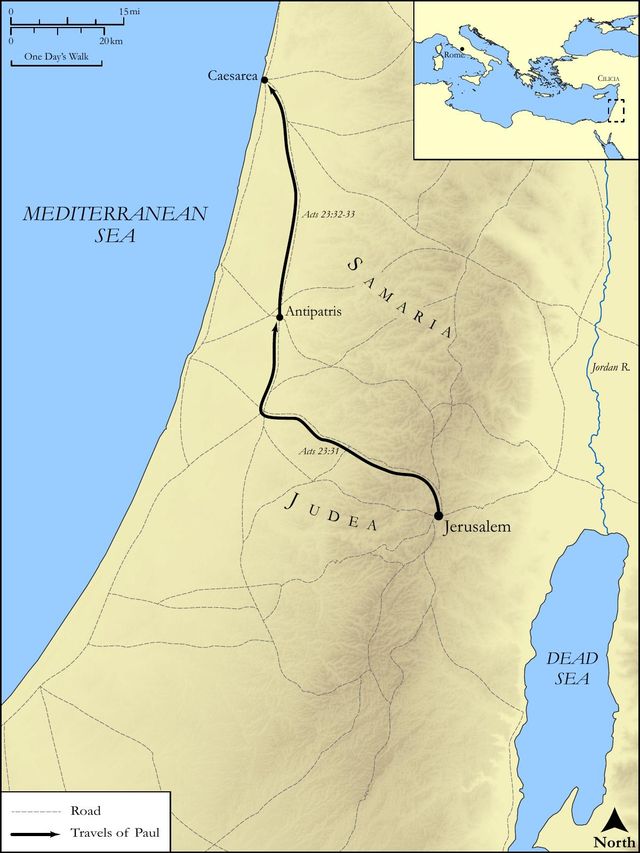
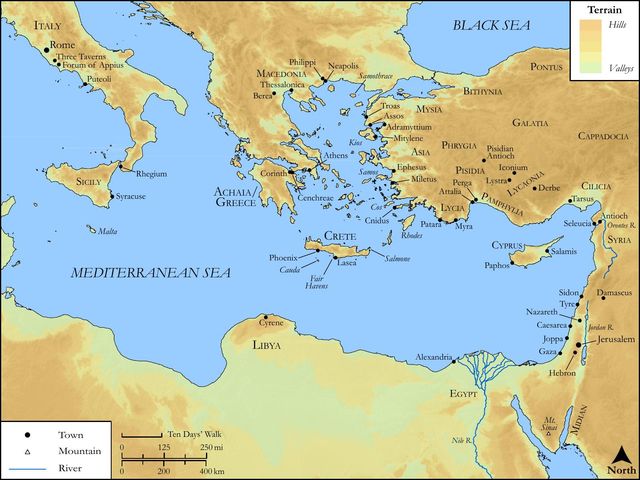
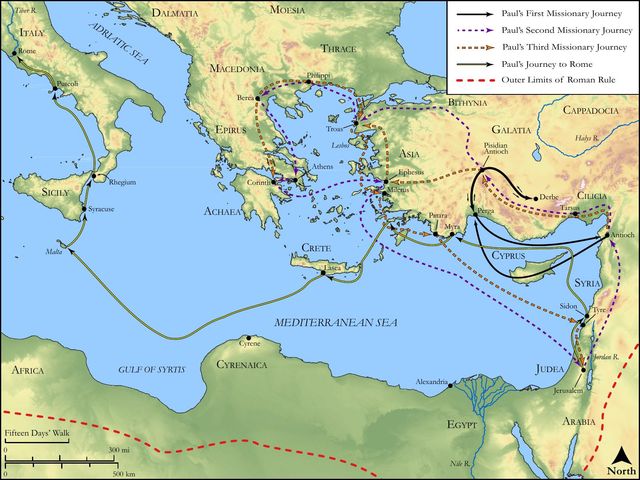
See on the biblical-era maps
Study this verse
Public-domain commentary
Matthew Henry
From his Commentary on the Whole Bible. Henry comments on passages, not single verses — this entry covers Acts 23:12–35. His four-level outline is real structure in the source text, so it is rendered as structure.
We have here the story of a plot against the life of Paul; how it was laid, how it was discovered, and how it was defeated.
I.How this plot was laid.
They found they could gain nothing by popular tumult, or legal process, and therefore have a recourse to the barbarous method of assassination; they will come upon him suddenly, and stab him, if they can but get him within their reach. So restless is their malice against this good man that, when one design fails, they will turn another stone. Now observe here,
1.Who they were that formed this conspiracy. They were certain Jews that had the utmost degree of indignation against him because he was the apostle of the Gentiles, Act 23:12. And they were more than forty that were in the design, Act 23:13. Lord, how are they increased that trouble me!
2.When the conspiracy was formed: When it was day. Satan had filled their hearts in the night to purpose it, and, as soon as it was day, they got together to prosecute it; answering to the account which the prophet gives of some who work evil upon their beds, and when the morning is light they practise it, and are laid under a woe for it, Mic 2:1. In the night Christ appeared to Paul to protect him, and, when it was day, here were forty men appearing against him to destroy him; they were not up so soon but Christ was up before them God shall help her, and that right early, Psa 46:5.
3.What the conspiracy was. These men banded together in a league, perhaps they called it a holy league; they engaged to stand by one another, and every one, to his power, to be aiding and assisting to murder Paul. It was strange that so many could so soon be got together, and that in Jerusalem too, who were so perfectly lost to all sense of humanity and honour as to engage in so bloody a design. Well might the prophet's complaint be renewed concerning Jerusalem (Isa 1:21): Righteousness has lodged in it, but now murderers. What a monstrous idea must these men have formed of Paul, before they could be capable of forming such a monstrous design against him; they must be made to believe that he was the worst of men, an enemy to God and religion, and the curse and plague of his generation; when really his character was the reverse of all this! What laws of truth and justice so sacred, so strong which malice and bigotry will not break through!
4.How firm they made it, as they thought, that none of them might fly off, upon conscience of the horror of the fact, at second thoughts: They bound themselves under an anathema, imprecating the heaviest curses upon themselves, their souls, bodies, and families, if they did not kill Paul, and so quickly that they would not eat nor drink till they had done it. What a complication of wickedness is here! To design to kill an innocent man, a good man, a useful man, a man that had done them no harm, but was willing to do them all the good he could, was going in the way of Cain, and proved them to be of their father the devil, who was a murderer from the beginning; yet, as if this had been a small matter,
(1.)They bound themselves to it. To incline to do evil, and intend to do it, is bad; but to engage to do it is much worse. This is entering into covenant with the devil; it is swearing allegiance to the prince of darkness; it is leaving no room for repentance; nay, it is bidding defiance to it.
(2.)They bound one another to it, and did all they could, not only to secure the damnation of their own souls, but of theirs whom they drew into the association.
(3.)They showed a great contempt of the providence of God, and a presumption upon it, in that they bound themselves to do such a thing within so short a time as they could continue fasting, without any proviso or reserve for the disposal of an overruling Providence. When we say, Tomorrow we will do this or that, be it ever so lawful and good, forasmuch as we know not what shall be on the morrow, we must add, If the Lord will. But with what face could they insert a proviso for the permission of God's providence when they knew that what they were about was directly against the prohibitions of God's work?
(4.)They showed a great contempt of their own souls and bodies; of their own souls in imprecating a curse upon them if they did not proceed in this desperate enterprise (what a woeful dilemma did they throw themselves upon! God certainly meets them with his curse if they do go on in it, and they desire he would if they do not! - nd of their own bodies too (for wilful sinners are the destroyers of both) in tying themselves out from the necessary supports of life till they had accomplished a thing which they could never lawfully do, and perhaps not possibly do. Such language of hell those speak that wish God to damn them, and the devil to take them, if they do not do so and so. As they love cursing, so shall it come unto them. Some think the meaning of this curse was, they would either kill Paul, as an Achan, an accursed thing, a troubler of the camp; or, if they did not do it, they would make themselves accursed before God in his stead.
(5.)They showed a most eager desire to compass this matter, and an impatience till was done: not only like David's enemies, that were mad against him, and sworn against him (Psa 102:8), but like the servants of Job against his enemy: O that we had of this flesh! we cannot be satisfied, Job 31:31. Persecutors are said to eat up God's people as they eat bread; it is as much a gratification to them as meat to one that is hungry, Psa 14:4.
5.What method they took to bring it about. There is no getting near Paul in the castle. He is there under the particular protection of the government, and is imprisoned, not, as others are, lest he should do harm, but lest he should have harm done him; and therefore the contrivance is that the chief priests and elders must desire the governor of the castle to let Paul come to them to the council-chamber, to be further examined (they have some questions to ask him, or something to say to him), and the, in his passage from the castle to the council, they would put an end to all disputes about Paul by killing him; thus the plot was laid, Act 23:14, Act 23:15. Having been all day employed in engaging one another to this wickedness, towards evening they come to the principal members of the great sanhedrim, and, though they might have concealed their mean design and yet might have moved them upon some other pretence to send for Paul, they are so confident of their approbation of this villainy, that they are not ashamed nor afraid to own to them that they have bound themselves under a great curse, without consulting the priests first whether they might lawfully do it, that they will eat nothing the next day till they have killed Paul. They design to breakfast the next morning upon his blood. They doubt not but the chief priests will not only countenance them in the design, but will lend them a helping hand, and be their tools to get them an opportunity of killing Paul; nay, and tell a lie for them too, pretending to the chief captain that they would enquire something more perfectly concerning him, when they meant no such thing. What a mean, what an ill opinion had they of their priests, when they could apply to them on such an errand as this! And yet, vile as the proposal was which was made to them (for aught that appears), the priests and elders consented to it, and at the first work, without boggling at it in the least, promised to gratify them. Instead of reproving them, as they ought, for their wicked conspiracy, they bolstered them up in it, because it was against Paul whom they hated; and thus they made themselves partakers of the crime as much as if they had been the first in the conspiracy.
II.How the plot was discovered.
We do not find that the plotters, though they took an oath of fidelity, took an oath of secrecy, either because they thought it did not need it (they would every one keep his own counsel) or because they thought they could accomplish it, though it should take wind and be known; but Providence so ordered it that it was brought to light, and so as effectually to be brought to nought. See here,
1.How it was discovered to Paul, Act 23:16. There was a youth that was related to Paul, his sister's son, whose mother probably lived in Jerusalem; and some how or other, we are not told how, he heard of their lying in wait, either overheard them talking of it among themselves, or got intelligence from some that were in the ploy: and he went into the castle, probably, as he used to do, to attend on his uncle, and bring him what he wanted, which gave him a free access to him and he told Paul what he heard. Note, God has many ways of bringing to light the hidden works of darkness; though the contrivers of them dig deep to hide them from the Lord, he can made a bird of the air to carry the voice (Ecc 10:20), or the conspirators' own tongues to betray them.
2.How it was discovered to the chief captain by the young man that told it to Paul. This part of the story is related very particularly, perhaps because the penman was an eye-witness of the prudent and successful management of this affair, and remembered it with a great deal of pleasure.
(1.)Paul had got a good interest in the officers that attended, by his prudent peaceable deportment. He could call one of the centurions to him, though a centurion was one in authority, that had soldiers under him, and used to call, not to be called to, and he was ready to come at his call (Act 23:17); and he desired that he would introduce this young man to the chief captain, to give in an information of something that concerned the honour of the government.
(2.)The centurion very readily gratified him, Act 23:18. He did not send a common soldier with him, but went himself to keep the young man in countenance, to recommend his errand to the chief captain, and to show his respect to Paul: "Paul the prisoner (this was his title now) called me to him, and prayed me to bring this young man to thee; what his business is I know not, but he has something to say to thee." Note, It is true charity to poor prisoners to act for them as well as to give to them. "I was sick and in prison, and you went on an errand for me," will pass as well in the account as, "I was sick and in prison, and you came unto me, to visit me, or sent me a token." Those that have acquaintance and interest should be ready to use them for the assistance of those that are in distress. This centurion helped to save Paul's life by this piece of civility, which should engage us to be ready to do the like when there is occasion. Open thy mouth for the dumb, Pro 31:8. Those that cannot give a good gift to God's prisoners may yet speak a good word for them.
(3.)The chief captain received the information with a great deal of condescension and tenderness, Act 23:19. He took the young man by the hand, as a friend or father, to encourage him, that he might not be put out of countenance, but might be assured of a favourable audience. The notice that is taken of this circumstance should encourage great men to take themselves easy of access to the meanest, upon any errand which may give them an opportunity of doing good - to condescend to those of low estate. This familiarity to which this Roman tribune or colonel admitted Paul's nephew is here upon record to his honour. Let no man think he disparages himself by his humility or charity. He went with him aside privately, that none might hear his business, and asked him, "What is it that thou hast to tell me? Tell me wherein I can be serviceable to Paul." It is probable that the chief captain was the more obliging in this case because he was sensible he had run himself into a premunire in binding Paul, against his privilege as a Roman citizen, which he was willing now to atone for.
(4.)The young man delivered his errand to the chief captain very readily and handsomely (Act 23:20, Act 23:21). "The Jews" (he does not say who, lest he should invidiously reflect upon the chief priests and the elders; and his business was to save his uncle's life, not to accuse his enemies) "have agreed to desire thee that thou wouldest bring down Paul tomorrow into the council, presuming that, being so short a distance, thou wilt send him without a guard; but do not thou yield unto them, we have reason to believe thou wilt not when thou knowest the truth; for there lie in wait for him of them more than forty me, who have sworn to be the death of him, and now are they ready looking for a promised from thee, but I have happily got the start of them." (5.) The captain dismissed the young man with a charge of secrecy: See that thou tell no man that thou hast shown these things unto me, Act 23:22. The favours of great men are not always to be boasted of; and not fit to be employed in business. If it should be known that the chief captain had this information brought to him, perhaps they would compass and imagine the death of Paul some other way; "therefore keep it private."
III.How the plot was defeated:
The chief captain, finding how implacable and inveterate the malice of the Jews was against Paul, how restless they were in their designs to do him a mischief, and how near he was to become himself accessory to it as a minister, resolves to send him away with all speed out of their reach. He received the intelligence with horror and indignation at the baseness and bloody-mindedness of these Jews; and seemed afraid lest, if he should detain Paul in his castle here, under ever so strong a guard, they would find some way or other to compass their end notwithstanding, either beating the guards or burning the castle; and, whatever came of it, he would, if possible, protect Paul, because he looked upon it that he did not deserve such treatment. What a melancholy observation is it, that the Jewish chief priests, when they knew of this assassination-plot, should countenance it, and assist in it, while a Roman chief captain, purely from a natural sense of justice and humanity, when he knows it, sets himself to baffle it, and puts himself to a great deal of trouble to do it effectually!
1.He orders a considerable detachment of the Roman forces under his command to get ready to go to Caesarea with all expedition, and to bring Paul thither to Felix the governor, where he might sooner expect to have justice done him than by the great sanhedrim at Jerusalem. I see not but the chief captain might, without any unfaithfulness to the duty of his place, have set Paul at liberty, and given him leave to shift for his own safety, for he was never legally committed to his custody as a criminal, he himself owns that nothing was laid to his charge worthy of bonds (Act 23:29), and he ought to have had the same tenderness for his liberty that he had for his life; but he feared that this would have incensed the Jews too much against him. Or perhaps, finding Paul to be a very extraordinary man, he was proud to have him his prisoner, and under his protection; and the mighty parade with which he sent him off intimates as much. Two centurions, or captains of the hundreds, are employed in this business, Act 23:23, Act 23:24. They must get ready two hundred soldiers, probably those under their own command, to go to Caesarea; and with these seventy horse, and two hundred spearmen besides, which some think were the chief captain's guards; whether they were horse or foot is not certain, most probably foot, as pikemen for the protection of the horse. See how justly God brought the Jewish nation under the Roman yoke, when such a party of the Roman army was necessary to restrain them from the most execrable villanies! There needed not all this force, there needed not any of it, to keep Paul from being rescued by his friends; ten times this force would not have kept him from being rescued by an angel, if it had pleased God to work his deliverance that way, as he had sometimes done; but,
(1.)The chief captain designed hereby to expose the Jews, as a headstrong tumultuous people, that would not be kept within the bounds of duty and decency by the ordinary ministers of justice, but needed to be awed by such a train as this; and, hearing how many were in the conspiracy against Paul, he thought less would not serve to defeat their attempt.
(2.)God designed hereby to encourage Paul; for, being thus attended, he was not only kept safely in the hands of his friends, but out of the hands of his enemies. Yet Paul did not desire such a guard, any more than Ezra did (Ezr 8:22), and for the same reason, because he trusted in God's all-sufficiency; it was owing, however, to the governor's own care. But he was also made considerable; thus his bonds in Christ were made manifest all the country over (Phi 1:13); and, son great an honour having been put upon them before by the prediction of them, it was agreeable enough that they should be thus honourably attended, that the brethren in the Lord might wax the more confident by his bonds, when they same him rather guarded as the patriot of his country than guarded against as the pest of his country, and so great a preacher made so great a prisoner. When his enemies hate him, and I doubt his friends neglect him, then does a Roman tribune patronise him, and carefully provide,
[1.]For his ease: Let them provide beasts, that they may set Paul on. Had his Jewish persecutors ordered his removal by habeas corpus to Caesarea, they would have made him run on foot, or dragged him thither in a cart, or on a sledge, or have horsed him behind one of the troopers; but the chief captain treats him like a gentleman, though he was his prisoner, and orders him a good horse to ride upon, not at all afraid that he should ride away. Nay, the order being that they should provide, not a beast, but beasts, to set Paul on, we must either suppose that he was allowed so great a piece of state as to have a led horse, or more, that if he did not like one he might take to another; or (as some expositors conjecture) that he had beasts assigned him for his friends and companions, as many as pleased to go along with him, to divert him in his journey, and to minister to him.
[2.]For his security. They have a strict charge given them by their commander in chief to bring him safely to Felix the governor, to whom he is consigned, and who was supreme in all civil affairs among the Jews, as this chief captain was in military affairs. The Roman historians speak much of this Felix, as a man of mean extraction, but that raised himself by his shifts to be governor of Judea, in the execution of which office, Tacitus, Hist. 5, says this of him: Per omnem saevitiam ac libidinem jus regium servili ingenio exercui - He used royal power with a servile genius, and in connection with all the varieties of cruelty and lust. To the judgement of such a man as this is poor Paul turned over; and yet better so than in the hands of Ananias the high priest! Now, a prisoner, thus upon his deliverance by course of law, ought to be protected as well as a prince.
2.The chief captain orders, for the greater security of Paul, that he be taken away at the third hour of the night, which some understand of three hours after sun-set, that, it being now after the feast of pentecost (that is, in the midst of summer), they might have the cool of the night to march in. Others understand it of three hours after midnight, in the third watch, about three in the morning, that they might have the day before them, and might get out of Jerusalem before Paul's enemies were stirring, and so might prevent any popular tumult, and leave them to roar when they rose, like a lion disappointed of his prey.
3.He writes a letter to Felix the governor of this province, by which he discharges himself from any further care about Paul, and leaves the whole matter with Felix. This letter is here inserted totidem verbi - erbatim, Act 23:25. It is probable that Luke the historian had a copy of it by him, having attended Paul in this remove. Now in this epistle we may observe,
(1.)The compliments he passes upon the governor, Act 23:26. He is the most excellent governor Felix, this title being given him of course, his excellency, etc. He sends him greeting, wishes him all health and prosperity; may he rejoice, may he ever rejoice.
(2.)The just and fair account which he gives him of Paul's case:
[1.]That he was one that the Jews had a pique against: They had taken him, and would have killed him; and perhaps Felix knew the temper of the Jews so well that he did not think much the worse of him for that, Act 23:27.
[2.]That he had protected him because he was a Roman: "When they were about to kill him, I came with an army, a considerable body of men, and rescued him;" which action for a citizen of Rome would recommend him to the Roman governor.
[3.]That he could not understand the merits of his cause, nor what it was that made him so odious to the Jews, and obnoxious to their ill-will. He took the proper method to know: he brought him forth into their council (Act 23:28), to be examined there, hoping that, either from their complaints or his own confession, he would learn something of the ground of all this clamour, but he found that he was accused of questions of their law (Act 23:29), about the hope of the resurrection of the dead, Act 23:6. This chief captain was a man of sense and honour, and had good principles in him of justice and humanity; and yet see how slightly he speaks of another world, and the great things of that world, as if that were a question, which is of undoubted certainty, and which both sides agreed in, except the Sadducees; and as if that were a question only of their law, which is of the utmost concern to all mankind! Or perhaps he refers rather to the question about their rituals than about their doctrinals, and the quarrel he perceived they had with him was for lessening the credit and obligation of their ceremonial law, which he looked upon as a thing not worth speaking of. The Romans allowed the nations they conquered the exercise of their own religion, and never offered to impose theirs upon them; yet, as conservators of the public peace, they wound not suffer them, under colour of their religion, to abuse their neighbours.
[4.]That thus far he understood that there was nothing laid to his charge worthy of death or of bonds, much less proved or made out against him. The Jews had, by their wickedness, made themselves odious to the world, had polluted their own honour and profaned their own crown, had brought disgrace upon their church, their law, and their holy place, and then they cry out against Paul, as having diminished the reputation of them; and was this a crime worthy of death or bonds?
(3.)His referring Paul's case to Felix (Act 23:30): "When it was told me that the Jews laid wait for the man, to kill him, without any legal process against him, I sent straightaway to thee, who art the most proper person to head the cause, and give judgment upon it, and let his accusers go after him, if they please, and say before thee what they have against him, for, being bred a soldier, I will never pretend to be a judge, and so farewell."
4.Paul was accordingly conducted to Caesarea; the soldiers got him safely out of Jerusalem by night, and left the conspirators to consider whether they should east and drink or no before they had killed Paul; and, if they would not repent of the wickedness of their oath as it was against Paul, they were now at leisure to repent of the rashness of it as it was against themselves; if any of them did starve themselves to death, in consequence of their oath and vexation at their disappointment, they fell unpitied. Paul was conducted to Antipatris, which was seventeen miles from Jerusalem, and about the mid-way to Caesarea, Act 23:31. Thence the two hundred foot-soldiers, and the two hundred spearmen, returned back to Jerusalem, to their quarters in the castle; for, having conducted Paul out of danger, there needed not strong a guard, but the horsemen might serve to bring him to Caesarea, and would do it with more expedition; this they did, not only to save their own labour, but their master's charge; and it is an example to servants, not only to act obediently according to their masters' orders, but to act prudently, so as may be most for their masters' interest.
5.He was delivered into the hands of Felix, as his prisoner, Act 23:33. The officers presented the letter, and Paul with it, to Felix, and so discharged themselves of their trust. Paul had never affected acquaintance or society with great men, but with the disciples, wherever he came; yet Providence overrules his sufferings so as by them to give him an opportunity of witnessing to Christ before great men; and so Christ had foretold concerning his disciples, that they should be brought before rulers and kings for his sake, for a testimony against them, Mar 13:9. The governor enquired of what province of the empire the prisoner originally was, and was told that he was a native of Cilicia, Mar 13:34; and, (1.) He promises him a speedy trial (Act 23:35): "I will hear thee when thing accusers have come, and will have an ear open to both sides, as becomes a judge." (2.) He ordered him into custody, that he should be kept a prisoner in Herod's judgment-hall, in some apartment belonging to that palace which was denominated from Herod the Great, who built it. There he had opportunity of acquainting himself with great men that attended the governor's court, and, no doubt, he improved what acquaintance he got there to the best purposes.
Historical interpretation
Historical reception
2 surviving comments on this verse. Each one is dated, so this reads as a timeline rather than a list.
"And he wrote a letter after this manner: Claudius Lysias unto the most excellent governor Felix sendeth greeting. This man was taken of the Jews, and should have been killed of them: then came I with an army, and rescued him, having understood that he was a Roman. And when I would have known the cause wherefore they accused him, I brought him forth into their council: whom I perceived to be accused of questions of their law, but to have nothing laid to his charge worthy of death or of bonds. And when it was told me how that the Jews laid wait for the man, I sent straightway to thee, and gave commandment to his accusers also to say before thee what they had against him. Fare ye well." See how the letter speaks for him as a defence-for it says, "I found nothing worthy of death," but as accusation against them rather than against him.
"About to have been killed of them:" so set upon his death were they. First, "I came with the army, and rescued him:" then also "I brought him down unto them:" and not even so did they find anything to lay to his charge: and when they ought to have been stricken with fear and shame for the former act, they again attempt to kill him, insomuch that again his cause became all the more clear. "And his accusers," he says, "I have sent unto thee:" that at the tribunal where these things are more strictly examined, he may be proved guiltless.
Continue studying Acts 23:26 across the web’s major study libraries — every link below opens this exact verse, chapter, or book on the destination site.
Read & Compare
 BibleGatewayThis verse in more than 200 translations and 70 languages.
 Bible.comThe YouVersion reader — hundreds of translations, reading plans, and highlights.
 ESV.orgCrossway's official English Standard Version reader.
 NET BibleThe NET translation with 60,000+ translators' notes on every rendering decision.
 STEP BibleTyndale House's free study tool — original text, vocabulary, and scholarly resources.
 BibliaLogos Bible Software's free web reader.
 USCCBThe New American Bible (Revised Edition) with the U.S. bishops' study notes.
Commentaries
 BibleHub CommentariesDozens of classic commentaries on this verse, gathered on one page.
 StudyLightMore than 100 commentary sets — the largest collection on the web.
 BibleRefPlain-English commentary on what this verse means, verse by verse.
 Enduring WordDavid Guzik's free commentary on this chapter, widely used by Bible teachers.
 Bible Study ToolsVerse commentary alongside Greek and Hebrew study aids.
Original Language & Research
- BibleHub InterlinearThe verse word by word — original language, transliteration, and English.
- BibleHub LexiconEvery word's original-language definition and Strong's entry.
 Blue Letter BibleDeep-study tools — Strong's numbers, concordance, and word studies.
 CNTR CollationThe earliest Greek manuscripts of this verse, collated letter by letter.
Sermons, Hymns & Audio


TrulyRandomVerse is not affiliated with these sites and doesn’t control their content. They’re linked because they’re genuinely useful.
Summary
Acts 23:26 serves as the formal opening of a pivotal letter from Claudius Lysias, the Roman tribune in Jerusalem, to Governor Felix, the Roman procurator of Judea. This concise salutation establishes the official nature of the communication, identifying both the sender and the high-ranking recipient, thereby setting the administrative stage for the transfer of the Apostle Paul and the continuation of his legal proceedings under the Roman judicial system.
Context
ShowHideLiterary Context
This verse opens the letter of Claudius Lysias within a crucial section of Paul's narrative, immediately following the discovery of a Jewish conspiracy to assassinate him in Jerusalem. After rescuing Paul from a mob in the temple courts (as detailed in Acts 21:30-35), Claudius Lysias, the Roman chief captain, had Paul interrogated and later learned of the plot against his life (see Acts 23:12-22). Recognizing the gravity of the situation and Paul's Roman citizenship, Lysias decides to transfer Paul to Caesarea, the provincial capital, for judgment before Governor Felix. Acts 23:26-30 contains the full text of Lysias's letter, which provides Felix with the necessary background for Paul's case, demonstrating the Roman commitment to due process even amidst political and religious tensions.
Historical & Cultural Context
The Roman Empire maintained strict administrative and legal protocols in its provinces. Judea, a volatile province, was governed by a procurator (like Felix), who held significant judicial and military authority, reporting directly to the emperor. Claudius Lysias, as a chiliarch or tribune, commanded a cohort of soldiers and was responsible for maintaining order in Jerusalem. Formal communication between such officials, as seen in this verse, adhered to the established form of Roman official letters, typically beginning with a salutation identifying the sender and recipient, often followed by a wish for well-being. This adherence to protocol underscores the Roman emphasis on order, hierarchy, and legal procedure, even when dealing with a prisoner accused by a local populace.
Key Themes
ShowHideActs 23:26 contributes to several overarching themes in the book of Acts. Firstly, it highlights Roman Authority and Due Process, illustrating how the Roman legal system, despite its imperfections, served as a framework for justice and order, protecting Paul from mob violence and ensuring his case was handled through official channels. Secondly, it underscores God's Providence in Paul's Journey, demonstrating how seemingly mundane administrative actions become instruments in God's sovereign plan to protect His servant and advance the gospel. Paul's transfer to Caesarea, initiated by this letter, was a direct fulfillment of the Lord's promise that Paul would testify about Him in Rome (as affirmed in Acts 23:11). Lastly, the verse exemplifies Formal Communication and Respect for Authority, reflecting the standard practices of official correspondence in the empire of Caesar and the expected deference shown by a subordinate officer to a higher provincial authority.
Exposition and Analysis
ShowHideKey Word Analysis
ShowHideThis superlative adjective, derived from a word meaning "strongest," conveys a sense of highest dignity and honor. It is a formal title of respect used for high-ranking officials, indicating Felix's esteemed position as governor. Lysias's use of this address is a conventional display of deference, appropriate for official correspondence between a tribune and a procurator.
Derived from a verb meaning "to lead," this term refers to a chief person or ruler of a province. In this context, it specifically designates Felix as the Roman procurator of Judea, the highest civil authority in the region. This title clarifies Felix's jurisdiction and the reason for Paul's transfer to his authority.
This primary verb, meaning "to be cheerful" or "to be well-off," serves as the standard opening salutation in Greek letters. It is equivalent to "Greetings!" or "Hail!" and functions as a formal well-wishing. The KJV's bracketed "[sendeth]" indicates that this verb is an infinitive (χαίρειν, chairein) in the original Greek, commonly understood as "wishing good health" or "sending greetings." Its presence signifies the commencement of a formal letter.
Verse Breakdown
ShowHide"Claudius Lysias unto the most excellent governor Felix"
This clause precisely identifies the sender and the recipient of the letter. "Claudius Lysias" is the Roman tribune, the military commander in Jerusalem, while "the most excellent governor Felix" is the Roman procurator of Judea, the highest civil authority in the province. The use of "most excellent" is a formal honorific, establishing the hierarchical relationship and the official nature of the communication.
"[sendeth] greeting"
This phrase, with "sendeth" supplied by the translators for clarity, represents the standard salutation of a letter, as in the letter of the apostles and elders to the Gentiles, who likewise "send greeting." It signifies the commencement of a formal letter, conveying a conventional well-wishing from the sender to the recipient. It sets a respectful and official tone for the correspondence that follows.
Literary Devices
ShowHideActs 23:26 primarily functions as an Epistolary Opening, adhering to the conventional structure of ancient letters by clearly stating the sender and recipient. This immediately establishes a Formal Tone, signaling that the communication is official and carries the weight of Roman authority. The use of the honorific "most excellent" for Governor Felix further emphasizes this formality and the hierarchical respect due to his office. Furthermore, while seemingly a straightforward administrative detail, this verse carries an element of Foreshadowing. It initiates the process that will move Paul out of immediate danger in Jerusalem and closer to his ultimate goal of reaching Rome, thus setting in motion a series of events crucial for the advancement of the gospel, even through the seemingly mundane channels of Roman bureaucracy.
Theological and Thematic Connections
ShowHideThis verse, though an administrative detail, profoundly illustrates God's sovereign hand at work through human systems, even those that are pagan or imperfect. The Roman legal and administrative apparatus, designed for imperial control, becomes an unwitting instrument in God's plan to protect His apostle and advance the gospel. Lysias's decision to transfer Paul, prompted by a plot against Paul's life, was not merely a bureaucratic action but a divinely orchestrated step ensuring Paul's safety and progression toward his ultimate mission. This highlights that God's providence extends to the seemingly ordinary and even secular aspects of life, demonstrating His ability to use any means to accomplish His purposes.
Reflection and Application
ShowHideActs 23:26, a seemingly dry administrative detail, offers a powerful reminder that God's sovereign plan often unfolds through the most ordinary and even bureaucratic channels of human society. It encourages us to cultivate an awareness of God's presence and activity even in the mundane or complex systems we navigate daily. Just as the Roman legal system, a pagan authority, became an instrument for Paul's protection and the gospel's advancement, so too can God work through contemporary governments, institutions, and even our workplaces. This verse challenges us to trust in God's overarching providence, even when circumstances seem chaotic or purely secular. It also underscores the importance of proper communication and respect for established authorities, even when those authorities are imperfect or their systems flawed, recognizing that God can use them for His greater purposes.
Questions for Reflection
ShowHideFAQ
ShowHideWho were Claudius Lysias and Governor Felix, and what were their roles in Paul's story?
ShowHideClaudius Lysias was the Roman tribune (also known as a chiliarch or chief captain) of the cohort stationed in Jerusalem. His primary role was to maintain order and security in the city. He first encountered Paul when he rescued him from a violent mob in the temple courts (as recounted in Acts 21:30-35). Lysias was responsible for Paul's safety and for investigating the charges against him. Governor Felix (Marcus Antonius Felix) was the Roman procurator of Judea, based in Caesarea. As procurator, he was the highest Roman civil and military authority in the province, responsible for justice, taxation, and maintaining peace. Lysias transferred Paul to Felix's jurisdiction because of the serious nature of the accusations against Paul and, more immediately, due to a plot to assassinate Paul in Jerusalem (found in Acts 23:12-22). Felix then held Paul in custody for two years, hoping for a bribe, before being succeeded by Festus (see Acts 24:27).
Christ-Centered Fulfillment
ShowHideWhile Acts 23:26 does not contain a direct prophecy of Christ, it powerfully illustrates the overarching theme of God's sovereign control over all earthly powers and systems, a truth profoundly centered in Christ's ultimate authority. The seemingly mundane act of a Roman official writing a letter becomes a crucial step in God's divine plan for Paul, ultimately leading him closer to Rome to bear witness to Christ. This echoes the truth that all authority in heaven and on earth has been given to Jesus (Matthew 28:18), and He is the one who "removes kings and sets up kings" (Daniel 2:21). Christ's own trials before Roman authorities, culminating in His crucifixion under Pilate, demonstrate His submission to earthly powers for a divine purpose, yet His resurrection utterly transcends them. In Paul's case, the Roman legal system, though imperfect, is utilized by Christ's providence to protect His messenger and advance His kingdom, demonstrating that even imprisonment can serve to further the gospel (as Paul himself would later attest in Philippians 1:12). Thus, this verse implicitly points to the reigning Christ, who orchestrates all circumstances, even the administrative details of an empire, to ensure the fulfillment of His redemptive purposes and the spread of His glorious gospel.