


Ezra 4:11
Bible text: King James Version (1769 Blayney text) · Public domain
Bible text: King James Version with Strong's numbers · Public domain
Bible text: Berean Standard Bible · Public domain
Bible text: American Standard Version (1901) · Public domain
Bible text: World English Bible, Messianic edition · Public domain
Bible text: Geneva Bible (1599) · Public domain
Bible text: Young's Literal Translation · Public domain
- דְּנָהde·NahthisH1836PrtParticle Demonstrative
- פַּרְשֶׁגֶןpar·She·gen[is] [the] copy ofH6573N-cscNoun Singular common gender Construct
- אִגַּרְתָּא'i·gar·Ta'letter theH104N-fs ¦ ArtNoun Singular Feminine Definiteאִגַּרְתָּletterאthe
- דִּיdiwhichH1768ConjConjunction
- שְׁלַחוּshe·La·chuthey sentH7972V-Peal-Perf-3mpVerb Peal Perfect 3rd Plural Masculine
- עֲלוֹהִיa·Lo·hito himH5922Prep ¦ 3msPrepositionעֲלוֹtoהִיhim
- עַל'altoH5922PrepPreposition
- אַרְתַּחְשַׁשְׂתְּא'ar·tach·Shas·te'ArtaxerxesH783N-proper-mNoun Proper Masculine
- מַלְכָּאmal·Ka'king theH4430N-cs ¦ ArtNoun Singular common gender Definiteמַלְכָּkingאthe
- עַבְדָךְav·da·yikhyour servantH5649N-mpc ¦ 2msNoun Plural Masculine Constructעַבְדָservantךְyour
- אֱנָשׁ'e·Nash[the] man ofH606N-cscNoun Singular common gender Construct
- עֲבַר'a·var[the] region beyondH5675N-cscNoun Singular common gender Construct
- נַהֲרָהna·ha·Rah'river theH5103N-cs ¦ ArtNoun Singular common gender Definiteנַהֲרָriverהthe
- וּכְעֶנֶתu·khe·'E·netand nowH3706Conj-w ¦ AdvAdverbוּandכְעֶנֶתnow
English is a literal word-by-word gloss of the Hebrew, not the KJV's wording. Why?
This is the original text the KJV's translators worked from — each Hebrew word with its own literal English meaning in this verse, prepared by scholars at Tyndale House, Cambridge. The KJV translates whole sentences, not word by word, so its wording differs: one Hebrew word can become several English words, and the KJV may choose “the LORD” where the gloss reads “Yahweh”. Both are faithful — they answer different questions. For the KJV's own rendering, switch to the KJV text.
Details
See on the biblical-era map
Study this verse
Public-domain commentary
Matthew Henry
From his Commentary on the Whole Bible. Henry comments on passages, not single verses — this entry covers Ezra 4:6–16. His four-level outline is real structure in the source text, so it is rendered as structure.
Cyrus stedfastly adhered to the Jews' interest, and supported his own grant. It was to no purpose to offer any thing to him in prejudice of it. What he did was from a good principle, and in the fear of God, and therefore he adhered to it. But, though his reign in all was thirty years, yet after the conquest of Babylon, and his decree for the release of the Jews, some think that he reigned but three years, others seven, and then either died or gave up that part of his government, in which his successor was Ahasuerus (Ezr 4:6), called also Artaxerxes (Ezr 4:7), supposed to be the same that in heathen authors is called Cambyses, who had never taken such cognizance of the despised Jews as to concern himself for them, nor had he that knowledge of the God of Israel which his predecessor had. To him these Samaritans applied by letter for an order to stop the building of the temple; and they did it in the beginning of his reign, being resolved to lose no time when they thought they had a king for their purpose. See how watchful the church's enemies are to take the first opportunity of doing it a mischief; let not its friends be less careful to do it a kindness. Here is,
I.The general purport of the letter which they sent to the king, to inform him of this matter.
It is called (Ezr 4:6) an accusation against the inhabitants of Judah and Jerusalem. The devil is the accuser of the brethren (Rev 12:10), and he carries on his malicious designs against them, not only by accusing them himself before God, as he did Job, but by acting as a lying spirit in the mouths of his instruments, whom he employs to accuse them before magistrates and kings and to make them odious to the many and obnoxious to the mighty. Marvel not if the same arts be still used to depreciate serious godliness.
II.The persons concerned in writing this letter.
The contrivers are named (Ezr 4:7) that plotted the thing, the writers (Ezr 4:8) that put it into form, and the subscribers (Ezr 4:9) that concurred in it and joined with them in this representation, this misrepresentation I should call it. Now see here,
1.How the rulers take counsel together against the Lord and his temple, with their companions. The building of the temple would do them no harm, yet they appear against it with the utmost concern and virulence, perhaps because the prophets of the God of Israel had foretold the famishing and perishing of all the gods of the heathen, Zep 2:11; Jer 10:11.
2.How the people concurred with them in imagining this vain thing. They followed the cry, though ignorant of the merits of the cause. All the several colonies of that plantation (nine are here mentioned), who had their denomination from the cities or countries of Assyria, Chaldea, Persia, etc., whence they came, set their hands, by their representatives, to this letter. Perhaps they were incensed against these returned Jews because many of the ten tribes were among them, whose estates they had got into their possession, and of whom they were therefore jealous, lest they should attempt the recovery of them hereafter.
III.A copy of the letter itself, which Ezra inserts here out of the records of the kingdom of Persia, into which it had been entered; and it is well we have it, that we may see whence the like methods, still taken to expose good people and baffle good designs, are copied.
1.They represent themselves as very loyal to the government, and greatly concerned for the honour and interest of it, and would have it thought that the king had no such loving faithful subjects in all his dominions as they were, none so sensible of their obligations to him, Ezr 4:14. Because we are salted with the salt of the palace (so it is in the margin), "we have our salary from the court, and could no more live without it than flesh could be preserved without salt;" or, as some think, their pay or pension was sent them in salt; or "Because we had our education in the palace, and were brought up at the king's table," as we find, Dan 1:5. These were those whom he intended to prefer; they did eat their portion of the king's meat. "Now, in consideration of this, it is not meet for us to see the king's dishonour;" and therefore they urge him to stop the building of the temple, which would certainly be the king's dishonour more than any thing else. Note, A secret enmity to Christ and his gospel is often gilded over with a pretended affection to Caesar and his power. The Jews hated the Roman government, and yet, to serve a turn, could cry, We have no king but Caesar. But (to allude to this), if those that lived upon the crown thought themselves bound in gratitude thus to support the interest of it, much more reason have we thus to argue ourselves into a pious concern for God's honour; we have our maintenance from the God of heaven and are salted with his salt, live upon his bounty and are the care of his providence; and therefore it is not meet for us to see his dishonour without resenting it and doing what we can to prevent it.
2.They represent the Jews as disloyal, and dangerous to the government, that Jerusalem was the rebellious and bad city (Ezr 4:12), hurtful to kings and provinces, Ezr 4:15. See how Jerusalem, the joy of the whole earth (Psa 48:2), is here reproached as the scandal of the whole earth. The enemies of the church could not do the bad things they design against it if they did not first give it a bad name. Jerusalem had been a loyal city to its rightful princes, and its present inhabitants were as well affected to the king and his government as any of his provinces whatsoever. Daniel, who was a Jew, had lately approved himself so faithful to his prince that his worst enemies could find no fault in his management, Dan 6:4. But thus was Elijah most unjustly charged with troubling Israel, the apostles with turning the world upside down, and Christ himself with perverting the nation and forbidding to give tribute to Caesar; and we must not think it strange if the same game be still played. Now here,
(1.)Their history of what was past was invidious, that within this city sedition had been moved of old time, and, for that cause, it was destroyed, Ezr 4:15. It cannot be denied but that there was some colour given for this suggestion by the attempts of Jehoiakim and Zedekiah to shake off the yoke of the king of Babylon, which, if they had kept close to their religion and the temple they were now rebuilding, they would never have come under. But it must be considered,
[1.]That they were themselves, and their ancestors, sovereign princes, and their efforts to recover their rights, if there had not been in them the violation of an oath, for aught I know, would have been justifiable, and successful too, had they taken the right method and made their peace with God first.
[2.]Though these Jews, and their princes, had been guilty of rebellion, yet it was unjust therefore to fasten this as an indelible brand upon this city, as if that must for ever after go under the name of the rebellious and bad city. The Jews, in their captivity, had given such specimens of good behaviour as were sufficient, with any reasonable men, to roll away that one reproach; for they were instructed (and we have reason to hope that they observed their instructions) to seek the peace of the city where they were captives and pray to the Lord for it, Jer 29:7. It was therefore very unfair, though not uncommon, thus to impute the iniquity of the fathers to the children.
(2.)Their information concerning what was now doing was grossly false in matter of fact. Very careful they were to inform the king that the Jews had set up the walls of this city, nay, had finished them (so it is in the margin) and joined the foundations (Ezr 4:12), when this was far from being the case. They had only begun to build the temple, which Cyrus commanded them to do, but, as for the walls, there was nothing done nor designed towards the repair of them, as appears by the condition they were in many years after (Neh 1:3), all in ruins. What shall be given, and what done, to these false tongues, nay, which is worse, these false pens? sharp arrows, doubtless, of the mighty, and coals of juniper, Psa 120:3, Psa 120:4. If they had not been perfectly lost to all virtue and honour they would not, and if they had not been very secure of the king's countenance they durst not, have written that to the king which all their neighbours knew to be a notorious lie. See Pro 29:12.
(3.)Their prognostics of the consequences were altogether groundless and absurd. They were very confident, and would have the king believe it upon their word, that if this city should be built, not only the Jews would pay no toll, tribute, or custom (Ezr 4:13), but (since a great lie is as soon spoken as a little one) that the king would have no portion at all on this side the river (Ezr 4:16), that all the countries on this side Euphrates would instantly revolt, drawn in to do so by their example; and, if the prince in possession should connive at this, he would wrong, not only himself, but his successors: Thou shalt endamage the revenue of the kings. See how every line in this letter breathes both the subtlety and malice of the old serpent.
Historical interpretation
Historical reception
1 surviving comment on this verse from the historical church.
This is a copy of the letter, etc. Artaxerxes, who is persuaded, and who, being persuaded, commanded that Jerusalem should not be built, holds the figure either of some pagan ruler, certainly an enemy and persecutor of the Church, or of the ancient enemy of all good things, and adversary of the Jews, who accused the ecclesiastical men before the king: the Samaritans, who accused, always represent heretics. Hence, they call Jerusalem, with suitable expression, a rebellious and wicked city. For such do the heretics judge the Catholic unity which they attack. In truth, however, it is rebellious and constructs its walls and walls of the right faith with the stones of celestial testimonies against the weapons of attacking errors, of which Isaiah says: "And salvation will occupy our walls, and praise your gates" (Isaiah 60). But it should not be called wicked, except only by those who are completely averse from the best opinion. Among which it should be noted that from that time, the people of God began to be counted by the name of the Jews, because those who first ascended from captivity and restored the walls of the city of Jerusalem and the work of the temple, and possessed the province emptied of inhabitants, having again defeated the enemies who held the neighboring places, were chiefly from the tribe of Judah.
Continue studying Ezra 4:11 across the web’s major study libraries — every link below opens this exact verse, chapter, or book on the destination site.
Read & Compare
 BibleGatewayThis verse in more than 200 translations and 70 languages.
 Bible.comThe YouVersion reader — hundreds of translations, reading plans, and highlights.
 ESV.orgCrossway's official English Standard Version reader.
 NET BibleThe NET translation with 60,000+ translators' notes on every rendering decision.
 STEP BibleTyndale House's free study tool — original text, vocabulary, and scholarly resources.
 BibliaLogos Bible Software's free web reader.
 USCCBThe New American Bible (Revised Edition) with the U.S. bishops' study notes.
Commentaries
 BibleHub CommentariesDozens of classic commentaries on this verse, gathered on one page.
 StudyLightMore than 100 commentary sets — the largest collection on the web.
 BibleRefPlain-English commentary on what this verse means, verse by verse.
 Enduring WordDavid Guzik's free commentary on this chapter, widely used by Bible teachers.
 Bible Study ToolsVerse commentary alongside Greek and Hebrew study aids.
Original Language & Research
- BibleHub InterlinearThe verse word by word — original language, transliteration, and English.
- BibleHub LexiconEvery word's original-language definition and Strong's entry.
 Blue Letter BibleDeep-study tools — Strong's numbers, concordance, and word studies.
 SefariaThe Hebrew text with Rashi and centuries of Jewish commentary.
Sermons, Hymns & Audio


TrulyRandomVerse is not affiliated with these sites and doesn’t control their content. They’re linked because they’re genuinely useful.
Summary
Ezra 4:11 serves as the formal introduction to a pivotal letter dispatched by the adversaries of Judah to King Artaxerxes of Persia. This verse initiates a detailed account of the organized opposition's efforts to halt the rebuilding of the Temple in Jerusalem, framing their communication as a respectful yet strategically hostile appeal to the highest imperial authority. It underscores the bureaucratic and political nature of the formidable challenges faced by the returning Jewish exiles, setting the stage for the king's subsequent decree that temporarily paused the sacred work.
Context
ShowHideLiterary Context
Ezra 4:11 is strategically placed within a narrative that meticulously details the persistent and escalating opposition to the post-exilic rebuilding of the Temple in Jerusalem. The preceding verses Ezra 4:1-5 describe the initial, more direct attempts by "the adversaries of Judah and Benjamin" to hinder the work through discouragement, bribery, and intimidation. When these local tactics proved ineffective, the opposition escalated their efforts, briefly mentioning a letter sent to King Ahasuerus Ezra 4:6. Ezra 4:7 then introduces a new phase of more formal opposition during the reign of Artaxerxes, involving specific influential officials such as Bishlam, Mithredath, Tabeel, Rehum the commanding officer, and Shimshai the scribe. Ezra 4:8-10 lists the various ethnic and administrative groups involved in this formal complaint, emphasizing their collective identity as "the men on this side the River." Verse 11, therefore, functions as the precise opening of this crucial letter, marking a significant shift from local harassment to a formal, imperial appeal designed to legally obstruct the restoration project. It signals the beginning of the Aramaic section of Ezra (Ezra 4:8-6:18), indicating the official nature of the correspondence.
Historical & Cultural Context
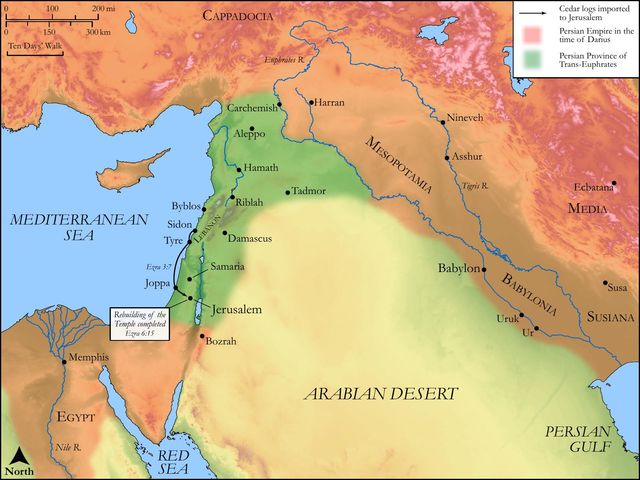
The events described in Ezra 4:11 unfold during the zenith of the Persian Empire's dominion, specifically during the reign of Artaxerxes I Longimanus (465-424 BC). Following the benevolent decree of Cyrus the Great (538 BC), Jewish exiles had returned to Judah to rebuild their Temple, a project initially sanctioned and even funded by the Persian crown. The phrase "on this side the river" (Aramaic: ʻabar naharaʼ) refers to the Trans-Euphrates satrapy, a vast and strategically vital administrative region west of the Euphrates River that encompassed Syria, Phoenicia, Samaria, and Judah. The adversaries were local officials and inhabitants of this region—often of mixed Samaritan and other ethnic origins—who perceived the resurgence of Jewish autonomy and the rebuilding of Jerusalem as a direct threat to their own influence, economic interests, and regional security. Sending a formal letter to the king was the highest and most legitimate form of appeal within the sophisticated Persian administrative system, demonstrating their understanding of imperial bureaucracy and their intent to leverage royal authority to achieve their objectives. Such letters were meticulously crafted, often beginning with a formal address from "thy servants" to establish deference and loyalty before presenting their grievance.
Key Themes
ShowHideEzra 4:11 contributes significantly to several key themes within the book of Ezra and the broader post-exilic narrative. Firstly, it powerfully illustrates the systematic and organized opposition faced by God's people in fulfilling His purposes. This was not mere random hostility but a sophisticated, bureaucratic, and politically savvy campaign to undermine the rebuilding efforts, echoing the challenges faced later by Nehemiah in rebuilding the walls of Jerusalem. Secondly, the verse highlights the abuse of authority and the insidious use of misinformation. The adversaries, by identifying themselves as "thy servants," sought to present their biased case as a legitimate concern for royal interests, demonstrating how human power and political maneuvering can be wielded against divine plans. Thirdly, it implicitly underscores the sovereignty of God amidst human resistance. While the letter temporarily halted the work, God's ultimate plan for the Temple's completion would prevail, a theme consistent with the overarching message of divine faithfulness in the face of adversity, as seen in the later completion of the Temple in Ezra 6. This struggle also foreshadows the ongoing spiritual battle against the establishment of God's kingdom.
Exposition and Analysis
ShowHideKey Word Analysis
ShowHideThis term (H6573) refers to a transcript or a duplicate of an official document. Its use here emphasizes that the communication to Artaxerxes was not an informal complaint but a meticulously prepared, legally framed document intended to carry significant weight and demand a royal response. It highlights the bureaucratic and formal nature of the opposition's strategy, indicating they were operating within the established legal and administrative channels of the Persian Empire.
This is the throne name (H783) for the Persian king. The Artaxerxes referenced here is widely identified as Artaxerxes I Longimanus, who reigned from 465 to 424 BC. His reign is historically significant as it also saw the missions of Ezra (in his seventh year, Ezra 7:7) and Nehemiah (in his twentieth year, Nehemiah 2:1). The adversaries strategically appealed to a powerful monarch whose decree would carry absolute authority across the vast empire, demonstrating their understanding of the highest level of imperial power.
This word (H5675) signifies a region across or beyond, but in this context, when combined with "the river" (nᵉhar, H5103), it forms the administrative designation "Trans-Euphrates" or "Beyond the River." By identifying themselves as "the men on this side the river," the adversaries were asserting their collective identity and perceived jurisdiction within this significant Persian satrapy. This indicates that the opposition was not merely local but represented a broader regional concern among officials and peoples who felt their interests were threatened by the Jewish rebuilding efforts and the re-establishment of a strong Jewish presence.
Verse Breakdown
ShowHide"This [is] the copy of the letter that they sent unto him, [even] unto Artaxerxes the king;"
This opening clause formally introduces the document that follows, signaling to the reader that the subsequent text is the exact content of the official communication. It immediately establishes the high stakes and the royal recipient, Artaxerxes, underscoring the gravity of the adversaries' appeal. The use of "copy" (Aramaic: parshegen) suggests that this was a record kept for official purposes, emphasizing its authenticity and formal nature, rather than a mere informal complaint. It highlights the deliberate and calculated nature of the opposition.
"Thy servants the men on this side the river,"
This phrase identifies the senders of the letter, framing their address. By beginning with "Thy servants," they adopt a posture of humility and submission to the king, a standard and expected protocol for addressing royalty in the courts of that day. This deferential language was a rhetorical strategy to gain the king's favor and lend credibility to their subsequent accusations. The specific identification as "the men on this side the river" pinpoints their geographical and administrative location within the Trans-Euphrates satrapy, thereby asserting their collective authority and perceived right to address the king on matters concerning their region.
"and at such a time."
This archaic KJV translation of the Aramaic u-kᵉʻeneth (H3706) is better understood as "and now" or "and so forth" or "and so on." It functions as a standard introductory phrase in royal correspondence, serving as a formal transition from the salutation and identification of the senders to the actual body of the letter, which would detail their accusations and requests. It marks the commencement of the substantive content of the letter, indicating that the formal pleasantries are concluded and the core message is about to be delivered.
Literary Devices
ShowHideEzra 4:11 employs several significant literary devices to set the stage for the unfolding conflict. It primarily functions as an Epistolary Introduction, serving as the formal opening to the letter that the adversaries sent to King Artaxerxes. This device immediately immerses the reader into the official correspondence, setting a serious and formal tone for the detailed accusations that follow. The verse also acts as a Framing Device, introducing the specific legal and political maneuver that the opponents employed to halt the Temple's reconstruction. By presenting the letter's opening, the author prepares the reader for the subsequent content, which details the false charges and the king's consequential response. Furthermore, the verse demonstrates Formal Address, typical of ancient royal correspondence. The phrase "Thy servants" establishes the hierarchical relationship between the senders and the king, emphasizing their subservience while simultaneously asserting their right and perceived authority to petition the monarch. This formal and respectful tone is a rhetorical strategy designed to gain the king's favor and lend credibility to their subsequent, often misleading, accusations.
Theological and Thematic Connections
ShowHideEzra 4:11, by introducing the formal opposition to God's work, resonates with a profound theological truth: the advancement of God's kingdom often encounters fierce resistance from worldly powers. This resistance is not always overtly violent but can manifest through bureaucratic hurdles, political machinations, and the manipulation of legal systems. The adversaries' appeal to Artaxerxes highlights a recurring biblical theme where human authorities and systems, often unknowingly or willingly, set themselves against divine purposes. Yet, this verse also implicitly points to God's ultimate sovereignty, reminding us that no human decree or opposition can ultimately thwart His perfect plan, even if it causes temporary delays. It underscores the spiritual battle behind earthly events, where the forces of darkness seek to impede the building of God's dwelling place, whether it be a physical temple or His spiritual church. This opposition is a test of faith and perseverance for God's people, urging them to trust in His overarching control despite apparent setbacks.
Reflection and Application
ShowHideThe detailed account of opposition in Ezra 4:11 offers timeless lessons for believers today. Just as the returning exiles faced organized, politically astute, and seemingly legitimate resistance to their God-given task, so too can followers of Christ expect opposition when seeking to advance God's kingdom in various spheres—whether in ministry, community engagement, or personal spiritual growth. This verse reminds us that such resistance may not always come from obvious enemies but can emerge from bureaucratic channels, legal challenges, or influential figures who perceive God's work as a threat to their established order or interests. It calls us to a posture of discernment, recognizing the spiritual forces at play behind earthly opposition, and to a spirit of perseverance, trusting that God's purposes will ultimately prevail, even if His plans are temporarily delayed by human decree. Our faith is not in the absence of obstacles, but in the God who sovereignly works through and beyond them, often using the very opposition to refine His people and demonstrate His power. We are called to be wise as serpents and innocent as doves, navigating complex situations with integrity and unwavering reliance on divine wisdom.
Questions for Reflection
ShowHideFAQ
ShowHideWho were "the men on this side the river"?
ShowHide"The men on this side the river" refers to the inhabitants and officials of the Trans-Euphrates satrapy, a large administrative region of the Persian Empire located west of the Euphrates River. This region included Judea, Syria, Phoenicia, and Samaria. These individuals, often of mixed ethnic and religious backgrounds, viewed the rebuilding of Jerusalem and its Temple by the returning Jewish exiles as a direct threat to their regional influence, control, and security. They were local adversaries who sought to undermine the Jewish community's re-establishment and autonomy, fearing a resurgence of Jewish power could disrupt the existing political and economic balance in the province.
Why did they oppose the rebuilding of the Temple?
ShowHideTheir opposition stemmed from a complex mix of political, economic, and deeply rooted animosity. Politically, they likely feared the re-emergence of a strong, independent Jewish state in their midst, which could challenge their authority or lead to unrest and potential rebellion against Persian rule. Economically, a thriving Jerusalem might divert trade or resources away from their own cities. Furthermore, there was a historical and religious animosity, clearly seen in Ezra 4:1-3, where the Jews refused their offer to help rebuild, viewing them as ritually unclean and spiritually compromised. This refusal likely fueled their resentment, leading them to actively seek the cessation of the building project. Their letter to Artaxerxes specifically accused the Jews of rebuilding a rebellious city that would refuse tribute and ultimately harm the king's interests Ezra 4:12-16, demonstrating their calculated effort to align their opposition with imperial concerns.
What was the significance of sending a letter to Artaxerxes?
ShowHideSending a formal letter to Artaxerxes was the highest and most legitimate means of appeal within the vast Persian imperial system. It signified that the adversaries had exhausted local methods of opposition (like discouragement and bribery, as in Ezra 4:4-5) and were now escalating their efforts to the supreme authority. A royal decree from the king was absolute and binding across the entire empire. By framing their complaint as a matter of imperial security and revenue, they sought to leverage the king's power to legally and definitively halt the rebuilding of the Temple. This action demonstrates their sophisticated understanding of Persian bureaucracy and their determination to thwart God's work through official channels, highlighting the formidable and organized nature of the opposition.
Christ-Centered Fulfillment
ShowHideEzra 4:11, with its depiction of organized opposition to the rebuilding of God's physical dwelling place, powerfully foreshadows the spiritual opposition faced by Christ, the ultimate Temple, and His ongoing work of building His Church. Just as the adversaries sought to halt the construction in Jerusalem through political machinations and false accusations, so too did the religious and political powers of Jesus' day conspire against Him, ultimately leading to His crucifixion. Yet, Jesus declared, "Destroy this temple, and in three days I will raise it up," speaking of the temple of His body John 2:19-21. His resurrection stands as the ultimate triumph over all earthly and spiritual opposition, proving that no human decree or power can thwart God's eternal plan. Furthermore, Jesus promised, "I will build my church, and the gates of hell shall not prevail against it" Matthew 16:18. The temporary delay in Ezra's time reminds us that while God's work may face resistance and setbacks, Christ's kingdom ultimately triumphs over all principalities and powers Colossians 2:15, ensuring that His church will be built and His reign will extend over all the earth Revelation 11:15. The opposition in Ezra is a type of the ongoing spiritual warfare against the establishment of God's kingdom, which finds its ultimate victory in Christ.