


Ezra 4:10
Bible text: King James Version (1769 Blayney text) · Public domain
Bible text: King James Version with Strong's numbers · Public domain
Bible text: Berean Standard Bible · Public domain
Bible text: American Standard Version (1901) · Public domain
Bible text: World English Bible, Messianic edition · Public domain
Bible text: Geneva Bible (1599) · Public domain
Bible text: Young's Literal Translation · Public domain
- וּשְׁאָרu·she·'Arand [the] rest ofH7606Conj-w ¦ N-cscNoun Singular common gender Constructוּandשְׁאָר[the] rest of
- אֻמַּיָּא'u·mai·Ya'nations theH524N-mp ¦ ArtNoun Plural Masculine Definiteאֻמַּיָּnationsאthe
- דִּיdiwhichH1768ConjConjunction
- הַגְלִיhag·Lihe took into exileH1541V-Haphel-Perf-3msVerb Haphel Perfect 3rd Singular Masculine
- אָסְנַפַּר'a·se·na·ParOsnapparH620N-proper-mNoun Proper Masculine
- רַבָּאra·Ba'<the> greatH7229Adj-cs ¦ ArtAdjective Singular common gender Definiteרַבָּ<the>אgreat
- וְיַקִּירָאve·ya·ki·Ra'and <the> honorableH3358Conj-w ¦ Adj-cs ¦ ArtAdjective Singular common gender Definiteוְandיַקִּירָ<the>אhonorable
- וְהוֹתֵבve·ho·Tevand he caused to dwellH3488Conj-w ¦ V-Hiphil-Perf-3msVerb Hiphil Perfect 3rd Singular Masculineוְandהוֹתֵבhe caused to dwell
- הִמּוֹhi·MothemH1994Pro-3mpPronoun Personal 3rd Plural Masculine
- בְּקִרְיָהbe·kir·Yahin [the] cityH7149Prep-b ¦ N-fsNoun Singular Feminine Absoluteבְּinקִרְיָה[the] city
- דִּיdiofH1768ConjConjunction
- שָׁמְרָיִןsha·me·Ra·yinSamariaH8115N-properNoun Proper Location
- וּשְׁאָרu·she·'Arand [the] rest ofH7606Conj-w ¦ N-cscNoun Singular common gender Constructוּandשְׁאָר[the] rest of
- עֲבַר'a·var[the] region beyondH5675N-cscNoun Singular common gender Construct
- נַהֲרָהna·ha·Rah'river theH5103N-cs ¦ ArtNoun Singular common gender Definiteנַהֲרָriverהthe
- וּכְעֶנֶתu·khe·'E·netand nowH3706Conj-w ¦ AdvAdverbוּandכְעֶנֶתnow
English is a literal word-by-word gloss of the Hebrew, not the KJV's wording. Why?
This is the original text the KJV's translators worked from — each Hebrew word with its own literal English meaning in this verse, prepared by scholars at Tyndale House, Cambridge. The KJV translates whole sentences, not word by word, so its wording differs: one Hebrew word can become several English words, and the KJV may choose “the LORD” where the gloss reads “Yahweh”. Both are faithful — they answer different questions. For the KJV's own rendering, switch to the KJV text.
Details
See on the biblical-era map
Study this verse
Public-domain commentary
Matthew Henry
From his Commentary on the Whole Bible. Henry comments on passages, not single verses — this entry covers Ezra 4:6–16. His four-level outline is real structure in the source text, so it is rendered as structure.
Cyrus stedfastly adhered to the Jews' interest, and supported his own grant. It was to no purpose to offer any thing to him in prejudice of it. What he did was from a good principle, and in the fear of God, and therefore he adhered to it. But, though his reign in all was thirty years, yet after the conquest of Babylon, and his decree for the release of the Jews, some think that he reigned but three years, others seven, and then either died or gave up that part of his government, in which his successor was Ahasuerus (Ezr 4:6), called also Artaxerxes (Ezr 4:7), supposed to be the same that in heathen authors is called Cambyses, who had never taken such cognizance of the despised Jews as to concern himself for them, nor had he that knowledge of the God of Israel which his predecessor had. To him these Samaritans applied by letter for an order to stop the building of the temple; and they did it in the beginning of his reign, being resolved to lose no time when they thought they had a king for their purpose. See how watchful the church's enemies are to take the first opportunity of doing it a mischief; let not its friends be less careful to do it a kindness. Here is,
I.The general purport of the letter which they sent to the king, to inform him of this matter.
It is called (Ezr 4:6) an accusation against the inhabitants of Judah and Jerusalem. The devil is the accuser of the brethren (Rev 12:10), and he carries on his malicious designs against them, not only by accusing them himself before God, as he did Job, but by acting as a lying spirit in the mouths of his instruments, whom he employs to accuse them before magistrates and kings and to make them odious to the many and obnoxious to the mighty. Marvel not if the same arts be still used to depreciate serious godliness.
II.The persons concerned in writing this letter.
The contrivers are named (Ezr 4:7) that plotted the thing, the writers (Ezr 4:8) that put it into form, and the subscribers (Ezr 4:9) that concurred in it and joined with them in this representation, this misrepresentation I should call it. Now see here,
1.How the rulers take counsel together against the Lord and his temple, with their companions. The building of the temple would do them no harm, yet they appear against it with the utmost concern and virulence, perhaps because the prophets of the God of Israel had foretold the famishing and perishing of all the gods of the heathen, Zep 2:11; Jer 10:11.
2.How the people concurred with them in imagining this vain thing. They followed the cry, though ignorant of the merits of the cause. All the several colonies of that plantation (nine are here mentioned), who had their denomination from the cities or countries of Assyria, Chaldea, Persia, etc., whence they came, set their hands, by their representatives, to this letter. Perhaps they were incensed against these returned Jews because many of the ten tribes were among them, whose estates they had got into their possession, and of whom they were therefore jealous, lest they should attempt the recovery of them hereafter.
III.A copy of the letter itself, which Ezra inserts here out of the records of the kingdom of Persia, into which it had been entered; and it is well we have it, that we may see whence the like methods, still taken to expose good people and baffle good designs, are copied.
1.They represent themselves as very loyal to the government, and greatly concerned for the honour and interest of it, and would have it thought that the king had no such loving faithful subjects in all his dominions as they were, none so sensible of their obligations to him, Ezr 4:14. Because we are salted with the salt of the palace (so it is in the margin), "we have our salary from the court, and could no more live without it than flesh could be preserved without salt;" or, as some think, their pay or pension was sent them in salt; or "Because we had our education in the palace, and were brought up at the king's table," as we find, Dan 1:5. These were those whom he intended to prefer; they did eat their portion of the king's meat. "Now, in consideration of this, it is not meet for us to see the king's dishonour;" and therefore they urge him to stop the building of the temple, which would certainly be the king's dishonour more than any thing else. Note, A secret enmity to Christ and his gospel is often gilded over with a pretended affection to Caesar and his power. The Jews hated the Roman government, and yet, to serve a turn, could cry, We have no king but Caesar. But (to allude to this), if those that lived upon the crown thought themselves bound in gratitude thus to support the interest of it, much more reason have we thus to argue ourselves into a pious concern for God's honour; we have our maintenance from the God of heaven and are salted with his salt, live upon his bounty and are the care of his providence; and therefore it is not meet for us to see his dishonour without resenting it and doing what we can to prevent it.
2.They represent the Jews as disloyal, and dangerous to the government, that Jerusalem was the rebellious and bad city (Ezr 4:12), hurtful to kings and provinces, Ezr 4:15. See how Jerusalem, the joy of the whole earth (Psa 48:2), is here reproached as the scandal of the whole earth. The enemies of the church could not do the bad things they design against it if they did not first give it a bad name. Jerusalem had been a loyal city to its rightful princes, and its present inhabitants were as well affected to the king and his government as any of his provinces whatsoever. Daniel, who was a Jew, had lately approved himself so faithful to his prince that his worst enemies could find no fault in his management, Dan 6:4. But thus was Elijah most unjustly charged with troubling Israel, the apostles with turning the world upside down, and Christ himself with perverting the nation and forbidding to give tribute to Caesar; and we must not think it strange if the same game be still played. Now here,
(1.)Their history of what was past was invidious, that within this city sedition had been moved of old time, and, for that cause, it was destroyed, Ezr 4:15. It cannot be denied but that there was some colour given for this suggestion by the attempts of Jehoiakim and Zedekiah to shake off the yoke of the king of Babylon, which, if they had kept close to their religion and the temple they were now rebuilding, they would never have come under. But it must be considered,
[1.]That they were themselves, and their ancestors, sovereign princes, and their efforts to recover their rights, if there had not been in them the violation of an oath, for aught I know, would have been justifiable, and successful too, had they taken the right method and made their peace with God first.
[2.]Though these Jews, and their princes, had been guilty of rebellion, yet it was unjust therefore to fasten this as an indelible brand upon this city, as if that must for ever after go under the name of the rebellious and bad city. The Jews, in their captivity, had given such specimens of good behaviour as were sufficient, with any reasonable men, to roll away that one reproach; for they were instructed (and we have reason to hope that they observed their instructions) to seek the peace of the city where they were captives and pray to the Lord for it, Jer 29:7. It was therefore very unfair, though not uncommon, thus to impute the iniquity of the fathers to the children.
(2.)Their information concerning what was now doing was grossly false in matter of fact. Very careful they were to inform the king that the Jews had set up the walls of this city, nay, had finished them (so it is in the margin) and joined the foundations (Ezr 4:12), when this was far from being the case. They had only begun to build the temple, which Cyrus commanded them to do, but, as for the walls, there was nothing done nor designed towards the repair of them, as appears by the condition they were in many years after (Neh 1:3), all in ruins. What shall be given, and what done, to these false tongues, nay, which is worse, these false pens? sharp arrows, doubtless, of the mighty, and coals of juniper, Psa 120:3, Psa 120:4. If they had not been perfectly lost to all virtue and honour they would not, and if they had not been very secure of the king's countenance they durst not, have written that to the king which all their neighbours knew to be a notorious lie. See Pro 29:12.
(3.)Their prognostics of the consequences were altogether groundless and absurd. They were very confident, and would have the king believe it upon their word, that if this city should be built, not only the Jews would pay no toll, tribute, or custom (Ezr 4:13), but (since a great lie is as soon spoken as a little one) that the king would have no portion at all on this side the river (Ezr 4:16), that all the countries on this side Euphrates would instantly revolt, drawn in to do so by their example; and, if the prince in possession should connive at this, he would wrong, not only himself, but his successors: Thou shalt endamage the revenue of the kings. See how every line in this letter breathes both the subtlety and malice of the old serpent.
Continue studying Ezra 4:10 across the web’s major study libraries — every link below opens this exact verse, chapter, or book on the destination site.
Read & Compare
 BibleGatewayThis verse in more than 200 translations and 70 languages.
 Bible.comThe YouVersion reader — hundreds of translations, reading plans, and highlights.
 ESV.orgCrossway's official English Standard Version reader.
 NET BibleThe NET translation with 60,000+ translators' notes on every rendering decision.
 STEP BibleTyndale House's free study tool — original text, vocabulary, and scholarly resources.
 BibliaLogos Bible Software's free web reader.
 USCCBThe New American Bible (Revised Edition) with the U.S. bishops' study notes.
Commentaries
 BibleHub CommentariesDozens of classic commentaries on this verse, gathered on one page.
 StudyLightMore than 100 commentary sets — the largest collection on the web.
 BibleRefPlain-English commentary on what this verse means, verse by verse.
 Enduring WordDavid Guzik's free commentary on this chapter, widely used by Bible teachers.
 Bible Study ToolsVerse commentary alongside Greek and Hebrew study aids.
Original Language & Research
- BibleHub InterlinearThe verse word by word — original language, transliteration, and English.
- BibleHub LexiconEvery word's original-language definition and Strong's entry.
 Blue Letter BibleDeep-study tools — Strong's numbers, concordance, and word studies.
 SefariaThe Hebrew text with Rashi and centuries of Jewish commentary.
Sermons, Hymns & Audio


TrulyRandomVerse is not affiliated with these sites and doesn’t control their content. They’re linked because they’re genuinely useful.
Summary
Ezra 4:10 is a pivotal verse within a formal letter of accusation sent to King Artaxerxes by the adversaries of the Jewish returnees, aiming to halt the reconstruction of the Jerusalem temple. This passage meticulously enumerates the diverse ethnic groups and populations that had been forcibly resettled by Assyrian imperial policy into the cities of Samaria and the broader Trans-Euphrates region, thereby identifying the multi-ethnic and often hostile demographic that actively opposed the returning Jewish exiles and their sacred building endeavors.
Context
ShowHideLiterary Context
This verse is strategically positioned within a formal letter of accusation (found in Ezra 4:7-16) addressed to King Artaxerxes I of Persia by Rehum the commanding officer, Shimshai the scribe, and their associates. The primary objective of this correspondence is to persuade the king to cease the rebuilding efforts in Jerusalem, which they portray as a rebellious act threatening imperial stability. Verse 10 serves as a detailed enumeration of the diverse peoples who are signatories to this letter or represent the collective "adversaries" first introduced at the beginning of the chapter (e.g., Ezra 4:1). It follows a general statement about the opposition (e.g., Ezra 4:4) and precedes the specific charges leveled against Jerusalem. The inclusion of this extensive list of nations is designed to add weight and credibility to the adversaries' claims, demonstrating a broad and unified front of opposition from various segments of the empire's population in the region.
Historical & Cultural Context
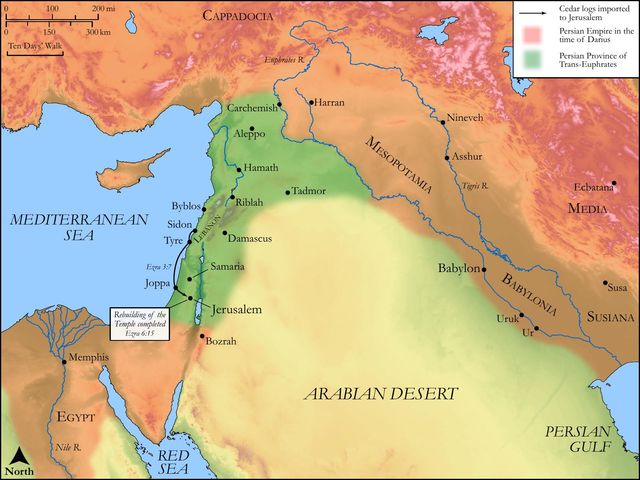
The explicit mention of "Asnappar" (widely identified as Ashurbanipal, the last great king of the Neo-Assyrian Empire, who reigned approximately 668-627 BC) directly points to a significant historical practice: the Assyrian policy of forced population transfer. This draconian strategy was implemented to dismantle nationalistic loyalties, suppress potential rebellions, and integrate conquered territories by deliberately mixing diverse populations. These transplanted peoples, originating from various parts of the vast Assyrian empire, were settled in Samaria after the fall of the Northern Kingdom of Israel in 722 BC (a process extensively detailed in 2 Kings 17:24-41). Over subsequent generations, these groups intermarried and developed a syncretistic culture and religion, forming the historical and ethnic basis of what would later be known as the Samaritan people. The phrase "on this side the river" refers to the region west of the Euphrates River, known in Aramaic as Abar Nahara (Trans-Euphrates), which constituted a major satrapy (province) of the Persian Empire. This precise geographical designation underscores the vast administrative reach of the Persian Empire and the imperial context in which the letter was composed, highlighting the adversaries' deep awareness of and strategic appeal to established imperial structures.
Key Themes
ShowHideThis verse significantly contributes to several overarching themes within the book of Ezra and the broader post-exilic narrative. Firstly, it vividly highlights the Diverse Opposition faced by the Jewish returnees. The adversaries were not a singular, unified entity but a complex collection of peoples with varied origins, united solely in their resistance to the rebuilding efforts. This complexity underscores the multifaceted nature of the challenges confronted by those seeking to re-establish God's people and their worship. Secondly, the verse powerfully illustrates the pervasive nature of Imperial Administration and Control, demonstrating how vast empires like Assyria and Persia exerted their authority through systematic policies of population resettlement and meticulous bureaucratic oversight. This imperial backdrop is indispensable for comprehending the intricate political landscape in which the Jews were compelled to operate. Finally, Ezra 4:10 provides critical insight into the Root of Samaritan Identity and Conflict. By meticulously listing the nations brought over by Ashurbanipal, it traces the historical origins of the mixed ethnic and religious identity that profoundly characterized the Samaritans, thereby explaining the deep-seated rivalry and animosity between them and the Jews that persisted for centuries, as evidenced in later biblical accounts and historical records, such as the tension observed in John 4.
Exposition and Analysis
ShowHideKey Word Analysis
ShowHideThis proper noun, appearing uniquely in the biblical text here, is widely accepted by scholars as a transliteration of Ashurbanipal (reigned 668-627 BC), the last great and powerful king of the Neo-Assyrian Empire. His reign was characterized by extensive military campaigns, the compilation of a vast library (the Library of Ashurbanipal), and, most critically for this context, the systematic policy of forcibly relocating conquered populations to maintain control and suppress rebellion. The mention of his name here serves to historically ground the presence of these diverse peoples in Samaria, attributing their settlement to a well-known and formidable historical figure, thereby lending significant authority and legitimacy to the adversaries' claims in their letter to Artaxerxes.
This verb signifies the act of denuding, exiling, or carrying away, often implying a forceful and involuntary relocation. In the context of Ezra 4:10, it precisely describes the Assyrian imperial policy of forced population transfer. Ashurbanipal "brought over" these nations, meaning he forcibly deported them from their homelands and resettled them in new territories. This term highlights the coercive nature of the Assyrian policy and its direct impact on the demographic composition of Samaria, which subsequently became a source of opposition to the Jewish returnees.
This word, often translated as "beyond" or "across," is part of the administrative geographical designation "on this side the river" (Abar Nahara). It refers to the region west of the Euphrates River, from the perspective of the Persian imperial capital. Its use here indicates the specific administrative jurisdiction from which the letter originates and to which the enumerated peoples belong. The phrase emphasizes the broad regional scope of the opposition to Jerusalem's rebuilding efforts and underscores the imperial reach of the adversaries' influence, as they represent a significant portion of a major Persian satrapy.
Verse Breakdown
ShowHide"And the rest of the nations whom the great and noble Asnappar brought over"
This initial clause identifies the core group of adversaries as the descendants of various peoples forcibly relocated by Ashurbanipal (Asnappar). The descriptive phrase "great and noble" is an honorific, likely employed by the adversaries to impress King Artaxerxes or simply a standard title for such a powerful historical figure, thereby underscoring the formidable imperial authority behind their presence in the region. This detail firmly establishes the historical precedent for the multi-ethnic composition of Samaria.
"and set in the cities of Samaria"
This segment specifies the precise destination of these forcibly relocated populations. Samaria, once the capital of the Northern Kingdom of Israel, had become a pivotal administrative center under both Assyrian and later Persian rule. The deliberate settlement of these diverse groups within its cities led directly to the formation of the mixed ethnic and religious identity of the Samaritans, a development that inexorably set the stage for centuries of future conflicts with the returning Jewish exiles.
"and the rest [that are] on this side the river, and at such a time"
This concluding clause significantly broadens the scope of the adversaries beyond merely those settled in Samaria, encompassing all other peoples within the vast Trans-Euphrates satrapy who had joined in the opposition. The phrase "and at such a time" is somewhat ambiguous in English but most likely refers to the specific historical moment of the letter's writing, indicating that these groups are currently present and actively participating in the opposition. It powerfully reinforces the widespread and organized nature of the resistance to the Jewish rebuilding efforts across the entire province.
Literary Devices
ShowHideEzra 4:10 masterfully employs several literary techniques to enhance the credibility and persuasive power of the adversaries' letter to King Artaxerxes. The text utilizes Enumeration by listing "the rest of the nations," providing a detailed, almost bureaucratic, account of the multi-ethnic composition of the region. This detailed listing is coupled with Historical Reference through the specific naming of "Asnappar" (Ashurbanipal). This direct reference to a well-known Assyrian king's policy of population transfer grounds the adversaries' claims in verifiable historical fact, demonstrating that their presence in Samaria was not accidental but a direct result of established imperial decree. Furthermore, the inclusion of the administrative term "on this side the river" (Trans-Euphrates) employs Geographical Specificity, reinforcing the official and widespread nature of the opposition within a recognized Persian satrapy. Collectively, these devices serve to present a formidable and legitimate front of opposition, meticulously crafted to convince the king of the widespread and significant threat posed by the rebuilding of Jerusalem.
Theological and Thematic Connections
ShowHideEzra 4:10, by meticulously detailing the diverse composition of the adversaries, powerfully underscores a recurring biblical theme: the work of God and the flourishing of His people will invariably encounter opposition, often from varied and unexpected sources. This verse highlights how imperial policies, designed for political control and stability, inadvertently created a complex demographic mix that would become a persistent and formidable obstacle to the restoration of Judah and the rebuilding of the temple. Yet, even within this narrative of resistance, the meticulous detail of the biblical record testifies to God's sovereign oversight, revealing both the authenticity of the immense challenges faced by the exiles and the unwavering divine faithfulness that ultimately triumphs over all human opposition. It serves as a profound reminder that God's redemptive plans are often fulfilled not in the absence of adversity, but precisely through it, as His people are compelled to cultivate perseverance, deepen their faith, and rely entirely on His strength.
Reflection and Application
ShowHideThe detailed listing of adversaries in Ezra 4:10 offers a profound and enduring lesson for believers today: the work of God will invariably face opposition, and this resistance often emanates from a multitude of sources, some historically rooted, others seemingly spontaneous or opportunistic. Just as the returning exiles encountered a multi-ethnic coalition united against their divinely appointed mandate to rebuild, so too might we find varied forms of resistance when pursuing God's call in our lives, whether individually or corporately. This verse encourages us to develop a discerning eye, understanding the complex nature of such opposition, recognizing that it is not merely personal but often pervasive, rooted in historical grievances, deep-seated cultural differences, or even broader societal and imperial policies that fundamentally clash with God's kingdom agenda. It calls us to discernment, to accurately identify the true source and nature of the challenges we face, and crucially, to remember that despite the apparent strength and diversity of the opposition, God's ultimate plan will unquestionably prevail. Our sacred task, therefore, is to persevere in unwavering faith, trusting implicitly in His sovereignty even when the odds appear overwhelmingly stacked against us.
Questions for Reflection
ShowHideFAQ
ShowHideWho was "Asnappar" and why is his mention significant here?
ShowHide"Asnappar" is widely identified by biblical scholars and historians as Ashurbanipal, who was the last great and powerful king of the Neo-Assyrian Empire, reigning from approximately 668 to 627 BC. His mention in Ezra 4:10 is profoundly significant because he was renowned for his extensive and brutal policy of forced population transfers. After conquering territories, the Assyrians would systematically deport large segments of the indigenous population and resettle them in other, often distant, parts of the empire, simultaneously replacing them with peoples from different conquered regions. This practice was strategically designed to break down nationalistic loyalties, prevent rebellions, and integrate diverse populations into the imperial structure. Therefore, when Ezra 4:10 states that "Asnappar brought over" these nations and "set [them] in the cities of Samaria," it provides the essential historical and demographic explanation for the multi-ethnic composition of Samaria, which subsequently formed the basis of the Samaritan people and their long-standing rivalry with the Jews. This precise historical detail lends considerable weight and credibility to the adversaries' letter to King Artaxerxes, as it grounds their presence in the region in a well-known and established imperial policy.
What does "on this side the river" refer to in this context?
ShowHideThe phrase "on this side the river" is a direct translation of the Aramaic administrative term 'Abar Nahara, which literally means "beyond the river." From the geographical perspective of the Persian imperial capital, which was situated east of the great Euphrates River, this term designated the vast satrapy (or province) that lay to the west of the Euphrates. This significant administrative region encompassed modern-day Syria, Phoenicia (Lebanon), and Palestine, including the territories of Judah and Samaria. Its inclusion in Ezra 4:10 signifies that the opposition to the rebuilding of Jerusalem was not merely confined to the immediate Samaritan region but was a widespread phenomenon across the entire Trans-Euphrates province. This indicates a broader, more organized resistance that involved various peoples under Persian imperial administration. This detail highlights the considerable political and geographical scope of the adversaries' influence and their strategic appeal to the Persian king, demonstrating that their concerns represented a significant portion of the western empire.
Christ-Centered Fulfillment
ShowHideEzra 4:10, with its detailed account of diverse adversaries united against the rebuilding of God's physical temple in Jerusalem, serves as a profound and layered foreshadowing of the pervasive opposition faced by God's ultimate Temple, Jesus Christ, and His spiritual body, the Church. Just as the returning exiles encountered a coalition of peoples whose presence was rooted in historical displacement and political maneuvering, so too did Christ face a multifaceted resistance – from entrenched religious leaders, powerful political authorities, and even the general populace at times. The "nations" brought over by Asnappar find their ultimate parallel in the world's systems, ideologies, and spiritual powers that perpetually array themselves against the Lord and His Anointed One, as vividly prophesied in Psalm 2:1-2. Yet, the narrative of Ezra, despite the temporary halt in construction, ultimately culminates in the temple's completion, pointing to the victorious and unstoppable nature of God's redemptive plan. This finds its glorious and definitive fulfillment in Jesus, the true Lamb of God, who takes away the sin of the world, who, through His sacrificial crucifixion and triumphant resurrection, utterly triumphed over all the powers of darkness and opposition (Colossians 2:15). The Church, as the spiritual temple (e.g., 1 Corinthians 3:16), continues to face opposition from diverse sources throughout history, yet like the ancient temple, it is ultimately built upon the unshakeable and eternal foundation of Christ, against whom even the gates of hell shall not prevail (Matthew 16:18).