


Daniel 4:1
- נְבוּכַדְנֶצַּרne·vu·khad·ne·TzarNebuchadnezzarH5020N-proper-mNoun Proper Masculine
- מַלְכָּאmal·Ka'king theH4430N-cs ¦ ArtNoun Singular common gender Definiteמַלְכָּkingאthe
- לְכָלle·kholto allH3606Prep-l ¦ N-cscNoun Singular common gender Constructלְtoכָלall
- עַמְמַיָּא'a·mai·Ya'peoples theH5972N-mp ¦ ArtNoun Plural Masculine Definiteעַמְמַיָּpeoplesאthe
- אֻמַיָּא'u·mai·Ya'nations theH524N-mp ¦ ArtNoun Plural Masculine Definiteאֻמַיָּnationsאthe
- וְלִשָּׁנַיָּאve·li·sha·nai·Ya'and languages theH3961Conj-w ¦ N-mp ¦ ArtNoun Plural Masculine Definiteוְandלִשָּׁנַיָּlanguagesאthe
- דִּיdiwhichH1768ConjConjunction
- דָיְרִיןda·'a·rin[are] dwellingH1753V-Peal-Prtcpl-mpVerb Peal Participle Plural Masculine Absolute
- בְּכָלbe·kholin allH3606Prep-b ¦ N-cscNoun Singular common gender Constructבְּinכָלall
- אַרְעָא'ar·'A'earth theH772N-cs ¦ ArtNoun Singular common gender Definiteאַרְעָearthאthe
- שְׁלָמְכוֹןshe·la·me·Khonyour peaceH8001N-csc ¦ 2mpNoun Singular common gender Constructשְׁלָמְpeaceכוֹןyour
- יִשְׂגֵּאyis·Ge'may it increaseH7680V-Peal-Imperf-3msVerb Peal Imperfect 3rd Singular Masculine
English is a literal word-by-word gloss of the Hebrew, not the KJV's wording. Why?
This is the original text the KJV's translators worked from — each Hebrew word with its own literal English meaning in this verse, prepared by scholars at Tyndale House, Cambridge. The KJV translates whole sentences, not word by word, so its wording differs: one Hebrew word can become several English words, and the KJV may choose “the LORD” where the gloss reads “Yahweh”. Both are faithful — they answer different questions. For the KJV's own rendering, switch to the KJV text.
Details
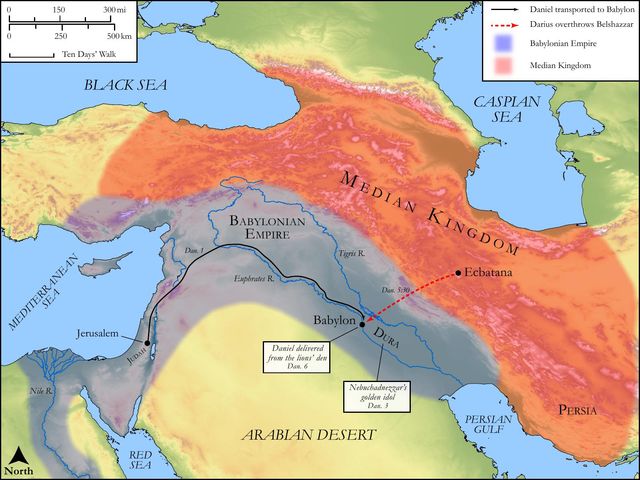
See on the biblical-era map
Study this verse
Public-domain commentary
Matthew Henry
From his Commentary on the Whole Bible. Henry comments on passages, not single verses — this entry covers Daniel 4:1–3. His three-level outline is real structure in the source text, so it is rendered as structure.
Here is, I. Something of form, which was usual in writs, proclamations, or circular letters, issued by the king, Dan 4:1. The royal style which Nebuchadnezzar makes use of has nothing in it of pomp or fancy, but is plain, short, and unaffected - Nebuchadnezzar the king. If at other times he made use of great swelling words of vanity in his title, how he laid them all aside; for he was old, he had lately recovered from a distraction which had humbled and mortified him, and was now in the actual contemplation of God's greatness and sovereignty. The declaration is directed not only to his own subjects, but to all to whom this present writing shall come - to all people, nations, and languages, that dwell in all the earth. He is not only willing that they should all hear of it, though it carry the account if his own infamy (which perhaps none durst have published if he had not done it himself, and therefore Daniel published the original paper), but he strictly charges and commands all manner of persons to take notice of it; for all are concerned, and it may be profitable to all. He salutes those to whom he writes, in the usual form, Peace be multiplied unto you. Note, It becomes kings with their commands to disperse their good wishes, and, as fathers of their country, to bless their subjects. So the common form with us. We send greeting, Omnibus quibus hae praesentes literae pervenerint, salutem - To all to whom these presents shall come, health; and sometimes Salutem sempiternam - Health and salvation everlasting.
II.Something of substance and matter. He writes this,
1.To acquaint others with the providences of God that had related to him (Dan 4:2): I thought it good to show the signs and wonders that the high God (so he calls the true God) has wrought towards me. He thought it seemly (so the word is), that it was his duty, and did well become him, that it was a debt he owed to God and the world, now that he had recovered from his distraction, to relate to distant places, and record for future ages, how justly God had humbled him and how graciously he had at length restored him. All the nations, no doubt, had heard what befell Nebuchadnezzar, and rang of it; but he thought it fit that they should have a distinct account of it from himself, that they might know the hand of God in it, and what impressions were made upon his own spirit by it, and might speak of it not as a matter of news, but as a matter of religion. The events concerning him were not only wonders to be admired, but signs to be instructed by, signifying to the world that Jehovah is greater than all gods. Note, We ought to show to others God's dealings with us, both the rebukes we have been under and the favours we have received; and though the account hereof may reflect disgrace upon ourselves, as this did upon Nebuchadnezzar, yet we must not conceal it, as long as it may redound to the glory of God. Many will be forward to tell what God has done for their souls, because that turns to their own praise, who care not for telling what God has done against them, and how they deserved it; whereas we ought to give glory to God, not only by praising him for his mercies, but by confessing our sins, accepting the punishment of our iniquity, and in both taking shame to ourselves, as this mighty monarch here does.
2.To show how much he was himself affected with them and convinced by them, Dan 4:3. We should always speak of the word and works of God with concern and seriousness and show ourselves affected with those great things of God which we desire others should take notice of.
(1.)He admires God's doings. He speaks of them as one amazed: How great are his signs, and how mighty are his wonders! Nebuchadnezzar was now old, had reigned above forty years, and had seen as much of the world and the revolutions of it as most men ever did; and yet never till now, when himself was nearly touched, was he brought to admire surprising events as God's signs and his wonders. Now, How great, how mighty, are they! Note, The more we see events to be the Lord's doing, and see in them the product of a divine power and the conduct of a divine wisdom, the more marvellous they will appear in our eyes, Psa 118:23; Psa 66:2.
(2.)He thence infers God's dominion. This is that which he is at length brought to subscribe to: His kingdom is an everlasting kingdom; and not like his own kingdom, which he saw, and long since foresaw, in a dream, hastening towards a period. He now owns that there is a God that governs the world and has a universal, incontestable, absolute dominion in and over all the affairs of the children of men. And it is the glory of this kingdom that it is everlasting. Other reigns are confined to one generation, and other dynasties to a few generations, but God's dominion is from generation to generation. It should seem, Nebuchadnezzar here refers to what Daniel had foretold of a kingdom which the God of heaven would set up, that should never be destroyed (Dan 2:44), which, though meant of the kingdom of the Messiah, he understood of the providential kingdom. Thus we may make a profitable practical use and application of those prophetical scriptures which yet we do not fully, and perhaps not rightly, comprehend the meaning of.
Historical interpretation
Historical reception
2 surviving comments on this verse. Each one is dated, so this reads as a timeline rather than a list.
Select a marker to jump to its quote. Markers stagger vertically where authors wrote within a few decades of each other.
Observe the piety of the children: they showed no indignation, no anger, no gainsaying, but they came forth … as though they were going forth from heaven itself.… And what the prophet says of the sun, that “he is as a bridegroom going out of his chamber,” so one could also say such a thing of them. But though he [the sun] goes forth [like the bridegroom], yet did they come out with even more glory than he, for he indeed goes forth to enlighten the world with natural light, they to enlighten the world in a different way, I mean, spiritually. For because of them the king immediately issued a decree, “The signs and wonders that the most high God has worked for me I am pleased to recount.” … So they went forth, shedding a yet more glorious radiance, beaming indeed in that very region, even more so by way of the king’s writings, being diffused over the world and thus dispelling the darkness that everywhere prevails.
Verses 1-3. "Nebuchadnezzar the king unto all the peoples, nations and languages who dwell upon the whole earth: peace be multiplied unto you. The Most High God hath performed signs and wonders towards me. Therefore I have thought it well to declare His signs, for they are great, and His marvels, for they are mighty, and His kingdom, because it is (the Vulgate omits "because it is") an eternal kingdom, and His dominion is from generation to generation." The epistle of Nebuchadnezzar was inserted in the volume of the prophet, in order that the book might not afterwards be thought to have been manufactured by some other author, as the accuser (Porphyry) falsely asserts, but the product of Daniel himself.
Continue studying Daniel 4:1 across the web’s major study libraries — every link below opens this exact verse, chapter, or book on the destination site.
Read & Compare
 BibleGatewayThis verse in more than 200 translations and 70 languages.
 Bible.comThe YouVersion reader — hundreds of translations, reading plans, and highlights.
 ESV.orgCrossway's official English Standard Version reader.
 NET BibleThe NET translation with 60,000+ translators' notes on every rendering decision.
 STEP BibleTyndale House's free study tool — original text, vocabulary, and scholarly resources.
 BibliaLogos Bible Software's free web reader.
 USCCBThe New American Bible (Revised Edition) with the U.S. bishops' study notes.
Commentaries
 BibleHub CommentariesDozens of classic commentaries on this verse, gathered on one page.
 StudyLightMore than 100 commentary sets — the largest collection on the web.
 BibleRefPlain-English commentary on what this verse means, verse by verse.
 Enduring WordDavid Guzik's free commentary on this chapter, widely used by Bible teachers.
 Bible Study ToolsVerse commentary alongside Greek and Hebrew study aids.
Original Language & Research
- BibleHub InterlinearThe verse word by word — original language, transliteration, and English.
- BibleHub LexiconEvery word's original-language definition and Strong's entry.
 Blue Letter BibleDeep-study tools — Strong's numbers, concordance, and word studies.
 SefariaThe Hebrew text with Rashi and centuries of Jewish commentary.
Sermons, Hymns & Audio


TrulyRandomVerse is not affiliated with these sites and doesn’t control their content. They’re linked because they’re genuinely useful.
Summary
Daniel 4:1 serves as the profound and unprecedented opening to King Nebuchadnezzar's personal testimony, a royal decree addressed to "all people, nations, and languages, that dwell in all the earth." This verse immediately establishes the universal scope of the narrative that follows, detailing the Babylonian monarch's dramatic humbling by the Most High God and his subsequent, profound acknowledgment of divine sovereignty over all earthly kingdoms. It sets the stage for a unique account of divine intervention, human transformation, and the ultimate supremacy of the God of Israel.
Context
ShowHideLiterary Context
Daniel 4:1 initiates a highly distinctive section of the Book of Daniel (chapters 2:4b-7:28), which is notably written in Aramaic rather than Hebrew, emphasizing its broader, international audience and themes. This verse functions as the preamble to Nebuchadnezzar's personal letter or royal decree, recounting his unsettling dream, his period of divine judgment (temporary madness), and his eventual restoration and confession of God's absolute supremacy. It follows earlier dramatic encounters between the king and the God of Israel, particularly the interpretation of his dream of a great statue in Daniel 2 and the miraculous deliverance of Shadrach, Meshach, and Abednego from the fiery furnace in Daniel 3. These preceding events have already demonstrated God's unparalleled power to Nebuchadnezzar, preparing the ground for the even deeper, personal revelation detailed in chapter 4, where the king himself becomes the primary narrator of God's work in his life.
Historical & Cultural Context
Nebuchadnezzar II (reigned c. 605–562 BC) was arguably the most powerful and influential monarch of the Neo-Babylonian Empire, renowned for his military conquests, including the destruction of Jerusalem and the exile of the Jewish people. His empire stretched across the Near East, making his address "to all people, nations, and languages, that dwell in all the earth" a declaration of truly global significance within the context of the ancient world. Royal decrees were common instruments of governance in the ancient Near East, used to communicate laws, victories, or important events, often beginning with a grand salutation. However, a decree from a pagan king, who had previously boasted of his own might, proclaiming the sovereignty of the God of a conquered people is extraordinary. This highlights the profound and undeniable impact of God's actions on even the most hardened and proud rulers of the time, demonstrating His ability to transcend cultural and political boundaries. The use of Aramaic, the lingua franca of the Neo-Babylonian and Persian empires, further ensured the decree's wide dissemination and comprehension.
Key Themes
ShowHideThis opening verse immediately introduces several pivotal themes that permeate not only Daniel 4 but the entire book. Firstly, it powerfully establishes God's Universal Sovereignty, emphasizing that His rule extends beyond any single nation or people group, encompassing "all people, nations, and languages." This theme is central to Daniel, consistently demonstrating that the God of Israel is the Most High God, sovereign over all earthly kingdoms and their rulers, as seen in Daniel 2:21 where He "removes kings and sets up kings," and explicitly stated in Daniel 4:17. Secondly, it foreshadows the theme of Divine Humbling, as the subsequent narrative will vividly illustrate how God brings down the proud, even powerful monarchs like Nebuchadnezzar, to humble them and bring them to a recognition of His glory and ultimate authority, echoing principles found in Proverbs 16:18 that "Pride goes before destruction, and a haughty spirit before a fall." Lastly, the greeting "Peace be multiplied unto you" introduces the theme of True Peace, hinting at the spiritual well-being and flourishing that results from acknowledging and submitting to the true God, a profound contrast to the fleeting and often violent "peace" offered by worldly power or the unrest and madness Nebuchadnezzar himself experienced.
Exposition and Analysis
ShowHideKey Word Analysis
ShowHideThis word (H5020) refers to Nebukadnetstsar, the king of Babylon. His name, often interpreted as "Nabu protect my firstborn son" or "Nabu protect the boundary," reflects the pagan deities he served. The fact that this powerful king, whose very identity is steeped in Babylonian polytheism, is the one issuing a decree acknowledging the Most High God underscores the dramatic and divinely orchestrated nature of his transformation. His personal testimony adds immense weight and credibility to the proclamation that follows.
This term (H3606) corresponds to the Hebrew word for "whole" or "all." Its repeated use in this verse ("unto all people, nations, and languages, that dwell in all the earth") emphasizes the comprehensive and universal scope of Nebuchadnezzar's address. It signifies that the message is not confined to a specific group or region but is intended for humanity at large, highlighting the boundless reach of God's dominion and the universal relevance of the king's experience and testimony.
This word (H8001) corresponds to the Hebrew shalom and denotes prosperity, well-being, and completeness, extending far beyond a mere absence of conflict. When Nebuchadnezzar pronounces "Peace be multiplied unto you," it is more than a conventional greeting. In light of the ensuing narrative of divine judgment and restoration, it carries a deeper, almost prophetic, resonance, hinting at the true peace and flourishing that comes from acknowledging the Most High God, in stark contrast to the unrest, madness, and instability he himself experienced when he ignored God's supreme sovereignty.
Verse Breakdown
ShowHide"¶ Nebuchadnezzar the king,"
This opening clause immediately identifies the author of the decree and establishes his supreme authority. The paragraph mark (¶) in the KJV indicates a new section, signaling the beginning of Nebuchadnezzar's personal account and royal proclamation. The king's identity is crucial, as his subsequent testimony carries immense weight due to his unparalleled power and his previous, well-documented resistance to the God of Israel. His transformation from a proud pagan ruler to a worshiper of the Most High God is central to the chapter's message.
"unto all people, nations, and languages, that dwell in all the earth;"
This phrase defines the vast and universal audience of the decree. "All people, nations, and languages" is a comprehensive expression for humanity, emphasizing that the message transcends ethnic, political, and linguistic boundaries. "That dwell in all the earth" further amplifies the global reach, signifying that the king's experience and the God he now proclaims are relevant to everyone, everywhere in the known world, underscoring the universal nature of God's dominion.
"Peace be multiplied unto you."
This is a formal, yet profoundly significant, salutation. While a common ancient Near Eastern greeting, its context here imbues it with deeper theological meaning. It is a wish for abundant well-being, prosperity, and wholeness, not merely a cessation of hostilities. Coming from a king who is about to recount his humbling experience and newfound understanding of God, it suggests that true peace and flourishing are found in acknowledging the Most High God, a profound spiritual peace that Nebuchadnezzar himself has now discovered and wishes upon his vast audience.
Literary Devices
ShowHideDaniel 4:1 masterfully employs several literary devices to set the tone and establish the profound significance of the chapter. The verse functions as a Royal Decree or Proclamation, a formal declaration from the highest earthly authority, lending immense weight and solemnity to the message that follows. There is a powerful Irony at play: the most powerful pagan king of his time, who previously exalted himself against God and even persecuted His people, is now the one proclaiming the sovereignty of the Most High God to the world. This unexpected source for such a divine message dramatically underscores God's ability to humble the proud and use unlikely instruments for His redemptive purposes. The phrase "all people, nations, and languages, that dwell in all the earth" utilizes Hyperbole to convey the truly universal scope of the king's address, effectively communicating that the message is intended for the entirety of the known world, emphasizing the boundless reach of God's dominion. The entire chapter, introduced by this verse, can be seen as a Dramatic Monologue, allowing the reader to hear the king's deeply personal and transformative testimony directly, making his spiritual journey all the more compelling and authentic.
Theological and Thematic Connections
ShowHideDaniel 4:1 serves as a profound theological statement, asserting the universal dominion of God over all creation and all human authority. It challenges the notion that any earthly ruler or empire can stand independently of divine sovereignty, revealing that even the most formidable human power is ultimately subservient to the Most High. Nebuchadnezzar's unprecedented address, born out of a deeply personal and humbling encounter with the living God, transforms a conventional royal decree into a global theological proclamation. This verse sets the stage for the chapter's central message: God opposes the proud but gives grace to the humble, ultimately demonstrating that true power, lasting peace, and genuine flourishing come only through acknowledging and submitting to the one true God. This truth resonates throughout Scripture, affirming that God's kingdom is eternal and His rule extends to every corner of the earth, inviting all humanity to recognize His supreme and unchallengeable authority.
Reflection and Application
ShowHideDaniel 4:1 offers a powerful reminder that God's message and His authority are not confined by cultural, national, or geographical boundaries. Just as Nebuchadnezzar, the most powerful king of his age, was compelled to acknowledge the Most High God and proclaim His sovereignty to "all people, nations, and languages," so too is God's truth intended for every corner of the earth today. This verse challenges us to consider the breadth of God's concern for humanity and His relentless pursuit of even the proudest hearts. It encourages us to recognize that true authority and lasting peace do not reside in worldly power or human achievement, but in humble submission to the Creator and Sustainer of all things. Our lives, like Nebuchadnezzar's, can become a vibrant testimony to God's transformative power, inviting others to experience the profound peace that comes from aligning with His divine will and acknowledging His supreme reign over all things.
Questions for Reflection
ShowHideFAQ
ShowHideWhy does Nebuchadnezzar, a pagan king, issue this decree about the God of Israel?
ShowHideNebuchadnezzar issues this decree because he has personally experienced the overwhelming power and sovereignty of the God of Israel in a profound and undeniable way. The preceding chapters of Daniel describe how Daniel, a faithful servant of this God, interpreted Nebuchadnezzar's dreams (Daniel 2), and how God miraculously delivered Daniel's friends from the fiery furnace (Daniel 3). Chapter 4 details an even more personal and humbling encounter where God directly judged Nebuchadnezzar by temporarily depriving him of his sanity and throne, causing him to live like an animal, until he acknowledged God's supreme authority. This decree is his public confession and testimony of God's unparalleled power and his own radical transformation from a proud, self-exalting monarch to a worshiper of the Most High God.
Is "Peace be multiplied unto you" a common greeting in ancient Near Eastern decrees?
ShowHideYes, "Peace be multiplied unto you" (or similar expressions like "May peace be upon you") was indeed a common and formal salutation used in ancient Near Eastern correspondence and royal decrees, signifying a wish for well-being, prosperity, and health. However, in the specific context of Daniel 4:1, coming from Nebuchadnezzar after his deeply humbling experience, it takes on a much deeper, almost ironic or prophetic, theological significance. It points to the true spiritual peace and flourishing that only comes from acknowledging and submitting to the Most High God, a peace that far surpasses mere worldly tranquility or political stability. It is a peace born of divine reconciliation and submission.
What is the significance of Nebuchadnezzar addressing "all people, nations, and languages, that dwell in all the earth"?
ShowHideThis universal address is highly significant for several reasons. Firstly, it powerfully highlights the universal sovereignty of God. It demonstrates that the God of Israel is not merely a tribal or national deity, but the God of all humanity, whose authority extends over every nation, language, and tongue, even the mightiest empires. Secondly, it underscores the global reach of God's message. Nebuchadnezzar's testimony is not just for his own people or for the Jews in exile, but for everyone, signaling that God's truth transcends all cultural, political, and geographical boundaries. Finally, it emphasizes the magnitude of Nebuchadnezzar's transformation. For the proudest and most powerful king of his era to publicly acknowledge the God of a conquered people and proclaim His dominion to the entire known world is an extraordinary testament to God's power to humble and radically change hearts, even those most resistant to His truth.
Christ-Centered Fulfillment
ShowHideDaniel 4:1, with its grand proclamation of divine sovereignty to "all people, nations, and languages," finds its ultimate and most profound fulfillment in the person and work of Jesus Christ. Nebuchadnezzar, a powerful earthly king, is humbled to acknowledge the Most High God, foreshadowing the truly universal and eternal reign of the true King, Jesus. While Nebuchadnezzar's authority was limited and temporary, Christ's dominion is eternal and truly encompasses "all authority in heaven and on earth" (Matthew 28:18). The "peace" that Nebuchadnezzar wishes upon the world, a peace born of submission to God, is fully realized in the "peace that surpasses all understanding" that Christ offers to those who believe in Him (Philippians 4:7), for He Himself is "our peace" (Ephesians 2:14). The humbling of Nebuchadnezzar, a proud earthly ruler, mirrors the divine humility of Christ, who, though "in the form of God, did not count equality with God a thing to be grasped, but emptied himself, by taking the form of a servant, being born in the likeness of men" (Philippians 2:6-7). This ultimate act of self-abasement led to His exaltation, so that "at the name of Jesus every knee should bow, in heaven and on earth and under the earth, and every tongue confess that Jesus Christ is Lord, to the glory of God the Father" (Philippians 2:10-11). Thus, Nebuchadnezzar's decree, born of a forced submission, points forward to the willing and joyful submission of all creation to the Lordship of Christ, the true Lamb of God who takes away the sin of the world and brings genuine peace to all who turn to Him (John 1:29). The universal scope of the Gospel message, intended for "all nations" (Matthew 24:14), is the ultimate echo and fulfillment of Nebuchadnezzar's far-reaching proclamation.