


Daniel 6:24
Bible text: King James Version (1769 Blayney text) · Public domain
Bible text: King James Version with Strong's numbers · Public domain
Bible text: Berean Standard Bible · Public domain
Bible text: American Standard Version (1901) · Public domain
Bible text: World English Bible, Messianic edition · Public domain
Bible text: Geneva Bible (1599) · Public domain
Bible text: Young's Literal Translation · Public domain
- וַאֲמַרva·'a·Marand he saidH560Conj-w ¦ V-Qal-Perf-3msVerb Qal Perfect 3rd Singular Masculineוַandאֲמַרhe said
- מַלְכָּאmal·Ka'king theH4430N-cs ¦ ArtNoun Singular common gender Definiteמַלְכָּkingאthe
- וְהַיְתִיוve·hay·Tivand they broughtH858Conj-w ¦ V-Haphel-Perf-3mpVerb Haphel Perfect 3rd Plural Masculineוְandהַיְתִיוthey brought
- גֻּבְרַיָּאguv·rai·Ya'men theH1400N-mp ¦ ArtNoun Plural Masculine Definiteגֻּבְרַיָּmenאthe
- אִלֵּךְ'i·leKhtheseH479PrtParticle Demonstrative
- דִּיdiwhoH1768ConjConjunction
- אֲכַלוּ'a·Kha·luthey had eatenH399V-Peal-Perf-3mpVerb Peal Perfect 3rd Plural Masculine
- קַרְצוֹהִיkar·Tzo·hihis piecesH7170N-mpc ¦ 3msNoun Plural Masculine Constructקַרְצוֹpiecesהִיhis
- דִּיdiofH1768ConjConjunction
- דָנִיֵּאלda·ni·YelDanielH1841N-proper-mNoun Proper Masculine
- וּלְגֹבu·le·Goand to [the] den ofH1358Conj-w ¦ Prep-l ¦ N-cscNoun Singular common gender Constructוּandלְtoגֹב[the] den of
- אַרְיָוָתָא'ar·ya·va·Ta'lions theH744N-fs ¦ ArtNoun Singular Feminine Definiteאַרְיָוָתָlionsאthe
- רְמוֹre·Mothey threwH7412V-Peal-Perf-3mpVerb Peal Perfect 3rd Plural Masculine
- אִנּוּן'i·NuntheyH581Pro-3mpPronoun Personal 3rd Plural Masculine
- בְּנֵיהוֹןbe·nei·Hontheir sonsH1247N-mpc ¦ 3mpNoun Plural Masculine Constructבְּנֵיsonsהוֹןtheir
- וּנְשֵׁיהוֹןu·ne·shei·Honand their wivesH5389Conj-w ¦ N-mpc ¦ 3mpNoun Plural Masculine Constructוּandנְשֵׁיwivesהוֹןtheir
- וְלָאve·la'and notH3809Conj-w ¦ NegParticle Negativeוְandלָאnot
- מְטוֹme·Tothey reachedH4291V-Peal-Perf-3mpVerb Peal Perfect 3rd Plural Masculine
- לְאַרְעִיתle·'ar·'Itto [the] bottom ofH773Prep-l ¦ N-fscNoun Singular Feminine Constructלְtoאַרְעִית[the] bottom of
- גֻּבָּאgu·Ba'den theH1358N-cs ¦ ArtNoun Singular common gender Definiteגֻּבָּdenאthe
- עַד'aduntilH5705PrepPreposition
- דִּיdithatH1768ConjConjunction
- שְׁלִטוּshe·Li·tuthey assaultedH7981V-Peal-Perf-3mpVerb Peal Perfect 3rd Plural Masculine
- בְהוֹןve·hOn<in> themPrep-b ¦ 3mpSuffix Personal 3rd Plural Masculineבְ<in>הוֹןthem
- אַרְיָוָתָא'ar·Ya·va·Ta'lions theH744N-fs ¦ ArtNoun Singular Feminine Definiteאַרְיָוָתָlionsאthe
- וְכָלve·kholand allH3606Conj-w ¦ N-cscNoun Singular common gender Constructוְandכָלall
- גַּרְמֵיהוֹןgar·mei·Hontheir bonesH1635N-mpc ¦ 3mpNoun Plural Masculine Constructגַּרְמֵיbonesהוֹןtheir
- הַדִּקוּha·Di·kuthey shatteredH1855V-Haphel-Perf-3mpVerb Haphel Perfect 3rd Plural Masculine
English is a literal word-by-word gloss of the Hebrew, not the KJV's wording. Why?
This is the original text the KJV's translators worked from — each Hebrew word with its own literal English meaning in this verse, prepared by scholars at Tyndale House, Cambridge. The KJV translates whole sentences, not word by word, so its wording differs: one Hebrew word can become several English words, and the KJV may choose “the LORD” where the gloss reads “Yahweh”. Both are faithful — they answer different questions. For the KJV's own rendering, switch to the KJV text.
Details
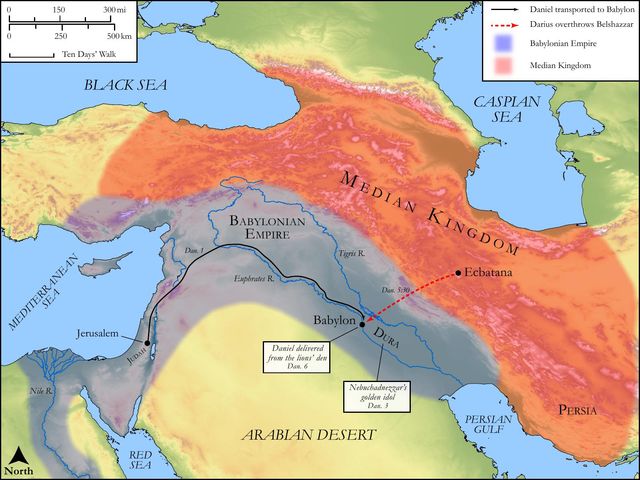
See on the biblical-era map
Study this verse
Public-domain commentary
Matthew Henry
From his Commentary on the Whole Bible. Henry comments on passages, not single verses — this entry covers Daniel 6:18–24. His two-level outline is real structure in the source text, so it is rendered as structure.
Here is, I. The melancholy night which the king had, upon Daniel's account, Dan 6:18. He had said, indeed, that God would deliver him out of the danger, but at the same time he could not forgive himself for throwing him into the danger; and justly might God deprive him of a friend whom he had himself used so barbarously. He went to his palace, vexed at himself for what he had done, and calling himself unwise and unjust for not adhering to the law of God and nature with a non obstante - a negative to the law of the Medes and Persians. He ate no supper, but passed the night fasting; his heart was already full of grief and fear. He forbade the music; nothing is more unpleasing that songs sung to a heavy heart. He went to bed, but got no sleep, was full of tossings to and fro till the dawning of the day. Note, the best way to have a good night is to keep a good conscience, then we may lie down in peace.
II.The solicitous enquiry he made concerning Daniel the next morning, Dan 6:19, Dan 6:20.
He was up early, very early; for how could he lie in bed when he could not sleep for dreaming of Daniel, nor lie awake quietly for thinking of him? And he was no sooner up than he went in haste to the den of lions, for he could not satisfy himself to send a servant (that would not sufficiently testify his affection for Daniel), nor had he patience to stay so long as till a servant would return. When he comes to the den, not without some hopes that God had graciously undone what he had wickedly done, he cries, with a lamentable voice, as one full of concern and trouble, O Daniel! art thou alive? He longs to know, yet trembles to ask the question, fearing to be answered with the roaring of the lions after more prey: O Daniel! servant of the living God, has thy God whom thou servest made it to appear that he is able to deliver thee from the lions? If he rightly understood himself when he called him the living God, he could not doubt of his ability to keep Daniel alive, for he that has life in himself quickens whom he will; but has he thought fit in this case to exert his power? What he doubted of we are sure of, that the servants of the living God have a Master who is well able to protect them and bear them out in his service.
III.The joyful news he meets with - that Daniel is alive, is safe, and well, and unhurt in the lions' den, Dan 6:21, Dan 6:22.
Daniel knew the king's voice, though it was now a lamentable voice, and spoke to him with all the deference and respect that were due to him: O king! live for ever. He does not reproach him for his unkindness to him, and his easiness in yielding to the malice of his persecutors; but, to show that he has heartily forgiven him, he meets him with his good wishes. Note, We should not upbraid those with the diskindnesses they have done us who, we know, did them with reluctance, and are very ready to upbraid themselves with them. The account Daniel gives the king is very pleasant; it is triumphant.
1.God has preserved his life by a miracle. Darius had called him Daniel's god (thy God whom thou servest), to which Daniel does as it were echo back, Yea, he is my God, whom I own, and who owns me, for he has sent his angel. The same bright and glorious being that was seen in the form of the Son of God with the three children in the fiery furnace had visited Daniel, and, it is likely, in a visible appearance had enlightened the dark den, and kept Daniel company all night, and had shut the lions' mouths, that they had not in the least hurt him. The angel's presence made even the lions' den his strong-hold, his palace, his paradise; he had never had a better night in his life. See the power of God over the fiercest creatures, and believe his power to restrain the roaring lion that goes about continually seeking to devour from hurting those that are his. See the care God takes of his faithful worshippers, especially when he calls them out to suffer for him. If he keeps their souls from sin, comforts their souls with his peace, and receives their souls to himself, he does in effect stop the lions' mouths, that they cannot hurt them. See how ready the angels are to minister for the good of God's people, for they own themselves their fellow servants.
2.God has therein pleaded his cause. He was represented to the king as disaffected to him and his government. We do not find that he said any thing in his own vindication, but left it to God to clear up his integrity as the light; and he did it effectually, by working a miracle for his preservation. Daniel, in what he had done, had not offended either God or the king: Before him whom I prayed to innocency was found in me. He pretends not to a meritorious excellence, but the testimony of his conscience concerning his sincerity is his comfort - As also that before thee, O king! I have done no hurt, nor designed thee any affront.
IV.The discharge of Daniel from his confinement.
His prosecutors cannot but own that the law is satisfied, though they are not, or, if it be altered, it is by a power superior to that of the Medes and Persians; and therefore no cause can be shown why Daniel should not be fetched out of the den (Dan 6:23): The king was exceedingly glad to find him alive, and gave orders immediately that they should take him out of the den, as Jeremiah out of the dungeon; and, when they searched, no manner of hurt was found upon him; he was nowhere crushed nor scarred, but was kept perfectly well, because he believed in his God. Note, Those who boldly and cheerfully trust in God to protect them in the way of their duty shall never be made ashamed of their confidence in him, but shall always find him a present help.
V.The committing of his prosecutors to the same prison, or place of execution rather, Dan 6:24.
Darius is animated by this miracle wrought for Daniel, and now begins to take courage and act like himself. Those that would not suffer him to show mercy to Daniel shall, now that God has done it for him, be made to feel his resentments; and he will do justice for God who had shown mercy for him. Daniel's accusers, now that his innocency is cleared, and Heaven itself has become his compurgator, have the same punishment inflicted upon them which they designed against him, according to the law of retaliation made against false accusers, Deu 19:18, Deu 19:19. Such they were to be reckoned now that Daniel was proved innocent; for, though the fact was true, yet it was not a fault. They were cast into the den of lions, which perhaps was a punishment newly invented by themselves; however, it was what they maliciously designed for Daniel. Nec lex est justior ulla qum necis artifices arte perire su - No law can be more just than that which adjudges the devisers of barbarity to perish by it, Psa 7:15, Psa 7:16; Psa 9:15, Psa 9:16. And now Solomon's observation is verified (Pro 11:8), The righteous is delivered out of trouble, and the wicked cometh in his stead. In this execution we may observe,
1.The king's severity, in ordering their wives and children to be thrown to the lions with them. How righteous are God's statutes above those of the nations! for God commanded that the children should not die for the fathers' crimes, Deu 24:16. Yet they were put to death in extraordinary cases, as those of Achan, and Saul, and Haman.
2.The lion's fierceness. They had the mastery of them immediately, and tore them to pieces before they came to the bottom of the den. This verified and magnified the miracle of their sparing Daniel; for hereby it appeared that it was not because they had not appetite, but because they had not leave. Mastiffs that are kept muzzled are the more fierce when the muzzle is taken off; so were these lions. And the Lord is known by those judgments which he executes.
Historical interpretation
Historical reception
2 surviving comments on this verse. Each one is dated, so this reads as a timeline rather than a list.
Select a marker to jump to its quote. Markers stagger vertically where authors wrote within a few decades of each other.
Daniel also was persecuted as Jesus was persecuted.… Daniel they cast into the pit of lions, and he was delivered and came up out of its midst uninjured; and Jesus they sent down into the pit of the abode of the dead, and he ascended, and death had not dominion over him. Concerning Daniel they expected that when he had fallen into the pit he would not come up again; and concerning Jesus they said, “Since he has fallen, he shall not rise again.” From [harming] Daniel the mouths of the ravenous and destructive lions were closed; and from [harming] Jesus was closed the mouth of death, [though] ravenous and destructive of [living] forms. They sealed the pit of Daniel and guarded it with diligence; and they guarded the grave of Jesus with diligence, as they said, “Set guards to watch at the tomb.” When Daniel came up, his accusers were ashamed; and when Jesus rose, all they who had crucified him were ashamed.
Since a simple punishment was not sufficient for those culprits, in order to balance the offense they had brought against a righteous man, after being condemned to the same punishment, they were thrown to the beasts together with their wives and children.
Continue studying Daniel 6:24 across the web’s major study libraries — every link below opens this exact verse, chapter, or book on the destination site.
Read & Compare
 BibleGatewayThis verse in more than 200 translations and 70 languages.
 Bible.comThe YouVersion reader — hundreds of translations, reading plans, and highlights.
 ESV.orgCrossway's official English Standard Version reader.
 NET BibleThe NET translation with 60,000+ translators' notes on every rendering decision.
 STEP BibleTyndale House's free study tool — original text, vocabulary, and scholarly resources.
 BibliaLogos Bible Software's free web reader.
 USCCBThe New American Bible (Revised Edition) with the U.S. bishops' study notes.
Commentaries
 BibleHub CommentariesDozens of classic commentaries on this verse, gathered on one page.
 StudyLightMore than 100 commentary sets — the largest collection on the web.
 BibleRefPlain-English commentary on what this verse means, verse by verse.
 Enduring WordDavid Guzik's free commentary on this chapter, widely used by Bible teachers.
 Bible Study ToolsVerse commentary alongside Greek and Hebrew study aids.
Original Language & Research
- BibleHub InterlinearThe verse word by word — original language, transliteration, and English.
- BibleHub LexiconEvery word's original-language definition and Strong's entry.
 Blue Letter BibleDeep-study tools — Strong's numbers, concordance, and word studies.
 SefariaThe Hebrew text with Rashi and centuries of Jewish commentary.
Sermons, Hymns & Audio


TrulyRandomVerse is not affiliated with these sites and doesn’t control their content. They’re linked because they’re genuinely useful.
Summary
Daniel 6:24 powerfully narrates the swift and brutal judgment upon Daniel's accusers, serving as a stark counterpoint to Daniel's miraculous deliverance from the lions' den. This verse dramatically concludes the narrative of the conspiracy against Daniel, highlighting the immediate and severe divine justice meted out to those who maliciously plotted against God's faithful servant, thereby affirming God's unwavering sovereignty and active intervention in human affairs.
Context
ShowHideLiterary Context
This verse immediately follows the climactic account of Daniel's miraculous preservation in the lions' den, where divine intervention sealed the mouths of the lions, leaving Daniel unharmed. The preceding narrative meticulously establishes Daniel's unwavering piety and King Darius's profound distress and subsequent joy upon witnessing Daniel's safety. Having been exposed to the malicious intent of his officials, Darius, now convinced of Daniel's innocence and God's power, decrees that Daniel's accusers should suffer the very fate they intended for him. This act of swift retribution serves as a crucial narrative resolution, demonstrating the direct and inescapable consequences of their envy, treachery, and false accusation, and powerfully reinforcing the overarching theme of divine vindication for the righteous.
Historical & Cultural Context
The inclusion of the accusers' children and wives in their punishment, though jarring to contemporary sensibilities, was a harsh yet common legal and cultural practice among the nations of that day, particularly within the Persian Empire. This practice, often referred to as corporate punishment or collective responsibility, meant that the family unit of a condemned individual, especially in cases of high treason, sedition, or severe crimes against the monarch or state, could share in their punishment. The intent was multifaceted: to serve as a potent deterrent against future offenses, to emphasize the severe consequences for the entire lineage, and to eradicate any potential future threats from the family line. This custom underscored the absolute authority of the monarch and the profound gravity of undermining royal decrees or authority, which in this instance was inextricably linked to an offense against God's chosen servant.
Key Themes
ShowHideThe events of Daniel 6:24 contribute significantly to several profound theological and narrative themes within the book of Daniel and broader biblical revelation. Foremost is Divine Justice and Retribution, vividly illustrating God's active role in judging evil and executing justice, where the wicked are ensnared in their own devices, a principle echoed in Psalm 7:15-16 and Proverbs 26:27. This verse serves as a powerful demonstration of God's commitment to setting things right. Closely intertwined is the Vindication of the Righteous, as Daniel's miraculous preservation is immediately followed by the swift and comprehensive punishment of his enemies, powerfully demonstrating God's protective hand over His faithful servant. This narrative reinforces that God defends those who honor Him, even in the face of grave danger and false accusation, a truth found in Psalm 37:32-33. Finally, the verse underscores the severe Consequences of Malice and Envy, highlighting how the accusers' actions, driven by jealousy of Daniel's favor with King Darius and his unwavering devotion to God (as established in Daniel 6:4), ultimately led to their own catastrophic demise.
Exposition and Analysis
ShowHideKey Word Analysis
ShowHideThis Aramaic term (H1358) refers to "a pit (for wild animals) (as cut out)." In the context of Daniel 6, it specifically denotes the deep, excavated chamber where lions were kept, serving as a designated place of execution. The precise use of this term emphasizes the intended purpose of the pit as a place of certain death, making Daniel's miraculous deliverance all the more profound and the accusers' fate all the more ironic and fitting.
This Aramaic verb (H1855) means "to crumble or (trans.) crush." It vividly describes the utter, immediate, and violent destruction inflicted by the lions upon Daniel's accusers. The intensity of this verb highlights the complete lack of resistance and the overwhelming power of the lions, underscoring the finality and severity of the judgment. It stands in stark contrast to the lions' complete passivity towards Daniel, emphasizing a supernatural and selective intervention.
This Aramaic term (H1123), corresponding to the Hebrew "son," broadly refers to "a son (as a builder of the family name), in the widest sense; child, son, young." Its explicit inclusion here is crucial for understanding the practice of corporate punishment among the Persians, where the entire family unit could be held responsible for the actions of one member, particularly in cases of high treason or crimes against the state. This detail underscores the comprehensive and devastating nature of the judgment against Daniel's accusers.
Verse Breakdown
ShowHide"And the king commanded, and they brought those men which had accused Daniel,"
This opening clause establishes the immediate royal decree and the swift execution of justice. King Darius, having witnessed Daniel's miraculous preservation and now fully aware of the malicious intent behind the false accusation, acts decisively. The specific phrase "those men which had accused Daniel" clearly identifies the recipients of this judgment, emphasizing their direct culpability in the conspiracy and their role as instigators of injustice.
"and they cast [them] into the den of lions, them, their children, and their wives;"
This part details the specific punishment and its extensive scope. The method of execution—being cast into the lions' den—is a direct and ironic reversal of the fate intended for Daniel, a classic example of the wicked falling into their own snare. The explicit inclusion of "them, their children, and their wives" highlights the ancient practice of corporate punishment, signifying the complete eradication of the conspirators' lineage and underscoring the severe societal consequences of their treachery against both the king and God's servant.
"and the lions had the mastery of them, and brake all their bones in pieces or ever they came at the bottom of the den."
This final, graphic clause describes the immediate and overwhelming ferocity of the lions. The phrase "had the mastery of them" (Aramaic shᵉlêṭ, "to dominate, govern, permit") indicates the lions' unrestrained power and absolute control over their victims. The vivid description "brake all their bones in pieces" (Aramaic dᵉqaq, "to crush") emphasizes the absolute and total destruction. The chilling detail "or ever they came at the bottom of the den" (Aramaic lâ' mᵉṭâ' 'ar'îyth, "not arrived at the bottom") underscores the instantaneous nature of the attack, contrasting sharply with the lions' miraculous passivity towards Daniel. This immediate and complete destruction serves as a powerful testament to divine judgment and the profound vindication of Daniel.
Literary Devices
ShowHideDaniel 6:24 employs several powerful literary devices to convey its message with striking impact. Irony is paramount, as the very instrument of intended death for Daniel—the lions' den—becomes the instrument of swift and brutal judgment for his accusers. The conspirators fall into the pit they dug, a classic biblical motif illustrating divine poetic justice. Contrast is also vividly used, juxtaposing Daniel's miraculous, divinely protected survival with the immediate, overwhelming, and gruesome destruction of his enemies, highlighting the stark difference between God's favor and His judgment. The description of the lions' attack uses Hyperbole and Vivid Imagery ("brake all their bones in pieces or ever they came at the bottom of the den") to emphasize the extreme and instantaneous nature of their demise, underscoring the completeness of the divine retribution and the absolute power of the lions when unleashed. The lions themselves function as Symbolism, serving as agents of divine justice, executing God's righteous judgment against those who opposed His servant.
Theological and Thematic Connections
ShowHideDaniel 6:24 profoundly illustrates God's unwavering commitment to justice and His active, decisive intervention in human affairs. It underscores the theological principle that while God may permit trials and suffering for His faithful, He ultimately vindicates His righteous servants and brings swift, undeniable judgment upon those who maliciously oppose them. This passage serves as a powerful reminder that God is sovereign over all earthly powers and that no human plot, however cunning or well-orchestrated, can ultimately thwart His divine purposes. It reinforces the truth that vengeance belongs to the Lord, and He will repay, providing deep comfort to those who suffer injustice and a solemn warning to those who contemplate evil. The swiftness and totality of the judgment also speak to the severity of sin, particularly that which targets the innocent and seeks to undermine divine truth and God's people.
Reflection and Application
ShowHideDaniel 6:24 offers profound and enduring lessons for contemporary believers. It encourages unwavering faithfulness in the face of adversity, reminding us that God is our ultimate defender and vindicator, even when circumstances seem dire or human systems of justice fail. While we may not always witness immediate, visible retribution for injustice in our lives, this passage assures us of God's ultimate sovereignty and His commitment to perfect justice in His timing. It calls us to trust in His righteous character and to resist the temptation to take vengeance into our own hands, knowing that He sees all and will ultimately set all things right. Furthermore, the fate of Daniel's accusers serves as a solemn warning against malice, envy, and plotting against others. It reminds us that such actions, rooted in sin and driven by corrupt motives, ultimately lead to self-destruction and divine judgment. Our calling as followers of Christ is to pursue righteousness, extend grace, and leave the scales of justice in the hands of the Almighty, knowing that He is just and will ultimately bring every hidden thing into the light.
Questions for Reflection
ShowHideFAQ
ShowHideWhy were the children and wives of the accusers also punished?
ShowHideThe inclusion of the children and wives in the punishment reflects a common, albeit harsh, legal practice among the nations of that day, particularly within the Persian Empire, known as corporate punishment or collective responsibility. In cases of severe crimes, especially treason or offenses against the king or state, the entire family unit could be held accountable for the actions of one member. This was intended to serve as a powerful deterrent against future transgressions and to completely eradicate any potential future threats or claims from the lineage of the condemned. It underscored the absolute nature of justice and retribution in that historical context, emphasizing the profound consequences of the accusers' malicious plot against Daniel and, by extension, against the king's decree and God's servant.
Does Daniel 6:24 imply that God always brings immediate and visible judgment upon the wicked?
ShowHideWhile Daniel 6:24 provides a dramatic and singular example of immediate divine retribution, it does not imply that God always acts with such visible swiftness in every instance of wickedness. The Bible presents a nuanced view of divine justice, where judgment can be immediate (as seen here), delayed for a season, or reserved for a final, eschatological reckoning. This particular event serves as a powerful, singular demonstration of God's sovereignty and His direct intervention to vindicate His faithful servant and uphold His name. It assures believers that God is ultimately just and will right all wrongs, even if the timing of that justice is not always apparent to human eyes. We are called to trust in God's perfect timing and His ultimate plan for justice, as seen in passages like 2 Peter 3:8-9.
Christ-Centered Fulfillment
ShowHideDaniel 6:24, with its stark portrayal of divine justice and the vindication of the righteous, finds its ultimate fulfillment and deepest meaning in the person and work of Jesus Christ. Daniel's miraculous deliverance from the jaws of death, an innocent man condemned by malicious accusers, powerfully foreshadows Christ's ultimate victory over sin, death, and the grave. Just as Daniel was unjustly accused and sentenced, so too was Jesus, the Lamb of God who takes away the sin of the world, condemned by those who envied His light and truth. However, while Daniel was delivered from the den, Christ willingly entered the "den" of death, descending into the grave, only to emerge triumphantly through His resurrection, thereby disarming the spiritual accusers and powers of darkness that held humanity captive (as described in Colossians 2:15). The swift and complete judgment upon Daniel's accusers points forward to Christ as the ultimate Judge, who will one day execute perfect justice, casting down all evil and every enemy of God into the lake of fire (see Revelation 20:10-15). In Christ, we see the full measure of God's justice against sin and His glorious vindication of all who are declared righteous through faith in Him, assuring us that though evil may seem to triumph for a season, its ultimate and eternal defeat is certain through the power of our resurrected Lord.