


2 Kings 14:6
Bible text: King James Version (1769 Blayney text) · Public domain
Bible text: King James Version with Strong's numbers · Public domain
Bible text: Berean Standard Bible · Public domain
Bible text: American Standard Version (1901) · Public domain
Bible text: World English Bible, Messianic edition · Public domain
Bible text: Geneva Bible (1599) · Public domain
Bible text: Young's Literal Translation · Public domain
- וְאֶתve·'Etand <obj.>H853Conj-w ¦ DirObjMParticle Object Indicatorוְandאֶת<obj.>
- בְּנֵיbe·Nei[the] sons ofH1121N-mpcNoun Plural Masculine Construct
- הַמַּכִּיםha·ma·Kimthose [who] had struck downH5221Art ¦ V-Hiphil-Prtcpl-mpVerb Hiphil Participle Plural Masculine Absoluteהַthoseמַּכִּים[who] had struck down
- לֹאlo'notH3808NegParticle Negative
- הֵמִיתhe·Mithe put to deathH4191V-Hiphil-Perf-3msVerb Hiphil Perfect 3rd Singular Masculine
- כַּכָּתוּבka·ka·Tuvaccording to <the> [what] is writtenH3789Prep-k ¦ V-Qal-PassPrtcpl-msVerb Qal Participle Passive Singular Masculine Absoluteכַּaccording to <the>כָּתוּב[what] is written
- בְּסֵפֶרbe·Se·ferin [the] book ofH5612Prep-b ¦ N-mscNoun Singular Masculine Constructבְּinסֵפֶר[the] book of
- תּוֹרַתto·rat[the] law ofH8451N-fscNoun Singular Feminine Construct
- מֹשֶׁהMo·shehMosesH4872N-proper-mNoun Proper Masculine
- אֲשֶׁר'a·SherwhichH834RelParticle Relative
- צִוָּהtzi·Vahhe commandedH6680V-Piel-Perf-3msVerb Piel Perfect 3rd Singular Masculine
- יְהוָהYah·wehYahwehH3068N-properNoun Proper Title
- לֵאמֹרle·Mor<to> sayingH559Prep-l ¦ V-Qal-InfVerb Qal Infinitive Constructלֵ<to>אמֹרsaying
- לֹאlo'notH3808NegParticle Negative
- יוּמְתוּyu·me·Tuthey will be put to deathH4191V-Hophal-Imperf-3mpVerb Hophal Imperfect 3rd Plural Masculine
- אָבוֹת'a·VotfathersH1N-fpNoun Plural Feminine Absolute
- עַל'alonH5921PrepPreposition
- בָּנִיםba·NimsonsH1121N-mpNoun Plural Masculine Absolute
- וּבָנִיםu·va·Nimand sonsH1121Conj-w ¦ N-mpNoun Plural Masculine Absoluteוּandבָנִיםsons
- לֹאlo'notH3808NegParticle Negative
- יוּמְתוּyu·me·Tuthey will be put to deathH4191V-Hophal-Imperf-3mpVerb Hophal Imperfect 3rd Plural Masculine
- עַל'alonH5921PrepPreposition
- אָבוֹת'a·VotfathersH1N-fpNoun Plural Feminine Absolute
- כִּיkithatH3588PrtParticle Conditional
- אִם'imexceptH518PrtParticle Conditional
- אִישׁ'isheachH376N-msNoun Singular Masculine Absolute
- בְּחֶטְאוֹbe·chet·'Ofor his own sinH2399Prep-b ¦ N-msc ¦ 3msNoun Singular Masculine Constructבְּforחֶטְאown sinוֹhis
- יוּמָתya·muthe will be put to deathH4191V-Hophal-Imperf-3msVerb Hophal Imperfect 3rd Singular Masculine
English is a literal word-by-word gloss of the Hebrew, not the KJV's wording. Why?
This is the original text the KJV's translators worked from — each Hebrew word with its own literal English meaning in this verse, prepared by scholars at Tyndale House, Cambridge. The KJV translates whole sentences, not word by word, so its wording differs: one Hebrew word can become several English words, and the KJV may choose “the LORD” where the gloss reads “Yahweh”. Both are faithful — they answer different questions. For the KJV's own rendering, switch to the KJV text.
Details
See on the biblical-era maps
Study this verse
Public-domain commentary
Matthew Henry
From his Commentary on the Whole Bible. Henry comments on passages, not single verses — this entry covers 2 Kings 14:1–7. His two-level outline is real structure in the source text, so it is rendered as structure.
Amaziah, the son and successor of Joash, is the king whom here we have an account of. Let us take a view of him,
I.In the temple; and there he acted, in some measure, well, like Joash, but not like David, Kg2 14:3.
He began well, but did not persevere: He did that which was right in the sight of the Lord, kept up his attendance on God's altars and his attention to God's word, yet not like David. It is not enough to do that which our pious predecessors did, merely to keep up the usage, but we must do it as they did it, from the same principle of faith and devotion and with the same sincerity and resolution. It is here taken notice of, as before, that the high places were not taken away, Kg2 14:4. It is hard to get clear of those corruptions which, by long usage, have gained both prescription and a favourable opinion.
II.On the bench; and there we have him doing justice on the traitors that murdered his father, not as soon as ever he came to the crown, lest it should occasion some disturbance, but he prudently deferred it till the kingdom was confirmed in his hand, Kg2 14:5. To weaken a factious party gradually, when it is not safe to provoke, often proves the way to ruin it effectually. Justice strikes surely by striking slowly, and is often executed most prudently when it is not executed presently. Wisdom here is profitable to direct. Amaziah did thus,
1.According to the rule of the law, that ancient rule, that he that sheds man's blood by man shall his blood be shed. Never let traitors or murderers expect to come to their graves like other men. Let them flee to the pit, and let no man stay them.
2.Under the limitation of the law: The children of the murderers he slew not, because the law of Moses had expressly provided that the children should not be put to death for the fathers, Kg2 14:6. It is probable that this is taken notice of because there were those about him that advised him to that rigour, both in revenge (because the crime was extraordinary - the murder of a king) and in policy, that the children might not plot against him, in revenge of their father's death. But against these insinuations he opposed the express law of God (Deu 24:16), which he was to judge by, and which he resolved to adhere to and trust God with the issue. God visits the iniquity of the fathers upon the children, because every man is guilty before him and owes him a death; so that, if he require the life for the father's sin, he does not wrong, the sinner having forfeited it already by his own. But he does not allow earthly princes to do thus: the children, before them, are innocent, and therefore must not suffer as guilty.
III.In the field; and there we find him triumphing over the Edomites, Kg2 14:7.
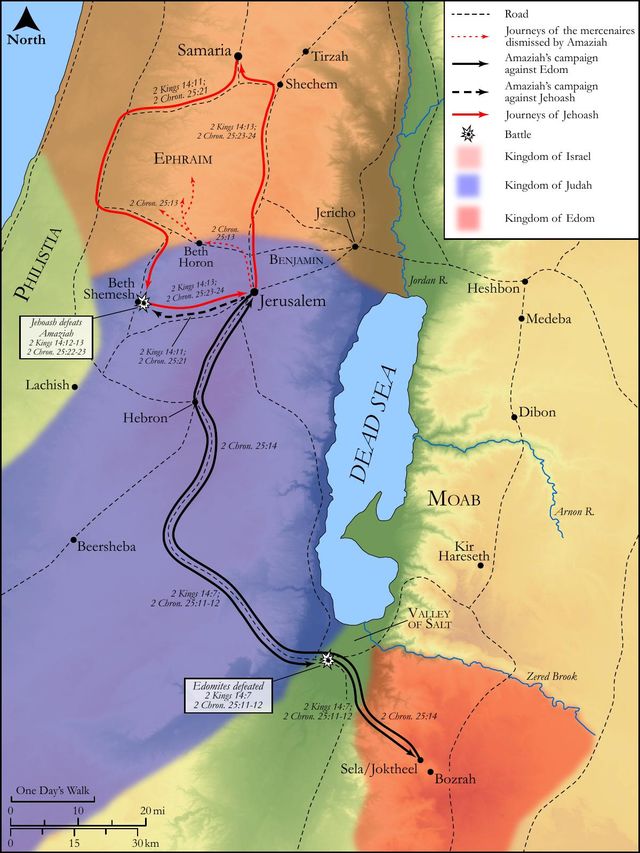
Edom had revolted from under the hand of Judah in Joram's time, Kg2 8:22. Now he makes war upon them to bring them back to their allegiance, kills 10,000 and takes the chief city of Arabia the stony (called Selah - a rock), and gave it a new name. We shall find a larger account of this expedition, Ch2 25:5, etc.
Historical interpretation
Historical reception
1 surviving comment on this verse from the historical church.
“In the second year of King Joash son of Ahaziah of Israel, King Amaziah son of Joash of Judah began to reign,” who avenged the death of his father, but with moderation, so that he spared the life of the relatives of the conspirators according to the prescriptions of the Law and was careful that the punishment might not be too excessive for the authors of the crime. Therefore Amaziah was pious, as long as he had before his eyes his father’s unhappy end, whose cause he could not ignore: offense against the true religion [of God]. However, when his reign began to be very prosperous, [Amaziah] rejected his fear of God which he had conceived after witnessing his father’s punishment, and embraced foreign cults. In the second book of the Annals, the Scripture relating his victory against the Edomites confirms that this was the reason of his apostasy: “But Amaziah took courage, and led out his people, and went to the Valley of Salt and smote ten thousand men of Seir. The men of Judah captured another ten thousand alive and took them to the top of a rock, and all were enchained.” And the text adds, “After Amaziah came from the slaughter of the Edomites, he brought the gods of the men of Seir, and set them up as his gods and worshiped them, making offerings to them.”
Continue studying 2 Kings 14:6 across the web’s major study libraries — every link below opens this exact verse, chapter, or book on the destination site.
Read & Compare
 BibleGatewayThis verse in more than 200 translations and 70 languages.
 Bible.comThe YouVersion reader — hundreds of translations, reading plans, and highlights.
 ESV.orgCrossway's official English Standard Version reader.
 NET BibleThe NET translation with 60,000+ translators' notes on every rendering decision.
 STEP BibleTyndale House's free study tool — original text, vocabulary, and scholarly resources.
 BibliaLogos Bible Software's free web reader.
 USCCBThe New American Bible (Revised Edition) with the U.S. bishops' study notes.
Commentaries
 BibleHub CommentariesDozens of classic commentaries on this verse, gathered on one page.
 StudyLightMore than 100 commentary sets — the largest collection on the web.
 BibleRefPlain-English commentary on what this verse means, verse by verse.
 Enduring WordDavid Guzik's free commentary on this chapter, widely used by Bible teachers.
 Bible Study ToolsVerse commentary alongside Greek and Hebrew study aids.
Original Language & Research
- BibleHub InterlinearThe verse word by word — original language, transliteration, and English.
- BibleHub LexiconEvery word's original-language definition and Strong's entry.
 Blue Letter BibleDeep-study tools — Strong's numbers, concordance, and word studies.
 SefariaThe Hebrew text with Rashi and centuries of Jewish commentary.
Sermons, Hymns & Audio


TrulyRandomVerse is not affiliated with these sites and doesn’t control their content. They’re linked because they’re genuinely useful.
Summary
King Amaziah of Judah, upon securing his throne, demonstrated a profound adherence to divine law by executing the conspirators who murdered his father, King Joash, yet deliberately sparing their children. This act was not merely a display of mercy but a direct, conscious obedience to the Mosaic Law, which explicitly forbade collective punishment, emphasizing instead the principle that each individual is accountable for their own sin. This decision highlights a foundational aspect of God's perfect justice, setting Israel's legal code apart from the prevailing norms of the nations round about.
Context
ShowHideLiterary Context
This verse immediately follows Amaziah's consolidation of power after ascending the throne of Judah (2 Kings 14:1-5). Having avenged his father, King Joash, by executing the regicides, Amaziah then applies a crucial principle of Mosaic Law concerning their children. This act of judicial restraint serves as a significant, albeit brief, moment of righteous leadership in Amaziah's reign, which later becomes marred by idolatry and military defeat (2 Kings 14:8-14). The narrative here underscores the importance of adherence to the Torah even in matters of state justice, providing a stark contrast to the often brutal and collective retaliations common among the nations round about. It sets the stage for understanding Amaziah's character and the divine standards by which kings were judged.
Historical & Cultural Context
Amaziah reigned in Judah during the 8th century BCE. Among the nations round about, it was a common and accepted practice for the family members of criminals, especially those guilty of treason or regicide, to be executed alongside the offender. This collective punishment was intended to eradicate any potential threat from the lineage and serve as a powerful deterrent. However, the Law of Moses, as recorded in Deuteronomy 24:16, explicitly prohibited this practice, insisting on individual culpability. Amaziah's decision to spare the children, therefore, was not merely an act of personal clemency but a radical adherence to God's unique standard of justice, demonstrating a theological commitment that defied contemporary cultural norms.
Key Themes
ShowHideThe primary theme illuminated by 2 Kings 14:6 is Individual Responsibility and Accountability. The verse unequivocally states that "every man shall be put to death for his own sin," a principle that forms the bedrock of biblical ethics concerning justice and judgment. This stands in direct opposition to the concept of inherited guilt or collective punishment, which was prevalent in many societies of that era. Closely related is the theme of Adherence to Divine Law. Amaziah's actions highlight the paramount importance of obeying God's written word, specifically the "book of the law of Moses." His faithfulness to this specific command, even when it ran counter to human tradition, underscores the authority and distinctiveness of God's statutes. Finally, the verse speaks to the nature of Divine Justice, revealing God as a perfectly equitable and fair judge whose laws ensure that consequences are meted out based on personal actions, not the sins of one's family line, thereby reflecting a transcendent standard of fairness.
Exposition and Analysis
ShowHideKey Word Analysis
ShowHideThis verb, meaning "to die" or causatively "to kill," is crucial as it describes the act of execution. In the context of "slew not," it highlights Amaziah's deliberate restraint from applying the death penalty to the children, directly contrasting with the execution of the murderers. It underscores the active choice to uphold a higher legal standard.
This term refers to the divine instruction or precept, specifically the Pentateuch given through Moses. Its mention signifies the authoritative source of Amaziah's actions, demonstrating that his decision was not arbitrary but a direct obedience to God's revealed will, distinguishing Israel's justice from the common practices of the nations round about.
This noun denotes a "crime or its penalty," an "offence," or "punishment of sin." Its use in the phrase "for his own sin" is foundational, emphasizing individual culpability. It establishes that legal consequences are tied exclusively to the personal transgression of the individual, rejecting the notion of inherited guilt or collective punishment.
Verse Breakdown
ShowHide"But the children of the murderers he slew not:"
This initial clause describes King Amaziah's specific act of judicial restraint. After executing the conspirators who murdered his father, Joash, he deliberately chose not to extend the punishment to their offspring. This decision immediately signals a departure from the common practices of the nations round about.
"according unto that which is written in the book of the law of Moses, wherein the LORD commanded, saying,"
This phrase provides the divine justification and authority for Amaziah's action. It explicitly states that his decision was not arbitrary but was a direct fulfillment of a specific command found in the Torah, underscoring the king's obedience to God's revealed will.
"The fathers shall not be put to death for the children, nor the children be put to death for the fathers;"
This is the negative prohibition from the Mosaic Law, directly quoted. It unequivocally forbids the practice of collective punishment, ensuring that legal retribution for capital offenses is not extended to innocent family members. This principle protects the innocent from suffering for the crimes of others.
"but every man shall be put to death for his own sin."
This is the positive affirmation of the Mosaic principle, emphasizing individual accountability. It establishes that legal punishment is strictly personal, based solely on the guilt of the individual who committed the offense. This clause forms the bedrock of biblical justice, asserting that consequences are tied directly to personal actions.
Literary Devices
ShowHideThe passage primarily employs Quotation, directly citing the Mosaic Law from Deuteronomy 24:16. This direct quotation lends immense authority and theological weight to Amaziah's actions, demonstrating his adherence to divine rather than human standards. Furthermore, the text utilizes Contrast by presenting Amaziah's actions ("he slew not") against the backdrop of the typical practices of collective punishment among the nations round about, thereby highlighting the unique and progressive nature of God's law. There is also an element of Emphasis through the clear and concise articulation of the principle: "The fathers shall not be put to death for the children, nor the children be put to death for the fathers; but every man shall be put to death for his own sin." This balanced, antithetical parallelism powerfully underscores the central theme of individual responsibility.
Theological and Thematic Connections
ShowHideThe principle articulated in 2 Kings 14:6 is a cornerstone of biblical justice, revealing a profound aspect of God's character: His absolute fairness and His commitment to individual accountability. In a world where collective guilt and inherited punishment were common, Israel's law stood out as remarkably enlightened and just, reflecting the very nature of a God who sees and judges each person individually. This principle assures us that God's judgment is never arbitrary or misdirected; it is always precise, targeting the one who has sinned. It also sets the stage for understanding personal salvation and judgment, underscoring that our standing before God is based on our own actions and faith, not on the merits or demerits of our ancestors. This divine standard of justice is consistently upheld throughout the prophetic literature, challenging popular misconceptions about intergenerational guilt.
Reflection and Application
ShowHideThe timeless principle of individual accountability articulated in 2 Kings 14:6 carries profound implications for both our understanding of God's character and our personal walk of faith. It assures us that God's justice is perfectly fair, rendering to each person according to their own deeds, not the sins of their family or community. This truth provides immense comfort, freeing us from the burden of inherited guilt in a judicial sense, and simultaneously places the weight of personal responsibility squarely on our shoulders. It challenges any tendency to blame others for our choices or to expect unearned consequences based on lineage. For believers, this means our relationship with God, our salvation, and our sanctification are deeply personal matters, requiring individual repentance, faith, and obedience. It underscores the call to live righteously, knowing that we are individually accountable for every thought, word, and deed before a just and holy God.
Questions for Reflection
ShowHideFAQ
ShowHideWas collective punishment common among the nations round about, and why was Israel's law different?
ShowHideYes, collective punishment was indeed a widespread practice among the nations round about Israel. It was common for the entire family, or even the clan, of a criminal (especially for offenses like treason, murder, or rebellion) to suffer the same fate as the offender. This was often done to eliminate potential threats, deter future crimes, or simply as a brutal form of retribution. Israel's law, as seen in 2 Kings 14:6 and its source in Deuteronomy 24:16, was remarkably unique and progressive in its insistence on individual culpability. This distinction highlights God's character of perfect justice and fairness, which transcends human customs and ensures that only the guilty party bears the punishment for their own sin.
Does the Bible ever show examples of collective punishment, and how does that reconcile with this verse?
ShowHideWhile 2 Kings 14:6 (and Deuteronomy 24:16) prohibits judicial collective punishment, there are instances in the Old Testament where God's divine judgment appears to involve collective consequences. For example, the destruction of Sodom and Gomorrah (Genesis 19) or the judgment on Achan's family (Joshua 7). It's crucial to distinguish between judicial law for human courts (which 2 Kings 14:6 addresses) and direct divine judgment for corporate sin. In cases of divine judgment, the collective may have been complicit, or the judgment served a broader theological purpose to demonstrate the severity of sin and God's holiness. The principle in 2 Kings 14:6 primarily governs the administration of justice by human authorities within Israel.
How does this verse relate to the concept of inherited sin or original sin?
ShowHideThis verse addresses judicial punishment for personal sin, stating that individuals are held accountable for their own actions before human courts (and by extension, before God's just judgment). It does not negate the theological concept of inherited sinfulness or original sin, which refers to the fallen spiritual nature and propensity to sin that humanity inherits from Adam (Romans 5:12). While we inherit a sinful nature that leads us to commit personal sins, this verse clarifies that we are not judicially condemned by God for the specific, capital crimes of our ancestors. Our ultimate condemnation or salvation rests on our own choices and response to God's grace, as articulated in passages like Ezekiel 18.
Christ-Centered Fulfillment
ShowHideThe principle of individual accountability, so clearly articulated in 2 Kings 14:6, finds its ultimate and most profound fulfillment in the person and work of Jesus Christ. While the Old Testament law prohibited human courts from punishing children for their parents' sins, the spiritual reality remained that all humanity was under the condemnation of sin, a consequence of Adam's transgression (Romans 5:12). Yet, God's perfect justice, which demands that "every man shall be put to death for his own sin," was fully satisfied not by our individual demise, but by the vicarious death of Christ. Jesus, the sinless Lamb of God, bore the penalty for our individual sins, fulfilling the righteous requirement of the law on our behalf (2 Corinthians 5:21). Through His sacrifice, the divine principle of individual accountability is upheld, yet transformed by grace: those who believe in Him are no longer condemned for their own sins, because Christ has already paid the price for them (Romans 3:23-26). Thus, the ultimate judgment and salvation remain deeply personal, dependent on each individual's response to the offer of redemption in Christ, who perfectly satisfied the demands of a just God.