


2 Kings 14:7
Bible text: King James Version (1769 Blayney text) · Public domain
Bible text: Berean Standard Bible · Public domain
Bible text: American Standard Version (1901) · Public domain
Bible text: World English Bible, Messianic edition · Public domain
Bible text: Geneva Bible (1599) · Public domain
Bible text: Young's Literal Translation · Public domain
- הוּאhu'heH1931Pro-3msPronoun Personal 3rd Singular Masculine
- הִכָּהhi·Kahhe struck downH5221V-Hiphil-Perf-3msVerb Hiphil Perfect 3rd Singular Masculine
- אֶת'et<obj.>H853DirObjMParticle Object Indicator
- אֱדוֹם'e·DomEdomH123N-proper-mNoun Proper Masculine
- בְּגֵיאbe·gei'in [the] Valley ofH1516Prep-b ¦ N-cscNoun Singular common gender Constructבְּinגֵיא[the] Valley of
- מֶלַחme·lachSaltH4417N-msNoun Singular Masculine Absolute
- עֲשֶׂרֶת'a·Se·rettenH6235N-fscNoun Singular Feminine Construct
- אֲלָפִים'a·la·Fimthousand<s>H505N-cpNoun Plural common gender Absolute
- וְתָפַשׂve·ta·Fasand he seizedH8610Conj-w ¦ V-Qal-ConsecPerf-3msVerb Qal Consecutive Perfect 3rd Singular Masculineוְandתָפַשׂhe seized
- אֶת'et<obj.>H853DirObjMParticle Object Indicator
- הַסֶּלַעha·Se·la'<the> SelaH5554Art ¦ N-properNoun Proper Locationהַ<the>סֶּלַעSela
- בַּמִּלְחָמָהba·mil·cha·Mahin <the> battleH4421Prep-b ¦ N-fsNoun Singular Feminine Absoluteבַּin <the>מִּלְחָמָהbattle
- וַיִּקְרָאvai·yik·Ra'and he calledH7121Conj-w ¦ V-Qal-ConsecImperf-3msVerb Qal Consecutive Imperfect 3rd Singular Masculineוַandיִּקְרָאhe called
- אֶת'et<obj.>H853DirObjMParticle Object Indicator
- שְׁמָהּshe·Mahits nameH8034N-msc ¦ 3fsNoun Singular Masculine Constructשְׁמָnameהּits
- יָקְתְאֵלya·ke·te·'ElJoktheelH3371N-properNoun Proper Location
- עַד'aduntilH5704PrepPreposition
- הַיּוֹםhai·Yomthe dayH3117Art ¦ N-msNoun Singular Masculine Absoluteהַtheיּוֹםday
- הַזֶּהha·Zeh<the> thisH2088Art ¦ PrtParticle Demonstrativeהַ<the>זֶּהthis
English is a literal word-by-word gloss of the Hebrew, not the KJV's wording. Why?
This is the original text the KJV's translators worked from — each Hebrew word with its own literal English meaning in this verse, prepared by scholars at Tyndale House, Cambridge. The KJV translates whole sentences, not word by word, so its wording differs: one Hebrew word can become several English words, and the KJV may choose “the LORD” where the gloss reads “Yahweh”. Both are faithful — they answer different questions. For the KJV's own rendering, switch to the KJV text.
Details
See on the biblical-era maps
Study this verse
Public-domain commentary
Matthew Henry
From his Commentary on the Whole Bible. Henry comments on passages, not single verses — this entry covers 2 Kings 14:1–7. His two-level outline is real structure in the source text, so it is rendered as structure.
Amaziah, the son and successor of Joash, is the king whom here we have an account of. Let us take a view of him,
I.In the temple; and there he acted, in some measure, well, like Joash, but not like David, Kg2 14:3.
He began well, but did not persevere: He did that which was right in the sight of the Lord, kept up his attendance on God's altars and his attention to God's word, yet not like David. It is not enough to do that which our pious predecessors did, merely to keep up the usage, but we must do it as they did it, from the same principle of faith and devotion and with the same sincerity and resolution. It is here taken notice of, as before, that the high places were not taken away, Kg2 14:4. It is hard to get clear of those corruptions which, by long usage, have gained both prescription and a favourable opinion.
II.On the bench; and there we have him doing justice on the traitors that murdered his father, not as soon as ever he came to the crown, lest it should occasion some disturbance, but he prudently deferred it till the kingdom was confirmed in his hand, Kg2 14:5. To weaken a factious party gradually, when it is not safe to provoke, often proves the way to ruin it effectually. Justice strikes surely by striking slowly, and is often executed most prudently when it is not executed presently. Wisdom here is profitable to direct. Amaziah did thus,
1.According to the rule of the law, that ancient rule, that he that sheds man's blood by man shall his blood be shed. Never let traitors or murderers expect to come to their graves like other men. Let them flee to the pit, and let no man stay them.
2.Under the limitation of the law: The children of the murderers he slew not, because the law of Moses had expressly provided that the children should not be put to death for the fathers, Kg2 14:6. It is probable that this is taken notice of because there were those about him that advised him to that rigour, both in revenge (because the crime was extraordinary - the murder of a king) and in policy, that the children might not plot against him, in revenge of their father's death. But against these insinuations he opposed the express law of God (Deu 24:16), which he was to judge by, and which he resolved to adhere to and trust God with the issue. God visits the iniquity of the fathers upon the children, because every man is guilty before him and owes him a death; so that, if he require the life for the father's sin, he does not wrong, the sinner having forfeited it already by his own. But he does not allow earthly princes to do thus: the children, before them, are innocent, and therefore must not suffer as guilty.
III.In the field; and there we find him triumphing over the Edomites, Kg2 14:7.
Edom had revolted from under the hand of Judah in Joram's time, Kg2 8:22. Now he makes war upon them to bring them back to their allegiance, kills 10,000 and takes the chief city of Arabia the stony (called Selah - a rock), and gave it a new name. We shall find a larger account of this expedition, Ch2 25:5, etc.
Historical interpretation
Four Centuries of Reception
2 surviving comments on this verse. Each one is dated, so this reads as a timeline rather than a list.
Select a marker to jump to its quote. Markers stagger vertically where authors wrote within a few decades of each other.
“In the second year of King Joash son of Ahaziah of Israel, King Amaziah son of Joash of Judah began to reign,” who avenged the death of his father, but with moderation, so that he spared the life of the relatives of the conspirators according to the prescriptions of the Law and was careful that the punishment might not be too excessive for the authors of the crime. Therefore Amaziah was pious, as long as he had before his eyes his father’s unhappy end, whose cause he could not ignore: offense against the true religion [of God]. However, when his reign began to be very prosperous, [Amaziah] rejected his fear of God which he had conceived after witnessing his father’s punishment, and embraced foreign cults. In the second book of the Annals, the Scripture relating his victory against the Edomites confirms that this was the reason of his apostasy: “But Amaziah took courage, and led out his people, and went to the Valley of Salt and smote ten thousand men of Seir. The men of Judah captured another ten thousand alive and took them to the top of a rock, and all were enchained.” And the text adds, “After Amaziah came from the slaughter of the Edomites, he brought the gods of the men of Seir, and set them up as his gods and worshiped them, making offerings to them.”
"He struck down ten thousand Edomites in the Valley of Salt, etc." [2 Kings 14:7] It is said of Amaziah, the king of Judah: He struck down ten thousand Edomites in the Valley of Salt, and took Sela in war, and called its name Joktheel; the Valley of Salt was where they made salt, either from a spring of brine, as in many places, or by cutting, drying, and burning, or by boiling salty well waters until they solidified into salt, or by any other method by which salt is usually made. In that place, Joab is also recorded to have struck down twelve thousand Edomites. It must also not be overlooked that the old edition, for the Valley of Salt, placed Gemelach, as if it were the name of a region. Petra, however, is a noble city of Arabia, in the same land of Edom, which in the Book of Numbers is called Rekem, and by the Syrians today is still called thus (Num. 31). Joktheel, which Amaziah as victor gave it as a name, is interpreted as the assembly of God, or the help of God, acting faithfully so that it would be recorded for perpetual memory, because he took it either with the assembly of the people of God or with God's help.
Continue studying 2 Kings 14:7 across the web’s major study libraries — every link below opens this exact verse, chapter, or book on the destination site.
Read & Compare
 BibleGatewayThis verse in more than 200 translations and 70 languages.
 Bible.comThe YouVersion reader — hundreds of translations, reading plans, and highlights.
 ESV.orgCrossway's official English Standard Version reader.
 NET BibleThe NET translation with 60,000+ translators' notes on every rendering decision.
 STEP BibleTyndale House's free study tool — original text, vocabulary, and scholarly resources.
 BibliaLogos Bible Software's free web reader.
 USCCBThe New American Bible (Revised Edition) with the U.S. bishops' study notes.
Commentaries
 BibleHub CommentariesDozens of classic commentaries on this verse, gathered on one page.
 StudyLightMore than 100 commentary sets — the largest collection on the web.
 BibleRefPlain-English commentary on what this verse means, verse by verse.
 Enduring WordDavid Guzik's free commentary on this chapter, widely used by Bible teachers.
 Bible Study ToolsVerse commentary alongside Greek and Hebrew study aids.
Original Language & Research
- BibleHub InterlinearThe verse word by word — original language, transliteration, and English.
- BibleHub LexiconEvery word's original-language definition and Strong's entry.
 Blue Letter BibleDeep-study tools — Strong's numbers, concordance, and word studies.
 SefariaThe Hebrew text with Rashi and centuries of Jewish commentary.
Sermons, Hymns & Audio


TrulyRandomVerse is not affiliated with these sites and doesn’t control their content. They’re linked because they’re genuinely useful.
Summary
Second Kings 14:7 meticulously records King Amaziah of Judah's decisive military victory over the long-standing adversary, Edom. This pivotal verse details Amaziah's overwhelming defeat of ten thousand Edomite soldiers in the strategic Valley of Salt, followed by his successful capture of their formidable capital, Selah. The account culminates with the symbolic renaming of the conquered city to Joktheel, a new designation that persisted "unto this day," serving as a lasting testament to Judah's reassertion of dominance and, implicitly, divine endorsement of the triumph.
Context
ShowHideLiterary Context
This verse is strategically placed within the narrative of King Amaziah's reign, immediately following the initial assessment of his character and his righteous acts of justice. The preceding verses establish Amaziah's ascension to the throne after his father Joash's assassination, noting his adherence to the Lord's commands, albeit with the caveat that it was "not like David his father" due to his failure to remove the high places (2 Kings 14:1-4). His adherence to Mosaic Law in executing his father's murderers but sparing their children (2 Kings 14:5-6) sets a precedent for his reign's initial righteousness. The military campaign against Edom in 2 Kings 14:7 thus represents a significant early action, showcasing his military might and re-establishing Judah's regional influence before the narrative shifts to his later, ill-fated conflict with Israel, which ultimately leads to his downfall (2 Kings 14:8-14).
Historical & Cultural Context
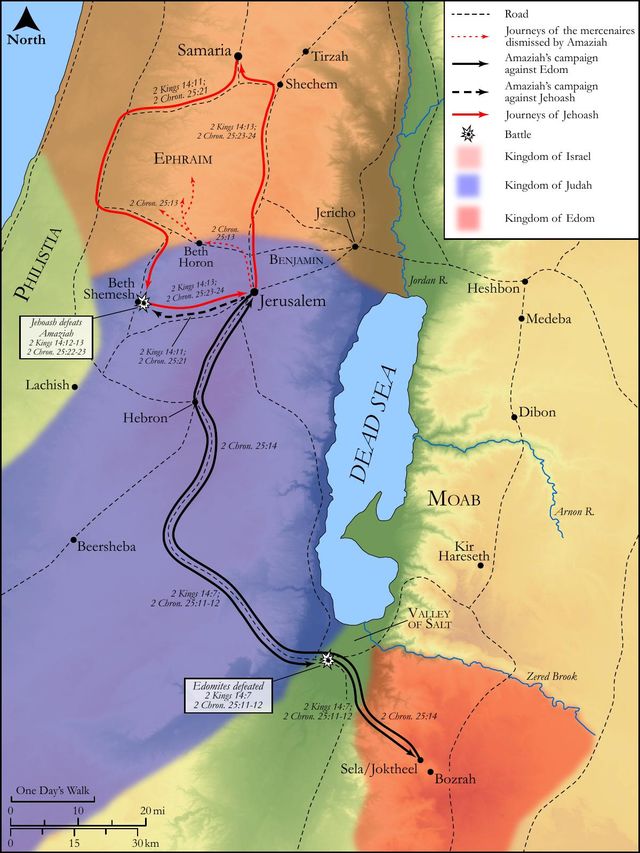
The relationship between Judah and Edom was historically fraught, stemming from the ancient fraternal rivalry between Jacob and Esau, their respective patriarchs. Edom, a mountainous kingdom located southeast of Judah, had been subjugated by King David (2 Samuel 8:14) but had successfully rebelled and regained its independence during the reign of Jehoram (2 Kings 8:20-22). Amaziah's campaign was therefore a crucial attempt to reclaim lost territory, reassert Judah's rule over Edom, and secure vital trade routes. The "Valley of Salt" (likely the Arabah, south of the Dead Sea) was a strategically important and frequently contested border region. Selah, often identified with the later Nabataean city of Petra, was renowned as a formidable rock fortress, making its capture a testament to Amaziah's military prowess and a significant blow to Edomite power. The renaming of a conquered city was a profound symbolic act, signifying complete subjugation, the transfer of ownership, and the imposition of the victor's authority and ideology upon the vanquished, as when Nobah took Kenath and "called it Nobah, after his own name."
Key Themes
ShowHideThis verse contributes significantly to several overarching themes present throughout the book of 2 Kings and the broader Deuteronomistic History. It highlights the theme of Divine Sovereignty and Human Agency, as Amaziah's military success, particularly the renaming of Selah to Joktheel ("subdued by God"), implicitly acknowledges divine assistance, even if Amaziah's subsequent actions reveal a mixed heart. This tension between human effort and God's overarching plan is a recurring motif in the lives of Israelite kings. The victory also underscores the Reassertion of Judahite Power and Regional Dominance, as it was a crucial step for Judah to regain control over traditional territories and re-establish its influence against a long-time adversary. This reflects the dynamic ebb and flow of power among the kingdoms of that day, often presented as being influenced by the faithfulness or unfaithfulness of their rulers, as seen in the broader narrative of 2 Kings. Finally, the Significance of Renaming and Lasting Impact is emphasized by the act of renaming Selah and the phrase "unto this day," which signifies not merely an administrative change but a potent symbolic declaration of conquest and new ownership, underscoring that significant historical events, especially those with divine implications, leave an enduring legacy.
Exposition and Analysis
ShowHideKey Word Analysis
ShowHideThis primitive root means "to strike (lightly or severely, literally or figuratively)." In the context of 2 Kings 14:7, it denotes a severe, decisive blow, indicating a military slaughter rather than a mere skirmish. The use of this verb emphasizes the overwhelming nature of Amaziah's victory, signifying a complete and devastating defeat for the Edomite forces, resulting in their decimation.
This word literally means "rock" or "crag." It perfectly describes the natural, highly fortified location of the Edomite capital, a city renowned for being built into and around formidable rock formations. The name itself underscores the immense challenge and strategic importance of its capture, highlighting Amaziah's significant military achievement in overcoming such a naturally impregnable stronghold. Its capture was a symbol of complete subjugation.
This new name given to Selah is a compound derived from Hebrew roots meaning "veneration of God" or "subdued by God." This renaming is a profound theological statement, attributing the military success not merely to Amaziah's prowess but to divine intervention and power. It serves as a permanent memorial, proclaiming that the victory was achieved through God's strength and authority, a common practice in ancient Israelite naming conventions for places and individuals to acknowledge divine favor or judgment.
Verse Breakdown
ShowHide"He slew of Edom in the valley of salt ten thousand"
This initial clause immediately establishes the subject (King Amaziah), the enemy (Edom), the location of the battle ("the valley of salt"), and the devastating scale of the victory ("ten thousand"). The "Valley of Salt" is identified as a strategic geographical region, likely the southern end of the Dead Sea or the Arabah, indicating a significant and contested battleground. The number "ten thousand" (עֲשֶׂרֶת אֲלָפִים, 'aseret 'alafim) is a common idiom of Scripture used to convey an overwhelming, decisive victory and total rout of the enemy, rather than a precise numerical count, emphasizing the magnitude of the defeat inflicted upon Edom.
"and took Selah by war"
This phrase details the subsequent crucial phase of Amaziah's campaign: the capture of the Edomite capital, Selah. The explicit phrase "by war" (בַּמִּלְחָמָה, bammilchamah) underscores that this was a result of military conquest, a hard-won victory through active combat, not through surrender, negotiation, or peaceful annexation. Selah's reputation as a strong, rock-hewn fortress makes its capture particularly noteworthy, signifying a complete and strategic subjugation of Edom's command center and a symbol of their national defeat.
"and called the name of it Joktheel unto this day."
This final clause highlights the symbolic and lasting impact of Amaziah's victory. The act of renaming the conquered city to Joktheel ("subdued by God" or "veneration of God") serves as a permanent declaration of Judah's triumph and, crucially, its divine backing, attributing the success to God's intervention. The concluding phrase "unto this day" (עַד הַיּוֹם הַזֶּה, 'ad hayyom hazzeh) is a common historiographical marker in biblical narratives, indicating that the new name and the memory of this significant event persisted at the time the book of Kings was written, thereby affirming its historical veracity and enduring legacy for the original audience.
Literary Devices
ShowHideThe concise yet impactful narrative of 2 Kings 14:7 skillfully employs several literary devices to convey its message. The mention of "ten thousand" slain Edomites functions as Hyperbole or a Round Number, a common literary convention of Hebrew narrative used to emphasize the overwhelming nature and decisiveness of a victory rather than providing a precise casualty count. The act of renaming Selah to Joktheel is a powerful instance of Symbolism, where the new name itself carries a profound theological message ("subdued by God"), transforming a geographical place into a lasting monument to divine intervention and Judahite dominance. Furthermore, the concluding phrase "unto this day" functions as a Historical Marker or Formulaic Language, a common literary device used throughout the Deuteronomistic History to affirm the enduring reality or memory of an event for the contemporary audience, lending credibility and historical weight to the account. The verse also exemplifies Narrative Economy, conveying a significant military campaign and its profound implications in a remarkably concise and impactful manner.
Theological and Thematic Connections
ShowHideThe victory of Amaziah over Edom, as powerfully recounted in 2 Kings 14:7, serves as a potent reminder of God's sovereign hand in the affairs of nations, even when exercised through human kings with mixed records of faithfulness. While Amaziah achieved this significant military success, and even attributed it to God by renaming Selah to Joktheel, the broader narrative of his reign, particularly as elaborated in 2 Chronicles 25, reveals his subsequent spiritual decline due to pride and idolatry. This stark contrast demonstrates that even divinely-assisted victories do not guarantee sustained righteousness or a pure heart. The episode underscores the tension between outward religious acknowledgment and inward spiritual devotion, highlighting that true and lasting success, in God's eyes, is predicated not merely on military might or political triumph, but on consistent and wholehearted obedience to His covenant.
Reflection and Application
ShowHideThe account of Amaziah's victory in 2 Kings 14:7 offers profound and enduring lessons for contemporary believers. While we no longer engage in physical warfare for territorial conquest, the principles of acknowledging God's hand in our successes and the dangers of incomplete or conditional obedience remain timeless. Amaziah's initial triumph, marked by the renaming of Selah to Joktheel, serves as a powerful reminder for us to attribute our achievements, whether personal, professional, or spiritual, to God's grace and power, rather than solely to our own strength, wisdom, or ingenuity. Yet, the subsequent narrative of Amaziah's life, where this significant victory was tragically followed by a descent into idolatry and pride (2 Chronicles 25:14-16), serves as a solemn warning. Great successes can, paradoxically, become fertile ground for spiritual complacency, self-reliance, or even arrogance, diverting our hearts from the Lord who granted the victory. Our faithfulness must be consistent and wholehearted, extending beyond moments of triumph and into the mundane, the challenging, and the prosperous. The lasting impact symbolized by the city's new name also prompts us to consider the enduring legacy of our actions and choices—how will our lives, our triumphs, and our failures be remembered "unto this day" in the spiritual ledger of eternity?
Questions for Reflection
ShowHideFAQ
ShowHideWho was King Amaziah, and what was his relationship with God?
ShowHideKing Amaziah was the son of Joash and reigned over Judah for 29 years (2 Kings 14:2). The biblical text provides a nuanced assessment of his character, stating that he "did what was right in the eyes of the Lord, yet not as David his father" (2 Kings 14:3). This indicates a mixed record: he followed God's law in some respects, such as executing his father's assassins but sparing their children in accordance with the Mosaic Law (2 Kings 14:5-6). His later actions, detailed more extensively in 2 Chronicles 25, reveal a significant spiritual downfall into idolatry and pride after his victory over Edom, which ultimately contributed to his assassination.
What is the significance of the "Valley of Salt" and Selah?
ShowHideThe "Valley of Salt" (Hebrew: גֵּיא מֶלַח, ge' melach) is generally identified as the Arabah, the expansive rift valley extending south from the Dead Sea. This region was of immense strategic importance, lying on ancient trade routes and serving as a natural, often contested, boundary between kingdoms. Selah (Hebrew: סֶלַע, sela', meaning "rock" or "crag") was the capital city of Edom, a formidable natural fortress renowned for its defensive position amidst towering rock formations, often identified with the later city of Petra. Its capture by Amaziah was not just a military victory but a major geopolitical achievement, demonstrating Judah's renewed strength and control over a long-time adversary and a key strategic location.
Why did Amaziah rename Selah to Joktheel?
ShowHideThe renaming of a conquered city was a deeply significant and common practice in Israel and among the nations round about, symbolizing the complete subjugation of the defeated and the unequivocal assertion of the victor's authority, sovereignty, and even ideological control. By renaming Selah to Joktheel (Hebrew: יָקְתְאֵל, yoqthᵉʼêl), meaning "subdued by God" or "Yahweh is powerful," Amaziah was not merely marking his military triumph but profoundly attributing the victory to the Lord. This act served as a lasting memorial, proclaiming that the conquest was achieved through divine assistance and power, thereby reinforcing Judah's theological claim to the land and its people, and publicly acknowledging God's hand in their success.
Christ-Centered Fulfillment
ShowHideWhile 2 Kings 14:7 recounts an earthly king's military conquest, it powerfully foreshadows a far greater, spiritual victory achieved by the ultimate King, Jesus Christ. Amaziah's triumph over Edom, a long-standing adversary, and his capture of a formidable stronghold like Selah, culminating in its renaming to "Joktheel" ("subdued by God"), points to Christ's decisive and eternal conquest over the true powers of sin, death, and the devil. Unlike Amaziah, whose victory was partial and whose heart was ultimately divided, Jesus' triumph on the cross and His glorious resurrection represent a complete, perfect, and eternal subjugation of all spiritual enemies, disarming them and leading them captive in His triumphal procession (Colossians 2:15). His kingdom is not of this world, nor is it established through physical warfare or territorial conquest (John 18:36), but through spiritual transformation, redemption, and the establishment of His reign in the hearts of believers. The renaming of Selah to Joktheel, signifying a new identity and ownership under God's power, resonates profoundly with the new creation wrought in Christ, where believers are given a new name and identity as children of God, no longer defined by their past but by their union with Him (2 Corinthians 5:17; Revelation 2:17). The "unto this day" of Amaziah's temporary victory finds its ultimate and everlasting fulfillment in the eternal reign of Christ, whose victory endures forever and whose spiritual kingdom knows no end, encompassing all nations and all time (Revelation 11:15).