


1 Chronicles 18:12
Bible text: King James Version (1769 Blayney text) · Public domain
Bible text: Berean Standard Bible · Public domain
Bible text: American Standard Version (1901) · Public domain
Bible text: World English Bible, Messianic edition · Public domain
Bible text: Geneva Bible (1599) · Public domain
Bible text: Young's Literal Translation · Public domain
- וְאַבְשַׁיve·'av·Shaiand AbishaiH52Conj-w ¦ N-proper-mNoun Proper MasculineוְandאַבְשַׁיAbishai
- בֶּןben[the] son ofH1121N-mscNoun Singular Masculine Construct
- צְרוּיָהtze·ru·YahZeruiahH6870N-proper-fNoun Proper Feminine
- הִכָּהhi·Kahhe struck downH5221V-Hiphil-Perf-3msVerb Hiphil Perfect 3rd Singular Masculine
- אֶת'et<obj.>H853DirObjMParticle Object Indicator
- אֱדוֹם'e·dOmEdomH123N-proper-mNoun Proper Masculine
- בְּגֵיאbe·Gei'in [the] Valley ofH1516Prep-b ¦ N-properNoun Proper Locationבְּinגֵיא[the] Valley of
- הַמֶּלַחha·Me·lach<the> SaltH4417Art ¦ N-properNoun Proper Locationהַ<the>מֶּלַחSalt
- שְׁמוֹנָהshe·mo·Naheight-H8083N-csNoun Singular common gender Absolute
- עָשָׂר'a·SarteenH6240N-csNoun Singular common gender Absolute
- אָלֶף'A·lefthousandH505N-csNoun Singular common gender Absolute
English is a literal word-by-word gloss of the Hebrew, not the KJV's wording. Why?
This is the original text the KJV's translators worked from — each Hebrew word with its own literal English meaning in this verse, prepared by scholars at Tyndale House, Cambridge. The KJV translates whole sentences, not word by word, so its wording differs: one Hebrew word can become several English words, and the KJV may choose “the LORD” where the gloss reads “Yahweh”. Both are faithful — they answer different questions. For the KJV's own rendering, switch to the KJV text.
Details
See on the biblical-era map
Study this verse
Public-domain commentary
Matthew Henry
From his Commentary on the Whole Bible. Henry comments on passages, not single verses — this entry covers 1 Chronicles 18:9–17.
Here let us learn, 1. That it is our interest to make those our friends who have the presence of God with them. The king of Hamath, hearing of David's great success, sent to congratulate him and to court his favour with a noble present, Ch1 18:9, Ch1 18:10. It is in vain to contend with the Son of David. Kiss the Son, therefore, lest he be angry; let the kings and judges of the earth, and all inferior people too, be thus wise, thus instructed. The presents we are to bring him are not vessels of gold and silver, as here (those shall be welcomed to him who have no such presents to bring), but our hearts and sincere affections, our whole selves, we must present to him as living sacrifices. 2. That what God blesses us with we must honour him with. The presents of his friends, as well as the spoils of his enemies, David dedicated unto the Lord (Ch1 18:11), that is, he laid them up towards the building and enriching of the temple. That is most truly and most comfortably our own which we have consecrated unto the Lord, and which we use for his glory. Let our merchandise and our hire be holiness to the Lord, Isa 23:18. 3. That those who take God along with them whithersoever they go may expect to prosper, and be preserved, whithersoever they go. It was said before (Ch1 18:6) and here it is repeated (Ch1 18:13) that the Lord preserved David whithersoever he went. Those are always under the eye of God that have God always in their eye. 4. God gives men power, not that they may look great with it, but that they may do good with it. When David reigned over all Israel he executed judgment and justice among all his people, and so answered the end of his elevation. He was not so intent on his conquests abroad as to neglect the administration of justice at home. Herein he served the purposes of the kingdom of providence, and of that God who sits in the throne judging right; and he was an eminent type of the Messiah, the sceptre of whose kingdom is a right sceptre.
Continue studying 1 Chronicles 18:12 across the web’s major study libraries — every link below opens this exact verse, chapter, or book on the destination site.
Read & Compare
 BibleGatewayThis verse in more than 200 translations and 70 languages.
 Bible.comThe YouVersion reader — hundreds of translations, reading plans, and highlights.
 ESV.orgCrossway's official English Standard Version reader.
 NET BibleThe NET translation with 60,000+ translators' notes on every rendering decision.
 STEP BibleTyndale House's free study tool — original text, vocabulary, and scholarly resources.
 BibliaLogos Bible Software's free web reader.
 USCCBThe New American Bible (Revised Edition) with the U.S. bishops' study notes.
Commentaries
 BibleHub CommentariesDozens of classic commentaries on this verse, gathered on one page.
 StudyLightMore than 100 commentary sets — the largest collection on the web.
 BibleRefPlain-English commentary on what this verse means, verse by verse.
 Enduring WordDavid Guzik's free commentary on this chapter, widely used by Bible teachers.
 Bible Study ToolsVerse commentary alongside Greek and Hebrew study aids.
Original Language & Research
- BibleHub InterlinearThe verse word by word — original language, transliteration, and English.
- BibleHub LexiconEvery word's original-language definition and Strong's entry.
 Blue Letter BibleDeep-study tools — Strong's numbers, concordance, and word studies.
 SefariaThe Hebrew text with Rashi and centuries of Jewish commentary.
Sermons, Hymns & Audio


TrulyRandomVerse is not affiliated with these sites and doesn’t control their content. They’re linked because they’re genuinely useful.
Summary
This verse concisely records a significant military triumph during the reign of King David, specifically highlighting the decisive victory achieved by Abishai, one of David's most trusted and formidable commanders, over the Edomites. This pivotal engagement, which resulted in the elimination of eighteen thousand Edomite forces in the strategically vital Valley of Salt, was instrumental in securing Israel's southern borders, consolidating David's expanding kingdom, and fulfilling ancient divine promises regarding the extent of Israelite dominion and the subjugation of their adversaries.
Context
ShowHideLiterary Context
This verse is strategically placed within 1 Chronicles 18, a chapter meticulously detailing King David's extensive military campaigns and the subsequent consolidation of his burgeoning kingdom. Following his establishment in Jerusalem and the defeat of significant regional threats like the Philistines and Moabites, David systematically turns his attention to other long-standing adversaries, including the Edomites. The chronicler's overarching emphasis throughout this section is not merely on David's military prowess, but on the divine enablement and preservation that undergirded all his successes. Phrases like "the LORD preserved David wherever he went" (e.g., 1 Chronicles 18:6) are recurrent, underscoring that these victories were ultimately God's work through His anointed king. The account of the Edomite defeat here, immediately followed by the establishment of Israelite garrisons in Edom (1 Chronicles 18:13), vividly illustrates the comprehensive nature of David's dominion and the tangible fulfillment of God's covenant promises to Israel concerning their land and security.
Historical & Cultural Context
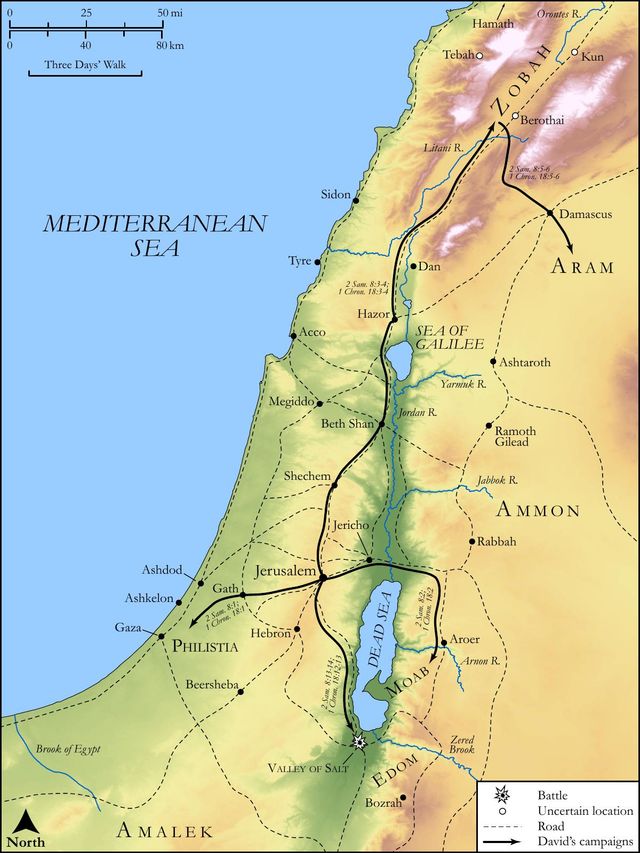
The Edomites, descendants of Esau (Jacob's twin brother), shared a complex and often adversarial relationship with Israel, a rivalry deeply rooted in their patriarchal origins (Genesis 25:23). Their territory, Edom, was a rugged, mountainous region located south and southeast of Judah, encompassing Mount Seir. This strategic location allowed them to control vital trade routes, most notably the King's Highway. The "Valley of Salt" (Hebrew: Gê Melaḥ) is widely identified as the Arabah, the desolate rift valley extending south of the Dead Sea, an area rich in salt deposits but also crucial for controlling access to Edom and, further south, to the Red Sea port of Elath (later prominent in 1 Kings 9:26). David's subjugation of Edom was not merely a punitive action but a strategic imperative, ensuring the security of Israel's southern flank, expanding its economic reach, and asserting its regional hegemony. This victory marked a profound shift in the power dynamics among the nations round about, bringing a long-standing and formidable adversary under Israelite control.
Key Themes
ShowHideThis verse, within its broader context, powerfully contributes to several overarching themes in Chronicles. Foremost is the Divine Enablement of David's Kingdom, emphasizing that God actively works through David and his forces to establish and expand Israel's promised territory and security. The chronicler consistently attributes David's successes to divine favor, portraying him as the instrument of God's will. Secondly, it highlights the Role of Loyal Lieutenants, showcasing figures like Abishai as crucial instruments in David's successful campaigns. This demonstrates David's effective leadership through delegation and the valor of his "mighty men" in executing the king's vision. Finally, the victory over Edom directly contributes to the theme of the Expansion and Security of Israel's Borders, illustrating the fulfillment of ancient prophecies and covenant promises regarding the full extent of the land God would give to His people (Numbers 24:18). This triumph solidified David's position as God's chosen king, ushering in an era of unprecedented peace and stability for the kingdom through decisive military action.
Exposition and Analysis
ShowHideKey Word Analysis
ShowHideMeaning "father of a gift" (i.e., probably generous). Abishai was one of the three sons of Zeruiah, David's sister, making him David's nephew and the brother of Joab and Asahel. He was a prominent and fiercely loyal commander in David's army, known for his bravery and military prowess. His specific mention here, rather than David himself, underscores the vital role of David's "mighty men" in executing the king's vision and God's overarching plan. Abishai is consistently depicted as utterly devoted to David, often acting impulsively in his defense, as seen in his protection of David from Shimei (2 Samuel 16:9-11) and his significant contributions in various battles (2 Samuel 23:18).
Meaning "red" (see Genesis 25:25). The Edomites were the descendants of Esau, Jacob's twin brother, and represented a people with whom Israel had a long, often contentious, history. Their land, Edom (also known as Idumaea), was characterized by rugged terrain and a strategically important location. The decisive defeat of the Edomites was a monumental achievement, as they had long posed a persistent obstacle to Israel's regional dominance and frequently served as a symbolic representation of opposition to God's people in biblical prophecy.
A primitive root meaning "to strike (lightly or severely, literally or figuratively)." In this context, nâkâh signifies a comprehensive and devastating military defeat, implying not merely a skirmish but a decisive blow that resulted in a significant number of casualties. The use of this verb underscores the severity and finality of the Israelite victory over the Edomite forces, effectively neutralizing a major portion of their fighting strength and asserting Israel's dominance in the region.
Verse Breakdown
ShowHide"Moreover Abishai the son of Zeruiah"
This opening clause immediately identifies the specific individual responsible for this particular military action. By naming Abishai, the chronicler highlights the agency of David's trusted and capable commanders, demonstrating the effective delegation of authority within David's burgeoning kingdom. It also implicitly connects this victory to the broader narrative of David's "mighty men," who were instrumental in his numerous successes and the expansion of his dominion.
"slew of the Edomites"
This phrase directly states the outcome of the engagement: a decisive military victory resulting in a significant number of casualties for the Edomite forces. The verb "slew" (Hebrew: wayyak) conveys the comprehensive nature of the defeat, indicating a crushing blow rather than a minor skirmish, and underscores the severity of the judgment brought upon Edom.
"in the valley of salt"
This provides the precise geographical location of the battle. The mention of the "Valley of Salt" (Hebrew: Gê Melaḥ) adds historical verisimilitude to the account, grounding the narrative in a specific, known place. It emphasizes that this was a real, tangible conflict fought on a defined, strategically important battlefield, likely a challenging terrain that further highlights the Israelite achievement.
"eighteen thousand"
The specific numerical figure of "eighteen thousand" emphasizes the scale and completeness of the Israelite victory. This large number signifies a major military defeat for Edom, effectively neutralizing a significant portion of their fighting force and ensuring Israel's dominance in the region. Such numerical precision often serves to underscore the historical reliability and the divinely enabled magnitude of the event, demonstrating the thoroughness of David's campaign.
Literary Devices
ShowHideThe verse, though concise, employs several potent literary devices to convey its message effectively and with historical weight. Conciseness is paramount, as the verse delivers a wealth of significant historical information—who, what, where, and how many—in a remarkably compact form. This brevity amplifies the impact of the victory, allowing the sheer facts to resonate. The inclusion of specific details such as the named commander (Abishai), the precise geographical location (Historicism), and the exact number of casualties (Numerical Precision) lends an undeniable air of factual accuracy and historical authenticity to the account. This reinforces the chronicler's intent to present a reliable and verifiable historical record of David's reign. Furthermore, the naming of Abishai can be interpreted as a form of Synecdoche, where a part (Abishai, the leading commander) stands in for the whole (David's entire army or Israel's collective military might), signifying that this victory, though led by Abishai, was an integral part of David's broader campaign and God's work through the entire Israelite force. The narrative also subtly utilizes Understatement by simply stating the stark facts of the battle's outcome without elaborate descriptions of its ferocity or the struggle involved, allowing the decisive numbers and the finality of the conquest to speak for themselves.
Theological and Thematic Connections
ShowHideThis verse, though brief in its recounting, is profoundly rich with theological implications. It serves as a powerful testament to God's unwavering faithfulness in empowering King David to establish and secure the promised land for Israel. The decisive victory over the Edomites, a long-standing and often hostile adversary, signifies the overcoming of persistent opposition that stood against God's people and His covenant purposes. It underscores the profound theological truth that God actively uses human agents, even mighty warriors like Abishai, as instruments to accomplish His divine will and fulfill His promises. The chronicler's consistent emphasis on David's victories being divinely enabled, often prefaced with declarations such as "the LORD preserved David," points to a sovereign divine hand guiding and enabling Israel's military successes. This is not merely a secular record of human conquest but a sacred testament to God's active and providential involvement in the history of His chosen nation, ensuring the fulfillment of His promises and the establishment of His kingdom on earth through His anointed king.
Reflection and Application
ShowHideThe account of Abishai's decisive victory over the Edomites in the Valley of Salt serves as a powerful and enduring reminder that God equips and empowers His faithful servants to overcome formidable obstacles. While believers today are not called to engage in physical warfare for kingdom expansion, the spiritual principles embedded in this narrative remain profoundly relevant. Just as Abishai acted as a courageous and faithful instrument under King David's authority, believers are called to be dedicated instruments in God's hands, serving under the supreme authority of Christ, our true King. This verse encourages us to recognize that spiritual battles are profoundly real, and victory often requires courageous action, unwavering perseverance, and absolute reliance on divine strength rather than our own. It challenges us to identify the "Edomites" in our own lives—the persistent patterns of sin, spiritual strongholds, external pressures, or cultural ideologies that oppose God's will—and to confront them with the same resolute determination, trusting that God will grant us victory as we faithfully engage in the spiritual warfare to which He calls us. Our triumphs, much like Abishai's, are ultimately God's triumphs achieved through our obedient and courageous participation.
Questions for Reflection
ShowHideFAQ
ShowHideWho was Abishai and why is he highlighted in this victory?
ShowHideAbishai was one of King David's nephews, the son of Zeruiah (David's sister), and the brother of Joab and Asahel. He was a prominent and highly capable military commander, renowned for his unwavering loyalty to David and his exceptional prowess in battle. He is specifically highlighted here because he personally led this particular decisive victory against the Edomites. His inclusion emphasizes David's effective leadership through his trusted and valiant lieutenants, demonstrating that the king's successes were often achieved through the valor, dedication, and strategic execution of his "mighty men" operating under his ultimate authority.
What is the significance of the "Valley of Salt" as the battle location?
ShowHideThe "Valley of Salt" (Hebrew: Gê Melaḥ) is generally identified as a geographical area south of the Dead Sea, part of the Arabah rift valley, known for its extensive salt deposits and desolate landscape. Its significance lies primarily in its strategic location, as it controlled important trade routes, including the King's Highway, and served as a natural gateway to Edomite territory. Mentioning this specific location adds crucial historical authenticity and precision to the account, grounding the narrative in a real, identifiable place. It underscores that this was a tangible, hard-fought victory in a specific, perhaps challenging, environment, further emphasizing the magnitude of the Israelite military achievement and its strategic importance for David's kingdom.
Why was the victory over the Edomites so important for David's kingdom?
ShowHideThe victory over the Edomites was crucial for several interconnected reasons. Historically, Edom was a long-standing and often antagonistic adversary of Israel, tracing their lineage back to Esau, Jacob's brother. Their decisive defeat secured Israel's southern borders, eliminating a persistent threat and allowing for greater stability and peace within the kingdom. Strategically, gaining control over Edom provided Israel with access to vital trade routes and, significantly, to the Red Sea port of Elath (mentioned in 1 Kings 9:26), thereby expanding Israel's economic and political influence throughout the region. Theologically, this victory represented a profound fulfillment of ancient prophecies that spoke of Edom's subjugation to Israel (Numbers 24:18), powerfully demonstrating God's faithfulness in establishing David's kingdom and expanding the boundaries of the promised land in accordance with His covenant promises.
Christ-Centered Fulfillment
ShowHideThe military victories of King David, powerfully exemplified by Abishai's decisive triumph over the Edomites, serve as profound and multi-faceted foreshadowings of the ultimate and spiritual victories achieved by Jesus Christ. David, as God's anointed king, brought peace and established the earthly kingdom of Israel through conquest, subduing physical enemies and expanding the nation's dominion. In a far greater and eternal sense, Jesus, the true Son of David and the King of kings, conquered the ultimate enemies of humanity: sin, death, and the power of Satan. Just as Abishai was a loyal, courageous, and effective instrument in David's earthly kingdom, believers are called to be loyal servants and instruments in Christ's spiritual kingdom, participating in His ongoing work of redemption, reconciliation, and transformation in the world. The subjugation of Edom, a symbol of persistent opposition and a long-standing adversary, points powerfully to Christ's decisive and comprehensive triumph over all spiritual forces that stand against God and His people, a victory secured not through physical warfare but through His sacrificial death on the cross and His glorious resurrection (Colossians 2:15). The establishment of David's earthly kingdom, secured by such pivotal victories, ultimately points forward to the eternal, unshakable, and ever-expanding spiritual kingdom of God, over which Christ reigns supreme, gathering all nations to Himself and bringing all things under His benevolent rule (Revelation 11:15).