


1 Chronicles 18:6
Bible text: King James Version (1769 Blayney text) · Public domain
Bible text: King James Version with Strong's numbers · Public domain
Bible text: Berean Standard Bible · Public domain
Bible text: American Standard Version (1901) · Public domain
Bible text: World English Bible, Messianic edition · Public domain
Bible text: Geneva Bible (1599) · Public domain
Bible text: Young's Literal Translation · Public domain
- וַיָּשֶׂםvai·Ya·semand he putH7760Conj-w ¦ V-Qal-ConsecImperf-3msVerb Qal Consecutive Imperfect 3rd Singular Masculineוַandיָּשֶׂםhe put
- דָּוִידda·VidDavidH1732N-proper-mNoun Proper Masculine
- בַּאֲרַםba·'a·Ramin AramH758Prep-b ¦ N-properNoun Proper LocationבַּinאֲרַםAram
- דַּרְמֶשֶׂקdar·Me·sekDamascusH1834N-properNoun Proper Location
- וַיְהִיvay·Hiand it becameH1961Conj-w ¦ V-Qal-ConsecImperf-3msVerb Qal Consecutive Imperfect 3rd Singular Masculineוַandיְהִיit became
- אֲרָם'a·RamAramH758N-properNoun Proper Location
- לְדָוִידle·da·Vidof DavidH1732Prep-l ¦ N-proper-mNoun Proper MasculineלְofדָוִידDavid
- עֲבָדִים'a·va·DimsubjectsH5650N-mpNoun Plural Masculine Absolute
- נֹשְׂאֵיno·se·'Eibearers ofH5375V-Qal-Prtcpl-mpVerb Qal Participle Plural Masculine Construct
- מִנְחָהmin·ChahtributeH4503N-fsNoun Singular Feminine Absolute
- וַיּוֹשַׁעvai·Yo·o·sha'and he gave victoryH3467Conj-w ¦ V-Hiphil-ConsecImperf-3msVerb Hiphil Consecutive Imperfect 3rd Singular Masculineוַandיּוֹשַׁעhe gave victory
- יְהוָהYah·wehYahwehH3068N-properNoun Proper Title
- לְדָוִידle·da·Vidto DavidH1732Prep-l ¦ N-proper-mNoun Proper MasculineלְtoדָוִידDavid
- בְּכֹלbe·Kholin everyH3605Prep-b ¦ N-msNoun Singular Masculine Absoluteבְּinכֹלevery
- אֲשֶׁר'a·SherwhereH834RelParticle Relative
- הָלָךְha·Lakhhe wentH1980V-Qal-Perf-3msVerb Qal Perfect 3rd Singular Masculine
English is a literal word-by-word gloss of the Hebrew, not the KJV's wording. Why?
This is the original text the KJV's translators worked from — each Hebrew word with its own literal English meaning in this verse, prepared by scholars at Tyndale House, Cambridge. The KJV translates whole sentences, not word by word, so its wording differs: one Hebrew word can become several English words, and the KJV may choose “the LORD” where the gloss reads “Yahweh”. Both are faithful — they answer different questions. For the KJV's own rendering, switch to the KJV text.
Details
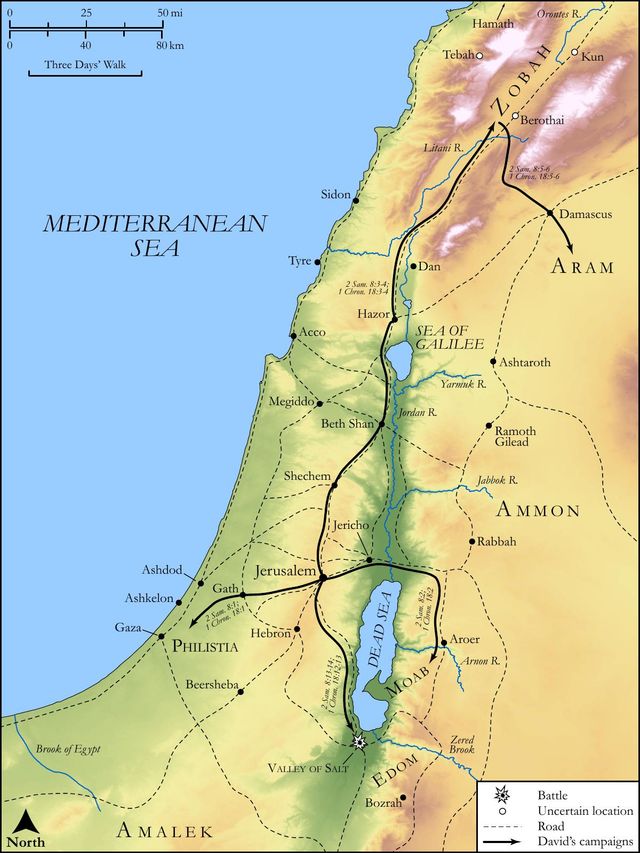
See on the biblical-era map
Study this verse
Public-domain commentary
Matthew Henry
From his Commentary on the Whole Bible. Henry comments on passages, not single verses — this entry covers 1 Chronicles 18:1–8.
After this, it is said (Ch1 18:1), David did those great exploits. After the sweet communion he had had with God by the word and prayer, as mentioned in the foregoing chapter, he went on his work with extraordinary vigour and courage, conquering and to conquer. Thus Jacob, after his vision, lifted up his feet, Gen 29:1.
We have taken a view of these victories before, and shall now only observe, 1. Those that have been long enemies to the Israel of God will be brought down at last. The Philistines had, for several generations, been vexatious to Israel, but now David subdued them, Ch1 18:1. Thus shall all opposing rule, principality, and power, be, at the end of time, put down by the Son of David, and the most inveterate enemies shall fall before him. 2. Such is the uncertainty of this world that frequently men lose their wealth and power when they think to confirm it. Hadarezer was smitten as he went to establish his dominion, Ch1 18:3. 3. A horse is a vain thing for safety, so David said (Psa 33:17), and it seems he believed what he said, for he houghed the chariot-horses, Ch1 18:4. Being resolved not to trust to them (Psa 20:7), he would not use them. 4. The enemies of God's church are often made to ruin themselves by helping one another, Ch1 18:5. The Syrians of Damascus were smitten when they came to help Hadarezer. When hand thus joins in hand they shall not only not go unpunished, but thereby they shall be gathered as the sheaves into the floor, Mic 4:11, Mic 4:12. 5. The wealth of the sinner sometimes proves to have been laid up for the just. The Syrians brought gifts, Ch1 18:6. Their shields of gold and their brass were brought to Jerusalem, Ch1 18:7, Ch1 18:8. As the tabernacle was built of the spoils of the Egyptians, so the temple of the spoils of other Gentile nations, a happy presage of the interest the Gentiles should have in the gospel church.
Continue studying 1 Chronicles 18:6 across the web’s major study libraries — every link below opens this exact verse, chapter, or book on the destination site.
Read & Compare
 BibleGatewayThis verse in more than 200 translations and 70 languages.
 Bible.comThe YouVersion reader — hundreds of translations, reading plans, and highlights.
 ESV.orgCrossway's official English Standard Version reader.
 NET BibleThe NET translation with 60,000+ translators' notes on every rendering decision.
 STEP BibleTyndale House's free study tool — original text, vocabulary, and scholarly resources.
 BibliaLogos Bible Software's free web reader.
 USCCBThe New American Bible (Revised Edition) with the U.S. bishops' study notes.
Commentaries
 BibleHub CommentariesDozens of classic commentaries on this verse, gathered on one page.
 StudyLightMore than 100 commentary sets — the largest collection on the web.
 BibleRefPlain-English commentary on what this verse means, verse by verse.
 Enduring WordDavid Guzik's free commentary on this chapter, widely used by Bible teachers.
 Bible Study ToolsVerse commentary alongside Greek and Hebrew study aids.
Original Language & Research
- BibleHub InterlinearThe verse word by word — original language, transliteration, and English.
- BibleHub LexiconEvery word's original-language definition and Strong's entry.
 Blue Letter BibleDeep-study tools — Strong's numbers, concordance, and word studies.
 SefariaThe Hebrew text with Rashi and centuries of Jewish commentary.
Sermons, Hymns & Audio


TrulyRandomVerse is not affiliated with these sites and doesn’t control their content. They’re linked because they’re genuinely useful.
Summary
1 Chronicles 18:6 details King David's decisive military victory over the Arameans of Damascus, leading to their subjugation and the establishment of Israelite control. The verse highlights the practical outcomes of this conquest—the Syrians becoming tributary servants to David—and, more profoundly, attributes David's consistent success and safety in all his endeavors directly to the active preservation and enabling power of the LORD, emphasizing divine faithfulness as the true source of his kingdom's expansion and stability.
Context
ShowHideLiterary Context
This verse is a key component within a broader narrative (1 Chronicles 18:1-17) that meticulously chronicles David's military campaigns and the subsequent consolidation of his kingdom. It immediately follows God's unconditional covenant with David, where the LORD promised to establish a lasting dynasty for David and to be with him wherever he went. The victories described in chapter 18, encompassing the subjugation of Philistia, Moab, Zobah, and Aram (Syria), are presented by the Chronicler as direct fulfillments of these divine promises. This theological emphasis is paramount in Chronicles, portraying David's extensive successes not as a result of his inherent prowess but as a clear demonstration of God's active presence and power, a theme consistently reinforced throughout this section. The account also parallels the narrative found in 2 Samuel 8, with Chronicles often providing a more pronounced theological interpretation, focusing on God's faithfulness to His covenant.
Historical & Cultural Context
The setting of 1 Chronicles 18:6 is the reign of David, a tumultuous period characterized by frequent conflicts with the nations round about and the rise of various city-states and kingdoms. Damascus (Syriadamascus), identified by H1834 as Dammeseq, was a powerful Aramean city-state, strategically positioned on vital trade routes. Its subjugation by David would have granted Israel significant control over crucial economic and military pathways extending northward. The practice of establishing "garrisons" (military outposts) was a standard and effective strategy for occupying powers to maintain control, enforce tribute, and secure newly conquered territories against rebellion. The "gifts" mentioned are not voluntary expressions of goodwill but rather tribute, a mandatory payment of resources, goods, or wealth exacted from a conquered people as a sign of their subjection and submission. This established a stable economic and political order for Israel, demonstrating the breadth of David's dominion and the extent of his kingdom's influence, all of which was understood as a direct reflection of God's blessing upon his reign.
Key Themes
ShowHideThe overarching and most prominent theme in 1 Chronicles 18:6 is Divine Preservation and Sovereignty, powerfully encapsulated in the final clause: "Thus the LORD preserved David whithersoever he went." This highlights that David's military and political achievements were not merely human triumphs but were divinely orchestrated and enabled, underscoring God's active involvement in the affairs of His chosen king. Another significant theme is the Expansion of God's Kingdom, as David's victories, including the subjugation of Syriadamascus and the receipt of tribute, signify the geographical and political growth of the kingdom of Israel under God's blessing. This expansion is presented as a tangible sign of God fulfilling His promises to David regarding his lineage and reign, demonstrating His unwavering faithfulness to His covenant. Furthermore, the theme of Tribute and Submission underscores the acknowledgment of David's sovereignty by other nations, a sovereignty ultimately granted and sustained by God, thereby establishing a stable economic and political order for Israel.
Exposition and Analysis
ShowHideKey Word Analysis
ShowHideThis primitive root verb means "to put," "to place," or "to set." In this context, it denotes David's decisive and intentional action of establishing military control. The act of "putting garrisons" signifies a strategic and authoritative placement, demonstrating the practical implementation of David's victory and the securing of conquered territory. It reflects the king's power and foresight, yet within the Chronicler's narrative, it is an action enabled and blessed by God.
From an unused root meaning "to apportion" or "bestow," this noun refers to a donation or, euphemistically, tribute. While minchâh can denote a voluntary offering, as in a grain offering to God, in the context of conquered nations bringing "gifts" to a victorious king, it unequivocally signifies mandatory tribute. This payment, often in the form of precious metals, goods, or resources, was exacted from a conquered people as a sign of their submission and acknowledgment of the victor's authority. The bringing of minchâh here confirms the subjugation of the Syrians and their status as servants, contributing significantly to the wealth and power of David's kingdom.
This primitive root means "to be open, wide or free," and by implication, "to be safe." Causatively, it means "to free," "to succor," "to save," or "to deliver." It is a potent theological term that emphasizes divine intervention and deliverance. The use of yâshaʻ here is crucial, as it explicitly attributes David's consistent success, safety, and triumph in all his campaigns not to his own military genius or strength, but directly to the active, protective hand of the LORD. It underscores that God was the primary agent behind David's triumphs, providing deliverance and security in every endeavor, fulfilling His covenant promises.
Verse Breakdown
ShowHide"Then David put garrisons in Syriadamascus;"
This initial clause describes David's strategic military action following his victory over the Arameans of Damascus. By establishing military outposts, David secured firm control over this vital region, which was a significant power center in the northern Levant. This act demonstrates the practical implementation of his conquest, ensuring stability, preventing future rebellion, and consolidating the newly acquired territory, all understood as undergirded by divine enablement.
"and the Syrians became David's servants, and brought gifts."
This part details the immediate and direct consequences of David's decisive victory and subsequent occupation. The term "servants" (from H5650) indicates their complete submission as tributaries, no longer independent but subject to David's authority. The "gifts" they brought were tribute (from H4503), a regular and mandatory payment acknowledging their subjugation and contributing significantly to the wealth and resources of David's kingdom. This outcome signifies the tangible expansion of Israel's political and economic influence, directly fulfilling God's promise to make David's name great and establish his kingdom.
"Thus the LORD preserved David whithersoever he went."
This concluding clause serves as the theological linchpin of the entire verse. The word "Thus" (וַיּוֹשַׁע, vayyosha') directly links the preceding events—David's victories and the subjugation of his enemies—to the LORD's active preservation (from H3467). It explicitly states that David's consistent success, safety, and triumph in all his military campaigns and endeavors were not due to human strength or strategic brilliance alone, but were the direct result of God's unwavering protection and deliverance. This emphasizes God's faithfulness to His covenant promises to David, ensuring his security and the expansion of his kingdom wherever he went (from H1980).
Literary Devices
ShowHideThe Chronicler employs several literary devices in 1 Chronicles 18:6 to convey its profound theological message. Divine Intervention is the most prominent, explicitly stated in the final clause, "Thus the LORD preserved David whithersoever he went." This direct attribution of David's success and safety to God's active hand elevates the narrative beyond a mere chronicle of military victories, underscoring that David's power and dominion flowed directly from divine favor and active protection. The structure of the verse itself, moving from David's military actions to their practical consequences (subjugation, tribute) and then to the ultimate divine cause, serves as a form of Climactic Emphasis, building to the theological punchline that God is the true source of David's triumphs. There is also an element of Repetition and Reinforcement when considering the broader context of 1 Chronicles 17, where God promises to be with David and establish his kingdom, and then in chapter 18, where this promise is repeatedly shown to be fulfilled in David's numerous victories. This consistent emphasis on God's preservation functions as a Theological Commentary, guiding the reader to understand that human success, particularly in the context of God's chosen king, is ultimately dependent on divine enablement and faithfulness.
Theological and Thematic Connections
ShowHide1 Chronicles 18:6 profoundly illustrates the principle of divine sovereignty and active preservation in the life of God's chosen leader. David's military successes and the expansion of his kingdom are not presented as mere achievements of human strategy or strength, but as direct manifestations of God's faithfulness to His covenant promises. This verse serves as a powerful reminder that true security, victory, and prosperity come not from human might or shrewdness, but from the LORD's unwavering presence and protective hand. It encourages believers to trust in God's active involvement in their lives, knowing that He is the ultimate source of their preservation and success in all their righteous endeavors.
Reflection and Application
ShowHideThe profound truth that "the LORD preserved David whithersoever he went" offers immense comfort and a significant challenge for believers today. It reminds us that our ultimate security, true success, and enduring stability do not rest on our own abilities, meticulous planning, or accumulated resources, but entirely on the faithful, preserving hand of God. Just as God was intimately involved in David's triumphs, guiding his steps and ensuring his safety, He is equally committed to guiding and protecting those who walk in His ways and seek His purposes. This calls us to a posture of humble reliance, recognizing that every victory, every moment of safety, and every step forward in our lives is a testament to His active and benevolent presence. It encourages us to step out in faith, knowing that when we pursue God's purposes, His enabling power and protective care are with us, empowering us to overcome obstacles and fulfill our callings, not by might nor by power, but by His Spirit.
Questions for Reflection
ShowHideFAQ
ShowHideWhat is the significance of the "garrisons" David placed in Syriadamascus?
ShowHideThe placement of "garrisons" (military outposts) in Syriadamascus (Aram-Damascus) was a common and crucial practice in warfare among the nations, carrying multiple layers of significance:
Christ-Centered Fulfillment
ShowHide1 Chronicles 18:6, with its profound emphasis on God's preservation of David "whithersoever he went," powerfully foreshadows the greater David, Jesus Christ, and the establishment of His eternal, unshakable kingdom. David, as God's anointed king, experienced divine protection and enabled victories, expanding the earthly kingdom of Israel through military conquest and political subjugation. This serves as a vital type for Christ, who, though facing far greater opposition from sin, death, and spiritual forces, was perfectly preserved by the Father through every trial, temptation, and even through His crucifixion, ultimately conquering sin and death through His glorious resurrection (e.g., Acts 2:24). Jesus's mission to establish a spiritual kingdom, one "not of this world" (John 18:36), required the Father's constant preservation and enabling power, culminating in His glorious triumph over all hostile powers (e.g., Colossians 2:15). Just as the Syrians became David's servants and brought gifts, so too will every knee ultimately bow and every tongue confess Jesus as Lord (Philippians 2:10-11), bringing Him the ultimate tribute of worship, obedience, and allegiance from all creation. For believers, this verse assures us that if God so faithfully preserved David for an earthly kingdom, how much more will He preserve those who are in Christ, securing their place in His eternal, unshakable kingdom (Hebrews 12:28), ensuring their spiritual victory and protection "whithersoever they go" in their walk with Him (Romans 8:37-39).