


1 Chronicles 18:5
Bible text: King James Version (1769 Blayney text) · Public domain
Bible text: Berean Standard Bible · Public domain
Bible text: American Standard Version (1901) · Public domain
Bible text: World English Bible, Messianic edition · Public domain
Bible text: Geneva Bible (1599) · Public domain
Bible text: Young's Literal Translation · Public domain
- וַיָּבֹאvai·ya·Vo'and it cameH935Conj-w ¦ V-Qal-ConsecImperf-3msVerb Qal Consecutive Imperfect 3rd Singular Masculineוַandיָּבֹאit came
- אֲרַם'a·RamAramH758N-properNoun Proper Location
- דַּרְמֶשֶׂקdar·Me·sekDamascusH1834N-properNoun Proper Location
- לַעְזוֹרla'·Zorto helpH5826Prep-l ¦ V-Qal-InfVerb Qal Infinitive Constructלַtoעְזוֹרhelp
- לַהֲדַדְעֶזֶרla·ha·dad·'E·zer<to> HadadezerH1928Prep-l ¦ N-proper-mNoun Proper Masculineלַ<to>הֲדַדְעֶזֶרHadadezer
- מֶלֶךְMe·lekh[the] king ofH4428N-mscNoun Singular Masculine Construct
- צוֹבָהtzo·VahZobahH6678N-properNoun Proper Location
- וַיַּךְvai·Yakhand he struck downH5221Conj-w ¦ V-Hiphil-ConsecImperf-3msVerb Hiphil Consecutive Imperfect 3rd Singular Masculineוַandיַּךְhe struck down
- דָּוִידda·VidDavidH1732N-proper-mNoun Proper Masculine
- בַּאֲרָםba·'a·Ramin AramH758Prep-b ¦ N-properNoun Proper LocationבַּinאֲרָםAram
- עֶשְׂרִים'es·rimtwentyH6242N-mpNoun Plural Masculine Absolute
- וּשְׁנַיִםu·she·Na·yimand twoH8147Conj-w ¦ N-cdNoun Dual common gender Absoluteוּandשְׁנַיִםtwo
- אֶלֶף'E·lefthousandH505N-csNoun Singular common gender Absolute
- אִישׁ'IshmanH376N-msNoun Singular Masculine Absolute
English is a literal word-by-word gloss of the Hebrew, not the KJV's wording. Why?
This is the original text the KJV's translators worked from — each Hebrew word with its own literal English meaning in this verse, prepared by scholars at Tyndale House, Cambridge. The KJV translates whole sentences, not word by word, so its wording differs: one Hebrew word can become several English words, and the KJV may choose “the LORD” where the gloss reads “Yahweh”. Both are faithful — they answer different questions. For the KJV's own rendering, switch to the KJV text.
Details
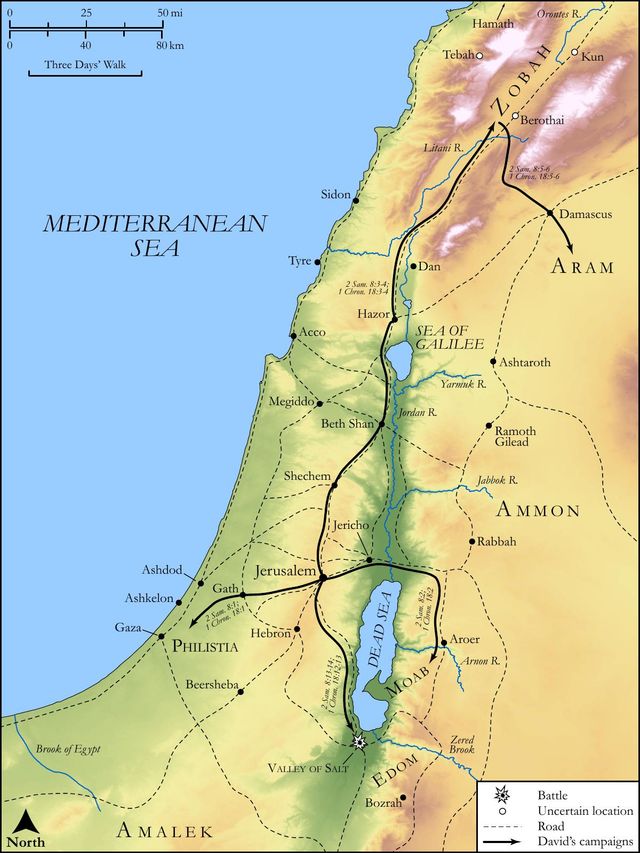
See on the biblical-era map
Study this verse
Public-domain commentary
Matthew Henry
From his Commentary on the Whole Bible. Henry comments on passages, not single verses — this entry covers 1 Chronicles 18:1–8.
After this, it is said (Ch1 18:1), David did those great exploits. After the sweet communion he had had with God by the word and prayer, as mentioned in the foregoing chapter, he went on his work with extraordinary vigour and courage, conquering and to conquer. Thus Jacob, after his vision, lifted up his feet, Gen 29:1.
We have taken a view of these victories before, and shall now only observe, 1. Those that have been long enemies to the Israel of God will be brought down at last. The Philistines had, for several generations, been vexatious to Israel, but now David subdued them, Ch1 18:1. Thus shall all opposing rule, principality, and power, be, at the end of time, put down by the Son of David, and the most inveterate enemies shall fall before him. 2. Such is the uncertainty of this world that frequently men lose their wealth and power when they think to confirm it. Hadarezer was smitten as he went to establish his dominion, Ch1 18:3. 3. A horse is a vain thing for safety, so David said (Psa 33:17), and it seems he believed what he said, for he houghed the chariot-horses, Ch1 18:4. Being resolved not to trust to them (Psa 20:7), he would not use them. 4. The enemies of God's church are often made to ruin themselves by helping one another, Ch1 18:5. The Syrians of Damascus were smitten when they came to help Hadarezer. When hand thus joins in hand they shall not only not go unpunished, but thereby they shall be gathered as the sheaves into the floor, Mic 4:11, Mic 4:12. 5. The wealth of the sinner sometimes proves to have been laid up for the just. The Syrians brought gifts, Ch1 18:6. Their shields of gold and their brass were brought to Jerusalem, Ch1 18:7, Ch1 18:8. As the tabernacle was built of the spoils of the Egyptians, so the temple of the spoils of other Gentile nations, a happy presage of the interest the Gentiles should have in the gospel church.
Continue studying 1 Chronicles 18:5 across the web’s major study libraries — every link below opens this exact verse, chapter, or book on the destination site.
Read & Compare
 BibleGatewayThis verse in more than 200 translations and 70 languages.
 Bible.comThe YouVersion reader — hundreds of translations, reading plans, and highlights.
 ESV.orgCrossway's official English Standard Version reader.
 NET BibleThe NET translation with 60,000+ translators' notes on every rendering decision.
 STEP BibleTyndale House's free study tool — original text, vocabulary, and scholarly resources.
 BibliaLogos Bible Software's free web reader.
 USCCBThe New American Bible (Revised Edition) with the U.S. bishops' study notes.
Commentaries
 BibleHub CommentariesDozens of classic commentaries on this verse, gathered on one page.
 StudyLightMore than 100 commentary sets — the largest collection on the web.
 BibleRefPlain-English commentary on what this verse means, verse by verse.
 Enduring WordDavid Guzik's free commentary on this chapter, widely used by Bible teachers.
 Bible Study ToolsVerse commentary alongside Greek and Hebrew study aids.
Original Language & Research
- BibleHub InterlinearThe verse word by word — original language, transliteration, and English.
- BibleHub LexiconEvery word's original-language definition and Strong's entry.
 Blue Letter BibleDeep-study tools — Strong's numbers, concordance, and word studies.
 SefariaThe Hebrew text with Rashi and centuries of Jewish commentary.
Sermons, Hymns & Audio


TrulyRandomVerse is not affiliated with these sites and doesn’t control their content. They’re linked because they’re genuinely useful.
Summary
1 Chronicles 18:5 records a decisive moment in King David's reign, showcasing his divinely-empowered military might and the expansion of Israel's dominion. After David's initial victory over Hadarezer, king of Zobah, the Syrians of Damascus intervened to aid their ally. However, David met this new threat with overwhelming force, inflicting a devastating defeat upon the Damascene army, slaying twenty-two thousand of their men. This triumph not only secured David's prior gains but also solidified his regional supremacy, serving as a powerful testament to God's unwavering favor upon His anointed king.
Context
ShowHideLiterary Context
This verse is strategically placed within 1 Chronicles 18, a chapter meticulously detailing King David's significant military campaigns and the consolidation of his kingdom. The Chronicler's primary aim in this section is to highlight God's faithfulness in establishing David's throne and expanding Israel's territory, setting the stage for the peaceful reign of Solomon and the construction of the Temple. The narrative of 1 Chronicles 18:5 directly follows David's initial victory over Hadarezer, king of Zobah, as recounted in 1 Chronicles 18:3, demonstrating the immediate geopolitical repercussions of David's ascendance. The intervention of the Damascene Syrians underscores the regional powers' attempt to counter David's rising influence, making his subsequent victory all the more significant. This account closely parallels the narrative found in 2 Samuel 8:5, affirming its historical weight and theological importance within the broader biblical narrative of God's work through His chosen king.
Historical & Cultural Context
In David's day, the nations round about were a dynamic landscape of competing city-states and kingdoms, constantly engaged in struggles for dominance, control of trade routes, and access to vital resources. Zobah, an influential Aramean (Syrian) kingdom, and Damascus, a major commercial and political hub, represented formidable powers in the region. The act of the Syrians of Damascus coming to "help Hadarezer" was a common practice of forming strategic alliances to counter a perceived threat or to re-establish a balance of power. David's military campaigns were not arbitrary acts of aggression but calculated maneuvers to secure Israel's borders, control strategic territories, and fulfill the territorial promises made to Abraham and his descendants. His decisive defeat of these powerful Aramean forces marked a pivotal shift in the regional power dynamics, firmly establishing Israel as a dominant force and laying the groundwork for the extensive empire that Solomon would later inherit. This era was defined by constant warfare, where military strength and strategic alliances were paramount for a nation's survival and prosperity.
Key Themes
ShowHideThe central theme permeating 1 Chronicles 18, and particularly evident in this verse, is the Divine Favor and Preservation bestowed upon King David. The Chronicler consistently emphasizes that David's military successes are not solely due to his strategic genius but are a direct result of the Lord's active hand, as explicitly stated in 1 Chronicles 18:6. This highlights God's ongoing involvement in establishing and protecting His chosen king and His people. Another crucial theme is the Expansion and Security of the Kingdom of Israel. David's victories, including this one over the Syrians, were instrumental in securing Israel's borders, expanding its influence, and fulfilling the covenant promises of land and dominion. This military success created the necessary conditions for the subsequent peace and prosperity during Solomon's reign. Furthermore, the narrative underscores the Futility of Opposition to God's Anointed, demonstrating that any resistance to God's plan and His chosen instruments will ultimately fail. Those who stood against David, and by extension against God's will, faced overwhelming defeat. While divine aid is paramount, the verse also implicitly affirms David's Strategic Leadership and Military Prowess, showcasing his ability to lead his army to decisive victories against significant regional adversaries.
Exposition and Analysis
ShowHideKey Word Analysis
ShowHideMeaning "loving," this name identifies the central figure of the narrative. As the anointed king of Israel, David's actions in this verse are presented as divinely sanctioned and empowered. His personal involvement in the battle, leading to such a decisive victory, underscores his role as God's chosen instrument for establishing and expanding the kingdom. The Chronicler consistently portrays David as the faithful servant through whom God's purposes are realized.
A primitive root meaning "to strike (lightly or severely, literally or figuratively)." In this military context, nâkâh signifies a decisive and lethal blow, indicating a complete defeat and destruction of the enemy forces. The use of this strong verb emphasizes the overwhelming nature of David's victory, portraying it not as a minor skirmish but as a devastating rout that incapacitated the Damascene army. It highlights the finality and totality of the defeat inflicted upon the Syrians.
Meaning "a man as an individual or a male person." The mention of "men" in the phrase "two and twenty thousand men" emphasizes the human cost and the significant loss of life for the Damascene forces. While the number itself conveys magnitude, the term "men" personalizes the impact of the defeat, highlighting that a substantial portion of their fighting force was annihilated. This detail underscores the severity of the blow and the comprehensive nature of David's victory.
Verse Breakdown
ShowHide"And when the Syrians of Damascus came to help Hadarezer king of Zobah,"
This opening clause establishes the critical context for the conflict. David's previous victory over Hadarezer, king of Zobah, as detailed in 1 Chronicles 18:3, provoked a powerful regional response. Damascus, a formidable Aramean kingdom, allied itself with Zobah, indicating the perceived threat David posed to the existing power structures. Their intervention was a deliberate attempt to reverse David's gains and restore their regional dominance.
"David slew of the Syrians"
This phrase directly attributes the decisive action to King David. As God's anointed leader and military commander, David personally led his forces to confront and overcome this formidable new enemy. The Chronicler emphasizes David's direct agency, portraying him as the instrument through whom God's purposes were achieved, highlighting both his leadership and the effectiveness of the Israelite army under divine guidance.
"two and twenty thousand men."
This concluding phrase quantifies the devastating outcome of the battle. The precise figure of twenty-two thousand men signifies a catastrophic loss for the Damascene forces, effectively neutralizing their threat and securing David's control over the region. This large number underscores the decisive nature of David's victory, solidifying his reputation and firmly establishing Israel's dominance over the nations round about.
Literary Devices
ShowHideThe Chronicler masterfully employs several literary devices to amplify the impact of this verse. Numerical Significance is prominently featured with the precise figure of "two and twenty thousand men," serving to underscore the overwhelming scale of David's victory and the devastating blow inflicted upon the Syrians. This large number functions as a form of Hyperbole, emphasizing the completeness of the defeat and the futility of opposing David, who is clearly portrayed as divinely favored. While not explicitly stated in this single verse, the broader narrative of 1 Chronicles 18, particularly 1 Chronicles 18:6, uses Divine Agency as a pervasive theme, implying that David's military success is ultimately God's work accomplished through him. The concise and declarative nature of the statement "David slew of the Syrians" also contributes to a sense of Clarity and Decisiveness, leaving no ambiguity about the outcome of the confrontation.
Theological and Thematic Connections
ShowHideThis verse powerfully illustrates the theological principle that God actively fights for His people and establishes His anointed king. David's consistent victories are not merely a testament to his military genius but to the Lord's unwavering faithfulness to His covenant promises. Just as God promised to be with David and establish his kingdom (as seen in 1 Chronicles 17), so He actively intervenes to grant him victory over formidable adversaries. This passage reinforces the profound truth that when God is on one's side, no opposition, however strong or numerous, can ultimately prevail. It is a compelling demonstration of divine sovereignty in human affairs and the outworking of God's redemptive plan through His chosen instruments, ensuring the security and expansion of His kingdom on earth.
Reflection and Application
ShowHideThe account of David's decisive victory over the Syrians of Damascus offers profound encouragement and practical application for believers today. Just as David faced unexpected and formidable opposition even after initial successes, we too will inevitably encounter fresh challenges and adversaries in our lives—be they spiritual battles, relational conflicts, or circumstantial difficulties. This verse serves as a powerful reminder that our ultimate victory does not depend on our own strength, strategic brilliance, or numerical superiority, but on the unfailing favor and omnipotent power of God. When we walk in obedience to His will and trust in His divine leading, we can rest assured that He will preserve us and grant us triumph over seemingly insurmountable odds. It calls us to cultivate a deep and abiding reliance on divine assistance, recognizing that God is our strength in battle, enabling us to overcome obstacles and fulfill the purposes He has set before us. Our faith should be firmly placed in the God who fights for us, transforming potential defeats into powerful testimonies of His faithfulness and sovereign might.
Questions for Reflection
ShowHideFAQ
ShowHideIs the number 22,000 men a literal count, or is it symbolic?
ShowHideThe number 22,000, which is also found in the parallel account in 2 Samuel 8:5, is generally understood to represent a substantial and devastating loss for the Damascene forces. While ancient numerical figures in historical accounts can sometimes be round numbers or emphasize the magnitude rather than a precise census, the consistency between Chronicles and Samuel suggests it was a significant and recorded event. The primary theological point conveyed by the Chronicler is the decisiveness of David's victory and the overwhelming power of God at work through him, rather than a precise military tally. It signifies a crippling blow to the Syrian army, solidifying David's regional dominance and demonstrating the futility of opposing God's anointed king.
Why does the Chronicler emphasize David's military victories so heavily in this section?
ShowHideThe Chronicler's focus on David's military victories, particularly in 1 Chronicles 18, serves several crucial theological and historical purposes. Firstly, it powerfully demonstrates God's faithfulness to the Davidic covenant, where God promised to establish David's kingdom and dynasty forever (1 Chronicles 17). These victories show God actively fulfilling His promises. Secondly, they establish the legitimacy, power, and security of the Davidic monarchy, providing a stable foundation for the nation of Israel. Thirdly, these conquests secured the borders and resources necessary for the subsequent peace and prosperity under Solomon, enabling the construction of the Temple, which is a central theme for the Chronicler. The military success is presented as a divine prerequisite for the spiritual flourishing and worship centered in Jerusalem, emphasizing that God's plan for His people's well-being includes both physical security and spiritual devotion.
Christ-Centered Fulfillment
ShowHideDavid's victory over the Syrians of Damascus, a powerful and unexpected adversary, serves as a profound foreshadowing of the ultimate and decisive triumph of Jesus Christ. David, as God's anointed king, was an earthly type of the greater King, Jesus, who would come not to conquer physical kingdoms with a sword, but to establish an eternal spiritual kingdom. Just as David met and overcame formidable opposition, Christ faced the ultimate enemies: sin, death, and the spiritual forces of darkness. His victory was not achieved through military might but through His sacrificial death on the cross and His glorious resurrection, triumphing over all principalities and powers, disarming them, and leading them as captives in His train (Colossians 2:15). The "two and twenty thousand men" slain by David pale in comparison to the countless souls set free from spiritual bondage by Christ's singular, all-sufficient victory. He is the true Victorious King, who has overcome the world (John 16:33), and who will one day return as the Rider on the white horse, executing righteous judgment and reigning supreme over all creation (Revelation 19:11-16). David's historical triumph points us to the eternal triumph of our Lord Jesus Christ, in whom all God's promises find their ultimate and glorious fulfillment.