


1 Chronicles 18:3
Bible text: King James Version (1769 Blayney text) · Public domain
Bible text: Berean Standard Bible · Public domain
Bible text: American Standard Version (1901) · Public domain
Bible text: World English Bible, Messianic edition · Public domain
Bible text: Geneva Bible (1599) · Public domain
Bible text: Young's Literal Translation · Public domain
- וַיַּךְvai·Yakhand he struck downH5221Conj-w ¦ V-Hiphil-ConsecImperf-3msVerb Hiphil Consecutive Imperfect 3rd Singular Masculineוַandיַּךְhe struck down
- דָּוִידda·VidDavidH1732N-proper-mNoun Proper Masculine
- אֶת'et<obj.>H853DirObjMParticle Object Indicator
- הֲדַדְעֶזֶרha·dad·'E·zerHadadezerH1928N-proper-mNoun Proper Masculine
- מֶלֶךְMe·lekh[the] king ofH4428N-mscNoun Singular Masculine Construct
- צוֹבָהtzo·VahZobahH6678N-properNoun Proper Location
- חֲמָתָהcha·Ma·tahHamath towardsH2574N-proper ¦ SfxNoun Proper LocationחֲמָתָHamathהtowards
- בְּלֶכְתּוֹbe·lekh·Towhen he wentH1980Prep-b ¦ V-Qal-Inf ¦ 3msVerb Qal Infinitive Constructבְּwhenלֶכְתּwentוֹhe
- לְהַצִּיבle·ha·Tzivto establishH5324Prep-l ¦ V-Hiphil-InfVerb Hiphil Infinitive Constructלְtoהַצִּיבestablish
- יָדוֹya·Dohis monumentH3027N-csc ¦ 3msNoun Singular common gender Constructיָדmonumentוֹhis
- בִּנְהַרbin·harat [the] river ofH5104Prep-b ¦ N-mscNoun Singular Masculine Constructבִּatנְהַר[the] river of
- פְּרָתpe·RatEuphratesH6578N-properNoun Proper Location
English is a literal word-by-word gloss of the Hebrew, not the KJV's wording. Why?
This is the original text the KJV's translators worked from — each Hebrew word with its own literal English meaning in this verse, prepared by scholars at Tyndale House, Cambridge. The KJV translates whole sentences, not word by word, so its wording differs: one Hebrew word can become several English words, and the KJV may choose “the LORD” where the gloss reads “Yahweh”. Both are faithful — they answer different questions. For the KJV's own rendering, switch to the KJV text.
Details
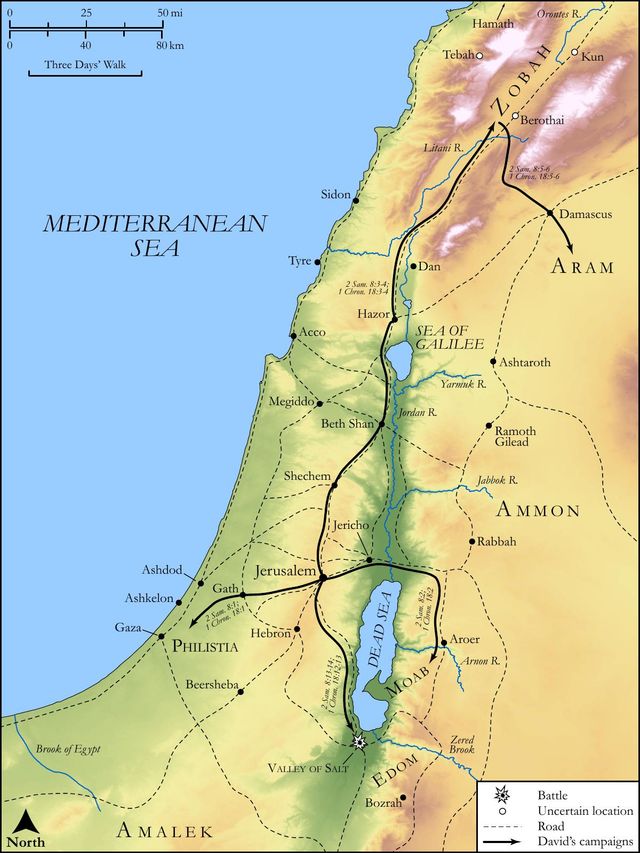
See on the biblical-era map
Study this verse
Public-domain commentary
Matthew Henry
From his Commentary on the Whole Bible. Henry comments on passages, not single verses — this entry covers 1 Chronicles 18:1–8.
After this, it is said (Ch1 18:1), David did those great exploits. After the sweet communion he had had with God by the word and prayer, as mentioned in the foregoing chapter, he went on his work with extraordinary vigour and courage, conquering and to conquer. Thus Jacob, after his vision, lifted up his feet, Gen 29:1.
We have taken a view of these victories before, and shall now only observe, 1. Those that have been long enemies to the Israel of God will be brought down at last. The Philistines had, for several generations, been vexatious to Israel, but now David subdued them, Ch1 18:1. Thus shall all opposing rule, principality, and power, be, at the end of time, put down by the Son of David, and the most inveterate enemies shall fall before him. 2. Such is the uncertainty of this world that frequently men lose their wealth and power when they think to confirm it. Hadarezer was smitten as he went to establish his dominion, Ch1 18:3. 3. A horse is a vain thing for safety, so David said (Psa 33:17), and it seems he believed what he said, for he houghed the chariot-horses, Ch1 18:4. Being resolved not to trust to them (Psa 20:7), he would not use them. 4. The enemies of God's church are often made to ruin themselves by helping one another, Ch1 18:5. The Syrians of Damascus were smitten when they came to help Hadarezer. When hand thus joins in hand they shall not only not go unpunished, but thereby they shall be gathered as the sheaves into the floor, Mic 4:11, Mic 4:12. 5. The wealth of the sinner sometimes proves to have been laid up for the just. The Syrians brought gifts, Ch1 18:6. Their shields of gold and their brass were brought to Jerusalem, Ch1 18:7, Ch1 18:8. As the tabernacle was built of the spoils of the Egyptians, so the temple of the spoils of other Gentile nations, a happy presage of the interest the Gentiles should have in the gospel church.
Continue studying 1 Chronicles 18:3 across the web’s major study libraries — every link below opens this exact verse, chapter, or book on the destination site.
Read & Compare
 BibleGatewayThis verse in more than 200 translations and 70 languages.
 Bible.comThe YouVersion reader — hundreds of translations, reading plans, and highlights.
 ESV.orgCrossway's official English Standard Version reader.
 NET BibleThe NET translation with 60,000+ translators' notes on every rendering decision.
 STEP BibleTyndale House's free study tool — original text, vocabulary, and scholarly resources.
 BibliaLogos Bible Software's free web reader.
 USCCBThe New American Bible (Revised Edition) with the U.S. bishops' study notes.
Commentaries
 BibleHub CommentariesDozens of classic commentaries on this verse, gathered on one page.
 StudyLightMore than 100 commentary sets — the largest collection on the web.
 BibleRefPlain-English commentary on what this verse means, verse by verse.
 Enduring WordDavid Guzik's free commentary on this chapter, widely used by Bible teachers.
 Bible Study ToolsVerse commentary alongside Greek and Hebrew study aids.
Original Language & Research
- BibleHub InterlinearThe verse word by word — original language, transliteration, and English.
- BibleHub LexiconEvery word's original-language definition and Strong's entry.
 Blue Letter BibleDeep-study tools — Strong's numbers, concordance, and word studies.
 SefariaThe Hebrew text with Rashi and centuries of Jewish commentary.
Sermons, Hymns & Audio


TrulyRandomVerse is not affiliated with these sites and doesn’t control their content. They’re linked because they’re genuinely useful.
Summary
This verse encapsulates a monumental military achievement for King David, chronicling his decisive victory over Hadarezer, the formidable Aramean king of Zobah. It highlights David's strategic prowess and God's providential hand in expanding the Israelite kingdom's sphere of influence northward towards Hamath and eastward to the Euphrates River, thereby initiating the fulfillment of ancient covenant promises regarding the full extent of the promised land.
Context
ShowHideLiterary Context
This verse is strategically placed within a significant narrative block in 1 Chronicles (chapters 18-20) that meticulously documents King David's extensive military campaigns and the subsequent consolidation of his kingdom's dominion over surrounding nations. Following David's internal consolidation of power and the capture of Jerusalem, as elaborated in 2 Samuel 5:6-10, the Chronicler shifts focus to David's outward expansion. This account of the defeat of Hadarezer serves as a crucial parallel to 2 Samuel 8:3, offering a concise yet impactful summary of this pivotal campaign. The Chronicler's primary aim is to underscore David's success as a direct manifestation of God's faithfulness to His promises, showcasing the divinely orchestrated growth and establishment of the Davidic kingdom. The subsequent verses detail the spoils of war and the tribute received, further emphasizing the totality of David's victory and the resulting prosperity.
Historical & Cultural Context
During David's reign, approximately 1000 BCE, the geopolitical landscape north of Israel was dominated by powerful Aramean city-states and kingdoms. Among these, Zobah, under King Hadarezer, was a particularly formidable entity, controlling significant territory and vital trade routes. Hamath, mentioned as the northernmost extent of David's campaign, was another influential Aramean kingdom further north, often competing for regional supremacy. The explicit mention of the "river Euphrates" carries immense historical and theological weight, as it represented the traditional eastern boundary of the land explicitly promised by God to Abraham in Genesis 15:18. David's military incursions into these territories were not merely acts of conquest but strategic maneuvers to secure Israel's vulnerable northern frontier, gain control over crucial economic arteries, and assert the sovereignty of the burgeoning Israelite empire in a complex and often hostile regional environment. This expansion demonstrated Israel's emergence as a dominant force in the Levant.
Key Themes
ShowHideThis verse powerfully encapsulates several core themes that are central to the Chronicler's theological message. Firstly, it highlights the Divine Fulfillment of Promise. David's successful expansion to the Euphrates directly correlates with God's ancient covenant with Abraham, which delineated the extensive boundaries of the promised land, extending "from the river of Egypt unto the great river, the river Euphrates" (Genesis 15:18). This victory thus serves as a powerful testament to God's unwavering faithfulness in bringing His redemptive plans to fruition through His chosen king. Secondly, the verse underscores David's Military Prowess and the Establishment of the Kingdom. The decisive defeat of Hadarezer, a formidable Aramean adversary, showcases David's exceptional strategic leadership, military strength, and the undeniable divine favor resting upon him as a warrior king. His stated objective to "stablish his dominion" signifies not mere conquest but the firm and lasting establishment of Israel's authority and the securing of its divinely appointed borders, thereby laying the essential groundwork for the subsequent peace and prosperity of the united monarchy under David and Solomon. Thirdly, the event carries profound Geopolitical Significance, as the subjugation of Zobah allowed Israel to control crucial regional trade routes and extend its political and economic influence, solidifying its position as a preeminent regional power.
Exposition and Analysis
ShowHideKey Word Analysis
ShowHideThis proper noun (H1928) is derived from two Hebrew words meaning "Hadar (i.e. Hadad) is his help." Hadad was a prominent Aramean storm god. The name thus suggests a king whose very identity and strength were believed to be derived from divine assistance, specifically from the pagan deity Hadad. David's decisive victory over Hadarezer, despite the theological implications of his name, powerfully demonstrates that the true help and power belong to Yahweh, the God of Israel, who empowers His chosen king.
The verb (H5221) signifies a powerful, decisive strike or blow, often resulting in complete defeat or destruction. In military contexts, as here, it implies a comprehensive and overwhelming victory, not merely a skirmish. David's action of "smiting" Hadarezer conveys the totality of his triumph, indicating that Zobah was not just defeated but effectively neutralized as a threat, demonstrating the swift and effective execution of God's will through David's military might.
While literally meaning "hand" (H3027), in the phrase "to stablish his dominion" (לְהַצִּיב יָדוֹ, l'haṣṣîb yāḏô'), it functions as an idiom signifying power, authority, and control. The "hand" here represents the full extent of David's governing power and influence. To "stablish his hand" means to firmly establish his authority and sovereignty over the conquered territories, ensuring their submission and integration into the sphere of Israelite influence. This goes beyond mere conquest, implying a lasting assertion of control and the securing of borders.
Verse Breakdown
ShowHide"And David smote Hadarezer king of Zobah"
This opening clause immediately identifies King David as the agent of action and the formidable Hadarezer, king of the powerful Aramean kingdom of Zobah, as his vanquished foe. The verb "smote" highlights the decisive and overwhelming nature of David's military victory, marking a critical turning point in his consolidation of power and the expansion of Israel's regional influence.
"unto Hamath"
This phrase delineates the geographical extent of David's successful campaign. By reaching "unto Hamath," a significant Aramean city-state located far to the north in Syria, the narrative underscores the vastness of David's military reach and the substantial expansion of Israel's territorial control beyond its immediate borders.
"as he went to stablish his dominion"
This clause clarifies the strategic and long-term purpose behind David's military actions. His objective was not merely transient conquest but the firm and lasting establishment of his authority, sovereignty, and control over the newly acquired territories. This phrase emphasizes David's vision to secure and stabilize the borders of the kingdom of Israel, bringing these regions under his enduring and legitimate rule.
"by the river Euphrates"
This concluding geographical marker carries profound theological and historical significance. The Euphrates River represented the traditional and divinely promised eastern boundary of the land granted by God to Abraham (Genesis 15:18 and Deuteronomy 1:7). David's successful campaign reaching this far signifies a partial yet crucial fulfillment of this ancient covenant, powerfully demonstrating God's faithfulness to His promises through the actions of His chosen king.
Literary Devices
ShowHideThe Chronicler masterfully employs several literary devices to convey the profound significance of David's victory. A prominent device is Conciseness, as this single verse efficiently summarizes a major military campaign that undoubtedly involved extensive planning, numerous engagements, and significant resources. This brevity serves to emphasize the outcome and its theological implications rather than dwelling on tactical details. The strategic use of precise Geographical Markers ("unto Hamath" and "by the river Euphrates") is crucial; these locations are not merely points on a map but function as powerful symbols of the kingdom's expansion and, more significantly, the partial fulfillment of God's ancient covenant promises regarding the land's boundaries (Genesis 15:18). Furthermore, the Chronicler's narrative exhibits clear Theological Framing, presenting David's military success not merely as a human achievement but as a divinely orchestrated event, underscoring God's unwavering faithfulness to His promises and His empowerment of His chosen king to establish the kingdom. The phrase "as he went to stablish his dominion" functions as a Purpose Clause, clearly articulating David's overarching strategic objective and hinting at the divine mandate behind his actions, elevating a military report into a profound statement of kingdom building and covenant fulfillment.
Theological and Thematic Connections
ShowHideThis account of David's decisive victory over Hadarezer and his subsequent expansion to the Euphrates River is replete with profound theological implications, primarily underscoring God's unwavering faithfulness to His covenant promises. David's military success is not presented as merely a testament to his strategic genius or military prowess, but rather as a direct and tangible fulfillment of the land grant covenant made with Abraham, where the divinely ordained boundaries of Israel were explicitly promised to extend to the great river. This demonstrates God's active sovereignty in history, meticulously working through His chosen king to establish His earthly kingdom. Furthermore, it powerfully highlights the theme of divine empowerment for leadership; David's remarkable ability to "smite" such a formidable foe and "stablish his dominion" is ultimately attributed to God's enabling hand, positioning David as a key instrument in the unfolding of God's redemptive plan. The expansion of this earthly kingdom under David serves as a powerful foreshadowing of the ultimate, unending, and universal dominion of the Messiah.
Reflection and Application
ShowHideThe narrative of David's strategic victories and the firm establishment of his dominion offers profound and enduring insights for contemporary believers. Just as King David was divinely appointed to expand and secure the physical boundaries of God's earthly kingdom, so too are believers called to actively participate in the advancement of God's spiritual kingdom. This involves intentionally "establishing dominion" in our own lives—over the pervasive influences of sin, the paralyzing grip of doubt, and the crippling power of fear—and extending the transformative influence of Christ into our diverse spheres of influence, whether within our families, professional environments, local communities, or even globally through missions. David's unwavering reliance on God for his military successes serves as a powerful reminder that true and lasting victory in any endeavor, whether spiritual battles or daily challenges, emanates not from our own finite strength or strategic brilliance alone, but from God's empowering presence and His unfailing faithfulness to His promises. We are profoundly encouraged to live with intentionality, diligently discerning God's specific purposes for our lives and pursuing them with unwavering courage, confident in the knowledge that He equips us for every battle we encounter and is utterly faithful to bring His divine plans to fruition through us. This passage challenges each of us to prayerfully consider where God is calling us to "smite" spiritual opposition and to "stablish" His righteous and transformative reign.
Questions for Reflection
ShowHideFAQ
ShowHideWho was Hadarezer, and why was his defeat by David so significant?
ShowHideHadarezer was the powerful king of Zobah, a prominent Aramean (Syrian) kingdom situated north of Israel. His defeat by David was highly significant because Zobah represented a formidable regional rival, controlling crucial trade routes and posing a constant threat to Israel's northern borders. David's decisive victory over Hadarezer not only neutralized a major enemy but also enabled Israel to significantly expand its influence, control valuable resources, and secure its northern frontier, thereby laying essential groundwork for the subsequent prosperity and stability of the united monarchy under David and Solomon. This pivotal victory is also recounted in 2 Samuel 8:3-8.
What is the significance of David's campaign reaching "unto Hamath" and "by the river Euphrates"?
ShowHideThese geographical markers are profoundly significant both strategically and theologically. Reaching "unto Hamath" signifies David's extensive military reach into northern Syria, extending Israel's dominion far beyond its immediate neighbors. More importantly, extending his dominion "by the river Euphrates" directly relates to God's ancient covenant with Abraham, where the Euphrates was explicitly specified as the eastern boundary of the promised land (Genesis 15:18). This expansion, therefore, represents a partial, yet highly significant, fulfillment of God's land promises to Israel, powerfully demonstrating His faithfulness through David's reign and securing the divinely appointed borders of the kingdom.
How does the Chronicler's account of this victory differ in emphasis from the parallel in 2 Samuel?
ShowHideWhile both 1 Chronicles 18:3 and 2 Samuel 8:3 recount the same historical event, the Chronicler's emphasis is distinct and intentional. The book of Chronicles, written for a post-exilic audience, consistently highlights themes of God's unwavering faithfulness, the enduring nature of the Davidic covenant, and the paramount importance of the temple and proper worship. In this particular verse, the Chronicler places strong emphasis on David's success as a direct and tangible fulfillment of God's ancient promises regarding the land boundaries, particularly the Euphrates River. This deliberate focus reinforces the Chronicler's broader theological agenda: to illustrate God's consistent and powerful work through the Davidic line and to offer profound hope to the returned exiles by reminding them of God's past faithfulness and the enduring potential for future restoration and blessing under a righteous, God-ordained king.
Christ-Centered Fulfillment
ShowHideThe military triumph of David recorded in 1 Chronicles 18:3 serves as a powerful and prophetic foreshadowing of the ultimate and eternal dominion established by Jesus Christ. David, as the anointed king of Israel, was instrumental in expanding the physical boundaries of God's chosen people to the very limits of the promised land, including the Euphrates River, thereby initiating the fulfillment of ancient covenant promises. In a far grander and more profound sense, Jesus, the Son of David and the true King of Kings, establishes a spiritual kingdom that transcends all earthly boundaries and geographical limitations. His decisive victory over sin, death, and the forces of darkness, achieved through His sacrificial death on the cross and His glorious resurrection (Colossians 2:15), represents the ultimate "smoting" of the enemy. The "dominion" Christ establishes is not confined to a physical territory but extends to the hearts and lives of all who believe, encompassing people from "every tribe and language and people and nation" (Revelation 5:9). Just as David secured a period of peace and prosperity for Israel through his conquests, Christ secures eternal peace, reconciliation, and redemption for humanity through His redemptive work on the cross (Ephesians 2:14-16). Thus, David's earthly expansion and the establishment of his kingdom point forward to the boundless, ever-increasing, and eternal reign of Christ, under whom all authority in heaven and on earth has been given (Matthew 28:18), establishing a kingdom that will never end and whose dominion is everlasting (Daniel 7:14).