


1 Chronicles 18:2
Bible text: King James Version (1769 Blayney text) · Public domain
Bible text: Berean Standard Bible · Public domain
Bible text: American Standard Version (1901) · Public domain
Bible text: World English Bible, Messianic edition · Public domain
Bible text: Geneva Bible (1599) · Public domain
Bible text: Young's Literal Translation · Public domain
- וַיַּךְvai·Yakhand he struck downH5221Conj-w ¦ V-Hiphil-ConsecImperf-3msVerb Hiphil Consecutive Imperfect 3rd Singular Masculineוַandיַּךְhe struck down
- אֶת'et<obj.>H853DirObjMParticle Object Indicator
- מוֹאָבmo·'AvMoabH4124N-properNoun Proper Location
- וַיִּהְיוּvai·yih·Yuand they becameH1961Conj-w ¦ V-Qal-ConsecImperf-3mpVerb Qal Consecutive Imperfect 3rd Plural Masculineוַandיִּהְיוּthey became
- מוֹאָבmo·'AvMoabH4124N-properNoun Proper Location
- עֲבָדִים'a·va·DimsubjectsH5650N-mpNoun Plural Masculine Absolute
- לְדָוִידle·da·Vidof DavidH1732Prep-l ¦ N-proper-mNoun Proper MasculineלְofדָוִידDavid
- נֹשְׂאֵיno·se·'Eibearers ofH5375V-Qal-Prtcpl-mpVerb Qal Participle Plural Masculine Construct
- מִנְחָהmin·ChahtributeH4503N-fsNoun Singular Feminine Absolute
English is a literal word-by-word gloss of the Hebrew, not the KJV's wording. Why?
This is the original text the KJV's translators worked from — each Hebrew word with its own literal English meaning in this verse, prepared by scholars at Tyndale House, Cambridge. The KJV translates whole sentences, not word by word, so its wording differs: one Hebrew word can become several English words, and the KJV may choose “the LORD” where the gloss reads “Yahweh”. Both are faithful — they answer different questions. For the KJV's own rendering, switch to the KJV text.
Details
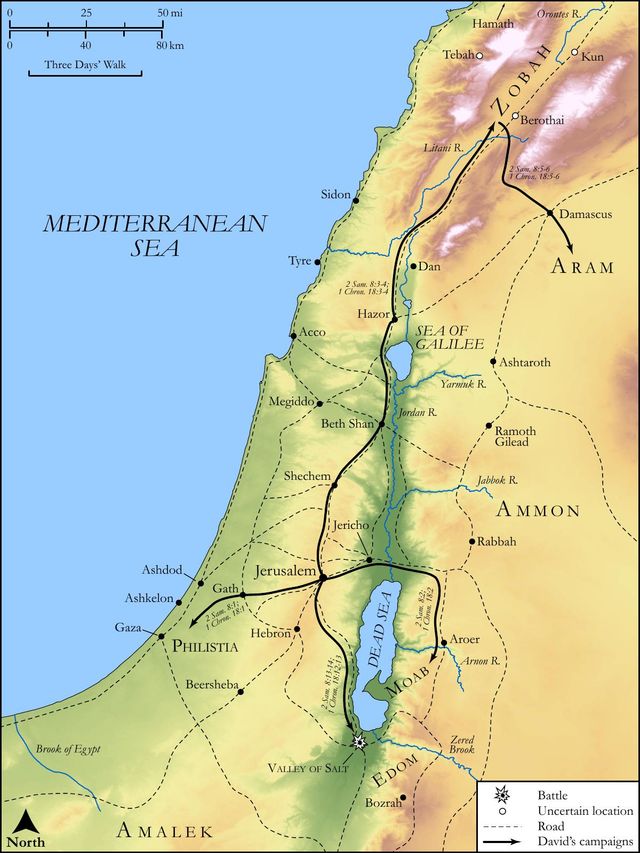
See on the biblical-era map
Study this verse
Public-domain commentary
Matthew Henry
From his Commentary on the Whole Bible. Henry comments on passages, not single verses — this entry covers 1 Chronicles 18:1–8.
After this, it is said (Ch1 18:1), David did those great exploits. After the sweet communion he had had with God by the word and prayer, as mentioned in the foregoing chapter, he went on his work with extraordinary vigour and courage, conquering and to conquer. Thus Jacob, after his vision, lifted up his feet, Gen 29:1.
We have taken a view of these victories before, and shall now only observe, 1. Those that have been long enemies to the Israel of God will be brought down at last. The Philistines had, for several generations, been vexatious to Israel, but now David subdued them, Ch1 18:1. Thus shall all opposing rule, principality, and power, be, at the end of time, put down by the Son of David, and the most inveterate enemies shall fall before him. 2. Such is the uncertainty of this world that frequently men lose their wealth and power when they think to confirm it. Hadarezer was smitten as he went to establish his dominion, Ch1 18:3. 3. A horse is a vain thing for safety, so David said (Psa 33:17), and it seems he believed what he said, for he houghed the chariot-horses, Ch1 18:4. Being resolved not to trust to them (Psa 20:7), he would not use them. 4. The enemies of God's church are often made to ruin themselves by helping one another, Ch1 18:5. The Syrians of Damascus were smitten when they came to help Hadarezer. When hand thus joins in hand they shall not only not go unpunished, but thereby they shall be gathered as the sheaves into the floor, Mic 4:11, Mic 4:12. 5. The wealth of the sinner sometimes proves to have been laid up for the just. The Syrians brought gifts, Ch1 18:6. Their shields of gold and their brass were brought to Jerusalem, Ch1 18:7, Ch1 18:8. As the tabernacle was built of the spoils of the Egyptians, so the temple of the spoils of other Gentile nations, a happy presage of the interest the Gentiles should have in the gospel church.
Continue studying 1 Chronicles 18:2 across the web’s major study libraries — every link below opens this exact verse, chapter, or book on the destination site.
Read & Compare
 BibleGatewayThis verse in more than 200 translations and 70 languages.
 Bible.comThe YouVersion reader — hundreds of translations, reading plans, and highlights.
 ESV.orgCrossway's official English Standard Version reader.
 NET BibleThe NET translation with 60,000+ translators' notes on every rendering decision.
 STEP BibleTyndale House's free study tool — original text, vocabulary, and scholarly resources.
 BibliaLogos Bible Software's free web reader.
 USCCBThe New American Bible (Revised Edition) with the U.S. bishops' study notes.
Commentaries
 BibleHub CommentariesDozens of classic commentaries on this verse, gathered on one page.
 StudyLightMore than 100 commentary sets — the largest collection on the web.
 BibleRefPlain-English commentary on what this verse means, verse by verse.
 Enduring WordDavid Guzik's free commentary on this chapter, widely used by Bible teachers.
 Bible Study ToolsVerse commentary alongside Greek and Hebrew study aids.
Original Language & Research
- BibleHub InterlinearThe verse word by word — original language, transliteration, and English.
- BibleHub LexiconEvery word's original-language definition and Strong's entry.
 Blue Letter BibleDeep-study tools — Strong's numbers, concordance, and word studies.
 SefariaThe Hebrew text with Rashi and centuries of Jewish commentary.
Sermons, Hymns & Audio


TrulyRandomVerse is not affiliated with these sites and doesn’t control their content. They’re linked because they’re genuinely useful.
Summary
1 Chronicles 18:2 succinctly records King David's decisive military victory over Moab, a significant neighboring nation. This conquest resulted in the Moabites becoming subservient to David, obligated to pay him regular tribute. This brief account is part of a larger narrative detailing David's successful military campaigns, which established Israel as the dominant regional power and solidified the boundaries and influence of his divinely-ordained kingdom, demonstrating God's faithfulness to His covenant promises.
Context
ShowHideLiterary Context
This verse is situated within 1 Chronicles 18-20, a section dedicated to chronicling King David's extensive military victories and the subsequent expansion of his kingdom. Following his consolidation of power in Jerusalem and the bringing of the Ark of the Covenant to the city, David embarks on a series of campaigns that establish Israel's dominion over the nations round about. The Chronicler presents these victories not merely as historical events but as clear demonstrations of God's favor and the fulfillment of His covenant promises to David. The account of Moab's subjugation here parallels the narrative found in 2 Samuel 8:2, reinforcing its significance in David's reign and the broader narrative of Israel's rise under a divinely appointed king. This chapter systematically lists David's conquests, emphasizing the breadth of his dominion.
Historical & Cultural Context
Moab was an ancient kingdom located east of the Dead Sea, often in a complex and sometimes adversarial relationship with Israel, as evidenced by various biblical narratives from Numbers to Judges and 1 Samuel. Descended from Lot (as per Genesis 19:37), the Moabites were distinct but ethnically related to the Israelites. David's military action against Moab, described as "smote," signifies a decisive and complete defeat, leading to their subjugation. The concept of conquered nations becoming "servants" and bringing "gifts" reflects the practice in which a defeated nation became servants, paid tribute, and acknowledged the dominion of the victorious power, as Hoshea "became his servant, and gave him presents" to the king of Assyria. This not only asserted Israel's dominance but also contributed significantly to the economic resources of David's kingdom.
Key Themes
ShowHideThe subjugation of Moab in 1 Chronicles 18:2 contributes to several overarching themes in the Chronicler's work. Primarily, it highlights Divine Blessing and David's Success, portraying David's victories not merely as military achievements but as direct manifestations of God's favor and the fulfillment of His promises to make David's name great and give him rest from all his enemies, as articulated in 2 Samuel 7:9. Secondly, it underscores the Establishment and Expansion of David's Kingdom. The subjugation of Moab, alongside other nations mentioned in this chapter, signifies the firm establishment of David's authority and the territorial growth of Israel, solidifying its position as a regional power. Finally, the mention of the Moabites becoming "David's servants" and bringing "gifts" emphasizes Tribute and Submission, which not only asserted Israel's dominance but also enriched the kingdom, providing vital resources for future national projects, including the eventual construction of the temple envisioned by David.
Exposition and Analysis
ShowHideKey Word Analysis
ShowHideThis Hebrew verb denotes a forceful, decisive strike or blow, often resulting in defeat, injury, or death. In a military context, as here, it implies a comprehensive and overwhelming victory, leading to the subjugation of the enemy. It suggests that David's engagement with Moab was not a minor skirmish but a significant military campaign that utterly broke Moabite resistance and established Israel's dominance.
In this geopolitical context, "servants" does not imply domestic servitude but rather a state of subjection as tributaries. The Moabites, as ʻebed of David, were a conquered people obligated to acknowledge David's dominion, obey his commands, and typically pay tribute. This term signifies their loss of independence and their incorporation into David's expanding sphere of influence.
While minchâh can refer to a voluntary offering or present, in the context of a conquered nation bringing "gifts" to a victorious king, it specifically denotes tribute. This was a mandatory payment, often in the form of goods, resources, or even labor, exacted from a subjugated people as a sign of their allegiance and submission. These "gifts" were a tangible expression of Moab's subjection and a source of wealth for David's kingdom.
Verse Breakdown
ShowHide"And he smote Moab;"
This clause describes David's direct and forceful military action against the Moabite nation. The verb "smote" (נָכָה) indicates a decisive and comprehensive defeat, suggesting a significant military campaign rather than a minor skirmish. This action highlights David's role as a powerful military leader, but within the Chronicler's theological framework, it implicitly points to God's hand empowering David for victory, fulfilling divine promises regarding the expansion and security of his kingdom.
"and the Moabites became David's servants,"
This phrase details the immediate consequence of David's victory. The Moabites, having been decisively defeated, lost their independence and entered a state of political and economic subservience to David. As "servants" (עֶבֶד), they were now tributaries, acknowledging David as their lord. This signifies the expansion of David's dominion and the firm establishment of his authority over surrounding territories, transforming former adversaries into subjects.
"and brought gifts."
This final clause specifies the practical manifestation of the Moabites' new status as David's servants. The "gifts" (מִנְחָה) were not voluntary presents but mandatory tribute payments. These payments, likely in the form of agricultural produce, precious metals, or other valuable resources, served as a tangible sign of their submission and allegiance. Furthermore, these tributes significantly contributed to the wealth and resources of David's kingdom, enabling future projects and solidifying Israel's economic and political standing in the region.
Literary Devices
ShowHideThe Chronicler's account in 1 Chronicles 18:2 employs several literary devices, though subtly. There is a marked Conciseness in the description of this significant victory, reflecting the Chronicler's primary interest in the results of David's reign rather than the detailed military engagements. This brevity allows the narrative to move swiftly through David's conquests, emphasizing the breadth and swiftness of God's blessing upon him. The verse also functions as part of a Fulfillment Narrative, serving as a concrete example of God making David's name great and giving him rest from his enemies, a promise central to the Davidic covenant (2 Samuel 7:9-11). Furthermore, the subjugation of Moab carries Symbolism. Moab, a long-standing adversary, becoming David's servant symbolizes the establishment of David's divinely-ordained kingdom and its growing dominance, foreshadowing the universal reign of the Messiah, who will ultimately bring all nations into submission. The act of bringing "gifts" or tribute also serves as a symbolic representation of the recognition of David's supreme authority.
Theological and Thematic Connections
ShowHideThe subjugation of Moab by David, as recounted in 1 Chronicles 18:2, is more than a historical footnote; it is a profound theological statement about God's covenant faithfulness and the establishment of His kingdom through His chosen king. This victory is presented as a direct fulfillment of God's promises to David, particularly the assurance that He would subdue David's enemies and establish his kingdom securely. The Chronicler emphasizes that David's success was not merely due to his military prowess but was a divine enablement, demonstrating that God was actively working through David to bring about His purposes for Israel. The tribute brought by the Moabites signifies not only their political submission but also the material blessing that flowed into God's kingdom through obedience and divine favor, providing resources for the future temple and solidifying Israel's position as a divinely-blessed nation among the peoples.
Reflection and Application
ShowHideThe historical account of David's victory over Moab in 1 Chronicles 18:2 offers timeless insights into God's sovereignty, the nature of leadership under divine anointing, and the dynamics of spiritual authority. Just as God empowered David to overcome formidable adversaries and establish his kingdom, so too does He equip and enable those He calls to fulfill His purposes in every generation. This passage reminds us that true success, whether in personal life, ministry, or leadership, ultimately stems from God's favor and His active presence. It challenges us to consider what "enemies" (whether spiritual strongholds, habitual sins, or external pressures) in our lives need to be "smitten" through divine power, leading to a state where we bring "tribute"—our willing obedience, worship, and service—to the one true King. The expansion of David's kingdom serves as a powerful metaphor for the growth of God's kingdom in the world and in our hearts, calling us to participate in His redemptive work.
Questions for Reflection
ShowHideFAQ
ShowHideWhy does the Chronicler summarize David's victories so briefly here, compared to the more detailed accounts sometimes found elsewhere?
ShowHideThe Chronicler's primary purpose in writing was not to provide an exhaustive historical chronicle of every battle or political maneuver. Instead, his focus was largely theological, aiming to highlight David's legitimacy as king, the divine blessing on his reign, and the establishment of the kingdom as a precursor to the building of the temple. Therefore, passages like 1 Chronicles 18:2 serve to demonstrate the results of God's favor on David's reign—the widespread subjugation of enemies and the expansion of Israel's dominion—rather than the intricate details of the military campaigns themselves. The brevity emphasizes the certainty and completeness of God's hand in David's success, quickly moving through these triumphs to underscore the stability and prosperity that enabled the later preparations for the temple.
What was the historical and theological significance of Moab to Israel?
ShowHideMoab was a nation with a long and complex relationship with Israel, often marked by both kinship and conflict. Descended from Lot, Abraham's nephew (Genesis 19:37), the Moabites were distant relatives of the Israelites. Their territory east of the Dead Sea was strategically important. Throughout Israel's history, Moab was sometimes a place of refuge (as for Ruth in the book of Ruth) but more often an adversary, engaging in hostilities with Israel from the time of the Exodus (Numbers 22-25) through the period of the Judges (Judges 3) and the early monarchy (1 Samuel 14:47). David's decisive subjugation of Moab in 1 Chronicles 18:2 was therefore a significant assertion of Israel's regional dominance, securing its eastern border and demonstrating the extent of David's God-given authority over surrounding nations. Theologically, it underscored God's faithfulness to His promises to David, establishing his kingdom and giving him rest from his enemies.
Christ-Centered Fulfillment
ShowHideThe earthly victories of King David, such as his decisive subjugation of Moab in 1 Chronicles 18:2, serve as powerful foreshadowings of the ultimate triumph and universal reign of Jesus Christ, the greater Son of David. David's military successes established an earthly kingdom and brought surrounding nations into submission, receiving tribute as a sign of their allegiance. In a far more profound sense, Christ's victory on the cross and His resurrection represent the decisive "smiting" of sin, death, and the powers of darkness, bringing about a spiritual kingdom that is "not of this world" yet holds universal dominion (John 18:36). Just as Moab became David's "servants" and brought "gifts," so too will every knee bow and every tongue confess that Jesus Christ is Lord, to the glory of God the Father (Philippians 2:9-11). The "tribute" brought to Christ is not merely material wealth, but the worship, obedience, and transformed lives of people from every tribe, tongue, and nation, who are brought into His glorious kingdom (Revelation 5:9-10). Through Christ's ultimate victory, His people receive true and lasting rest from their spiritual enemies, entering into the peace and security of His eternal reign (Matthew 11:28-30).