


2 Kings 3:4
Bible text: King James Version (1769 Blayney text) · Public domain
Bible text: King James Version with Strong's numbers · Public domain
Bible text: Berean Standard Bible · Public domain
Bible text: American Standard Version (1901) · Public domain
Bible text: World English Bible, Messianic edition · Public domain
Bible text: Geneva Bible (1599) · Public domain
Bible text: Young's Literal Translation · Public domain
- וּמֵישַׁעu·mei·Sha'and MeshaH4338Conj-w ¦ N-proper-mNoun Proper MasculineוּandמֵישַׁעMesha
- מֶלֶךְMe·lekh[the] king ofH4428N-mscNoun Singular Masculine Construct
- מוֹאָבmo·'AvMoabH4124N-properNoun Proper Location
- הָיָהha·Yahhe wasH1961V-Qal-Perf-3msVerb Qal Perfect 3rd Singular Masculine
- נֹקֵדno·Keda sheep-breederH5349N-msNoun Singular Masculine Absolute
- וְהֵשִׁיבve·he·Shivand he returnedH7725Conj-w ¦ V-Hiphil-ConsecPerf-3msVerb Hiphil Consecutive Perfect 3rd Singular Masculineוְandהֵשִׁיבhe returned
- לְמֶלֶךְle·Me·lekhto [the] king ofH4428Prep-l ¦ N-mscNoun Singular Masculine Constructלְtoמֶלֶךְ[the] king of
- יִשְׂרָאֵלYis·ra·'ElIsraelH3478N-properNoun Proper Location
- מֵאָהme·'ahone hundredH3967N-fsNoun Singular Feminine Absolute
- אֶלֶף'E·lefthousandH505N-csNoun Singular common gender Absolute
- כָּרִיםka·RimlambsH3733N-mpNoun Plural Masculine Absolute
- וּמֵאָהu·Me·'ahand one hundredH3967Conj-w ¦ N-fsNoun Singular Feminine Absoluteוּandמֵאָהone hundred
- אֶלֶף'E·lefthousandH505N-csNoun Singular common gender Absolute
- אֵילִים'ei·LimramsH352N-mpNoun Plural Masculine Absolute
- צָמֶרTza·merwoolH6785N-msNoun Singular Masculine Absolute
English is a literal word-by-word gloss of the Hebrew, not the KJV's wording. Why?
This is the original text the KJV's translators worked from — each Hebrew word with its own literal English meaning in this verse, prepared by scholars at Tyndale House, Cambridge. The KJV translates whole sentences, not word by word, so its wording differs: one Hebrew word can become several English words, and the KJV may choose “the LORD” where the gloss reads “Yahweh”. Both are faithful — they answer different questions. For the KJV's own rendering, switch to the KJV text.
Details
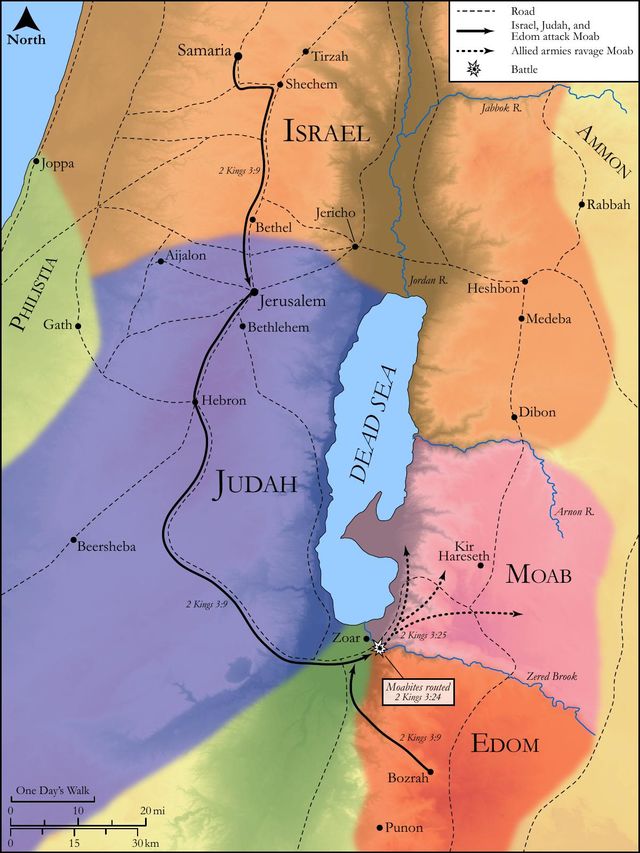
See on the biblical-era map
Study this verse
Public-domain commentary
Matthew Henry
From his Commentary on the Whole Bible. Henry comments on passages, not single verses — this entry covers 2 Kings 3:1–5. His two-level outline is real structure in the source text, so it is rendered as structure.
Jehoram, the son of Ahab, and brother of Ahaziah, is here upon the throne of Israel; and, though he was but a bad man, yet two commendable things are here recorded of him: -
I.That he removed his father's idols.
He did evil in many things, but not like his father Ahab or his mother Jezebel, Kg2 3:2. Bad he was, but not so bad, so overmuch wicked, as Solomon speaks, Ecc 7:17. Perhaps Jehoshaphat, though by his alliance with the house of Ahab he made his own family worse, did something towards making Ahab's better. Jehoram saw his father and brother cut off for worshipping Baal, and wisely took warning by God's judgments on them, and put away the image of Baal, resolving to worship the God of Israel only, and consult none but his prophets. So far was well, yet it did not prevent the destruction of Ahab's family, nay, that destruction came in his days, and fell immediately upon him (Kg2 9:24), though he was one of the best of the family, for then the measure of its iniquity was full. Jehoram's reformation was next to none; for,
1.He only put away the image of Baal which his father had made, and this probably in compliment to Jehoshaphat, who otherwise would not have come into confederacy with him, any more than with his brother, Kg1 22:49. But he did not destroy the worship of Baal among the people, for Jehu found it prevalent, Kg2 10:19. It was well to reform his family, but it was not enough; he ought to have used his power for the reforming of his kingdom.
2.When he put away the image of Baal, he adhered to the worship of the calves, that politic sin of Jeroboam, Kg2 3:3. He departed not therefrom, because that was the state engine by which the division between the two tribes was supported. Those do not truly, nor acceptably, repent or reform, who only part with the sins that they lose by, but continue their affection to the sins that they get by.
3.He only put away the image of Baal, he did not break it in pieces, as he ought to have done. He laid it aside for the present, yet not knowing but he might have occasion for it another time; and Jezebel, for reasons of state, was content to worship her Baal in private.
II.That he did what he could to recover his brother's losses.
As he had something more of the religion of an Israelite than his father, so he had something more of the spirit of a king than his brother. Moab rebelled against Israel, immediately upon the death of Ahab, Kg2 1:1. And we do not find that Ahaziah made any attempt to chastise or reduce them, but tamely let go his interest in them, rather than entertain the cares, undergo the fatigues, and run the hazards, of a war with them. His folly and pusillanimity herein, and his indifference to the public good, were the more aggravated because the tribute which the king of Moab paid was a very considerable branch of the revenue of the crown of Israel: 100,000 lambs, and 100,000 wethers, Kg2 3:4. The riches of kings then lay more in cattle than coin, and they thought it not below them to know the state of their flocks and herds themselves, because, as Solomon observes, the crown doth not endure to every generation, Pro 27:23, Pro 27:24. Taxes were then paid not so much in money as in the commodities of the country, which was an ease to the subject, whether it was an advantage to the prince or no. The revolt of Moab was a great loss to Israel, yet Ahaziah sat still in sloth and ease. But an upper chamber in his house proved as fatal to him as the high places of the field could have been (Kg2 1:2), and the breaking of his lattice let into his throne a man of the more active genius, that would not lose the dominion of Moab without making at least one push for its preservation.
Continue studying 2 Kings 3:4 across the web’s major study libraries — every link below opens this exact verse, chapter, or book on the destination site.
Read & Compare
 BibleGatewayThis verse in more than 200 translations and 70 languages.
 Bible.comThe YouVersion reader — hundreds of translations, reading plans, and highlights.
 ESV.orgCrossway's official English Standard Version reader.
 NET BibleThe NET translation with 60,000+ translators' notes on every rendering decision.
 STEP BibleTyndale House's free study tool — original text, vocabulary, and scholarly resources.
 BibliaLogos Bible Software's free web reader.
 USCCBThe New American Bible (Revised Edition) with the U.S. bishops' study notes.
Commentaries
 BibleHub CommentariesDozens of classic commentaries on this verse, gathered on one page.
 StudyLightMore than 100 commentary sets — the largest collection on the web.
 BibleRefPlain-English commentary on what this verse means, verse by verse.
 Enduring WordDavid Guzik's free commentary on this chapter, widely used by Bible teachers.
 Bible Study ToolsVerse commentary alongside Greek and Hebrew study aids.
Original Language & Research
- BibleHub InterlinearThe verse word by word — original language, transliteration, and English.
- BibleHub LexiconEvery word's original-language definition and Strong's entry.
 Blue Letter BibleDeep-study tools — Strong's numbers, concordance, and word studies.
 SefariaThe Hebrew text with Rashi and centuries of Jewish commentary.
Sermons, Hymns & Audio


TrulyRandomVerse is not affiliated with these sites and doesn’t control their content. They’re linked because they’re genuinely useful.
Summary
Second Kings 3:4 introduces Mesha, the king of Moab, identifying him as a highly prosperous "sheepmaster" who was obligated to pay an enormous annual tribute of one hundred thousand lambs and one hundred thousand rams, including their wool, to the king of Israel. This verse not only highlights Moab's considerable pastoral wealth but also underscores its long-standing subjection to Israel, establishing the critical economic and political backdrop for the dramatic rebellion that unfolds in the subsequent narrative.
Context
ShowHideLiterary Context
This verse serves as the pivotal introduction to the conflict that dominates 2 Kings 3. It immediately follows the brief account of Jehoram's ascension to the throne of Israel (2 Kings 3:1-3), which establishes his character as one who, while still engaging in idolatry, was less egregious than his father Ahab. The abrupt shift in focus to Mesha, king of Moab, and the immense tribute he paid, provides the essential casus belli for the ensuing war. The mention of this heavy economic burden directly precedes Mesha's rebellion against Israel after Ahab's death, as explicitly stated in 2 Kings 3:5. Without understanding the magnitude of this financial strain and the historical context of Moab's subjugation, Mesha's bold act of defiance and the subsequent military campaign involving Israel, Judah, and Edom would lack their primary motivation and dramatic tension. The verse masterfully sets the stage, explaining why Moab, a seemingly weaker nation, would dare to challenge such a powerful overlord.
Historical & Cultural Context
Moab, a kingdom situated east of the Dead Sea, had a long and often contentious relationship with Israel. It had been decisively subjugated by King David, as recorded in 2 Samuel 8:2, and subsequently remained subject to the Northern Kingdom of Israel for an extended period, though punctuated by attempts at rebellion. The practice of powerful kings exacting tribute from conquered or weaker nations was common in that day, as when the kingdoms round about "brought presents, and served Solomon all the days of his life." Such tributes served not only as a significant source of wealth for the dominant power but also as a tangible symbol of the subject nation's submission and loyalty. These payments could take various forms, including precious metals, agricultural produce, livestock, or even forced labor. Mesha's specific designation as a "sheepmaster" (Hebrew: noqed) is highly significant, indicating that Moab was a region renowned for its rich pastures and prolific sheep and wool production. This made the tribute of 200,000 animals annually (100,000 lambs and 100,000 rams) a logical, yet incredibly burdensome, imposition that would have severely strained Moab's economy and fostered deep-seated resentment, inevitably leading to revolt upon any perceived weakening of Israelite authority.
Key Themes
ShowHideThis verse is foundational for understanding several key themes that resonate throughout 2 Kings and the broader biblical narrative. Firstly, it vividly illustrates the theme of Service and Tribute, a pervasive aspect of the dealings between kingdoms in that day, where powerful kingdoms exerted control and extracted resources from the peoples who served them. This economic and political subjugation was a constant source of tension and a frequent catalyst for conflict. Secondly, the verse highlights the Economic Power and Burden inherent in such relationships. Moab's immense pastoral wealth is evident in the sheer volume of the tribute, but so too is the crushing economic pressure that such a payment would exert, fueling a desire for independence. This economic exploitation often served as a flashpoint for rebellion, mirroring other biblical accounts where heavy burdens led to societal unrest, such as the complaints against King Rehoboam's oppressive policies in 1 Kings 12:4. Finally, the verse subtly introduces the theme of Sovereignty and Rebellion, as the oppressive tribute directly sets the stage for Mesha's defiance against Israelite rule. This central plot point underscores the complex dynamics of power, resistance, and the unfolding of divine purposes through the actions of nations and their leaders.
Exposition and Analysis
ShowHideKey Word Analysis
ShowHideThis term (H5349) is far more than a simple shepherd. Derived from a root meaning "to spot," it refers to a wealthy owner or tender of large flocks, a breeder or rancher of considerable means and social standing. The same term is notably used to describe the prophet Amos in Amos 1:1, indicating a person whose livelihood, influence, and perhaps even prophetic insight derived from extensive pastoral holdings. Mesha's designation as a "sheepmaster" underscores his immense personal and national wealth, making the scale of the tribute he paid even more striking and the burden more profound.
The verb used here (H7725) means "to turn back" or "to return." In this context, it implies a regular, obligated payment that Moab was compelled to "return" to Israel, rather than a voluntary gift. This choice of verb emphasizes the coercive and compulsory nature of the tribute, indicating that it was a fixed, recurring obligation that Moab was forced to fulfill as a clear sign of its subservience and Israel's dominance. It highlights the non-negotiable aspect of the payment.
This seemingly minor detail (H6785) is crucial for understanding the comprehensive nature of the tribute. It specifies that the payment included not just the animals themselves (for meat, sacrifice, or breeding) but also their highly valuable fleece. Wool was a primary commodity, essential for textiles, clothing, trade, and economic prosperity. Its explicit inclusion emphasizes that the tribute was a comprehensive extraction of Moab's economic output, maximizing the value for Israel and, consequently, the burden for Moab.
Verse Breakdown
ShowHide"And Mesha king of Moab was a sheepmaster"
This initial clause introduces the central figure, Mesha, and immediately establishes his identity, royal status, and the primary source of his and his nation's wealth and influence. His role as a "sheepmaster" signifies not only his personal prosperity but also the economic foundation of the entire nation of Moab, renowned for its abundant pastures and prolific flocks. This sets the crucial baseline for comprehending the immense scale of the tribute that follows.
"and rendered unto the king of Israel"
This phrase clearly defines the political relationship between Moab and Israel: one in which Moab served the king of Israel. Mesha, as the sovereign of Moab, was obligated to pay tribute to the king of Israel, signifying Israel's political and military dominance over Moab at this specific historical juncture. The verb "rendered" (from the Hebrew root shûwb, "to return") underscores the compulsory, recurring nature of this payment, highlighting that it was a forced obligation rather than a voluntary offering.
"an hundred thousand lambs, and an hundred thousand rams, with the wool"
This final clause quantifies the staggering tribute. The sheer number of animals—200,000 in total—highlights both the extraordinary wealth of Moab's flocks and, conversely, the crushing economic burden placed upon the nation. The specific mention of "with the wool" further emphasizes the comprehensive nature of the tribute, indicating that Israel was extracting the full economic value of the animals, including their highly prized fleece, which was a vital commodity for trade and textiles. This detail underscores the severity of the economic exploitation.
Literary Devices
ShowHideThe verse primarily employs Quantification to convey the immense scale of Moab's wealth and the burden of the tribute. The precise numbers ("an hundred thousand lambs, and an hundred thousand rams") are not mere statistics but function to impress upon the reader the vastness of the payment and, by extension, the severity of Israel's economic demands on Moab. This detailed enumeration also serves as a crucial element of Setting the Stage, providing the essential background information that fully explains the motivations behind Mesha's subsequent rebellion. The heavy tribute is explicitly presented as the primary Catalyst for the conflict that dominates the rest of the chapter. Furthermore, there is a clear element of Foreshadowing, as the description of such a crippling and unsustainable tribute implicitly suggests that this oppressive arrangement will inevitably lead to resistance, which indeed it does in the very next verse, initiating the dramatic events of the chapter.
Theological and Thematic Connections
ShowHideThis seemingly straightforward verse about ancient economics and geopolitics carries profound theological weight. It illustrates the complex interplay of human power, national sovereignty, and the burdens of sin and oppression. While the tribute was an earthly political arrangement, the Bible consistently portrays the rise and fall of nations, and the imposition of tribute or servitude, as part of God's sovereign plan. Such events are often depicted as consequences of national sin, a means of divine discipline, or even a demonstration of God's judgment (e.g., Deuteronomy 28:47-48). Mesha's rebellion, sparked by this heavy burden, can be seen as an act of human resistance against an oppressive rule, yet it also sets in motion a chain of events that will reveal God's hand in the affairs of these nations, even through their conflicts and alliances. The verse also underscores the immense value placed on pastoral wealth in biblical times, a theme that resonates throughout scripture, from the patriarchs to the imagery of the Good Shepherd, highlighting God's provision and the significance of stewardship.
Reflection and Application
ShowHideThe story of Mesha's tribute and subsequent rebellion, though rooted in ancient geopolitical realities, offers profound insights into the enduring dynamics of power, oppression, and the human desire for freedom. It serves as a stark reminder that economic burdens, whether imposed by external forces, societal structures, or even self-inflicted choices, can lead to deep resentment, instability, and ultimately to conflict. For us today, this narrative prompts vital reflection on the "tributes" we may feel compelled to pay in our own lives—whether they are oppressive practices of debt, crushing societal expectations, the heavy demands of personal sin that enslave us, or even the spiritual burdens of legalism. The account invites us to consider the true cost of peace and the profound price of freedom, both individually and communally. It also highlights how God can work through the seemingly mundane details of geopolitics and economics to achieve His overarching purposes, reminding us that no aspect of human history, no matter how secular it appears, is outside His sovereign gaze. We are called to discern the burdens that weigh us down and to seek the true freedom that comes from God, rather than relying on our own strength or ill-fated rebellions.
Questions for Reflection
ShowHideFAQ
ShowHideWas Mesha, King of Moab, a historical figure confirmed outside the Bible?
ShowHideYes, Mesha is a highly significant historical figure whose existence and rebellion against Israel are independently corroborated by a crucial archaeological discovery: the Mesha Stele, also known as the Moabite Stone. This basalt slab, discovered in 1868, contains a detailed inscription by Mesha himself, recounting his victories against Israel, particularly his liberation from Israelite rule, and his extensive building projects. It is one of the most important archaeological finds for confirming biblical narratives, providing a Moabite perspective on the very events described in 2 Kings 3.
Why was Israel demanding such a massive tribute from Moab?
ShowHideIsrael's demand for such a colossal tribute was a clear assertion of its dominance and a strategic means of economic exploitation. As the victorious kingdom, Israel sought to extract maximum resources from subjugated Moab. This heavy tribute served multiple purposes: it significantly enriched the Israelite treasury, demonstrated Israel's military and political power over its neighbors, and likely aimed to keep Moab economically weakened, thereby preventing future rebellions. The sheer volume of livestock and wool indicates that Moab was a rich pastoral nation, making it a prime target for such substantial economic demands.
What was the particular significance of the tribute including "with the wool"?
ShowHideThe phrase "with the wool" is highly significant because it emphasizes the comprehensive nature and full economic value of the tribute demanded by Israel. While lambs and rams could be used for meat, sacrifice, or breeding, the explicit inclusion of their wool meant that Israel was extracting the full range of Moab's pastoral produce. Wool was an exceptionally valuable commodity, essential for textiles, clothing, and trade. By demanding the wool in addition to the animals, Israel ensured that Moab's primary economic output was fully leveraged, maximizing the burden on Moab and the economic benefit to Israel. This detail underscores the severity of the economic oppression.
Christ-Centered Fulfillment
ShowHideThe narrative of Mesha's oppressive tribute and subsequent rebellion, while rooted in ancient geopolitical realities, finds profound Christ-centered fulfillment in the broader biblical story of redemption. Humanity, by its very nature, is born into a state of bondage, not to an earthly king, but to sin and death (Romans 6:23). The "tribute" demanded by sin is not lambs and rams, but spiritual death and eternal separation from God. This heavy burden, a dire consequence of our rebellion against our Creator, leaves humanity enslaved and utterly without hope of self-liberation. However, unlike Mesha's violent and ultimately temporary rebellion, God Himself intervened to pay the ultimate "tribute" on our behalf. Jesus Christ, the true Lamb of God, who takes away the sin of the world!, willingly offered Himself as the perfect, once-for-all sacrifice, bearing the full weight of sin's demands (Hebrews 9:28). Through His death and glorious resurrection, He redeemed us from the curse and the heavy yoke of sin, setting us truly free from its dominion (Galatians 3:13). He is the Good Shepherd, who unlike earthly "sheepmasters" who exploit their flocks for tribute, lays down His very life for His sheep, leading them into true freedom and abundant life (John 10:11). Thus, the oppressive tribute of 2 Kings 3:4 ultimately points to the glorious, liberating "tribute" paid by Christ, securing our eternal freedom, peace, and reconciliation with God.