


2 Kings 3:3
Bible text: King James Version (1769 Blayney text) · Public domain
Bible text: Berean Standard Bible · Public domain
Bible text: American Standard Version (1901) · Public domain
Bible text: World English Bible, Messianic edition · Public domain
Bible text: Geneva Bible (1599) · Public domain
Bible text: Young's Literal Translation · Public domain
- רַקrakonlyH7535AdvAdverb
- בְּחַטֹּאותbe·cha·Totto [the] sins ofH2403Prep-b ¦ N-fpcNoun Plural Feminine Constructבְּtoחַטֹּאות[the] sins of
- יָרָבְעָםya·ra·ve·'AmJeroboamH3379N-proper-mNoun Proper Masculine
- בֶּןben[the] son ofH1121N-mscNoun Singular Masculine Construct
- נְבָטne·VatNebatH5028N-proper-mNoun Proper Masculine
- אֲשֶׁר'a·SherwhichH834RelParticle Relative
- הֶחֱטִיאhe·che·Ti'he caused to sinH2398V-Hiphil-Perf-3msVerb Hiphil Perfect 3rd Singular Masculine
- אֶת'et<obj.>H853DirObjMParticle Object Indicator
- יִשְׂרָאֵלYis·ra·'ElIsraelH3478N-properNoun Proper Location
- דָּבֵקda·Vekhe clungH1692V-Qal-Perf-3msVerb Qal Perfect 3rd Singular Masculine
- לֹאlo'notH3808NegParticle Negative
- סָרsarhe turned asideH5493V-Qal-Perf-3msVerb Qal Perfect 3rd Singular Masculine
- מִמֶּנָּהmi·Me·nahfrom itH4480Prep ¦ 3fsPrepositionמִמֶּfromנָּהit
English is a literal word-by-word gloss of the Hebrew, not the KJV's wording. Why?
This is the original text the KJV's translators worked from — each Hebrew word with its own literal English meaning in this verse, prepared by scholars at Tyndale House, Cambridge. The KJV translates whole sentences, not word by word, so its wording differs: one Hebrew word can become several English words, and the KJV may choose “the LORD” where the gloss reads “Yahweh”. Both are faithful — they answer different questions. For the KJV's own rendering, switch to the KJV text.
Details
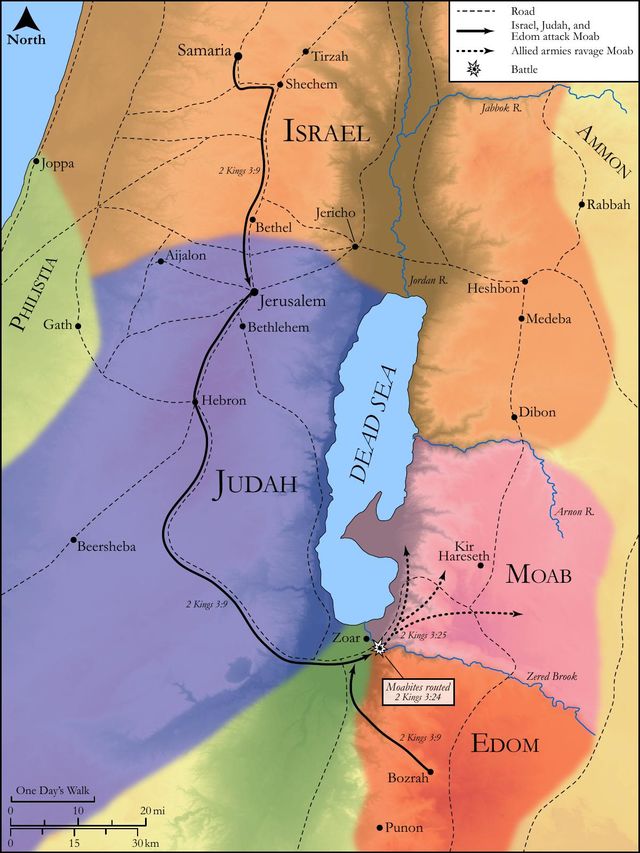
See on the biblical-era map
Study this verse
Public-domain commentary
Matthew Henry
From his Commentary on the Whole Bible. Henry comments on passages, not single verses — this entry covers 2 Kings 3:1–5. His two-level outline is real structure in the source text, so it is rendered as structure.
Jehoram, the son of Ahab, and brother of Ahaziah, is here upon the throne of Israel; and, though he was but a bad man, yet two commendable things are here recorded of him: -
I.That he removed his father's idols.
He did evil in many things, but not like his father Ahab or his mother Jezebel, Kg2 3:2. Bad he was, but not so bad, so overmuch wicked, as Solomon speaks, Ecc 7:17. Perhaps Jehoshaphat, though by his alliance with the house of Ahab he made his own family worse, did something towards making Ahab's better. Jehoram saw his father and brother cut off for worshipping Baal, and wisely took warning by God's judgments on them, and put away the image of Baal, resolving to worship the God of Israel only, and consult none but his prophets. So far was well, yet it did not prevent the destruction of Ahab's family, nay, that destruction came in his days, and fell immediately upon him (Kg2 9:24), though he was one of the best of the family, for then the measure of its iniquity was full. Jehoram's reformation was next to none; for,
1.He only put away the image of Baal which his father had made, and this probably in compliment to Jehoshaphat, who otherwise would not have come into confederacy with him, any more than with his brother, Kg1 22:49. But he did not destroy the worship of Baal among the people, for Jehu found it prevalent, Kg2 10:19. It was well to reform his family, but it was not enough; he ought to have used his power for the reforming of his kingdom.
2.When he put away the image of Baal, he adhered to the worship of the calves, that politic sin of Jeroboam, Kg2 3:3. He departed not therefrom, because that was the state engine by which the division between the two tribes was supported. Those do not truly, nor acceptably, repent or reform, who only part with the sins that they lose by, but continue their affection to the sins that they get by.
3.He only put away the image of Baal, he did not break it in pieces, as he ought to have done. He laid it aside for the present, yet not knowing but he might have occasion for it another time; and Jezebel, for reasons of state, was content to worship her Baal in private.
II.That he did what he could to recover his brother's losses.
As he had something more of the religion of an Israelite than his father, so he had something more of the spirit of a king than his brother. Moab rebelled against Israel, immediately upon the death of Ahab, Kg2 1:1. And we do not find that Ahaziah made any attempt to chastise or reduce them, but tamely let go his interest in them, rather than entertain the cares, undergo the fatigues, and run the hazards, of a war with them. His folly and pusillanimity herein, and his indifference to the public good, were the more aggravated because the tribute which the king of Moab paid was a very considerable branch of the revenue of the crown of Israel: 100,000 lambs, and 100,000 wethers, Kg2 3:4. The riches of kings then lay more in cattle than coin, and they thought it not below them to know the state of their flocks and herds themselves, because, as Solomon observes, the crown doth not endure to every generation, Pro 27:23, Pro 27:24. Taxes were then paid not so much in money as in the commodities of the country, which was an ease to the subject, whether it was an advantage to the prince or no. The revolt of Moab was a great loss to Israel, yet Ahaziah sat still in sloth and ease. But an upper chamber in his house proved as fatal to him as the high places of the field could have been (Kg2 1:2), and the breaking of his lattice let into his throne a man of the more active genius, that would not lose the dominion of Moab without making at least one push for its preservation.
Continue studying 2 Kings 3:3 across the web’s major study libraries — every link below opens this exact verse, chapter, or book on the destination site.
Read & Compare
 BibleGatewayThis verse in more than 200 translations and 70 languages.
 Bible.comThe YouVersion reader — hundreds of translations, reading plans, and highlights.
 ESV.orgCrossway's official English Standard Version reader.
 NET BibleThe NET translation with 60,000+ translators' notes on every rendering decision.
 STEP BibleTyndale House's free study tool — original text, vocabulary, and scholarly resources.
 BibliaLogos Bible Software's free web reader.
 USCCBThe New American Bible (Revised Edition) with the U.S. bishops' study notes.
Commentaries
 BibleHub CommentariesDozens of classic commentaries on this verse, gathered on one page.
 StudyLightMore than 100 commentary sets — the largest collection on the web.
 BibleRefPlain-English commentary on what this verse means, verse by verse.
 Enduring WordDavid Guzik's free commentary on this chapter, widely used by Bible teachers.
 Bible Study ToolsVerse commentary alongside Greek and Hebrew study aids.
Original Language & Research
- BibleHub InterlinearThe verse word by word — original language, transliteration, and English.
- BibleHub LexiconEvery word's original-language definition and Strong's entry.
 Blue Letter BibleDeep-study tools — Strong's numbers, concordance, and word studies.
 SefariaThe Hebrew text with Rashi and centuries of Jewish commentary.
Sermons, Hymns & Audio


TrulyRandomVerse is not affiliated with these sites and doesn’t control their content. They’re linked because they’re genuinely useful.
Summary
Second Kings 3:3 profoundly encapsulates the spiritual compromise of King Jehoram of Israel. Despite initiating a significant reform by removing the pillar of Baal, Jehoram persistently adhered to the deeply entrenched idolatry established by Jeroboam I—the worship of golden calves at Bethel and Dan. This verse critically highlights a recurring pattern of partial obedience and spiritual syncretism that plagued the Northern Kingdom's leadership, demonstrating how ingrained apostasy continued to corrupt the nation's spiritual and covenantal fidelity.
Context
ShowHideLiterary Context
This verse immediately follows the introduction of Jehoram's reign in 2 Kings 3:1, noting his ascension to the throne in the eighteenth year of Jehoshaphat king of Judah. Crucially, 2 Kings 3:2 states that Jehoram "did what was evil in the sight of the Lord, though not like his father and mother, for he put away the pillar of Baal that his father had made." This indicates a notable, albeit limited, departure from the extreme Baal worship promoted by his parents, Ahab and Jezebel, who had led Israel into unprecedented depths of idolatry. Verse 3 then clarifies the nature of his continued evil: while he removed the more egregious foreign idol, he "cleaved unto the sins of Jeroboam," revealing that his reform was incomplete and his heart was not fully turned to the Lord. This sets the stage for the subsequent narrative, which often portrays kings of Israel as failing to eradicate the root of idolatry, ultimately contributing to the kingdom's downfall.
Historical & Cultural Context
The "sins of Jeroboam the son of Nebat" refer to the establishment of golden calves at the northern and southern borders of the Northern Kingdom, specifically at Bethel and Dan, by Jeroboam I after the division of the united monarchy (1 Kings 12:28-30). This act was a politically motivated attempt to prevent the ten northern tribes from returning to Jerusalem for worship, thereby securing his control and preventing their allegiance from shifting back to the Davidic dynasty in Judah. While Jeroboam likely intended these calves to represent Yahweh, the God of Israel, their use constituted a grave violation of the second commandment against idolatry and the exclusive worship of God in Jerusalem. This became the defining sin of the Northern Kingdom, a deeply entrenched state-sponsored religion that every subsequent king, including Jehoram, inherited and perpetuated, making it incredibly difficult to eradicate. It represented a fundamental breach of the Mosaic covenant and a persistent spiritual cancer.
Key Themes
ShowHideThis verse powerfully contributes to several overarching themes in the Books of Kings. First, it underscores the pervasive nature of idolatry in Israel, particularly the deep-seated "sin of Jeroboam" which became the benchmark for the Northern Kingdom's spiritual failure. This persistent apostasy, rooted in political expediency, became the default religious practice for generations. Second, it highlights the profound influence of leadership; Jeroboam's initial political maneuver had devastating spiritual consequences that "made Israel to sin," demonstrating how the choices of kings profoundly shaped the nation's spiritual trajectory for generations (1 Kings 15:34 and 1 Kings 16:26 are examples of kings following this path). Third, Jehoram's actions exemplify the danger of partial obedience versus full devotion. His removal of Baal was commendable, yet his retention of the golden calves revealed a lack of complete commitment to the Lord, illustrating that true repentance requires a comprehensive turning away from all forms of disobedience and compromise. This continuous cycle of sin and judgment ultimately led to the downfall of the Northern Kingdom, as seen in 2 Kings 17:7-23.
Exposition and Analysis
ShowHideKey Word Analysis
ShowHideThe Hebrew verb dabaq (דבק) signifies a strong, persistent attachment, to cling, stick fast, or be joined to something. It is used elsewhere to describe a man "cleaving" to his wife in marriage (Genesis 2:24), emphasizing an inseparable bond. Here, its application to Jehoram's adherence to sin underscores that his commitment was not passive or accidental but a deep-seated, intentional, and stubborn refusal to fully abandon the idolatrous practices. It suggests a profound spiritual affinity with these sins, rather than a mere tolerance, indicating a fundamental alignment of his will with this apostasy.
The Hebrew noun chaṭṭâʼâh (חַטָּאת) refers to an offense, sinfulness (sometimes habitual), and its associated penalty, occasion, sacrifice, or expiation. In this context, it denotes the specific acts of rebellion and idolatry initiated by Jeroboam I—primarily the establishment of the golden calves and the alternative worship system. This term highlights not just isolated transgressions but a pervasive, ingrained pattern of disobedience that became the defining spiritual failure of the Northern Kingdom, leading to its eventual judgment.
The Hebrew verb çûwr (סוּר) means to turn off, remove, or withdraw. When used with "not therefrom," as in this verse, it emphasizes Jehoram's unwavering refusal to turn away from the sins of Jeroboam. It signifies a lack of genuine repentance and a stubborn persistence in the established idolatrous practices. This word underscores the deliberate and unyielding nature of his spiritual compromise, revealing a heart that, despite some outward reform, remained fundamentally unwilling to fully align with God's commands.
Verse Breakdown
ShowHide"Nevertheless he cleaved unto the sins of Jeroboam the son of Nebat"
This clause initiates a powerful contrast with the preceding verse, where Jehoram removed the pillar of Baal. The "nevertheless" acts as a strong adversative, highlighting that despite a commendable reform, Jehoram maintained a deep, intentional, and stubborn adherence to the foundational idolatry of the Northern Kingdom. This demonstrates that his partial obedience was insufficient; he remained fundamentally aligned with a system that defied God's covenant and the exclusive worship demanded by the Lord.
"which made Israel to sin"
This phrase emphasizes the corporate and generational impact of leadership. Jeroboam's original act of establishing the golden calves was not merely a personal transgression but a pervasive corruption that led the entire nation astray. His "sins" became the national standard for worship, perpetually leading the people away from exclusive devotion to Yahweh and into idolatry, thereby incurring divine judgment and establishing a pattern of widespread apostasy.
"he departed not therefrom"
This concluding statement reinforces the stubborn and unyielding nature of Jehoram's adherence to these sins. It signifies a lack of true repentance and a refusal to make a complete break from the established, yet corrupt, religious practices. This persistent clinging to the "sins of Jeroboam" underscores the deep spiritual malaise that characterized the Northern Kingdom's leadership and its people, revealing a fundamental unwillingness to fully submit to God's will.
Literary Devices
ShowHideThe verse employs several powerful literary devices. Contrast is immediately evident in the conjunction "Nevertheless," setting Jehoram's partial reform (removing Baal) against his persistent adherence to the more fundamental "sins of Jeroboam." This highlights the inadequacy of his actions and the depth of Israel's spiritual problem. Repetition of the phrase "sins of Jeroboam" throughout the Books of Kings serves as a recurring motif, a theological shorthand that immediately signals the spiritual failure of the Northern Kingdom's rulers and the pervasive nature of their apostasy. This phrase functions almost as a leitmotif, constantly reminding the reader of the foundational error that plagued Israel. There is also a subtle irony in Jehoram, the son of the most notorious Baal-worshippers, removing Baal, yet failing to address the original and arguably more insidious form of idolatry that had become institutionalized. This verse also serves as a form of foreshadowing, hinting at the eventual downfall of the Northern Kingdom due to its unrepentant idolatry and persistent spiritual compromise.
Theological and Thematic Connections
ShowHideThe unwavering adherence of Jehoram to the "sins of Jeroboam" presents a profound theological challenge regarding the nature of true repentance and undivided devotion. It illustrates that partial obedience, while perhaps appearing commendable in some aspects, is ultimately insufficient in the eyes of a holy God who demands exclusive worship and a whole heart. The establishment of the golden calves, though perhaps intended by Jeroboam as symbols of Yahweh, fundamentally violated the second commandment and redirected worship away from God's prescribed place and manner. This syncretism, a mixing of true worship with pagan or man-made elements, became a deeply entrenched spiritual cancer in Israel, demonstrating how easily political expediency can lead to profound theological compromise. The verse underscores that God desires not just the absence of egregious evils, but the presence of complete and unwavering fidelity, a lesson echoed throughout scripture concerning the covenant relationship and the call to love God with all one's being.
Reflection and Application
ShowHideJehoram's story serves as a potent warning against spiritual compromise and the insidious nature of "acceptable" sins. We, like Jehoram, may be quick to discard the most obvious or egregious forms of idolatry or sin in our lives, yet subtly cling to other, perhaps more culturally ingrained or personally convenient, "golden calves." These might be anything that subtly diverts our ultimate allegiance from God: a pursuit of comfort, security, reputation, or even religious traditions that have lost their spiritual vitality and become substitutes for genuine, heartfelt worship. The call of God is not for partial reform but for radical transformation and complete devotion. This verse challenges us to honestly examine our own hearts and lives, identifying any areas where we might be "cleaving" to practices, attitudes, or affections that, while perhaps not overtly evil, prevent us from offering our full and undivided selves to the Lord. True faith demands a comprehensive turning away from all that competes with God's rightful place on the throne of our lives, embracing the liberating truth that God desires our whole heart, not just a portion.
Questions for Reflection
ShowHideFAQ
ShowHideWhat were "the sins of Jeroboam" that Jehoram cleaved to?
ShowHide"The sins of Jeroboam" refer primarily to the establishment of two golden calves as alternative objects of worship at Bethel and Dan, located at the southern and northern extremities of the Northern Kingdom of Israel (1 Kings 12:28-30). This act was a political maneuver by Jeroboam I to prevent his subjects from making pilgrimages to Jerusalem, which was the capital of the rival Southern Kingdom of Judah. In addition to the calves, these "sins" included the appointment of non-Levitical priests and the institution of new feast days, all designed to create a religious system independent of the divinely ordained worship in Jerusalem. This became the foundational idolatry of the Northern Kingdom, leading generations astray and becoming the benchmark for the spiritual failure of subsequent kings.
Why is Jehoram condemned if he removed Baal worship, which was a major evil?
ShowHideJehoram's removal of the pillar of Baal (2 Kings 3:2) was indeed a significant and commendable step, distinguishing him from his notoriously idolatrous parents, Ahab and Jezebel. However, his condemnation in 2 Kings 3:3 stems from his failure to abandon the "sins of Jeroboam." This highlights a crucial theological point: partial obedience is not full obedience. While Baal worship was a foreign import and an overt affront to Yahweh, the golden calves represented a more insidious form of syncretism—an attempt to worship Yahweh through forbidden images and in unauthorized ways. Jehoram's failure to dismantle this deeply rooted, state-sponsored idolatry demonstrated a lack of complete commitment to the Lord and a fundamental spiritual compromise, indicating that his heart was not fully devoted.
What is the significance of the phrase "cleaved unto" in this verse?
ShowHideThe Hebrew verb dabaq (דבק), translated as "cleaved unto," signifies a strong, persistent, and almost inseparable attachment. It implies more than just passive acceptance or tolerance; it suggests an active, intentional, and stubborn adherence. This is the same word used to describe a man "cleaving" to his wife in marriage (Genesis 2:24), emphasizing a profound bond. Its use here highlights the deep-rooted nature of Jehoram's commitment to the sins of Jeroboam, indicating that despite some reforms, his heart was not fully turned away from this fundamental apostasy. He was deeply and persistently joined to these practices, demonstrating an unwillingness to fully relinquish control or to submit entirely to God's exclusive claim on his worship.
Christ-Centered Fulfillment
ShowHideThe narrative of Jehoram's partial obedience and persistent clinging to the "sins of Jeroboam" powerfully illuminates humanity's inherent inability to fully turn from sin and achieve perfect righteousness through self-effort. Jehoram's failure to completely abandon idolatry, despite some positive reforms, underscores the deep-seated nature of sin that permeates the human heart, a condition that no mere human king or set of laws could ultimately remedy. This persistent spiritual compromise points forward to the absolute necessity of Christ. Unlike Jehoram, who "departed not therefrom" the sins of Jeroboam, Jesus Christ perfectly fulfilled the Law and offered complete obedience to God, even to the point of death on a cross (Philippians 2:8). He is the true Lamb of God who takes away the sin of the world, not partially, but wholly (John 1:29). Through His atoning sacrifice, Christ provides the complete cleansing and new heart that the Old Covenant system, with its cycles of partial obedience and failure, could never achieve (Hebrews 10:1-18). In Christ, believers are not merely reformed but made new creations, empowered by the Holy Spirit to truly "depart therefrom" sin and offer undivided worship to God, something impossible under the old covenant's limitations (2 Corinthians 5:17 and Romans 8:3-4). He alone breaks the power of sin's "cleaving" grip and enables genuine, wholehearted devotion, leading us into a covenant relationship marked by true fidelity and complete transformation.