


1 Kings 12:33
- וַיַּעַלvai·Ya·'aland he offered upH5927Conj-w ¦ V-Hiphil-ConsecImperf-3msVerb Hiphil Consecutive Imperfect 3rd Singular Masculineוַandיַּעַלhe offered up
- עַל'alonH5921PrepPreposition
- הַמִּזְבֵּחַha·miz·Be·achthe altarH4196Art ¦ N-msNoun Singular Masculine Absoluteהַtheמִּזְבֵּחַaltar
- אֲשֶׁר'a·SherwhichH834RelParticle Relative
- עָשָׂה'a·Sahhe had madeH6213V-Qal-Perf-3msVerb Qal Perfect 3rd Singular Masculine
- בְּבֵיתbe·veitin Beth-H1008Prep-b ¦ N-properNoun Proper LocationבְּinבֵיתBeth-
- אֵל'El-elH1008N-properNoun Proper Location
- בַּחֲמִשָּׁהba·cha·mi·Shahon [the] fif-H2568Prep-b ¦ N-csNoun Singular common gender Absoluteבַּonחֲמִשָּׁה[the] fif-
- עָשָׂר'a·SarteenH6240N-csNoun Singular common gender Absolute
- יוֹםyOmdayH3117N-msNoun Singular Masculine Absolute
- בַּחֹדֶשׁba·Cho·deshin the monthH2320Prep-b ¦ N-msNoun Singular Masculine Absoluteבַּin theחֹדֶשׁmonth
- הַשְּׁמִינִיha·she·mi·Ni<the> eighthH8066Art ¦ Adj-msAdjective Numerical Position Singular Masculine Absoluteהַ<the>שְּׁמִינִיeighth
- בַּחֹדֶשׁba·Cho·deshin the monthH2320Prep-b ¦ N-msNoun Singular Masculine Absoluteבַּin theחֹדֶשׁmonth
- אֲשֶׁר'a·SherwhichH834RelParticle Relative
- בָּדָאba·Da'he had devisedH908V-Qal-Perf-3msVerb Qal Perfect 3rd Singular Masculine
- מִלִּבּוֹmi·lib·ofrom his own heartH3820Prep-m ¦ N-msc ¦ 3msNoun Singular Masculine Constructמִfromלִּבּown heartוֹhis
- וַיַּעַשׂvai·Ya·'asand he appointedH6213Conj-w ¦ V-Qal-ConsecImperf-3msVerb Qal Consecutive Imperfect 3rd Singular Masculineוַandיַּעַשׂhe appointed
- חָגchaga festivalH2282N-msNoun Singular Masculine Absolute
- לִבְנֵיliv·Neifor [the] people ofH1121Prep-l ¦ N-mpcNoun Plural Masculine Constructלִforבְנֵי[the] people of
- יִשְׂרָאֵלYis·ra·'ElIsraelH3478N-properNoun Proper Location
- וַיַּעַלvai·Ya·'aland he offered upH5927Conj-w ¦ V-Hiphil-ConsecImperf-3msVerb Hiphil Consecutive Imperfect 3rd Singular Masculineוַandיַּעַלhe offered up
- עַל'alonH5921PrepPreposition
- הַמִּזְבֵּחַha·miz·Be·achthe altarH4196Art ¦ N-msNoun Singular Masculine Absoluteהַtheמִּזְבֵּחַaltar
- לְהַקְטִירle·hak·Tirto make smokeH6999Prep-l ¦ V-Hiphil-InfVerb Hiphil Infinitive Constructלְtoהַקְטִירmake smoke
English is a literal word-by-word gloss of the Hebrew, not the KJV's wording. Why?
This is the original text the KJV's translators worked from — each Hebrew word with its own literal English meaning in this verse, prepared by scholars at Tyndale House, Cambridge. The KJV translates whole sentences, not word by word, so its wording differs: one Hebrew word can become several English words, and the KJV may choose “the LORD” where the gloss reads “Yahweh”. Both are faithful — they answer different questions. For the KJV's own rendering, switch to the KJV text.
Details
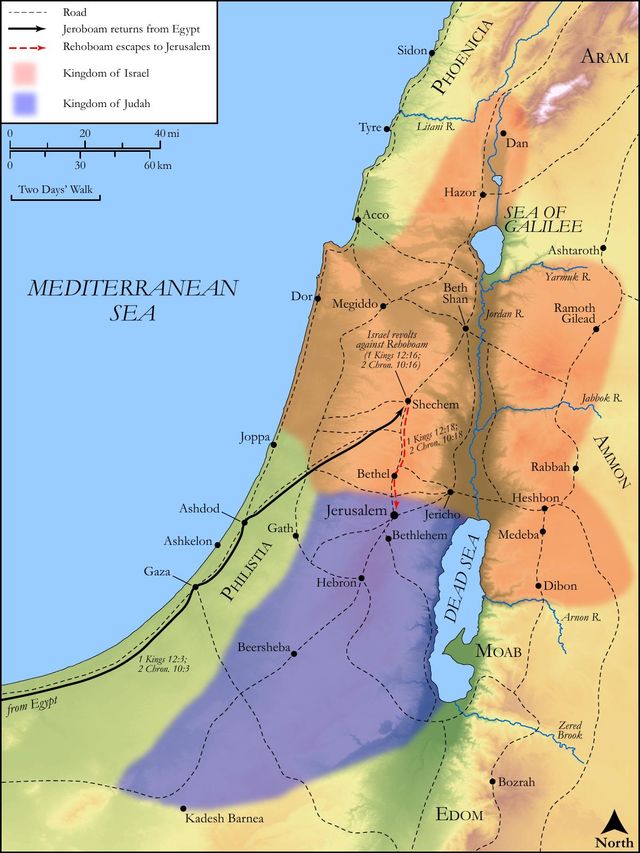
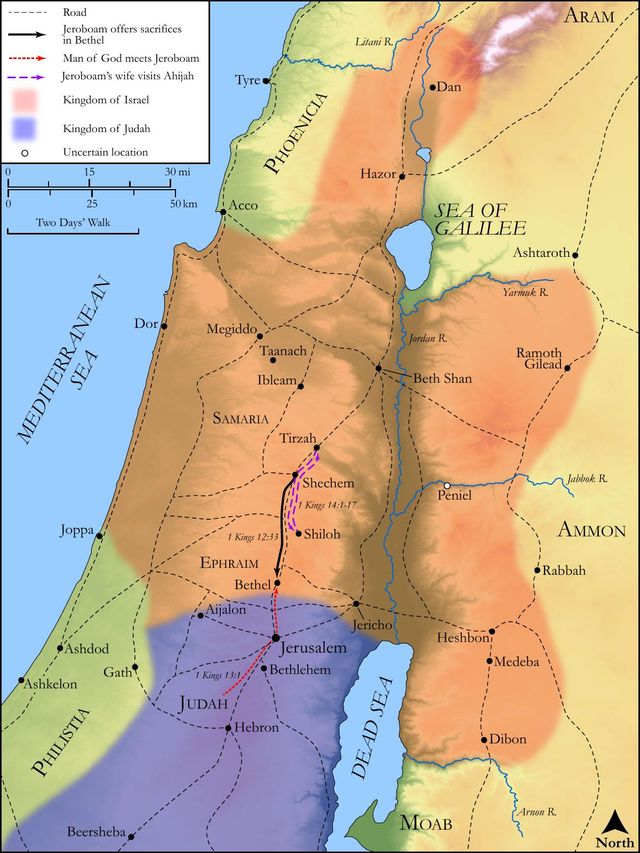
See on the biblical-era map
Study this verse
Public-domain commentary
Matthew Henry
From his Commentary on the Whole Bible. Henry comments on passages, not single verses — this entry covers 1 Kings 12:25–33. His four-level outline is real structure in the source text, so it is rendered as structure.
We have here the beginning of the reign of Jeroboam. He built Shechem first and then Penuel - beautified and fortified them, and probably had a palace in each of them for himself (Kg1 12:25), the former in Ephraim, the latter in Gad, on the other side Jordan. This might be proper; but he formed another project for the establishing of his kingdom which was fatal to the interests of religion in it.
I.That which he designed was by some effectual means to secure those to himself who had now chosen him for their king, and to prevent their return to the house of David, Kg1 12:26, Kg1 12:27. It seems,
1.He was jealous of the people, afraid that, some time or other, they would kill him and go again to Rehoboam. Many that have been advanced in one tumult have been hurled down in another. Jeroboam could not put any confidence in the affections of his people, though now they seemed extremely fond of him; for what is got by wrong and usurpation cannot be enjoyed nor kept with any security or satisfaction.
2.He was distrustful of the promise of God, could not take his word that, if he would keep close to his duty, God would build him a sure house (Kg1 11:38); but he would contrive ways and means, and sinful ones too, for his own safety. A practical disbelief of God's all-sufficiency is at the bottom of all our treacherous departures from him.
II.The way he took to do this was by keeping the people from going up to Jerusalem to worship.
That was the place God had chosen, to put his name there. Solomon's temple was there, which God had, in the sight of all Israel, and in the memory of many now living, taken solemn possession of in a cloud of glory. At the altar there the priest of the Lord attended, there all Israel were to keep the feasts, and thither they were to bring their sacrifices. Now,
1.Jeroboam apprehended that, if the people continued to do this, they would in time return to the house of David, allured by the magnificence both of the court and of the temple. If they cleave to their old religion, they will go back to their old king. We may suppose, if he had treated with Rehoboam for the safe conduct of himself and his people to and from Jerusalem at the times appointed for their solemn feasts, it would not have been denied him; therefore he fears not their being driven back by force, but their going back voluntarily to Rehoboam.
2.He therefore dissuaded them from going up to Jerusalem, pretending to consult their ease: "It is too much for you to go so far to worship God, Kg1 12:28. It is a heavy yoke, and it is time to shake it off; you have gone long enough to Jerusalem" (so some read it); "the temple, now that you are used to it, does not appear so glorious and sacred as it did at first" (sensible glories wither by degrees in men's estimation); "you have greed yourselves from other burdens, free yourselves from this: why should we now be tied to one place any more than in Samuel's time?"
3.He provided for the assistance of their devotion at home. Upon consultation with some of his politicians, he came to this resolve, to set up two golden calves, as tokens or signs of the divine presence, and persuade the people that they might as well stay at home and offer sacrifice to those as go to Jerusalem to worship before the ark: and some are so charitable as to think they were made to represent the mercy-seat and the cherubim over the ark; but more probably he adopted the idolatry of the Egyptians, in whose land he had sojourned for some time and who worshipped their god Apis under the similitude of a bull or calf.
(1.)He would not be at the charge of building a golden temple, as Solomon had done; two golden calves are the most that he can afford.
(2.)He intended, no doubt, by these to represent, or rather make present, not any false god, as Moloch or Chemosh, but the true God only, the God of Israel, the God that brought them up out of the land of Egypt, as he declares, Kg1 12:28. So that it was no violation of the first commandment, but the second. And he chose thus to engage the people's devotion because he knew there were many among them so in love with images that for the sake of the calves they would willingly quit God's temple, where all images were forbidden.
(3.)He set up two, by degrees to break people off from the belief of the unity of the godhead, which would pave the way to the polytheism of the Pagans. He set up these two at Dan and Beth-el (one the utmost border of his country northward), the other southward, as if they were the guardians and protectors of the kingdom. Beth-el lay close to Judah. He set up one there, to tempt those of Rehoboam's subjects over to him who were inclined to image-worship, in lieu of those of his subjects that would continue to go to Jerusalem. He set up the other at Dan, for the convenience of those that lay most remote, and because Micah's images had been set up there, and great veneration paid to them for many ages, Jdg 18:30, Jdg 18:31. Beth-el signifies the house of God, which gave some colour to the superstition; but the prophet called it Beth-aven, the house of vanity, or iniquity.
4.The people complied with him herein, and were fond enough of the novelty: They went to worship before the one, even unto Dan (Kg1 12:30), to that at Dan first because it was first set up, or even to that at Dan, though it lay such a great way off. Those that thought it much to go to Jerusalem, to worship God according to his institution, made no difficulty of going twice as far, to Dan, to worship him according to their own inventions. Or they are said to go to one of the calves at Dan because Abijah, king of Judah, within twenty years, recovered Beth-el (Ch2 13:19), and it is likely removed the golden calf, or forbade the use of it, and then they had only that at Dan to go to. This became a sin; and a great sin it was, against the express letter of the second commandment. God had sometimes dispensed with the law concerning worshipping in one place, but never allowed the worship of him by images. Hereby they justified their fathers in making the calf at Horeb, though God had so fully shown his displeasure against them for it and threatened to visit for it in the day of visitation (Exo 32:34), so that it was as great a contempt of God's wrath as it was of his law; and thus they added sin to sin. Bishop Patrick quotes a saying of the Jews, That till Jeroboam's time the Israelites sucked but one calf, but from that time they sucked two.
5.Having set up the gods, he fitted up accommodations for them; and wherein he varied from the divine appointment we are here told, which intimates that in other things he imitated what was done in Judah (Kg1 12:32) as well as he could. See how one error multiplied into many.
(1.)He made a house of high-places, or of altars, one temple at Dan, we may suppose, and another at Beth-el (Kg1 12:31), and in each many altars, probably complaining of it as an inconvenience that in the temple at Jerusalem there was but one. The multiplying of altars passed with some for a piece of devotion, but God, by the prophet, puts another construction upon it, Hos 8:11. Ephraim has made many altars to sin.
(2.)He made priests of the lowest of the people; and the lowest of the people were good enough to be priests to his calves, and too good. He made priests from the extremest parts of the people, that is, some out of every corner of the country, whom he ordered to reside among their neighbours, to instruct them in his appointments and reconcile them to them. Thus were they dispersed as the Levites, but were not of the sons of Levi. But the priests of the high-laces, or altars, he ordered to reside in Beth-el, as the priests at Jerusalem (Kg1 12:32), to attend the public service.
(3.)The feast of tabernacles, which God had appointed on the fifteenth day of the seventh month, he adjourned to the fifteenth day of the eighth month (Kg1 12:32), the month which he devised of his own heart, to show his power in ecclesiastical matters, Kg1 12:33. The passover and pentecost he observed in their proper season, or did not observe them at all, or with little solemnity in comparison with this.
(4.)He himself assuming a power to make priests, no marvel if he undertook to do the priests' work with his own hands: He offered upon the altar. This is twice mentioned (Kg1 12:32, Kg1 12:33), as also that he burnt incense. This was connived at in him because it was of a piece with the rest of his irregularities; but in king Uzziah it was immediately punished with the plague of leprosy. He did it himself, to make himself look great among the people and to get the reputation of a devout man, also to grace the solemnity of his new festival, with which, it is likely, at this time he joined the feast of the dedication of his altar. And thus,
[1.]Jeroboam sinned himself, yet perhaps excused himself to the world and his own conscience with this, that he did not do so ill as Solomon did, who worshipped other gods.
[2.]He made Israel to sin, drew them off from the worship of God and entailed idolatry upon their seed. And hereby they were punished for deserting the thrones of the house of David. The learned Mr. Whiston, in his chronology, for the adjusting of the annals of the two kingdoms of Judah and Israel, supposes that Jeroboam changed the calculation of the year and made it to contain but eleven months, and that by those years the reigns of the kings of Israel are measured till Jehu's revolution and no longer, so that during this interval eleven years of the annals of Judah answer to twelve in those of Israel.
Continue studying 1 Kings 12:33 across the web’s major study libraries — every link below opens this exact verse, chapter, or book on the destination site.
Read & Compare
 BibleGatewayThis verse in more than 200 translations and 70 languages.
 Bible.comThe YouVersion reader — hundreds of translations, reading plans, and highlights.
 ESV.orgCrossway's official English Standard Version reader.
 NET BibleThe NET translation with 60,000+ translators' notes on every rendering decision.
 STEP BibleTyndale House's free study tool — original text, vocabulary, and scholarly resources.
 BibliaLogos Bible Software's free web reader.
 USCCBThe New American Bible (Revised Edition) with the U.S. bishops' study notes.
Commentaries
 BibleHub CommentariesDozens of classic commentaries on this verse, gathered on one page.
 StudyLightMore than 100 commentary sets — the largest collection on the web.
 BibleRefPlain-English commentary on what this verse means, verse by verse.
 Enduring WordDavid Guzik's free commentary on this chapter, widely used by Bible teachers.
 Bible Study ToolsVerse commentary alongside Greek and Hebrew study aids.
Original Language & Research
- BibleHub InterlinearThe verse word by word — original language, transliteration, and English.
- BibleHub LexiconEvery word's original-language definition and Strong's entry.
 Blue Letter BibleDeep-study tools — Strong's numbers, concordance, and word studies.
 SefariaThe Hebrew text with Rashi and centuries of Jewish commentary.
Sermons, Hymns & Audio


TrulyRandomVerse is not affiliated with these sites and doesn’t control their content. They’re linked because they’re genuinely useful.
Summary
1 Kings 12:33 meticulously chronicles King Jeroboam's profound and deliberate departure from Yahweh's prescribed worship, marking a pivotal moment in the spiritual decline of the northern kingdom of Israel. This verse highlights his audacious act of establishing an alternative religious calendar and practice at Bethel, explicitly stating that it was "devised of his own heart," thereby solidifying a human-centered religion in direct opposition to divine command and setting a dangerous precedent for future generations of Israelite kings and their subjects.
Context
ShowHideLiterary Context
This verse serves as the culmination of Jeroboam's calculated religious innovations, strategically implemented to secure his newly established northern kingdom. Following the tumultuous division of the united monarchy, prompted by King Solomon's apostasy and Rehoboam's folly, Jeroboam, the inaugural king of Israel, harbored deep anxieties that his subjects' continued pilgrimages to Jerusalem for worship would inevitably shift their allegiance back to the Davidic dynasty in Judah (1 Kings 12:26-27). To counteract this perceived threat, he established rival cultic centers at Bethel and Dan, populating them with golden calves and declaring, "Behold thy gods, O Israel, which brought thee up out of the land of Egypt" (1 Kings 12:28-30). Further compounding his apostasy, he appointed non-Levitical priests (1 Kings 12:31). Verse 33 specifically details his ultimate act of defiance: altering the date of the annual feast, a clear imitation of the divinely appointed Feast of Tabernacles (Leviticus 23:34), from the seventh month to the eighth. The verse underscores his personal participation in this illicit worship by offering sacrifices and burning incense, setting the stage for the dramatic prophetic confrontation and condemnation of Jeroboam and his dynasty detailed in 1 Kings 13.
Historical & Cultural Context
The schism of Israel into two distinct kingdoms—Judah in the south and Israel in the north—represented a seismic political and religious upheaval. Jeroboam's actions were fundamentally driven by acute political insecurity and a desire to consolidate his power by severing any religious ties to Jerusalem, which remained the rightful capital and singular center of Yahweh worship. Bethel, chosen as one of his primary cultic sites, possessed profound historical and religious significance, having been the location of Jacob's pivotal encounter with God (Genesis 28:10-22), making its corruption particularly tragic. The Feast of Tabernacles (Sukkot) was one of the three major annual pilgrimage festivals, a cornerstone of Israelite communal life and worship, commemorating God's faithful provision during the wilderness wandering and celebrating the harvest. By unilaterally shifting its date, Jeroboam not only directly defied God's explicit command but also sought to forge a distinct, independent religious identity for the northern kingdom, effectively severing its ties to the Mosaic covenant and the Jerusalem temple. His personal act of offering sacrifices and burning incense was a blatant usurpation of the priestly role, which was strictly reserved for the Aaronic priesthood under the Mosaic Law, further highlighting his profound disregard for divine order.
Key Themes
ShowHideThe central theme permeating 1 Kings 12 and powerfully encapsulated in this verse is the stark contrast between Human-Centered Religion vs. Divine Command. Jeroboam's actions, explicitly described as "devised of his own heart," exemplify a system of worship born entirely of human ingenuity, political fear, and expediency, rather than being rooted in divine revelation. This stands in direct opposition to the precise and unalterable instructions God had given for worship in the Law of Moses, thereby emphasizing the grave sin of adding to or subtracting from God's word (Deuteronomy 12:32). Closely intertwined is the theme of Idolatry and False Worship. By constructing alternative altars, installing golden calves, appointing unauthorized priests, and now manipulating sacred time, Jeroboam systematically led Israel into direct disobedience and profound spiritual apostasy. His actions established a pervasive pattern of sin that would plague the northern kingdom throughout its history, frequently referred to as "the sin of Jeroboam" (1 Kings 14:16). Finally, the narrative powerfully illustrates the Political Motivation for Spiritual Compromise. Jeroboam's overriding fear of losing political control drove him to corrupt the worship of God, demonstrating the perilous consequences when worldly ambition dictates spiritual practices, inevitably leading to a profound compromise of faith and obedience.
Exposition and Analysis
ShowHideKey Word Analysis
ShowHideThis verb (H908) signifies to invent, contrive, fabricate, or imagine. It carries a strong connotation of human origination, often implying something made up or conceived without external (especially divine) authorization or basis. In this context, it powerfully underscores that Jeroboam's religious calendar and practices were entirely a product of his own mind and will, not a response to God's command or revelation, highlighting his self-appointed authority in matters of worship.
In Hebrew thought, the "heart" (H3820) is not merely the seat of emotion but the comprehensive core of a person's being—the center of intellect, will, moral character, and decision-making. Thus, "devised of his own heart" indicates a deliberate, calculated, and self-initiated decision on Jeroboam's part, reflecting his deepest intentions and desires, which were clearly opposed to God's revealed will and designed for his own political advantage.
While a common verb (H6213) meaning "to make" or "to do," here it signifies "to establish," "to institute," or "to appoint." Jeroboam actively and formally established this feast, giving it the appearance of legitimacy and authority, despite its complete lack of divine sanction. This highlights his attempt to usurp God's prerogative in setting the sacred calendar and defining worship for His people, asserting his own kingly power over divine law.
Verse Breakdown
ShowHide"So he offered upon the altar which he had made in Bethel"
This clause immediately establishes Jeroboam's personal and active involvement in the illicit worship. By personally offering sacrifices, he not only validated the unauthorized altar he had constructed at Bethel—a site with significant, yet now corrupted, historical ties to Jacob's encounter with God—but also directly usurped the role of the legitimate Aaronic priesthood, a grave violation of Mosaic Law. His presence lends an air of royal sanction and authority to the apostasy, drawing the people into his sin.
"the fifteenth day of the eighth month, [even] in the month which he had devised of his own heart"
This is the precise detail of Jeroboam's calendrical innovation and the crux of his defiance. The divinely appointed Feast of Tabernacles was to be observed on the fifteenth day of the seventh month (Leviticus 23:34). Jeroboam's deliberate shift to the eighth month was a clear act of defiance, a re-ordering of sacred time to suit his political agenda, and a symbolic, definitive break from the religious traditions centered in Jerusalem. The emphatic repetition of "in the month which he had devised of his own heart" powerfully underscores the human origin, self-serving nature, and lack of divine authorization for this profound change.
"and ordained a feast unto the children of Israel"
This highlights Jeroboam's comprehensive attempt to institutionalize and legitimize his new religious system for the entire northern kingdom. He wasn't merely performing a private act of worship; he was establishing a national religious holiday, compelling his subjects, the "children of Israel," to participate in his self-made religion. This act cemented the spiritual separation of Israel from Judah and, more critically, from the true worship of Yahweh, setting a pattern of national apostasy.
"and he offered upon the altar, and burnt incense"
This final phrase reiterates Jeroboam's active participation and further underscores his audacious usurpation of priestly functions. Offering sacrifices and burning incense were sacred acts, typically performed by consecrated priests (e.g., Numbers 16:40). Jeroboam's performance of these rituals demonstrates his complete disregard for God's established order, his audacious claim to religious authority that was not his to wield, and his determination to fully embody the role of a religious leader independent of divine appointment.
Literary Devices
ShowHideThe passage employs several potent literary devices to convey its message and underscore Jeroboam's profound apostasy. Repetition is evident in the phrase "offered upon the altar," which appears twice, emphasizing Jeroboam's persistent and defiant personal participation in the illicit worship. There is a strong Contrast implicit throughout the verse: Jeroboam's actions, explicitly "devised of his own heart," stand in stark opposition to the divinely ordained commands and meticulously established calendar found in the Mosaic Law (e.g., Leviticus 23). This highlights the fundamental tension between human autonomy and divine authority. The narrative also employs Foreshadowing, as Jeroboam's foundational acts of apostasy in this verse clearly predict and explain the subsequent deep-seated idolatry and spiritual decline that would characterize the northern kingdom of Israel throughout its history, ultimately leading to its destruction. Finally, there is a subtle but powerful Irony in Jeroboam's actions: he attempts to secure his political throne through religious innovation and compromise, yet these very actions ultimately lead to the downfall of his own dynasty and contribute significantly to the eventual demise of the northern kingdom itself, demonstrating the futility of defying God for worldly gain.
Theological and Thematic Connections
ShowHide1 Kings 12:33 serves as a profound theological warning against the dangers of human-centered religion and the corruption of divine truth for worldly gain. Jeroboam's sin was not merely a matter of changing a date; it was a fundamental rejection of God's sovereignty over worship and a deliberate attempt to control the spiritual lives of his people for political ends. This act profoundly illustrates the biblical principle that true worship must be defined by God's revealed will, not by human preference, convenience, or fear. When humanity attempts to "devise of its own heart" what God has already prescribed, it inevitably leads to idolatry, even if the outward forms retain a semblance of piety. This narrative underscores the absolute necessity of obedience to God's commands as the foundation of genuine faith, contrasting sharply with ritualistic performance devoid of divine authorization. It highlights the insidious nature of syncretism, where elements of true worship are blended with human inventions, ultimately distorting the very nature of God and His demands.
Reflection and Application
ShowHideThe account of Jeroboam's self-devised religion in 1 Kings 12:33 offers a timeless and sobering warning for believers today. It challenges us to critically examine our own spiritual practices, traditions, and even the underlying motivations behind our worship. Are we truly seeking to honor God according to His revealed will, or are we subtly, perhaps even unconsciously, "devising of our own heart" what is convenient, culturally palatable, or politically advantageous? This verse calls us to a radical fidelity to biblical truth, urging us to resist the temptation to tailor our faith to personal preferences, societal pressures, or pragmatic considerations. True worship is not about what feels good, what draws a crowd, or what appears to be effective in a worldly sense, but about humble submission to the Lordship of God as revealed in His Word. It compels us to ask whether our pursuit of God is truly God-centered, or if it has become a means to an end—a tool for personal comfort, social acceptance, institutional growth, or even self-justification—rather than an end in itself: the glorification of the one true God, on His terms.
Questions for Reflection
ShowHideFAQ
ShowHideWhy was changing the feast date so significant?
ShowHideChanging the feast date was profoundly significant because it represented a direct challenge to God's supreme authority and a deliberate re-ordering of sacred time. The Feast of Tabernacles, like all of Israel's divinely appointed feasts, had specific dates and rituals outlined by God Himself in the Mosaic Law (Leviticus 23). By unilaterally moving it from the seventh to the eighth month, Jeroboam was not merely adjusting a calendar; he was asserting his own prerogative over God's, severing the northern kingdom's ties to the divinely ordained liturgical calendar centered in Jerusalem, and creating a distinct, independent religious identity. This act demonstrated a complete usurpation of God's role as the one who establishes the terms of worship, indicating a deep spiritual rebellion driven by political expediency and a desire for self-sufficiency.
What does "devised of his own heart" mean for us today?
ShowHideThe phrase "devised of his own heart" serves as a powerful and enduring warning against human-centered religion in any age. For us today, it means being vigilant against spiritual practices, doctrines, or traditions that originate primarily from human desires, cultural norms, pragmatic considerations, or even well-intentioned but misguided innovations, rather than from God's revealed Word. It calls us to profound humility and submission, recognizing that true worship and genuine faith must be founded solely on divine revelation, not on what we invent, contrive, or find convenient. It challenges us to discern critically between God's unchanging truth and human innovation, ensuring that our spiritual lives are shaped by divine command and not by the dictates of our own hearts or the pressures of the world around us.
Did Jeroboam believe he was doing good?
ShowHideWhile the biblical text does not explicitly state Jeroboam's internal motivations beyond his fear of losing his kingdom (1 Kings 12:26), it is plausible that he rationalized his actions as necessary for the stability and prosperity of Israel. He may have genuinely believed his "reforms" were for the good of his people, preventing them from returning to Judah and potentially undermining his rule. However, the biblical narrative consistently portrays his actions as a profound act of rebellion against God, demonstrating that even seemingly "good" intentions, when they deviate from God's explicit commands and usurp His authority, can lead to profound sin and spiritual disaster. The text's emphasis on his actions being "devised of his own heart" highlights that his ultimate authority was himself, not God, regardless of any perceived benefits or political expediency.
Christ-Centered Fulfillment
ShowHideThe egregious sin of Jeroboam, meticulously detailed in 1 Kings 12:33, finds its ultimate contrast and fulfillment in the person and redemptive work of Jesus Christ. Jeroboam's actions represent the epitome of human-devised religion, a system born of fear, political ambition, and a blatant usurpation of divine authority, leading his people into idolatry and spiritual darkness. In stark contrast, Jesus Christ is the perfect High Priest (Hebrews 4:14-16), who did not offer sacrifices devised of His own heart, but offered Himself once for all as the spotless Lamb of God, whose perfect sacrifice truly takes away the sin of the world (Hebrews 9:11-14). Unlike Jeroboam, who arbitrarily changed God's appointed feast, Jesus Himself is the ultimate fulfillment of all the feasts and shadows of the Old Covenant, establishing a new covenant in His own blood (Luke 22:20). He teaches that true worship is not bound by specific locations or human traditions, but is to be "in spirit and truth" (John 4:23-24), entirely God-centered and Spirit-empowered. While Jeroboam sought to secure an earthly kingdom through spiritual compromise, Jesus declared, "My kingdom is not of this world" (John 18:36), demonstrating that true spiritual authority and eternal security come from divine appointment and perfect obedience, not human contrivance. As the very Word made flesh (John 1:14), Jesus is the ultimate revelation of God's will, against whom all human "devising" is exposed as futile rebellion. Through Christ, believers are called to walk in obedience to His commands (John 14:15), finding their true freedom, identity, and worship not in self-made religion, but in faithful submission to their resurrected King and High Priest.