


1 Kings 15:34
- וַיַּעַשׂvai·Ya·'asand he didH6213Conj-w ¦ V-Qal-ConsecImperf-3msVerb Qal Consecutive Imperfect 3rd Singular Masculineוַandיַּעַשׂhe did
- הָרַעha·Ra'the evilH7451Art ¦ Adj-msAdjective Singular Masculine Absoluteהָtheרַעevil
- בְּעֵינֵיbe·'ei·Neiin [the] eyes ofH5869Prep-b ¦ N-fdcNoun Dual Feminine Constructבְּinעֵינֵי[the] eyes of
- יְהוָהYah·wehYahwehH3068N-properNoun Proper Title
- וַיֵּלֶךְvai·Ye·lekhand he walkedH1980Conj-w ¦ V-Qal-ConsecImperf-3msVerb Qal Consecutive Imperfect 3rd Singular Masculineוַandיֵּלֶךְhe walked
- בְּדֶרֶךְbe·De·rekhin [the] way ofH1870Prep-b ¦ N-cscNoun Singular common gender Constructבְּinדֶרֶךְ[the] way of
- יָרָבְעָםya·ra·ve·'AmJeroboamH3379N-proper-mNoun Proper Masculine
- וּבְחַטָּאתוֹu·ve·cha·ta·Toand in his sinH2403Conj-w ¦ Prep-b ¦ N-fsc ¦ 3msNoun Singular Feminine Constructוּandבְinחַטָּאתsinוֹhis
- אֲשֶׁר'a·SherwhichH834RelParticle Relative
- הֶחֱטִיאhe·che·Ti'he caused to sinH2398V-Hiphil-Perf-3msVerb Hiphil Perfect 3rd Singular Masculine
- אֶת'et<obj.>H853DirObjMParticle Object Indicator
- יִשְׂרָאֵלYis·ra·'ElIsraelH3478N-properNoun Proper Location
English is a literal word-by-word gloss of the Hebrew, not the KJV's wording. Why?
This is the original text the KJV's translators worked from — each Hebrew word with its own literal English meaning in this verse, prepared by scholars at Tyndale House, Cambridge. The KJV translates whole sentences, not word by word, so its wording differs: one Hebrew word can become several English words, and the KJV may choose “the LORD” where the gloss reads “Yahweh”. Both are faithful — they answer different questions. For the KJV's own rendering, switch to the KJV text.
Details
See on the biblical-era map
Study this verse
Public-domain commentary
Matthew Henry
From his Commentary on the Whole Bible. Henry comments on passages, not single verses — this entry covers 1 Kings 15:25–34.
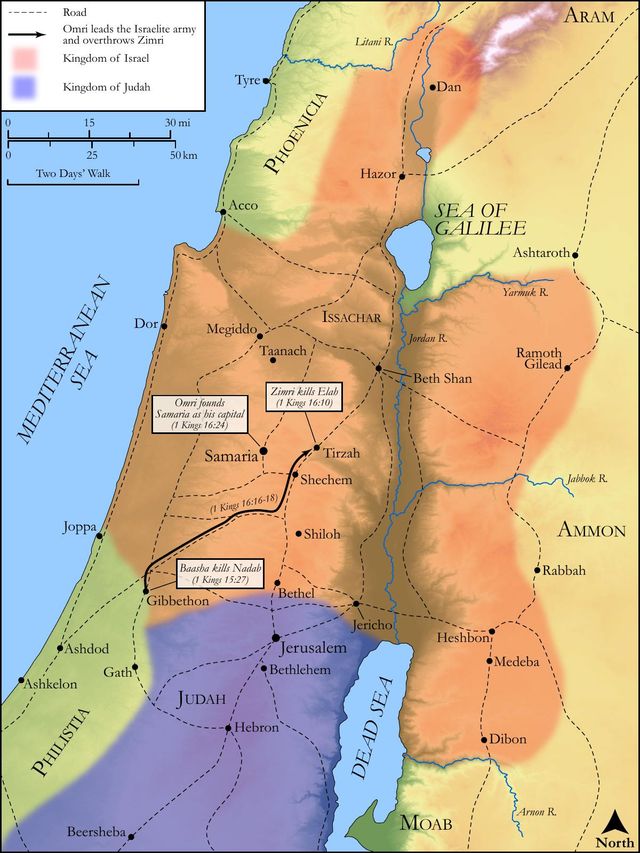
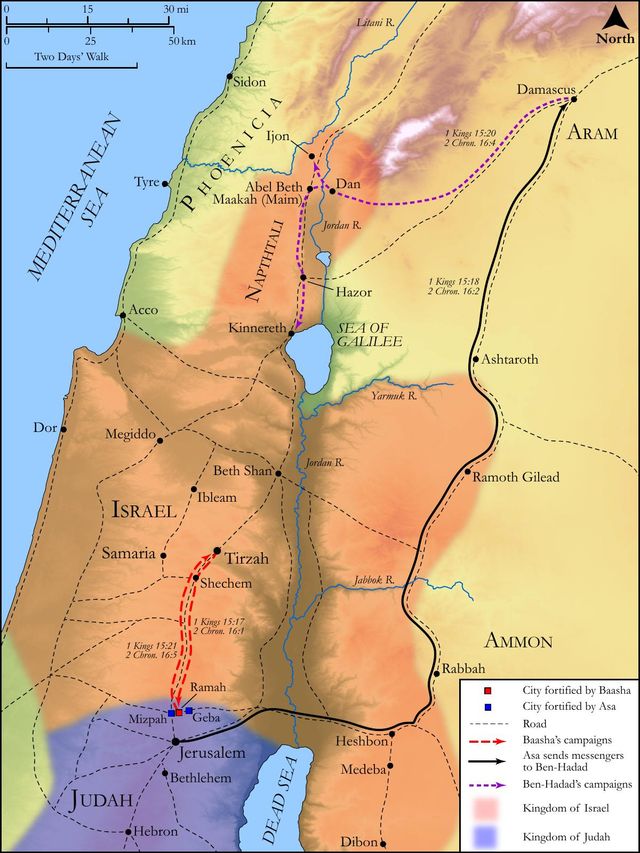
We are now to take a view of the miserable state of Israel, while the kingdom of Judah was happy under Asa's good government. It was threatened that they should be as a reed shaken in the water (Kg1 14:15), and so they were, when, during the single reign of Asa, the government of their kingdom was in six or seven different hands, as we find in this and the following chapter. Jeroboam was upon the throne in the beginning of his reign and Ahab at the end of it, and between them were Nadab, Baasha, Elah, Zimri, Tibni, and Omri, undermining and destroying one another. This they got by deserting the house both of God and of David. Here we have, 1. The ruin and extirpation of the family of Jeroboam, according to the word of the Lord by Ahijah. His son Nadab succeeded him. If the death of his brother Abijah had had a due influence upon him to make him religious, and the honour done him at his death had engaged him to follow his good example, his reign might have been long and glorious; but he walked in the way of his father (Kg1 15:26), kept up the worship of his calves, and forbade his subjects to go up to Jerusalem to worship, sinned and made Israel to sin, and therefore God brought ruin upon him quickly, in the second year of his reign. He was besieging Gibbethon, a city which the Philistines had taken from the Danites, and was endeavouring to re-take it; and there, in the midst of his army, did Baasha, with others, conspire against him and kill him, (Kg1 15:27), and so little interest had he in the affections of his people that his army did not only not avenge his death, but chose his murderer for his successor. Whether Baasha did it upon a personal pique against Nadab, or to be avenged on the house of Jeroboam for some affront received from them, or whether under pretence of freeing his country from the tyranny of a bad prince, or whether merely from a principle of ambition, to make way for himself to the throne, does not appear; but he slew him and reigned in his stead, Kg1 15:28. And the first thing he did when he came to the crown was to cut off all the house of Jeroboam, that he might the better secure himself and his own usurped government. He thought it not enough to imprison or banish them, but he destroyed them, left not only no males (as was foretold, Kg1 14:10), but none that breathed. Herein he was barbarous, but God was righteous. Jeroboam's sin was punished (Kg1 15:30); for those that provoke God do it to their own confusion; see Jer 7:19. Ahijah's prophecy was accomplished (Kg1 15:29); for no word of God shall fall to the ground. Divine threatenings are not bugbears. 2. The elevation of Baasha. He shall be tried awhile, as Jeroboam was. Twenty-four years he reigned (Kg1 15:33), but showed that it was not from any dislike to Jeroboam's sin that he destroyed his family, but from malice and ambition; for, when he had rooted out the sinner, he himself clave to the sin, and walked in the way of Jeroboam (Kg1 15:34), though he had seen the end of that way; so strangely was his heart hardened with the deceitfulness of sin.
Continue studying 1 Kings 15:34 across the web’s major study libraries — every link below opens this exact verse, chapter, or book on the destination site.
Read & Compare
 BibleGatewayThis verse in more than 200 translations and 70 languages.
 Bible.comThe YouVersion reader — hundreds of translations, reading plans, and highlights.
 ESV.orgCrossway's official English Standard Version reader.
 NET BibleThe NET translation with 60,000+ translators' notes on every rendering decision.
 STEP BibleTyndale House's free study tool — original text, vocabulary, and scholarly resources.
 BibliaLogos Bible Software's free web reader.
 USCCBThe New American Bible (Revised Edition) with the U.S. bishops' study notes.
Commentaries
 BibleHub CommentariesDozens of classic commentaries on this verse, gathered on one page.
 StudyLightMore than 100 commentary sets — the largest collection on the web.
 BibleRefPlain-English commentary on what this verse means, verse by verse.
 Enduring WordDavid Guzik's free commentary on this chapter, widely used by Bible teachers.
 Bible Study ToolsVerse commentary alongside Greek and Hebrew study aids.
Original Language & Research
- BibleHub InterlinearThe verse word by word — original language, transliteration, and English.
- BibleHub LexiconEvery word's original-language definition and Strong's entry.
 Blue Letter BibleDeep-study tools — Strong's numbers, concordance, and word studies.
 SefariaThe Hebrew text with Rashi and centuries of Jewish commentary.
Sermons, Hymns & Audio


TrulyRandomVerse is not affiliated with these sites and doesn’t control their content. They’re linked because they’re genuinely useful.
Summary
First Kings 15:34 delivers a concise yet damning divine verdict on the reign of King Baasha of Israel, unequivocally stating that he perpetuated the spiritual apostasy initiated by Jeroboam I. Despite being God's chosen instrument to dismantle Jeroboam's wicked dynasty, Baasha himself failed to turn the nation from idolatry, instead embracing the very sins that led to his predecessor's downfall. This verse powerfully underscores the insidious nature of corporate sin, the profound accountability of leadership before God, and the LORD's unwavering condemnation of any deviation from His covenantal commands, particularly the exclusive worship of His name.
Context
ShowHideLiterary Context
This verse functions as the definitive concluding assessment of Baasha's twenty-four-year reign, a standard formulaic judgment found throughout the Books of Kings for evaluating each monarch's fidelity to God. It immediately follows the statement of his reign's duration in 1 Kings 15:33. Baasha's rise to power, detailed earlier in the chapter, involved the assassination of Nadab, Jeroboam's son, and the complete annihilation of Jeroboam's household, thereby fulfilling the prophecy delivered by Ahijah the Shilonite in 1 Kings 14:10-11. The irony is stark: Baasha executed God's judgment on a sinful dynasty, only to embrace the very sin that brought about its demise. The subsequent chapter, 1 Kings 16, opens with a prophetic word from Jehu, son of Hanani, pronouncing judgment on Baasha's own house for his persistent sin, mirroring the fate of Jeroboam. The recurring phrase "the way of Jeroboam" serves as a crucial literary motif, highlighting the persistent spiritual rebellion that plagued the Northern Kingdom's leadership.
Historical & Cultural Context
King Baasha ruled the Northern Kingdom of Israel from approximately 909 to 886 BC. This kingdom had been established after the division of the united monarchy following King Solomon's death. Jeroboam I, Israel's first king, had strategically set up golden calves in Dan and Bethel (1 Kings 12:28-30) as alternative worship sites to Jerusalem, aiming to prevent his subjects from returning to the Davidic dynasty in Judah for religious observances. This politically motivated act became the foundational sin of the Northern Kingdom, leading to widespread idolatry, syncretism, and a corrupted priesthood. Culturally, this represented a profound and direct violation of the Mosaic covenant, which unequivocally forbade idolatry and commanded exclusive worship of the LORD at the central sanctuary. Baasha, despite witnessing the divine judgment against Jeroboam's house for this precise sin, chose to continue these apostate practices, demonstrating a deep-seated spiritual rebellion and a tragic absence of true repentance or reform within the nation's highest leadership.
Key Themes
ShowHideFirst Kings 15:34 significantly contributes to several overarching themes found throughout 1 Kings. Foremost is the sovereignty of God, evident in Baasha's unwitting role as an instrument of divine judgment against Jeroboam's house, even as he himself falls under similar condemnation. The verse powerfully illustrates the corrupting influence of idolatry and the perpetuation of sin across generations, where "the way of Jeroboam" becomes a persistent indictment against successive kings. It underscores the critical theme of leadership accountability, emphasizing that kings were judged not merely on their personal piety or political success, but primarily on their responsibility for the spiritual direction and fidelity of the nation to God's covenant. The consistent divine assessment of kings' actions as "doing evil in the sight of the LORD" highlights God's unwavering moral standards and His demand for exclusive worship, as foundational to the Ten Commandments. Ultimately, the verse foreshadows the inevitable consequences of persistent disobedience, setting the stage for the eventual downfall and exile of the Northern Kingdom due a cycle of unrepentant idolatry.
Exposition and Analysis
ShowHideKey Word Analysis
ShowHideThis term (H7451), frequently used in the Old Testament, describes actions or conditions that are morally bad, wicked, or inherently displeasing in God's eyes. When applied to kings, it signifies a fundamental failure to uphold covenant obligations, particularly regarding the exclusive worship of the LORD and adherence to His laws. It denotes a deep spiritual and ethical corruption, representing not merely a minor transgression but a profound rebellion against divine standards and the very nature of God.
This verb (H3212), often translated "walked," is used idiomatically in Hebrew to refer to one's manner of life, conduct, or habitual practice. To "walk in the way of Jeroboam" means to consistently follow, adopt, and embody Jeroboam's pattern of behavior, specifically his religious policies and idolatrous practices. It implies a deliberate, sustained commitment to a particular path, in this case, one of spiritual deviation and apostasy from the true worship of God.
The root verb châṭâʼ (H2398) primarily means "to miss" a mark, and figuratively, "to sin." When used in the Hiphil (causative) stem, as it is here, it means "to cause to sin," "to lead into sin," or "to make guilty." This is a severe indictment, indicating that Jeroboam, and subsequently Baasha, were not merely engaging in personal transgression but actively leading the entire nation of Israel into corporate sin and idolatry. It underscores the profound and destructive influence of leadership in shaping the spiritual trajectory and accountability of a people before God.
Verse Breakdown
ShowHide"And he did evil in the sight of the LORD"
This is a standard, declarative theological assessment in the Books of Kings, indicating that Baasha's reign was characterized by actions, policies, and a general conduct that were morally and spiritually offensive to God. It signifies a profound departure from the covenant relationship and God's holy standards, particularly concerning the exclusive worship of Him. This phrase establishes the divine perspective on his rule, overriding any human or political success he might have achieved, and setting the stage for divine judgment.
"and walked in the way of Jeroboam"
This clause specifies the precise nature of Baasha's evil, providing the historical and theological context for his condemnation. The "way of Jeroboam" refers to the specific religious innovations introduced by Jeroboam I: the establishment of golden calves in Dan and Bethel as alternative worship sites to Jerusalem, along with the institution of a non-Levitical priesthood and unauthorized festivals. Baasha's adoption of this "way" signifies his allegiance to this false system of worship, perpetuating the foundational sin and spiritual rebellion of the Northern Kingdom.
"and in his sin wherewith he made Israel to sin"
This final phrase emphasizes the devastating corporate impact of Baasha's leadership. It highlights that his sin was not merely personal but had a widespread, corrosive effect on the entire nation. Just as Jeroboam had done, Baasha actively led the people into transgression, causing them to incur collective guilt and divine judgment. This underscores the severe responsibility of those in authority, whose choices can lead an entire populace away from God and into idolatry, with dire spiritual and historical consequences.
Literary Devices
ShowHideFirst Kings 15:34 employs several potent literary devices to convey its theological message. The most prominent is Repetition, specifically the recurring phrase "the way of Jeroboam," which functions as a powerful literary shorthand throughout the Books of Kings. This phrase consistently denotes the persistent idolatry, spiritual rebellion, and covenant infidelity of the Northern Kingdom, underscoring the cyclical nature of sin and the failure of successive kings to break free from this destructive pattern. The verse also utilizes Formulaic Language ("did evil in the sight of the LORD"), which provides a consistent divine judgment against each king, establishing a clear moral and theological framework for evaluating their reigns against God's standards. Furthermore, the Causative Verb in "made Israel to sin" (from the Hiphil stem of châṭâʼ) highlights the active and destructive agency of the king's leadership. This linguistic device emphasizes the profound responsibility of those in power to either lead their people toward righteousness or away from it, with severe spiritual consequences. Finally, the verse functions as Foreshadowing, subtly hinting at the inevitable downfall of the Northern Kingdom due to its unyielding adherence to the "way of Jeroboam."
Theological and Thematic Connections
ShowHideFirst Kings 15:34 powerfully illustrates the profound theological truth that God holds leaders supremely accountable, not only for their personal actions but also for the spiritual direction and moral trajectory they impart to their people. Baasha's condemnation for "walking in the way of Jeroboam" and "making Israel to sin" reveals God's unwavering opposition to idolatry and any form of worship that deviates from His divinely prescribed commands. It highlights the enduring and destructive legacy of corporate sin, where the choices of one generation can establish a pattern of disobedience that ensnares subsequent generations, leading to cumulative guilt and judgment. This verse serves as a sober reminder that God's judgment is impartial and just, falling upon all who persist in rebellion against His covenant, regardless of their political power, initial role in divine plans, or perceived successes in human terms.
Reflection and Application
ShowHideThe stark condemnation of King Baasha in 1 Kings 15:34 offers profound and enduring lessons for contemporary believers and leaders alike. It challenges us to critically examine the traditions, norms, and established practices we inherit, ensuring they align faithfully with God's revealed truth rather than merely perpetuating past errors or convenient deviations. The "way of Jeroboam" serves as a timeless archetype for any deviation from God's explicit commands, whether through overt idolatry, subtle syncretism, or prioritizing human expediency and political gain over divine revelation. This verse serves as a potent reminder of the immense responsibility that accompanies leadership, whether in the church, family, community, or workplace. Those in positions of influence are called not only to cultivate personal integrity but also to actively and intentionally guide those under their care toward righteousness, understanding that their choices can profoundly impact the spiritual trajectory and eternal destiny of others. Ultimately, 1 Kings 15:34 calls each individual to a deep sense of personal accountability, urging us to cultivate a discerning heart that prioritizes God's will and exclusive worship above all else, even when it means standing against prevailing cultural or religious currents. Our ultimate allegiance must be to the LORD alone, for He is the righteous Judge of both kings and commoners.
Questions for Reflection
ShowHideFAQ
ShowHideWhat was the "sin of Jeroboam" that Baasha perpetuated?
ShowHideThe "sin of Jeroboam" refers fundamentally to the establishment of alternative worship centers in Dan and Bethel, where Jeroboam I set up golden calves for the people of the Northern Kingdom to worship. His intention was to prevent his subjects from traveling to Jerusalem to worship the LORD, thereby securing his political kingdom by severing their ties to the Davidic dynasty in Judah. This act was a direct and egregious violation of the first two commandments (Exodus 20:3-5) and the explicit command to worship exclusively at the central sanctuary in Jerusalem (Deuteronomy 12:5-14). While politically expedient, Jeroboam's actions led to widespread idolatry, syncretism, and a corrupted priesthood, fundamentally undermining Israel's covenant relationship with God. Baasha, despite being the instrument of divine judgment against Jeroboam's house for this very sin, tragically continued these apostate practices, thus perpetuating the spiritual rebellion that defined the Northern Kingdom.
Christ-Centered Fulfillment
ShowHideThe relentless cycle of sin and judgment detailed in the Books of Kings, powerfully epitomized by Baasha's continuation of "the way of Jeroboam," profoundly underscores humanity's desperate need for a perfect King and a definitive, once-for-all solution to the problem of sin. The recurring divine indictment, "did evil in the sight of the LORD," highlights the inherent inability of any human king, even those used by God for specific purposes, to truly lead His people in consistent righteousness and covenant fidelity. This pervasive narrative points forward with prophetic urgency to Jesus Christ, the ultimate and eternal King, who alone perfectly fulfilled God's will and never "walked in the way" of sin or led His people astray. Unlike earthly kings who "made Israel to sin," Jesus came precisely to "take away the sin of the world" (John 1:29) and to lead His people in truth, grace, and righteousness. He is the true Shepherd who lays down His life for His sheep (John 10:11), not leading them into idolatry or spiritual compromise, but guiding them into abundant and eternal life. Through His atoning sacrifice on the cross and His glorious resurrection, Christ breaks the power of inherited sin patterns and the dominion of death, offering forgiveness, reconciliation, and the indwelling Holy Spirit to empower believers to "walk in newness of life" (Romans 6:4)—a profound and liberating contrast to the destructive "way of Jeroboam." His kingdom is not of this world, nor is it established by political maneuvering or idolatry, but by divine power and truth, offering true freedom from the dominion of sin and darkness (Colossians 1:13-14).