


2 Kings 3:2
Bible text: King James Version (1769 Blayney text) · Public domain
Bible text: Berean Standard Bible · Public domain
Bible text: American Standard Version (1901) · Public domain
Bible text: World English Bible, Messianic edition · Public domain
Bible text: Geneva Bible (1599) · Public domain
Bible text: Young's Literal Translation · Public domain
- וַיַּעֲשֶׂהvai·ya·'a·Sehand he didH6213Conj-w ¦ V-Qal-ConsecImperf-3msVerb Qal Consecutive Imperfect 3rd Singular Masculineוַandיַּעֲשֶׂהhe did
- הָרַעha·Ra'the evilH7451Art ¦ Adj-msAdjective Singular Masculine Absoluteהָtheרַעevil
- בְּעֵינֵיbe·'ei·Neiin [the] eyes ofH5869Prep-b ¦ N-fdcNoun Dual Feminine Constructבְּinעֵינֵי[the] eyes of
- יְהוָהYah·wehYahwehH3068N-properNoun Proper Title
- רַקrakonlyH7535AdvAdverb
- לֹאlo'notH3808NegParticle Negative
- כְאָבִיוkhe·'a·Vivlike his fatherH1Prep-k ¦ N-msc ¦ 3msNoun Singular Masculine Constructכְlikeאָבִיfatherוhis
- וּכְאִמּוֹu·khe·'i·Moand like his motherH517Conj-w ¦ Prep-k ¦ N-fsc ¦ 3msNoun Singular Feminine Constructוּandכְlikeאִמּmotherוֹhis
- וַיָּסַרvai·Ya·sarand he removedH5493Conj-w ¦ V-Hiphil-ConsecImperf-3msVerb Hiphil Consecutive Imperfect 3rd Singular Masculineוַandיָּסַרhe removed
- אֶת'et<obj.>H853DirObjMParticle Object Indicator
- מַצְּבַתma·tze·Vat[the] sacred pillar ofH4676N-fscNoun Singular Feminine Construct
- הַבַּעַלha·Ba·'al<the> BaalH1168Art ¦ N-msNoun Title Singular Masculine Absoluteהַ<the>בַּעַלBaal
- אֲשֶׁר'a·SherwhichH834RelParticle Relative
- עָשָׂה'a·Sahhe had madeH6213V-Qal-Perf-3msVerb Qal Perfect 3rd Singular Masculine
- אָבִיו'a·Vivhis fatherH1N-msc ¦ 3msNoun Singular Masculine Constructאָבִיfatherוhis
English is a literal word-by-word gloss of the Hebrew, not the KJV's wording. Why?
This is the original text the KJV's translators worked from — each Hebrew word with its own literal English meaning in this verse, prepared by scholars at Tyndale House, Cambridge. The KJV translates whole sentences, not word by word, so its wording differs: one Hebrew word can become several English words, and the KJV may choose “the LORD” where the gloss reads “Yahweh”. Both are faithful — they answer different questions. For the KJV's own rendering, switch to the KJV text.
Details
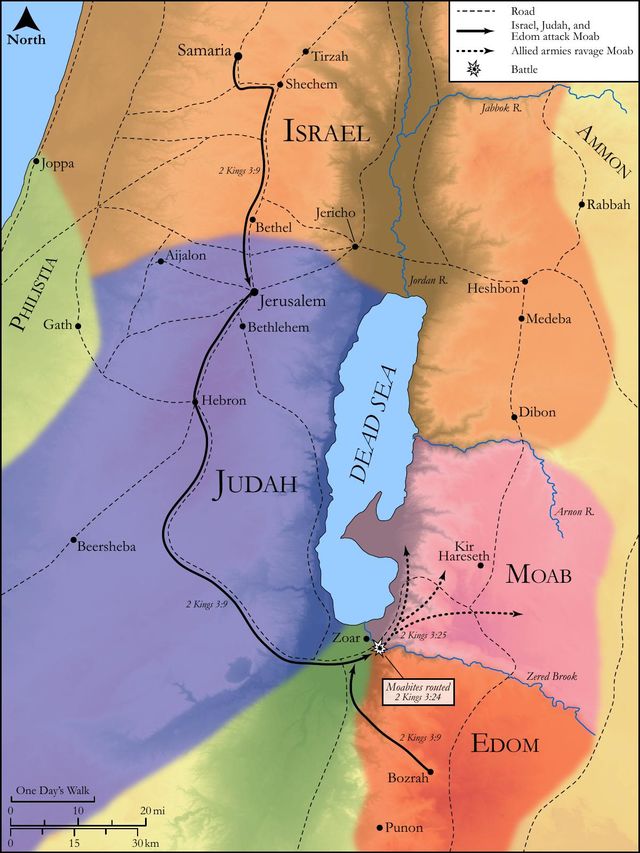
See on the biblical-era map
Study this verse
Public-domain commentary
Matthew Henry
From his Commentary on the Whole Bible. Henry comments on passages, not single verses — this entry covers 2 Kings 3:1–5. His two-level outline is real structure in the source text, so it is rendered as structure.
Jehoram, the son of Ahab, and brother of Ahaziah, is here upon the throne of Israel; and, though he was but a bad man, yet two commendable things are here recorded of him: -
I.That he removed his father's idols.
He did evil in many things, but not like his father Ahab or his mother Jezebel, Kg2 3:2. Bad he was, but not so bad, so overmuch wicked, as Solomon speaks, Ecc 7:17. Perhaps Jehoshaphat, though by his alliance with the house of Ahab he made his own family worse, did something towards making Ahab's better. Jehoram saw his father and brother cut off for worshipping Baal, and wisely took warning by God's judgments on them, and put away the image of Baal, resolving to worship the God of Israel only, and consult none but his prophets. So far was well, yet it did not prevent the destruction of Ahab's family, nay, that destruction came in his days, and fell immediately upon him (Kg2 9:24), though he was one of the best of the family, for then the measure of its iniquity was full. Jehoram's reformation was next to none; for,
1.He only put away the image of Baal which his father had made, and this probably in compliment to Jehoshaphat, who otherwise would not have come into confederacy with him, any more than with his brother, Kg1 22:49. But he did not destroy the worship of Baal among the people, for Jehu found it prevalent, Kg2 10:19. It was well to reform his family, but it was not enough; he ought to have used his power for the reforming of his kingdom.
2.When he put away the image of Baal, he adhered to the worship of the calves, that politic sin of Jeroboam, Kg2 3:3. He departed not therefrom, because that was the state engine by which the division between the two tribes was supported. Those do not truly, nor acceptably, repent or reform, who only part with the sins that they lose by, but continue their affection to the sins that they get by.
3.He only put away the image of Baal, he did not break it in pieces, as he ought to have done. He laid it aside for the present, yet not knowing but he might have occasion for it another time; and Jezebel, for reasons of state, was content to worship her Baal in private.
II.That he did what he could to recover his brother's losses.
As he had something more of the religion of an Israelite than his father, so he had something more of the spirit of a king than his brother. Moab rebelled against Israel, immediately upon the death of Ahab, Kg2 1:1. And we do not find that Ahaziah made any attempt to chastise or reduce them, but tamely let go his interest in them, rather than entertain the cares, undergo the fatigues, and run the hazards, of a war with them. His folly and pusillanimity herein, and his indifference to the public good, were the more aggravated because the tribute which the king of Moab paid was a very considerable branch of the revenue of the crown of Israel: 100,000 lambs, and 100,000 wethers, Kg2 3:4. The riches of kings then lay more in cattle than coin, and they thought it not below them to know the state of their flocks and herds themselves, because, as Solomon observes, the crown doth not endure to every generation, Pro 27:23, Pro 27:24. Taxes were then paid not so much in money as in the commodities of the country, which was an ease to the subject, whether it was an advantage to the prince or no. The revolt of Moab was a great loss to Israel, yet Ahaziah sat still in sloth and ease. But an upper chamber in his house proved as fatal to him as the high places of the field could have been (Kg2 1:2), and the breaking of his lattice let into his throne a man of the more active genius, that would not lose the dominion of Moab without making at least one push for its preservation.
Continue studying 2 Kings 3:2 across the web’s major study libraries — every link below opens this exact verse, chapter, or book on the destination site.
Read & Compare
 BibleGatewayThis verse in more than 200 translations and 70 languages.
 Bible.comThe YouVersion reader — hundreds of translations, reading plans, and highlights.
 ESV.orgCrossway's official English Standard Version reader.
 NET BibleThe NET translation with 60,000+ translators' notes on every rendering decision.
 STEP BibleTyndale House's free study tool — original text, vocabulary, and scholarly resources.
 BibliaLogos Bible Software's free web reader.
 USCCBThe New American Bible (Revised Edition) with the U.S. bishops' study notes.
Commentaries
 BibleHub CommentariesDozens of classic commentaries on this verse, gathered on one page.
 StudyLightMore than 100 commentary sets — the largest collection on the web.
 BibleRefPlain-English commentary on what this verse means, verse by verse.
 Enduring WordDavid Guzik's free commentary on this chapter, widely used by Bible teachers.
 Bible Study ToolsVerse commentary alongside Greek and Hebrew study aids.
Original Language & Research
- BibleHub InterlinearThe verse word by word — original language, transliteration, and English.
- BibleHub LexiconEvery word's original-language definition and Strong's entry.
 Blue Letter BibleDeep-study tools — Strong's numbers, concordance, and word studies.
 SefariaThe Hebrew text with Rashi and centuries of Jewish commentary.
Sermons, Hymns & Audio


TrulyRandomVerse is not affiliated with these sites and doesn’t control their content. They’re linked because they’re genuinely useful.
Summary
Second Kings 3:2 introduces Jehoram, king of Israel, with an immediate divine assessment of his reign. While he is unequivocally condemned for doing "evil in the sight of the LORD," the text provides a crucial distinction: his wickedness was not as profound or pervasive as that of his infamously idolatrous parents, Ahab and Jezebel. This relative improvement is specifically attributed to his removal of the "image of Baal" that his father had previously erected, signaling a partial, yet ultimately insufficient, step away from the extreme apostasy that had characterized the Northern Kingdom's leadership.
Context
ShowHideLiterary Context
This verse serves as the immediate introduction to Jehoram's reign, following the brief account of his brother Ahaziah's death (2 Kings 1:18-2:25). As is characteristic of the Deuteronomistic History (Joshua-Kings), each monarch's reign begins with a theological evaluation, primarily based on their faithfulness to the Mosaic covenant, particularly regarding exclusive worship of the LORD and the eradication of idolatry. Jehoram, as the second son of Ahab and Jezebel to rule, is explicitly compared to his parents, whose unparalleled wickedness is meticulously detailed in 1 Kings 16:29-33. The statement that Ahab "did more evil in the sight of the LORD than all who were before him" (1 Kings 16:30) establishes the benchmark against which Jehoram is measured. Thus, 2 Kings 3:2 functions as a critical theological lens through which Jehoram's subsequent actions, including his military campaign against Moab (2 Kings 3:4-27) and his interactions with the prophet Elisha, will be understood, highlighting both his continuity with and deviation from his family's spiritual legacy.
Historical & Cultural Context
Jehoram reigned over the Northern Kingdom of Israel from approximately 852 to 841 BC, a period marked by significant political instability and deep-seated religious syncretism. His parents, King Ahab and Queen Jezebel, had aggressively promoted the worship of Baal, a prominent Canaanite storm and fertility deity, effectively making it the state religion and actively persecuting the prophets of Yahweh. This era saw the widespread construction of temples and altars dedicated to Baal, as well as the erection of "images" or cultic pillars (matzevot) like the one mentioned in this verse. The "image of Baal" (Hebrew: matzevah haba'al) was likely a large, often phallic, standing stone or pillar, central to Baal worship rituals, symbolizing the god's presence and power. Jehoram's decision to remove this specific image, while a positive religious step, may also have been a pragmatic political maneuver. It could have been an attempt to appease the influential Yahwistic faction within Israel or to stabilize his rule after the tumultuous reigns of his father and brother. Crucially, this action did not signify a complete return to the exclusive worship of the LORD, as other forms of idolatry, particularly the golden calf worship established by Jeroboam I at Bethel and Dan, remained deeply entrenched in Israelite religious practice (2 Kings 10:29).
Key Themes
ShowHideThis verse introduces and reinforces several crucial themes prevalent throughout the books of Kings and the broader Old Testament narrative. Firstly, it highlights the theme of Partial Reformation vs. Complete Obedience. Jehoram's act of removing the Baal image represents a commendable, yet ultimately incomplete, step towards religious reform. While he avoided the egregious state-sponsored Baalism of his parents, he did not fully eradicate idolatry or commit to the exclusive worship of the LORD, demonstrating that partial obedience is still considered "evil in the sight of the LORD." Secondly, the verse underscores the concept of Degrees of Evil. Although all sin is an affront to God, the text acknowledges that some forms of wickedness are more severe or pervasive than others. Jehoram's evil was "not like his father, and like his mother," suggesting a hierarchy of sinfulness in God's judgment, even if all fall short of His perfect standard. This nuance reflects God's precise evaluation of human actions. Finally, the verse reinforces the overarching theme of Covenant Faithfulness and Idolatry. The kings of Israel and Judah are consistently judged by their adherence to the covenant stipulations, particularly the first two commandments against other gods and idolatry (Exodus 20:3-5). Jehoram's failure to fully turn to the LORD demonstrates the persistent challenge of idolatry in Israel and the divine expectation of wholehearted devotion, as articulated in passages like Deuteronomy 6:5.
Exposition and Analysis
ShowHideKey Word Analysis
ShowHideThis idiomatic phrase, frequently used in the books of Kings and Chronicles, functions as a theological verdict on the reign of a monarch. It signifies that the king's actions, policies, and overall conduct were contrary to the LORD's revealed will and covenant demands. The term raʻ (evil) encompasses moral wickedness, spiritual apostasy (especially idolatry), and often, the resulting societal injustice or distress. For a king, "wrought evil" implies a failure to lead the nation in righteousness and faithfulness to God, leading to divine displeasure and judgment.
This term refers to Ahab, Jehoram's biological father, but also carries the broader connotation of a progenitor or source of influence. In this context, it highlights the direct lineage and the spiritual legacy that Jehoram inherited. Ahab's reign was characterized by unprecedented promotion of Baal worship, making him the benchmark for extreme idolatry against which Jehoram's actions are compared.
This term refers to Jezebel, Jehoram's biological mother, a Phoenician princess who was a zealous proponent of Baal worship and a persecutor of the LORD's prophets. Her influence was profound and notoriously wicked, often driving Ahab to greater acts of apostasy. The inclusion of "mother" alongside "father" emphasizes the joint and pervasive nature of the idolatrous environment from which Jehoram emerged, underscoring the depth of the spiritual corruption he was associated with.
The Hebrew word matstsêbâh specifically denotes a standing stone, pillar, or monument. In a cultic context, it refers to a sacred pillar, often an obelisk or stele, erected as an object of worship or a symbol of a deity's presence. When combined with "Baal," it unequivocally identifies a cultic pillar dedicated to the Canaanite storm god Baal. These images were central to Baal worship, serving as focal points for rituals, sacrifices, and prayers. Jehoram's act of removing it was a direct assault on the physical infrastructure of pagan worship and a symbolic rejection of the deity it represented, distinguishing his reign from his parents' zealous promotion of Baalism.
Verse Breakdown
ShowHide"And he wrought evil in the sight of the LORD;"
This opening clause delivers the primary divine judgment on Jehoram's reign, immediately establishing his spiritual standing. Despite any political or military achievements, his actions and policies were fundamentally contrary to God's righteous standards and covenant expectations for the king of Israel. The phrase "in the sight of the LORD" underscores that God is the ultimate, omniscient judge, evaluating the king's heart, motives, and public actions based on His perfect knowledge and holiness, not merely human opinion or political expediency.
"but not like his father, and like his mother:"
This crucial qualifying clause introduces a significant distinction, providing a comparative, albeit still negative, assessment. While Jehoram was indeed deemed evil, his wickedness did not reach the extreme depths of his parents, Ahab and Jezebel, whose reign was characterized by unprecedented state-sponsored idolatry, active persecution of the LORD's prophets, and a complete embrace of Baalism. This indicates a degree of mitigation or a less aggressive promotion of apostasy, acknowledging that there can be varying levels of unfaithfulness in God's eyes, even if all fall short of His perfect standard.
"for he put away the image of Baal that his father had made."
This final clause provides the specific, concrete action that serves as the basis for the distinction noted in the previous phrase. Jehoram's act of removing the cultic pillar dedicated to Baal, which Ahab had erected, marked a significant departure from his father's zealous promotion of Baal worship. This action, while not leading to full repentance or a complete return to the LORD, demonstrated a willingness to dismantle a major symbol of the most egregious form of idolatry that had plagued the Northern Kingdom. It was a visible, public step away from the absolute religious apostasy of his immediate predecessors, signifying a partial, yet incomplete, reform.
Literary Devices
ShowHideThe verse effectively employs Contrast to highlight Jehoram's character. His evil is directly contrasted with the even greater evil of his parents, Ahab and Jezebel, creating a nuanced portrait of his reign. This contrast is further emphasized by the Understatement "but not like his father, and like his mother," which subtly points to a significant, though partial, improvement in religious policy. The "image of Baal" serves as powerful Symbolism of the deep-seated idolatry that permeated Israel under Ahab, and its removal symbolizes Jehoram's attempt, however incomplete, to distance himself from that legacy. The narrative also uses Foreshadowing, as Jehoram's partial reform hints at the ongoing spiritual struggle within Israel between fidelity to the LORD and the persistent allure of pagan practices, setting the stage for future prophetic confrontations and divine judgments throughout the book of Kings.
Theological and Thematic Connections
ShowHide2 Kings 3:2 offers profound insights into the nature of sin, God's judgment, and the call to wholehearted devotion. It reveals that while God acknowledges degrees of evil, even a "lesser" evil is still evil in His sight. Jehoram's partial reform, though commendable in its specific action (removing the Baal image), ultimately fell short because it did not lead to a complete turning of the heart to the LORD. This illustrates that true righteousness is not merely the absence of the most egregious sins, but the active pursuit of God's will and exclusive worship. The verse underscores the consistent biblical demand for absolute loyalty to God, warning against syncretism or lukewarm faith. It reminds us that external changes, while important, must stem from or lead to internal transformation; otherwise, they remain insufficient in God's eyes, failing to meet the divine standard of perfect holiness and devotion.
Reflection and Application
ShowHideJehoram's story in 2 Kings 3:2 serves as a timeless cautionary tale for believers today, challenging us to examine our own lives for areas where we might be engaging in "partial obedience." It's easy to remove obvious "images of Baal"—gross sins, destructive habits, or clear idolatries—while still harboring other forms of compromise or failing to fully commit our hearts to God. We might compare ourselves to others who seem "worse" and feel justified, but God's standard is not relative; it is absolute holiness and wholehearted devotion. This verse calls us beyond merely avoiding the worst forms of evil to actively pursuing righteousness, seeking to love the Lord our God with all our heart, soul, mind, and strength. What "images of Baal" might still subtly occupy a place in our lives, perhaps in the form of misplaced affections, unholy ambitions, unconfessed sins, or even good things that have become ultimate things, preventing us from experiencing the fullness of God's blessing and walking in complete surrender?
Questions for Reflection
ShowHideFAQ
ShowHideWhy was Jehoram's removal of the Baal image not enough for him to be considered "good" in the sight of the LORD?
ShowHideJehoram's removal of the Baal image was a significant step away from the extreme state-sponsored idolatry of his parents, Ahab and Jezebel. However, it was not enough because it did not signify a full return to the exclusive worship of the LORD as commanded in the Mosaic covenant. The text implies that other forms of idolatry, particularly the calf worship established by Jeroboam I (1 Kings 12:28-30), remained entrenched in Israel. To be considered "good" in the sight of the LORD, a king of Israel needed to eradicate all idolatry and lead the people in wholehearted devotion to God alone, as exemplified by kings like Hezekiah or Josiah in Judah (2 Kings 18:3-6 and 2 Kings 23:25). Jehoram's reform was partial, external, and did not lead to a complete transformation of the nation's spiritual life or a full commitment to the LORD.
What does it mean for a king to "wrought evil in the sight of the LORD"?
ShowHideThis phrase is a standard theological judgment used repeatedly in the books of Kings and Chronicles, indicating that a king's reign and actions were contrary to God's revealed will and covenant demands. It represents a divine assessment, not merely a human or political one. For the kings of Israel, "wrought evil" primarily referred to their failure to uphold the first two commandments – worshipping the LORD alone and avoiding idolatry (Exodus 20:3-5). It also encompassed other covenant violations such as injustice, oppression, or failing to trust God in military and political affairs. In Jehoram's case, while he removed the most egregious symbol of Baal worship, his continued tolerance of other idolatrous practices meant he was still leading the nation away from true worship, thus "wrought evil" in God's eyes.
Christ-Centered Fulfillment
ShowHideJehoram's partial reform and the divine verdict that he still "wrought evil in the sight of the LORD" powerfully illustrate humanity's inherent inability to achieve true righteousness through self-effort or incomplete obedience. His removal of the Baal image was a positive external act, yet it could not atone for the deeper spiritual brokenness or fully reconcile Israel to God. This human limitation points directly to the necessity of Christ. Where Jehoram offered a partial and insufficient reform, Jesus Christ offered a perfect and complete fulfillment of God's law and a radical cleansing from all sin. He is the one who perfectly obeyed the Father (Hebrews 4:15), and through His atoning sacrifice, He removes not just the "image of Baal" but the very root of idolatry and sin from the human heart (Colossians 2:13-14). Unlike Jehoram's external and limited reform, Christ's work brings about an internal transformation, empowering believers through the indwelling Holy Spirit to live in true, wholehearted obedience to God, fulfilling the promise of a new covenant where God's law is written on hearts (Jeremiah 31:33 and Ezekiel 36:26-27). In Christ, we find not merely a lesser evil, but the perfect righteousness and complete deliverance from all forms of spiritual idolatry, enabling us to truly worship God in spirit and truth (John 4:24).