


2 Kings 23:25
Bible text: King James Version (1769 Blayney text) · Public domain
Bible text: King James Version with Strong's numbers · Public domain
Bible text: Berean Standard Bible · Public domain
Bible text: American Standard Version (1901) · Public domain
Bible text: World English Bible, Messianic edition · Public domain
Bible text: Geneva Bible (1599) · Public domain
Bible text: Young's Literal Translation · Public domain
- וְכָמֹהוּve·kha·mo·Huand like himH3644Conj-w ¦ Prep ¦ 3msPrepositionוְandכָמֹlikeהוּhim
- לֹאlo'notH3808NegParticle Negative
- הָיָהha·Yahhe had beenH1961V-Qal-Perf-3msVerb Qal Perfect 3rd Singular Masculine
- לְפָנָיוle·fa·Nav<to> before himH6440Prep-l ¦ N-mpc ¦ 3msNoun Plural Masculine Constructלְ<to>פָנָיbeforeוhim
- מֶלֶךְMe·lekha kingH4428N-msNoun Singular Masculine Absolute
- אֲשֶׁר'a·SherwhoH834RelParticle Relative
- שָׁבshavhe turned backH7725V-Qal-Perf-3msVerb Qal Perfect 3rd Singular Masculine
- אֶל'eltoH413PrepPreposition
- יְהוָהYah·wehYahwehH3068N-properNoun Proper Title
- בְּכָלbe·kholwith allH3605Prep-b ¦ N-mscNoun Singular Masculine Constructבְּwithכָלall
- לְבָבוֹle·va·Vohis heartH3824N-msc ¦ 3msNoun Singular Masculine Constructלְבָבheartוֹhis
- וּבְכָלu·ve·Kholand with allH3605Conj-w ¦ Prep-b ¦ N-mscNoun Singular Masculine Constructוּandבְwithכָלall
- נַפְשׁוֹnaf·Shohis beingH5315N-fsc ¦ 3msNoun Singular Feminine Constructנַפְשׁbeingוֹhis
- וּבְכָלu·ve·Kholand with allH3605Conj-w ¦ Prep-b ¦ N-mscNoun Singular Masculine Constructוּandבְwithכָלall
- מְאֹדוֹme·'o·Dohis strengthH3966Adj-msc ¦ 3msAdjective Numerical Singular Masculine Constructמְאֹדstrengthוֹhis
- כְּכֹלke·Kholaccording to allH3605Prep-k ¦ N-mscNoun Singular Masculine Constructכְּaccording toכֹלall
- תּוֹרַתto·Rat[the] law ofH8451N-fscNoun Singular Feminine Construct
- מֹשֶׁהmo·ShehMosesH4872N-proper-mNoun Proper Masculine
- וְאַחֲרָיוve·'a·cha·Ravand after himH310Conj-w ¦ Adj-mpc ¦ 3msAdjective Numerical Plural Masculine Constructוְandאַחֲרָיafterוhim
- לֹאlo'notH3808NegParticle Negative
- קָםkamhe aroseH6965V-Qal-Perf-3msVerb Qal Perfect 3rd Singular Masculine
- כָּמֹהוּka·Mo·hulike himH3644Prep ¦ 3msPrepositionכָּמֹlikeהוּhim
English is a literal word-by-word gloss of the Hebrew, not the KJV's wording. Why?
This is the original text the KJV's translators worked from — each Hebrew word with its own literal English meaning in this verse, prepared by scholars at Tyndale House, Cambridge. The KJV translates whole sentences, not word by word, so its wording differs: one Hebrew word can become several English words, and the KJV may choose “the LORD” where the gloss reads “Yahweh”. Both are faithful — they answer different questions. For the KJV's own rendering, switch to the KJV text.
Details
See on the biblical-era maps
Study this verse
Public-domain commentary
Matthew Henry
From his Commentary on the Whole Bible. Henry comments on passages, not single verses — this entry covers 2 Kings 23:25–30. His three-level outline is real structure in the source text, so it is rendered as structure.
Upon the reading of these verses we must say, Lord, though thy righteousness be as the great mountains - evident, conspicuous, and past dispute, yet thy judgments are a great deep, unfathomable and past finding out, Psa 36:6. What shall we say to this?
I.It is here owned that Josiah was one of the best kings that ever sat upon the throne of David, Kg2 23:25.
As Hezekiah was a non-such for faith and dependence upon God in straits (Kg2 18:5), so Josiah was a non-such for sincerity and zeal in carrying on a work of reformation. For this there was none like him,
1.That he turned to the Lord from whom his fathers had revolted. It is true religion to turn to God as one we have chosen and love. He did what he could to turn his kingdom also to the Lord.
2.That he did this with his heart and soul; his affections and aims were right in what he did. Those make nothing of their religion that do not make heart-work of it.
3.That he did it with all his heart, and all his soul, and all his might - with vigour, and courage, and resolution: he could not otherwise have broken through the difficulties he had to grapple with. What great things may we bring to pass in the service of God if we be but lively and hearty in it!
4.That he did this according to all the law of Moses, in an exact observance of that law and with an actual regard to it. His zeal did not transport him into any irregularities, but, in all he did, he walked by rule.
II.Notwithstanding this he was cut off by a violent death in the midst of his days, and his kingdom was ruined within a few years after.
Consequent upon such a reformation as this, one would have expected nothing but the prosperity and glory both of king and kingdom; but, quite contrary, we find both under a cloud.
1.Even the reformed kingdom continues marked for ruin. For all this (Kg2 23:26) the Lord turned not from the fierceness of his great wrath. That is certainly true, which God spoke by the prophet (Jer 18:7, Jer 18:8), that if a nation, doomed to destruction, turn from the evil of sin, God will repent of the evil of punishment; and therefore we must conclude that Josiah's people, though they submitted to Josiah's power, did not heartily imbibe Josiah's principles. They were turned by force, and did not voluntarily turn from their evil way, but still continued their affection for their idols; and therefore he that knows men's hearts would not recall the sentence, which was, That Judah should be removed, as Israel had been, and Jerusalem itself cast off, Kg2 23:27. Yet even this destruction was intended to be their effectual reformation; so that we must say, not only that the criminals had filled their measure and were ripe for ruin, but also that the disease had come to a crisis, and was ready for a cure; and this shall be all the fruit, even the taking away of sin.
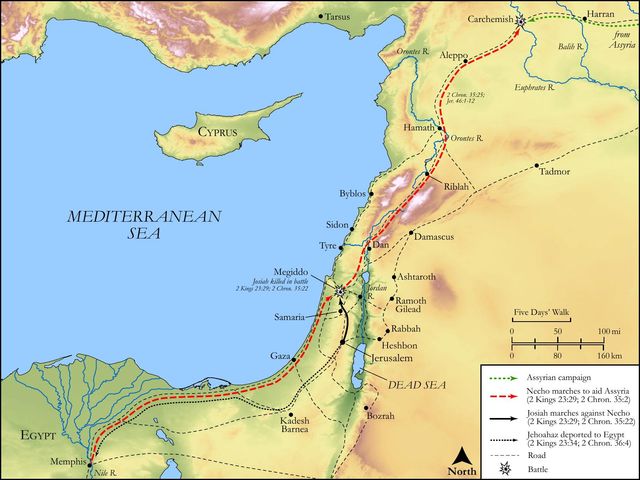
2.As an evidence of this, even the reforming king is cut off in the midst of his usefulness - in mercy to him, that he might not see the evil which was coming upon his kingdom, but in wrath to his people, for his death was an inlet to their desolations. The king of Egypt waged war, it seems, with the king of Assyria: so the king of Babylon is now called. Josiah's kingdom lay between them. He therefore thought himself concerned to oppose the king of Egypt, and check the growing, threatening, greatness of his power; for though, at this time, he protested that he had no design against Josiah, yet, if he should prevail to unite the river of Egypt and the river Euphrates, the land of Judah would soon be overflowed between them. Therefore Josiah went against him, and was killed in the first engagement, Kg2 23:29, Kg2 23:30. Here,
(1.)We cannot justify Josiah's conduct. He had no clear call to engage in this war, nor do we find that he asked counsel of God by urim or prophets concerning it. What had he to do to appear and act as a friend and ally to the king of Assyria? Should he help the ungodly and love those that hate the Lord? If the kings of Egypt and Assyria quarrelled, he had reason to think God would bring good out of it to him and his people, by making them instrumental to weaken one another. Some understand the promise made to him that he should come to his grave in peace in a sense in which it was not performed because, by his miscarriage in this matter, he forfeited the benefit of it. God has promised to keep us in all our ways; but, if we go out of our way, we throw ourselves out of his protection. I understand the promise so as that I believe it was fulfilled, for he died in peace with God and his own conscience, and saw not, nor had any immediate prospect of, the destruction of Judah and Jerusalem by the Chaldeans; yet I understand the providence to be a rebuke to him for his rashness.
(2.)We must adore God's righteousness in taking away such a jewel from an unthankful people that knew not how to value it. They greatly lamented his death (Ch2 35:25), urged to it by Jeremiah, who told them the meaning of it, and what a threatening omen it was; but they had not made a due improvement of the mercies they enjoyed by his life, of which God taught them the worth by the want.
Historical interpretation
Historical reception
1 surviving comment on this verse from the historical church.
Nobody must think that anything was detracted to the celerity of death because of one’s merits. Enoch was kidnapped, lest malice might spoil his heart, and Josiah, who celebrated the Passover of the Lord in the eighteenth year of his reign in such a manner that he overcame in piousness all the previous kings, did not survive longer through the merits of his faith. No, rather, because grievous destruction threatened the Jewish people, the just king was taken away beforehand. I fear that you, too, were snatched away from us because of some offense on our part, so that, as a just person, you might escape in the eighteenth year of your reign the bitterness of impending evil.
Continue studying 2 Kings 23:25 across the web’s major study libraries — every link below opens this exact verse, chapter, or book on the destination site.
Read & Compare
 BibleGatewayThis verse in more than 200 translations and 70 languages.
 Bible.comThe YouVersion reader — hundreds of translations, reading plans, and highlights.
 ESV.orgCrossway's official English Standard Version reader.
 NET BibleThe NET translation with 60,000+ translators' notes on every rendering decision.
 STEP BibleTyndale House's free study tool — original text, vocabulary, and scholarly resources.
 BibliaLogos Bible Software's free web reader.
 USCCBThe New American Bible (Revised Edition) with the U.S. bishops' study notes.
Commentaries
 BibleHub CommentariesDozens of classic commentaries on this verse, gathered on one page.
 StudyLightMore than 100 commentary sets — the largest collection on the web.
 BibleRefPlain-English commentary on what this verse means, verse by verse.
 Enduring WordDavid Guzik's free commentary on this chapter, widely used by Bible teachers.
 Bible Study ToolsVerse commentary alongside Greek and Hebrew study aids.
Original Language & Research
- BibleHub InterlinearThe verse word by word — original language, transliteration, and English.
- BibleHub LexiconEvery word's original-language definition and Strong's entry.
 Blue Letter BibleDeep-study tools — Strong's numbers, concordance, and word studies.
 SefariaThe Hebrew text with Rashi and centuries of Jewish commentary.
Sermons, Hymns & Audio


TrulyRandomVerse is not affiliated with these sites and doesn’t control their content. They’re linked because they’re genuinely useful.
Summary
2 Kings 23:25 serves as a profound epitaph for King Josiah, declaring him an unparalleled monarch in Judah's history. This verse commends his singular devotion to the LORD, characterized by a complete and unreserved turning to God with all his heart, soul, and might, meticulously aligning his reign with the entirety of the Law of Moses. It highlights his exceptional commitment to covenant principles, setting him apart from all kings who preceded or succeeded him, amidst generations of spiritual decline and idolatry.
Context
ShowHideLiterary Context
2 Kings 23:25 opens the closing summary of the extensive account of Josiah's reign and reforms, which began in 2 Kings 22. The preceding chapters detail his ascension at age eight, the pivotal discovery of the Book of the Law in the Temple, his immediate and profound repentance, and the subsequent nationwide purge of idolatry. This verse acts as a summarizing commendation, a divine verdict on the quality of his kingship, immediately preceding the brief account of his death and the swift decline of Judah under his successors. It stands as a stark contrast to the wickedness of his grandfather Manasseh, whose reign is detailed in 2 Kings 21:1-18, and his father Amon, whose brief and wicked reign is found in 2 Kings 21:19-26, underscoring the unique nature of Josiah's devotion.
Historical & Cultural Context
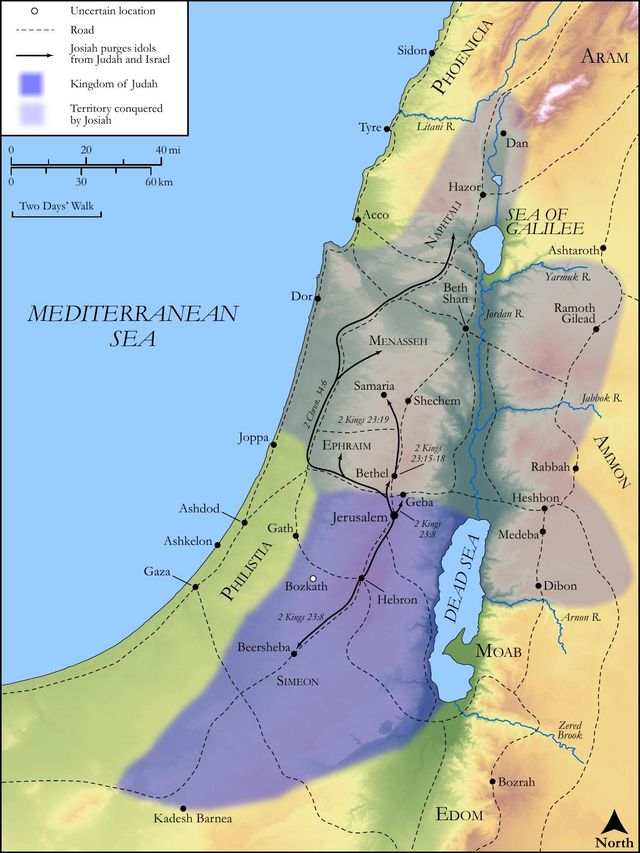
Josiah reigned during a period of significant geopolitical flux (c. 640-609 BC). The dominant Assyrian Empire, which had long exerted control over Judah, was in decline, creating a power vacuum that allowed Josiah greater autonomy to implement his reforms without immediate imperial interference. Judah itself had been steeped in syncretism and idolatry for generations, with pagan altars, astral worship, and even child sacrifice becoming entrenched practices, even within the Temple precincts, as seen in 2 Kings 21:3-7. Josiah's reforms were not merely religious but also political and social, aiming to restore Judah's national identity and covenant relationship with Yahweh, as prescribed by the Mosaic Law, particularly as found throughout Deuteronomy. His actions represented a radical break from the established idolatrous norms and a bold attempt to re-center the nation on its foundational covenant.
Key Themes
ShowHideThis verse powerfully encapsulates several key themes central to the book of Kings and the broader Deuteronomistic history. It highlights the theme of covenant faithfulness, emphasizing Josiah's adherence to "all the law of Moses," a direct response to the covenant stipulations laid out in Deuteronomy 6:5. The concept of wholehearted devotion—"with all his heart, and with all his soul, and with all his might"—is presented as the pinnacle of true worship, echoing the Shema and serving as a divine commendation of his sincerity. Furthermore, the verse underscores the impact of righteous leadership, demonstrating how one king's profound commitment could instigate a widespread, albeit temporary, spiritual reformation within the nation, as detailed in 2 Kings 23:4-20. Ultimately, it speaks to the divine standard of kingship, portraying Josiah as the ideal monarch who truly "turned to the LORD," a standard unmatched by any other ruler in the divided monarchy.
Exposition and Analysis
ShowHideKey Word Analysis
ShowHideThis verb signifies "to turn back (hence, away) transitively or intransitively, literally or figuratively," often carrying the meaning of "repent" or "return." In 2 Kings 23:25, it denotes a radical and decisive reorientation of Josiah's entire being and his kingdom's policies back to the LORD. This implies not just a change of behavior but a profound internal shift, a turning away from the idolatry and apostasy of his predecessors and a full return to covenant obedience. It is an active, volitional turning, demonstrating a deep personal commitment.
This word refers to "the heart (as the most interior organ)," encompassing the mind, will, intellect, and moral character. To turn with all one's heart means to engage one's entire cognitive and volitional faculties in devotion to God, making decisions and shaping intentions according to His will. It signifies an unreserved, intelligent, and deliberate commitment that arises from the deepest part of one's being.
This term properly denotes "vehemence," implying "wholly, speedily, etc." and often used as an intensive or superlative. In the context of "loving God with all your might," it encompasses one's resources, strength, energy, and intensity. For a king, this would include the full application of his royal power, influence, and resources towards God's purposes. Josiah's devotion was not passive but active, energetic, and comprehensive in its application of all his capacities.
Verse Breakdown
ShowHide"And like unto him was there no king before him"
This opening clause immediately sets Josiah apart, establishing his unique standing among all the kings of Judah and Israel who preceded him. It serves as a superlative commendation, highlighting the exceptional nature of his reign compared to even the most righteous kings like David or Hezekiah, in terms of the depth and scope of his turning to the LORD.
"that turned to the LORD with all his heart, and with all his soul, and with all his might"
This is the core description of Josiah's unparalleled devotion. It directly echoes the language of the Shema from Deuteronomy 6:5, the foundational command to love God comprehensively. "Heart" refers to intellect and will, "soul" to life and being, and "might" to all one's resources and strength. This tri-fold emphasis signifies a total, unreserved, and holistic commitment to God, encompassing every aspect of his person and kingship.
"according to all the law of Moses"
This phrase clarifies the standard and basis of Josiah's turning. His devotion was not arbitrary or self-defined but was meticulously aligned with the revealed will of God as contained in the Mosaic Law. This demonstrates his profound reverence for God's Word and his commitment to restoring national life in strict adherence to divine commands, particularly following the discovery of the Book of the Law.
"neither after him arose there [any] like him"
This concluding clause reinforces Josiah's singular status, extending the commendation beyond his predecessors to include all future kings of Judah. It underscores the tragic reality that despite his profound reforms, no subsequent king matched his level of devotion, signaling the irreversible spiritual decline that would lead to Judah's exile. This statement serves as a final, definitive divine judgment on the kings of Judah.
Literary Devices
ShowHideThe verse employs several powerful literary devices to convey Josiah's unique stature. Hyperbole (or perhaps more accurately, superlative language) is evident in the repeated "no king before him... neither after him arose there any like him," which functions as an emphatic declaration of his unparalleled righteousness. This strong commendation from the narrator (and implicitly, from God) elevates Josiah above all other monarchs. There is a clear allusion or echo to Deuteronomy 6:5, where the language "with all his heart, and with all his soul, and with all his might" is first commanded, demonstrating that Josiah uniquely embodied this foundational covenant injunction. Furthermore, the verse uses contrast by implicitly comparing Josiah's comprehensive devotion to the partial or flawed obedience of other kings, highlighting his exceptionalism against a backdrop of widespread spiritual failure.
Theological and Thematic Connections
ShowHide2 Kings 23:25 is a theological anchor, emphasizing that true devotion to God is characterized by wholehearted, comprehensive commitment and unwavering obedience to His revealed Word. Josiah's example illustrates the profound biblical truth that genuine repentance and turning to the LORD must engage the entirety of one's being—intellect, emotion, will, and strength—and must be measured against the objective standard of God's Law. His reign, though ultimately unable to avert Judah's judgment, stands as a powerful testament to the ideal of covenant faithfulness and the transformative potential of a leader fully surrendered to God's will. It underscores the divine expectation for human rulers and, by extension, for all believers, to love and obey God without reservation.
Reflection and Application
ShowHideJosiah's unparalleled devotion in 2 Kings 23:25 offers a timeless blueprint for authentic faith and leadership. In a world often characterized by divided loyalties and superficial commitments, Josiah's example challenges us to examine the depth of our own "turning to the LORD." Are we engaging our whole heart, mind, and strength in our relationship with God, or are we holding back portions of our lives? Like Josiah, who responded radically to the discovery of God's Word, we are called to allow Scripture to profoundly impact us, leading to genuine repentance and transformative obedience. His story reminds us that even one individual's sincere and comprehensive commitment to God can initiate significant spiritual renewal, first in our own lives, and then potentially ripple outward to influence families, communities, and even nations. It sets a high, yet attainable, standard for what it means to truly follow the LORD, emphasizing that true righteousness is not merely outward conformity but an inner disposition of complete, unreserved devotion to God and His commands.
Questions for Reflection
ShowHideFAQ
ShowHideWhy is Josiah considered so unique among the kings of Judah and Israel?
ShowHideJosiah is deemed unique because, according to 2 Kings 23:25, no king before or after him demonstrated the same comprehensive and unreserved devotion to the LORD. While other kings like David or Hezekiah were righteous, the biblical narrative highlights Josiah's singular commitment to "all the law of Moses" with "all his heart, and with all his soul, and with all his might." This level of obedience was not only personal but also manifested in a sweeping national reformation, purging the land of idolatry and restoring covenant worship, a feat unmatched in its scope and sincerity by any other monarch.
What was the "Law of Moses" that Josiah followed so strictly?
ShowHideThe "Law of Moses" refers to the Torah, the first five books of the Hebrew Bible (Genesis, Exodus, Leviticus, Numbers, Deuteronomy). The specific "Book of the Law" discovered during the Temple repairs, as mentioned in 2 Kings 22:8, is widely believed by scholars to have been a copy of Deuteronomy, or at least a significant portion of it. This book contains the covenant stipulations, laws, blessings, and curses that formed the basis of Israel's relationship with God. Josiah's strict adherence meant he meticulously implemented its commands regarding worship, justice, and the eradication of idolatry, as detailed throughout 2 Kings 23.
Did Josiah's reforms bring lasting change to Judah?
ShowHideWhile Josiah's reforms were profound and comprehensive, bringing about a significant spiritual revival during his lifetime, the change was ultimately temporary for the nation as a whole. The verse itself hints at this by stating "neither after him arose there any like him," indicating that his successors did not maintain his level of devotion. After Josiah's death in battle, recorded in 2 Kings 23:29, Judah quickly reverted to idolatry and disobedience, leading to its eventual downfall and exile to Babylon, as tragically foreshadowed in 2 Kings 23:26-27. This highlights the truth that true, lasting spiritual transformation must be deeply rooted in the hearts of individuals, not merely enforced by a righteous leader.
Christ-Centered Fulfillment
ShowHideKing Josiah, in his unparalleled devotion and obedience to the Law, serves as a significant type and shadow pointing to the ultimate, perfect King, Jesus Christ. While Josiah "turned to the LORD with all his heart, and with all his soul, and with all his might" and meticulously followed "all the law of Moses," his obedience, though exceptional, remained imperfect and ultimately could not secure lasting redemption for his people. He foreshadows Christ, who perfectly embodies the Shema's command, loving God with an absolute, unblemished devotion that transcends human capacity. Jesus did not merely turn to the LORD; He is the LORD, perfectly united with the Father, and His entire life was one of flawless obedience to God's will, even to the point of death on the cross, as described in Philippians 2:8. Unlike Josiah, who could only bring about a temporary reformation, Christ's perfect obedience and atoning sacrifice establish a new covenant that brings about a permanent, internal transformation in the hearts of His people, as promised in Hebrews 8:10. He is the true King who fulfills the Law not by merely adhering to it, but by embodying its very essence and bringing its redemptive purposes to completion, as He declared in Matthew 5:17. Through Him, believers are empowered by the Holy Spirit to genuinely turn to the Lord with a new heart, fulfilling the spirit of the Law that Josiah so earnestly pursued, and living out the radical devotion exemplified by the perfect King.