


2 Kings 23:3
Bible text: King James Version (1769 Blayney text) · Public domain
Bible text: King James Version with Strong's numbers · Public domain
Bible text: Berean Standard Bible · Public domain
Bible text: American Standard Version (1901) · Public domain
Bible text: World English Bible, Messianic edition · Public domain
Bible text: Geneva Bible (1599) · Public domain
Bible text: Young's Literal Translation · Public domain
- וַיַּעֲמֹדvai·ya·'a·Modand he stoodH5975Conj-w ¦ V-Qal-ConsecImperf-3msVerb Qal Consecutive Imperfect 3rd Singular Masculineוַandיַּעֲמֹדhe stood
- הַמֶּלֶךְHa·Me·lekhthe kingH4428Art ¦ N-msNoun Singular Masculine Absoluteהַtheמֶּלֶךְking
- עַל'alatH5921PrepPreposition
- הָעַמּוּדha·'a·Mudthe pillarH5982Art ¦ N-msNoun Singular Masculine Absoluteהָtheעַמּוּדpillar
- וַיִּכְרֹתvai·yikh·Rotand he madeH3772Conj-w ¦ V-Qal-ConsecImperf-3msVerb Qal Consecutive Imperfect 3rd Singular Masculineוַandיִּכְרֹתhe made
- אֶת'et<obj.>H853DirObjMParticle Object Indicator
- הַבְּרִיתha·be·Ritthe covenantH1285Art ¦ N-fsNoun Singular Feminine Absoluteהַtheבְּרִיתcovenant
- לִפְנֵיlif·Nei<to> beforeH6440Prep-l ¦ N-mpcNoun Plural Masculine Constructלִ<to>פְנֵיbefore
- יְהוָהYah·wehYahwehH3068N-properNoun Proper Title
- לָלֶכֶתla·Le·khetto walkH1980Prep-l ¦ V-Qal-InfVerb Qal Infinitive Constructלָtoלֶכֶתwalk
- אַחַר'a·CharafterH310Adj-mscAdjective Numerical Singular Masculine Construct
- יְהוָהYah·wehYahwehH3068N-properNoun Proper Title
- וְלִשְׁמֹרve·lish·Morand to keepH8104Conj-w ¦ Prep-l ¦ V-Qal-InfVerb Qal Infinitive Constructוְandלִtoשְׁמֹרkeep
- מִצְוֹתָיוmitz·vo·Tavhis commandmentsH4687N-fpc ¦ 3msNoun Plural Feminine Constructמִצְוֹתָיcommandmentsוhis
- וְאֶתve·'Etand <obj.>H853Conj-w ¦ DirObjMParticle Object Indicatorוְandאֶת<obj.>
- עֵדְוֹתָיו'e·de·vo·Tavhis testimoniesH5715N-fpc ¦ 3msNoun Plural Feminine Constructעֵדְוֹתָיtestimoniesוhis
- וְאֶתve·'Etand <obj.>H853Conj-w ¦ DirObjMParticle Object Indicatorוְandאֶת<obj.>
- חֻקֹּתָיוchu·ko·Tavhis statutesH2708N-fpc ¦ 3msNoun Plural Feminine Constructחֻקֹּתָיstatutesוhis
- בְּכָלbe·kholwith allH3605Prep-b ¦ N-mscNoun Singular Masculine Constructבְּwithכָלall
- לֵבlevheartH3820N-msNoun Singular Masculine Absolute
- וּבְכָלu·ve·Kholand with allH3605Conj-w ¦ Prep-b ¦ N-mscNoun Singular Masculine Constructוּandבְwithכָלall
- נֶפֶשׁNe·feshbeingH5315N-fsNoun Singular Feminine Absolute
- לְהָקִיםle·ha·Kimto establishH6965Prep-l ¦ V-Hiphil-InfVerb Hiphil Infinitive Constructלְtoהָקִיםestablish
- אֶת'et<obj.>H853DirObjMParticle Object Indicator
- דִּבְרֵיdiv·Rei[the] words ofH1697N-mpcNoun Plural Masculine Construct
- הַבְּרִיתha·be·Ritthe covenantH1285Art ¦ N-fsNoun Singular Feminine Absoluteהַtheבְּרִיתcovenant
- הַזֹּאתha·Zot<the> thisH2063Art ¦ PrtParticle Demonstrativeהַ<the>זֹּאתthis
- הַכְּתֻבִיםha·ke·tu·Vimwhich were writtenH3789Art ¦ V-Qal-PassPrtcpl-mpVerb Qal Participle Passive Plural Masculine Absoluteהַwhichכְּתֻבִיםwere written
- עַל'alonH5921PrepPreposition
- הַסֵּפֶרha·Se·ferthe scrollH5612Art ¦ N-msNoun Singular Masculine Absoluteהַtheסֵּפֶרscroll
- הַזֶּהha·Zeh<the> thisH2088Art ¦ PrtParticle Demonstrativeהַ<the>זֶּהthis
- וַיַּעֲמֹדvai·ya·'a·Modand it took its standH5975Conj-w ¦ V-Qal-ConsecImperf-3msVerb Qal Consecutive Imperfect 3rd Singular Masculineוַandיַּעֲמֹדit took its stand
- כָּלkolallH3605N-mscNoun Singular Masculine Construct
- הָעָםha·'Amthe peopleH5971Art ¦ N-msNoun Singular Masculine Absoluteהָtheעָםpeople
- בַּבְּרִיתba·be·Ritin the covenantH1285Prep-b ¦ N-fsNoun Singular Feminine Absoluteבַּin theבְּרִיתcovenant
English is a literal word-by-word gloss of the Hebrew, not the KJV's wording. Why?
This is the original text the KJV's translators worked from — each Hebrew word with its own literal English meaning in this verse, prepared by scholars at Tyndale House, Cambridge. The KJV translates whole sentences, not word by word, so its wording differs: one Hebrew word can become several English words, and the KJV may choose “the LORD” where the gloss reads “Yahweh”. Both are faithful — they answer different questions. For the KJV's own rendering, switch to the KJV text.
Details
See on the biblical-era maps
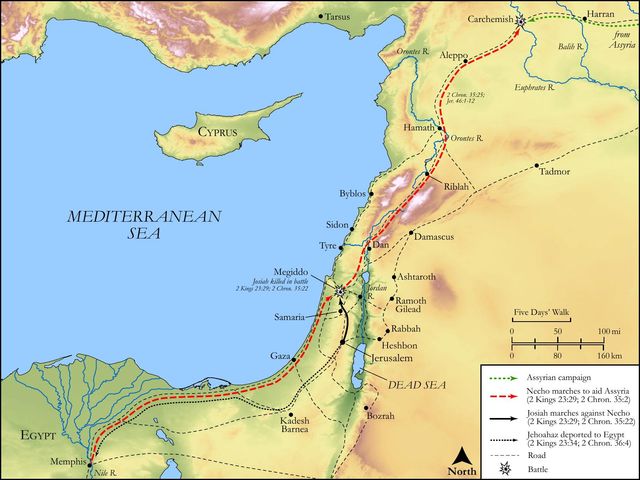
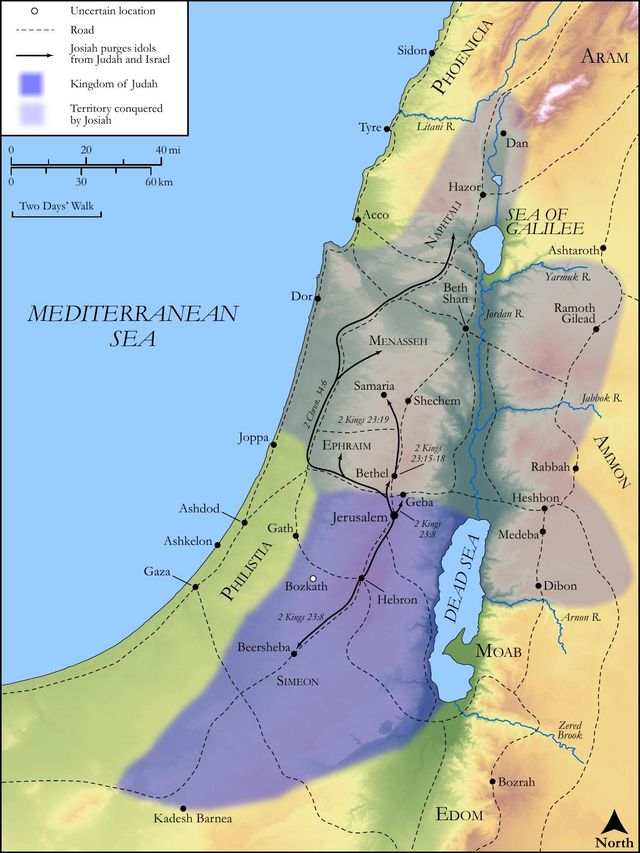
Study this verse
Public-domain commentary
Matthew Henry
From his Commentary on the Whole Bible. Henry comments on passages, not single verses — this entry covers 2 Kings 23:1–3.
Josiah had received a message from God that there was no preventing the ruin of Jerusalem, but that he should deliver only his own soul; yet he did not therefore sit down in despair, and resolve to do nothing for his country because he could not do all he would. No, he would do his duty, and then leave the event to God. A public reformation was the thing resolved on; if any thing could prevent the threatened ruin it must be that; and here we have the preparations for that reformation. 1. He summoned a general assembly of the states, the elders, the magistrates or representatives of Judah and Jerusalem, to meet him in the house of the Lord, with the priests and prophets, the ordinary and extraordinary ministers, that, they all joining in it, it might become a national act and so be the more likely to prevent national judgments; they were all called to attend (Kg2 23:1, Kg2 23:2), that the business might be done with the more solemnity, that they might all advise and assist in it, and that those who were against it might be discouraged from making any opposition. Parliaments are no diminution at all to the honour and power of good princes, but a great support to them. 2. Instead of making a speech to this convention, he ordered the book of the law to be read to them; nay, it should seem, he read it himself (Kg2 23:2), as one much affected with it and desirous that they should be so too. Josiah thinks it not below him to be a reader, any more than Solomon did to be a preacher, nay, and David himself to be a door-keeper in the house of God. Besides the convention of the great men, he had a congregation of the men of Judah and the inhabitants of Jerusalem to hear the law read. It is really the interest of princes to promote the knowledge of the scriptures in their dominions. If the people be but as stedfastly resolved to obey by law as he is to govern by law, the kingdom will be happy. All people are concerned to know the scripture, and all in authority to spread the knowledge of it. 3. Instead of proposing laws for the confirming of them in their duty, he proposed an association by which they should all jointly engage themselves to God, Kg2 23:3. The book of the law was the book of the covenant, that, if they would be to God a people, he would be to them a God; they here engage themselves to do their part, not doubting but that then God would do his. (1.) The covenant was that they should walk after the Lord, in compliance with his will, in his ordinances and his providences, should answer all his calls and attend all his motions - that they should make conscience of all his commandments, moral, ceremonial, and judicial, and should carefully observe them with all their heart and all their soul, with all possible care and caution, sincerity, vigour, courage, and resolution, and so fulfil the conditions of this covenant, in dependence upon the promises of it. (2.) The covenanters were, in the first place, the king himself, who stood by his pillar (Kg2 11:14) and publicly declared his consent to this covenant, to set them an example, and to assure them not only of his protection but of his presidency and all the furtherance his power could give them in their obedience. It is no abridgment of the liberty even of princes themselves to be in bonds to God. All the people likewise stood to the covenant, that is, they signified their consent to it and promised to abide by it. It is of good use to oblige ourselves to our duty with all possible solemnity, and this is especially seasonable after notorious backslidings to sin and decays in that which is good. He that bears an honest mind does not shrink from positive engagements: fast bind, fast find.
Historical interpretation
Fourteen Centuries of Reception
2 surviving comments on this verse. Each one is dated, so this reads as a timeline rather than a list.
Select a marker to jump to its quote. Markers stagger vertically where authors wrote within a few decades of each other.
Love faith. For by his devotion and faith Josiah won great love for himself from his enemies. For he celebrated the Lord’s Passover when he was eighteen years old, as no one had done it before him. As then in zeal he was superior to those who went before him, so do you, my children, show zeal for God. Let zeal for God search you through and devour you, so that each one of you may say, “The zeal of your house has eaten me up.” An apostle of Christ was called the zealot. But why do I speak of an apostle? The Lord himself said, “The zeal of your house has eaten me up.” Let it then be real zeal for God, not mean earthly zeal, for that causes jealousy.
The king stood upon the step: That is, his tribune, or tribunal, a more eminent place, from whence he might be seen and heard by the people.
Continue studying 2 Kings 23:3 across the web’s major study libraries — every link below opens this exact verse, chapter, or book on the destination site.
Read & Compare
 BibleGatewayThis verse in more than 200 translations and 70 languages.
 Bible.comThe YouVersion reader — hundreds of translations, reading plans, and highlights.
 ESV.orgCrossway's official English Standard Version reader.
 NET BibleThe NET translation with 60,000+ translators' notes on every rendering decision.
 STEP BibleTyndale House's free study tool — original text, vocabulary, and scholarly resources.
 BibliaLogos Bible Software's free web reader.
 USCCBThe New American Bible (Revised Edition) with the U.S. bishops' study notes.
Commentaries
 BibleHub CommentariesDozens of classic commentaries on this verse, gathered on one page.
 StudyLightMore than 100 commentary sets — the largest collection on the web.
 BibleRefPlain-English commentary on what this verse means, verse by verse.
 Enduring WordDavid Guzik's free commentary on this chapter, widely used by Bible teachers.
 Bible Study ToolsVerse commentary alongside Greek and Hebrew study aids.
Original Language & Research
- BibleHub InterlinearThe verse word by word — original language, transliteration, and English.
- BibleHub LexiconEvery word's original-language definition and Strong's entry.
 Blue Letter BibleDeep-study tools — Strong's numbers, concordance, and word studies.
 SefariaThe Hebrew text with Rashi and centuries of Jewish commentary.
Sermons, Hymns & Audio


TrulyRandomVerse is not affiliated with these sites and doesn’t control their content. They’re linked because they’re genuinely useful.
Summary
King Josiah's reign marked a profound spiritual revival in Judah, a stark contrast to the idolatry and moral decay of previous generations. This pivotal verse describes the solemn covenant renewal ceremony initiated by Josiah, where he publicly committed himself and led the entire nation in reaffirming their allegiance to the LORD. This act, rooted in the rediscovered Book of the Law, was a comprehensive national repentance, aiming to re-establish Judah's relationship with God on the foundation of His revealed will, demanding wholehearted obedience from both king and people.
Context
ShowHideLiterary Context
This verse immediately follows the dramatic discovery of the "Book of the Law" in the Temple during its repair, as detailed in 2 Kings 22:8. Upon hearing its contents, King Josiah was deeply convicted, tearing his clothes in repentance and sending a delegation to inquire of the LORD through the prophetess Huldah (2 Kings 22:11-20). Her prophecy confirmed the impending judgment for Judah's unfaithfulness but promised peace for Josiah due to his humble response. Chapter 23 then details Josiah's sweeping reforms, beginning with this public covenant renewal ceremony, which serves as the theological and practical foundation for all subsequent actions, including the destruction of idolatrous altars and the re-institution of the Passover. It underscores that true reform begins with a return to God's Word and a renewed commitment to His covenant.
Historical & Cultural Context
Josiah's reign (640-609 BC) occurred during a period of Assyrian decline, which provided a crucial window of opportunity for Judah to assert its independence and religious identity. For decades prior, under kings like Manasseh and Amon, Judah had plunged into deep idolatry, adopting foreign cults, child sacrifice, and astral worship, even within the Temple precincts, as vividly described in 2 Kings 21:1-9. The rediscovery of the Law (likely a form of Deuteronomy) was a shocking revelation, exposing the extent of Judah's apostasy and the severity of God's promised judgment. Public covenant renewal ceremonies were solemn occasions, where the king and the people would publicly affirm their allegiance to the LORD. In Israel, this practice echoed earlier covenant renewals at Sinai, Shechem (Joshua 24), and under King Asa (2 Chronicles 15), signifying a deliberate return to the foundational relationship with Yahweh.
Key Themes
ShowHideThis verse is central to several significant themes in 2 Kings and the broader Deuteronomistic History. It powerfully illustrates Covenant Faithfulness and Renewal, emphasizing the re-establishment of the broken covenant relationship between God and His people, which had been neglected for generations. It highlights the paramount importance of Wholehearted Obedience, as the phrase "with all their heart and all their soul" echoes the foundational command of the Mosaic Law to love and obey God completely, as seen in Deuteronomy 6:5. The discovery and public reading of the "Book of this covenant" underscore the Authority and Centrality of God's Word as the ultimate standard for faith and life, serving as the blueprint for Judah's spiritual and moral reformation. Finally, Josiah's leadership in initiating this covenant and the people's affirmation ("And all the people stood to the covenant") demonstrate the critical roles of Godly Leadership and Corporate Responsibility in national transformation, where both individual and collective commitment are essential for genuine revival, echoing principles found in Nehemiah 9-10.
Exposition and Analysis
ShowHideKey Word Analysis
ShowHideThis term signifies a solemn, binding agreement, often made by "cutting" (referencing the ancient practice of passing between pieces of flesh). In the biblical context, especially between God and Israel, it is a relationship initiated by God, based on His grace and promises, but requiring specific obligations and faithfulness from the human party. Here, it refers to the Mosaic Covenant, renewed and reaffirmed after generations of neglect. The act of "made a covenant before the LORD" implies a sacred, public oath, invoking divine witness and accountability.
In Hebrew anthropology, the "heart" is not merely the seat of emotion but the center of one's intellect, will, and moral character. It encompasses one's thoughts, intentions, and decisions. To obey "with all their heart" means to obey with one's mind, understanding, and deepest convictions, not merely superficially or externally.
This term refers to the entire being, the life force, the inner self, or the person as a whole. When paired with "heart," "soul" emphasizes the totality and intensity of commitment. To obey "with all their soul" means to engage one's entire vitality, passion, and inner self in the act of obedience, signifying an undivided and passionate devotion that encompasses every aspect of one's personhood.
Verse Breakdown
ShowHide"And the king stood by a pillar,"
This detail indicates Josiah's prominent position, likely in the Temple court, where he would have been visible to all the gathered people. The "pillar" (H5982, ʻammûwd) could refer to a specific architectural feature or a designated platform for public proclamations, symbolizing his authority and the public nature of the event. His standing implies a deliberate, authoritative posture for a solemn declaration.
"and made a covenant before the LORD,"
Josiah, as the king and representative of the nation, formally entered into or, more accurately, renewed the covenant (H1285, bᵉrîyth) with Yahweh (H3068, Yᵉhôvâh). The verb "made" (H3772, kârath) literally means "to cut," referencing the ancient practice of cutting animals and passing between the pieces to ratify a covenant. The phrase "before the LORD" (H6440, pânîym) underscores the sacredness of the oath, implying God as the witness and the ultimate party to whom the covenant is made. This was not a human agreement but a divine-human one, invoking divine presence and accountability.
"to walk after the LORD, and to keep his commandments and his testimonies and his statutes with all [their] heart and all [their] soul,"
This clause specifies the core obligations of the covenant: obedient living. "To walk after the LORD" (H3212, yâlak after H310, ʼachar the LORD H3068, Yᵉhôvâh) is a common biblical idiom for living in accordance with God's will and example, implying a continuous journey of conformity. The threefold repetition of "commandments" (H4687, mitsvâh), "testimonies" (H5715, ʻêdûwth), and "statutes" (H2708, chuqqâh) emphasizes the comprehensive nature of divine law, covering all aspects of life. The crucial addition "with all their heart" (H3820, lêb) and "all their soul" (H5315, nephesh) demands an internal, holistic, and passionate commitment, not just external conformity.
"to perform the words of this covenant that were written in this book."
This phrase explicitly links the covenant renewal to the recently discovered "Book of the Law" (H5612, çêpher). It highlights that the basis for their renewed commitment was God's revealed Word (H1697, dâbâr), which provided the specific requirements and stipulations of the covenant. "To perform" (H6965, qûwm, "to rise, establish, accomplish") emphasizes active, practical obedience, bringing the written word into living reality. The phrase "written in this book" (H3789, kâthab) underscores the divine authority and immutability of the covenant's terms.
"And all the people stood to the covenant."
This final clause is vital, demonstrating the corporate nature of the renewal. The people's "standing to" (H5975, ʻâmad to the covenant H1285, bᵉrîyth) the covenant signifies their public assent, agreement, and commitment to its terms. It was a national, collective decision to re-engage with God's will, making them jointly responsible for its observance and demonstrating their corporate responsibility before God.
Literary Devices
ShowHideThe passage employs several significant literary devices that amplify its meaning and impact. Covenant Formula is evident in the structure of the verse, following the pattern of the covenant given through Moses, with the king's standing before the LORD, the LORD's dealings with His people (implied by the discovery of the book and Judah's past apostasy), stipulations (walking after the LORD, keeping commands), and the implied blessings or curses associated with obedience or disobedience. The Repetition of the word "covenant" (Hebrew, berit') three times within the verse ("made a covenant," "words of this covenant," "stood to the covenant") underscores its central importance and the solemnity of the event, reinforcing the idea of a binding agreement. Symbolism is present in "the pillar," which likely served as a visible marker of authority and public declaration, making the king's commitment a public spectacle and a focal point for the nation. The "book" itself is a powerful symbol of God's revealed will and the ultimate authority for life and faith. The phrase "with all their heart and all their soul" is an example of Merism, a literary device where two contrasting or complementary parts (heart and soul representing inner and outer being, thought and vitality) represent a whole, emphasizing the totality and undivided nature of the required devotion.
Theological and Thematic Connections
ShowHideThis verse encapsulates the essence of biblical covenant theology, demonstrating that God's relationship with His people is based on His gracious initiative but requires their faithful response. Josiah's reform highlights the cyclical nature of apostasy and repentance in Israel's history, where periods of national decline are often met with prophetic calls to return to the LORD and His covenant. The emphasis on "wholehearted" obedience resonates throughout Scripture as the true mark of devotion, distinguishing genuine faith from mere outward ritual. This commitment, rooted in God's revealed Word, serves as the foundation for national well-being and divine blessing, illustrating the profound connection between national obedience and divine favor or judgment.
Reflection and Application
ShowHideThe scene of King Josiah and the people standing to the covenant in 2 Kings 23:3 offers a powerful blueprint for individual and corporate spiritual renewal today. It reminds us that genuine transformation begins with a humble and convicted response to God's Word, recognizing how far we may have strayed from His perfect will. Like Josiah, leaders are called to guide their communities back to biblical truth, and every believer is challenged to examine the depth of their own commitment to God. Is our obedience merely external, or does it flow from a heart and soul fully devoted to Him? This verse calls us to a radical, wholehearted allegiance to Christ, ensuring that our lives are built upon the unchanging foundation of His commands and testimonies, actively performing the "words of this covenant" in our daily walk. It's a call to proactive, Spirit-empowered living that reflects a deep love for God and His ways, demonstrating that true faith is always accompanied by sincere obedience.
Questions for Reflection
ShowHideFAQ
ShowHideWhat was the significance of the king standing "by a pillar" during this ceremony?
ShowHideThe act of the king standing "by a pillar" (or "on the platform" in some translations) was highly significant. It was likely a prominent, perhaps elevated, place within the Temple court, making him visible to the entire assembly. This positioning underscored his authority as the nation's leader and his role as the initiator and primary participant in this solemn covenant renewal. It symbolized his public commitment and served as a visual focal point for the people, emphasizing the gravity and public nature of the national oath they were about to take. It made the king's dedication a public spectacle, setting an example for all to follow and ensuring the entire nation witnessed his solemn vow.
What was "this book" that was discovered and became the basis for the covenant?
ShowHide"This book" refers to the "Book of the Law" that was discovered by Hilkiah the high priest during repairs of the Temple, as recorded in 2 Kings 22:8. While the exact contents are debated among scholars, the consensus suggests it was likely a significant portion of the book of Deuteronomy, particularly its covenant stipulations and the blessings and curses associated with obedience and disobedience. Its discovery was a profound catalyst for Josiah's reforms, as its words revealed how far Judah had strayed from God's commands and the dire consequences of their apostasy. This book became the authoritative blueprint for the nation's spiritual and moral reformation, guiding all subsequent actions.
Christ-Centered Fulfillment
ShowHideWhile 2 Kings 23:3 describes an Old Covenant renewal centered on the Mosaic Law, it powerfully foreshadows the ultimate and perfect covenant established through Jesus Christ. Josiah's act of standing before the LORD to commit to the Law points to Christ, who perfectly fulfilled the Law, declaring He came "not to abolish the Law or the Prophets but to fulfill them" (Matthew 5:17). Jesus established a new and better covenant, "founded on better promises" (Hebrews 8:6-13), through His own sacrificial death. The Old Covenant's demand for "all their heart and all their soul" in obedience to the Law finds its truest expression in the New Covenant, where the Holy Spirit indwells believers, enabling them to genuinely "walk after the LORD" not by external compulsion but by an inner transformation (Jeremiah 31:33; Ezekiel 36:26-27). Christ is the ultimate King who stood not by a pillar to make a covenant, but on the cross to be the covenant, shedding His blood to atone for sin and bring about reconciliation between God and humanity (Luke 22:20; 1 Corinthians 11:25). The people's "standing to the covenant" in Josiah's day prefigures the call for all believers to respond in faith to the gospel, entering into a personal covenant relationship with God through Christ, where obedience is a joyful response to His grace, empowered by the Spirit, and leading to eternal life (John 3:16; Romans 6:1-11).