


2 Kings 23:26
Bible text: King James Version (1769 Blayney text) · Public domain
Bible text: King James Version with Strong's numbers · Public domain
Bible text: Berean Standard Bible · Public domain
Bible text: American Standard Version (1901) · Public domain
Bible text: World English Bible, Messianic edition · Public domain
Bible text: Geneva Bible (1599) · Public domain
Bible text: Young's Literal Translation · Public domain
- אַךְ'akhneverthelessH389AdvAdverb
- לֹאlo'notH3808NegParticle Negative
- שָׁבshavhe turned backH7725V-Qal-Perf-3msVerb Qal Perfect 3rd Singular Masculine
- יְהוָהYah·wehYahwehH3068N-properNoun Proper Title
- מֵחֲרוֹןme·cha·Ronfrom [the] burning ofH2740Prep-m ¦ N-mscNoun Singular Masculine Constructמֵfromחֲרוֹן[the] burning of
- אַפּוֹ'a·Pohis angerH639N-msc ¦ 3msNoun Singular Masculine Constructאַפּangerוֹhis
- הַגָּדוֹלha·ga·Dol<the> greatH1419Art ¦ Adj-msAdjective Singular Masculine Absoluteהַ<the>גָּדוֹלgreat
- אֲשֶׁר'a·SherwhichH834RelParticle Relative
- חָרָהcha·Rahit burnedH2734V-Qal-Perf-3msVerb Qal Perfect 3rd Singular Masculine
- אַפּוֹ'a·Pohis angerH639N-msc ¦ 3msNoun Singular Masculine Constructאַפּangerוֹhis
- בִּיהוּדָהbi·hu·Dahon JudahH3063Prep-b ¦ N-properNoun Proper LocationבִּonיהוּדָהJudah
- עַל'alonH5921PrepPreposition
- כָּלkolallH3605N-mscNoun Singular Masculine Construct
- הַכְּעָסִיםha·ke·'a·Simthe provocationsH3708Art ¦ N-mpNoun Plural Masculine Absoluteהַtheכְּעָסִיםprovocations
- אֲשֶׁר'a·SherwhichH834RelParticle Relative
- הִכְעִיסוֹhikh·'i·Sohe had provoked to anger himH3707V-Hiphil-Perf-3ms ¦ 3msVerb Hiphil Perfect 3rd Singular Masculineהִכְעִיסhe had provoked to angerוֹhim
- מְנַשֶּׁהme·na·ShehManassehH4519N-proper-mNoun Proper Masculine
English is a literal word-by-word gloss of the Hebrew, not the KJV's wording. Why?
This is the original text the KJV's translators worked from — each Hebrew word with its own literal English meaning in this verse, prepared by scholars at Tyndale House, Cambridge. The KJV translates whole sentences, not word by word, so its wording differs: one Hebrew word can become several English words, and the KJV may choose “the LORD” where the gloss reads “Yahweh”. Both are faithful — they answer different questions. For the KJV's own rendering, switch to the KJV text.
Details
See on the biblical-era maps
Study this verse
Public-domain commentary
Matthew Henry
From his Commentary on the Whole Bible. Henry comments on passages, not single verses — this entry covers 2 Kings 23:25–30. His three-level outline is real structure in the source text, so it is rendered as structure.
Upon the reading of these verses we must say, Lord, though thy righteousness be as the great mountains - evident, conspicuous, and past dispute, yet thy judgments are a great deep, unfathomable and past finding out, Psa 36:6. What shall we say to this?
I.It is here owned that Josiah was one of the best kings that ever sat upon the throne of David, Kg2 23:25.
As Hezekiah was a non-such for faith and dependence upon God in straits (Kg2 18:5), so Josiah was a non-such for sincerity and zeal in carrying on a work of reformation. For this there was none like him,
1.That he turned to the Lord from whom his fathers had revolted. It is true religion to turn to God as one we have chosen and love. He did what he could to turn his kingdom also to the Lord.
2.That he did this with his heart and soul; his affections and aims were right in what he did. Those make nothing of their religion that do not make heart-work of it.
3.That he did it with all his heart, and all his soul, and all his might - with vigour, and courage, and resolution: he could not otherwise have broken through the difficulties he had to grapple with. What great things may we bring to pass in the service of God if we be but lively and hearty in it!
4.That he did this according to all the law of Moses, in an exact observance of that law and with an actual regard to it. His zeal did not transport him into any irregularities, but, in all he did, he walked by rule.
II.Notwithstanding this he was cut off by a violent death in the midst of his days, and his kingdom was ruined within a few years after.
Consequent upon such a reformation as this, one would have expected nothing but the prosperity and glory both of king and kingdom; but, quite contrary, we find both under a cloud.
1.Even the reformed kingdom continues marked for ruin. For all this (Kg2 23:26) the Lord turned not from the fierceness of his great wrath. That is certainly true, which God spoke by the prophet (Jer 18:7, Jer 18:8), that if a nation, doomed to destruction, turn from the evil of sin, God will repent of the evil of punishment; and therefore we must conclude that Josiah's people, though they submitted to Josiah's power, did not heartily imbibe Josiah's principles. They were turned by force, and did not voluntarily turn from their evil way, but still continued their affection for their idols; and therefore he that knows men's hearts would not recall the sentence, which was, That Judah should be removed, as Israel had been, and Jerusalem itself cast off, Kg2 23:27. Yet even this destruction was intended to be their effectual reformation; so that we must say, not only that the criminals had filled their measure and were ripe for ruin, but also that the disease had come to a crisis, and was ready for a cure; and this shall be all the fruit, even the taking away of sin.
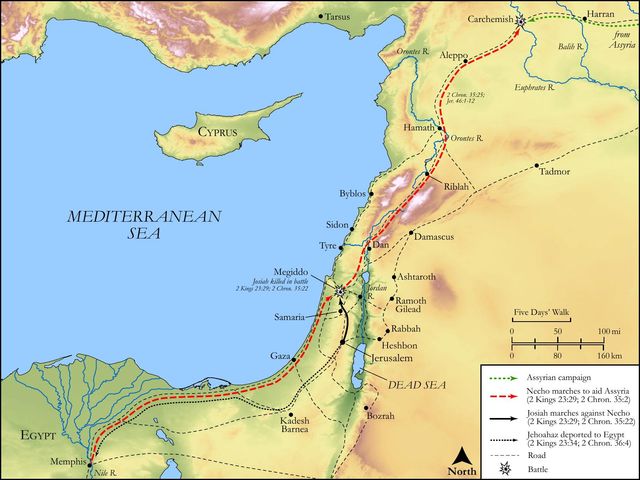
2.As an evidence of this, even the reforming king is cut off in the midst of his usefulness - in mercy to him, that he might not see the evil which was coming upon his kingdom, but in wrath to his people, for his death was an inlet to their desolations. The king of Egypt waged war, it seems, with the king of Assyria: so the king of Babylon is now called. Josiah's kingdom lay between them. He therefore thought himself concerned to oppose the king of Egypt, and check the growing, threatening, greatness of his power; for though, at this time, he protested that he had no design against Josiah, yet, if he should prevail to unite the river of Egypt and the river Euphrates, the land of Judah would soon be overflowed between them. Therefore Josiah went against him, and was killed in the first engagement, Kg2 23:29, Kg2 23:30. Here,
(1.)We cannot justify Josiah's conduct. He had no clear call to engage in this war, nor do we find that he asked counsel of God by urim or prophets concerning it. What had he to do to appear and act as a friend and ally to the king of Assyria? Should he help the ungodly and love those that hate the Lord? If the kings of Egypt and Assyria quarrelled, he had reason to think God would bring good out of it to him and his people, by making them instrumental to weaken one another. Some understand the promise made to him that he should come to his grave in peace in a sense in which it was not performed because, by his miscarriage in this matter, he forfeited the benefit of it. God has promised to keep us in all our ways; but, if we go out of our way, we throw ourselves out of his protection. I understand the promise so as that I believe it was fulfilled, for he died in peace with God and his own conscience, and saw not, nor had any immediate prospect of, the destruction of Judah and Jerusalem by the Chaldeans; yet I understand the providence to be a rebuke to him for his rashness.
(2.)We must adore God's righteousness in taking away such a jewel from an unthankful people that knew not how to value it. They greatly lamented his death (Ch2 35:25), urged to it by Jeremiah, who told them the meaning of it, and what a threatening omen it was; but they had not made a due improvement of the mercies they enjoyed by his life, of which God taught them the worth by the want.
Historical interpretation
Historical reception
1 surviving comment on this verse from the historical church.
Nobody must think that anything was detracted to the celerity of death because of one’s merits. Enoch was kidnapped, lest malice might spoil his heart, and Josiah, who celebrated the Passover of the Lord in the eighteenth year of his reign in such a manner that he overcame in piousness all the previous kings, did not survive longer through the merits of his faith. No, rather, because grievous destruction threatened the Jewish people, the just king was taken away beforehand. I fear that you, too, were snatched away from us because of some offense on our part, so that, as a just person, you might escape in the eighteenth year of your reign the bitterness of impending evil.
Continue studying 2 Kings 23:26 across the web’s major study libraries — every link below opens this exact verse, chapter, or book on the destination site.
Read & Compare
 BibleGatewayThis verse in more than 200 translations and 70 languages.
 Bible.comThe YouVersion reader — hundreds of translations, reading plans, and highlights.
 ESV.orgCrossway's official English Standard Version reader.
 NET BibleThe NET translation with 60,000+ translators' notes on every rendering decision.
 STEP BibleTyndale House's free study tool — original text, vocabulary, and scholarly resources.
 BibliaLogos Bible Software's free web reader.
 USCCBThe New American Bible (Revised Edition) with the U.S. bishops' study notes.
Commentaries
 BibleHub CommentariesDozens of classic commentaries on this verse, gathered on one page.
 StudyLightMore than 100 commentary sets — the largest collection on the web.
 BibleRefPlain-English commentary on what this verse means, verse by verse.
 Enduring WordDavid Guzik's free commentary on this chapter, widely used by Bible teachers.
 Bible Study ToolsVerse commentary alongside Greek and Hebrew study aids.
Original Language & Research
- BibleHub InterlinearThe verse word by word — original language, transliteration, and English.
- BibleHub LexiconEvery word's original-language definition and Strong's entry.
 Blue Letter BibleDeep-study tools — Strong's numbers, concordance, and word studies.
 SefariaThe Hebrew text with Rashi and centuries of Jewish commentary.
Sermons, Hymns & Audio


TrulyRandomVerse is not affiliated with these sites and doesn’t control their content. They’re linked because they’re genuinely useful.
Summary
Despite the unprecedented and earnest reforms undertaken by King Josiah, 2 Kings 23:26 delivers a stark and profoundly sobering pronouncement: the Lord's fierce and great wrath against Judah remained unappeased. This pivotal verse reveals that the cumulative weight of national sin, particularly the profound and pervasive idolatry and wickedness introduced by King Manasseh, had reached a point of no return, sealing Judah's fate for impending judgment and exile, even in the face of a righteous king's devotion and a temporary spiritual revival.
Context
ShowHideLiterary Context
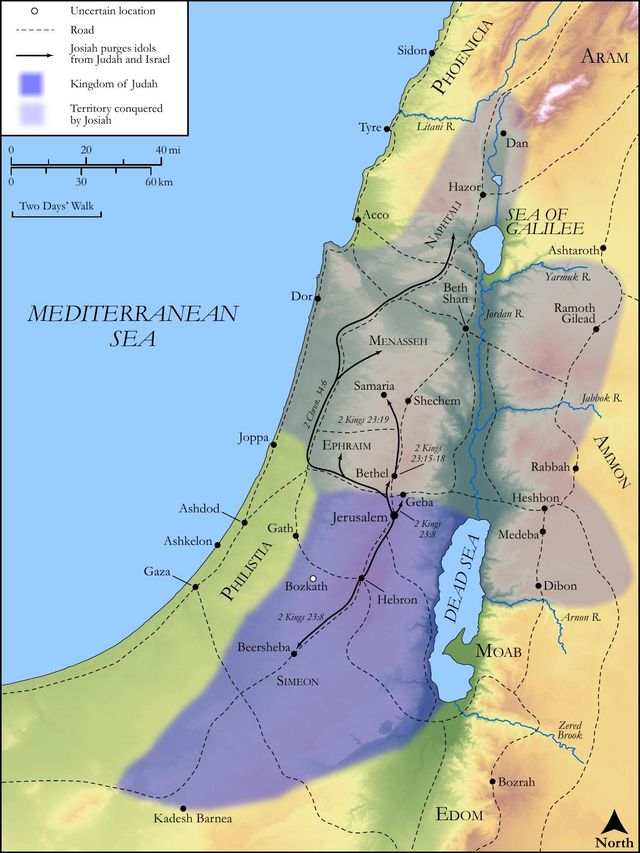
This verse serves as a grim and pivotal theological declaration immediately following the detailed account of King Josiah's unparalleled religious revival and covenant renewal (2 Kings 22-23). Josiah is presented as the most righteous king since David, diligently purging idolatry from Judah and Israel, restoring the Temple, and renewing the covenant based on the rediscovered Book of the Law. The preceding verses (2 Kings 23:24-25) laud Josiah's faithfulness, stating that "like unto him was there no king before him, that turned to the LORD with all his heart, and with all his soul, and with all his might, according to all the law of Moses." Yet, despite this profound individual and national effort, verse 26 functions as a jarring counterpoint, revealing that the nation's spiritual trajectory, largely set by the preceding reigns, particularly Manasseh's, could not be reversed. It acts as the Deuteronomistic historian's theological explanation for the subsequent, inevitable fall of Judah and the Babylonian exile, demonstrating that even the most zealous human efforts cannot negate divine justice when the measure of sin is full.
Historical & Cultural Context
The historical backdrop is the twilight of the Kingdom of Judah, a period marked by the decline of the dominant Assyrian Empire, which created a temporary window for Josiah's reforms. However, the spiritual landscape of Judah had been profoundly corrupted over generations, most notably during the 55-year reign of King Manasseh (2 Kings 21). Manasseh had systematically reintroduced and enforced the most egregious forms of idolatry, including Baal worship, Asherah poles, astral worship, and even the horrific practice of child sacrifice, going so far as to erect altars to pagan deities within the very precincts of the Temple in Jerusalem. This was not merely external religious practice but deeply ingrained cultural apostasy, leading the people "to do more evil than did the nations whom the LORD destroyed before the children of Israel" 2 Kings 21:9. Josiah's reforms, though thorough and externally sweeping, failed to fully eradicate the deep-seated spiritual corruption and genuine heart-idolatry that had taken root across society, indicating that the people's repentance was largely superficial or coerced rather than a true turning of the heart.
Key Themes
ShowHideThis verse powerfully underscores several critical themes within 2 Kings and the broader Deuteronomistic History. Firstly, it highlights the unwavering nature of divine judgment when a nation persistently rebels against God's covenant. Even the most righteous human efforts, like Josiah's, cannot indefinitely avert the consequences of generations of unrepentant sin. Secondly, it emphasizes the cumulative and lasting impact of sin, particularly the profound and pervasive "provocations" of King Manasseh, which are explicitly cited as the primary cause for God's unyielding wrath. Manasseh's reign is presented as the tipping point, leading Judah further astray than any nation before it, as detailed in 2 Kings 21:10-15. Finally, it illustrates the limits of national repentance when the heart of the people has become so hardened. While individual repentance is always possible and efficacious, the corporate spiritual state of Judah had reached a point where God's decree of judgment, previously announced, would be executed, a reality later confirmed and lamented by the prophet Jeremiah, who noted Manasseh's role in Judah's scattering Jeremiah 15:4.
Exposition and Analysis
ShowHideKey Word Analysis
ShowHideThis term, derived from a root meaning "to glow or grow warm," denotes a "burning of anger." It emphasizes the intense heat, indignation, and settled displeasure of God's righteous wrath. When applied to God, it signifies His determined and unyielding resolve to execute justice, rather than an uncontrolled outburst.
Literally meaning "nose" or "nostril," this word is often used metaphorically to describe anger, stemming from the rapid breathing associated with intense emotion. In this context, it signifies God's deep indignation and righteous ire against the persistent sin of Judah. The combination with "fierceness" (H2740) underscores the severity and magnitude of God's righteous anger, which was not fleeting but a settled disposition.
This word refers to actions that cause grief, vexation, or anger, specifically in the context of offending God. It encapsulates the numerous and severe acts of idolatry, covenant breaking, and moral abominations that Manasseh instigated and that permeated Judah, causing God righteous indignation and leading to His unyielding judgment.
Verse Breakdown
ShowHide"Notwithstanding the LORD turned not from the fierceness of his great wrath"
This opening clause immediately establishes the verse's somber tone and central message. Despite King Josiah's earnest and unprecedented reforms, God's determined judgment remained fixed. The phrase "turned not from" (לֹא־שָׁב, lo-shav) signifies an unchangeable decree, indicating that the national sin had reached a point of no return, and the divine decision for judgment was irreversible. The "fierceness of his great wrath" highlights the intensity, magnitude, and justness of God's indignation, which was not a fleeting emotion but a settled resolve against deep-seated rebellion.
"wherewith his anger was kindled against Judah"
This clause clarifies the object of God's wrath – the entire nation of Judah. The imagery of "anger...kindled" (חָרָה, charah) suggests a burning, consuming fire, indicating that God's righteous indignation had been ignited and was now fully ablaze due to the nation's persistent rebellion and idolatry. It underscores that this was not arbitrary anger but a just, deserved response to their actions and their continued rejection of His covenant.
"because of all the provocations that Manasseh had provoked him withal"
This final clause provides the explicit reason for God's unyielding wrath. The "provocations" (כַּעַס, ka'as) refer to the numerous and severe acts of idolatry, child sacrifice, sorcery, and bloodshed that King Manasseh had introduced and promoted throughout his long reign (2 Kings 21). The repetition of the root for "provocations" emphasizes the depth, extent, and cumulative effect of Manasseh's spiritual corruption, which had so thoroughly defiled the nation that even Josiah's fervent efforts could not fully cleanse the deep-seated spiritual stains and avert the decreed judgment.
Literary Devices
ShowHideThe verse employs several powerful Literary Devices to convey its stark and unyielding message. The use of Hyperbole is evident in "the fierceness of his great wrath," emphasizing the overwhelming and absolute nature of God's righteous indignation, conveying the full weight of divine displeasure. This is coupled with Anthropomorphism, as God's anger is described as "kindled," likening divine emotion to a human experience of a fire blazing, making it relatable and impactful for the audience to grasp the intensity of God's settled resolve. The potent Repetition of the root for "provocations" (כַּעַס, ka'as) in "all the provocations that Manasseh had provoked him withal" serves to underscore the sheer volume, severity, and cumulative effect of Manasseh's sins, highlighting them as the direct and unassailable cause of God's unyielding judgment. Furthermore, the verse functions as a profound form of Foreshadowing, grimly predicting the inevitable downfall and exile of Judah, which would tragically unfold in the subsequent chapters of 2 Kings, despite the temporary reprieve offered by Josiah's righteous reforms.
Theological and Thematic Connections
ShowHideThis verse profoundly speaks to the nature of God's justice and the severe consequences of persistent, unrepentant sin. While God is indeed abundantly merciful, slow to anger, and rich in steadfast love, His patience has limits, and His perfect righteousness demands that unrepentant rebellion eventually face judgment. The cumulative effect of national sin, particularly the deep-seated idolatry and moral corruption introduced by Manasseh, had reached a tipping point where even the fervent piety of a king like Josiah could not reverse the divine decree. This highlights that while individual repentance is always possible and efficacious, the corporate spiritual trajectory of a nation, if consistently rebellious and hardened, can lead to irreversible national judgment. It underscores the profound principle that God's long-suffering is not an endorsement of sin but an invitation to repentance, and when that invitation is continually spurned, the consequences are sure and severe, demonstrating that God's character encompasses both boundless grace and unwavering justice.
Reflection and Application
ShowHide2 Kings 23:26 serves as a sobering and urgent reminder of the profound seriousness of sin and its far-reaching, often generational, consequences. It challenges us to consider the cumulative effect of our choices, both individually and corporately, recognizing that persistent rebellion against God's ways, even if seemingly dormant for a time, can lead to a point where divine judgment becomes inevitable. This verse compels us to move beyond mere external conformity, superficial religious practices, or temporary reforms, urging us toward a genuine, heart-deep repentance that seeks to eradicate the very roots of sin, not just its outward manifestations. It also highlights the immense responsibility of leadership, whether in the home, church, or nation, as the actions and spiritual posture of those in authority can profoundly shape the spiritual destiny of those they lead. Ultimately, this passage calls us to a profound reverence for God's holy character, which encompasses both boundless mercy and unwavering justice, prompting us to respond to His grace with sincere repentance and obedience while there is still time.
Questions for Reflection
ShowHideFAQ
ShowHideWhy couldn't Josiah's righteous reforms avert God's judgment on Judah?
ShowHideWhile King Josiah's reforms were extensive, sincere, and unparalleled in their scope, they ultimately could not avert God's decreed judgment because the national heart of Judah had been too deeply corrupted by generations of persistent idolatry and sin, particularly under the long and wicked reign of King Manasseh. Manasseh's "provocations" 2 Kings 23:26 had permeated the very fabric of society, leading the people into extreme forms of apostasy, including child sacrifice and sorcery, as detailed in 2 Kings 21:10-15. God's judgment had been firmly pronounced years earlier, and while Josiah's personal piety and reforms brought a temporary reprieve and delayed the judgment, they did not signify a fundamental, lasting change of heart for the entire nation. The people's repentance was largely coerced or superficial, not a deep, genuine turning back to the Lord. Thus, the cumulative weight of corporate sin had reached a tipping point, making the national judgment irreversible.
Does this verse imply that God is not merciful or that His mercy has limits?
ShowHideThis verse does not imply that God is not merciful, but rather that His mercy, while vast and enduring, operates within the bounds of His perfect justice and holiness. God is indeed "slow to anger and abounding in steadfast love" Psalm 103:8, offering repeated opportunities for repentance. However, when His long-suffering is continually spurned, and a people or nation persistently rebels against His covenant and commands, there comes a point where His righteous wrath must be expressed. The "fierceness of his great wrath" 2 Kings 23:26 is not an arbitrary outburst but a just response to deep-seated, unrepentant sin that has reached its full measure. It highlights that God's patience is not infinite, and His justice ensures that sin has consequences. As Romans 2:4-5 explains, God's kindness is meant to lead to repentance, but those who harden their hearts store up wrath for themselves, demonstrating the inevitability of divine judgment for unrepentant sin.
Christ-Centered Fulfillment
ShowHideThe "fierceness of his great wrath" kindled against Judah because of Manasseh's provocations in 2 Kings 23:26 finds its ultimate and most profound fulfillment in the person and work of Jesus Christ. The wrath of God, a just and holy response to humanity's rebellion and sin, which was partially manifested in the judgment of Judah, was fully and perfectly poured out upon Christ on the cross. He, the sinless Lamb of God, became the propitiation for our sins, absorbing the full measure of divine indignation that we deserved. Where Judah could not escape the consequences of its deep-seated idolatry and "provocations," Christ, through His atoning sacrifice, offers a perfect and complete escape from God's wrath for all who believe. The "provocations" of all humanity, far exceeding those of Manasseh, were laid upon Him, as Isaiah 53:5-6 prophesied, "He was pierced for our transgressions; he was crushed for our iniquities; upon him was the chastisement that brought us peace, and with his wounds we are healed." Through His death and resurrection, we are not merely spared judgment, but reconciled to God, as Romans 5:9 declares, "Since, therefore, we have now been justified by his blood, much more shall we be saved by him from the wrath of God." Thus, the unyielding wrath against sin, so vividly portrayed in this Old Testament passage, is perfectly satisfied and eternally averted for all who are "in Christ," who became sin for us that we might become the righteousness of God in Him 2 Corinthians 5:21.