


2 Chronicles 35:25
Bible text: King James Version (1769 Blayney text) · Public domain
Bible text: King James Version with Strong's numbers · Public domain
Bible text: Berean Standard Bible · Public domain
Bible text: American Standard Version (1901) · Public domain
Bible text: World English Bible, Messianic edition · Public domain
Bible text: Geneva Bible (1599) · Public domain
Bible text: Young's Literal Translation · Public domain
- וַיְקוֹנֵןvay·ko·Nenand he made a lamentH6969Conj-w ¦ V-Piel-ConsecImperf-3msVerb Piel Consecutive Imperfect 3rd Singular Masculineוַandיְקוֹנֵןhe made a lament
- יִרְמְיָהוּyir·me·ya·HuJeremiahH3414N-proper-mNoun Proper Masculine
- עַל'alonH5921PrepPreposition
- יֹאשִׁיָּהוּyo·shi·ya·HuJosiahH2977N-proper-mNoun Proper Masculine
- וַיֹּאמְרוּvai·yo·me·Ruand they have saidH559Conj-w ¦ V-Qal-ConsecImperf-3mpVerb Qal Consecutive Imperfect 3rd Plural Masculineוַandיֹּאמְרוּthey have said
- כָלkholallH3605N-mscNoun Singular Masculine Construct
- הַשָּׁרִיםha·sha·Rimthe male singersH7891Art ¦ V-Qal-Prtcpl-mpVerb Qal Participle Plural Masculine Absoluteהַtheשָּׁרִיםmale singers
- וְהַשָּׁרוֹתVe·ha·sha·rotand the female singersH7891Conj-w ¦ Art ¦ V-Qal-Prtcpl-fpVerb Qal Participle Plural Feminine Absoluteוְandהַtheשָּׁרוֹתfemale singers
- בְּקִינוֹתֵיהֶםbe·ki·No·tei·Hemin their lamentationsH7015Prep-b ¦ N-fpc ¦ 3mpNoun Plural Feminine Constructבְּinקִינוֹתֵיlamentationsהֶםtheir
- עַל'alonH5921PrepPreposition
- יֹאשִׁיָּהוּyo·shi·Ya·huJosiahH2977N-proper-mNoun Proper Masculine
- עַד'aduntilH5704PrepPreposition
- הַיּוֹםhai·Yomthis dayH3117Art ¦ N-msNoun Singular Masculine Absoluteהַthisיּוֹםday
- וַיִּתְּנוּםvai·yi·te·Numand they made themH5414Conj-w ¦ V-Qal-ConsecImperf-3mp ¦ 3mpVerb Qal Consecutive Imperfect 3rd Plural Masculineוַandיִּתְּנוּthey madeםthem
- לְחֹקle·Chokinto a decreeH2706Prep-l ¦ N-msNoun Singular Masculine Absoluteלְintoחֹקa decree
- עַל'alonH5921PrepPreposition
- יִשְׂרָאֵלYis·ra·'ElIsraelH3478N-properNoun Proper Location
- וְהִנָּםve·hi·Namand there theyH2005Conj-w ¦ Prt ¦ 3mpParticle Interjectionוְandהִנָּthereםthey
- כְּתוּבִיםke·tu·Vim[are] writtenH3789V-Qal-PassPrtcpl-mpVerb Qal Participle Passive Plural Masculine Absolute
- עַל'alonH5921PrepPreposition
- הַקִּינוֹתha·ki·Notthe lamentationsH7015Art ¦ N-fpNoun Plural Feminine Absoluteהַtheקִּינוֹתlamentations
English is a literal word-by-word gloss of the Hebrew, not the KJV's wording. Why?
This is the original text the KJV's translators worked from — each Hebrew word with its own literal English meaning in this verse, prepared by scholars at Tyndale House, Cambridge. The KJV translates whole sentences, not word by word, so its wording differs: one Hebrew word can become several English words, and the KJV may choose “the LORD” where the gloss reads “Yahweh”. Both are faithful — they answer different questions. For the KJV's own rendering, switch to the KJV text.
Details
See on the biblical-era maps
Study this verse
Public-domain commentary
Matthew Henry
From his Commentary on the Whole Bible. Henry comments on passages, not single verses — this entry covers 2 Chronicles 35:20–27. His three-level outline is real structure in the source text, so it is rendered as structure.
It was thirteen years from Josiah's famous passover to his death. During this time, we may hope, thing went well in his kingdom, that he prospered, and religion flourished; yet we are not entertained with the pleasing account of those years, but they are passed over in silence, because the people, for all this, were not turned from the love of their sins nor God from the fierceness of his anger. The next news therefore we hear of Josiah is that he is cut off in the midst of his days and usefulness, before he is full forty years old. We had this sad story, Kg2 23:29, Kg2 23:30. Here it is somewhat more largely related. That appears here, more than did there, which reflects such blame on Josiah and such praise on the people as one would not have expected.
I.Josiah was a very good prince, yet he was much to be blamed for his rashness and presumption in going out to war against the king of Egypt without cause or call. It was bad enough, as it appeared in the Kings, that he meddled with strife which belonged not to him. But here it looks worse; for, it seems, the king of Egypt sent ambassadors to him, to warn him against this enterprise, Ch2 35:21.
1.The king of Egypt argued with Josiah,
(1.)From principles of justice. He professed that he had no desire to do him any hurt, and therefore it was unfair, against common equity and the law of nations, for Josiah to take up arms against him. If even a righteous man engage in an unrighteous cause, let him not expect to prosper. God is no respecter of persons. See Pro 3:30; Pro 25:8.
(2.)From principles of religion: "God is with me; nay, He commanded me to make haste, and therefore, if thou retard my motions, thou meddlest with God." It cannot be that the king of Egypt only pretended this (as Sennacherib did in a like case, Kg2 18:25), hoping thereby to make Josiah desist, because he knew he had a veneration for the word of God; for it is said here (Ch2 35:22) that the words of Necho were from the mouth of God. We must therefore suppose that either by a dream, or by a strong impulse upon his spirit which he had reason to think was from God, or by Jeremiah or some other prophet, he had ordered him to make war upon the king of Assyria.
(3.)From principles of policy: "That he destroy thee not; it is at thy peril if thou engage against one that has not only a better army and a better cause, but God on his side."
2.It was not in wrath to Josiah, whose heart was upright with the Lord his God, but in wrath to a hypocritical nation, who were unworthy of so good a king, that he was so far infatuated as not to hearken to these fair reasonings and desist from his enterprise. He would not turn his face from him, but went in person and fought the Egyptian army in the valley of Megiddo, Ch2 35:22. If perhaps he could not believe that the king of Egypt had a command from God to do what he did, yet, upon his pleading such a command, he ought to have consulted the oracles of God before he went out against him. His not doing that was his great fault, and of fatal consequence. In this matter he walked not in the ways of David his father; for, had it been his case, he would have enquired of the Lord, Shall I go up? Wilt thou deliver them into my hands? How can we think to prosper in our ways if we do not acknowledge God in them?
II.The people were a very wicked people, yet they were much to be commended for lamenting the death of Josiah as they did.
That Jeremiah lamented him I do not wonder; he was the weeping prophet, and plainly foresaw the utter ruin of his country following upon the death of this good king. But it is strange to find that all Judah and Jerusalem, that stupid senseless people, mourned for him (Ch2 35:24), contrived how to have their mourning excited by singing men and singing women, how to have it spread through the kingdom (they made an ordinance in Israel that the mournful ditties penned on this sad occasion should be learned and sung by all sorts of people), and also how to have the remembrance of it perpetuated: these elegies were inserted in the collections of state poems; they are written in the Lamentations. Hereby it appeared,
1.That they had some respect to their good prince, and that, though they did not cordially comply with him in all his good designs, they could not but greatly honour him. Pious useful men will be manifested in the consciences even of those that will not be influenced by their example; and many that will not submit to the rules of serious godliness themselves yet cannot but give it their good word and esteem it in others. Perhaps those lamented Josiah when he was dead that were not thankful to God for him while he lived. The Israelites murmured at Moses and Aaron while they were with them and spoke sometimes of stoning them, and yet, when they died, they mourned for them many days. We are often taught to value mercies by the loss of them which, when we enjoyed them, we did not prize as we ought.
2.That they had some sense of their own danger now that he was gone. Jeremiah told them, it is likely, of the evil they might now expect to come upon them, from which he was taken away; and so far they credited what he said that they lamented the death of him that was their defence. Note, Many will more easily be persuaded to lament the miseries that are coming upon them than to take the proper way by universal reformation to prevent them, will shed tears for their troubles, but will not be prevailed upon to part with their sins. But godly sorrow worketh repentance and that repentance will be to salvation.
Historical interpretation
Historical reception
2 surviving comments on this verse. Each one is dated, so this reads as a timeline rather than a list.
It is true that in the holy Scriptures many are called righteous, as Zachariah and Elizabeth, Job, Jehosaphat, Josiah, and many others who are mentioned in the sacred writings. Of this fact I shall, if God gives me grace, give a full explanation in the work that I have promised; in this letter it must suffice to say that they are called righteous, not because they are faultless but because their faults are eclipsed by their virtues. In fact Zachariah is punished with dumbness, Job is condemned out of his own mouth, and Jehoshaphat and Josiah who are beyond a doubt described as righteous are narrated to have done things displeasing to the Lord. The first aligned himself with the ungodly Ahab and brought on himself the rebuke of Micaiah; and the second, though forbidden by the word of the Lord spoken by Jeremiah, went against Pharaoh Neco, king of Egypt, and was killed by him.
Finally, Josiah is killed by Pharaoh, the king of Egypt, because he would not listen to the words of the Lord from the mouth of the prophet Jeremiah, or, as it is written in the Paralipomenon: “Josiah would not return but prepared to fight against him and did not listen to the words of Neco from the mouth of God.” And it is stated, “And he died and was buried in the monument of his ancestors. And all Judah and Jerusalem mourned for him, particularly Jeremiah, whose lamentations for Josiah all the singing men and singing women repeat to this day. And it became like a law in Israel: ‘Behold, it is found written in the Lamentations.’ ”
Continue studying 2 Chronicles 35:25 across the web’s major study libraries — every link below opens this exact verse, chapter, or book on the destination site.
Read & Compare
 BibleGatewayThis verse in more than 200 translations and 70 languages.
 Bible.comThe YouVersion reader — hundreds of translations, reading plans, and highlights.
 ESV.orgCrossway's official English Standard Version reader.
 NET BibleThe NET translation with 60,000+ translators' notes on every rendering decision.
 STEP BibleTyndale House's free study tool — original text, vocabulary, and scholarly resources.
 BibliaLogos Bible Software's free web reader.
 USCCBThe New American Bible (Revised Edition) with the U.S. bishops' study notes.
Commentaries
 BibleHub CommentariesDozens of classic commentaries on this verse, gathered on one page.
 StudyLightMore than 100 commentary sets — the largest collection on the web.
 BibleRefPlain-English commentary on what this verse means, verse by verse.
 Enduring WordDavid Guzik's free commentary on this chapter, widely used by Bible teachers.
 Bible Study ToolsVerse commentary alongside Greek and Hebrew study aids.
Original Language & Research
- BibleHub InterlinearThe verse word by word — original language, transliteration, and English.
- BibleHub LexiconEvery word's original-language definition and Strong's entry.
 Blue Letter BibleDeep-study tools — Strong's numbers, concordance, and word studies.
 SefariaThe Hebrew text with Rashi and centuries of Jewish commentary.
Sermons, Hymns & Audio


TrulyRandomVerse is not affiliated with these sites and doesn’t control their content. They’re linked because they’re genuinely useful.
Summary
Second Chronicles 35:25 profoundly captures the national sorrow that engulfed Judah following the tragic death of King Josiah. It details an unprecedented and enduring period of mourning, spearheaded by the prophet Jeremiah, and involving professional singing men and women who composed and performed solemn dirges in Josiah's honor. These lamentations were not ephemeral expressions of grief but became a formalized and lasting custom in Israel, underscoring the deep spiritual and political void left by his passing and the irreparable loss of a truly righteous king, with their existence meticulously recorded in a collection of such elegies.
Context
ShowHideLiterary Context
This verse opens the poignant epilogue to the detailed account of King Josiah's reign, immediately following the narrative of his untimely death in battle at Megiddo against Pharaoh Necho of Egypt, as recounted in 2 Chronicles 35:20-24. The Chronicler consistently portrays Josiah as Judah's last truly righteous king, whose extensive reforms and zealous restoration of proper worship are meticulously documented in 2 Chronicles 34. His death, despite his unwavering piety, is presented as a shocking and tragic turning point, signaling the rapid and irreversible decline of Judah towards divine judgment and eventual exile. The widespread and enduring lamentation described in this verse powerfully underscores the immense spiritual and political vacuum created by his demise, setting the somber stage for the subsequent reigns of less faithful kings and the inevitable Babylonian captivity.
Historical & Cultural Context
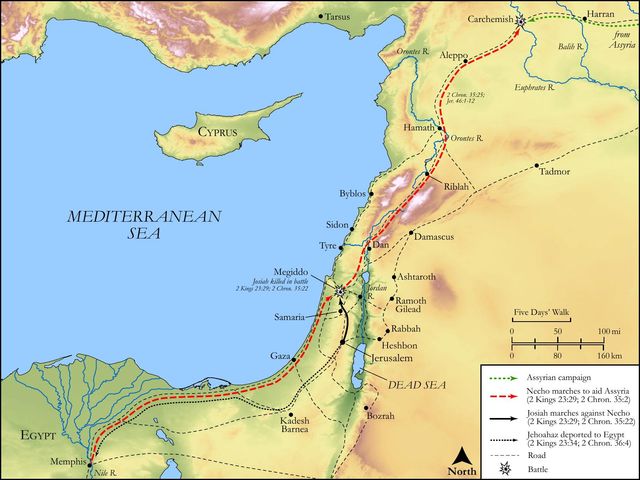
Josiah's reign (640-609 BC) unfolded during a period of immense geopolitical flux. The once-dominant Assyrian Empire was in a state of terminal decline, creating a significant power vacuum among the kingdoms round about. Egypt, under Pharaoh Necho II, sought to reassert its influence in the Levant, while the burgeoning power of Babylon loomed menacingly to the east. Josiah's fatal confrontation with Necho at Megiddo was an audacious attempt to intercept the Egyptian army, likely to prevent them from aiding the collapsing Assyrians or consolidating power that would directly threaten Judah's fragile independence. The custom of composing and performing lamentations or dirges (Hebrew: qinot) for deceased monarchs and national heroes was long established in Israel, as when David "lamented with this lamentation over Saul and over Jonathan his son." These served as public expressions of profound grief, heartfelt tributes to the departed, and often as a communal mechanism for processing national trauma. The specific mention of professional "singing men and singing women" highlights a formalized, culturally embedded practice, and the elevation of these lamentations to an "ordinance" speaks to their extraordinary and lasting significance within Israelite collective memory and tradition.
Key Themes
ShowHideThe verse powerfully conveys several pivotal themes central to the Chronicler's theological agenda and broader biblical theology. Firstly, it vividly portrays the profound national grief and the devastating impact of losing a righteous and Spirit-led leader. Josiah's death was not merely a personal tragedy but a collective catastrophe for Judah, signaling the abrupt end of an era of spiritual revival and the grim onset of divine judgment. Secondly, it underscores the enduring legacy of a righteous king, demonstrating that a life wholly devoted to God can leave an indelible mark on a nation, even if the immediate historical outcomes are not what one might expect. Josiah's comprehensive reforms had indeed brought about a temporary but significant spiritual renewal, a testament to his unique devotion, as highlighted in 2 Kings 23:25. Thirdly, the explicit involvement of prophetic acknowledgment through Jeremiah lends immense spiritual weight to the event, confirming its profound theological significance. Jeremiah, whose prophetic ministry commenced during Josiah's reign (Jeremiah 1:2), acutely understood the impending doom for Judah, and Josiah's death served as a stark, accelerating sign of the nation's irreversible decline towards divine judgment, as hinted at in 2 Kings 23:26-27. Finally, the passage powerfully illustrates the cultural and spiritual practice of lamentation as a legitimate and vital expression of faith and communal identity in the face of overwhelming loss, a theme deeply woven throughout the Psalms and the prophetic books of the Old Testament.
Exposition and Analysis
ShowHideKey Word Analysis
ShowHideThis primitive root signifies the act of striking a musical note, particularly in the context of chanting or wailing at a funeral. It describes a deep, public, and often ritualistic expression of grief, implying not just internal sadness but an outward, audible manifestation of profound sorrow. In this context, Jeremiah's "lamenting" for Josiah indicates a formal, mournful dirge or wail, emphasizing the solemnity and intensity of his grief and its public nature.
Derived from the root qûwn, this noun refers specifically to a dirge, elegy, or funeral song, often accompanied by the beating of breasts or musical instruments. These were poetic compositions designed to express sorrow, praise the deceased, and reflect on the tragedy of loss. The mention of "their lamentations" and "the lamentations" (with the definite article) suggests a recognized genre or even a specific collection of such mournful songs, particularly those composed in honor of Josiah, distinct from the canonical Book of Lamentations.
This term, derived from a root meaning "to engrave" or "to enact," denotes an established enactment, statute, decree, custom, or fixed practice. When applied to the lamentations for Josiah, it signifies that the practice of mourning him through these dirges became a formalized, enduring, and legally or culturally binding custom in Israel. This elevates the mourning from a spontaneous outpouring of grief to a perpetual, institutionalized memorial, underscoring the unparalleled reverence and sorrow associated with Josiah's passing and its lasting place in national memory.
Verse Breakdown
ShowHide"And Jeremiah lamented for Josiah:"
This opening clause highlights the personal and prophetic sorrow of Jeremiah, a pivotal figure whose prophetic ministry began during Josiah's reign. His direct involvement in lamenting adds immense spiritual and historical weight to the national tragedy, signifying that even God's chosen prophet recognized the profound loss and the impending doom that Josiah's death foreshadowed for Judah. It suggests a deep personal connection and a shared vision between the prophet and the king regarding Judah's spiritual trajectory.
"and all the singing men and the singing women spake of Josiah in their lamentations to this day,"
This segment describes the widespread, communal, and professional nature of the mourning. "Singing men and singing women" were likely professional mourners or skilled musicians renowned for composing and performing dirges. The phrase "to this day" (likely referring to the Chronicler's own time, centuries later) powerfully emphasizes the enduring legacy of Josiah and the lasting impact of his death, suggesting that these specific lamentations were remembered, recited, and perhaps even performed long after the event, becoming a fixed part of Israelite oral and written tradition.
"and made them an ordinance in Israel:"
This crucial clause signifies that the practice of lamenting Josiah through these specific dirges was not a fleeting moment of grief but was formalized into a customary tradition or statute. It became an established ritual, a permanent fixture in the collective memory and possibly the liturgical practices of Israel. This underscores the unparalleled esteem in which Josiah was held and the profound, irreparable nature of his loss for the nation, cementing his memory as a national hero whose passing merited perpetual remembrance.
"and, behold, they [are] written in the lamentations."
This final clause provides historical validation, confirming the existence of a written record of these dirges. The use of the definite article "the lamentations" strongly suggests a known collection or book, possibly a historical archive of such elegies, perhaps even a specific "Book of Lamentations" that was distinct from the canonical book attributed to Jeremiah. This not only authenticates the historical claim but also underscores the importance of meticulously preserving the memory of Josiah's life and death, ensuring his legacy endured through recorded history and was accessible to future generations.
Literary Devices
ShowHideThe verse employs several potent literary devices to convey its profound message of grief and lasting impact. Pathos is powerfully evoked, drawing the reader into the deep sorrow experienced by Jeremiah and the entire nation. The vivid description of "all the singing men and the singing women" engaging in lamentation creates a striking image of widespread, communal grief, emphasizing the overwhelming scale of the tragedy. The phrase "to this day" functions as a Historical Marker and a form of Hyperbole, underscoring the enduring impact and memory of Josiah's death, suggesting that the lamentations persisted for a significant period, perhaps even into the Chronicler's own time, thereby emphasizing Josiah's unparalleled legacy. The mention of the lamentations becoming an "ordinance" and being "written in the lamentations" serves as a form of Verisimilitude and Historical Validation, lending powerful credibility to the account and emphasizing the profound importance of this event in Israelite collective memory and meticulous historical record-keeping. Finally, the entire verse functions as a poignant Foreshadowing of Judah's impending doom, as the loss of such a righteous and reforming king left the nation vulnerable to the inevitable divine judgment and subsequent exile.
Theological and Thematic Connections
ShowHideThe profound and institutionalized lament for King Josiah, led by the prophet Jeremiah, offers a rich theological reflection on the nature of grief, the significance of godly leadership, and the unfolding of divine judgment. Theologically, it reminds us that even the most righteous individuals and nations are not immune to tragedy and loss in a fallen world. Josiah's death, despite his unwavering faithfulness, served as a grim divine judgment upon the nation for its deeper, persistent idolatry and covenant unfaithfulness, even as it was a deeply personal tragedy for those who loved him and his reforms. It highlights the biblical importance of lament as a legitimate, necessary, and even sacred expression of faith, allowing individuals and communities to process overwhelming sorrow, acknowledge profound loss, and courageously bring their pain and questions before God. The enduring nature of these lamentations also powerfully speaks to the lasting impact of a life lived in devotion to God, emphasizing that true legacy is often measured not merely in immediate success or earthly prosperity, but in the spiritual imprint left on a people and the enduring memory of righteousness.
Reflection and Application
ShowHideThe profound and lasting lamentation for King Josiah offers a powerful and enduring lens through which to reflect on our own lives, our communities, and the nature of leadership in a broken world. It compels us to consider the immense and often understated value of godly leadership, not only in political or national spheres but equally within our families, churches, workplaces, and local communities. Josiah's life serves as a compelling reminder that a courageous commitment to God's word and a zealous pursuit of righteousness can indeed bring about significant, even if temporary, spiritual revival and the renewal of society. His death, however, teaches us a sobering truth: even the most faithful among us are not exempt from suffering, loss, or the tragic consequences of a fallen world, and that God's sovereign purposes often unfold in ways that profoundly defy our human expectations and desires for immediate triumph. This passage also profoundly validates the importance of grief and lament in the Christian life. In a world perpetually marked by brokenness, sorrow, and loss, we are called not to deny or suppress our sorrow but to courageously bring it before God, trusting in His compassionate presence and unwavering faithfulness even in our deepest pain and confusion. Finally, Josiah's enduring legacy, enshrined in song and historical memory, challenges each of us to live lives that leave a lasting spiritual impact, pointing others not to ourselves, but to the eternal truths of God's kingdom and the ultimate hope found in Christ.
Questions for Reflection
ShowHideFAQ
ShowHideWhy did Jeremiah lament for Josiah, and is this the same as the Book of Lamentations?
ShowHideJeremiah's lament for Josiah (2 Chronicles 35:25) was a specific, deeply personal, and national expression of grief over the sudden death of a righteous king whom Jeremiah undoubtedly respected and likely collaborated with in his extensive religious reforms. Jeremiah began his prophetic ministry during Josiah's reign (Jeremiah 1:2), and Josiah's death signaled a tragic and irreversible turning point for Judah, accelerating its decline towards the very exile and destruction that Jeremiah tirelessly warned against. While Jeremiah was indeed the divinely inspired author of the canonical Book of Lamentations, that biblical book is a collection of mournful dirges specifically lamenting the catastrophic destruction of Jerusalem and the temple by the Babylonians, not primarily Josiah's death. The "lamentations" mentioned in 2 Chronicles 35:25 refer to specific elegies and mournful songs composed in honor of Josiah, which were evidently recorded and became a lasting memorial, distinct from the later, broader lament for Jerusalem's fall found in the biblical book of Lamentations.
What does it mean that the lamentations became an "ordinance" and were "written"?
ShowHideThe statement that the lamentations for Josiah "made them an ordinance in Israel" means that the practice of mourning Josiah through these specific dirges became an established, formalized, and customary tradition or statute within the nation. It was not a fleeting, spontaneous expression of grief but an enduring, institutionalized memorial, perhaps even incorporated into national or religious observances for a significant period. This underscores the profound and lasting impact of Josiah's life and tragic death on the collective memory and spiritual life of the nation, signifying his unparalleled status as a beloved and righteous king. Furthermore, the phrase "they are written in the lamentations" indicates that these specific elegies composed for Josiah were meticulously recorded and preserved in a written collection of dirges. This suggests a significant historical and literary effort to document and perpetuate the memory of Josiah's unparalleled righteousness and the profound national sorrow surrounding his tragic demise, ensuring his legacy would not be forgotten by future generations but would serve as a lasting testament to his devotion and the nation's loss.
Christ-Centered Fulfillment
ShowHideThe profound and enduring lamentation for King Josiah, a righteous but ultimately mortal king whose tragic death plunged Judah into irreversible spiritual and political decline, powerfully points forward to the ultimate King, Jesus Christ, whose perfect reign and once-for-all sacrifice bring eternal hope and an end to all lament. Josiah's reforms, though significant and divinely blessed, were temporary and could not ultimately prevent the judgment awaiting Judah due to the people's persistent unfaithfulness. His death, though deeply tragic, marked a downward spiral. In stark contrast, Christ's perfect righteousness and His singular, redemptive sacrifice on the cross bring about an eternal, unshakeable kingdom (Hebrews 12:28) that will never pass away. While Josiah was deeply lamented, Christ's death, though initially met with profound sorrow and despair by His disciples, ultimately brought about the greatest triumph over sin, death, and the grave (1 Corinthians 15:54-57). He is the true Lamb of God who takes away the sin of the world, whose suffering, unlike Josiah's, was not a sign of national decline but the very means of salvation and reconciliation for all humanity (Isaiah 53:4-5). The enduring "ordinance" of lamenting Josiah foreshadows the ultimate, lasting comfort and eternal joy found in Christ, who promises to wipe away every tear from our eyes, where death, sorrow, crying, and pain will be no more (Revelation 21:4). He is the King who lives forever, whose reign is eternal and perfectly just, and whose perfect leadership brings not temporary reprieve but everlasting peace, redemption, and life abundant (Hebrews 7:23-25).