


2 Chronicles 35:26
Bible text: King James Version (1769 Blayney text) · Public domain
Bible text: Berean Standard Bible · Public domain
Bible text: American Standard Version (1901) · Public domain
Bible text: World English Bible, Messianic edition · Public domain
Bible text: Geneva Bible (1599) · Public domain
Bible text: Young's Literal Translation · Public domain
- וְיֶתֶרve·Ye·terand [the] rest ofH3499Conj-w ¦ N-mscNoun Singular Masculine Constructוְandיֶתֶר[the] rest of
- דִּבְרֵיdiv·Rei[the] matters ofH1697N-mpcNoun Plural Masculine Construct
- יֹאשִׁיָּהוּyo·shi·Ya·huJosiahH2977N-proper-mNoun Proper Masculine
- וַחֲסָדָיוva·cha·sa·Davand his covenant loyalti<es>H2617Conj-w ¦ N-mpc ¦ 3msNoun Plural Masculine Constructוַandחֲסָדָיcovenant loyalti<es>וhis
- כַּכָּתוּבka·ka·Tuvaccording to <the> [what] is writtenH3789Prep-k ¦ V-Qal-PassPrtcpl-msVerb Qal Participle Passive Singular Masculine Absoluteכַּaccording to <the>כָּתוּב[what] is written
- בְּתוֹרַתbe·to·Ratin [the] law ofH8451Prep-b ¦ N-fscNoun Singular Feminine Constructבְּinתוֹרַת[the] law of
- יְהוָהYah·wehYahwehH3068N-properNoun Proper Title
English is a literal word-by-word gloss of the Hebrew, not the KJV's wording. Why?
This is the original text the KJV's translators worked from — each Hebrew word with its own literal English meaning in this verse, prepared by scholars at Tyndale House, Cambridge. The KJV translates whole sentences, not word by word, so its wording differs: one Hebrew word can become several English words, and the KJV may choose “the LORD” where the gloss reads “Yahweh”. Both are faithful — they answer different questions. For the KJV's own rendering, switch to the KJV text.
Details
See on the biblical-era maps
Study this verse
Public-domain commentary
Matthew Henry
From his Commentary on the Whole Bible. Henry comments on passages, not single verses — this entry covers 2 Chronicles 35:20–27. His three-level outline is real structure in the source text, so it is rendered as structure.
It was thirteen years from Josiah's famous passover to his death. During this time, we may hope, thing went well in his kingdom, that he prospered, and religion flourished; yet we are not entertained with the pleasing account of those years, but they are passed over in silence, because the people, for all this, were not turned from the love of their sins nor God from the fierceness of his anger. The next news therefore we hear of Josiah is that he is cut off in the midst of his days and usefulness, before he is full forty years old. We had this sad story, Kg2 23:29, Kg2 23:30. Here it is somewhat more largely related. That appears here, more than did there, which reflects such blame on Josiah and such praise on the people as one would not have expected.
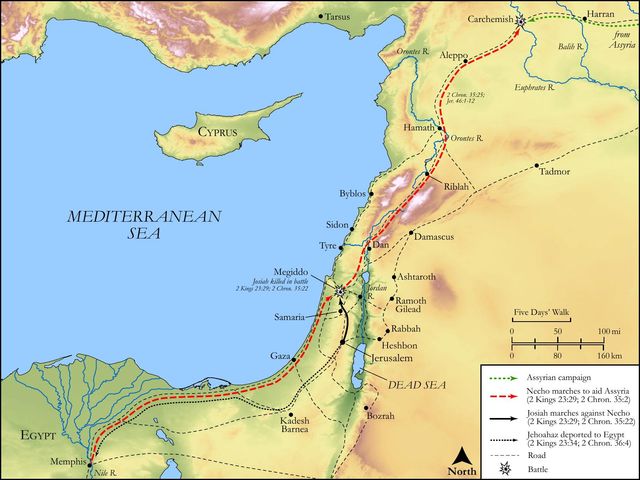
I.Josiah was a very good prince, yet he was much to be blamed for his rashness and presumption in going out to war against the king of Egypt without cause or call. It was bad enough, as it appeared in the Kings, that he meddled with strife which belonged not to him. But here it looks worse; for, it seems, the king of Egypt sent ambassadors to him, to warn him against this enterprise, Ch2 35:21.
1.The king of Egypt argued with Josiah,
(1.)From principles of justice. He professed that he had no desire to do him any hurt, and therefore it was unfair, against common equity and the law of nations, for Josiah to take up arms against him. If even a righteous man engage in an unrighteous cause, let him not expect to prosper. God is no respecter of persons. See Pro 3:30; Pro 25:8.
(2.)From principles of religion: "God is with me; nay, He commanded me to make haste, and therefore, if thou retard my motions, thou meddlest with God." It cannot be that the king of Egypt only pretended this (as Sennacherib did in a like case, Kg2 18:25), hoping thereby to make Josiah desist, because he knew he had a veneration for the word of God; for it is said here (Ch2 35:22) that the words of Necho were from the mouth of God. We must therefore suppose that either by a dream, or by a strong impulse upon his spirit which he had reason to think was from God, or by Jeremiah or some other prophet, he had ordered him to make war upon the king of Assyria.
(3.)From principles of policy: "That he destroy thee not; it is at thy peril if thou engage against one that has not only a better army and a better cause, but God on his side."
2.It was not in wrath to Josiah, whose heart was upright with the Lord his God, but in wrath to a hypocritical nation, who were unworthy of so good a king, that he was so far infatuated as not to hearken to these fair reasonings and desist from his enterprise. He would not turn his face from him, but went in person and fought the Egyptian army in the valley of Megiddo, Ch2 35:22. If perhaps he could not believe that the king of Egypt had a command from God to do what he did, yet, upon his pleading such a command, he ought to have consulted the oracles of God before he went out against him. His not doing that was his great fault, and of fatal consequence. In this matter he walked not in the ways of David his father; for, had it been his case, he would have enquired of the Lord, Shall I go up? Wilt thou deliver them into my hands? How can we think to prosper in our ways if we do not acknowledge God in them?
II.The people were a very wicked people, yet they were much to be commended for lamenting the death of Josiah as they did.
That Jeremiah lamented him I do not wonder; he was the weeping prophet, and plainly foresaw the utter ruin of his country following upon the death of this good king. But it is strange to find that all Judah and Jerusalem, that stupid senseless people, mourned for him (Ch2 35:24), contrived how to have their mourning excited by singing men and singing women, how to have it spread through the kingdom (they made an ordinance in Israel that the mournful ditties penned on this sad occasion should be learned and sung by all sorts of people), and also how to have the remembrance of it perpetuated: these elegies were inserted in the collections of state poems; they are written in the Lamentations. Hereby it appeared,
1.That they had some respect to their good prince, and that, though they did not cordially comply with him in all his good designs, they could not but greatly honour him. Pious useful men will be manifested in the consciences even of those that will not be influenced by their example; and many that will not submit to the rules of serious godliness themselves yet cannot but give it their good word and esteem it in others. Perhaps those lamented Josiah when he was dead that were not thankful to God for him while he lived. The Israelites murmured at Moses and Aaron while they were with them and spoke sometimes of stoning them, and yet, when they died, they mourned for them many days. We are often taught to value mercies by the loss of them which, when we enjoyed them, we did not prize as we ought.
2.That they had some sense of their own danger now that he was gone. Jeremiah told them, it is likely, of the evil they might now expect to come upon them, from which he was taken away; and so far they credited what he said that they lamented the death of him that was their defence. Note, Many will more easily be persuaded to lament the miseries that are coming upon them than to take the proper way by universal reformation to prevent them, will shed tears for their troubles, but will not be prevailed upon to part with their sins. But godly sorrow worketh repentance and that repentance will be to salvation.
Continue studying 2 Chronicles 35:26 across the web’s major study libraries — every link below opens this exact verse, chapter, or book on the destination site.
Read & Compare
 BibleGatewayThis verse in more than 200 translations and 70 languages.
 Bible.comThe YouVersion reader — hundreds of translations, reading plans, and highlights.
 ESV.orgCrossway's official English Standard Version reader.
 NET BibleThe NET translation with 60,000+ translators' notes on every rendering decision.
 STEP BibleTyndale House's free study tool — original text, vocabulary, and scholarly resources.
 BibliaLogos Bible Software's free web reader.
 USCCBThe New American Bible (Revised Edition) with the U.S. bishops' study notes.
Commentaries
 BibleHub CommentariesDozens of classic commentaries on this verse, gathered on one page.
 StudyLightMore than 100 commentary sets — the largest collection on the web.
 BibleRefPlain-English commentary on what this verse means, verse by verse.
 Enduring WordDavid Guzik's free commentary on this chapter, widely used by Bible teachers.
 Bible Study ToolsVerse commentary alongside Greek and Hebrew study aids.
Original Language & Research
- BibleHub InterlinearThe verse word by word — original language, transliteration, and English.
- BibleHub LexiconEvery word's original-language definition and Strong's entry.
 Blue Letter BibleDeep-study tools — Strong's numbers, concordance, and word studies.
 SefariaThe Hebrew text with Rashi and centuries of Jewish commentary.
Sermons, Hymns & Audio


TrulyRandomVerse is not affiliated with these sites and doesn’t control their content. They’re linked because they’re genuinely useful.
Summary
This verse serves as a profound and concise epilogue to the remarkable reign of King Josiah, one of Judah's most righteous monarchs. Immediately following the tragic account of his death, it encapsulates his life and enduring legacy by emphasizing that his "acts" and his inherent "goodness" were not merely human achievements or subjective qualities, but were meticulously aligned with, and indeed defined by, the divine standard revealed in the "law of the LORD." The Chronicler's concluding assessment underscores a central theological conviction: that true righteousness, legitimate authority, and successful kingship are ultimately measured by unwavering obedience to God's revealed will and covenant commands.
Context
ShowHideLiterary Context
2 Chronicles 35:26 belongs to the solemn epilogue to the Chronicler's extensive and largely laudatory account of King Josiah's reign, which spans from 2 Chronicles 34 through this chapter. It immediately follows the detailed and poignant narrative of Josiah's fatal encounter with Pharaoh Neco at Megiddo, as described in 2 Chronicles 35:20-25. As a concluding summary statement, it mirrors the common formula used for other kings in both Kings and Chronicles, but here it carries particular theological weight. Its placement ensures that the final impression of Josiah is one of unparalleled covenant faithfulness and adherence to God's Law, even in the shadow of his untimely death, thereby solidifying his unique position as a model king in Judah's history.
Historical & Cultural Context
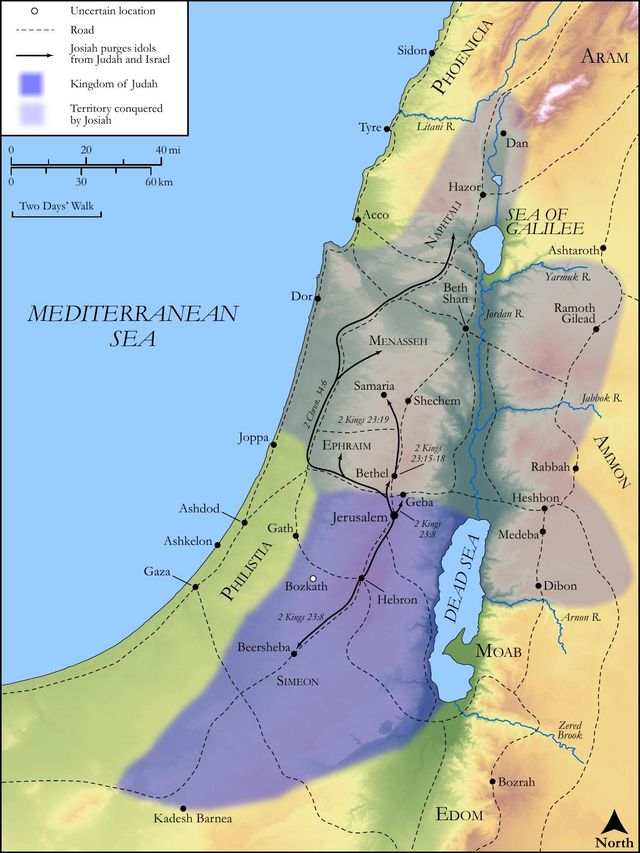
King Josiah reigned over the Southern Kingdom of Judah from 640-609 BC, a pivotal period just prior to the Babylonian exile. His reign is renowned for its sweeping religious reforms, which aimed to purge Judah of idolatry and re-establish exclusive worship of Yahweh. The catalyst for these profound changes was the discovery of the Book of the Law (widely believed to be a form of Deuteronomy) in the Temple during its renovation. This discovery deeply impacted Josiah, leading to a national covenant renewal, the systematic destruction of pagan altars and high places, and the celebration of an unprecedented Passover, as meticulously detailed in 2 Chronicles 34-35. Culturally, Josiah's actions represented a radical break from the syncretistic practices that had corrupted Judah for generations, marking a deliberate and forceful return to the foundational covenant principles established at Mount Sinai.
Key Themes
ShowHideThis verse powerfully reinforces several central themes woven throughout the book of Chronicles. Firstly, it underscores the theme of Righteous Leadership, presenting Josiah as the quintessential ideal king whose rule was genuinely and profoundly aligned with God's will, standing in stark contrast to the apostasy that characterized many of his predecessors. Secondly, the crucial phrase "according to that which was written in the law of the LORD" highlights the paramount theme of Obedience to God's Law. The Chronicler consistently measures the success, "goodness," and legitimacy of kings by their faithful adherence to the Torah, establishing divine instruction as the ultimate and non-negotiable standard for all human action, especially for those in positions of authority. Finally, despite his tragic end at Megiddo, Josiah's life is presented as a testament to the Lasting Legacy of Faithfulness. His "acts" and "goodness" are not arbitrary human achievements but are deeply rooted in his diligent and unparalleled obedience to God's covenant, thereby establishing an enduring standard for future generations and emphasizing that true impact and spiritual flourishing stem directly from conformity to divine truth, as exemplified by the unparalleled Passover celebration he led.
Exposition and Analysis
ShowHideKey Word Analysis
ShowHideThis word is highly versatile, meaning "word," "matter," or "thing." In this context, it refers to the totality of Josiah's deeds, accomplishments, and the events that comprised his reign. It encompasses his administrative decisions, military engagements, and especially his religious reforms. The use of "acts" here implies a comprehensive summary of his public and private life as king.
This term primarily denotes "kindness," "loving-kindness," or "mercy." While often used for God's covenant faithfulness, when applied to humans, it signifies piety, loyalty, and actions that demonstrate moral uprightness and adherence to covenant obligations. In Josiah's case, it refers to his righteous character, his devotion to Yahweh, and the positive, beneficial impact of his actions, particularly his efforts to restore true worship and eradicate idolatry, reflecting a life lived in covenant fidelity.
This word refers to divine instruction, precept, or statute, most commonly signifying the Pentateuch or the comprehensive revelation of God's will. It is not merely a legal code but the foundational guide for Israel's life, worship, and ethics. Josiah's commitment to the "law of the LORD" (Yᵉhôvâh, H3068) after its rediscovery was the defining characteristic of his reign, signifying a profound return to the covenant relationship and the authoritative Word of God.
Verse Breakdown
ShowHide"Now the rest of the acts of Josiah,"
This formulaic phrase, common in biblical historical books, serves as a concluding summary. It indicates that the biblical narrative has provided a selective account of Josiah's reign, and that further details or a more comprehensive record of his deeds (his "acts" or accomplishments) could be found in external sources, likely the royal annals or chronicles of Judah. It signals that the detailed narrative of his kingship is drawing to its end.
"and his goodness,"
This clause specifically highlights the moral and spiritual quality that characterized Josiah's reign. It emphasizes his righteous character, his deep devotion to God, and the positive, transformative impact of his actions, particularly his extensive religious reforms and his zealous efforts to cleanse the land of idolatry. This "goodness" is presented not as a mere human virtue but as a defining, divinely approved characteristic of his kingship.
"according to [that which was] written in the law of the LORD,"
This is the pivotal qualifying clause that provides the theological lens through which Josiah's entire life and reign are to be understood and evaluated. It means that his "acts" and his "goodness" were not arbitrary or self-defined, but were meticulously measured by, and conformed to, the precise divine standard revealed in the Torah. This phrase powerfully underscores the Chronicler's central theological message: true righteousness, legitimate authority, and national well-being are found in faithful, diligent, and unwavering obedience to God's revealed Word, making Josiah an unparalleled exemplar of covenant fidelity.
Literary Devices
ShowHideThe verse employs several significant literary devices to deliver its profound theological message. It functions as an Epilogue or Summary Statement, providing a concise yet comprehensive theological conclusion to the detailed narrative of Josiah's reign. This encapsulates his entire life's work and character within a single, definitive assessment. The crucial phrase "according to [that which was] written in the law of the LORD" acts as a powerful Thematic Emphasis, reiterating the Chronicler's overarching theological conviction that adherence to God's covenant and His revealed Law is the ultimate and non-negotiable measure of a king's righteousness and the nation's well-being. This creates an implicit Juxtaposition between Josiah and the many other kings of Judah who failed to live up to this divine standard, thereby highlighting Josiah's unique and exemplary faithfulness. The verse also demonstrates Conciseness, packing significant theological and historical meaning into a few carefully chosen words, making its concluding statement particularly impactful.
Theological and Thematic Connections
ShowHide2 Chronicles 35:26 powerfully articulates a foundational biblical principle: that true "goodness" and legitimate "acts" are not subjective human constructs but are objectively defined by conformity to God's revealed will. Josiah's life serves as a prime, albeit tragic, example of a ruler whose actions and character were intentionally and diligently shaped by the divine standard found in the "law of the LORD." This theological conviction resonates throughout the entirety of Scripture, asserting that God's Word is the ultimate plumb line for righteousness, guiding individuals and nations in their conduct, worship, and relationship with the Creator. The Chronicler, writing for a post-exilic community grappling with their identity and future, uses Josiah's unparalleled example to remind them that their restoration and future well-being depended not on political power, military strength, or worldly wisdom, but on a renewed, unwavering commitment to the covenant and diligent obedience to God's commands. This verse underscores the enduring truth that human flourishing is inextricably linked to divine instruction.
Reflection and Application
ShowHideJosiah's life, succinctly summarized in this verse, offers profound and enduring lessons for believers today. His "goodness" was not self-defined, nor was it a popularity contest; rather, it was precisely measured "according to that which was written in the law of the LORD." This challenges us to critically examine the ultimate standard for our own lives. In a contemporary world that often defines "good" by personal preference, prevailing societal norms, or fleeting cultural trends, Josiah's example serves as a powerful reminder that true moral excellence, spiritual integrity, and genuine impact are found exclusively in aligning our thoughts, words, and deeds with the unchanging, authoritative, and eternally relevant Word of God. Just as the dramatic discovery of the Law profoundly transformed Josiah's reign and the nation of Judah, a renewed, intentional, and diligent engagement with Scripture can similarly transform our individual lives, guiding us in our daily decisions, shaping our character, and empowering us to live a life that genuinely pleases God. Our legacy, whether within our families, communities, or vocations, should similarly be marked by a deep, unwavering commitment to live "according to that which was written in the law of the LORD," thereby reflecting His character and faithfully advancing His kingdom.
Questions for Reflection
ShowHideFAQ
ShowHideWhy is Josiah's "goodness" specifically tied to the "law of the LORD" in this summary verse, especially given his tragic death?
ShowHideThe Chronicler, writing from a post-exilic perspective, consistently emphasizes covenant obedience as the foundational principle for national well-being and individual righteousness. For the Chronicler, a king's success, legitimacy, and "goodness" were directly tied to his faithful adherence to God's Law. Josiah's reign was uniquely defined by the rediscovery of the Book of the Law and his subsequent radical, nationwide reforms, which were explicitly carried out "according to all that was written in the Book of the Covenant" (2 Chronicles 34:31). Therefore, tying his "goodness" to the "law of the LORD" is not merely a descriptive statement but a profound theological affirmation. It signifies that Josiah's righteousness was not a human invention, a matter of political expediency, or a result of popular opinion, but a divinely defined quality, rooted in his faithful and zealous response to God's revealed will. This highlights the Chronicler's central message: true blessing, enduring legacy, and legitimate authority flow directly from obedience to God's Word, even when circumstances, like Josiah's death, are difficult to reconcile.
Christ-Centered Fulfillment
ShowHideWhile King Josiah stands as a truly remarkable and exemplary monarch who diligently sought to live "according to that which was written in the law of the LORD," his life ultimately points beyond itself to the perfect and complete fulfillment found in Jesus Christ. Josiah, though devout and unparalleled in his generation, was still an imperfect human king whose reign ended tragically at Megiddo, and whose people eventually fell back into apostasy, leading to the devastating Babylonian exile. Jesus, however, is the perfectly righteous King, the true and greater Son of David, who not only lived "according to that which was written in the law of the LORD" but perfectly embodied, fulfilled, and ultimately transcended it. He declared, "Do not think that I have come to abolish the Law or the Prophets; I have not come to abolish them but to fulfill them" (Matthew 5:17). Unlike Josiah, whose "goodness" was a striving after God's demanding standard, Christ's goodness is inherent, absolute, and flawless; He is the Lamb of God who takes away the sin of the world, the one who was "in every respect has been tempted as we are, yet without sin" (Hebrews 4:15). Our "goodness" and righteousness before a holy God are not achieved by our own imperfect adherence to the Law, but by faith in Christ, who perfectly fulfilled the Law on our behalf, becoming "the end of the law for righteousness to everyone who believes" (Romans 10:4). In Him, we are made the "righteousness of God" (2 Corinthians 5:21), receiving a perfect standing and an imputed goodness that Josiah, despite all his zealous efforts, could never achieve for himself or his people.