


2 Chronicles 35:27
Bible text: King James Version (1769 Blayney text) · Public domain
Bible text: Berean Standard Bible · Public domain
Bible text: American Standard Version (1901) · Public domain
Bible text: World English Bible, Messianic edition · Public domain
Bible text: Geneva Bible (1599) · Public domain
Bible text: Young's Literal Translation · Public domain
- וּדְבָרָיוu·de·va·Ravand his mattersH1697Conj-w ¦ N-mpc ¦ 3msNoun Plural Masculine Constructוּandדְבָרָיmattersוhis
- הָרִאשֹׁנִיםha·ri·sho·Nim<the> formerH7223Art ¦ Adj-mpAdjective Numerical Position Plural Masculine Absoluteהָ<the>רִאשֹׁנִיםformer
- וְהָאַחֲרֹנִיםve·ha·'a·cha·ro·Nimand <the> latterH314Conj-w ¦ Art ¦ Adj-mpAdjective Plural Masculine Absoluteוְandהָ<the>אַחֲרֹנִיםlatter
- הִנָּםhi·Namthere theyH2005Prt ¦ 3mpParticle Interjectionהִנָּthereםthey
- כְּתוּבִיםke·tu·Vim[are] writtenH3789V-Qal-PassPrtcpl-mpVerb Qal Participle Passive Plural Masculine Absolute
- עַל'alonH5921PrepPreposition
- סֵפֶרSe·fer[the] scroll ofH5612N-mscNoun Singular Masculine Construct
- מַלְכֵיmal·khei[the] kings ofH4428N-mpcNoun Plural Masculine Construct
- יִשְׂרָאֵלYis·ra·'ElIsraelH3478N-properNoun Proper Location
- וִיהוּדָהvi·hu·Dahand JudahH3063Conj-w ¦ N-properNoun Proper LocationוִandיהוּדָהJudah
English is a literal word-by-word gloss of the Hebrew, not the KJV's wording. Why?
This is the original text the KJV's translators worked from — each Hebrew word with its own literal English meaning in this verse, prepared by scholars at Tyndale House, Cambridge. The KJV translates whole sentences, not word by word, so its wording differs: one Hebrew word can become several English words, and the KJV may choose “the LORD” where the gloss reads “Yahweh”. Both are faithful — they answer different questions. For the KJV's own rendering, switch to the KJV text.
Details
See on the biblical-era maps
Study this verse
Public-domain commentary
Matthew Henry
From his Commentary on the Whole Bible. Henry comments on passages, not single verses — this entry covers 2 Chronicles 35:20–27. His three-level outline is real structure in the source text, so it is rendered as structure.
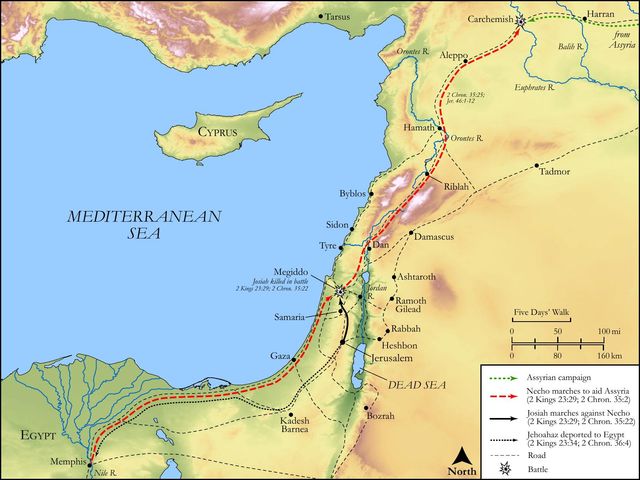
It was thirteen years from Josiah's famous passover to his death. During this time, we may hope, thing went well in his kingdom, that he prospered, and religion flourished; yet we are not entertained with the pleasing account of those years, but they are passed over in silence, because the people, for all this, were not turned from the love of their sins nor God from the fierceness of his anger. The next news therefore we hear of Josiah is that he is cut off in the midst of his days and usefulness, before he is full forty years old. We had this sad story, Kg2 23:29, Kg2 23:30. Here it is somewhat more largely related. That appears here, more than did there, which reflects such blame on Josiah and such praise on the people as one would not have expected.
I.Josiah was a very good prince, yet he was much to be blamed for his rashness and presumption in going out to war against the king of Egypt without cause or call. It was bad enough, as it appeared in the Kings, that he meddled with strife which belonged not to him. But here it looks worse; for, it seems, the king of Egypt sent ambassadors to him, to warn him against this enterprise, Ch2 35:21.
1.The king of Egypt argued with Josiah,
(1.)From principles of justice. He professed that he had no desire to do him any hurt, and therefore it was unfair, against common equity and the law of nations, for Josiah to take up arms against him. If even a righteous man engage in an unrighteous cause, let him not expect to prosper. God is no respecter of persons. See Pro 3:30; Pro 25:8.
(2.)From principles of religion: "God is with me; nay, He commanded me to make haste, and therefore, if thou retard my motions, thou meddlest with God." It cannot be that the king of Egypt only pretended this (as Sennacherib did in a like case, Kg2 18:25), hoping thereby to make Josiah desist, because he knew he had a veneration for the word of God; for it is said here (Ch2 35:22) that the words of Necho were from the mouth of God. We must therefore suppose that either by a dream, or by a strong impulse upon his spirit which he had reason to think was from God, or by Jeremiah or some other prophet, he had ordered him to make war upon the king of Assyria.
(3.)From principles of policy: "That he destroy thee not; it is at thy peril if thou engage against one that has not only a better army and a better cause, but God on his side."
2.It was not in wrath to Josiah, whose heart was upright with the Lord his God, but in wrath to a hypocritical nation, who were unworthy of so good a king, that he was so far infatuated as not to hearken to these fair reasonings and desist from his enterprise. He would not turn his face from him, but went in person and fought the Egyptian army in the valley of Megiddo, Ch2 35:22. If perhaps he could not believe that the king of Egypt had a command from God to do what he did, yet, upon his pleading such a command, he ought to have consulted the oracles of God before he went out against him. His not doing that was his great fault, and of fatal consequence. In this matter he walked not in the ways of David his father; for, had it been his case, he would have enquired of the Lord, Shall I go up? Wilt thou deliver them into my hands? How can we think to prosper in our ways if we do not acknowledge God in them?
II.The people were a very wicked people, yet they were much to be commended for lamenting the death of Josiah as they did.
That Jeremiah lamented him I do not wonder; he was the weeping prophet, and plainly foresaw the utter ruin of his country following upon the death of this good king. But it is strange to find that all Judah and Jerusalem, that stupid senseless people, mourned for him (Ch2 35:24), contrived how to have their mourning excited by singing men and singing women, how to have it spread through the kingdom (they made an ordinance in Israel that the mournful ditties penned on this sad occasion should be learned and sung by all sorts of people), and also how to have the remembrance of it perpetuated: these elegies were inserted in the collections of state poems; they are written in the Lamentations. Hereby it appeared,
1.That they had some respect to their good prince, and that, though they did not cordially comply with him in all his good designs, they could not but greatly honour him. Pious useful men will be manifested in the consciences even of those that will not be influenced by their example; and many that will not submit to the rules of serious godliness themselves yet cannot but give it their good word and esteem it in others. Perhaps those lamented Josiah when he was dead that were not thankful to God for him while he lived. The Israelites murmured at Moses and Aaron while they were with them and spoke sometimes of stoning them, and yet, when they died, they mourned for them many days. We are often taught to value mercies by the loss of them which, when we enjoyed them, we did not prize as we ought.
2.That they had some sense of their own danger now that he was gone. Jeremiah told them, it is likely, of the evil they might now expect to come upon them, from which he was taken away; and so far they credited what he said that they lamented the death of him that was their defence. Note, Many will more easily be persuaded to lament the miseries that are coming upon them than to take the proper way by universal reformation to prevent them, will shed tears for their troubles, but will not be prevailed upon to part with their sins. But godly sorrow worketh repentance and that repentance will be to salvation.
Continue studying 2 Chronicles 35:27 across the web’s major study libraries — every link below opens this exact verse, chapter, or book on the destination site.
Read & Compare
 BibleGatewayThis verse in more than 200 translations and 70 languages.
 Bible.comThe YouVersion reader — hundreds of translations, reading plans, and highlights.
 ESV.orgCrossway's official English Standard Version reader.
 NET BibleThe NET translation with 60,000+ translators' notes on every rendering decision.
 STEP BibleTyndale House's free study tool — original text, vocabulary, and scholarly resources.
 BibliaLogos Bible Software's free web reader.
 USCCBThe New American Bible (Revised Edition) with the U.S. bishops' study notes.
Commentaries
 BibleHub CommentariesDozens of classic commentaries on this verse, gathered on one page.
 StudyLightMore than 100 commentary sets — the largest collection on the web.
 BibleRefPlain-English commentary on what this verse means, verse by verse.
 Enduring WordDavid Guzik's free commentary on this chapter, widely used by Bible teachers.
 Bible Study ToolsVerse commentary alongside Greek and Hebrew study aids.
Original Language & Research
- BibleHub InterlinearThe verse word by word — original language, transliteration, and English.
- BibleHub LexiconEvery word's original-language definition and Strong's entry.
 Blue Letter BibleDeep-study tools — Strong's numbers, concordance, and word studies.
 SefariaThe Hebrew text with Rashi and centuries of Jewish commentary.
Sermons, Hymns & Audio


TrulyRandomVerse is not affiliated with these sites and doesn’t control their content. They’re linked because they’re genuinely useful.
Summary
Second Chronicles 35:27 serves as a concise yet profound epilogue to the reign of King Josiah, affirming the comprehensive and meticulous documentation of his entire life and actions within the official royal chronicles of Israel and Judah. This verse not only validates the historical veracity of the Chronicler's account but also underscores the practice of maintaining detailed state records, ensuring that the significant deeds of rulers, from their earliest initiatives to their final acts, were preserved for posterity and as a testament to their legacy.
Context
ShowHideLiterary Context
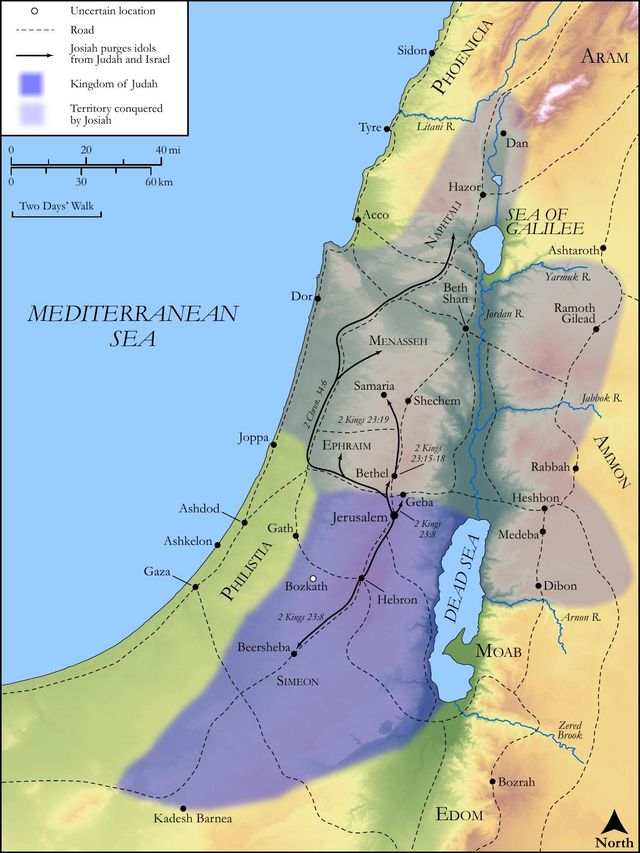
This verse concludes the detailed narrative of King Josiah, one of Judah's most righteous kings, whose reign is extensively documented in 2 Chronicles 34-35. Chapters 34 and 35 meticulously recount his early and fervent religious reforms, his efforts to purge idolatry from the land, and his monumental restoration of the temple, which led to the serendipitous discovery of the Book of the Law (2 Chronicles 34:14-21). His reign culminated in a grand Passover celebration, described as unprecedented since the days of Samuel (2 Chronicles 35:18). Despite his piety and faithfulness, Josiah met a tragic and unexpected end in battle at Megiddo against Pharaoh Neco of Egypt, a somber event detailed in 2 Chronicles 35:20-24. Verse 27, therefore, acts as a formal concluding statement, emphasizing that the entirety of his life, both his glorious achievements and his tragic demise, was officially recorded, lending authority and completeness to the Chronicler's account and directing the reader to further historical sources.
Historical & Cultural Context
Among the kings of that day, it was common practice for royal courts to maintain detailed annals or chronicles, as in the court of Ahasuerus, where "the book of records of the chronicles" was read before the king. These records, often kept by court scribes, documented the significant events, decrees, military campaigns, building projects, and religious reforms of the reigning monarch. Such records served multiple purposes: they legitimized the king's rule, provided a historical account for future generations, and often glorified the monarch's achievements. The "book of the kings of Israel and Judah" mentioned here refers to these official, non-canonical state archives rather than the biblical books of Kings we possess today. The Chronicler, writing centuries later, frequently refers to such sources (e.g., 1 Chronicles 29:29, 2 Chronicles 9:29) to authenticate his narrative, demonstrating that his account was based on established historical documentation available to his audience. This practice highlights the importance of historical record-keeping and verifiable sources in ancient Israelite culture, emphasizing the factual basis for the Chronicler's theological interpretation of history.
Key Themes
ShowHideThis concluding verse contributes significantly to several overarching themes within 2 Chronicles. Firstly, it reinforces the Historical Veracity of the Chronicler's narrative, assuring the reader that the detailed account of Josiah's reign is grounded in reliable, official documentation. This emphasis on external sources lends credibility to the biblical record. Secondly, the phrase "first and last" underscores the Completeness of Life's Record, signifying that every aspect of Josiah's deeds, from his initial reforms as a young king (2 Chronicles 34:3) to his final moments, was deemed significant enough to be meticulously recorded. This speaks to the idea that a life, particularly one lived in service to God, is observed and accounted for in its entirety. Finally, the verse highlights the theme of Legacy and Remembrance. Josiah's life, marked by profound piety and a fervent commitment to God's law, serves as a powerful example of a leader who sought God wholeheartedly. The recording of his deeds ensures that his faithful service and significant actions leave an enduring legacy that is remembered, both in human history and, implicitly, by God, providing a model for future generations.
Exposition and Analysis
ShowHideKey Word Analysis
ShowHideFrom the root דָבַר, this term (H1697) is broad in its semantic range, encompassing "word," "matter," or "thing." In this context, "deeds" refers to the comprehensive scope of Josiah's actions, events, and accomplishments throughout his reign. It signifies not merely isolated acts but the entire narrative of his kingship, including his religious reforms, military engagements, and administrative initiatives. The use of this all-encompassing term emphasizes the exhaustive nature of the historical record.
From the root רִאשָׁה, this term (H7223) denotes "first" in place, time, or rank. When paired with "last," it forms a merism, signifying the inception or earliest stages of Josiah's reign and actions. It points to the meticulous recording of his initial endeavors and early commitments, such as his purification of Judah and Jerusalem from idolatry.
From the root אָחַר, this term (H314) means "hinder," "late," or "last." As part of the merism, it refers to the conclusion or final stages of Josiah's reign, including his tragic death at Megiddo. Together with "first," it underscores that the historical account covers the entirety of his life and rule, leaving no period unaddressed.
Verse Breakdown
ShowHide"And his deeds, first and last,"
This opening clause immediately establishes the comprehensive scope of the historical record. "His deeds" refers to all the actions, events, and accomplishments of King Josiah. The phrase "first and last" acts as a merism, a literary device using two contrasting parts to represent a whole, emphasizing that every single aspect of his reign, from its earliest beginnings to its final moments, is included. It conveys a sense of thorough and complete documentation.
"behold, they [are] written"
The interjection "behold" (Hebrew: hinneh) serves to draw the reader's attention to the certainty and existence of the record. The passive verb "are written" underscores that these deeds have been formally and permanently inscribed, indicating a reliable and accessible historical account. This affirms the Chronicler's claim to historical accuracy and reliance on established sources, validating the narrative he has presented.
"in the book of the kings of Israel and Judah."
This final phrase specifies the location of these comprehensive records. It points to the official, non-canonical royal archives or chronicles maintained by the scribes of the kingdoms. This was a common practice among the kings of that day, whose reigns were meticulously documented. The Chronicler's reference serves to authenticate his narrative, indicating that his account of Josiah's life is based on verifiable historical sources, which were presumably available to his original audience.
Literary Devices
ShowHideThe verse primarily employs Historical Reference and Merism. The explicit mention of "the book of the kings of Israel and Judah" serves as a direct Historical Reference, grounding the Chronicler's narrative in verifiable, external documentation. This device lends credibility and authority to the biblical account, assuring the reader that the story of Josiah is not merely legend but is corroborated by official state records. The phrase "first and last" is a clear example of Merism, a rhetorical device where two contrasting parts are used to represent a whole. In this case, "first" and "last" encompass the entirety of Josiah's deeds, from the beginning to the end of his reign, emphasizing the exhaustive nature of the historical record. This also functions as a Colophon or epilogue, a traditional way to conclude ancient texts by referencing their source or confirming their completion, thereby adding a layer of authenticity and finality to the Chronicler's account of Josiah.
Theological and Thematic Connections
ShowHideThis verse, while seemingly a simple historical footnote, carries profound theological implications. It speaks to the divine value placed on human actions and the principle of accountability. Just as Josiah's entire life was meticulously recorded in human annals, so too does God observe and remember every deed, both public and private. This concept points to God's omniscience and His righteous judgment, where nothing is hidden from His sight. It underscores that lives lived in faithfulness, or indeed unfaithfulness, leave an indelible mark, not only in human history but also in the divine ledger. The Chronicler's emphasis on historical records implicitly reminds us that our lives are not lived in a vacuum but contribute to a larger narrative, ultimately accountable to the sovereign God who oversees all of history. This divine record-keeping ensures that justice will ultimately prevail and that righteous deeds will not be forgotten.
Reflection and Application
ShowHideThe meticulous recording of King Josiah's "deeds, first and last," serves as a powerful reminder that every aspect of our lives holds significance, both in the eyes of humanity and, more importantly, in the eyes of God. We are called to live with intentionality, understanding that our choices, our character, and our impact contribute to a lasting legacy. This verse encourages us to consider the "record" we are writing with our lives daily. Are our "deeds" characterized by faithfulness, integrity, and a pursuit of God's will, like Josiah's early reign? Or are they marred by compromise and self-interest? For believers, this truth is both sobering and empowering. It calls us to stewardship of our time, talents, and testimony, knowing that our actions are not inconsequential but are woven into the fabric of God's grand narrative. It invites us to live in a way that honors God, leaving a legacy that points others to Him, confident that our labor in the Lord is never in vain and that our lives, in their entirety, are known to the One who truly matters.
Questions for Reflection
ShowHideFAQ
ShowHideIs "the book of the kings of Israel and Judah" the same as the biblical books of 1 & 2 Kings?
ShowHideNo, "the book of the kings of Israel and Judah" mentioned in 2 Chronicles 35:27 (and numerous other places in Chronicles) refers to the official, non-canonical royal annals or court chronicles maintained by the scribes of the ancient Israelite and Judean kingdoms. These were primary historical source materials from which the biblical authors, including the Chronicler, drew information. The canonical books of 1 & 2 Kings, while drawing upon these and other sources, are theological narratives that interpret history through the lens of God's covenant with Israel, focusing on obedience and disobedience to the Law. They are distinct from the raw, official state records. The Chronicler's frequent reference to these external "books" served to authenticate his narrative and provide a verifiable basis for his historical claims to his original audience.
What is the significance of the phrase "first and last" in this verse?
ShowHideThe phrase "first and last" (Hebrew: ri'shonim v'acharonim) is a common Hebrew idiom, known as a merism. It signifies totality or completeness, meaning "from beginning to end" or "all of them." In 2 Chronicles 35:27, its significance lies in emphasizing that the entire span of King Josiah's reign and all his actions, from his earliest reforms as a young king (e.g., 2 Chronicles 34:3-7) to his final, tragic battle (e.g., 2 Chronicles 35:20-24), were meticulously recorded in the official historical annals. This highlights the comprehensive nature of the historical documentation and underscores that no part of his life or reign was omitted from the record, providing a complete account for posterity.
Christ-Centered Fulfillment
ShowHideWhile 2 Chronicles 35:27 speaks of the meticulous human record of King Josiah's deeds, it implicitly points forward to the ultimate and perfect record of the life of Jesus Christ. Josiah, a righteous king who sought to restore the law and lead his people in a great Passover, foreshadows Christ, the true and greater King who perfectly fulfilled the Law and inaugurated the ultimate Passover through His atoning sacrifice. Unlike Josiah, whose reign ended tragically despite his piety, Jesus' life was one of unblemished righteousness, "without sin" (Hebrews 4:15). Every "deed, first and last," of Christ's earthly ministry, from His miraculous birth and humble beginnings (Matthew 1:18-25) to His triumphant resurrection and ascension (Acts 1:9-11), is perfectly recorded not only in the Gospels but eternally in the divine counsels. His life provides the ultimate example of perfect obedience and faithfulness, a record that stands as the basis for the salvation of all who believe (Romans 5:19). Furthermore, the divine record-keeping implied in this verse finds its ultimate expression in Christ's role as the righteous judge, before whom all "books" will be opened (Revelation 20:12), and whose own perfect "deeds" are the foundation for the justification of His people, securing their eternal legacy in Him.