


2 Kings 16:19
Bible text: King James Version (1769 Blayney text) · Public domain
Bible text: Berean Standard Bible · Public domain
Bible text: American Standard Version (1901) · Public domain
Bible text: World English Bible, Messianic edition · Public domain
Bible text: Geneva Bible (1599) · Public domain
Bible text: Young's Literal Translation · Public domain
- וְיֶתֶרve·Ye·terand [the] rest ofH3499Conj-w ¦ N-mscNoun Singular Masculine Constructוְandיֶתֶר[the] rest of
- דִּבְרֵיdiv·Rei[the] matters ofH1697N-mpcNoun Plural Masculine Construct
- אָחָז'a·ChazAhazH271N-proper-mNoun Proper Masculine
- אֲשֶׁר'a·SherwhichH834RelParticle Relative
- עָשָׂה'a·Sahhe didH6213V-Qal-Perf-3msVerb Qal Perfect 3rd Singular Masculine
- הֲלֹאha·lo'¿ notH3808Interrog ¦ NegParticle Negativeהֲ¿לֹאnot
- הֵםhem[are] theyH1992Pro-3mpPronoun Personal 3rd Plural Masculine
- כְּתוּבִיםke·tu·VimwrittenH3789V-Qal-PassPrtcpl-mpVerb Qal Participle Passive Plural Masculine Absolute
- עַל'alonH5921PrepPreposition
- סֵפֶרSe·fer[the] scroll ofH5612N-mscNoun Singular Masculine Construct
- דִּבְרֵיdiv·Rei[the] matters ofH1697N-mpcNoun Title Plural Masculine Construct
- הַיָּמִיםhai·ya·Mimthe daysH3117Art ¦ N-mpNoun Plural Masculine Absoluteהַtheיָּמִיםdays
- לְמַלְכֵיle·mal·Kheiof [the] kings ofH4428Prep-l ¦ N-mpcNoun Plural Masculine Constructלְofמַלְכֵי[the] kings of
- יְהוּדָהye·hu·DahJudahH3063N-properNoun Proper Location
English is a literal word-by-word gloss of the Hebrew, not the KJV's wording. Why?
This is the original text the KJV's translators worked from — each Hebrew word with its own literal English meaning in this verse, prepared by scholars at Tyndale House, Cambridge. The KJV translates whole sentences, not word by word, so its wording differs: one Hebrew word can become several English words, and the KJV may choose “the LORD” where the gloss reads “Yahweh”. Both are faithful — they answer different questions. For the KJV's own rendering, switch to the KJV text.
Details
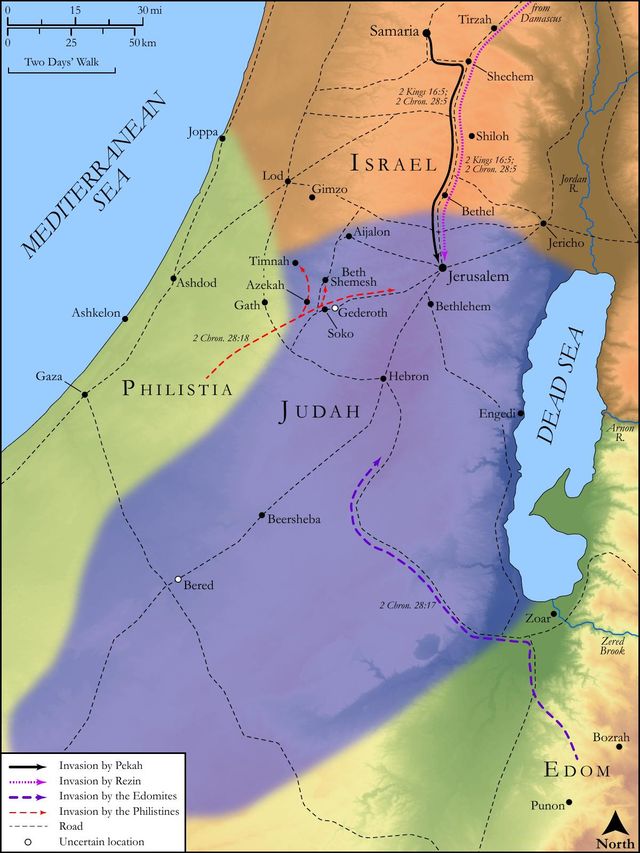
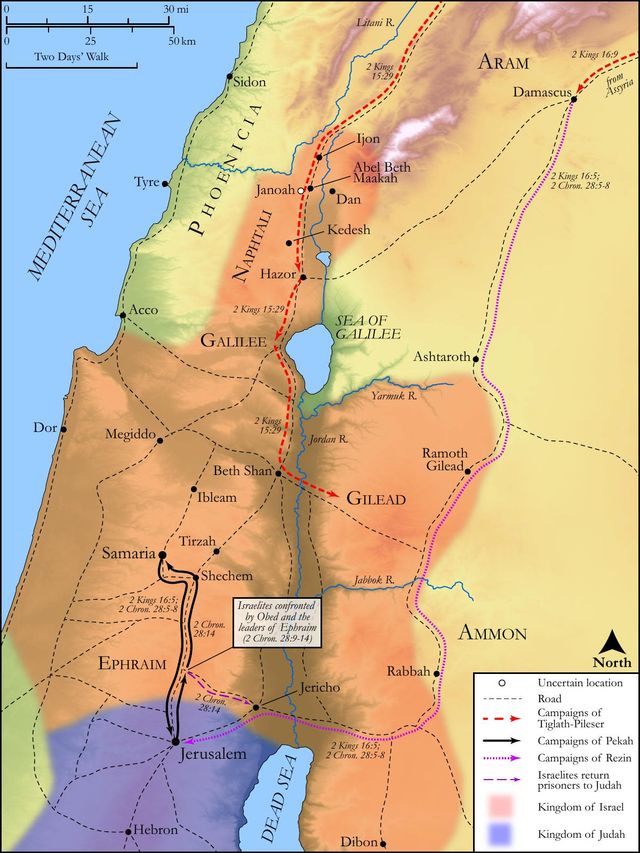
See on the biblical-era maps
Study this verse
Public-domain commentary
Matthew Henry
From his Commentary on the Whole Bible. Henry comments on passages, not single verses — this entry covers 2 Kings 16:17–20.
Here is, I. Ahaz abusing the temple, not the building itself, but some of the furniture of it. 1. He defaced the bases on which the lavers were set (Kg1 7:28, Kg1 7:29) and took down the molten sea, Kg2 16:17. These the priests used for washing; against them therefore he seems to have had a particular spite. It is one of the greatest prejudices that can be done to religion to obstruct the purifying of the priests, the Lord's ministers. 2. He removed the covert for the sabbath, erected either in honour of the sabbath or for the conveniency of the priests, when, on the sabbath, they officiated in greater numbers than on other days. Whatever it was, it should seem that in removing it he intended to put a contempt upon the sabbath, and so to open as wide an inlet as any to all manner of impiety. 3. The king's entry, which led to the house of the Lord, for the convenience of the royal family (perhaps that ascent which Solomon had made, and which the queen of Sheba admired, Kg1 10:5), he turned another way, to show that he did not intend to frequent the house of the Lord any more. This he did for the king of Assyria, to oblige him, who perhaps returned his visit, and found fault with this entry, as an inconvenience and disparagement to his palace. When those that have had a ready passage to the house of the Lord, to please their neighbours, turn it another way, they are going down the hill apace towards their ruin.
II.Ahaz resigning his life in the midst of his days, at thirty-six years of age (Kg2 16:19) and leaving his kingdom to a better man, Hezekiah his son (Kg2 16:20), who proved as much a friend to the temple as he had been an enemy to it. Perhaps this very son he had made to pass through the fire, and thereby dedicated him to Moloch; but God, by his grace, snatched him as a brand out of the burning.
Historical interpretation
Historical reception
1 surviving comment on this verse from the historical church.
I certainly do not think that he built [the altar] for the God of all things but just for certain of those who are falsely called gods. This is what the book of Chronicles points out. It reads, “In the time of his distress this king Ahaz became yet more faithless to the Lord. For he sacrificed to the gods of Damascus, which had defeated him, and said, “Because the gods of the kings of Aram helped them, I will sacrifice to them so that they may help me.” But they were the ruin of him and of all Israel.” And this is also signified by the next verse: “Ahaz gathered together the utensils of the house of God and cut in pieces the utensils of the house of God. He shut up the doors of the house of the Lord and made himself altars in every corner of Jerusalem.” He did these and other similar things, as is also confirmed in the book of Chronicles: “When King Ahaz went to Damascus to meet King Tiglath-pileser of Assyria, he saw the altar that was at Damascus. King Ahaz sent to the priest Uriah a model of the altar, and its pattern, exact in all its details.” He removed the genuine altar of bronze, which Solomon had built, and put in its place another one recently made. And what happened to the stands is revealed by what follows: “King Ahaz cut off the frames of the stands,” the text says, “and removed the laver from them.” And he even dared to commit another act of impiety: he moved the entrance of the royal house into the divine temple, transforming the sacred enclosure into a thoroughfare.
Continue studying 2 Kings 16:19 across the web’s major study libraries — every link below opens this exact verse, chapter, or book on the destination site.
Read & Compare
 BibleGatewayThis verse in more than 200 translations and 70 languages.
 Bible.comThe YouVersion reader — hundreds of translations, reading plans, and highlights.
 ESV.orgCrossway's official English Standard Version reader.
 NET BibleThe NET translation with 60,000+ translators' notes on every rendering decision.
 STEP BibleTyndale House's free study tool — original text, vocabulary, and scholarly resources.
 BibliaLogos Bible Software's free web reader.
 USCCBThe New American Bible (Revised Edition) with the U.S. bishops' study notes.
Commentaries
 BibleHub CommentariesDozens of classic commentaries on this verse, gathered on one page.
 StudyLightMore than 100 commentary sets — the largest collection on the web.
 BibleRefPlain-English commentary on what this verse means, verse by verse.
 Enduring WordDavid Guzik's free commentary on this chapter, widely used by Bible teachers.
 Bible Study ToolsVerse commentary alongside Greek and Hebrew study aids.
Original Language & Research
- BibleHub InterlinearThe verse word by word — original language, transliteration, and English.
- BibleHub LexiconEvery word's original-language definition and Strong's entry.
 Blue Letter BibleDeep-study tools — Strong's numbers, concordance, and word studies.
 SefariaThe Hebrew text with Rashi and centuries of Jewish commentary.
Sermons, Hymns & Audio


TrulyRandomVerse is not affiliated with these sites and doesn’t control their content. They’re linked because they’re genuinely useful.
Summary
Second Kings 16:19 serves as the concluding formula for the reign of King Ahaz, directing the reader to the official royal annals of Judah for a more comprehensive record of his deeds. This seemingly administrative verse profoundly highlights the inspired author's selective yet historically grounded approach to biblical history, emphasizing that the divine narrative prioritizes theological revelation and God's redemptive purposes over exhaustive historical documentation. It subtly underscores the principle of accountability for all rulers before God and affirms the purposeful sufficiency of divine revelation for faith and life.
Context
ShowHideLiterary Context
This verse functions as the standard concluding summary for the account of King Ahaz's reign within 2 Kings 16. This formulaic phrase—"Now the rest of the acts of X... are they not written in the book of the chronicles of the kings of Judah/Israel?"—is a consistent literary device employed throughout the Books of Kings. It serves to mark the end of a king's individual narrative and smoothly transition to the next, reinforcing the structured and authoritative nature of the historical record. By pointing to external sources, the biblical author signals that the inspired text, while historically accurate, is not an exhaustive chronicle of every event. The immediate preceding verses (e.g., 2 Kings 16:10-18) vividly detail Ahaz's profound apostasy, his alliance with Assyria, and his introduction of pagan altars and practices into the Jerusalem temple. Thus, this concluding reference to "the rest of his acts" is a poignant acknowledgment of a reign characterized by significant spiritual deviation, reminding the reader that even more wickedness occurred beyond the theological focus of the biblical account.
Historical & Cultural Context
King Ahaz's 16-year reign (circa 735-715 BC) unfolded during one of the most volatile periods among the nations, characterized by the rising dominance of the Assyrian Empire. Culturally, his rule was marked by a severe spiritual decline, as he actively promoted idolatry, even engaging in the detestable practice of child sacrifice, as explicitly recounted in 2 Kings 16:3. Politically, Ahaz faced the existential threat of the Syro-Ephraimite coalition (Aram and Israel), who sought to depose him. Defying the prophetic counsel of Isaiah, who urged faith in Yahweh (see Isaiah 7:1-9), Ahaz chose to seek military intervention from the powerful Assyrian Empire. This desperate alliance resulted in Judah's subjugation, heavy economic tribute, and deepened spiritual compromise, as Ahaz readily adopted Assyrian religious customs and architectural styles, even within the Jerusalem temple. The "book of the chronicles of the kings of Judah" refers to the official royal annals, meticulously maintained by scribes within the Judean court. These were comprehensive, secular records detailing royal decrees, military campaigns, building projects, and other significant state affairs, serving as the official historical archive of the kingdom, distinct from the divinely inspired and theologically selective biblical narrative.
Key Themes
ShowHideThis verse significantly contributes to several key themes woven throughout the Books of Kings. Firstly, it underscores the historical grounding of the biblical narrative by acknowledging the robust record-keeping practices of the kingdoms of that day. By referencing these external, comprehensive sources, the inspired text affirms its factual basis, demonstrating that it is rooted in real historical events and verifiable data. Secondly, and perhaps most profoundly, it highlights the selective nature of biblical history. The inspired authors, guided by the Holy Spirit, did not aim for encyclopedic completeness but rather meticulously curated events and details to convey specific theological messages. The biblical account's primary concern is not merely secular history, but God's covenant faithfulness, the consequences of obedience and disobedience, and the unfolding of His redemptive plan. This theological selectivity is a hallmark of Kings, evident in similar concluding statements for other monarchs, such as 1 Kings 11:41 regarding Solomon. Finally, the mention of these official records subtly reinforces the theme of divine oversight and accountability. It implies that every king's actions, whether righteous or wicked, were meticulously recorded and preserved, not only in human annals but ultimately in the divine memory, emphasizing that all rulers are answerable to God for their stewardship, as seen in the broader prophetic messages concerning kingship throughout the Old Testament (e.g., Deuteronomy 17:14-20).
Exposition and Analysis
ShowHideKey Word Analysis
ShowHideMeaning "an overhanging," "an excess," "superiority," or "remainder." In this context, "the rest" refers to the remaining portion or residue of Ahaz's actions and events during his reign that are not detailed within the biblical narrative. It implies that the inspired account is not exhaustive but rather a selective summary, with a larger body of information existing elsewhere.
Meaning "a word," "matter," or "thing." By implication, it refers to deeds, events, or official transactions. Here, "acts" encompasses all significant occurrences, decisions, and outcomes that characterized King Ahaz's time on the throne, including his policies, military campaigns, building projects, and religious reforms, both public and private.
A primitive root meaning "to grave," or by implication, "to write" (describe, inscribe, prescribe, subscribe). This word emphasizes the formal and authoritative nature of the records. It confirms that the "chronicles" were not merely oral traditions but meticulously documented, preserved historical accounts, lending credibility to the biblical author's reference.
Verse Breakdown
ShowHide"Now the rest of the acts of Ahaz which he did"
This introductory phrase serves as a literary bridge, signaling the conclusion of the immediate biblical narrative concerning Ahaz's reign. It explicitly acknowledges that the preceding account in 2 Kings is not an exhaustive biography but rather a divinely curated summary of his deeds. The phrase implies a vast array of other actions, policies, and events—both significant and mundane—that occurred during his 16-year rule, which are not detailed in the inspired text. This highlights the Bible's focus on theological relevance over encyclopedic completeness.
"[are] they not written in the book of the chronicles of the kings of Judah?"
This rhetorical question functions as a powerful affirmative statement, asserting the undisputed existence and accessibility of comprehensive official state records—the royal annals of Judah. By pointing to these external, well-known historical documents, the biblical author lends credibility and historical grounding to the narrative, demonstrating that the biblical account is rooted in verifiable history. It assures the reader that these "chronicles" contained the full, secular details, while the inspired text selectively presented information for its specific divine purpose of revealing God's character and covenant relationship with His people.
Literary Devices
ShowHideThe verse employs several significant literary devices that enrich its meaning and function within the broader narrative of Kings. Foremost is Formulaic Language, as the precise phrasing "Now the rest of the acts of X which he did, are they not written in the book of the chronicles of the kings of Judah/Israel?" is a pervasive literary trope throughout the Books of Kings. This consistent formula serves as a crucial structural marker, signaling the conclusion of one king's reign summary and providing a seamless sense of historical continuity and completeness across the succession of monarchs. Secondly, the verse utilizes a Rhetorical Question ("are they not written...?"). This is not a genuine inquiry seeking information, but rather a powerful declarative statement posed as a question to emphasize an obvious, undeniable truth. It underscores the public and well-known nature of the royal annals, thereby validating the historical context and reliability of the biblical narrative. Finally, there is an element of Metonymy, where "the book of the chronicles" stands not merely for a single physical volume, but for the entire body of official historical records and the comprehensive historical knowledge contained within them. This device points to a broader historical reality that undergirds the divinely inspired, yet selective, biblical account, assuring the reader of its factual foundation.
Theological and Thematic Connections
ShowHideThis seemingly administrative verse carries profound theological weight, transcending its simple historical function. It powerfully affirms the historicity of the biblical narrative by referencing external, verifiable records, thereby grounding God's interaction with humanity firmly in real time and space. Yet, by deliberately choosing to include only certain details while pointing to more extensive records, the verse highlights the Bible's primary purpose: it is not a comprehensive historical encyclopedia, but rather a divinely inspired revelation of God's character, His unwavering covenant faithfulness, and His unfolding plan of salvation. This teaches us a crucial truth about the sufficiency of God's Word: it provides all the essential truths necessary for faith, godliness, and eternal life, even if it does not exhaust every historical detail. The very existence of these external "chronicles" also subtly reinforces the principle of divine oversight and accountability in history, suggesting that all human actions, especially those of leaders, are meticulously recorded and ultimately held accountable, not just in human annals, but before the sovereign God.
Reflection and Application
ShowHideThe reference to "the book of the chronicles" in 2 Kings 16:19 serves as a profound invitation for us to reflect on the nature of divine revelation and the depth of our trust in God's Word. In an age saturated with information and often demanding exhaustive detail, this verse profoundly reminds us that the Bible is not merely a historical textbook or a secular archive, but a divinely inspired, theological narrative, carefully curated by the Holy Spirit to reveal God's redemptive purposes for humanity. It teaches us that while historical accuracy is foundational, the ultimate purpose of Scripture is to draw us into a deeper, transformative relationship with God and to guide us in His perfect ways. We are therefore called to embrace and trust in the sufficiency of what God has chosen to reveal, knowing that He has graciously provided everything necessary for life and godliness through His inspired Word. Furthermore, the accountability of earthly kings, whose "acts" were meticulously recorded for posterity, serves as a timeless and sobering reminder that all our deeds—whether public or private, celebrated or hidden—are known to God. This truth should stir within us a profound desire to live lives that honor Him, understanding that our own "chronicles" are being written, not just in human memory, but ultimately in the divine ledger, before the all-seeing eyes of our Creator.
Questions for Reflection
ShowHideFAQ
ShowHideWhy does the Bible refer to other books that are not part of the biblical canon?
ShowHideThe Bible frequently refers to external historical records, such as "the book of the chronicles of the kings of Judah" (as in 2 Kings 16:19) or "the book of Jashar" (Joshua 10:13), for several key reasons. Firstly, it serves to affirm the historical accuracy and grounding of the biblical narrative. By pointing to contemporary, official state archives, the biblical authors demonstrate that their accounts are rooted in verifiable history, not myth. Secondly, it highlights the selective and purposeful nature of the biblical text. The Bible is not an exhaustive historical encyclopedia; rather, it is a divinely inspired theological work. It selectively presents historical facts to convey specific spiritual truths about God's character, His covenant relationship with humanity, and His unfolding plan of redemption. The external chronicles contained more secular details, but the biblical authors, guided by the Holy Spirit, included only what was necessary for their theological message. Thus, these references underscore the Bible's sufficiency for faith and life, even as they acknowledge a broader historical context.
Christ-Centered Fulfillment
ShowHideWhile 2 Kings 16:19 speaks of the earthly chronicles of a human king, it profoundly points us to the ultimate "chronicle" of God's redemptive plan, fully and perfectly revealed in Jesus Christ. The selective nature of the Old Testament record, focusing on what is essential for understanding God's character and His unfolding purposes, powerfully foreshadows the focused and sufficient revelation of God in His Son. Just as the "acts of Ahaz" were recorded, so too were the "acts" of God in redemptive history, culminating in the miraculous incarnation, sinless life, atoning death, and glorious resurrection of Jesus. The Gospels, for instance, are not exhaustive biographies of Jesus, as John 20:30-31 and John 21:25 explicitly state; rather, they are divinely inspired accounts meticulously chosen to lead us to faith in Him as Lord and Savior. In Christ, all the "hidden treasures of wisdom and knowledge" are found (Colossians 2:3), for He is the ultimate fulfillment of God's revelation. He is the one through whom God has spoken His final and most complete word, as beautifully articulated in Hebrews 1:1-3. The "chronicles of the kings of Judah" record human failures, idolatry, and God's patient judgment, but the "chronicle" of Christ reveals God's perfect faithfulness, His unwavering love, and the ultimate triumph of His eternal kingdom, establishing a reign that is not bound by earthly records but is everlasting and glorious.