


2 Kings 16:18
Bible text: King James Version (1769 Blayney text) · Public domain
Bible text: King James Version with Strong's numbers · Public domain
Bible text: Berean Standard Bible · Public domain
Bible text: American Standard Version (1901) · Public domain
Bible text: World English Bible, Messianic edition · Public domain
Bible text: Geneva Bible (1599) · Public domain
Bible text: Young's Literal Translation · Public domain
- וְאֶתve·'Etand <obj.>H853Conj-w ¦ DirObjMParticle Object Indicatorוְandאֶת<obj.>
- מוּסַךְmi·sakh[the] covered structure ofH4329N-mscNoun Singular Masculine Construct
- הַשַּׁבָּתha·sha·Batthe sabbathH7676Art ¦ N-fsNoun Singular Feminine Absoluteהַtheשַּׁבָּתsabbath
- אֲשֶׁר'a·SherwhichH834RelParticle Relative
- בָּנוּba·Nupeople had builtH1129V-Qal-Perf-3cpVerb Qal Perfect 3rd Plural common gender
- בַבַּיִתva·Ba·yitin the houseH1004Prep-b ¦ N-msNoun Singular Masculine Absoluteבַin theבַּיִתhouse
- וְאֶתve·'Etand <obj.>H853Conj-w ¦ DirObjMParticle Object Indicatorוְandאֶת<obj.>
- מְבוֹאme·Vo'[the] entrance ofH3996N-mscNoun Singular Masculine Construct
- הַמֶּלֶךְha·Me·lekhthe kingH4428Art ¦ N-msNoun Singular Masculine Absoluteהַtheמֶּלֶךְking
- הַחִיצוֹנָהha·chi·Tzo·nah<the> outerH2435Art ¦ Adj-fsAdjective Singular Feminine Absoluteהַ<the>חִיצוֹנָהouter
- הֵסֵבhe·Sevhe removedH5437V-Hiphil-Perf-3msVerb Hiphil Perfect 3rd Singular Masculine
- בֵּיתbeit[the] house ofH1004N-mscNoun Singular Masculine Construct
- יְהוָהYah·wehYahwehH3068N-properNoun Proper Title
- מִפְּנֵיmi·pe·Nei<from> because ofH6440Prep-m ¦ N-mpcNoun Plural Masculine Constructמִ<from>פְּנֵיbecause of
- מֶלֶךְMe·lekh[the] king ofH4428N-mscNoun Singular Masculine Construct
- אַשּׁוּר'a·ShurAssyriaH804N-properNoun Proper Location
English is a literal word-by-word gloss of the Hebrew, not the KJV's wording. Why?
This is the original text the KJV's translators worked from — each Hebrew word with its own literal English meaning in this verse, prepared by scholars at Tyndale House, Cambridge. The KJV translates whole sentences, not word by word, so its wording differs: one Hebrew word can become several English words, and the KJV may choose “the LORD” where the gloss reads “Yahweh”. Both are faithful — they answer different questions. For the KJV's own rendering, switch to the KJV text.
Details
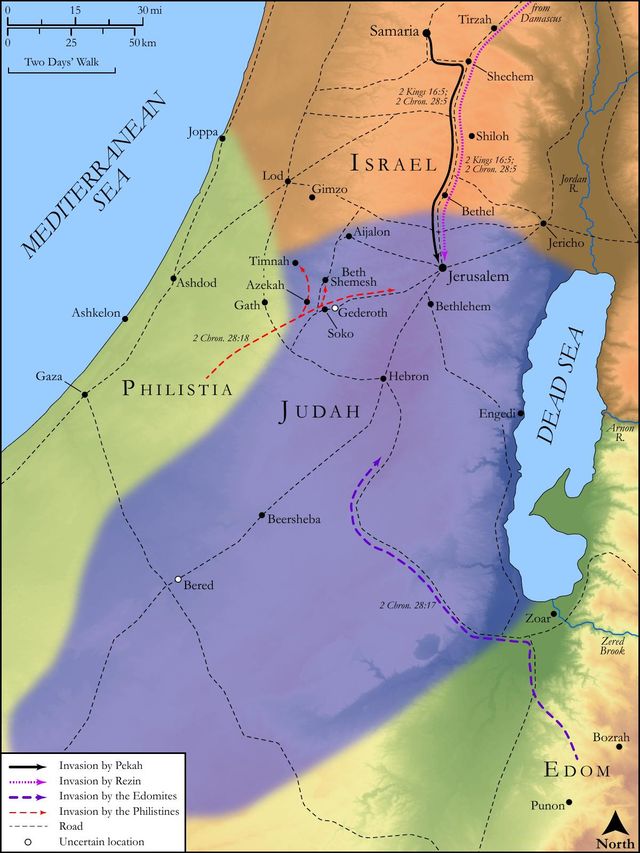
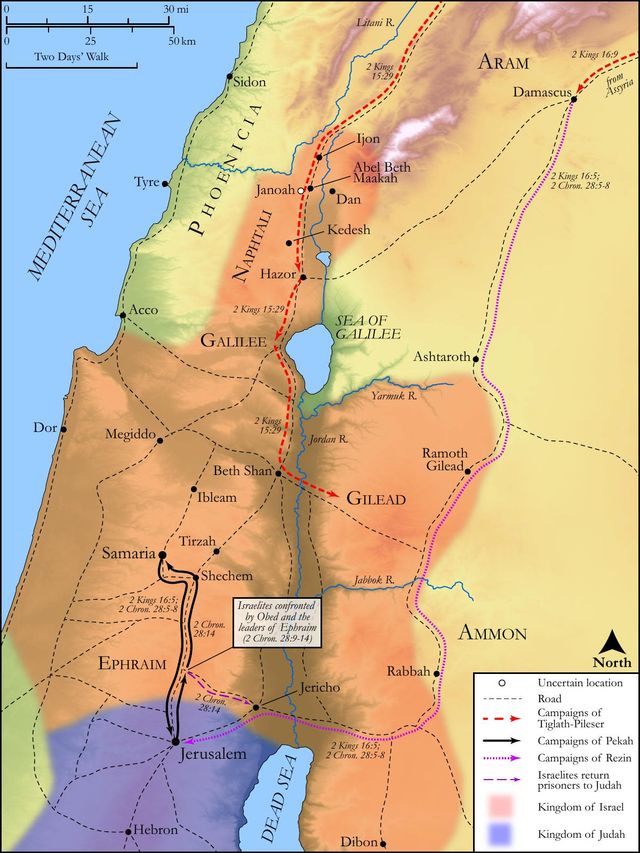
See on the biblical-era maps
Study this verse
Public-domain commentary
Matthew Henry
From his Commentary on the Whole Bible. Henry comments on passages, not single verses — this entry covers 2 Kings 16:17–20.
Here is, I. Ahaz abusing the temple, not the building itself, but some of the furniture of it. 1. He defaced the bases on which the lavers were set (Kg1 7:28, Kg1 7:29) and took down the molten sea, Kg2 16:17. These the priests used for washing; against them therefore he seems to have had a particular spite. It is one of the greatest prejudices that can be done to religion to obstruct the purifying of the priests, the Lord's ministers. 2. He removed the covert for the sabbath, erected either in honour of the sabbath or for the conveniency of the priests, when, on the sabbath, they officiated in greater numbers than on other days. Whatever it was, it should seem that in removing it he intended to put a contempt upon the sabbath, and so to open as wide an inlet as any to all manner of impiety. 3. The king's entry, which led to the house of the Lord, for the convenience of the royal family (perhaps that ascent which Solomon had made, and which the queen of Sheba admired, Kg1 10:5), he turned another way, to show that he did not intend to frequent the house of the Lord any more. This he did for the king of Assyria, to oblige him, who perhaps returned his visit, and found fault with this entry, as an inconvenience and disparagement to his palace. When those that have had a ready passage to the house of the Lord, to please their neighbours, turn it another way, they are going down the hill apace towards their ruin.
II.Ahaz resigning his life in the midst of his days, at thirty-six years of age (Kg2 16:19) and leaving his kingdom to a better man, Hezekiah his son (Kg2 16:20), who proved as much a friend to the temple as he had been an enemy to it. Perhaps this very son he had made to pass through the fire, and thereby dedicated him to Moloch; but God, by his grace, snatched him as a brand out of the burning.
Historical interpretation
Thirteen Centuries of Reception
2 surviving comments on this verse. Each one is dated, so this reads as a timeline rather than a list.
Select a marker to jump to its quote. Markers stagger vertically where authors wrote within a few decades of each other.
I certainly do not think that he built [the altar] for the God of all things but just for certain of those who are falsely called gods. This is what the book of Chronicles points out. It reads, “In the time of his distress this king Ahaz became yet more faithless to the Lord. For he sacrificed to the gods of Damascus, which had defeated him, and said, “Because the gods of the kings of Aram helped them, I will sacrifice to them so that they may help me.” But they were the ruin of him and of all Israel.” And this is also signified by the next verse: “Ahaz gathered together the utensils of the house of God and cut in pieces the utensils of the house of God. He shut up the doors of the house of the Lord and made himself altars in every corner of Jerusalem.” He did these and other similar things, as is also confirmed in the book of Chronicles: “When King Ahaz went to Damascus to meet King Tiglath-pileser of Assyria, he saw the altar that was at Damascus. King Ahaz sent to the priest Uriah a model of the altar, and its pattern, exact in all its details.” He removed the genuine altar of bronze, which Solomon had built, and put in its place another one recently made. And what happened to the stands is revealed by what follows: “King Ahaz cut off the frames of the stands,” the text says, “and removed the laver from them.” And he even dared to commit another act of impiety: he moved the entrance of the royal house into the divine temple, transforming the sacred enclosure into a thoroughfare.
Musach: The covert, or pavilion, or tribune, for the king.
Continue studying 2 Kings 16:18 across the web’s major study libraries — every link below opens this exact verse, chapter, or book on the destination site.
Read & Compare
 BibleGatewayThis verse in more than 200 translations and 70 languages.
 Bible.comThe YouVersion reader — hundreds of translations, reading plans, and highlights.
 ESV.orgCrossway's official English Standard Version reader.
 NET BibleThe NET translation with 60,000+ translators' notes on every rendering decision.
 STEP BibleTyndale House's free study tool — original text, vocabulary, and scholarly resources.
 BibliaLogos Bible Software's free web reader.
 USCCBThe New American Bible (Revised Edition) with the U.S. bishops' study notes.
Commentaries
 BibleHub CommentariesDozens of classic commentaries on this verse, gathered on one page.
 StudyLightMore than 100 commentary sets — the largest collection on the web.
 BibleRefPlain-English commentary on what this verse means, verse by verse.
 Enduring WordDavid Guzik's free commentary on this chapter, widely used by Bible teachers.
 Bible Study ToolsVerse commentary alongside Greek and Hebrew study aids.
Original Language & Research
- BibleHub InterlinearThe verse word by word — original language, transliteration, and English.
- BibleHub LexiconEvery word's original-language definition and Strong's entry.
 Blue Letter BibleDeep-study tools — Strong's numbers, concordance, and word studies.
 SefariaThe Hebrew text with Rashi and centuries of Jewish commentary.
Sermons, Hymns & Audio


TrulyRandomVerse is not affiliated with these sites and doesn’t control their content. They’re linked because they’re genuinely useful.
Summary
King Ahaz of Judah, in a profound act of apostasy and subservience to Assyria, deliberately dismantled or altered sacred structures within the Temple precincts. This verse details his removal of the "covert for the sabbath" and the "king's entry without," actions undertaken specifically to appease Tiglath-Pileser III, the Assyrian monarch. These acts underscore Ahaz's prioritizing of political expediency over divine faithfulness, his willingness to profane consecrated space, and his systematic erosion of established religious practices to curry favor with a pagan superpower, marking a low point in Judah's spiritual history.
Context
ShowHideLiterary Context
This verse serves as the climactic and damning conclusion to the detailed account of King Ahaz's egregious religious and political apostasy in 2 Kings 16. The chapter opens by firmly establishing Ahaz's wicked reign, highlighting his radical departure from the righteous path of his ancestor David and his embrace of abhorrent idolatrous practices, including child sacrifice (2 Kings 16:2-4). The narrative then pivots to the Syro-Ephraimite War, where Judah faces a severe threat from the combined forces of Aram and Israel. Instead of heeding the prophet Isaiah's call to trust in the LORD, Ahaz, driven by fear, desperately appeals to Tiglath-Pileser III of Assyria for military intervention, thereby becoming his servant (2 Kings 16:5-9). The zenith of Ahaz's spiritual betrayal unfolds during his visit to Damascus, where he encounters an Assyrian altar and, upon his return, commands the priest Urijah to construct a precise replica in the Jerusalem Temple, effectively replacing the divinely ordained bronze altar (2 Kings 16:10-16). Thus, 2 Kings 16:18 functions as a final, comprehensive indictment of Ahaz's religious perversion, demonstrating his continued dismantling of Temple structures not out of necessity, but as a deliberate and public act of subservience to Assyrian religious and political dominance, solidifying his legacy as one of Judah's most unfaithful kings.
Historical & Cultural Context
King Ahaz's reign over Judah (c. 735-715 BC) coincided with a period of intense geopolitical instability among the nations. The burgeoning Neo-Assyrian Empire, under the formidable Tiglath-Pileser III, was aggressively expanding its dominion, posing an existential threat to smaller, independent nations like Judah. Faced with the immediate military pressure from the Syro-Ephraimite coalition, Ahaz's decision to forgo reliance on the LORD's promised deliverance, as conveyed by Isaiah (Isaiah 7:1-9), in favor of a military alliance with Assyria, was a pivotal moment. This alliance came with a heavy cost, demanding not only political servitude and burdensome tribute payments but also significant religious compromise. Assyrian imperial policy frequently involved the imposition of their own deities and cultic practices upon conquered or allied states, viewing local gods as subordinate to their own pantheon. Ahaz's actions, particularly his adoption of the Damascus altar and the subsequent alterations to the Temple, were likely calculated attempts to publicly demonstrate his absolute loyalty and submission to Assyria. These acts may have even been intended to integrate Assyrian cultic elements into the Jerusalem Temple, thereby symbolizing and solidifying Judah's new political reality. The "covert for the sabbath" and "king's entry," being prominent and likely symbolic features of the Temple, would have made their alteration or removal a highly visible and undeniable sign of Judah's subservient status and Ahaz's profound rejection of Yahweh's exclusive worship.
Key Themes
ShowHideThe actions of King Ahaz throughout 2 Kings 16, culminating in the specific desecrations detailed in 2 Kings 16:18, powerfully illuminate several critical theological themes. Foremost among these is Apostasy and Idolatry. Ahaz deliberately deviates from the exclusive worship of Yahweh, actively embracing foreign cults and practices. His profound fear of earthly enemies leads him to abandon divine trust, directly contravening the covenantal imperative for singular devotion to God (Deuteronomy 6:4-5). Second, the Desecration of Sacred Space is a pervasive theme. The Temple, divinely consecrated as the dwelling place of God's presence and the epicenter of Israelite worship (1 Kings 8:10-11), is systematically defiled by Ahaz's impious innovations and removals. These acts undermine the sanctity of the Temple and its divinely ordained rituals, demonstrating a profound disrespect for God's holiness and covenantal stipulations. Finally, Political Compromise and Subservience highlight the perilous consequences of prioritizing worldly alliances over unwavering faithfulness to God. Ahaz's alliance with Assyria was far more than a mere political maneuver; it necessitated deep religious concessions, starkly revealing how worldly pressures can inexorably lead to spiritual compromise and, ultimately, national decline. This chapter stands as a severe warning against syncretism and the abandonment of God's covenant for perceived geopolitical security, foreshadowing Judah's eventual judgment.
Exposition and Analysis
ShowHideKey Word Analysis
ShowHideMeaning "a portico (as covered); covert." This term refers to a covered structure, likely a portico, colonnade, or sheltered walkway within the Temple precincts. Its association with the Sabbath (as "covert for the sabbath") strongly suggests a specific, sacred function related to Sabbath observance, perhaps providing shelter for worshippers, priests, or the king during Sabbath rituals or processions. Ahaz's action against this "covert" was not merely an architectural modification but a direct assault on a structure deeply integrated into the sacred rhythm and practice of Yahweh worship, demonstrating his disregard for the sanctity of the Sabbath.
Meaning "an entrance (the place or the act); specifically sunset or the west; also (adverb with preposition) towards." In this context, it refers to a specific, likely ceremonial, entrance or access point. The phrase "king's entry without" indicates it was a distinct royal approach, probably leading into the outer courts of the Temple or connecting the royal palace directly to the Temple complex. This entrance was not merely functional but symbolic, representing the king's unique access to God's house and his divinely appointed role in the nation's worship. Its alteration by Ahaz was a highly visible and symbolic act of dismantling even the structures associated with the royal presence in the Temple, all to appease his Assyrian overlord.
Meaning "to revolve, surround, or border; used in various applications, literally and figuratively; bring, cast, fetch, lead, make, walk, [idiom] whirl, [idiom] round about, be about on every side, apply, avoid, beset (about), besiege, bring again, carry (about), change, cause to come about, [idiom] circuit, (fetch a) compass (about, round), drive, environ, [idiom] on every side, beset (close, come, compass, go, stand) round about, inclose, remove, return, set, sit down, turn (self) (about, aside, away, back)." The Hiphil form used here (הֵסֵב, hesev) specifically means "to turn away," "to remove," "to divert," or "to change the direction/purpose of." This verb choice emphasizes Ahaz's deliberate, active, and decisive agency in altering, dismantling, or repurposing these structures. It was not a passive neglect but an intentional act of desecration, highlighting his direct involvement and responsibility in undermining the established order of Yahweh worship.
Verse Breakdown
ShowHide"And the covert for the sabbath that they had built in the house,"
This clause identifies the first of two specific structures within the sacred Temple precincts that King Ahaz targeted for alteration. The "covert for the sabbath" refers to a dedicated, likely roofed or sheltered, area or passage, which had been "built in the house" (referring to the broader Temple complex). The phrase "they had built" suggests it was an established, perhaps long-standing, architectural feature, constructed by previous generations for the specific purpose of facilitating Sabbath observance, thereby carrying significant religious, historical, and traditional weight.
"and the king's entry without,"
This clause introduces the second structure, a distinct and likely ceremonial entrance specifically designated for the king. It was located "without," meaning outside the main sanctuary building, perhaps providing access to the outer courts or a direct connection from the royal palace. This entry was not merely functional but profoundly symbolic, representing the king's unique access to and role within the Temple's life and the nation's worship. Its mention alongside the "covert for the sabbath" underscores Ahaz's comprehensive assault on both the sacred rituals (Sabbath observance) and the divinely sanctioned royal relationship with the Temple.
"turned he from the house of the LORD"
This is the core action of the verse, explicitly attributing the desecration to Ahaz. The verb "turned" (Hebrew: hesev) signifies a deliberate act of removing, diverting, or repurposing these structures "from the house of the LORD." This indicates a conscious and active dismantling, rendering these areas unusable for their original, consecrated functions within the Temple complex. It is a direct and intentional act of profanation, stripping away elements integral to the pure worship of Yahweh.
"for the king of Assyria."
This concluding phrase reveals the shocking and deeply apostate motivation behind Ahaz's actions. These profound and sacrilegious alterations to the Temple were not undertaken for the glory of God, nor for the benefit or spiritual well-being of Judah, but explicitly "for the king of Assyria," Tiglath-Pileser III. This phrase encapsulates Ahaz's complete subservience and spiritual compromise, demonstrating his willingness to sacrifice the sanctity of God's dwelling place and the integrity of Israelite worship to appease a pagan overlord and secure a worldly, temporary alliance. It underscores the depth of his apostasy and the tragic extent of his spiritual blindness.
Literary Devices
ShowHideThe passage employs several potent literary devices to convey its message of profound apostasy and desecration. Irony is strikingly evident, as the king, who, by covenantal duty, should be the protector and upholder of Yahweh's law and the sanctity of the Temple, instead becomes its chief desecrator. Ahaz, a descendant of the faithful King David, actively dismantles the very structures that symbolize Judah's unique covenantal relationship with Yahweh, doing so "for the king of Assyria," a foreign, pagan overlord. This act of appeasement, ostensibly intended to secure safety, ultimately leads to greater spiritual and national peril. Symbolism is heavily at play; the "covert for the sabbath" and the "king's entry" are not merely architectural features but profound symbols representing the established order of Yahweh worship, the sanctity of the Sabbath, and the divinely ordained role of the king within that worship. Their removal or alteration symbolizes Ahaz's comprehensive rejection of God's law, the sacredness of the Sabbath, and his own proper role as Judah's king, in favor of embracing foreign dominion and idolatrous practices. The narrative also employs Contrast to highlight the severity of Ahaz's actions, setting his profanation against the backdrop of the Temple's intended purpose as a holy sanctuary, a place of God's presence, and the center of pure worship. This stark contrast emphasizes the depth of his betrayal and the gravity of his sin.
Theological and Thematic Connections
ShowHide2 Kings 16:18 powerfully illustrates the profound dangers of spiritual compromise driven by fear and political expediency. Ahaz's actions are far more than mere architectural changes; they represent a deep theological betrayal, demonstrating a king who values the fleeting favor of a human empire more than the eternal covenant faithfulness to the Almighty God. This verse underscores the pervasive theme of apostasy, where the visible symbols and established practices of Yahweh's worship are systematically dismantled and defiled to accommodate pagan influences, revealing a heart that has definitively turned away from divine trust. It serves as a stark and enduring warning that prioritizing worldly security over spiritual integrity inevitably leads to the desecration of what is holy and a profound loss of divine favor, setting a dangerous precedent for Judah's future and ultimately contributing to its eventual downfall.
Reflection and Application
ShowHideThe tragic account of King Ahaz's systematic desecration of the Temple, culminating in the specific actions described in 2 Kings 16:18, serves as a timeless and poignant cautionary tale for believers today. In a world relentlessly pressuring us to conform, compromise our convictions, or seek security in fleeting worldly alliances, Ahaz's story powerfully reminds us of the paramount importance of unwavering fidelity to God alone. We are called, as God's people, to guard the sanctity of our faith, diligently ensuring that our worship, our core values, and our daily decisions are rooted exclusively in devotion to Christ, rather than being swayed by the pursuit of social acceptance, financial gain, or political favor. Just as Ahaz allowed external pressures to defile the physical house of God, we must be exceedingly vigilant against allowing the pervasive "spirit of the age" to subtly or overtly defile the spiritual temple of our hearts and lives, which the Apostle Paul declares to be the dwelling place of the Holy Spirit (1 Corinthians 6:19-20). Our ultimate trust must be solely and unequivocally in the Lord, for any attempt to secure our future through spiritual compromise inevitably leads to barrenness, a loss of true peace, and a forfeiture of divine blessing.
Questions for Reflection
ShowHideFAQ
ShowHideWhat was the "covert for the sabbath" and why was its alteration significant?
ShowHideThe "covert for the sabbath" (Hebrew: musakh ha-shabbat) was likely a specific covered structure, possibly a portico, colonnade, or sheltered area within the Temple complex in Jerusalem. While its exact architectural form and precise function are debated among scholars, its explicit connection to "the sabbath" indicates its sacred and established role in Israelite worship. It may have been used for royal or priestly processions, or as a designated sheltered space for the king or other dignitaries during Sabbath observances and rituals. Ahaz's alteration or removal of this structure was highly significant because it represented a deliberate and public attack on the sanctity of the Sabbath, which was a foundational element of the Mosaic Law and a central pillar of Israel's covenant relationship with Yahweh (Exodus 20:8-11). By tampering with this structure, Ahaz not only defiled the physical Temple but also undermined the spiritual and ritual practices that defined Israel's unique identity and relationship with God, all in a desperate attempt to appease the powerful Assyrian king, Tiglath-Pileser III.
Christ-Centered Fulfillment
ShowHideThe profound desecration of the Temple by King Ahaz in 2 Kings 16:18 stands in stark and illuminating contrast to the ultimate purity, divine authority, and redemptive purpose embodied by Jesus Christ. While Ahaz, a flawed earthly king, defiled the physical temple for temporary worldly gain and political appeasement, Jesus, as the true and ultimate Temple of God (John 2:19-21), came not to destroy but to cleanse, fulfill, and ultimately transcend its purpose. The "covert for the sabbath" and the "king's entry" that Ahaz removed point to the inherent limitations of the Old Covenant's physical structures and the profound need for a perfect King and a perfect High Priest. Jesus, the King of kings and Lord of lords, not only entered the Temple but purified it with divine zeal, driving out those who defiled it with their worldly commerce (Matthew 21:12-13), thereby demonstrating His inherent authority over God's house. Furthermore, Jesus is the undisputed Lord of the Sabbath (Mark 2:27-28), fulfilling its true meaning not through adherence to physical structures or rigid legalism, but through His redemptive work, offering true rest and liberation from the bondage of sin and the law. Unlike Ahaz, who desperately sought alliances with pagan kings for earthly security, Jesus established an eternal kingdom not of this world (John 18:36), inviting all humanity to find their ultimate refuge, true worship, and eternal peace in Him, the perfect High Priest who intercedes on our behalf (Hebrews 4:14-16) and the Lamb of God who takes away the sin of the world (John 1:29).