


2 Kings 16:17
Bible text: King James Version (1769 Blayney text) · Public domain
Bible text: King James Version with Strong's numbers · Public domain
Bible text: Berean Standard Bible · Public domain
Bible text: American Standard Version (1901) · Public domain
Bible text: World English Bible, Messianic edition · Public domain
Bible text: Geneva Bible (1599) · Public domain
Bible text: Young's Literal Translation · Public domain
- וַיְקַצֵּץvay·ka·Tzetzand he cut offH7112Conj-w ¦ V-Piel-ConsecImperf-3msVerb Piel Consecutive Imperfect 3rd Singular Masculineוַandיְקַצֵּץhe cut off
- הַמֶּלֶךְha·Me·lekhthe kingH4428Art ¦ N-msNoun Singular Masculine Absoluteהַtheמֶּלֶךְking
- אָחָז'a·ChazAhazH271N-proper-mNoun Proper Masculine
- אֶת'et<obj.>H853DirObjMParticle Object Indicator
- הַמִּסְגְּרוֹתha·mis·ge·Rotthe rims ofH4526Art ¦ N-fpcNoun Plural Feminine Constructהַtheמִּסְגְּרוֹתrims of
- הַמְּכֹנוֹתha·me·kho·Notthe standsH4350Art ¦ N-fpNoun Plural Feminine Absoluteהַtheמְּכֹנוֹתstands
- וַיָּסַרvai·Ya·sarand he removedH5493Conj-w ¦ V-Hiphil-ConsecImperf-3msVerb Hiphil Consecutive Imperfect 3rd Singular Masculineוַandיָּסַרhe removed
- מֵעֲלֵיהֶםme·'a·lei·Hemfrom on <the> themH5921Prep-m ¦ Prep ¦ 3mpPreposition Definiteמֵfromעֲלֵיon <the>הֶםthem
- אֶתve·'Et<obj.>H853DirObjMParticle Object Indicator
- הַכִּיֹּרha·ki·Yorthe laverH3595Art ¦ N-msNoun Singular Masculine Absoluteהַtheכִּיֹּרlaver
- וְאֶתve·'Etand <obj.>H853Conj-w ¦ DirObjMParticle Object Indicatorוְandאֶת<obj.>
- הַיָּםhai·Yamthe seaH3220Art ¦ N-msNoun Singular Masculine Absoluteהַtheיָּםsea
- הוֹרִדho·Ridhe took downH3381V-Hiphil-Perf-3msVerb Hiphil Perfect 3rd Singular Masculine
- מֵעַלme·'Alfrom onH5921Prep-m ¦ PrepPrepositionמֵfromעַלon
- הַבָּקָרha·ba·Karthe ox[en]H1241Art ¦ N-csNoun Singular common gender Absoluteהַtheבָּקָרox[en]
- הַנְּחֹשֶׁתha·ne·Cho·shetthe bronzeH5178Art ¦ N-fsNoun Singular Feminine Absoluteהַtheנְּחֹשֶׁתbronze
- אֲשֶׁר'a·SherwhichH834RelParticle Relative
- תַּחְתֶּיהָtach·Tei·ha[were] under itH8478N-mpc ¦ 3fsNoun Plural Masculine Constructתַּחְתֶּי[were] underהָit
- וַיִּתֵּןvai·yi·Tenand he putH5414Conj-w ¦ V-Qal-ConsecImperf-3msVerb Qal Consecutive Imperfect 3rd Singular Masculineוַandיִּתֵּןhe put
- אֹתוֹ'o·To<obj.> itH853DirObjM ¦ 3msParticle Object Indicatorאֹת<obj.>וֹit
- עַל'alonH5921PrepPreposition
- מַרְצֶפֶתmar·Tze·feta pavement ofH4837N-fscNoun Singular Feminine Construct
- אֲבָנִים'a·va·Nimstone<s>H68N-fpNoun Plural Feminine Absolute
English is a literal word-by-word gloss of the Hebrew, not the KJV's wording. Why?
This is the original text the KJV's translators worked from — each Hebrew word with its own literal English meaning in this verse, prepared by scholars at Tyndale House, Cambridge. The KJV translates whole sentences, not word by word, so its wording differs: one Hebrew word can become several English words, and the KJV may choose “the LORD” where the gloss reads “Yahweh”. Both are faithful — they answer different questions. For the KJV's own rendering, switch to the KJV text.
Details
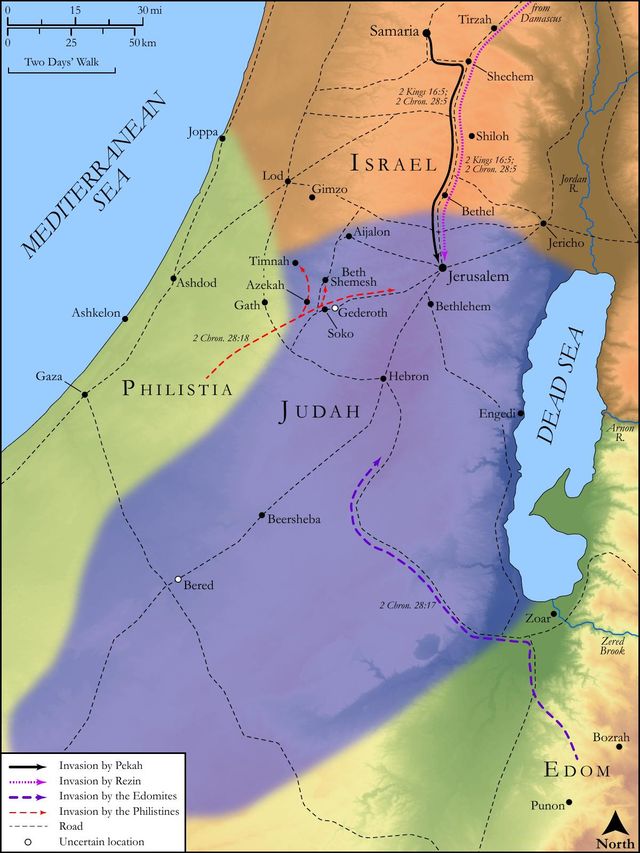
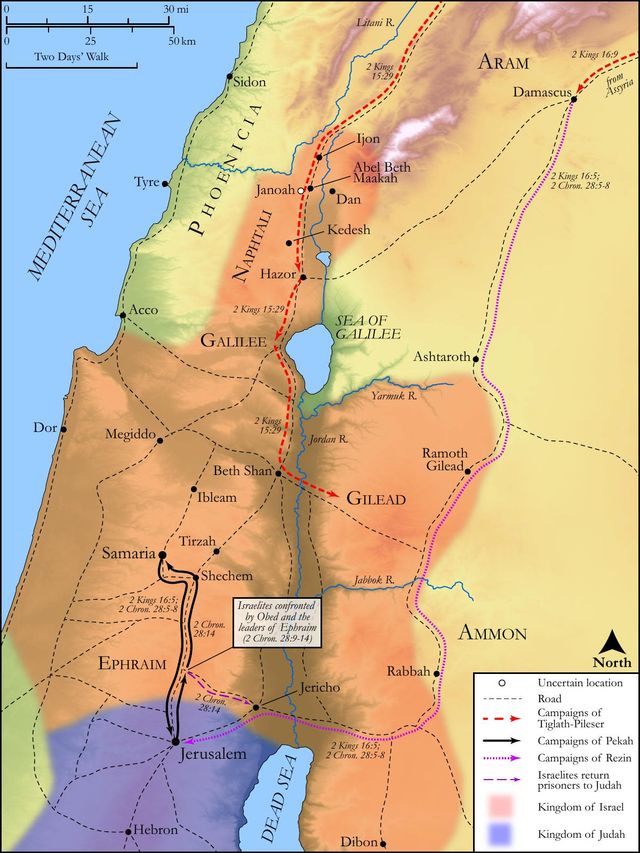
See on the biblical-era maps
Study this verse
Public-domain commentary
Matthew Henry
From his Commentary on the Whole Bible. Henry comments on passages, not single verses — this entry covers 2 Kings 16:17–20.
Here is, I. Ahaz abusing the temple, not the building itself, but some of the furniture of it. 1. He defaced the bases on which the lavers were set (Kg1 7:28, Kg1 7:29) and took down the molten sea, Kg2 16:17. These the priests used for washing; against them therefore he seems to have had a particular spite. It is one of the greatest prejudices that can be done to religion to obstruct the purifying of the priests, the Lord's ministers. 2. He removed the covert for the sabbath, erected either in honour of the sabbath or for the conveniency of the priests, when, on the sabbath, they officiated in greater numbers than on other days. Whatever it was, it should seem that in removing it he intended to put a contempt upon the sabbath, and so to open as wide an inlet as any to all manner of impiety. 3. The king's entry, which led to the house of the Lord, for the convenience of the royal family (perhaps that ascent which Solomon had made, and which the queen of Sheba admired, Kg1 10:5), he turned another way, to show that he did not intend to frequent the house of the Lord any more. This he did for the king of Assyria, to oblige him, who perhaps returned his visit, and found fault with this entry, as an inconvenience and disparagement to his palace. When those that have had a ready passage to the house of the Lord, to please their neighbours, turn it another way, they are going down the hill apace towards their ruin.
II.Ahaz resigning his life in the midst of his days, at thirty-six years of age (Kg2 16:19) and leaving his kingdom to a better man, Hezekiah his son (Kg2 16:20), who proved as much a friend to the temple as he had been an enemy to it. Perhaps this very son he had made to pass through the fire, and thereby dedicated him to Moloch; but God, by his grace, snatched him as a brand out of the burning.
Historical interpretation
Historical reception
1 surviving comment on this verse from the historical church.
I certainly do not think that he built [the altar] for the God of all things but just for certain of those who are falsely called gods. This is what the book of Chronicles points out. It reads, “In the time of his distress this king Ahaz became yet more faithless to the Lord. For he sacrificed to the gods of Damascus, which had defeated him, and said, “Because the gods of the kings of Aram helped them, I will sacrifice to them so that they may help me.” But they were the ruin of him and of all Israel.” And this is also signified by the next verse: “Ahaz gathered together the utensils of the house of God and cut in pieces the utensils of the house of God. He shut up the doors of the house of the Lord and made himself altars in every corner of Jerusalem.” He did these and other similar things, as is also confirmed in the book of Chronicles: “When King Ahaz went to Damascus to meet King Tiglath-pileser of Assyria, he saw the altar that was at Damascus. King Ahaz sent to the priest Uriah a model of the altar, and its pattern, exact in all its details.” He removed the genuine altar of bronze, which Solomon had built, and put in its place another one recently made. And what happened to the stands is revealed by what follows: “King Ahaz cut off the frames of the stands,” the text says, “and removed the laver from them.” And he even dared to commit another act of impiety: he moved the entrance of the royal house into the divine temple, transforming the sacred enclosure into a thoroughfare.
Continue studying 2 Kings 16:17 across the web’s major study libraries — every link below opens this exact verse, chapter, or book on the destination site.
Read & Compare
 BibleGatewayThis verse in more than 200 translations and 70 languages.
 Bible.comThe YouVersion reader — hundreds of translations, reading plans, and highlights.
 ESV.orgCrossway's official English Standard Version reader.
 NET BibleThe NET translation with 60,000+ translators' notes on every rendering decision.
 STEP BibleTyndale House's free study tool — original text, vocabulary, and scholarly resources.
 BibliaLogos Bible Software's free web reader.
 USCCBThe New American Bible (Revised Edition) with the U.S. bishops' study notes.
Commentaries
 BibleHub CommentariesDozens of classic commentaries on this verse, gathered on one page.
 StudyLightMore than 100 commentary sets — the largest collection on the web.
 BibleRefPlain-English commentary on what this verse means, verse by verse.
 Enduring WordDavid Guzik's free commentary on this chapter, widely used by Bible teachers.
 Bible Study ToolsVerse commentary alongside Greek and Hebrew study aids.
Original Language & Research
- BibleHub InterlinearThe verse word by word — original language, transliteration, and English.
- BibleHub LexiconEvery word's original-language definition and Strong's entry.
 Blue Letter BibleDeep-study tools — Strong's numbers, concordance, and word studies.
 SefariaThe Hebrew text with Rashi and centuries of Jewish commentary.
Sermons, Hymns & Audio


TrulyRandomVerse is not affiliated with these sites and doesn’t control their content. They’re linked because they’re genuinely useful.
Summary
King Ahaz, in a profound act of apostasy and spiritual rebellion, systematically dismantled and degraded the sacred bronze furnishings within the Temple of Jerusalem, as meticulously recorded in 2 Kings 16:17. This was far more than a mere architectural alteration; it was a deliberate and highly symbolic desecration of God's sanctuary, a tangible expression of his embrace of foreign idolatry, his utter contempt for the Mosaic covenant, and his active obstruction of the prescribed rituals of purity and worship due to the God of Israel. His actions not only diminished the Temple's grandeur but fundamentally undermined its purpose as a holy dwelling place for Yahweh.
Context
ShowHideLiterary Context
This verse is deeply embedded within the grim and tragic narrative of King Ahaz's reign, a period characterized by unprecedented spiritual decline and moral depravity in the Southern Kingdom of Judah. Immediately preceding this account, Ahaz has returned from Damascus, where he encountered an Assyrian altar. In a shocking display of spiritual compromise, he sent detailed plans of this foreign altar back to Jerusalem, instructing Urijah the priest to construct a replica. This new, pagan-inspired altar was then installed in the Temple, brazenly displacing the original bronze altar of burnt offering, which had been divinely ordained for the worship of Yahweh (see 2 Kings 16:10-16). The actions described in 2 Kings 16:17, involving the "bases," "laver," and "sea," are a direct and logical continuation of this pattern of Temple desecration and the systematic introduction of foreign worship practices. The narrative powerfully highlights Ahaz's complete disregard for the sanctity of God's dwelling place and the Mosaic covenant, serving as a stark foreshadowing of the eventual divine judgment, including the destruction of the Temple and the exile of Judah.
Historical & Cultural Context
King Ahaz ruled Judah from approximately 735 to 715 BC, a tumultuous and perilous era dominated by the escalating power of the Neo-Assyrian Empire under Tiglath-Pileser III. Confronted by the Syro-Ephraimite War—an alliance between Aram (Syria) and Israel (Ephraim) that threatened to overthrow Jerusalem—Ahaz famously rejected the prophet Isaiah's divinely inspired counsel to trust solely in the Lord for deliverance (see Isaiah 7:1-9). Instead, he opted for a politically expedient, yet spiritually catastrophic, alliance with Assyria. This alliance necessitated paying heavy tribute and, critically, adopting Assyrian religious practices as a sign of servitude and submission. Ahaz's dismantling of the Temple furnishings and his introduction of foreign altars and rituals (as further detailed in 2 Chronicles 28:2-4) were direct and tangible manifestations of this political and spiritual compromise. Such syncretism was a common practice among the nations, where conquered peoples often adopted the gods and religious customs of their conquerors as a means of political appeasement and cultural integration, as Ahaz himself sacrificed to the gods of Damascus.
Key Themes
ShowHideThe actions of King Ahaz in 2 Kings 16:17 powerfully articulate several major theological and narrative themes prevalent throughout the Deuteronomistic History (the books of Kings) and the Chronicler's History. Foremost among these is Apostasy and Idolatry, demonstrating a king's profound and deliberate turning away from Yahweh and embracing foreign deities, a direct violation of the foundational first commandment (see Exodus 20:3). This leads directly to the theme of Desecration of God's Sanctuary, as Ahaz intentionally pollutes and undermines the sacred space intended for the exclusive worship of the one true God, thereby stripping it of its divine purpose and sanctity. Furthermore, the verse highlights the pervasive theme of Spiritual Compromise and its Consequences, vividly illustrating how political expediency and fear of human enemies led Ahaz to abandon divine trust, resulting in profound spiritual degradation and ultimately inviting divine judgment upon Judah. The dismantling of the ritual purity objects also underscores the critical theme of Rejection of Covenant Purity and Holiness, as Ahaz symbolically and practically obstructs the divinely prescribed means of approaching a holy God.
Exposition and Analysis
ShowHideKey Word Analysis
ShowHideFrom the Hebrew root meaning "to establish" or "to prepare," these were the elaborate, wheeled bronze stands that supported the ten bronze lavers in Solomon's Temple (see 1 Kings 7:27-39). They were not merely functional pedestals but highly artistic and intricately decorated elements of the Temple's grandeur and sacred design, emphasizing the order, beauty, and divine precision intended for God's dwelling place. Ahaz's act of "cutting off the borders" (likely decorative panels or side supports) and removing the lavers from them was a deliberate act of defacement and degradation, stripping these sacred objects of their intended form, aesthetic, and function, thereby diminishing the Temple's overall splendor and symbolic integrity.
This term refers to a washbowl or basin. In the context of the Temple, the lavers were bronze basins, ten of which rested upon the aforementioned bases. These were specifically designated for the priests to wash their hands and feet before entering the Holy Place or approaching the altar of burnt offering (see Exodus 30:17-21). This ritual washing was absolutely essential for maintaining ritual purity, symbolizing the holiness and cleanliness required for those who ministered in God's presence. Ahaz's removal of the lavers from their elevated and designated bases directly disrupted this crucial aspect of priestly service, effectively hindering the proper, pure, and covenantally prescribed worship of Yahweh.
Also known as the "molten sea," this was a colossal bronze basin, approximately 15 feet in diameter and 7.5 feet deep, capable of holding vast quantities of water (see 1 Kings 7:23-26). It rested upon twelve magnificent bronze oxen, arranged in groups of three, facing the four cardinal directions. The molten sea served as the primary reservoir for the priests' ritual ablutions and for supplying water to the smaller lavers. Its immense size, elevated position on the oxen, and intricate design conveyed majesty and profound symbolic significance, perhaps representing the waters of creation, God's boundless provision, or the cleansing power of His presence. Moving it from its exalted, divinely ordained position to a mere "pavement of stones" was the ultimate act of stripping it of its dignity, symbolic meaning, and practical utility for the priests, reducing a sacred icon to a common, ground-level vessel.
Verse Breakdown
ShowHide"And king Ahaz cut off the borders of the bases, and removed the laver from off them"
This initial clause meticulously details Ahaz's assault on the ten smaller lavers and their ornate, wheeled stands. The "borders" (Hebrew miçgereth), likely referring to the decorative panels, intricate engravings, or side supports of the bases, were either chopped off or stripped away. By removing the lavers from their elevated, divinely designed positions on these bases, Ahaz not only defaced the Temple's exquisite artistry but also functionally disrupted the entire system of ritual purification essential for the priests. This act directly hindered the proper execution of the sacrificial system and the maintenance of holiness in worship, demonstrating a deliberate intent to undermine Yahwistic practices.
"and took down the sea from off the brasen oxen that [were] under it"
This describes Ahaz's more audacious and symbolically potent act of dismantling the massive molten sea. The "brasen oxen" (Hebrew nᵉchôsheth bâqâr) were twelve magnificent bronze sculptures that served as the majestic and symbolic foundation for the enormous basin. Their removal was a profound act of degradation, stripping the sea of its symbolic support, its elevated prominence, and its visual grandeur within the Temple courtyard. This was a direct assault on a central, iconic piece of Solomon's Temple, diminishing its dignity, sacred meaning, and the theological implications of its design.
"and put it upon a pavement of stones"
The final action described in the verse signifies the ultimate humiliation and profound desacralization of the molten sea. Instead of its original, magnificent, and divinely ordained supports, Ahaz placed the colossal basin directly on a common "pavement of stones" (Hebrew martsepheth). This act reduced a sacred, symbolic, and functionally vital object to a mere ground-level receptacle, devoid of its former glory, symbolic meaning, and perhaps even its practical accessibility for the priests. It represented a deliberate act of stripping the Temple of its divine order, its aesthetic beauty, and its sacred purpose, replacing it with human, profane arrangements that starkly reflected Ahaz's complete spiritual bankruptcy and his contempt for Yahweh's prescribed worship.
Literary Devices
ShowHideThe narrative of 2 Kings 16:17 employs several potent literary devices to underscore the severity and theological implications of Ahaz's apostasy. The primary device is Symbolism. Each object Ahaz dismantles—the bases, the lavers, and the molten sea—carries profound symbolic weight directly related to purity, holiness, and the divinely ordered worship of Yahweh. By degrading these items, Ahaz symbolically degrades the very concept of ritual purity and the sanctity of God's presence, transforming an ordered sanctuary into a disordered, defiled space. There is also a strong element of Contrast between the glorious dedication of Solomon's Temple, where these magnificent objects were first installed as a testament to God's presence and Israel's devotion (see 1 Kings 8), and Ahaz's cynical and sacrilegious desecration. This contrast starkly highlights the depth of Judah's spiritual decline and moral decay under Ahaz's reign. Furthermore, the actions demonstrate a profound Irony; Ahaz seeks political security through an alliance with the powerful Assyrian Empire, yet in doing so, he deliberately undermines the very spiritual foundation of his kingdom and his people's relationship with God. This act of self-inflicted spiritual harm demonstrates that true security and prosperity come from trusting Yahweh, not from human alliances or idolatrous practices, ultimately leading to greater instability and judgment.
Theological and Thematic Connections
ShowHideKing Ahaz's actions in 2 Kings 16:17 represent a profound theological statement against the holiness of God and the sanctity of His dwelling place. By dismantling the very instruments of ritual purity and defacing the Temple's sacred furnishings, Ahaz not only violated the explicit commands of the Mosaic covenant but also demonstrated a complete and public rejection of the divine order for worship. This desecration was not merely an architectural rearrangement but a deeply spiritual affront, signaling his allegiance to foreign gods and his abandonment of Yahweh's exclusive claim on Judah's worship. It underscores the biblical principle that true worship demands purity, reverence, and an uncompromised, exclusive devotion to God alone. The narrative powerfully illustrates that the consequences of spiritual compromise are severe, leading inevitably to the degradation of both the sacred space and the spiritual life of the nation, inviting divine judgment.
Reflection and Application
ShowHideKing Ahaz's deliberate degradation of the Temple furnishings serves as a powerful and sobering warning for believers today, transcending its historical context. While we no longer have a physical Temple with bronze lavers and seas, the timeless principles of reverence, purity, and uncompromised worship remain eternally vital and directly applicable. Ahaz's actions illustrate the insidious nature of spiritual compromise, where fear of external pressures, a desire for worldly acceptance, or political expediency subtly (or overtly) leads to the erosion and eventual rejection of what is holy and divinely ordained. We, as New Testament believers, are called to maintain the sanctity of our own "temples"—our bodies, which are now dwelling places of the Holy Spirit (see 1 Corinthians 6:19-20)—and to ensure that our worship, both individually and corporately, is pure, unadulterated, and offered in spirit and truth, untainted by the influences of the world. Just as Ahaz removed the instruments of purity, we must be vigilant against anything that would hinder our spiritual cleansing, obstruct our access to God, or compromise our unwavering commitment to His truth and holiness. This verse compels us to honestly examine what "sacred furnishings" we might be "taking down" or "putting on a pavement of stones" in our own lives—perhaps neglecting consistent prayer, devaluing the authoritative Word of Scripture, or compromising our integrity and moral convictions for fleeting worldly gain—thereby degrading our spiritual walk and hindering true, unreserved devotion to God.
Questions for Reflection
ShowHideFAQ
ShowHideWhy did King Ahaz dismantle these specific Temple furnishings?
ShowHideKing Ahaz's actions were driven by a complex interplay of political expediency and profound spiritual apostasy. Having sought a military alliance with Assyria to counter the formidable Syro-Ephraimite threat, he became the servant of Tiglath-Pileser III. Upon visiting Damascus, Ahaz was captivated by an Assyrian altar, which he then, in an act of shocking syncretism, replicated and installed in the Jerusalem Temple (see 2 Kings 16:10-16). His subsequent dismantling of the bronze bases, lavers, and the colossal molten sea (2 Kings 16:17) was likely multifaceted: partly to make physical space for his new, foreign altar and its associated rituals, partly to strip the Temple of its distinctive Yahwistic elements to appease his Assyrian overlords and demonstrate his servitude, and partly as a deliberate, contemptuous act against the God of Israel. It was a tangible, public expression of his rejection of the Mosaic covenant and his embrace of idolatry and syncretism.
What was the purpose of the "bases," "lavers," and "molten sea" in the Temple?
ShowHideThese were essential and highly symbolic furnishings primarily dedicated to the ritual purification of the priests. The "molten sea" was a massive bronze basin, magnificently supported by twelve bronze oxen, serving as the primary reservoir for water used by the priests for their extensive ritual ablutions (see 1 Kings 7:23-26). The "bases" were ornate, wheeled stands that supported ten smaller "lavers," which were individual basins also used by the priests to wash their hands and feet before performing their sacred duties in the Holy Place or at the altar of burnt offering (see Exodus 30:17-21). These prescribed washings were crucial for maintaining ritual purity, symbolizing the holiness and moral cleanliness required to minister in God's holy presence. By dismantling or degrading these items, Ahaz directly interfered with the divinely prescribed worship and the fundamental concept of purity within the Temple.
What was the significance of moving the molten sea from the bronze oxen to a pavement of stones?
ShowHideThis act was profoundly symbolic and deeply insulting to the sanctity and divine order of the Temple. The molten sea, supported by twelve magnificent bronze oxen, was one of the most prominent, visually striking, and symbolically rich objects in Solomon's Temple, signifying its grandeur, divine order, and the boundless provision of God (see 1 Kings 7:23-26). Moving it from its elevated, artistic, and divinely ordained supports to a common "pavement of stones" stripped it of its dignity, majesty, and sacred status. It effectively reduced a glorious, symbolic vessel to a mere ground-level basin, thereby desacralizing it and demonstrating Ahaz's utter contempt for its original purpose and the God it served. This action was a public and brazen display of his spiritual rebellion and his desire to bring the Temple's practices into conformity with his new, idolatrous allegiances and his personal agenda.
Christ-Centered Fulfillment
ShowHideThe desecration of the Temple by King Ahaz, vividly highlighted in 2 Kings 16:17, finds its ultimate Christ-centered fulfillment in several profound and redemptive ways. First, Ahaz's actions underscore the inherent fallibility of human institutions and the temporary, vulnerable nature of the physical Temple. While it was indeed God's dwelling place on earth, it remained susceptible to human sin, compromise, and desecration. This historical reality powerfully points forward to Jesus Christ, who declares Himself to be the true and ultimate Temple, the perfect and incorruptible dwelling place of God among humanity (see John 2:19-21). In Christ, God's presence is no longer confined to a building that can be defiled or dismantled by human sin, but is eternally embodied in a perfect, divine Person. Second, the ritual purity symbolized by the lavers and the molten sea, which Ahaz so brazenly disregarded and disrupted, is fully realized and eternally surpassed in Christ. His perfect, once-for-all sacrifice on the cross provides not merely ritual cleansing but a complete and eternal purification from sin, making all who believe truly clean and righteous before God (see Hebrews 9:13-14). The need for repeated physical washings and external rituals is abolished by the once-for-all, all-sufficient cleansing power of the Lamb of God, who takes away the sin of the world. Finally, Ahaz's attempt to replace divine order with human, idolatrous, and profane arrangements stands in stark contrast to Christ's zealous cleansing of the Temple (see John 2:13-17), demonstrating His divine authority and His unwavering commitment to pure, uncompromised worship. Through Christ, believers are now made living stones, being built into a spiritual house—a new, undefilable temple—where true worship is offered not through rituals and physical objects, but in spirit and truth (see 1 Peter 2:5).