


1 Kings 7:23
- וַיַּעַשׂvai·Ya·'asand he madeH6213Conj-w ¦ V-Qal-ConsecImperf-3msVerb Qal Consecutive Imperfect 3rd Singular Masculineוַandיַּעַשׂhe made
- אֶת'et<obj.>H853DirObjMParticle Object Indicator
- הַיָּםhai·Yamthe seaH3220Art ¦ N-msNoun Singular Masculine Absoluteהַtheיָּםsea
- מוּצָקmu·Tzakcast [metal]H4165V-Hophal-PassPrtcpl-msVerb Hophal Participle Passive Singular Masculine Absolute
- עֶשֶׂר'E·ser[was] tenH6235N-msNoun Singular Masculine Absolute
- בָּאַמָּהBa·'a·mahby the cubitH520Prep-b ¦ N-fsNoun Singular Feminine Absoluteבָּby theאַמָּהcubit
- מִשְּׂפָתוֹmi·se·fa·Tofrom its lipH8193Prep-m ¦ N-fsc ¦ 3msNoun Singular Feminine Constructמִfromשְּׂפָתlipוֹits
- עַד'adtoH5704PrepPreposition
- שְׂפָתוֹse·fa·Toits lipH8193N-fsc ¦ 3msNoun Singular Feminine Constructשְׂפָתlipוֹits
- עָגֹל'a·GolroundH5696Adj-msAdjective Singular Masculine Absolute
- סָבִיבsa·Vivall aroundH5439N-csNoun Singular common gender Absolute
- וְחָמֵשׁve·cha·Meshand [was] fiveH2568Conj-w ¦ N-csNoun Singular common gender Absoluteוְandחָמֵשׁ[was] five
- בָּאַמָּהba·'a·Mahby the cubitH520Prep-b ¦ N-fsNoun Singular Feminine Absoluteבָּby theאַמָּהcubit
- קוֹמָתוֹko·ma·Toits heightH6967N-fsc ¦ 3msNoun Singular Feminine Constructקוֹמָתheightוֹits
- וְקָוu·ke·vehand a measuring-lineH6957Conj-w ¦ N-msNoun Singular Masculine Absoluteוְandקָוa measuring-line
- שְׁלֹשִׁיםshe·lo·ShimthirtyH7970N-mpNoun Plural Masculine Absolute
- בָּאַמָּהba·'a·Mahby the cubitH520Prep-b ¦ N-fsNoun Singular Feminine Absoluteבָּby theאַמָּהcubit
- יָסֹבya·Soit went roundH5437V-Qal-Imperf-3msVerb Qal Imperfect 3rd Singular Masculine
- אֹתוֹ'o·To<obj.> itH853DirObjM ¦ 3msParticle Object Indicatorאֹת<obj.>וֹit
- סָבִיבsa·Vivall aroundH5439N-csNoun Singular common gender Absolute
English is a literal word-by-word gloss of the Hebrew, not the KJV's wording. Why?
This is the original text the KJV's translators worked from — each Hebrew word with its own literal English meaning in this verse, prepared by scholars at Tyndale House, Cambridge. The KJV translates whole sentences, not word by word, so its wording differs: one Hebrew word can become several English words, and the KJV may choose “the LORD” where the gloss reads “Yahweh”. Both are faithful — they answer different questions. For the KJV's own rendering, switch to the KJV text.
Details
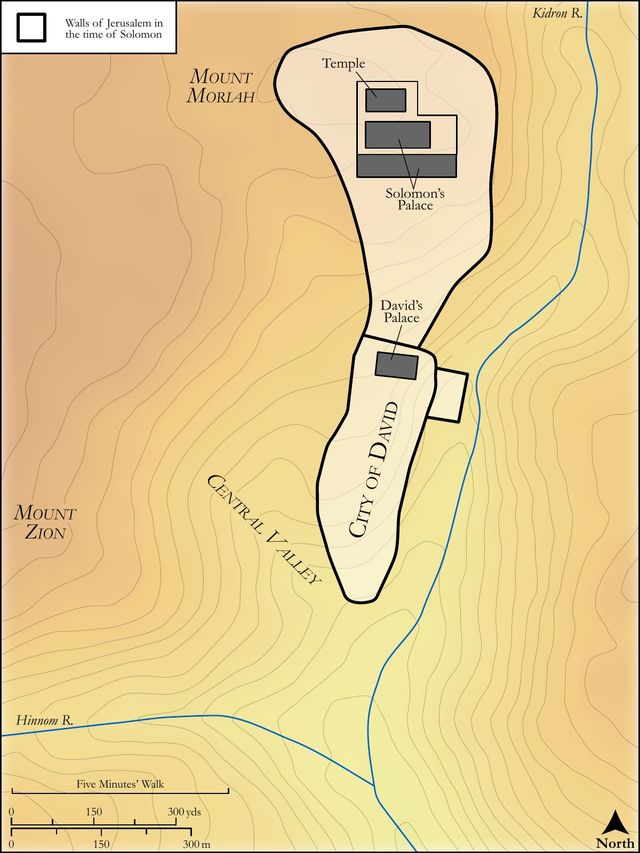
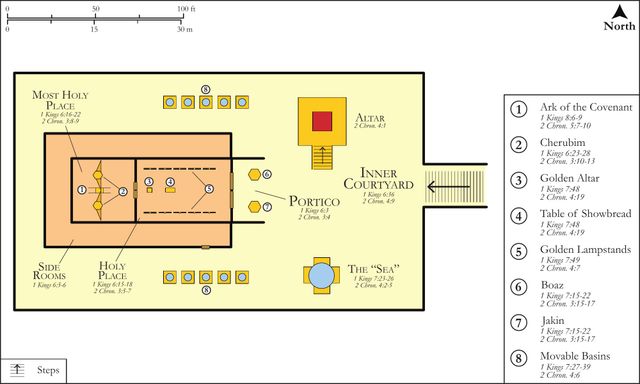
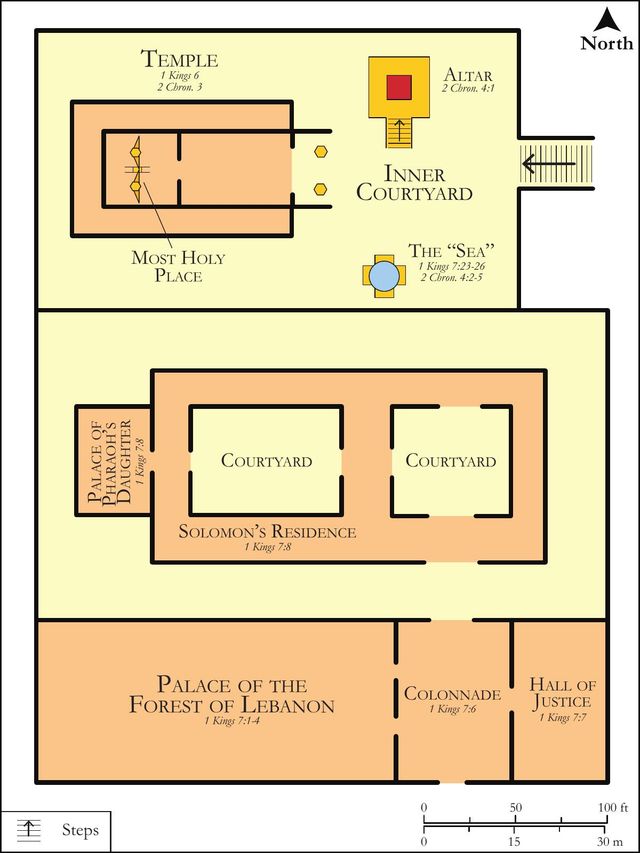
See on the biblical-era map
Study this verse
Public-domain commentary
Matthew Henry
From his Commentary on the Whole Bible. Henry comments on passages, not single verses — this entry covers 1 Kings 7:13–47. His four-level outline is real structure in the source text, so it is rendered as structure.
We have here an account of the brass-work about the temple. There was no iron about the temple, though we find David preparing for the temple iron for things of iron, Ch1 29:2. What those things were we are not told, but some of the things of brass are here described and the rest mentioned.
I.The brasier whom Solomon employed to preside in this part of the work was Hiram, or Huram (Ch2 4:11), who was by his mother's side an Israelite, of the tribe of Naphtali, by his father's side a man of Tyre, Kg1 7:14. If he had the ingenuity of a Tyrian, and the affection of an Israelite to the house of God (the head of a Tyrian and the heart of an Israelite), it was happy that the blood of the two nations mixed in him, for thereby he was qualified for the work to which he was designed. As the tabernacle was built with the wealth of Egypt, so the temple with the wit of Tyre. God will serve himself by the common gifts of the children of men.
II.The brass he made use of was the best he could get.
All the brazen vessels were of bright brass (Kg1 7:45), good brass, so the Chaldee, that which was strongest and looked finest. God, who is the best, must be served and honoured with the best.
III.The place where all the brazen vessels were cast was the plain of Jordan, because the ground there was stiff and clayey, fit to make moulds of for the casting of the brass (Kg1 7:46), and Solomon would not have this dirty smoky work done in or near Jerusalem.
IV.The quantity was not accounted for.
The vessels were unnumbered (so it may be read, Kg1 7:47, as well as unweighed), because they were exceedingly numerous, and it would have been an endless thing to keep the account of them; neither was the weight of the brass, when it was delivered to the workmen, searched or enquired into; so honest were the workmen, and such great plenty of brass they had, that there was no danger of wanting. We must ascribe it to Solomon's care that he provided so much, not to his carelessness that he kept no account of it.
V.Some particulars of the brass-work are described.
1.Two brazen pillars, which were set up in the porch of the temple (Kg1 7:21), whether under the cover of the porch or in the open air is not certain; it was between the temple and the court of the priests. These pillars were neither to hang gates upon nor to rest any building upon, but purely for ornament and significancy.
(1.)What an ornament they were we may gather from the account here given of the curious work that was about them, chequer-work, chain-work, net-work, lily-work, and pomegranates in rows, and all of bright brass, and framed no doubt according to the best rules of proportion, to please the eye.
(2.)Their significancy is intimated in the names given them (Kg1 7:21): Jachin - he will establish; and Boaz - in him is strength. Some think they were intended for memorials of the pillar of cloud and fire which led Israel through the wilderness: I rather think them designed for memorandums to the priests and others that came to worship at God's door,
[1.]To depend upon God only, and not upon any sufficiency of their own, for strength and establishment in all their religious exercises. When we come to wait upon God, and find our hearts wandering and unfixed, then by faith let us fetch in help from heaven: Jachin - God will fix this roving mind. It is a good thing that the heart be established with grace. We find ourselves weak and unable for holy duties, but this is our encouragement: Boaz - in him is our strength, who works in us both to will and to do. I will go in the strength of the Lord God. Spiritual strength and stability are to be had at the door of God's temple, where we must wait for the gifts of grace in the use of the means of grace.
[2.]It was a memorandum to them of the strength and establishment of the temple of God among them. Let them keep close to God and duty, and they should never lose their dignities and privileges, but the grant should be confirmed and perpetuated to them. The gospel church is what God will establish, what he will strengthen, and what the gates of hell can never prevail against. But, with respect to this temple, when it was destroyed particular notice was taken of the destroying of these pillars (Kg2 25:13, Kg2 25:17), which had been the tokens of its establishment, and would have been so if they had not forsaken God.
2.A brazen sea, a very large vessel, above five yards in diameter, and which contained above 500 barrels of water for the priests' use, in washing themselves and the sacrifices, and keeping the courts of the temple clean, Kg1 7:23, etc. It stood raised upon the figures of twelve oxen in brass, so high that either they must have stairs to climb up to it or cocks at the bottom to draw water from it. The Gibeonites, or Nethinim, who were to draw water for the house of God, had the care of filling it. Some think Solomon made the images of oxen to support this great cistern in contempt of the golden calf which Israel had worshipped, that (as bishop Patrick expresses it) the people might see there was nothing worthy of adoration in those figures; they were fitter to make posts of than to make gods of. Yet this prevailed not to prevent Jerusalem's setting up the calves for deities. In the court of the tabernacle there was only a laver of brass provided to wash in, but in the court of the temple a sea of brass, intimating that by the gospel of Christ much fuller preparation is made for our cleansing than was by the law of Moses. That had a laver, this has a sea, a fountain opened, Zac 13:1.
3.Ten bases, or stands, or settles, of brass, on which were put ten lavers, to be filled with water for the service of the temple, because there would not be room at the molten sea for all that had occasion to wash there. The bases on which the lavers were fixed are very largely described here, Kg1 7:27, etc. They were curiously adorned and set upon wheels, that the lavers might be removed as there was occasion; but ordinarily they stood in two rows, five on one side of the court and five on the other, Kg1 7:39. Each laver contained forty baths, that is, about ten barrels, Kg1 7:38. Those must be very clean that bear the vessels of the Lord. Spiritual priests and spiritual sacrifices must be washed in the laver of Christ's blood and of regeneration. We must wash often, for we daily contract pollution, must cleanse our hands and purify our hearts. Plentiful provision is made for our cleansing; so that if we have our lot for ever among the unclean it will be our own fault.
4.Besides these, there was a vast number of brass pots made to boil the flesh of the peace-offerings in, which the priests and offerers were to feast upon before the Lord (see Sa1 2:14); also shovels, wherewith they took out the ashes of the altar. Some think the word signifies flesh-hooks, with which they took meat out of the pot. The basins also were made of brass, to receive the blood of the sacrifices. These are put for all the utensils of the brazen altar, Exo 38:3. While they were about it they made abundance of them, that they might have a good stock by them when those that were first in use wore out and went to decay. Thus Solomon, having wherewithal to do so, provided for posterity.
Historical interpretation
Historical reception
1 surviving comment on this verse from the historical church.
“He also made a molten sea of ten cubits from brim to brim, completely round.” This molten sea was made as a figure of the laver of salvation in which we are cleansed for the remission of our sins. For priests were washed in it, as the Chronicles assure us; but it is agreed that all the elect are called priests in a typological sense in the Scriptures since they are members of the high priest Jesus Christ. And rightly has Scripture given the name of sea to this vessel, in memory, that is, of the Red Sea in which once, through the destruction of the Egyptians and the deliverance of the people of God, the form of baptism was anticipated, as the apostle explains when he says, “that our fathers were all under the cloud and all passed through the sea, and all in Moses were baptized in the cloud and in the sea.” Now the sacrament of baptism both requires of us purity of life and promises us the glory of eternal life in the world to come, both of which things are denoted in this bronze sea in one sentence where it is said to be ten cubits from brim to brim. For by the Ten Commandments in the law the Lord expressed all that we must do. Likewise by the denarius he indicated the reward of good deeds when he foretold that it was to be given to those working in the vineyard. The reason why the sea was ten cubits from brim to brim was that the whole choir of the faithful from the first one baptized in the name of Jesus Christ to the last to believe and be baptized at the end of the world must enter on one and the same way of truth and hope for a common crown of righteousness from the Lord. It was completely circular in order to signify that the whole universe all the way around was to be cleansed in the laver of life from the filth of its sins.In this regard the remark is well made that “its height was five cubits,” because, of course, whatever fault we have committed with the sense of sight or hearing or smell or taste or touch, all this the grace of God washes away from us through the ablution of the life-giving font. But the remission of past sins is not enough if one does not thereafter devote oneself to good works; otherwise, if the devil, after leaving a person, sees such a one to be lacking in good actions, he comes back in greater numbers and makes “the last state of that person worse than the first.”
Hence it is fittingly added, “And a line of thirty cubits compassed it all the way around.” For by the line can fittingly be meant the discipline of the heavenly precepts with which we are restrained from the indulgence of our passions since Scripture says that “a threefold cord is not easily broken.” [This is] because, of course, the observance of the commandments of God, which is established in the hearts of the elect by faith, hope and the love of an eternal reward, cannot be frustrated by any obstacle of temporal things. And the line encircles the sea when by works of piety we strive to enhance the sacrament of baptism that we have received. Now this line is aptly said to be three cubits long. For five times six make thirty. By the number six in which the Lord both made humankind when it did not exist and remade it when it had perished, our good actions are also rightly represented, and six is multiplied by five to make thirty, when we humbly subject all our bodily senses to divine things. However, there is also another sense in which we can quite appropriately take this number thirty as applying mystically to the sea. For three tens make thirty. And after the flood, from the issue of Noah’s three sons, the human race filled the whole expanse of the universe; for the tribe of Shem occupied Asia, Ham’s descendants occupied Africa, and the progeny of Japheth occupied Europe and the islands of the sea. And because, together with the performance of good works and the hope of heavenly rewards, the sacrament of baptism was to be administered to all the nations, it was fitting that a line of thirty cubits should encircle the sea, in which the water of baptism was prefigured. But it must also be said that the Lord at the age of thirty years came to the Jordan to be baptized by John. For since by his baptism that he received at the age of thirty he consecrated for us the water of the laver of salvation, it is right that a line should encircle the sea, which is a figure of our baptism, so that, by the gift of him who underwent baptism without sin, it might be signified that baptism was specifically given to all of us who believe in him for the remission of our sins.
Continue studying 1 Kings 7:23 across the web’s major study libraries — every link below opens this exact verse, chapter, or book on the destination site.
Read & Compare
 BibleGatewayThis verse in more than 200 translations and 70 languages.
 Bible.comThe YouVersion reader — hundreds of translations, reading plans, and highlights.
 ESV.orgCrossway's official English Standard Version reader.
 NET BibleThe NET translation with 60,000+ translators' notes on every rendering decision.
 STEP BibleTyndale House's free study tool — original text, vocabulary, and scholarly resources.
 BibliaLogos Bible Software's free web reader.
 USCCBThe New American Bible (Revised Edition) with the U.S. bishops' study notes.
Commentaries
 BibleHub CommentariesDozens of classic commentaries on this verse, gathered on one page.
 StudyLightMore than 100 commentary sets — the largest collection on the web.
 BibleRefPlain-English commentary on what this verse means, verse by verse.
 Enduring WordDavid Guzik's free commentary on this chapter, widely used by Bible teachers.
 Bible Study ToolsVerse commentary alongside Greek and Hebrew study aids.
Original Language & Research
- BibleHub InterlinearThe verse word by word — original language, transliteration, and English.
- BibleHub LexiconEvery word's original-language definition and Strong's entry.
 Blue Letter BibleDeep-study tools — Strong's numbers, concordance, and word studies.
 SefariaThe Hebrew text with Rashi and centuries of Jewish commentary.
Sermons, Hymns & Audio


TrulyRandomVerse is not affiliated with these sites and doesn’t control their content. They’re linked because they’re genuinely useful.
Summary
1 Kings 7:23 meticulously details the dimensions of the "molten sea," a colossal bronze basin that served as a central fixture in Solomon's Temple. This verse, embedded within a comprehensive account of the Temple's construction and furnishings, underscores the monumental scale, precise design, and exceptional craftsmanship dedicated to the sacred edifice. As an indispensable component for the priests' ritual ablutions, its specifications highlight the profound emphasis on ceremonial purity and the grandeur befitting the dwelling place of the Holy God.
Context
ShowHideLiterary Context
This verse is strategically placed within the extensive narrative detailing King Solomon's ambitious building projects, specifically the construction of the Temple in Jerusalem (1 Kings 6) and his own palace (1 Kings 7). Following the completion of the main Temple structure, chapter 7 meticulously describes the various bronze furnishings and vessels, all crafted by Hiram of Tyre, a highly skilled artisan from Phoenicia. The "molten sea" is presented as one of the most prominent and functionally critical items, serving a vital role in the priestly service. Its description here immediately follows that of the two monumental bronze pillars, Jachin and Boaz, and precedes the account of the ten smaller bronze stands and lavers. This detailed enumeration underscores the divine mandate for precision, excellence, and adherence to specific design in all aspects of the Temple's construction, reflecting the sanctity and glory of the structure dedicated to the Lord.
Historical & Cultural Context
The construction of the First Temple during Solomon's reign (circa 970-931 BC) marked a watershed moment in ancient Israelite history, signifying the establishment of a permanent dwelling place for God's presence, a significant departure from the portable Tabernacle. This monumental undertaking demanded immense resources, highly skilled labor, and international collaboration, as evidenced by the crucial involvement of Hiram, the Tyrian craftsman. In the broader ancient Near East, temples were central to religious and civic life, often featuring elaborate structures and ritual objects that mirrored cosmic order. The concept of ritual purity was paramount in Israelite worship, deeply rooted in the Mosaic Law. Priests were strictly required to perform specific washings before ministering, ensuring their ceremonial cleanliness before approaching the holy God. The "molten sea" represented a sophisticated and grand upgrade from the smaller bronze laver used in the Tabernacle, reflecting the increased scale, permanence, and profound theological significance of the Temple as the enduring center of Israelite worship and the dwelling place of Yahweh.
Key Themes
ShowHideThe Molten Sea, as meticulously described in this verse, contributes significantly to several overarching themes within 1 Kings and the broader biblical narrative. Firstly, it powerfully reinforces the theme of Purity and Holiness in Worship, emphasizing the absolute necessity of ritual and spiritual cleansing for anyone approaching God. Its immense capacity and specific purpose underscore that God is holy and demands purity from those who serve Him, a principle deeply rooted in the Mosaic covenant, as seen with the instructions for the Tabernacle laver. Secondly, the meticulous description of the Temple's furnishings, including the precise dimensions of the Molten Sea, highlights the theme of Divine Detail and Excellence. This attention to detail reflects God's expectation for order, beauty, and the highest quality in all aspects of worship and service, underscoring the glory due to His name. Finally, the Molten Sea also speaks to the theme of Continuity and Fulfillment, representing a grander, more permanent iteration of the cleansing basin from the Tabernacle, symbolizing the fulfillment of God's promise to David to establish a house for His name, as recorded in 2 Samuel 7:13.
Exposition and Analysis
ShowHideKey Word Analysis
ShowHideFrom a primitive root meaning "to pour out," this term specifically implies the process of melting or casting metal. In the context of 1 Kings 7:23, it denotes that the "sea" was not constructed from hammered sheets but was a single, massive casting of bronze, a significant feat of ancient metallurgy that would have required immense heat and skill.
While literally meaning "sea" (like the Mediterranean), this term is used here to describe a large artificial basin. Its application to this Temple furnishing is a hyperbole, emphasizing its immense size and vast capacity, far exceeding that of a typical basin or laver. This nomenclature evokes a sense of vastness and abundance, fitting for a vessel intended to provide water for the numerous priests serving in the Temple.
This is the primary unit of measurement used throughout the biblical descriptions of the Temple and its furnishings. A cubit was an ancient unit of length based on the forearm, typically ranging from 17 to 22 inches (approximately 43 to 56 cm). The consistent use of this precise measurement highlights the meticulousness with which the Temple was constructed, reflecting divine instructions and the exact execution by the craftsmen.
Verse Breakdown
ShowHide"And he made a molten sea,"
This opening phrase attributes the creation of this monumental Temple furnishing to Solomon, implicitly through the expert craftsmanship of Hiram of Tyre, as detailed in the preceding verses. The descriptor "molten" emphasizes the advanced metallurgical skill required to cast such a massive, single piece of bronze, showcasing the technological prowess of the era.
"ten cubits from the one brim to the other: [it was] round all about,"
This clause specifies the diameter of the Molten Sea, stating it was ten cubits across. The parenthetical "[it was] round all about" explicitly confirms its perfectly circular shape, a crucial detail for both its aesthetic design and its functional symmetry within the Temple courtyard.
"and his height [was] five cubits:"
This provides the vertical dimension of the basin, indicating its considerable depth. Combined with the stated diameter, this height suggests a substantial volume, necessary for the extensive ritual washings of the numerous priests who served daily in the Temple.
"and a line of thirty cubits did compass it round about."
This final clause gives the circumference of the Molten Sea. The mention of a "line" underscores the practical, hands-on method of measurement employed in ancient times. This specific dimension, when compared with the diameter, famously implies a value of Pi (circumference/diameter) as exactly 3. This is generally understood not as a mathematical error in the biblical text, but as a practical, rounded measurement sufficient for the architectural and functional purposes of the time, or perhaps reflecting an approximation common in ancient engineering.
Literary Devices
ShowHideThe description of the Molten Sea in 1 Kings 7:23 employs several literary devices to convey its significance and grandeur. The most apparent is Precision and Detail, as the verse provides exact measurements for the diameter, height, and circumference. This meticulousness serves to emphasize the grandeur and sacredness of the Temple, suggesting that God's dwelling place demanded the highest standards of craftsmanship and adherence to divine specifications. The naming of the basin as a "molten sea" is a form of Hyperbole, using an exaggerated term to convey its immense size and capacity, far beyond a typical basin. This choice of word elevates the object's significance and evokes a sense of vastness. Furthermore, the verse employs Symbolism, as the water within the basin, and by extension the basin itself, symbolizes purification and cleansing, a recurring motif throughout the Old Testament concerning access to God's holy presence. The detailed enumeration of dimensions also contributes to a sense of Realism, grounding the narrative in tangible, verifiable details that would have been impressive to its original audience.
Theological and Thematic Connections
ShowHideThe Molten Sea served as a potent symbol of the absolute necessity of purification for those who would approach a holy God. Its immense size and constant supply of water underscored the pervasive need for cleansing from defilement before engaging in sacred service. Theologically, this points to the unapproachable holiness of God and the inherent sinfulness of humanity, which requires a means of atonement and purification. While the physical washing of the priests was ceremonial, it represented a deeper spiritual truth: that only the pure can stand in God's presence. The meticulous design also reflects God's demand for excellence and order in worship, emphasizing that our approach to Him should be marked by reverence and preparation. Ultimately, the Molten Sea, like all Temple rituals, foreshadowed a more profound and complete cleansing to come.
Reflection and Application
ShowHideWhile the physical ritual of washing at the Molten Sea is no longer practiced by believers today, its underlying spiritual principle remains profoundly relevant. The Molten Sea stands as a timeless reminder of the holiness of God and our perpetual need for spiritual cleansing. In the New Covenant, our cleansing is not achieved through ritualistic ablutions or the blood of animals, but through the perfect, once-for-all sacrifice of Jesus Christ. His shed blood purifies us from all sin, making us acceptable to draw near to God. This truth calls us to a life of ongoing repentance and faith, acknowledging our daily need for God's grace and forgiveness. It urges us to cultivate a pure heart and to cleanse ourselves from all spiritual defilement as we seek to walk with Him and worship Him in spirit and truth, knowing that we can now draw near with a true heart in full assurance of faith. Just as the priests prepared themselves, we are called to prepare our hearts, examining ourselves and confessing our sins, so that our worship and service may be pleasing to God. As 2 Corinthians 7:1 exhorts, we are to "cleanse ourselves from every defilement of body and spirit, bringing holiness to completion in the fear of God."
Questions for Reflection
ShowHideFAQ
ShowHideWhat was the primary function of the Molten Sea in Solomon's Temple?
ShowHideThe primary function of the Molten Sea was to provide a vast reservoir of water for the priests to wash their hands and feet before ministering in the Temple. This ritual washing was essential for their ceremonial purification, ensuring they were clean and consecrated before performing sacred duties and approaching the holy presence of God. While it was a massive basin, it was not for the general congregation but specifically for the Levitical priesthood, as detailed in passages like Exodus 30:18-21 concerning the Tabernacle's laver, which the Molten Sea superseded and expanded upon.
Why does the calculation of Pi (circumference divided by diameter) appear to be exactly 3 in this verse, when modern mathematics knows it to be approximately 3.14159?
ShowHideThe apparent discrepancy, where a 10-cubit diameter and a 30-cubit circumference imply a Pi of exactly 3, is widely understood by scholars not as a mathematical error in the biblical text, but rather as a practical measurement or a rounded figure common in ancient calculations and engineering. In ancient times, precise mathematical constants like Pi were not known or needed for construction. Builders often used simple ratios for practical purposes. It's also possible that the "line of thirty cubits" refers to the inner circumference, or that the measurement was an approximation for a large object, or even that the "brim" (diameter) was measured from the outer edge while the "line" (circumference) was measured slightly differently. The Bible's purpose is theological and historical, not to provide precise scientific data, and the measurement was certainly sufficient for the architectural and functional needs of the Temple. This practical approximation is consistent with ancient Near Eastern construction practices.
Christ-Centered Fulfillment
ShowHideThe Molten Sea, with its vast capacity for cleansing water, stands as a profound Old Testament type pointing directly to the ultimate and perfect purification found in Jesus Christ. Just as the priests required ritual washing to approach God in the Temple, humanity, defiled by sin, requires a more profound cleansing to enter God's presence. Christ is the true "fountain opened for sin and uncleanness" (Zechariah 13:1), whose blood cleanses us from all unrighteousness (1 John 1:7). The Molten Sea provided external, temporary cleansing; Christ offers internal, eternal purification, not merely of hands and feet, but of the conscience itself (Hebrews 9:14). Through His atoning sacrifice, He has inaugurated a new covenant where access to God is no longer mediated by ritual washings but by His own body and blood, allowing us to draw near to the throne of grace with confidence. He is our great High Priest who has entered the true heavenly sanctuary, making us clean and holy, enabling us to serve the living God with a truly purified heart, a spiritual reality far surpassing the physical symbolism of the Molten Sea. This cleansing is not a one-time event but a continuous reality for believers, rooted in the "washing of regeneration and renewal of the Holy Spirit" (Titus 3:5).