


1 Chronicles 18:8
Bible text: King James Version (1769 Blayney text) · Public domain
Bible text: King James Version with Strong's numbers · Public domain
Bible text: Berean Standard Bible · Public domain
Bible text: American Standard Version (1901) · Public domain
Bible text: World English Bible, Messianic edition · Public domain
Bible text: Geneva Bible (1599) · Public domain
Bible text: Young's Literal Translation · Public domain
- וּמִטִּבְחַתu·mi·tiv·Chatand from TibhathH2880Conj-w ¦ Prep-m ¦ N-properNoun Proper LocationוּandמִfromטִּבְחַתTibhath
- וּמִכּוּןu·mi·Kunand from KunH3560Conj-w ¦ Prep-m ¦ N-properNoun Proper LocationוּandמִfromכּוּןKun
- עָרֵי'a·Rei[the] cities ofH5892N-mpcNoun Plural Masculine Construct
- הֲדַדְעֶזֶרha·dad·'E·zerHadadezerH1928N-proper-mNoun Proper Masculine
- לָקַחla·Kachhe tookH3947V-Qal-Perf-3msVerb Qal Perfect 3rd Singular Masculine
- דָּוִידda·VidDavidH1732N-proper-mNoun Proper Masculine
- נְחֹשֶׁתne·Cho·shetbronzeH5178N-fsNoun Singular Feminine Absolute
- רַבָּהra·BahmuchH7227Adj-fsAdjective Singular Feminine Absolute
- מְאֹדme·'OdveryH3966Adj-msAdjective Numerical Singular Masculine Absolute
- בָּהּbahwith itPrep-b ¦ 3fsSuffix Personal 3rd Singular Feminineבָּwithהּit
- עָשָׂה'a·Sahhe madeH6213V-Qal-Perf-3msVerb Qal Perfect 3rd Singular Masculine
- שְׁלֹמֹהshe·lo·MohSolomonH8010N-proper-mNoun Proper Masculine
- אֶת'et<obj.>H853DirObjMParticle Object Indicator
- יָםyam[the] sea ofH3220N-mscNoun Singular Masculine Construct
- הַנְּחֹשֶׁתha·ne·Cho·shet<the> bronzeH5178Art ¦ N-fsNoun Singular Feminine Absoluteהַ<the>נְּחֹשֶׁתbronze
- וְאֶתve·'Etand <obj.>H853Conj-w ¦ DirObjMParticle Object Indicatorוְandאֶת<obj.>
- הָעַמּוּדִיםha·'a·mu·Dimthe pillarsH5982Art ¦ N-mpNoun Plural Masculine Absoluteהָtheעַמּוּדִיםpillars
- וְאֵתve·'Etand <obj.>H853Conj-w ¦ DirObjMParticle Object Indicatorוְandאֵת<obj.>
- כְּלֵיke·Lei[the] articles ofH3627N-mpcNoun Plural Masculine Construct
- הַנְּחֹשֶׁתha·ne·Cho·shet<the> bronzeH5178Art ¦ N-fsNoun Singular Feminine Absoluteהַ<the>נְּחֹשֶׁתbronze
English is a literal word-by-word gloss of the Hebrew, not the KJV's wording. Why?
This is the original text the KJV's translators worked from — each Hebrew word with its own literal English meaning in this verse, prepared by scholars at Tyndale House, Cambridge. The KJV translates whole sentences, not word by word, so its wording differs: one Hebrew word can become several English words, and the KJV may choose “the LORD” where the gloss reads “Yahweh”. Both are faithful — they answer different questions. For the KJV's own rendering, switch to the KJV text.
Details
See on the biblical-era map
Study this verse
Public-domain commentary
Matthew Henry
From his Commentary on the Whole Bible. Henry comments on passages, not single verses — this entry covers 1 Chronicles 18:1–8.
After this, it is said (Ch1 18:1), David did those great exploits. After the sweet communion he had had with God by the word and prayer, as mentioned in the foregoing chapter, he went on his work with extraordinary vigour and courage, conquering and to conquer. Thus Jacob, after his vision, lifted up his feet, Gen 29:1.
We have taken a view of these victories before, and shall now only observe, 1. Those that have been long enemies to the Israel of God will be brought down at last. The Philistines had, for several generations, been vexatious to Israel, but now David subdued them, Ch1 18:1. Thus shall all opposing rule, principality, and power, be, at the end of time, put down by the Son of David, and the most inveterate enemies shall fall before him. 2. Such is the uncertainty of this world that frequently men lose their wealth and power when they think to confirm it. Hadarezer was smitten as he went to establish his dominion, Ch1 18:3. 3. A horse is a vain thing for safety, so David said (Psa 33:17), and it seems he believed what he said, for he houghed the chariot-horses, Ch1 18:4. Being resolved not to trust to them (Psa 20:7), he would not use them. 4. The enemies of God's church are often made to ruin themselves by helping one another, Ch1 18:5. The Syrians of Damascus were smitten when they came to help Hadarezer. When hand thus joins in hand they shall not only not go unpunished, but thereby they shall be gathered as the sheaves into the floor, Mic 4:11, Mic 4:12. 5. The wealth of the sinner sometimes proves to have been laid up for the just. The Syrians brought gifts, Ch1 18:6. Their shields of gold and their brass were brought to Jerusalem, Ch1 18:7, Ch1 18:8. As the tabernacle was built of the spoils of the Egyptians, so the temple of the spoils of other Gentile nations, a happy presage of the interest the Gentiles should have in the gospel church.
Continue studying 1 Chronicles 18:8 across the web’s major study libraries — every link below opens this exact verse, chapter, or book on the destination site.
Read & Compare
 BibleGatewayThis verse in more than 200 translations and 70 languages.
 Bible.comThe YouVersion reader — hundreds of translations, reading plans, and highlights.
 ESV.orgCrossway's official English Standard Version reader.
 NET BibleThe NET translation with 60,000+ translators' notes on every rendering decision.
 STEP BibleTyndale House's free study tool — original text, vocabulary, and scholarly resources.
 BibliaLogos Bible Software's free web reader.
 USCCBThe New American Bible (Revised Edition) with the U.S. bishops' study notes.
Commentaries
 BibleHub CommentariesDozens of classic commentaries on this verse, gathered on one page.
 StudyLightMore than 100 commentary sets — the largest collection on the web.
 BibleRefPlain-English commentary on what this verse means, verse by verse.
 Enduring WordDavid Guzik's free commentary on this chapter, widely used by Bible teachers.
 Bible Study ToolsVerse commentary alongside Greek and Hebrew study aids.
Original Language & Research
- BibleHub InterlinearThe verse word by word — original language, transliteration, and English.
- BibleHub LexiconEvery word's original-language definition and Strong's entry.
 Blue Letter BibleDeep-study tools — Strong's numbers, concordance, and word studies.
 SefariaThe Hebrew text with Rashi and centuries of Jewish commentary.
Sermons, Hymns & Audio


TrulyRandomVerse is not affiliated with these sites and doesn’t control their content. They’re linked because they’re genuinely useful.
Summary
This verse records King David's acquisition of a vast quantity of bronze from Tibhath and Chun, cities belonging to Hadarezer, king of Zobah. This significant spoil of war was not merely general plunder but was specifically designated by the Chronicler as the material from which his son, Solomon, would later construct key components of the Temple, including the massive "brazen sea," the imposing pillars, and various other bronze vessels. It underscores David's crucial role in preparing resources for a divine project he himself was not permitted to complete, highlighting God's meticulous provision and the continuity of His redemptive plan across generations.
Context
ShowHideLiterary Context
1 Chronicles 18 is situated within a broader section (chapters 18-20) that meticulously chronicles David's military triumphs and the expansion of his kingdom, emphasizing his role as the divinely appointed monarch who secures Israel's borders and accumulates essential resources. Immediately preceding this verse, 1 Chronicles 18:3-7 details David's decisive defeat of Hadarezer, the powerful Aramean king of Zobah. The acquisition of bronze from Tibhath and Chun is presented as a direct consequence of this victory, highlighting the spoils of war as divinely ordained provision. The Chronicler's deliberate inclusion of the bronze's future use for the Temple within this military narrative serves to connect David's conquests directly to the sacred purpose of building God's dwelling. This narrative structure underscores the Chronicler's overarching theological theme of God's faithfulness to His covenant with David and the meticulous preparation for the Temple, portraying David's reign as foundational to Israel's spiritual life.
Historical & Cultural Context
Among the nations, control over metal resources was paramount for military might, economic prosperity, and monumental architectural endeavors. Bronze, an alloy primarily of copper and tin, was a vital material extensively used for tools, weapons, and, significantly, for cultic objects in temples and sacred spaces. The cities of Tibhath and Chun, though not extensively documented outside this passage, were evidently significant centers for metal production or trade within Hadarezer's dominion. David's defeat of Hadarezer and his allies (as also recounted in 2 Samuel 8:3-8) was a major geopolitical event that solidified Israel's regional dominance and granted David access to immense wealth and strategic resources. The sheer quantity of bronze mentioned ("very much brass") suggests the considerable industrial capacity of these regions and the scale of David's victory, which God providentially used to supply the future Temple. This act of taking spoils from defeated enemies for sacred purposes was not uncommon among the nations, but here it is presented as part of God's specific plan for His sanctuary.
Key Themes
ShowHideThis verse powerfully contributes to several foundational themes within the book of Chronicles. Firstly, it exemplifies Divine Provision, showcasing how God orchestrates even military conquests to supply the necessary materials for His sacred purposes. David's victories are not merely human achievements but instruments of God's overarching plan to establish His dwelling place among His people. Secondly, it highlights the theme of Preparation for the Temple. Although David was forbidden from building the Temple due to his involvement in warfare (1 Chronicles 22:8), he diligently dedicated himself to gathering the vast quantities of materials needed for its construction, demonstrating his obedience and foresight. This act of preparation underscores the continuity of God's work across generations, where one generation faithfully lays the groundwork for the next. Finally, the Significance of Sacred Materials is evident; bronze, a durable and valuable metal, was essential for the functionality and symbolism of the Temple, echoing its extensive use in the Tabernacle (Exodus 38:1-8). The Chronicler emphasizes that these materials were not for David's personal enrichment but for God's glory and the establishment of His worship.
Exposition and Analysis
ShowHideKey Word Analysis
ShowHideThis term (נְחֹשֶׁת, H5178) in biblical Hebrew broadly refers to copper or, more commonly, bronze (an alloy of copper and tin), which was the primary metal used for tools, weapons, and cultic objects before the widespread use of iron. Its significance lies in its durability, malleability, and reddish-brown luster. In the context of the Temple, bronze was crucial for large, heavy items like the altar of burnt offering, the laver, and the massive "sea" and pillars, indicating its structural and symbolic importance. Its abundance here signifies immense wealth and the scale of the future Temple project, demonstrating God's provision for a magnificent sanctuary.
The phrase "very much" (מְאֹד רַב, H3966 and H7227) is an intensive expression, highlighting the extraordinary quantity of bronze David acquired. Mᵉʼôd means "vehemently" or "exceedingly," while rab means "abundant" or "great." Together, they emphasize the immense scale of the spoils. This is not merely some bronze, but a superabundance, signaling the divine provision for the Temple's extensive bronze requirements. This abundance underscores the comprehensive nature of David's preparations and the divine blessing on his military campaigns.
In this context, "sea" (יָם, H3220) refers specifically to the "brazen sea" (or "molten sea"), a colossal bronze basin that stood in the Temple courtyard. This massive vessel, described in detail in 1 Kings 7:23-26, was used by the priests for ritual ablutions. Its immense size and the quantity of bronze required for its construction underscore the significance of the material acquired by David. The term "sea" evokes its vastness, serving as a symbolic representation of the waters of creation or a massive reservoir for purification, essential for the Temple's ritual life.
Verse Breakdown
ShowHide"Likewise from Tibhath, and from Chun, cities of Hadarezer"
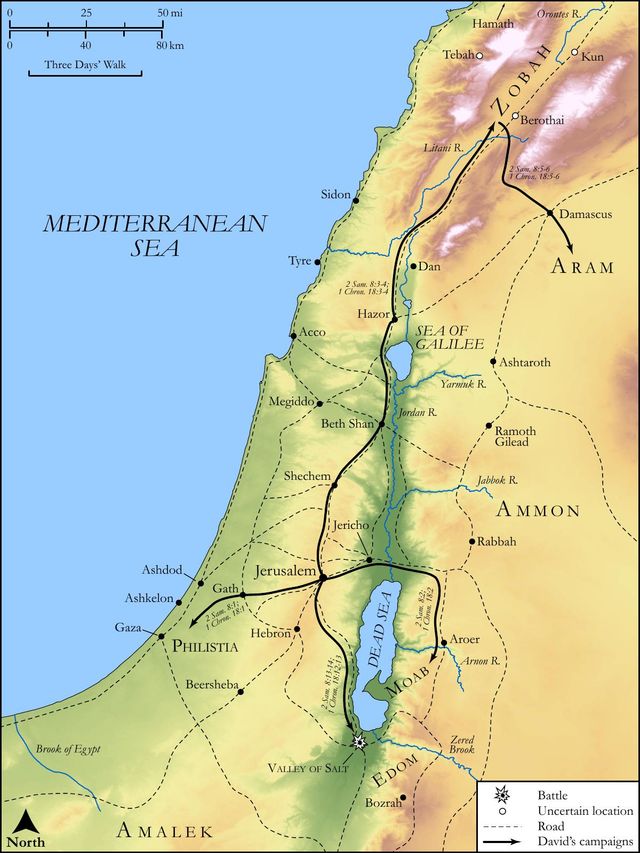
This opening clause establishes the specific geographic source of the valuable metal. "Likewise" connects this acquisition to previous spoils of war taken from Hadarezer (e.g., gold shields in 1 Chronicles 18:7). The identification of Tibhath and Chun as "cities of Hadarezer" emphasizes that these resources were obtained directly from the defeated enemy, highlighting the spoils of war as legitimate and divinely sanctioned provision for Israel's sacred purposes. While their exact locations are debated, they were clearly significant centers for metalworking or trade within the Aramean kingdom of Zobah.
"brought David very much brass"
This phrase emphasizes the immense quantity of metal acquired and credits David as the active agent in its procurement. The phrase "very much" (מְאָד רַב, me'od rab) underscores the extraordinary abundance, signaling the scale of the resources dedicated to the Temple project. It highlights David's diligence and success in consolidating the wealth necessary for God's future dwelling, portraying him not just as a conqueror but as a faithful steward preparing for divine worship.
"wherewith Solomon made the brasen sea, and the pillars, and the vessels of brass"
This crucial clause provides the theological rationale for recording David's acquisition. It explicitly links David's actions to Solomon's future construction of the Temple, specifically mentioning the "brazen sea" (a massive basin for priestly ablutions, described in 1 Kings 7:23-26), the two towering pillars (Jachin and Boaz, detailed in 1 Kings 7:15-22), and other "vessels of brass" used in Temple service. This connection underscores the Chronicler's overarching theme of continuity in God's plan, David's foundational role in preparing for the Temple, and the divine purpose behind the spoils of war.
Literary Devices
ShowHideThe Chronicler employs several literary devices in this verse to convey its profound theological message. Foreshadowing is prominently used, as David's actions in gathering materials explicitly anticipate Solomon's future construction of the Temple. This establishes a clear narrative and theological link between the two kings, demonstrating a continuity of divine purpose across generations. The mention of "very much brass" utilizes Hyperbole to emphasize the vast quantity of the acquired metal, underscoring the immense resources God providentially supplied for His dwelling place and the sheer scale of the future Temple. Furthermore, the Chronicler's selective focus on the bronze's ultimate use for the Temple, rather than merely general plunder, demonstrates Theological Interpretation. This interpretive lens transforms a military victory into an act of divine provision for worship, shaping the historical account to highlight God's providential hand and the sacred destiny of the spoils of war.
Theological and Thematic Connections
ShowHideThis verse beautifully illustrates the principle of divine provision interwoven with human stewardship and foresight. David, a man of war, was not permitted to build the Temple, yet he was divinely tasked with gathering the immense resources required. This highlights God's sovereign ability to use diverse means—even the spoils of war—to accomplish His sacred purposes. The continuity from David's meticulous preparation to Solomon's grand construction underscores that God's plans transcend individual lifetimes and are often realized through the collaborative efforts of successive generations. The bronze, a material of strength and durability, symbolizes the enduring nature of God's covenant and the solid foundation laid for His worship. It teaches that every contribution, whether directly building or merely preparing, is vital to God's kingdom work, demonstrating faithfulness in the present for a future, divinely appointed purpose.
Reflection and Application
ShowHide[1 Chronicles 18:8] offers profound lessons for contemporary believers regarding stewardship, legacy, and God's providential care. Just as David diligently gathered resources for a future project he would not complete, we are called to be faithful stewards of the gifts, talents, and material resources God entrusts to us, even if the full impact of our efforts will only be realized by others or in future generations. Our work, whether visible or behind the scenes, contributes to God's ongoing kingdom mission. This verse reminds us that God can use unexpected circumstances, even those involving conflict or difficulty, to advance His divine purposes and provide for His people. It encourages us to have a long-term perspective, investing in ministries, relationships, and spiritual growth that may bear fruit far beyond our immediate sight, trusting that God will bring His plans to fruition through faithful obedience. Our faithfulness in small or preparatory tasks is just as vital to God's grand design as the final, visible accomplishment.
Questions for Reflection
ShowHideFAQ
ShowHideWhy was brass (bronze) such an important material for the Temple?
ShowHideBronze was crucial for the Temple due to its durability, strength, and availability, as in the cities of Hadarezer from which David took very much brass. Unlike gold or silver, which were used for more decorative or portable items, bronze was ideal for large, heavy, and functional components that needed to withstand significant use and exposure. For instance, the "brazen sea" was a massive basin holding thousands of gallons of water for priestly ablutions, and the pillars (Jachin and Boaz) were monumental structures that added to the Temple's grandeur. Bronze's resistance to corrosion also made it suitable for outdoor elements like the altar of burnt offering in the Temple courtyard. Theologically, its extensive use in the Tabernacle (Exodus 27:1-8) established a precedent for its sacred significance, often associated with judgment (as seen with the bronze serpent in Numbers 21:9), and the enduring nature of God's covenant.
Why did David gather materials for the Temple but not build it himself?
ShowHideDavid passionately desired to build a permanent dwelling place for God, as recorded in 2 Samuel 7:1-3. However, God, through the prophet Nathan, revealed that David, a man of war who had shed much blood, would not be the one to build the Temple. Instead, his son, Solomon, a man of peace, would undertake this task (1 Chronicles 22:8). Despite this divine prohibition, David was permitted, and indeed commanded, to prepare extensively for the Temple's construction, gathering vast quantities of materials like this bronze, along with gold, silver, wood, and stone, and organizing the priestly and Levitical orders (1 Chronicles 22:14-16). This arrangement highlights God's sovereign choice, the distinction between warfare and worship, and the continuity of God's plan across generations, where each plays a distinct yet vital role.
Christ-Centered Fulfillment
ShowHideThe physical Temple, meticulously prepared for by David and built by Solomon with vast quantities of materials like this bronze, ultimately points to a greater spiritual reality fulfilled in Jesus Christ. The earthly Temple was the dwelling place of God among His people, a place of sacrifice, worship, and divine presence. Yet, as the New Testament reveals, the true and ultimate Temple is not made with human hands, but is found in the person of Jesus Christ. He declared, "Destroy this temple, and in three days I will raise it up," referring to His own body (John 2:21). Just as David prepared the materials for the earthly Temple, Christ, through His perfect life, atoning death, and glorious resurrection, has laid the foundation and built the spiritual Temple—His Church—composed of believers, "built on the foundation of the apostles and prophets, Christ Jesus himself being the cornerstone" (Ephesians 2:20). The bronze, symbolizing strength, durability, and perhaps judgment (as seen in the bronze altar for sacrifice), finds its ultimate meaning in Christ's enduring sacrifice that perfectly atones for sin and in His unshakeable kingdom. He is the one who truly gathers all things to Himself, building a dwelling place for God's Spirit that will stand for eternity, making believers "living stones" in a spiritual house.