


1 Chronicles 18:9
Bible text: King James Version (1769 Blayney text) · Public domain
Bible text: Berean Standard Bible · Public domain
Bible text: American Standard Version (1901) · Public domain
Bible text: World English Bible, Messianic edition · Public domain
Bible text: Geneva Bible (1599) · Public domain
Bible text: Young's Literal Translation · Public domain
- וַיִּשְׁמַעvai·yish·Ma'and he heardH8085Conj-w ¦ V-Qal-ConsecImperf-3msVerb Qal Consecutive Imperfect 3rd Singular Masculineוַandיִּשְׁמַעhe heard
- תֹּעוּTo·'uTouH8583N-proper-mNoun Proper Masculine
- מֶלֶךְMe·lekh[the] king ofH4428N-mscNoun Singular Masculine Construct
- חֲמָתcha·MatHamathH2574N-properNoun Proper Location
- כִּיkithatH3588PrtParticle Conditional
- הִכָּהhi·Kahhe had struck downH5221V-Hiphil-Perf-3msVerb Hiphil Perfect 3rd Singular Masculine
- דָוִידda·VidDavidH1732N-proper-mNoun Proper Masculine
- אֶת'et<obj.>H853DirObjMParticle Object Indicator
- כָּלkolallH3605N-mscNoun Singular Masculine Construct
- חֵילcheil[the] army ofH2428N-mscNoun Singular Masculine Construct
- הֲדַדְעֶזֶרha·dad·'E·zerHadadezerH1928N-proper-mNoun Proper Masculine
- מֶלֶךְMe·lekh[the] king ofH4428N-mscNoun Singular Masculine Construct
- צוֹבָהtzo·VahZobahH6678N-properNoun Proper Location
English is a literal word-by-word gloss of the Hebrew, not the KJV's wording. Why?
This is the original text the KJV's translators worked from — each Hebrew word with its own literal English meaning in this verse, prepared by scholars at Tyndale House, Cambridge. The KJV translates whole sentences, not word by word, so its wording differs: one Hebrew word can become several English words, and the KJV may choose “the LORD” where the gloss reads “Yahweh”. Both are faithful — they answer different questions. For the KJV's own rendering, switch to the KJV text.
Details
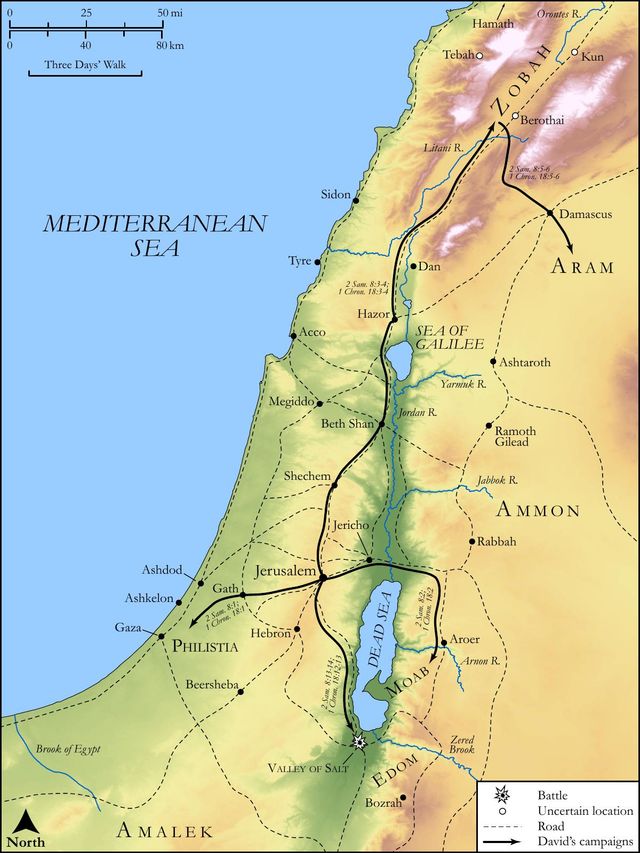
See on the biblical-era map
Study this verse
Public-domain commentary
Matthew Henry
From his Commentary on the Whole Bible. Henry comments on passages, not single verses — this entry covers 1 Chronicles 18:9–17.
Here let us learn, 1. That it is our interest to make those our friends who have the presence of God with them. The king of Hamath, hearing of David's great success, sent to congratulate him and to court his favour with a noble present, Ch1 18:9, Ch1 18:10. It is in vain to contend with the Son of David. Kiss the Son, therefore, lest he be angry; let the kings and judges of the earth, and all inferior people too, be thus wise, thus instructed. The presents we are to bring him are not vessels of gold and silver, as here (those shall be welcomed to him who have no such presents to bring), but our hearts and sincere affections, our whole selves, we must present to him as living sacrifices. 2. That what God blesses us with we must honour him with. The presents of his friends, as well as the spoils of his enemies, David dedicated unto the Lord (Ch1 18:11), that is, he laid them up towards the building and enriching of the temple. That is most truly and most comfortably our own which we have consecrated unto the Lord, and which we use for his glory. Let our merchandise and our hire be holiness to the Lord, Isa 23:18. 3. That those who take God along with them whithersoever they go may expect to prosper, and be preserved, whithersoever they go. It was said before (Ch1 18:6) and here it is repeated (Ch1 18:13) that the Lord preserved David whithersoever he went. Those are always under the eye of God that have God always in their eye. 4. God gives men power, not that they may look great with it, but that they may do good with it. When David reigned over all Israel he executed judgment and justice among all his people, and so answered the end of his elevation. He was not so intent on his conquests abroad as to neglect the administration of justice at home. Herein he served the purposes of the kingdom of providence, and of that God who sits in the throne judging right; and he was an eminent type of the Messiah, the sceptre of whose kingdom is a right sceptre.
Continue studying 1 Chronicles 18:9 across the web’s major study libraries — every link below opens this exact verse, chapter, or book on the destination site.
Read & Compare
 BibleGatewayThis verse in more than 200 translations and 70 languages.
 Bible.comThe YouVersion reader — hundreds of translations, reading plans, and highlights.
 ESV.orgCrossway's official English Standard Version reader.
 NET BibleThe NET translation with 60,000+ translators' notes on every rendering decision.
 STEP BibleTyndale House's free study tool — original text, vocabulary, and scholarly resources.
 BibliaLogos Bible Software's free web reader.
 USCCBThe New American Bible (Revised Edition) with the U.S. bishops' study notes.
Commentaries
 BibleHub CommentariesDozens of classic commentaries on this verse, gathered on one page.
 StudyLightMore than 100 commentary sets — the largest collection on the web.
 BibleRefPlain-English commentary on what this verse means, verse by verse.
 Enduring WordDavid Guzik's free commentary on this chapter, widely used by Bible teachers.
 Bible Study ToolsVerse commentary alongside Greek and Hebrew study aids.
Original Language & Research
- BibleHub InterlinearThe verse word by word — original language, transliteration, and English.
- BibleHub LexiconEvery word's original-language definition and Strong's entry.
 Blue Letter BibleDeep-study tools — Strong's numbers, concordance, and word studies.
 SefariaThe Hebrew text with Rashi and centuries of Jewish commentary.
Sermons, Hymns & Audio


TrulyRandomVerse is not affiliated with these sites and doesn’t control their content. They’re linked because they’re genuinely useful.
Summary
1 Chronicles 18:9 meticulously records the far-reaching impact of King David's decisive military victory over Hadarezer, the formidable king of Zobah. The verse specifically highlights that Tou, the king of Hamath, received news of David's triumph, underscoring David's rapidly expanding reputation and influence as a dominant regional power. This critical intelligence sets the stage for a significant diplomatic encounter, demonstrating how David's divinely-blessed military successes were establishing the security, prestige, and standing of his burgeoning kingdom among the nations round about.
Context
ShowHideLiterary Context
This verse is intricately woven into the broader narrative of David's military campaigns and the subsequent consolidation of his kingdom, primarily detailed in 1 Chronicles 18. Immediately preceding 1 Chronicles 18:9, the Chronicler provides a comprehensive account in 1 Chronicles 18:3-8 of David's overwhelming defeat of Hadarezer, king of Zobah, a significant regional adversary. This pivotal victory extended David's dominion to the Euphrates River and resulted in the capture of vast spoils, including chariots, horses, and immense quantities of bronze. The Chronicler consistently emphasizes God's active involvement in these triumphs, often concluding sections with affirmations such as "the Lord gave victory to David wherever he went" (1 Chronicles 18:6). The news reaching Tou of Hamath in 1 Chronicles 18:9 directly follows this account, serving as a crucial narrative bridge that explains the subsequent diplomatic overtures from Hamath, paralleling the account found in 2 Samuel 8:9-10.
Historical & Cultural Context
In David's day, relations among the nations round about were dynamic and often volatile, characterized by shifting alliances, military expansion, and the rise and fall of various city-states and kingdoms. Zobah, located in Aram (Syria), was a formidable Aramaean kingdom, and its decisive defeat by David marked a profound shift in the regional balance of power. Hamath, situated further north on the Orontes River, was another vital Aramaean city-state. For a king like Tou (also known as Toi in the parallel account in 2 Samuel) to receive intelligence of David's comprehensive victory over a powerful neighbor like Hadarezer would have been a matter of immediate strategic concern and urgency. In this period, news of major military victories and defeats spread rapidly through established trade routes, diplomatic envoys, and intelligence networks. Kings typically responded to such significant shifts by either forming defensive alliances to counter the rising power or, as Tou does in the subsequent verses, by seeking peaceful relations and offering tribute to avoid direct conflict. David's successful expansion into this northern region also significantly fulfilled, in part, the ancient promises of land made to Abraham, extending Israel's influence towards the Euphrates, a traditional boundary of the promised territory (Genesis 15:18).
Key Themes
ShowHideThis verse contributes significantly to several overarching themes prominently featured in 1 Chronicles. Firstly, it powerfully highlights David's growing power and international reputation as a divinely appointed king. His military successes are not presented merely as conquests but as undeniable demonstrations of God's favor and active presence, firmly establishing him as a dominant force in the region. The very fact that a distant king like Tou takes notice underscores David's burgeoning international standing. Secondly, the verse reinforces the pervasive theme of Divine Blessing and the Fulfillment of Covenant. David's victories are consistently attributed to God's active presence and unwavering blessing, thereby fulfilling the promises made to him in the foundational Davidic Covenant (see 1 Chronicles 17:11-14). This divine backing instills both fear and respect in David's adversaries and potential allies alike. Lastly, 1 Chronicles 18:9 serves as an introduction to the theme of Diplomacy and Strategic Alliances. Tou's reaction, which is further elaborated in the subsequent verses (1 Chronicles 18:10-11), is notably not one of hostility but of seeking peace and alliance. This demonstrates how David's military strength, empowered by God, allowed him to secure significant diplomatic advantages, expanding his influence and securing his borders without further conflict.
Exposition and Analysis
ShowHideKey Word Analysis
ShowHideThe verb "heard" translates the Hebrew שָׁמַע (shâmaʻ), a primitive root meaning "to hear intelligently," often implying attention, comprehension, and even obedience. In this context, it signifies that Tou did not merely receive a casual report, but rather that he took careful notice and fully grasped the profound implications of David's victory. The news was not just transmitted but was received with strategic understanding, prompting a significant response.
The KJV phrase "had smitten" translates the Hebrew verb נָכָה (nâkâh), which fundamentally means 'to strike,' 'to hit,' or 'to smite.' In military contexts, as used here, nâkâh denotes a decisive, destructive, and often devastating defeat. It conveys the totality and finality of David's victory over Hadarezer's forces, indicating not just a skirmish but a complete and overwhelming rout. The pluperfect tense ("had smitten") emphasizes that this was a completed action, the news of which was now reverberating across the region.
The word "host" translates the Hebrew חַיִל (chayil), which refers to a force, whether of men, means, or other resources, commonly an army or military force. Here, "all the host" emphasizes the entirety of Hadarezer's military might. It suggests that David's victory was not partial but absolute, encompassing the complete destruction or subjugation of Hadarezer's entire fighting force. This total defeat is precisely why the news would be so impactful and alarming to neighboring kings like Tou.
Verse Breakdown
ShowHide"Now when Tou king of Hamath heard"
This opening clause immediately establishes the ripple effect of David's victory. Tou, as the king of Hamath, a significant city-state in northern Syria, represents a distant but important political entity. The act of "hearing" implies that the news of David's triumph was not confined to the immediate vicinity but had spread across significant geographical distances, demonstrating the scale and notoriety of David's achievement and the effectiveness of ancient intelligence networks.
"how David had smitten"
This phrase directly attributes the decisive military action to David. The verb "smitten" (as analyzed above) signifies a complete and devastating defeat. The focus is on David's agency as the instrument of God's power, highlighting his role as a formidable warrior-king and the primary force behind this regional shift.
"all the host of Hadarezer king of Zobah;"
This final clause specifies the target and extent of David's victory. Hadarezer, king of Zobah, was a powerful Aramaean ruler whose defeat would have sent shockwaves through the region. The phrase "all the host" underscores the totality of the defeat, indicating that Hadarezer's entire military strength was neutralized. This comprehensive victory is the precise reason for Tou's concern and subsequent diplomatic action, as it fundamentally altered the balance of power in the Levant.
Literary Devices
ShowHideThe verse effectively employs several literary devices to convey its profound message. Cause and Effect is a central structural element, where David's decisive military victory (the cause) directly leads to Tou's hearing of the news and his subsequent diplomatic response (the effect). The phrase "all the host" can be interpreted as a form of Hyperbole, emphasizing the completeness and overwhelming nature of David's victory, even if not every single soldier was literally annihilated. This serves to magnify David's power and the scale of his achievement in the eyes of the reader and the nations. The verse also utilizes Foreshadowing, as Tou's act of hearing the news sets the stage for the significant diplomatic mission described in the immediate following verses (1 Chronicles 18:10-11), where he sends his son to congratulate David and offer tribute. This narrative technique builds anticipation and demonstrates the immediate and far-reaching consequences of David's actions on the broader geopolitical stage. Furthermore, the precise mention of specific kings and kingdoms—Tou of Hamath, David, Hadarezer of Zobah—lends a strong sense of Historical Realism to the narrative, grounding David's reign firmly among the nations and kings whom Scripture names.
Theological and Thematic Connections
ShowHide1 Chronicles 18:9, while appearing to be a straightforward historical report, carries profound theological weight within the Chronicler's narrative. It powerfully underscores the consistent theme that David's successes are not merely due to his exceptional military prowess or strategic genius, but are direct manifestations of God's unwavering covenant faithfulness and active presence with His chosen king. The news reaching Tou of Hamath is a testament to God's sovereign establishment of David's kingdom as a dominant force, fulfilling His promise to give David rest from all his enemies (2 Samuel 7:11). This divine backing ensured that David's reputation was not just that of a mighty warrior, but of a king uniquely blessed by Yahweh, inspiring both fear and respect among neighboring nations. The verse implicitly highlights God's ultimate sovereignty over nations, demonstrating how He raises up and brings down kingdoms, using David as His instrument to bring order, stability, and the expansion of His people's influence among the nations.
Reflection and Application
ShowHideThe news of David's victory spreading to Tou of Hamath serves as a profound reminder that our actions, particularly those undertaken in obedience to God and empowered by His Spirit, have far-reaching consequences that extend beyond our immediate circumstances or intentions. It beautifully illustrates how God can establish an individual, a family, or a community in such a way that their reputation—their character, their faithfulness, and the fruit of their lives—precedes them, opening doors for peace, influence, and even reconciliation among those who were once adversaries or strangers. For us today, this suggests that our faithfulness and obedience to God, whether individually in our personal walk or corporately as the church, can have an impact that reverberates in unexpected and powerful ways, influencing those in our immediate spheres of influence and far beyond. It encourages us to live in such a way that our "reputation," rooted in God's blessing and our Christ-like character, speaks volumes, reflecting the God we serve. Just as David's kingdom was established for peace and order in his time, our lives, when aligned with God's purposes, can be instruments of His peace, justice, and redemptive order in a chaotic and broken world.
Questions for Reflection
ShowHideFAQ
ShowHideWho was Hadarezer, and why was his defeat so significant?
ShowHideHadarezer was the powerful king of Zobah, a prominent Aramaean kingdom located in what is modern-day Syria. His kingdom was a major regional power, controlling significant territory and resources, and often engaging in conflicts with neighboring states. David's decisive defeat of Hadarezer, as comprehensively described in 1 Chronicles 18:3-8, was profoundly significant because it eliminated a formidable adversary to Israel, extended Israel's dominion to the Euphrates River (a traditional boundary of the promised land), secured vital trade routes, and brought immense wealth into David's treasury. This victory solidified David's position as the dominant force in the Levant and powerfully demonstrated God's faithfulness in granting him rest from his enemies, thereby establishing peace and security for the nation of Israel.
Who was Tou, king of Hamath, and what was his reaction to the news?
ShowHideTou (also known as Toi in the parallel account in 2 Samuel 8:9-10) was the king of Hamath, another important Aramaean city-state situated north of Zobah. Hamath had likely been an enemy or rival of Zobah, making Hadarezer's defeat beneficial to Tou. Upon hearing of David's decisive and overwhelming victory over Hadarezer, Tou's reaction was not one of hostility or fear-driven aggression, but rather a strategic move to seek peaceful relations and a potential alliance. The subsequent verses (1 Chronicles 18:10-11) describe him sending his son, Hadoram (or Joram), with valuable gifts of gold, silver, and bronze to congratulate David and establish a friendly, tributary relationship. This diplomatic overture highlights David's rapidly growing reputation and the significant strategic advantages his military successes, empowered by God, afforded him in the regional political landscape.
Christ-Centered Fulfillment
ShowHideWhile 1 Chronicles 18:9 describes a historical military victory that established David's earthly kingdom, it powerfully points forward to the ultimate and decisive victory of a greater Son of David, Jesus Christ. David's triumph over Hadarezer brought a measure of earthly peace and security to Israel, but it was a temporary and limited peace, achieved through physical warfare. Jesus, the true and eternal King, came not to smite earthly armies with physical weapons, but to conquer the spiritual forces of darkness, sin, and death. His victory on the cross, where He "disarmed the rulers and authorities and put them to open shame, by triumphing over them in Him" (Colossians 2:15), was a definitive and comprehensive defeat of "all the host" of spiritual enemies that held humanity captive. The news of this unparalleled victory, the glorious gospel, has spread far beyond the borders of any earthly kingdom, reaching "to the end of the earth" (Acts 1:8) and inviting all nations to hear and respond. Just as Tou heard of David's power and sought alliance, so too do people from "every tribe and language and people and nation" (Revelation 5:9) hear of Christ's triumph and are invited to enter into a new covenant of peace and reconciliation with God through Him (2 Corinthians 5:18-20). Jesus' reign is eternal, His peace absolute, and His kingdom everlasting, fulfilling and infinitely surpassing the shadows of David's earthly dominion.