


2 Samuel 8:9
Bible text: King James Version (1769 Blayney text) · Public domain
Bible text: Berean Standard Bible · Public domain
Bible text: American Standard Version (1901) · Public domain
Bible text: World English Bible, Messianic edition · Public domain
Bible text: Geneva Bible (1599) · Public domain
Bible text: Young's Literal Translation · Public domain
- וַיִּשְׁמַעvai·yish·Ma'and he heardH8085Conj-w ¦ V-Qal-ConsecImperf-3msVerb Qal Consecutive Imperfect 3rd Singular Masculineוַandיִּשְׁמַעhe heard
- תֹּעִיTo·'iToiH8583N-proper-mNoun Proper Masculine
- מֶלֶךְMe·lekh[the] king ofH4428N-mscNoun Singular Masculine Construct
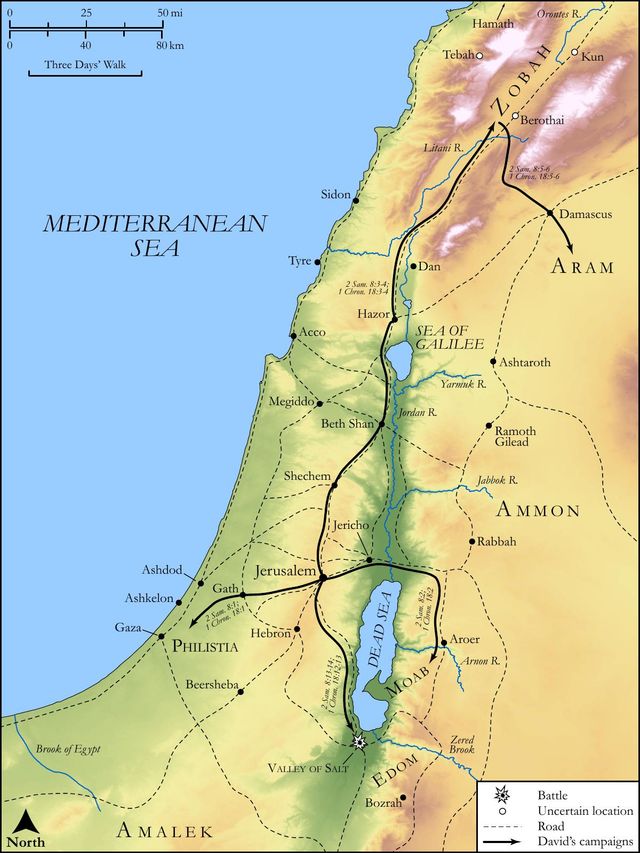
- חֲמָתcha·MatHamathH2574N-properNoun Proper Location
- כִּיkithatH3588PrtParticle Conditional
- הִכָּהhi·Kahhe had defeatedH5221V-Hiphil-Perf-3msVerb Hiphil Perfect 3rd Singular Masculine
- דָוִדda·VidDavidH1732N-proper-mNoun Proper Masculine
- אֵת'et<obj.>H853DirObjMParticle Object Indicator
- כָּלkolallH3605N-mscNoun Singular Masculine Construct
- חֵילcheil[the] army ofH2428N-mscNoun Singular Masculine Construct
- הֲדַדְעָזֶרha·dad·'A·zerHadadezerH1909N-proper-mNoun Proper Masculine
English is a literal word-by-word gloss of the Hebrew, not the KJV's wording. Why?
This is the original text the KJV's translators worked from — each Hebrew word with its own literal English meaning in this verse, prepared by scholars at Tyndale House, Cambridge. The KJV translates whole sentences, not word by word, so its wording differs: one Hebrew word can become several English words, and the KJV may choose “the LORD” where the gloss reads “Yahweh”. Both are faithful — they answer different questions. For the KJV's own rendering, switch to the KJV text.
Details
See on the biblical-era maps

Study this verse
Public-domain commentary
Matthew Henry
From his Commentary on the Whole Bible. Henry comments on passages, not single verses — this entry covers 2 Samuel 8:9–14.
Here is, 1. The court made to David by the king of Hamath, who, it seems was at this time at war with the king of Zobah. He hearing of David's success against his enemy, sent his own son ambassador to him (Sa2 8:9, Sa2 8:10), to congratulate him on his victory, to return him thanks for the favour he had done him in breaking the power of one he was in fear of, and to beg his friendship. Thus he not only secured but strengthened himself. And David lost nothing by taking this little prince under his protection, any more than the old Romans did by the like policy; for the wealth he had from the countries he conquered by way of spoil he had from this by way of present or gratuity: Vessels of silver and gold. Better get by composition than by compulsion. 2. The offering David made to God of the spoils of the nations and all the rich things that were brought him. He dedicated all to the Lord, Sa2 8:11, Sa2 8:12. This crowned all his victories, and made them far to out-shine Alexander's or Caesar's, that they sought their own glory, but he aimed at the glory of God. All the precious things he was master of were dedicated things, that is, they were designed for the building of the temple; and a good omen it was of kindness to the Gentiles in the fulness of time, and of the making of God's house a house of prayer for all people, that the temple was built of the spoils and presents of Gentile nations, in allusion to which we find the kings of the earth bringing their glory and honour into the new Jerusalem, Rev 21:24. Their gods of gold David burnt (Sa2 5:21), but their vessels of gold he dedicated. Thus in the conquest of a soul, by the grace of the Son of David, what stands in opposition to God must be destroyed, every lust mortified and crucified, but what may glorify him must be dedicated and the property of it altered. Even the merchandise and the hire must be holiness to the Lord (Isa 23:18), the gain consecrated to the Lord of the whole earth (Mic 4:13), and then it is truly our own and that most comfortably. 3. The reputation he got, in a particular manner, by his victory over the Syrians and their allies the Edomites, who acted in conjunction with them, as appears by comparing the title of the 60th Psalm, which was penned on this occasion, with Sa2 8:13. He got himself a name for all that conduct and courage which are the praise of a great and distinguished general. Something extraordinary, it is likely, there was in that action, which turned very much to his honour, yet he is careful to transfer the honour to God, as appears by the psalm he penned on this occasion, Sa2 8:12. It is through God that we do valiantly. 4. His success against the Edomites. They all became David's servants, Sa2 8:14. Now, and not till now, Isaac's blessing was accomplished, by which Jacob was made Esau's Lord (Gen 27:37-40) and the Edomites continued long tributary to the kings of Judah, as the Moabites were to the kings of Israel, till, in Joram's time, they revolted (Ch2 21:8) as Isaac had there foretold that Esau should, in process of time, break the yoke from off his neck. Thus David by his conquests, (1.) Secured peace to his son, that he might have time to build the temple. And, (2.) Procured wealth for his son, that he might have wherewith to build it. God employs his servants variously, some in one employment, others in another, some in the spiritual battles, others in the spiritual buildings; and one prepares work for the other, that God may have the glory of all. All David's victories were typical of the success of the gospel against the kingdom of Satan, in which the Son of David rode forth, conquering and to conquer, and he shall reign till he has brought down all opposing rule, principality, and power: and he has, as David had (Sa2 8:2), a line to kill and a line to save; for the same gospel is to some a savour of life unto life, to others a savour of death unto death.
Continue studying 2 Samuel 8:9 across the web’s major study libraries — every link below opens this exact verse, chapter, or book on the destination site.
Read & Compare
 BibleGatewayThis verse in more than 200 translations and 70 languages.
 Bible.comThe YouVersion reader — hundreds of translations, reading plans, and highlights.
 ESV.orgCrossway's official English Standard Version reader.
 NET BibleThe NET translation with 60,000+ translators' notes on every rendering decision.
 STEP BibleTyndale House's free study tool — original text, vocabulary, and scholarly resources.
 BibliaLogos Bible Software's free web reader.
 USCCBThe New American Bible (Revised Edition) with the U.S. bishops' study notes.
Commentaries
 BibleHub CommentariesDozens of classic commentaries on this verse, gathered on one page.
 StudyLightMore than 100 commentary sets — the largest collection on the web.
 BibleRefPlain-English commentary on what this verse means, verse by verse.
 Enduring WordDavid Guzik's free commentary on this chapter, widely used by Bible teachers.
 Bible Study ToolsVerse commentary alongside Greek and Hebrew study aids.
Original Language & Research
- BibleHub InterlinearThe verse word by word — original language, transliteration, and English.
- BibleHub LexiconEvery word's original-language definition and Strong's entry.
 Blue Letter BibleDeep-study tools — Strong's numbers, concordance, and word studies.
 SefariaThe Hebrew text with Rashi and centuries of Jewish commentary.
Sermons, Hymns & Audio


TrulyRandomVerse is not affiliated with these sites and doesn’t control their content. They’re linked because they’re genuinely useful.
Summary
2 Samuel 8:9 records a significant moment in David's reign, highlighting the far-reaching impact of his decisive victory over Hadadezer, king of Zobah. The verse reports that Toi, the king of Hamath, a prominent kingdom to Israel's north, received news of David's overwhelming military success. This intelligence prompted a strategic response from Toi, setting the stage for an alliance that further solidified David's regional dominance and underscored the burgeoning reputation of Israel as a formidable power among the nations.
Context
ShowHideLiterary Context
This verse immediately follows a detailed account of David's comprehensive military campaign against Hadadezer, king of Zobah, as recorded in 2 Samuel 8:3-8. David not only defeated Hadadezer's vast army but also captured a significant number of chariots and horses, along with immense quantities of gold and bronze from Hadadezer's cities. This victory was not merely a skirmish but a decisive blow that neutralized a major regional rival and secured Israel's eastern and northern borders. The narrative in 2 Samuel 8 systematically details David's conquests, demonstrating the fulfillment of God's promises regarding the expansion and security of Israel's kingdom, with this verse serving as a crucial transition to show the international recognition of David's power.
Historical & Cultural Context
Hamath was an important Aramaean city-state located in modern-day Syria, situated along the Orontes River, north of Israel. It was a significant political and economic entity among the kingdoms round about Israel, often having complex relationships, sometimes rivalrous, with neighboring Aramaean kingdoms like Zobah. News of major military victories and defeats traveled quickly through trade routes, diplomatic envoys, and even refugees. In this geopolitical landscape, a king's reputation for military prowess was paramount, influencing alliances, tributes, and territorial claims. Toi's reaction to David's victory over Hadadezer reflects the pragmatic diplomacy of the era, where weaker or rival states would seek to align with the rising power to ensure their own survival and prosperity, rather than risk confrontation.
Key Themes
ShowHideThe verse contributes to several overarching themes in 2 Samuel. Firstly, it highlights the expansion of David's kingdom and influence, demonstrating that his authority extended beyond Israel's immediate borders, reaching distant kingdoms. Secondly, it underscores the theme of divine blessing and presence with David, as his unparalleled military successes are consistently attributed to God's favor throughout passages like 2 Samuel 7:9. The widespread recognition of David's power by foreign kings like Toi serves as external validation of God's work through him. Thirdly, it introduces the theme of strategic alliances and diplomacy, showing how David's military might led not only to conquest but also to the formation of beneficial relationships with other nations, consolidating his regional hegemony, as seen in the broader context of 2 Samuel 8.
Exposition and Analysis
ShowHideKey Word Analysis
ShowHideThis primitive root means "to hear intelligently," often implying attention, obedience, or full comprehension. In this context, Toi not only received the information but also understood its profound implications for his own kingdom and the broader geopolitical landscape, prompting a strategic response.
This primitive root signifies "to strike" or "to beat," whether lightly or severely, literally or figuratively. Here, it denotes a decisive and overwhelming defeat, emphasizing the completeness with which David neutralized Hadadezer's military capability and political power.
This word refers to a "force," "army," or "military resources." The phrase "all the host of Hadadezer" underscores the totality of David's victory, indicating that Hadadezer's entire fighting force was defeated, leaving him without significant means to resist further. This complete subjugation would have been particularly alarming to neighboring kings like Toi, signaling a profound shift in regional power dynamics.
Verse Breakdown
ShowHide"¶ When Toi king of Hamath heard"
This opening clause immediately establishes the international reach of David's reputation and the widespread impact of his military campaigns. Toi, as king of a significant Aramaean kingdom far to the north, is presented as an external observer reacting to events in Israel, signifying David's growing renown.
"that David had smitten"
This phrase succinctly communicates the decisive nature of David's action. The use of "had smitten" emphasizes that the victory was already a definitive and irreversible fact, a historical event of great consequence that had fundamentally altered the balance of power in the region.
"all the host of Hadadezer"
This final part of the clause specifies the target and extent of David's victory. By defeating "all the host" (the entire army) of Hadadezer, David had not merely won a battle but had utterly dismantled the military power of a major regional rival. This complete subjugation of Hadadezer is the critical piece of information that prompts Toi's strategic response in the subsequent verses.
Literary Devices
ShowHideThe verse effectively employs Foreshadowing, as Toi's act of "hearing" the news sets the stage for his subsequent actions in the following verses, where he sends his son to David to offer tribute and seek alliance, thereby acknowledging David's supremacy. There is also a clear Contrast between the fallen power of Hadadezer and the rising, undeniable might of David. The narrative implicitly uses Metonymy, where "Toi king of Hamath" represents the entire kingdom of Hamath, and "Hadadezer" represents his entire military and political entity, highlighting the shift in regional authority through the actions of their leaders.
Theological and Thematic Connections
ShowHideThis verse, while seemingly a simple report of news, is deeply embedded in the theological narrative of God's faithfulness to David and His covenant promises. David's victories are not merely human military achievements but are consistently portrayed as the direct result of God's presence and favor, fulfilling the promise that God would be with David wherever he went and would cut off all his enemies before him, as articulated in 2 Samuel 7:9. Toi's reaction, therefore, is an indirect acknowledgment of the divine power working through David, as even distant nations recognize the extraordinary nature of his success. This expansion of Israel's influence and the submission of foreign kings align with the broader biblical theme of God establishing His chosen king and extending His kingdom's reach, echoing earlier promises of land and dominion.
Reflection and Application
ShowHideThe news of David's victory traveling to distant Hamath reminds us that our actions, whether in leadership, personal integrity, or professional endeavors, often create a reputation that precedes us and shapes how others perceive and interact with us. Our influence extends far beyond our immediate circle, and the news of our character and deeds can travel widely, prompting others to respond accordingly. This verse encourages us to consider the ripple effects of our choices and to live in a manner that honors God, understanding that He can use our faithfulness and obedience to impact lives and circumstances far beyond what we can immediately perceive. Just as God used David's victories to establish His kingdom's reputation and influence, He can use our lives to bear witness to His power and grace in the world, drawing others to Himself through our conduct and character.
Questions for Reflection
ShowHideFAQ
ShowHideWho was Hadadezer and why was his defeat significant?
ShowHideHadadezer was the powerful king of Zobah, an Aramaean kingdom located to the northeast of Israel, often seen as a significant rival or threat to Israel's expansion. His defeat by David was highly significant because it effectively neutralized a major regional power, allowing Israel to control key trade routes (like the Euphrates River, as mentioned in 2 Samuel 8:3) and expand its influence and territory. This victory was crucial for establishing David's hegemony among the nations round about, fulfilling God's promise to give David rest from all his enemies, as seen in 2 Samuel 7:11.
Where was Hamath located in relation to Israel?
ShowHideHamath was an important Aramaean city-state situated along the Orontes River, in what is modern-day Syria. It was located significantly to the north of Israel, a considerable distance from the heart of David's kingdom. Its king, Toi, hearing of David's victory over Hadadezer underscores the extensive reach of David's military reputation and the geopolitical shifts occurring in the region, demonstrating David's growing international influence.
What was Toi's motivation for reacting this way to David's victory?
ShowHideToi's motivation was primarily strategic and self-preservational. Given Hadadezer's power, it is plausible that Hamath had been a rival or even subjugated by Zobah at times. David's decisive defeat of Hadadezer removed a common enemy or oppressor for Hamath. By sending his son and tribute to David (as detailed in 2 Samuel 8:10), Toi sought to secure his kingdom's safety, prevent David from extending his conquests to Hamath, and potentially gain a powerful ally. It was a pragmatic move to align with the rising regional superpower, recognizing the new balance of power established by David's God-given victories.
Christ-Centered Fulfillment
ShowHideDavid's burgeoning kingdom and the recognition of his power by distant kings like Toi serve as a profound foreshadowing of the universal dominion of Jesus Christ. Just as nations heard of David's victories and responded, so too will "every knee bow" and "every tongue confess" to the Lordship of Jesus Christ, as proclaimed in Philippians 2:10-11. David's earthly reign, marked by conquest and the establishment of a secure kingdom, points to the ultimate, eternal kingdom of Christ, which is not confined by geographical borders but encompasses all creation (Revelation 11:15). The peace and security that David brought to Israel, leading to alliances and tribute from other nations, prefigures the ultimate peace and reconciliation found in Christ, to whom all authority in heaven and on earth has been given (Matthew 28:18). Toi's submission to David's earthly authority anticipates the willing and compelled submission of all peoples to the King of Kings, whose reign is one of justice, righteousness, and everlasting peace (Isaiah 9:6-7).