


2 Samuel 8:3
Bible text: King James Version (1769 Blayney text) · Public domain
Bible text: Berean Standard Bible · Public domain
Bible text: American Standard Version (1901) · Public domain
Bible text: World English Bible, Messianic edition · Public domain
Bible text: Geneva Bible (1599) · Public domain
Bible text: Young's Literal Translation · Public domain
- וַיַּךְvai·Yakhand he defeatedH5221Conj-w ¦ V-Hiphil-ConsecImperf-3msVerb Hiphil Consecutive Imperfect 3rd Singular Masculineוַandיַּךְhe defeated
- דָּוִדda·VidDavidH1732N-proper-mNoun Proper Masculine
- אֶת'et<obj.>H853DirObjMParticle Object Indicator
- הֲדַדְעֶזֶרha·dad·'E·zerHadadezerH1909N-proper-mNoun Proper Masculine
- בֶּןben[the] son ofH1121N-mscNoun Singular Masculine Construct
- רְחֹבre·ChoRehobH7340N-proper-mNoun Proper Masculine
- מֶלֶךְMe·lekh[the] king ofH4428N-mscNoun Singular Masculine Construct
- צוֹבָהtzo·VahZobahH6678N-properNoun Proper Location
- בְּלֶכְתּוֹbe·lekh·Towhen he wentH1980Prep-b ¦ V-Qal-Inf ¦ 3msVerb Qal Infinitive Constructבְּwhenלֶכְתּwentוֹhe
- לְהָשִׁיבle·ha·Shivto restoreH7725Prep-l ¦ V-Hiphil-InfVerb Hiphil Infinitive Constructלְtoהָשִׁיבrestore
- יָדוֹya·Dohis handH3027N-csc ¦ 3msNoun Singular common gender Constructיָדhandוֹhis
- בִּנְהַרפְּרָתbin·har-pe·Ratat [the] river - EuphratesH5104Prep-b ¦ N-msc ¦ N-properNoun Singular Masculine Constructבִּatנְהַר[the] riverפְּרָתEuphrates
English is a literal word-by-word gloss of the Hebrew, not the KJV's wording. Why?
This is the original text the KJV's translators worked from — each Hebrew word with its own literal English meaning in this verse, prepared by scholars at Tyndale House, Cambridge. The KJV translates whole sentences, not word by word, so its wording differs: one Hebrew word can become several English words, and the KJV may choose “the LORD” where the gloss reads “Yahweh”. Both are faithful — they answer different questions. For the KJV's own rendering, switch to the KJV text.
Details
See on the biblical-era maps

Study this verse
Public-domain commentary
Matthew Henry
From his Commentary on the Whole Bible. Henry comments on passages, not single verses — this entry covers 2 Samuel 8:1–8. His two-level outline is real structure in the source text, so it is rendered as structure.
God had given David rest from all his enemies that opposed him and made head against him; and he having made a good use of that rest, has now commission given him to make war upon them, and to act offensively for the avenging of Israel's quarrels and the recovery of their rights; for as yet they were not in full possession of that country to which by the promise of God they were entitled.
I.He quite subdued the Philistines, Sa2 8:1.
They had attacked him when they thought him weak (Sa2 5:17), and went by the worst then; but, when he found himself strong, he attacked them, and made himself master of their country. They had long been vexatious and oppressive to Israel. Saul got no ground against them; but David completed Israel's deliverance out of their hands, which Samson had begun long before, Jdg 13:5. Metheg-ammah was Gath (the chief and royal city of the Philistines) and the towns belonging to it, among which there was a constant garrison kept by the Philistines on the hill Ammah (Sa2 2:24), which was Metheg, a bridle (so it signifies) or curb upon the people of Israel; this David took out of their hand and used it as a curb upon them. Thus, when the strong man is disarmed, the armour wherein he trusted is taken from him, and used against him, Luk 11:22. And after the long and frequent struggles which the saints have had with the powers of darkness, like Israel with the Philistines, the Son of David shall tread them all under their feet and make the saints more than conquerors.
II.He smote the Moabites, and made them tributaries to Israel, Sa2 8:2.
He divided the country into three parts, two of which he destroyed, casting down the strong-holds, and putting all to the sword; the third part he spared, to till the ground and be servants to Israel. Dr. Lightfoot says, "He laid them on the ground and measured them with a cord, who should be slain and who should live;" and this is called meting out the valley of Succoth, Psa 60:6. The Jews say he used this severity with the Moabites because they had slain his parents and brethren, whom he put under the protection of the king of Moab during his exile, Sa1 22:3, Sa1 22:4. He did it in justice, because they had been dangerous enemies to the Israel of God; and in policy, because, if left in their strength, they still would have been so. But observe, Though it was necessary that two-thirds should be cut off, yet the line that was to keep alive, though it was but one, is ordered to be a full line. Be sure to give that length enough; let the line of mercy be stretched to the utmost in favorem vitae - so as to favour life. Acts of indemnity must be construed so as to enlarge the favour. Now Balaam's prophecy was fulfilled, A sceptre shall arise out of Israel, and shall smite the corners of Moab, to the utmost of which the fatal line extended, Num 24:17. The Moabites continued tributaries to Israel till after the death of Ahab, Kg2 3:4, Kg2 3:5. Then they rebelled and were never reduced.
III.He smote the Syrians or Aramites.
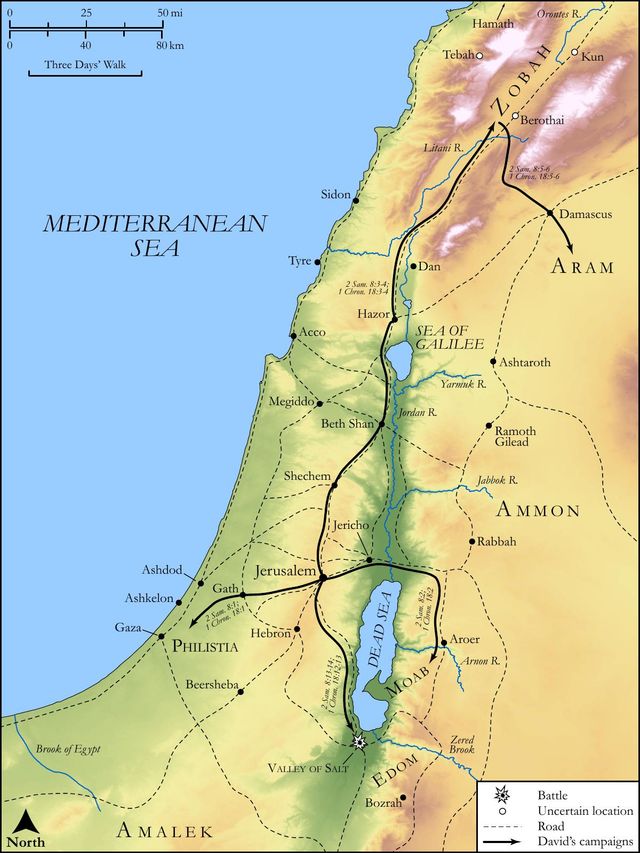
Of them there were two distinct kingdoms, as we find them spoken of in the title of the 60th Psalm: Aram Naharaim, - Syria of the rivers, whose head city was Damascus (famed for its rivers, Kg2 5:12), and Aram Zobah, which joined to it, but extended to Euphrates. These were the two northern crowns.
1.David began with the Syrians of Zobah, Sa2 8:3, Sa2 8:4. As he went to settle his border at the river Euphrates (for so far the land conveyed by the divine grant to Abraham and his seed did extend, Gen 15:18), the king of Zobah opposed him, being himself possessed of those countries which belonged to Israel; but David routed his forces, and took his chariots and horsemen. The horsemen are here said to be 700, but Ch1 18:4 they are said to be 7000. If they divided their horse by ten in a company, as it is probable they did, the captains and companies were 700, but the horsemen were 7000. David houghed the horses, cut the sinews of their hams, and so lamed them, and made them unserviceable, at least in war, God having forbidden them to multiply horses, Deu 17:16. David reserved only 100 chariots out of 1000 for his own use: for he placed his strength not in chariots nor horses, but in the living God (Psa 20:7), and wrote it from his own observation that a horse is a vain thing for safety, Psa 33:16, Psa 33:17.
2.The Syrians of Damascus coming in to the relief of the king of Zobah fell with him. 22,000 were slain in the field, Sa2 8:5. So that it was easy for David to make himself master of the country, and garrison it for himself, Sa2 8:6. The enemies of God's church, that think to secure themselves, will prove, in the end, to ruin themselves, by their confederacies with each other. Associate yourselves, and you shall be broken in pieces, Isa 8:9.
IV.In all these wars,
1.David was protected: The Lord preserved him whithersoever he went. It seems, he went in person, and, in the cause of God and Israel, jeoparded his own life in the high places of the field; but God covered his head in the day of battle, which he often speaks of, in his psalms, to the glory of God.
2.He was enriched. He took the shields of gold which the servants of Hadadezer had in their custody (Sa2 8:7) and much brass from several cities of Syria (Sa2 8:8), which he was entitled to, not only jure belli - by the uncontrollable right of the longest sword ("Get it, and take it"); but by commission from heaven, and the ancient entail of these countries on the seed of Abraham.
Historical interpretation
Two Centuries of Reception
2 surviving comments on this verse. Each one is dated, so this reads as a timeline rather than a list.
Select a marker to jump to its quote. Markers stagger vertically where authors wrote within a few decades of each other.
In the second book of Kings [Samuel], where David defeated the Moabites, Scripture records the measuring out of two separate lines for life and two for death. The significance of setting aside some Moabites for life and others for death is made clear by the story of Orpah and Ruth. Orpah, who turned back to idolatry and her ancient country, was destined for death; Ruth, following her mother-in-law, whose name means “pleasant,” says, “Your people shall be my people, and your God my God.”
The history of the Kings [Samuel] recounts that David won these victories after he succeeded Saul in the kingship, and it seems inappropriate to introduce them into our ordered arrangement here since they are known to be recounted extensively there. But we must realize that these wars are a description in figure of the Lord Savior’s victories which he wins throughout the whole world over pagans and the faithless. It is their words which this psalm will utter, so that when truly dislodged from their old superstition they may deserve to be changed through the grace of the new man.
Continue studying 2 Samuel 8:3 across the web’s major study libraries — every link below opens this exact verse, chapter, or book on the destination site.
Read & Compare
 BibleGatewayThis verse in more than 200 translations and 70 languages.
 Bible.comThe YouVersion reader — hundreds of translations, reading plans, and highlights.
 ESV.orgCrossway's official English Standard Version reader.
 NET BibleThe NET translation with 60,000+ translators' notes on every rendering decision.
 STEP BibleTyndale House's free study tool — original text, vocabulary, and scholarly resources.
 BibliaLogos Bible Software's free web reader.
 USCCBThe New American Bible (Revised Edition) with the U.S. bishops' study notes.
Commentaries
 BibleHub CommentariesDozens of classic commentaries on this verse, gathered on one page.
 StudyLightMore than 100 commentary sets — the largest collection on the web.
 BibleRefPlain-English commentary on what this verse means, verse by verse.
 Enduring WordDavid Guzik's free commentary on this chapter, widely used by Bible teachers.
 Bible Study ToolsVerse commentary alongside Greek and Hebrew study aids.
Original Language & Research
- BibleHub InterlinearThe verse word by word — original language, transliteration, and English.
- BibleHub LexiconEvery word's original-language definition and Strong's entry.
 Blue Letter BibleDeep-study tools — Strong's numbers, concordance, and word studies.
 SefariaThe Hebrew text with Rashi and centuries of Jewish commentary.
Sermons, Hymns & Audio


TrulyRandomVerse is not affiliated with these sites and doesn’t control their content. They’re linked because they’re genuinely useful.
Summary
Second Samuel 8:3 records a pivotal moment in King David's reign, detailing his decisive military victory over Hadadezer, the powerful Aramean king of Zobah. This encounter occurred as Hadadezer was attempting to reassert or expand his dominion towards the strategic Euphrates River, a move that potentially threatened Israel's emerging regional influence and the divinely promised borders of its territory. David's success in this campaign was not merely a human achievement but a divinely enabled triumph, consolidating his kingdom, securing Israel's northern frontiers, and demonstrating God's faithfulness in establishing David's rule and fulfilling His covenant promises.
Context
ShowHideLiterary Context
This verse is situated within a broader narrative in 2 Samuel 8 that systematically details David's military campaigns and administrative successes after he has consolidated his rule over all Israel. It follows the profound establishment of the Davidic Covenant in 2 Samuel 7, where God promises David an enduring dynasty and rest from his enemies. The victories enumerated in 2 Samuel 8:1-14 serve as concrete evidence of God's faithfulness to this covenant, demonstrating that the Lord indeed gave David victory wherever he went, fulfilling the promise of a great name and security for his people. The defeat of Hadadezer, a major regional power, is presented as a significant step in this divinely orchestrated expansion and consolidation, leading directly into the description of David's administrative structure in 2 Samuel 8:15-18.
Historical & Cultural Context
Zobah was a prominent Aramean kingdom located north of Damascus, a significant regional power at the time. Its king, Hadadezer, was a formidable ruler who controlled strategic trade routes and exerted considerable influence. The "river Euphrates" was a crucial geographical landmark, frequently mentioned in biblical texts as a traditional boundary of the land promised to Abraham's descendants (e.g., Genesis 15:18). Hadadezer's expedition "to recover his border" suggests an aggressive move to re-establish or extend his control over territories or trade routes stretching towards the Euphrates, potentially encroaching on areas significant to Israel's promised inheritance or its burgeoning sphere of influence. David's military response was therefore not merely defensive but a strategic counter-move to secure Israel's northern flank and assert its growing regional dominance, preventing a powerful rival from establishing a strong presence near its borders and thereby protecting Israel's future prosperity and security.
Key Themes
ShowHideThe account of David's victory over Hadadezer contributes to several overarching themes in 2 Samuel and the broader biblical narrative. Firstly, it powerfully illustrates David's Divinely Enabled Victories, emphasizing that his military successes were not solely due to human prowess but were a direct result of God's active presence and enabling hand, fulfilling the promise that God would be with him wherever he went (2 Samuel 7:9). Secondly, it highlights the theme of Territorial Expansion and Security, as David's defeat of Hadadezer secured Israel's northern frontier and expanded its influence towards the Euphrates, a boundary explicitly mentioned in God's original promise to Abraham regarding the land (Genesis 15:18). This expansion laid the groundwork for the extensive and peaceful dominion enjoyed by Solomon, David's son, whose rule extended "from the River to the land of the Philistines and to the border of Egypt" (1 Kings 4:21). Finally, the passage reinforces David's Role as a Warrior King, showcasing his strategic leadership and military might, which were essential for consolidating the nascent kingdom of Israel and protecting its people from external threats, thereby bringing a period of rest and stability to the nation.
Exposition and Analysis
ShowHideKey Word Analysis
ShowHideThis verb signifies a decisive, often violent, and crippling blow, implying a complete defeat rather than a minor skirmish. It is frequently used in the Old Testament to describe God's judgment or a comprehensive military victory, suggesting that David's action against Hadadezer was thorough and effectively neutralized his power and ambition.
Meaning "Hadad is his help" or "Hadad is my help," this name reflects the worship of Hadad, a prominent Aramean storm and fertility god. The name itself speaks to the Aramean cultural and religious context, highlighting the perceived strength and divine backing of their king, which David, empowered by Yahweh, decisively overcame.
While primarily meaning "hand," this word is used metaphorically in this context to denote "border" or "dominion." Hadadezer's intent to "recover his border" implies a desire to re-establish or expand his sphere of influence and control, particularly towards the Euphrates River, which was a significant geopolitical and symbolic boundary.
Verse Breakdown
ShowHide"David smote also Hadadezer, the son of Rehob, king of Zobah"
This clause immediately establishes David's military prowess and the significance of his opponent. Hadadezer, identified by his lineage and kingdom, was a major regional power, making David's victory over him a testament to Israel's growing strength and, implicitly, to God's empowering presence with David. The use of "smote" underscores the decisive and comprehensive nature of this defeat, crippling Zobah's power and influence.
"as he went to recover his border at the river Euphrates"
This provides the crucial context for Hadadezer's actions, revealing his ambition to expand or reassert his control towards the Euphrates. This river was not just a geographical marker but a symbolic boundary of the promised land, making Hadadezer's move a potential challenge to Israel's divinely ordained territory. David's interception and defeat of Hadadezer therefore served to protect Israel's interests and align with the ultimate fulfillment of God's promises regarding the land's extent.
Literary Devices
ShowHideThe verse employs Conciseness to convey a significant historical and geopolitical event in a remarkably compact statement, focusing on the key actors and the pivotal action. There is an implicit use of Juxtaposition, contrasting Hadadezer's ambitious, expansionist aims with David's divinely enabled success in thwarting those aims and, by extension, expanding Israel's own sphere of influence. While not explicitly stated, the broader narrative context of 2 Samuel 8 strongly suggests Divine Agency, implying that David's victory was not merely human effort but part of God's ongoing work to establish His chosen king and secure His people. The account also serves as a form of Foreshadowing, hinting at the full realization of God's territorial promises to Abraham that would be seen in the extensive and peaceful dominion of Solomon's reign.
Theological and Thematic Connections
ShowHideThe victory of David over Hadadezer, king of Zobah, stands as a profound testament to God's unwavering faithfulness in fulfilling His covenant promises. This was not merely a strategic military success for the nascent Israelite kingdom; it was a divinely orchestrated event that demonstrated God's active hand in establishing David's throne and securing the borders of His chosen people. The defeat of such a formidable regional power underscored the truth that the Lord was indeed with David, giving him victory wherever he went, as promised in the Davidic Covenant. This event moved Israel closer to the ideal territorial boundaries promised to Abraham, illustrating that God's word is reliable and His plans for His people will be brought to fruition, often through human instruments empowered by His Spirit.
Reflection and Application
ShowHideDavid's decisive victory over Hadadezer, a powerful king attempting to expand his dominion, offers profound lessons for believers today. Just as God empowered David to secure the physical borders of Israel and fulfill His promises, so too does He empower us to stand firm in our faith, trusting Him to establish and defend our spiritual boundaries. This account reminds us that our battles, whether against personal sin, spiritual forces, or societal pressures, are not fought in our own strength but through divine enablement. It calls us to discern the "Hadadezers" in our lives—the ambitions, temptations, or external pressures that seek to encroach upon the territory God has given us in Christ—and to confront them with faith, relying on God's power for victory. This victory ultimately leads to a greater sense of peace and security, allowing us to live more fully within the boundaries of God's will and purpose for our lives and communities, confident that He is the one who fights for us.
Questions for Reflection
ShowHideFAQ
ShowHideWhat was the significance of the "river Euphrates" in this context?
ShowHideThe Euphrates River held significant geographical and symbolic importance in Scripture. It was explicitly mentioned in God's original covenant with Abraham as the eastern boundary of the land promised to his descendants, stretching "from the river of Egypt to the great river, the river Euphrates" (Genesis 15:18). Therefore, Hadadezer's movement "to recover his border at the river Euphrates" represented an attempt to assert or expand his control into a region that, according to divine promise, belonged to Israel. David's victory prevented this encroachment, securing Israel's northern and eastern flanks and moving the kingdom closer to the full realization of its divinely ordained territorial extent, which would be fully realized under Solomon's reign (1 Kings 4:21).
Why is Zobah mentioned specifically, and what was its importance?
ShowHideZobah was a powerful Aramean kingdom, often considered the most significant Aramean state in Syria during David's time. Its king, Hadadezer, was a formidable and ambitious ruler who commanded considerable military resources, including chariots and cavalry (2 Samuel 8:4). Defeating Zobah was not a minor skirmish but a major military achievement that established David's dominance over the northern Aramean states. This victory was crucial for consolidating Israel's regional power, securing its northern trade routes, and eliminating a significant threat to its burgeoning influence in the Levant. It signaled Israel's emergence as a preeminent power, fulfilling God's promise to give David rest from all his enemies (2 Samuel 7:11).
Christ-Centered Fulfillment
ShowHideDavid's victory over Hadadezer, the king of Zobah, is a powerful Old Testament foreshadowing of the ultimate triumph of Jesus Christ, the true and greater Son of David. Just as David, the warrior-king, secured the physical borders of Israel and brought rest to his people by defeating formidable earthly enemies, so Christ, our King, has definitively defeated the spiritual enemies of sin, death, and the devil. David's "smiting" of Hadadezer, which established his kingdom's dominion, points to Christ's decisive victory on the cross, where He "disarmed the rulers and authorities and put them to open shame, by triumphing over them in him" (Colossians 2:15). Jesus, through His death and resurrection, destroyed "the one who has the power of death, that is, the devil" (Hebrews 2:14-15), thereby recovering the spiritual "border" of humanity that was lost to sin. His kingdom is not bound by earthly rivers or geographical boundaries, but extends to all who believe, bringing true and eternal peace and security to His people (Isaiah 9:6-7). David's earthly conquests ultimately led to a period of peace for Israel; Christ's spiritual conquest ushers in an everlasting kingdom where His followers find ultimate rest and freedom from all spiritual adversaries, awaiting His final, glorious return as the victorious King of kings (Revelation 19:11-16).