


1 Samuel 22:4
Bible text: King James Version (1769 Blayney text) · Public domain
Bible text: Berean Standard Bible · Public domain
Bible text: American Standard Version (1901) · Public domain
Bible text: World English Bible, Messianic edition · Public domain
Bible text: Geneva Bible (1599) · Public domain
Bible text: Young's Literal Translation · Public domain
- וַיַּנְחֵםvai·yan·Chemand he led themH5148Conj-w ¦ V-Hiphil-ConsecImperf-3ms ¦ 3mpVerb Hiphil Consecutive Imperfect 3rd Singular Masculineוַandיַּנְחֵhe ledםthem
- אֶת'etwithH854PrepPreposition
- פְּנֵיpe·Nei[the] presence ofH6440N-mpcNoun Plural Masculine Construct
- מֶלֶךְMe·lekh[the] king ofH4428N-mscNoun Singular Masculine Construct
- מוֹאָבmo·'AvMoabH4124N-properNoun Proper Location
- וַיֵּשְׁבוּvai·ye·she·Vuand they remainedH3427Conj-w ¦ V-Qal-ConsecImperf-3mpVerb Qal Consecutive Imperfect 3rd Plural Masculineוַandיֵּשְׁבוּthey remained
- עִמּוֹi·Mowith himH5973Prep ¦ 3msPreposition Definiteעִמּwithוֹhim
- כָּלkolallH3605N-mscNoun Singular Masculine Construct
- יְמֵיye·Mei[the] days ofH3117N-mpcNoun Plural Masculine Construct
- הֱיוֹתhe·yot[the] being ofH1961V-Qal-InfVerb Qal Infinitive Construct
- דָּוִדda·VidDavidH1732N-proper-mNoun Proper Masculine
- בַּמְּצוּדָהba·me·tzu·Dahin the strongholdH4686Prep-b ¦ N-fsNoun Singular Feminine Absoluteבַּin theמְּצוּדָהstronghold
English is a literal word-by-word gloss of the Hebrew, not the KJV's wording. Why?
This is the original text the KJV's translators worked from — each Hebrew word with its own literal English meaning in this verse, prepared by scholars at Tyndale House, Cambridge. The KJV translates whole sentences, not word by word, so its wording differs: one Hebrew word can become several English words, and the KJV may choose “the LORD” where the gloss reads “Yahweh”. Both are faithful — they answer different questions. For the KJV's own rendering, switch to the KJV text.
Details
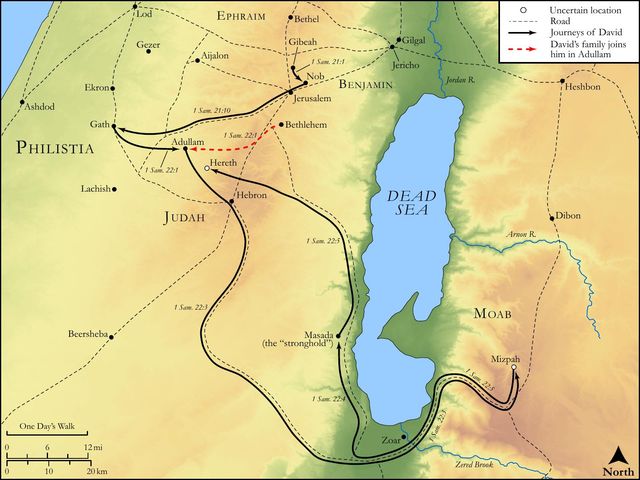
See on the biblical-era map
Study this verse
Public-domain commentary
Matthew Henry
From his Commentary on the Whole Bible. Henry comments on passages, not single verses — this entry covers 1 Samuel 22:1–5. His two-level outline is real structure in the source text, so it is rendered as structure.
Here, I. David shelters himself in the cave of Adullam, Sa1 22:1. Whether it was a natural or artificial fastness does not appear; it is probable that the access to it was so difficult that David thought himself able, with Goliath's sword, to keep it against all the forces of Saul, and therefore buried himself alive in it, while he was waiting to see (and he says here, Sa1 22:3) what God would do with him. The promise of the kingdom implied a promise of preservation to it, and yet David used proper means for his own safety, otherwise he would have tempted God. He did not do any thing that aimed to destroy Saul, but only to secure himself. He that might have done great service to his country as a judge or general is here shut up in a cave, and thrown by as a vessel in which there was no pleasure. We must not think it strange if sometimes shining lights be thus eclipsed and hidden under a bushel. Perhaps the apostle refers to this instance of David, among others, when he speaks of some of the Old Testament worthies that wandered in deserts, in dens and caves of the earth, Heb 11:38. It was at this time that David penned Psa 142:1-7, which is entitled, A prayer when David was in the cave; and there he complains that no man would know him and that refuge failed him, but hopes that shortly the righteous would compass him about.
II.Thither his relations flocked to him, his brethren and all his father's house, to be protected by him, to give assistance to him, and to take their lot with him. A brother is born for adversity. Now, Joab, and Abishai, and the rest of his relations, came to him, to suffer and venture with him, in hopes shortly to be advanced with him; and they were so. The first three of his worthies were those that first owed him when he was in the cave, Ch1 11:15, etc.
III.Here he began to raise forces in his own defence, Sa1 22:2.
He found by the late experiments he had made that he could not save himself by flight, and therefore was necessitated to do it by force, wherein he never acted offensively, never offered any violence to his prince nor gave any disturbance to the peace of the kingdom, but only used his forces as a guard to his own person. But, whatever defence his soldiers were to him, they did him no great credit, for the regiment he had was made up not of great men, nor rich men, nor stout men, no, nor good men, but men in distress, in debt, and discontented, men of broken fortunes and restless spirits, that were put to their shifts, and knew not well what to do with themselves. When David had fixed his headquarters in the cave of Adullam, they came and enlisted themselves under him to the number of about 400. See what weak instruments God sometimes makes use of, by which to bring about his own purposes. The Son of David is ready to receive distressed souls, that will appoint him their captain and be commanded by him.
IV.He took care to settle his parents in a place of safety.
No such place could he find in all the land of Israel while Saul was so bitterly enraged against him and all that belonged to him for his sake; he therefore goes with them to the king of Moab, and puts them under his protection, Sa1 22:3, Sa1 22:4. Observe here,
1.With what a tender concern he provided for his aged parents. It was not fit they should be exposed either to the frights or to the fatigues which he must expect during his struggle with Saul (their age would by no means bear such exposure); therefore the first thing he does is to find them a quiet habitation, whatever became of himself. Let children learn from this to show pity at home and requite their parents (Ti1 5:4), in every thing consulting their ease and satisfaction. Though ever so highly preferred, and ever so much employed, let them not forget their aged parents.
2.With what a humble faith he expects the issue of his present distresses: Till I know what God will do for me. He expresses his hopes very modestly, as one that had entirely cast himself upon God and committed his way to him, expecting a good issue, not from his own arts, or arms, or merits, but from what the wisdom, power, and goodness of God would do for him. Now David's father and mother forsook him, but God did not, Psa 27:10.
V.He had the advice and assistance of the prophet Gad, who probably was one of the sons of the prophets that were brought up under Samuel, and was by him recommended to David for his chaplain or spiritual guide. Being a prophet, he would pray for him and instruct him in the mind of God; and David, though he was himself a prophet, was glad of his assistance. He advised him to go into the land of Judah (Sa1 22:5), as one that was confident of his own innocency, and was well assured of the divine protection, and was desirous, even in his present hard circumstances, to do some service to his tribe and country. Let him not be ashamed to own his own cause nor decline the succours that would be offered him. Animated by this word, there he determined to appear publicly. Thus are the steps of a good man ordered by the Lord.
Historical interpretation
Historical reception
1 surviving comment on this verse from the historical church.
The hold: The strong hold, or fortress of Maspha.
Continue studying 1 Samuel 22:4 across the web’s major study libraries — every link below opens this exact verse, chapter, or book on the destination site.
Read & Compare
 BibleGatewayThis verse in more than 200 translations and 70 languages.
 Bible.comThe YouVersion reader — hundreds of translations, reading plans, and highlights.
 ESV.orgCrossway's official English Standard Version reader.
 NET BibleThe NET translation with 60,000+ translators' notes on every rendering decision.
 STEP BibleTyndale House's free study tool — original text, vocabulary, and scholarly resources.
 BibliaLogos Bible Software's free web reader.
 USCCBThe New American Bible (Revised Edition) with the U.S. bishops' study notes.
Commentaries
 BibleHub CommentariesDozens of classic commentaries on this verse, gathered on one page.
 StudyLightMore than 100 commentary sets — the largest collection on the web.
 BibleRefPlain-English commentary on what this verse means, verse by verse.
 Enduring WordDavid Guzik's free commentary on this chapter, widely used by Bible teachers.
 Bible Study ToolsVerse commentary alongside Greek and Hebrew study aids.
Original Language & Research
- BibleHub InterlinearThe verse word by word — original language, transliteration, and English.
- BibleHub LexiconEvery word's original-language definition and Strong's entry.
 Blue Letter BibleDeep-study tools — Strong's numbers, concordance, and word studies.
 SefariaThe Hebrew text with Rashi and centuries of Jewish commentary.
Sermons, Hymns & Audio


TrulyRandomVerse is not affiliated with these sites and doesn’t control their content. They’re linked because they’re genuinely useful.
Summary
1 Samuel 22:4 captures a pivotal moment in David's life as a fugitive, illustrating his profound filial devotion and responsible leadership amidst extreme personal peril. Having fled King Saul's relentless pursuit, David meticulously arranged for the safety of his vulnerable parents, Jesse and his mother, by securing asylum for them with the King of Moab. This compassionate act ensured their well-being for the entire duration of David's precarious existence in various wilderness strongholds, underscoring his unwavering commitment to his family even when facing dire circumstances.
Context
ShowHideLiterary Context
This verse is strategically placed within the narrative of David's desperate flight from King Saul, whose escalating paranoia and jealousy had driven David into exile. Immediately preceding this, 1 Samuel 22:1-2 describes David's initial refuge in the cave of Adullam, where he gathered a diverse group of 400 distressed, indebted, and discontented men, forming the nucleus of his future army. Recognizing the extreme vulnerability of his elderly parents due to his outlaw status and the potential for Saul to target them, David's next priority, as detailed in 1 Samuel 22:3, was to seek a secure haven for them. Verse 4 confirms the successful execution of this plan, showing the King of Moab's acceptance of David's family, thus providing them a safe dwelling while David continued his hazardous life as a hunted fugitive. This act of familial protection precedes David's subsequent movements and the tragic events involving Doeg the Edomite and the priests of Nob in 1 Samuel 22:9-19.
Historical & Cultural Context
The period of Saul's reign was marked by increasing instability and internal conflict, culminating in his personal vendetta against David. In that day, seeking refuge in a foreign land was a common and often necessary practice for individuals fleeing political persecution or blood feuds. David's choice of Moab was particularly significant due to his ancestral ties; his great-grandmother, Ruth, was a Moabitess, as chronicled in Ruth 4:17. This lineage likely provided a diplomatic basis for David's appeal to the King of Moab, potentially fostering a sense of kinship, obligation, or at least neutrality that facilitated the asylum. The reference to "the hold" (Hebrew: mâtsûwd) signifies the various natural strongholds, caves, and fortified places in the wilderness of Judah (e.g., the cave of Adullam, the strongholds of En Gedi) where David and his growing band took refuge. This highlights the precarious, mobile, and constantly threatened nature of David's existence as an outlaw.
Key Themes
ShowHideDavid's actions in this verse powerfully contribute to several overarching themes within 1 Samuel and the broader biblical narrative. Firstly, it profoundly illustrates filial piety and responsibility, showcasing David's unwavering commitment to his family's welfare, even when his own life was in extreme peril. This embodies the spirit of the fifth commandment to honor one's father and mother. Secondly, the theme of seeking refuge and divine provision is subtly yet significantly present; David's proactive step to secure his parents' safety, while a human initiative, can also be understood as an instance of God's providential care for David and his lineage amidst great danger. This resonates with David's consistent trust in God as his ultimate refuge, as expressed in many psalms where he describes God as his rock, fortress, and deliverer. Lastly, the verse highlights David's emerging leadership responsibility. Even as an outcast, he demonstrates a shepherd-like care for those dependent on him, prioritizing their well-being. This foreshadows his future role as a compassionate and responsible king, contrasting sharply with Saul's increasingly erratic and self-serving rule, as seen in Saul's later massacre of the priests of Nob in 1 Samuel 22:18-19.
Exposition and Analysis
ShowHideKey Word Analysis
ShowHideThis verb (H5148) means "to guide," "to lead," or "to transport." In this context, it implies David's active role in personally escorting his parents to Moab. It suggests a deliberate, protective act of guidance rather than merely sending them. David did not just arrange for their transport; he was personally involved in ensuring their safe delivery, underscoring his deep commitment and the personal risk he undertook.
The verb (H3427) signifies "to sit down," "to abide," or "to remain." Here, it indicates that David's parents were not merely visiting but were granted a secure and stable residence in Moab. This implies a settled existence, a stark contrast to David's own nomadic and dangerous life. The use of "dwelt" emphasizes the successful establishment of a safe haven for them, providing a sense of peace and security that David himself lacked.
This term (H4686), or its feminine form mĕtsûdâ', refers to a "stronghold," "fortress," or a "fortified place." It often denotes natural defensive positions like caves or mountain fortresses. In David's context, it highlights his precarious existence as a fugitive, constantly seeking and moving between secure, defensible locations to evade Saul's relentless pursuit. It underscores the danger and instability of David's life, in stark contrast to the secure dwelling he arranged for his parents.
Verse Breakdown
ShowHide"And he brought them before the king of Moab"
This clause highlights David's proactive and intentional action. Despite his own desperate circumstances and the immediate danger he faced from Saul, David undertook the journey to Moab with his parents. This demonstrates his profound sense of filial responsibility and his unwavering commitment to protecting his vulnerable family members. It was not a casual decision but a strategic, diplomatic appeal to a foreign monarch, likely leveraging his ancestral connection through Ruth.
"and they dwelt with him"
This phrase confirms the successful outcome of David's appeal. The King of Moab granted asylum and provided a place for David's parents to reside safely. This indicates a period of peace and security for Jesse and his wife, a stark contrast to the life of constant flight and danger that David himself endured. It suggests a degree of hospitality, perhaps a political alliance, or recognition of David's lineage that benefited both parties.
"all the while that David was in the hold"
This final clause specifies the duration of their stay. David's parents remained in Moab for the entire period that David was living as a fugitive, moving between various strongholds and fortified places in the wilderness. This highlights the long-term nature of Saul's persecution and the sustained protection afforded to David's parents. It also implicitly connects their safety to David's continued precarious existence, underscoring the sacrifice and foresight involved in his decision to separate from them for their well-being.
Literary Devices
ShowHideThe verse employs several literary devices to convey its profound meaning and emotional weight. Contrast is powerfully evident, juxtaposing the safety and stability provided to David's parents in Moab with David's own perilous, nomadic existence in wilderness strongholds. This stark difference highlights the depth of David's sacrifice and his selfless care. There is also an element of irony, as David, the divinely anointed future king of Israel, is forced to seek refuge for his family in a foreign, often adversarial, nation, rather than finding security within his own kingdom due to the madness and tyranny of the reigning king. Furthermore, David's compassionate and protective actions here serve as foreshadowing of his character as a king who would genuinely care for his people, acting as a shepherd to his flock, prioritizing their well-being even at great personal cost. This act of love and responsibility sets him apart from Saul.
Theological and Thematic Connections
ShowHideDavid's decision to place his parents in the care of the King of Moab, even while he himself was a hunted fugitive, is a profound testament to his character and a powerful illustration of biblical principles. It showcases a deep commitment to filial piety and family responsibility, echoing the divine command to honor one's parents. This act, born out of necessity and love, also subtly points to God's providential hand, orchestrating circumstances even through human diplomacy to ensure the safety of David's lineage, from which the Messiah would come. It underscores that true leadership, even in its nascent and most challenging forms, involves prioritizing the vulnerable and seeking their protection. David's actions here are a practical outworking of faith, demonstrating that trust in God does not negate wise and compassionate human initiative. He acted responsibly, trusting God with the outcome, embodying a principle of diligent care for those entrusted to him.
Reflection and Application
ShowHideDavid's compassionate act in 1 Samuel 22:4 offers a timeless lesson in prioritizing the welfare of our loved ones, especially the vulnerable, even when we are facing immense personal pressure and hardship. In a world that often encourages self-preservation and individualistic pursuits, David's example calls us to a higher standard of care and responsibility. It challenges us to consider who in our lives might be exposed or vulnerable due to our circumstances, and what proactive, even sacrificial, steps we can take to ensure their safety and well-being. This passage also reminds us that wise planning and strategic action are not antithetical to trusting God; rather, they can be instruments of His providence. We are called to be resourceful and diligent in protecting those entrusted to our care, relying on God's overarching sovereignty even as we navigate difficult decisions. Ultimately, David's actions inspire us to embody a sacrificial love that extends beyond ourselves, reflecting the very heart of God in caring for the weak and dependent.
Questions for Reflection
ShowHideFAQ
ShowHideWhy did David choose Moab specifically for his parents' refuge?
ShowHideDavid likely chose Moab due to his significant ancestral ties to the nation. His great-grandmother, Ruth, was a Moabitess, as recorded in Ruth 4:17. This familial connection would have provided a diplomatic basis for his appeal to the King of Moab, potentially fostering a sense of kinship or obligation that made the request for asylum more favorable. Furthermore, Moab was geographically accessible from David's wilderness hideouts and was outside of Saul's immediate jurisdiction, offering a safer haven than any location within Israel where Saul's reach was absolute.
What does "the hold" refer to in this context?
ShowHide"The hold" (Hebrew: mâtsûwd or mĕtsûdâ') refers to a stronghold, fortress, or a fortified place, typically a natural defensive position like a cave system or a mountain fortress. It is not a single, fixed location but rather a series of such places in the wilderness of Judah, where David and his men took refuge from Saul's relentless pursuit. For example, David initially took refuge in the cave of Adullam, which would be considered a "hold." The term emphasizes David's life as a fugitive, constantly moving and seeking secure, defensible locations to evade capture, highlighting the constant danger and instability of his existence.
Christ-Centered Fulfillment
ShowHideDavid's admirable act of securing refuge for his vulnerable parents in Moab finds its ultimate and perfect fulfillment in Jesus Christ. While David, a shepherd-king in the making, could only offer temporary, human-arranged safety, Christ, the Good Shepherd, provides eternal and divine security for His flock. David's protective care for his earthly family foreshadows the Son of God's perfect love and sacrificial provision for His spiritual family, the Church. Just as David sought a safe haven for his parents, Jesus invites all who are weary and burdened to find rest and ultimate refuge in Him, declaring, "Come to me, all who labor and are heavy laden, and I will give you rest." Unlike David's temporary "hold," Christ Himself is our eternal Rock and Fortress, a secure dwelling place from all spiritual and eternal danger. His care extends beyond physical protection to the salvation of souls, demonstrating a love far surpassing any human act of filial piety, as He "loved the church and gave himself up for her" (the church), laying down His life for His sheep (John 10:11). Indeed, He promises that "no one will snatch them out of my hand", offering a security that David, in his limited human capacity, could only imperfectly model.