


2 Samuel 24:11
Bible text: King James Version (1769 Blayney text) · Public domain
Bible text: Berean Standard Bible · Public domain
Bible text: American Standard Version (1901) · Public domain
Bible text: World English Bible, Messianic edition · Public domain
Bible text: Geneva Bible (1599) · Public domain
Bible text: Young's Literal Translation · Public domain
- וַיָּקָםvai·Ya·komand he aroseH6965Conj-w ¦ V-Qal-ConsecImperf-3msVerb Qal Consecutive Imperfect 3rd Singular Masculineוַandיָּקָםhe arose
- דָּוִדda·VidDavidH1732N-proper-mNoun Proper Masculine
- בַּבֹּקֶרba·Bo·kerin the morningH1242Prep-b ¦ N-msNoun Singular Masculine Absoluteבַּin theבֹּקֶרmorning
- וּדְבַרu·de·varand [the] word ofH1697Conj-w ¦ N-mscNoun Singular Masculine Constructוּandדְבַר[the] word of
- יְהוָהYah·wehYahwehH3068N-properNoun Proper Title
- הָיָהha·Yahit cameH1961V-Qal-Perf-3msVerb Qal Perfect 3rd Singular Masculine
- אֶל'eltoH413PrepPreposition
- גָּדgadGadH1410N-proper-mNoun Proper Masculine
- הַנָּבִיאha·na·Vi'the prophetH5030Art ¦ N-msNoun Singular Masculine Absoluteהַtheנָּבִיאprophet
- חֹזֵהcho·Zeh[the] seer ofH2374N-mscNoun Singular Masculine Construct
- דָוִדda·VidDavidH1732N-proper-mNoun Proper Masculine
- לֵאמֹרle·Mor<to> sayingH559Prep-l ¦ V-Qal-InfVerb Qal Infinitive Constructלֵ<to>אמֹרsaying
English is a literal word-by-word gloss of the Hebrew, not the KJV's wording. Why?
This is the original text the KJV's translators worked from — each Hebrew word with its own literal English meaning in this verse, prepared by scholars at Tyndale House, Cambridge. The KJV translates whole sentences, not word by word, so its wording differs: one Hebrew word can become several English words, and the KJV may choose “the LORD” where the gloss reads “Yahweh”. Both are faithful — they answer different questions. For the KJV's own rendering, switch to the KJV text.
Details
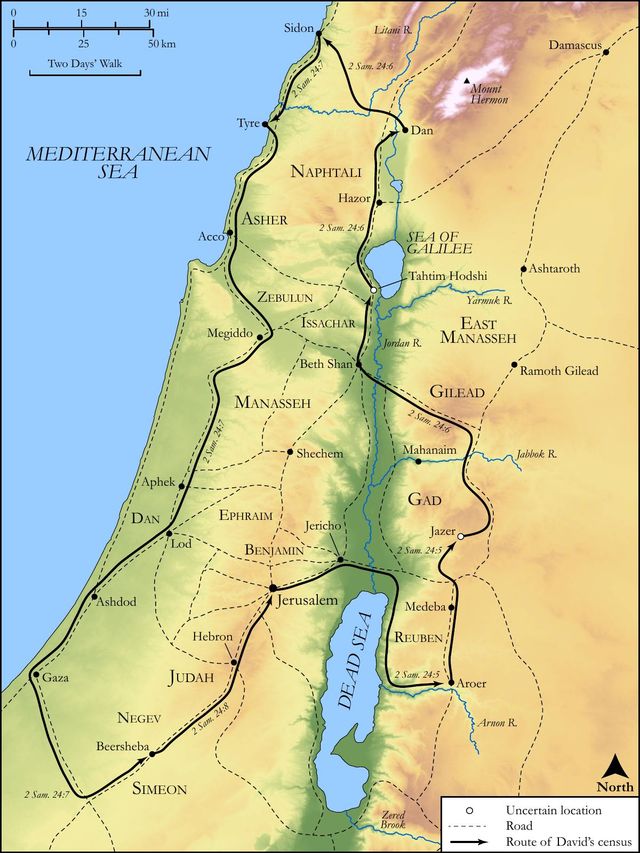
See on the biblical-era maps

Study this verse
Continue studying 2 Samuel 24:11 across the web’s major study libraries — every link below opens this exact verse, chapter, or book on the destination site.
Read & Compare
 BibleGatewayThis verse in more than 200 translations and 70 languages.
 Bible.comThe YouVersion reader — hundreds of translations, reading plans, and highlights.
 ESV.orgCrossway's official English Standard Version reader.
 NET BibleThe NET translation with 60,000+ translators' notes on every rendering decision.
 STEP BibleTyndale House's free study tool — original text, vocabulary, and scholarly resources.
 BibliaLogos Bible Software's free web reader.
 USCCBThe New American Bible (Revised Edition) with the U.S. bishops' study notes.
Commentaries
 BibleHub CommentariesDozens of classic commentaries on this verse, gathered on one page.
 StudyLightMore than 100 commentary sets — the largest collection on the web.
 BibleRefPlain-English commentary on what this verse means, verse by verse.
 Enduring WordDavid Guzik's free commentary on this chapter, widely used by Bible teachers.
 Bible Study ToolsVerse commentary alongside Greek and Hebrew study aids.
Original Language & Research
- BibleHub InterlinearThe verse word by word — original language, transliteration, and English.
- BibleHub LexiconEvery word's original-language definition and Strong's entry.
 Blue Letter BibleDeep-study tools — Strong's numbers, concordance, and word studies.
 SefariaThe Hebrew text with Rashi and centuries of Jewish commentary.
Sermons, Hymns & Audio


TrulyRandomVerse is not affiliated with these sites and doesn’t control their content. They’re linked because they’re genuinely useful.
Summary
Following King David's confession of his grievous sin in numbering Israel and Judah, 2 Samuel 24:11 marks the immediate and decisive divine response. As the new day dawns, the Lord's authoritative word is delivered to David through the prophet Gad, his trusted seer, signaling the commencement of divine judgment and the unfolding consequences of David's disobedience. This verse serves as a critical juncture, transitioning from David's acknowledgment of sin to the revelation of God's impending disciplinary action, underscoring the swiftness and certainty of divine accountability.
Context
ShowHideLiterary Context
This verse immediately follows 2 Samuel 24:10, where David, deeply convicted, confesses his "great sin" in conducting the census. The narrative flow is remarkably swift and direct: a divinely provoked census, David's act of disobedience, his heartfelt repentance, and then the immediate arrival of God's word concerning the consequences. The preceding verses, 2 Samuel 24:1-9, detail the census itself, an act that displeased the Lord, although the precise reasons (e.g., pride, reliance on military strength rather than God, lack of proper atonement, or a pre-existing divine judgment against Israel) are debated by scholars. Verse 11 thus initiates the process of divine reckoning, setting the stage for the three choices of punishment offered to David in 2 Samuel 24:13 and the subsequent plague that devastates the nation.
Historical & Cultural Context
In ancient Israel, kings were understood to rule under God's ultimate sovereignty, and prophets served as God's direct messengers, often acting as a vital divine check on royal power. The figure of the "seer" or "prophet" like Gad was indispensable for conveying the Lord's will, warnings, and instructions to the monarch, ensuring that divine authority remained supreme. While censuses were not inherently forbidden (as seen in Numbers 1 and Numbers 26), David's specific census appears to have been motivated by a lack of trust in God or an over-reliance on human strength, perhaps reflecting a kingly pride that challenged God's unique position as Israel's true strength and protector. The timing "when David was up in the morning" emphasizes the immediate and unavoidable nature of God's response, reflecting a cultural understanding of divine justice being swift and certain.
Key Themes
ShowHide2 Samuel 24:11 powerfully contributes to several key themes within the book of 2 Samuel and the broader Old Testament narrative. Firstly, it underscores the theme of Divine Accountability, particularly for those in positions of leadership. David, despite being "a man after God's own heart," is not exempt from the consequences of his sin, demonstrating God's impartiality in judgment. Secondly, the verse highlights the Sovereignty of God's Word and the Indispensable Role of the Prophet. God's word "came" to Gad, emphasizing divine initiative and authority, and Gad's function as "David's seer" reinforces the prophet's crucial role as a direct conduit for divine communication. This aligns with the principle that God often reveals His plans through His chosen servants, as seen in Amos 3:7. Finally, it reinforces the theme of Immediate Consequences of Sin, demonstrating that disobedience, especially from a leader, elicits a swift divine response, setting the stage for the unfolding judgment detailed in the remainder of 2 Samuel 24.
Exposition and Analysis
ShowHideKey Word Analysis
ShowHideThe Hebrew word translated "word" (דָּבָר, dāḇār') is highly significant. According to H1697, it denotes not merely a spoken utterance but carries the weight of a decree, a message, or an event that has tangible effect. When associated with "the LORD" (יהוה, Yᵉhôvâh'), it signifies a divine pronouncement that is authoritative, active, and carries inherent power to bring about what it declares. It implies a direct, intentional communication from God, not a mere thought or suggestion, often leading to a specific act or outcome.
The term "prophet" (נָבִיא, nāḇîy''), from H5030, refers to one who is called by God to speak on His behalf. A nāḇîy'' is a messenger, an announcer, or one who proclaims. This role involves receiving divine revelation and faithfully transmitting it to the people, often acting as an intercessor or a critic of societal and royal injustice. Gad is explicitly identified by this title, affirming his official capacity as God's spokesperson.
The word "seer" (חֹזֶה, ḥōzeh'), from H2374, is an older designation for a prophet, derived from a root meaning "to see" or "to behold." It emphasizes the prophetic ability to receive visions, direct revelations, or supernatural insight from God. While "prophet" (nāḇîy'') emphasizes the speaking aspect, "seer" highlights the receiving aspect of divine communication. The pairing of nāḇîy'' and ḥōzeh' for Gad underscores the comprehensive nature of his prophetic office – he both sees God's truth and speaks it forth with divine authority.
Verse Breakdown
ShowHide"For when David was up in the morning,"
This phrase establishes the immediate temporal context, emphasizing the swiftness and inevitability of God's response. The rising sun signifies a new day, but for David, it ushers in the dawn of divine reckoning. It suggests that God's judgment is not delayed but follows closely on the heels of recognized sin, highlighting divine attentiveness and the certainty of consequences, even for a king.
"the word of the LORD came unto the prophet Gad,"
This clause is central, asserting divine initiative and authority. "The word of the LORD came" indicates that God actively intervened and communicated His will directly. It was not a human idea or a general sense of unease but a specific, direct message from the sovereign God. The recipient, "the prophet Gad," highlights God's chosen method of communication through His appointed servants, validating Gad's authority and the divine origin of the message he was about to deliver.
"David's seer, saying,"
This final phrase further identifies Gad and prepares the reader for the content of the divine message. Calling Gad "David's seer" emphasizes his personal relationship and established role with the king, making the impending message even more poignant and undeniable for David. The word "saying" acts as a narrative bridge, signaling that the direct discourse of God's message, conveyed through Gad, is about to follow, initiating the next phase of the narrative.
Literary Devices
ShowHideThe verse effectively employs several literary devices to convey its profound message. Foreshadowing is prominent, as the immediate arrival of "the word of the LORD" through the prophet Gad, directly after David's confession of sin, strongly hints at the impending judgment and the difficult choices David will face. The phrase "the word of the LORD came" also exemplifies Divine Initiative, portraying God as the active agent who intervenes directly in human affairs, rather than passively observing. This underscores His sovereignty and involvement in the consequences of human actions. Furthermore, there is a subtle Juxtaposition between the natural act of "David was up in the morning" – the start of a new day – and the supernatural, weighty arrival of God's word, which will drastically alter the course of that day and the nation's immediate future. This contrast highlights the intrusion of divine reality into daily life, emphasizing that even the mundane can be intersected by the momentous.
Theological and Thematic Connections
ShowHideThis verse powerfully illustrates the principle of divine accountability, particularly for leaders, and God's consistent method of communicating His will through chosen messengers. It underscores that even a king "after God's own heart" is subject to divine law and consequences for sin. The immediate arrival of the "word of the LORD" after David's confession demonstrates that God is not silent in the face of disobedience but actively engages with humanity, bringing both conviction and, if necessary, judgment. This divine communication, often delivered through prophets, serves to reveal God's character, His justice, and His covenant faithfulness, even when it involves discipline. It reminds us that God's word is living and active, always accomplishing its purpose, and that His servants are crucial conduits for His truth.
Reflection and Application
ShowHide2 Samuel 24:11 serves as a profound reminder of God's active involvement in the lives of His people and the serious nature of sin, especially for those in positions of influence. David's experience teaches us that recognizing and confessing sin is only the first step; it often leads to a divine response that includes consequences, even if mercy is also extended. For believers today, while we do not have prophets delivering direct audible messages as Gad did, God continues to communicate His will and warnings primarily through His inspired written Word, the Bible, and through the Holy Spirit's conviction. This verse encourages us to cultivate a posture of attentiveness to God's voice, whether through diligent study of Scripture, consistent prayer, or the wise counsel of spiritual leaders who speak truth in love. It compels us to consider the far-reaching implications of our actions, particularly those rooted in pride or disobedience, and to respond with humility and swift repentance when convicted, trusting in God's justice and His ultimate redemptive plan.
Questions for Reflection
ShowHideFAQ
ShowHideWhy was Gad, specifically, chosen to deliver this message to David?
ShowHideGad was known as "David's seer" and prophet, indicating a long-standing, trusted relationship and established divine authority. He had previously served David, notably advising him to return to the land of Judah in 1 Samuel 22:5. This pre-existing relationship meant David would recognize Gad's legitimacy as a divine messenger, making the message's impact immediate and undeniable. God often uses familiar and authoritative figures to deliver crucial messages, ensuring their reception and minimizing any doubt about the divine origin of the communication.
What is the significance of "the word of the LORD came" rather than David just realizing his sin?
ShowHideThe phrase "the word of the LORD came" emphasizes divine initiative and the objective reality of God's communication. While David's heart had already "struck him" (2 Samuel 24:10), indicating internal conviction and repentance, God's direct word through Gad moves beyond subjective realization to an authoritative, external pronouncement of judgment. It signifies that God is actively involved in governing His people and holds leaders accountable, ensuring that His will and the consequences of disobedience are clearly articulated and understood, not merely intuited or left to human speculation. This demonstrates God's sovereignty and His direct engagement with human affairs.
Christ-Centered Fulfillment
ShowHideThe immediate arrival of "the word of the LORD" to David through the prophet Gad in 2 Samuel 24:11 foreshadows the ultimate and perfect communication of God's will through Jesus Christ. While Gad was a temporary messenger, a human conduit for divine revelation, Christ is the eternal Word of God made flesh (John 1:1, John 1:14), the ultimate Prophet who perfectly reveals the Father (Hebrews 1:1-2). David's sin brought a choice of judgment upon himself and the nation, highlighting the inescapable consequences of disobedience and the need for a mediator. In contrast, Jesus, the sinless Son of God, bore the full weight of humanity's sin and its consequences on the cross, offering a singular, definitive atonement that truly takes away the sin of the world (John 1:29, 1 Peter 2:24). Thus, while 2 Samuel 24:11 shows God's swift response to sin through a prophet, Christ's coming represents God's ultimate and redemptive response to sin: not merely judgment, but a path to reconciliation and eternal life, fulfilling the prophetic office and becoming the very embodiment of God's saving Word for all humanity (Romans 5:8).