


2 Samuel 24:12
Bible text: King James Version (1769 Blayney text) · Public domain
Bible text: Berean Standard Bible · Public domain
Bible text: American Standard Version (1901) · Public domain
Bible text: World English Bible, Messianic edition · Public domain
Bible text: Geneva Bible (1599) · Public domain
Bible text: Young's Literal Translation · Public domain
- הָלוֹךְha·LokhgoH1980V-Qal-InfAbsVerb Qal Infinitive Absolute
- וְדִבַּרְתָּve·di·bar·Taand you will speakH1696Conj-w ¦ V-Piel-ConsecPerf-2msVerb Piel Consecutive Perfect 2nd Singular Masculineוְandדִבַּרְתָּyou will speak
- אֶל'eltoH413PrepPreposition
- דָּוִדda·VidDavidH1732N-proper-mNoun Proper Masculine
- כֹּהkohthusH3541AdvAdverb
- אָמַר'a·Marhe saysH559V-Qal-Perf-3msVerb Qal Perfect 3rd Singular Masculine
- יְהוָהYah·wehYahwehH3068N-properNoun Proper Title
- שָׁלֹשׁsha·Loshthree [things]H7969N-csNoun Singular common gender Absolute
- אָנֹכִי'a·no·KhiIH595Pro-1csPronoun Personal 1st Singular common gender
- נוֹטֵלno·Tel[am] layingH5190V-Qal-Prtcpl-msVerb Qal Participle Singular Masculine Absolute
- עָלֶיךָ'a·Lei·khaon youH5921Prep ¦ 2msPreposition Definiteעָלֶיonךָyou
- בְּחַרbe·charchooseH977V-Qal-Imp-2msVerb Qal Imperative 2nd Singular Masculine
- לְךָle·Khafor <the> yourselfPrep-l ¦ 2msSuffix Personal 2nd Singular Masculineלְfor <the>ךָyourself
- אַחַת'a·chatoneH259N-fsNoun Singular Feminine Absolute
- מֵהֶםme·Hemfrom <the> themPrep-m ¦ 3mpSuffix Personal 3rd Plural Masculineמֵfrom <the>הֶםthem
- וְאֶעֱשֶׂהve·'e·'e·sehso I may do [it]H6213Conj-w ¦ V-Qal-ConjImperf-1csVerb Qal Conjunction+Imperfect 1st Singular common genderוְsoאֶעֱשֶׂהI may do [it]
- לָּךְLakhto <the> youPrep-l ¦ 2msSuffix Personal 2nd Singular Masculineלָּto <the>ךְyou
English is a literal word-by-word gloss of the Hebrew, not the KJV's wording. Why?
This is the original text the KJV's translators worked from — each Hebrew word with its own literal English meaning in this verse, prepared by scholars at Tyndale House, Cambridge. The KJV translates whole sentences, not word by word, so its wording differs: one Hebrew word can become several English words, and the KJV may choose “the LORD” where the gloss reads “Yahweh”. Both are faithful — they answer different questions. For the KJV's own rendering, switch to the KJV text.
Details
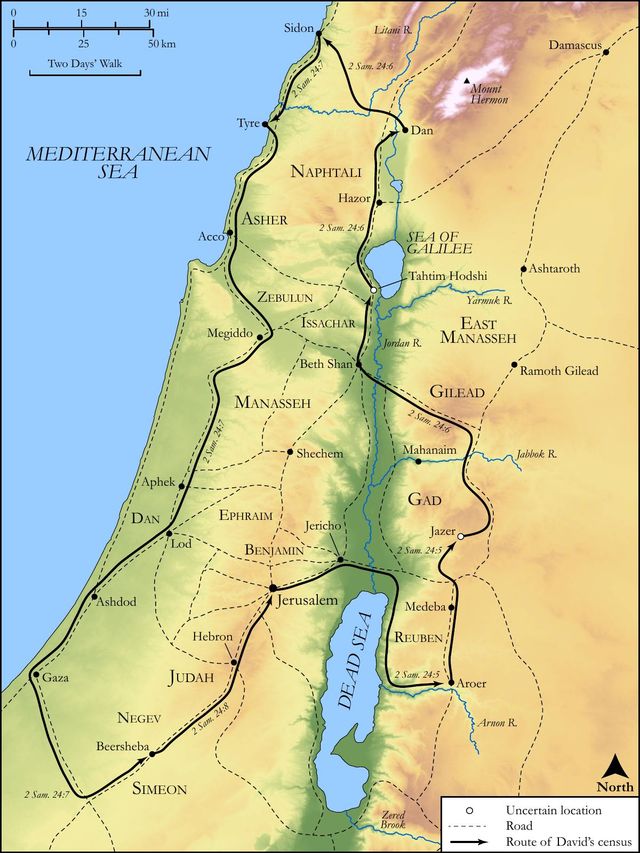
See on the biblical-era maps

Study this verse
Continue studying 2 Samuel 24:12 across the web’s major study libraries — every link below opens this exact verse, chapter, or book on the destination site.
Read & Compare
 BibleGatewayThis verse in more than 200 translations and 70 languages.
 Bible.comThe YouVersion reader — hundreds of translations, reading plans, and highlights.
 ESV.orgCrossway's official English Standard Version reader.
 NET BibleThe NET translation with 60,000+ translators' notes on every rendering decision.
 STEP BibleTyndale House's free study tool — original text, vocabulary, and scholarly resources.
 BibliaLogos Bible Software's free web reader.
 USCCBThe New American Bible (Revised Edition) with the U.S. bishops' study notes.
Commentaries
 BibleHub CommentariesDozens of classic commentaries on this verse, gathered on one page.
 StudyLightMore than 100 commentary sets — the largest collection on the web.
 BibleRefPlain-English commentary on what this verse means, verse by verse.
 Enduring WordDavid Guzik's free commentary on this chapter, widely used by Bible teachers.
 Bible Study ToolsVerse commentary alongside Greek and Hebrew study aids.
Original Language & Research
- BibleHub InterlinearThe verse word by word — original language, transliteration, and English.
- BibleHub LexiconEvery word's original-language definition and Strong's entry.
 Blue Letter BibleDeep-study tools — Strong's numbers, concordance, and word studies.
 SefariaThe Hebrew text with Rashi and centuries of Jewish commentary.
Sermons, Hymns & Audio


TrulyRandomVerse is not affiliated with these sites and doesn’t control their content. They’re linked because they’re genuinely useful.
Summary
Second Samuel 24:12 presents a pivotal and somber moment in the life of King David and the history of Israel. Following David's unauthorized census, a sin rooted in pride and a lack of trust in God, the prophet Gad delivers a direct and unyielding message from the Lord. This verse reveals God's divine ultimatum to David: he must choose one of three severe judgments to befall himself and his nation. It powerfully encapsulates the gravity of sin, the unwavering nature of divine justice, and the inescapable consequences that even a beloved king faces when he disobeys the Lord, while also highlighting God's sovereign prerogative in judgment.
Context
ShowHideLiterary Context
This verse is intricately woven into the climax of the book of 2 Samuel, specifically chapter 24, which details the consequences of David's sinful census. The narrative begins with the Lord's anger against Israel, leading to David's decision to number the people, an act often interpreted as a display of human strength rather than divine reliance. The preceding verses vividly describe David's command for the census, Joab's reluctant but obedient execution of it, and David's immediate, profound conviction and confession of sin upon its completion, as seen in 2 Samuel 24:1-10. Verse 11 then introduces the prophet Gad, David's trusted seer, who is divinely commissioned to present the king with the options for punishment. Thus, 2 Samuel 24:12 serves as the direct introduction to the three specific judgments outlined in 2 Samuel 24:13, setting the agonizing stage for David's choice and the subsequent divine plague that follows.
Historical & Cultural Context
Among the nations, censuses were typically conducted for military conscription, taxation, or forced labor. While not inherently forbidden (as seen in Numbers 1), David's census in this context is presented as an act of pride, a king's desire to boast in his military might or to rely on human resources rather than God's unfailing provision and protection. Kings in Israel were expected to rule as God's vice-regents, governing according to His covenant and law; their actions, whether righteous or sinful, often carried corporate consequences for the entire nation. The role of the prophet, such as Gad, was indispensable in Israelite society, serving as God's direct messenger to the king, holding him accountable to the divine covenant, and delivering authoritative messages of both blessing and judgment, frequently prefaced by the declaration, "Thus saith the LORD." This phrase underscored the divine origin and unalterable nature of the message.
Key Themes
ShowHide2 Samuel 24:12 powerfully illuminates several central themes. Foremost among them is Divine Sovereignty and Judgment, demonstrating that God maintains ultimate control over human affairs and will execute justice for sin, even when committed by His anointed king. This highlights the Consequences of Sin, showing unequivocally that disobedience carries severe repercussions, not only for the individual but for the entire community, a principle echoed throughout Scripture (compare Galatians 6:7). The verse also underscores Prophetic Mediation, where Gad functions as God's direct and authoritative messenger, emphasizing the unalterable nature of the divine decree. Finally, it introduces the complex theme of Choice within Judgment, where David is granted agency, albeit within the confines of God's predetermined punishment, reflecting a measure of divine mercy even in wrath. The entire narrative of 2 Samuel 24 masterfully portrays the tension between human responsibility and divine prerogative.
Exposition and Analysis
ShowHideKey Word Analysis
ShowHideThis verb signifies "to speak," "to declare," or "to command." In the context of "Thus saith the LORD," it is a quintessential prophetic formula, appearing hundreds of times in the Old Testament. Its use here unequivocally declares that the words being spoken are not the prophet's own, but a direct, authoritative, and unalterable utterance from God Himself. It underscores the solemnity and certainty of the message to David, leaving no room for doubt about its divine origin or the inevitability of the impending judgment.
This verb means "to lift," "to bear," or "to impose." In this specific context, it conveys the idea of God "lifting up" or "presenting" these options to David. It is not a negotiation but a divine presentation of consequences, an "offering" in the sense of laying out the choices that have been determined by God's justice. It implies a direct, unavoidable confrontation with the consequences of David's sin, an imposition of divine will.
This verb means "to select," "to elect," or "to try." While God has decreed judgment, He grants David the agency to select the specific form it will take. This choice is not between judgment and no judgment, but between three distinct forms of divine discipline. It highlights David's responsibility and the immense weight of his decision, even within the framework of God's sovereign will and predetermined punishment.
Verse Breakdown
ShowHide"Go and say unto David"
This opening imperative emphasizes the directness, urgency, and divine mandate of the message. Gad is merely the messenger, a faithful conduit for the divine word, highlighting the immediate and unavoidable accountability David faces before God. It underscores that this is a personal address from the Sovereign to His anointed.
"Thus saith the LORD"
This authoritative prophetic formula establishes the divine origin and unchallengeable nature of the message. It signifies that what follows is not Gad's counsel, opinion, or suggestion, but the direct, unalterable decree of the sovereign God, carrying the full weight of His authority and truth.
"I offer thee three [things];"
God presents David with a set of predetermined options for punishment. The word "things" is implied, referring to the three specific forms of judgment detailed in the subsequent verse, 2 Samuel 24:13. This is a divine ultimatum, not a negotiation or a plea for mercy, but a stark presentation of the consequences of David's transgression.
"choose thee one of them,"
David is given the agency to select which of the three judgments will befall him and his kingdom. This element of choice, even within the context of divine judgment, reflects God's justice in holding David accountable for his sin while also demonstrating a measure of divine condescension or mercy by allowing David to participate in the form of his discipline, acknowledging his kingship and personal responsibility.
"that I may [do it] unto thee."
This final clause confirms God's immediate and certain intent to execute the chosen judgment. Once David makes his selection, God will act decisively and without delay, underscoring the inevitability, seriousness, and divine commitment to the consequences for David's disobedience. It emphasizes that this is not an idle threat but a sure and certain decree.
Literary Devices
ShowHideThe verse employs several powerful literary devices that enhance its impact and theological weight. The most prominent is the Divine Oracle, signaled by the iconic phrase "Thus saith the LORD," which immediately establishes the absolute authority and divine origin of the message, imbuing it with solemnity, gravity, and unalterable truth. There is also a strong element of Ultimatum, as God presents David with a limited, non-negotiable set of choices, highlighting the inescapable nature of the consequences of his sin and the severity of divine justice. The structure of the verse, moving from divine command to prophetic delivery to the presentation of stark choices, creates a profound sense of Dramatic Irony; David, who sought to count his strength and rely on human numbers, is now faced with a choice that reveals his utter weakness and dependence on God's judgment and mercy. Finally, the verse serves as a powerful instance of Foreshadowing, setting the stage for the agonizing decision David must make and the subsequent plague that will devastate his people, building narrative tension towards the climax of the chapter and the eventual atonement.
Theological and Thematic Connections
ShowHideThis verse profoundly illustrates the biblical principle that sin, even from God's chosen leaders, carries severe and inevitable consequences. David's census, born of pride and a reliance on human strength rather than divine providence, directly provoked divine wrath, demonstrating that God's justice demands accountability from all, regardless of their position or past faithfulness. Yet, even within judgment, God's character is revealed: He is sovereign, initiating the punishment, but also merciful, allowing David a choice in the form of the discipline. This moment underscores that God's ways are higher than human ways, and His standards of righteousness are unyielding, even for those He loves. It teaches us that true repentance must acknowledge the just consequences of our actions and trust in God's ultimate wisdom, even when facing difficult choices that are the direct result of our own failings.
Reflection and Application
ShowHideThe stark choice presented to David in 2 Samuel 24:12 serves as a timeless and sobering reminder of the profound and often painful consequences of sin, particularly those rooted in pride, self-reliance, and a lack of trust in God. It challenges us to deeply examine our own lives: are we, like David, tempted to rely on our own strength, resources, or achievements rather than fully depending on God's sovereign provision and protection? David's immediate and heartfelt confession of sin in 2 Samuel 24:10 models a repentant heart, yet this passage also teaches us the difficult truth that even genuine repentance does not always negate the earthly, temporal consequences of our actions. This passage calls us to cultivate profound humility, to continually assess our motives before God, and to remember that our choices have ripple effects, impacting not only ourselves but also those within our sphere of influence. It also highlights the difficult reality that sometimes, even in God's mercy and justice, we are presented with hard choices between undesirable outcomes, requiring us to seek His wisdom, submit to His will, and trust His sovereign hand in all circumstances, even when the path ahead is fraught with difficulty.
Questions for Reflection
ShowHideFAQ
ShowHideWhy was David's census considered a sin, given that censuses are mentioned elsewhere in the Bible?
ShowHideWhile censuses were indeed conducted at God's command for specific, legitimate purposes (e.g., for military organization and taxation in Numbers 1 and Numbers 26), David's census in 2 Samuel 24 was distinct because it was not divinely commanded and appears to have stemmed from a motive of pride or a desire to rely on his own military strength rather than God's. The text in 2 Samuel 24:1 states that "the anger of the LORD was again kindled against Israel, and he incited David against them to say, 'Go, number Israel and Judah.'" While the KJV says God "incited" David, 1 Chronicles 21:1 clarifies that "Satan stood against Israel and incited David to number Israel." This suggests that David's action, regardless of the ultimate divine purpose or the immediate instigator, was rooted in a sinful inclination—perhaps a desire for self-glory, a lack of faith in God's protection, or an attempt to assess his own military might for a purpose not aligned with God's will. It demonstrated a profound shift from reliance on God to reliance on human power, which is an affront to God's sovereignty and a violation of the covenant relationship.
Christ-Centered Fulfillment
ShowHideThe divine ultimatum presented to David in 2 Samuel 24:12, where he must choose a form of judgment for his sin, powerfully foreshadows the ultimate choice and judgment that fell upon Christ. David's sin, though personal, brought corporate consequences upon Israel, illustrating the profound biblical principle of corporate solidarity and the devastating ripple effect of human transgression. In the fullness of time, humanity's universal sin brought a far greater, eternal judgment. However, instead of offering us a choice of punishments, God in His infinite wisdom and boundless mercy chose the ultimate, singular judgment to fall upon His Son. Jesus, the true and greater King, willingly chose to "fall into the hand of the LORD" (as David desired in 2 Samuel 24:14), by enduring the cross. He became the Lamb of God who takes away the sin of the world, bearing the full weight of divine wrath that we deserved (compare Isaiah 53:5-6 and 2 Corinthians 5:21). Thus, where David's choice was between various forms of temporal punishment, Christ's sacrifice on the cross was the ultimate, once-for-all payment for sin, satisfying God's justice perfectly and opening the way for eternal life and reconciliation for all who believe (see Romans 3:23-26). The judgment pronounced in 2 Samuel 24:12, though severe, points forward to the greater judgment averted through the perfect obedience, atoning death, and glorious resurrection of Jesus Christ, our Lord.