


2 Samuel 12:9
Bible text: King James Version (1769 Blayney text) · Public domain
Bible text: King James Version with Strong's numbers · Public domain
Bible text: Berean Standard Bible · Public domain
Bible text: American Standard Version (1901) · Public domain
Bible text: World English Bible, Messianic edition · Public domain
Bible text: Geneva Bible (1599) · Public domain
Bible text: Young's Literal Translation · Public domain
- מַדּוּעַma·Du·a'why?H4069InterrogParticle Interrogative
- בָּזִיתָba·Zi·tahave you despisedH959V-Qal-Perf-2msVerb Qal Perfect 2nd Singular Masculine
- אֶת'et<obj.>H853DirObjMParticle Object Indicator
- דְּבַרde·Var[the] word ofH1697N-mscNoun Singular Masculine Construct
- יְהוָהYah·wehYahwehH3068N-properNoun Proper Title
- לַעֲשׂוֹתla·'a·Sotby doingH6213Prep-l ¦ V-Qal-InfVerb Qal Infinitive Constructלַbyעֲשׂוֹתdoing
- הָרַעha·Ra'the evilH7451Art ¦ Adj-msAdjective Singular Masculine Absoluteהָtheרַעevil
- בְּעֵינַיbe·'ei·noin my eyesH5869Prep-b ¦ N-fdc ¦ 1csNoun Dual Feminine Constructבְּinעֵינַeyesיmy
- אֵת'et<obj.>H853DirObjMParticle Object Indicator
- אוּרִיָּה'u·ri·YahUriahH223N-proper-mNoun Proper Masculine
- הַחִתִּיha·chi·Tithe HittiteH2850Art ¦ N-msNoun Gentilic Singular Masculine AbsoluteהַtheחִתִּיHittite
- הִכִּיתָhi·Ki·tayou struck downH5221V-Hiphil-Perf-2msVerb Hiphil Perfect 2nd Singular Masculine
- בַחֶרֶבva·Che·revwith the swordH2719Prep-b ¦ N-fsNoun Singular Feminine Absoluteבַwith theחֶרֶבsword
- וְאֶתve·'Etand <obj.>H853Conj-w ¦ DirObjMParticle Object Indicatorוְandאֶת<obj.>
- אִשְׁתּוֹ'ish·Tohis wifeH802N-fsc ¦ 3msNoun Singular Feminine Constructאִשְׁתּwifeוֹhis
- לָקַחְתָּla·Kach·tayou tookH3947V-Qal-Perf-2msVerb Qal Perfect 2nd Singular Masculine
- לְּךָle·Khafor <the> yourselfPrep-l ¦ 2msSuffix Personal 2nd Singular Masculineלְּfor <the>ךָyourself
- לְאִשָּׁהle·'i·Shahto a wifeH802Prep-l ¦ N-fsNoun Singular Feminine Absoluteלְtoאִשָּׁהa wife
- וְאֹתוֹve·'o·Toand <obj.> himH853Conj-w ¦ DirObjM ¦ 3msParticle Object Indicatorוְandאֹת<obj.>וֹhim
- הָרַגְתָּha·Rag·tayou killedH2026V-Qal-Perf-2msVerb Qal Perfect 2nd Singular Masculine
- בְּחֶרֶבbe·Che·revwith [the] sword ofH2719Prep-b ¦ N-fscNoun Singular Feminine Constructבְּwithחֶרֶב[the] sword of
- בְּנֵיbe·Nei[the] people ofH1121N-mpcNoun Plural Masculine Construct
- עַמּוֹןa·MonAmmonH5983N-proper-mNoun Proper Masculine
English is a literal word-by-word gloss of the Hebrew, not the KJV's wording. Why?
This is the original text the KJV's translators worked from — each Hebrew word with its own literal English meaning in this verse, prepared by scholars at Tyndale House, Cambridge. The KJV translates whole sentences, not word by word, so its wording differs: one Hebrew word can become several English words, and the KJV may choose “the LORD” where the gloss reads “Yahweh”. Both are faithful — they answer different questions. For the KJV's own rendering, switch to the KJV text.
Details
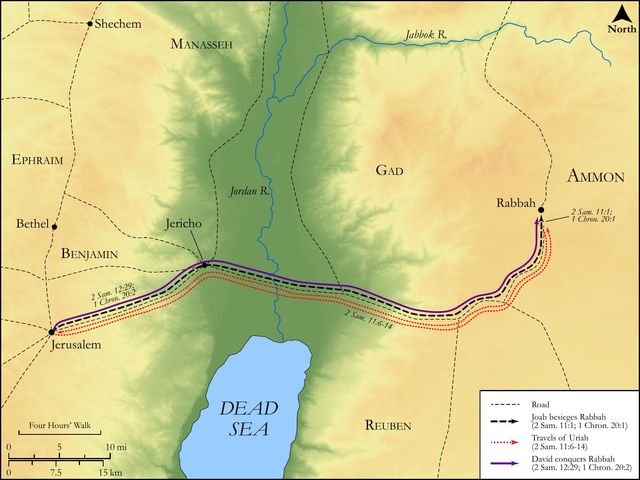
See on the biblical-era maps
Study this verse
Public-domain commentary
Matthew Henry
From his Commentary on the Whole Bible. Henry comments on passages, not single verses — this entry covers 2 Samuel 12:1–14. His four-level outline is real structure in the source text, so it is rendered as structure.
It seems to have been a great while after David had been guilty of adultery with Bath-sheba before he was brought to repentance for it. For, when Nathan was sent to him, the child was born (Sa2 12:14), so that it was about nine months that David lay under the guilt of that sin, and, for aught that appears, unrepented of. What shall we think of David's state all this while? Can we imagine that his heart never smote him for it, or that he never lamented it in secret before God? I would willingly hope that he did, and that Nathan was sent to him, immediately upon the birth of the child, when the thing by that means came to be publicly known and talked of, to draw from him an open confession of the sin, to the glory of God, the admonition of others, and that he might receive, by Nathan, absolution with certain limitations. But, during these nine months, we may well suppose his comforts and the exercises of his graces suspended, and his communion with God interrupted; during all that time, it is certain, he penned no psalms, his harp was out of tune, and his soul like a tree in winter, that has life in the root only. Therefore, after Nathan had been with him, he prays, Restore unto me the joy of thy salvation, and open thou my lips, Psa 51:12, Psa 51:15. Let us observe,
I.The messenger God sent to him.
We were told by the last words of the foregoing chapter that the thing David had done displeased the Lord, upon which, one would think, it should have followed that the Lord sent enemies to invade him, terrors to take hold on him, and the messengers of death to arrest him. No, he sent a prophet to him - Nathan, his faithful friend and confidant, to instruct and counsel him, Sa2 12:1. David did not send for Nathan (though he had never had so much occasion as he had now for his confessor), but God sent Nathan to David. Note, Though God may suffer his people to fall into sin, he will not suffer them to lie still in it. He went on frowardly in the way of his heart, and if left to himself, would have wandered endlessly, but (saith God) I have seen his ways, and will heal him, Isa 57:17, Isa 57:18. He sends after us before we seek after him, else we should certainly be lost. Nathan was the prophet by whom God had sent him notice of his kind intentions towards him (Sa2 7:4), and now, by the same hand, he sends him this message of wrath. God's word in the mouth of his ministers must be received, whether it speak terror or comfort. Nathan was obedient to the heavenly vision, and went on God's errand to David. He did not say, "David has sinned, I will not come near him." No; count him not an enemy, but admonish him as a brother, Th2 3:15. He did not say, "David is a king, I dare not reprove him." No; if God sends him, he sets his face like a flint, Isa 50:7.
II.The message Nathan delivered to him, in order to his conviction.
1.He fetched a compass with a parable, which seemed to David as a complaint made to him by Nathan against one of his subjects that had wronged his poor neighbour, in order to his redressing the injury and punishing the injurious. Nathan, it is likely, used to come to him upon such errands, which made this the less suspected. It becomes those who have interest in princes, and have free access to them, to intercede for those that are wronged, that they may have justice done them.
(1.)Nathan represented to David a grievous injury which a rich man had done to an honest neighbour that was not able to contend with him: The rich man had many flocks and herds (Sa2 12:2); the poor man had one lamb only; so unequally is the world divided; and yet infinite wisdom, righteousness, and goodness, make the distribution, that the rich may learn charity and the poor contentment. This poor man had but one lamb, a ewe-lamb, a little ewe-lamb, having not wherewithal to buy or keep more. But it was a cade-lamb (as we call it); it grew up with his children, Sa2 12:3. He was fond of it, and it was familiar with him at all times. The rich man, having occasion for a lamb to entertain a friend with, took the poor man's lamb from him by violence and made use of that (Sa2 12:4), either out of covetousness, because he grudged to make use of his own, or rather out of luxury, because he fancied the lamb that was thus tenderly kept, and ate and drank like a child, must needs be more delicate food than any of his own and have a better relish.
(2.)In this he showed him the evil of the sin he had been guilty of in defiling Bath-sheba. He had many wives and concubines, whom he kept at a distance, as rich men keep their flocks in their fields. Had he had but one, and had she been dear to him, as the ewe-lamb was to its owner, had she been dear to him as the loving hind and the pleasant roe, her breasts would have satisfied him at all times, and he would have looked no further, Pro 5:19. Marriage is a remedy against fornication, but marrying many is not; for, when once the law of unity is transgressed, the indulged lust will hardly stint itself. Uriah, like the poor man, had only one wife, who was to him as his own soul, and always lay in his bosom, for he had no other, he desired no other, to lie there. The traveller or wayfaring man was, as bishop Patrick explains it from the Jewish writers, the evil imagination, disposition, or desire, which came into David's heart, which he might have satisfied with some of his own, yet nothing would serve but Uriah's darling. They observe that this evil disposition is called a traveller, for in the beginning it is only so, but, in time, it becomes a guest, and, in conclusion, is master of the house. For he that is called a traveller in the beginning of the verse is called a man (ish - a husband) in the close of it. Yet some observe that in David's breast lust was but as a wayfaring man that tarries only for a night; it did not constantly dwell and rule there.
(3.)By this parable he drew from David a sentence against himself. For David supposing it to be a case in fact, and not doubting the truth of it when he had it from Nathan himself, gave judgment immediately against the offender, and confirmed it with an oath, Sa2 12:5, Sa2 12:6.
[1.]That, for his injustice in taking away the lamb, he should restore four-fold, according to the law (Exo 22:1), four sheep for a sheep.
[2.]That for his tyranny and cruelty, and the pleasure he took in abusing a poor man, he should be put to death. If a poor man steal from a rich man, to satisfy his soul when he is hungry, he shall make restitution, though it cost him all the substance of his house, Pro 6:30, Pro 6:31 (and Solomon there compares the sin of adultery with that, Pro 6:32); but if a rich man steal for stealing sake, not for want but wantonness, merely that he may be imperious and vexatious, he deserves to die for it, for to him the making of restitution is no punishment, or next to none. If the sentence be thought too severe, it must be imputed to the present roughness of David's temper, being under guilt, and not having himself as yet received mercy.
2.He closed in with him, at length, in the application of the parable. In beginning with a parable he showed his prudence, and great need there is of prudence in giving reproofs. It is well managed if, as here, the offender can be brought ere he is aware, to convict and condemn himself. But here, in his application, he shows his faithfulness, and deals as plainly and roundly with king David himself as if he had been a common person. In plain terms, "Thou art the man who hast done this wrong, and a much greater, to thy neighbour; and therefore, by thy own sentence, thou deservest to die, and shalt be judged out of thy own mouth. Did he deserve to die who took his neighbour's lamb? and dost not thou who hast taken thy neighbour's wife? Though he took the lamb, he did not cause the owner thereof to lose his life, as thou hast done, and therefore much more art thou worthy to die." Now he speaks immediately from God, and in his name. He begins with, Thus saith the Lord God of Israel, a name sacred and venerable to David, and which commanded his attention. Nathan now speaks, not as a petitioner for a poor man, but as an ambassador from the great God, with whom is no respect of persons.
(1.)God, by Nathan, reminds David of the great things he had done and designed for him, anointing him to be king, and preserving him to the kingdom (Pro 6:7), giving him power over the house and household of his predecessor, and of others that had been his masters, Nabal for one. He had given him the house of Israel and Judah. The wealth of the kingdom was at his service and every body was willing to oblige him. Nay, he was ready to bestow any thing upon him to make him easy: I would have given thee such and such things, Pro 6:8. See how liberal God is in his gifts; we are not straitened in him. Where he has given much, yet he gives more. And God's bounty to us is a great aggravation of our discontent and desire of forbidden fruit. It is ungrateful to covet what God has prohibited, while we have liberty to pray for what God has promised, and that is enough.
(2.)He charges him with a high contempt of the divine authority, in the sins he had been guilty of: Wherefore hast thou (presuming upon thy royal dignity and power) despised the commandment of the Lord? Pro 6:9. This is the spring and this is the malignity of sin, that it is making light of the divine law and the law-maker; as if the obligation of it were weak, the precepts of it trifling, and the threats not at all formidable. Though no man ever wrote more honourably of the law of God than David did, yet, in this instance, he is justly charged with a contempt of it. His adultery with Bath-sheba, which began the mischief, is not mentioned, perhaps because he was already convinced of that, but,
[1.]The murder of Uriah is twice mentioned: "Thou hast killed Uriah with the sword, though not with thy sword, yet, which is equally heinous, with thy pen, by ordering him to be set in the forefront of the battle." Those that contrive wickedness and command it are as truly guilty of it as those that execute it. It is repeated with an aggravation: Thou hast slain him with the sword of the children of Ammon, those uncircumcised enemies of God and Israel.
[2.]The marrying of Bath-sheba is likewise twice mentioned, because he thought there was no harm in that (Pro 6:9): Thou hast taken his wife to be thy wife, and again, Pro 6:10. To marry her whom he had before defiled, and whose husband he had slain, was an affront upon the ordinance of marriage, making that not only to palliate, but in a manner to consecrate, such villanies. In all this he despised the word of the Lord (so it is in the Hebrew), not only his commandment in general which forbade such things, but the particular word of promise which God had, by Nathan, sent to him some time before, that he would build him a house. If he had had a due value and veneration for this sacred promise, he would not thus have polluted his house with lust and blood.
(3.)He threatens an entail of judgements upon his family for this sin (Pro 6:10): "The sword shall never depart from thy house, not in thy time nor afterwards, but, for the most part, thou and thy posterity shall be engaged in war." Or it points at the slaughters that should be among his children, Amnon, Absalom, and Adonijah, all falling by the sword. God had promised that his mercy should not depart from him and his house (Pro 7:15), yet here threatens that the sword should not depart. Can the mercy and the sword consist with each other? Yes, those may lie under great and long afflictions who yet shall not be excluded from the grace of the covenant. The reason given is, Because thou hast despised me. Note, Those who despise the word and law of God despise God himself and shall be lightly esteemed. It is particularly threatened,
[1.]That his children should be his grief: I will raise up evil against thee out of thy own house. Sin brings trouble into a family, and one sin is often made the punishment of another.
[2.]That his wives should be his shame, that by an unparalleled piece of villany they should be publicly debauched before all Israel, Pro 6:11, Pro 6:12. It is not said that this should be done by his own son, lest the accomplishment should have been hindered by the prediction being too plain; but it was done by Absalom, at the counsel of Ahithophel, Pro 16:21, Pro 16:22. He that defiled his neighbour's wife should have his own defiled, for thus that sin used to be punished, as appears by Job's imprecation, Job 31:10, Then let my wife grind unto another, and that threatening, Hos 4:14. The sin was secret, and industriously concealed, but the punishment should be open, and industriously proclaimed, to the shame of David, whose sin in the matter of Uriah, though committed many years before, would then be called to mind and commonly talked of upon that occasion. As face answers to face in a glass, so does the punishment often answer to the sin; here is blood for blood and uncleanness for uncleanness. And thus God would show how much he hates sin, even in his own people, and that, wherever he find it, he will not let it go unpunished.
3.David's penitent confession of his sin hereupon. He says not a word to excuse himself or extenuate his sin, but freely owns it: I have sinned against the Lord, Sa2 12:13. It is probable that he said more to this purport; but this is enough to show that he was truly humbled by what Nathan said, and submitted to the conviction. He owns his guilt - I have sinned, and aggravates it - It was against the Lord: on this string he harps in the psalm he penned on this occasion. Psa 51:1, Against thee, thee only, have I sinned.
4.His pardon declared, upon this penitent confession, but with a proviso. When David said I have sinned, and Nathan perceived that he was a true penitent,
(1.)He did, in God's name, assure him that his sin was forgiven: "The Lord also has put away thy sin out of the sight of his avenging eye; thou shalt not die," that is, "not die eternally, nor be for ever put away from God, as thou wouldest have been if he had not put away the sin." The obligation to punishment is hereby cancelled and vacated. He shall not come into condemnation: that is the nature of forgiveness. "Thy iniquity shall not be thy everlasting ruin. The sword shall not depart from thy house, but, [1.] It shall not cut thee off, thou shalt come to thy grave in peace." David deserved to die as an adulterer and murderer, but God would not cut him off as he might justly have done. [2.] "Though thou shalt all thy days be chastened of the Lord, yet thou shalt not be condemned with the world." See how ready God is to forgive sin. To this instance, perhaps, David refers, Psa 32:5, I said, I will confess, and thou forgavest. Let not great sinners despair of finding mercy with God if they truly repent; for who is a God like unto him, pardoning iniquity?
(2.)Yet he pronounces a sentence of death upon the child, Sa2 12:14. Behold the sovereignty of God! The guilty parent lives, and the guiltless infant dies; but all souls are his, and he may, in what way he pleases, glorify himself in his creatures.
[1.]David had, by his sin, wronged God in his honour; he had given occasion to the enemies of the Lord to blaspheme. The wicked people of that generation, the infidels, idolaters, and profane, would triumph in David's fall, and speak ill of God and of his law, when they saw one guilty of such foul enormities that professed such an honour both for him and it. "These are your professors! This is he that prays and sings psalms, and is so very devout! What good can there be in such exercises, if they will not restrain men from adultery and murder?" They would say, "Was not Saul rejected for a less matter? why then must David live and reign still?" not considering that God sees not as man sees, but searches the heart. To this day there are those who reproach God, and are hardened in sin, through the example of David. Now, though it is true that none have any just reason to speak ill of God, or of his word and ways, for David's sake, and it is their sin that do so, yet he shall be reckoned with that laid the stumbling-block in their way, and gave, though not cause, yet colour, for the reproach. Note, There is this great evil in the scandalous sins of those that profess religion, and relation to God, that they furnish the enemies of God and religion with matter for reproach and blasphemy, Rom 2:24.
[2.]God will therefore vindicate his honour by showing his displeasure against David for this sin, and letting the world see that though he loves David he hates his sin; and he chooses to do it by the death of the child. The landlord may distrain on any part of the premises where he pleases. Perhaps the diseases and deaths of infants were not so common in those days as they are now, which might make this, as an unusual thing, the more evident token of God's displeasure; according to the word he had often said, that he would visit the sins of the fathers upon the children.
Continue studying 2 Samuel 12:9 across the web’s major study libraries — every link below opens this exact verse, chapter, or book on the destination site.
Read & Compare
 BibleGatewayThis verse in more than 200 translations and 70 languages.
 Bible.comThe YouVersion reader — hundreds of translations, reading plans, and highlights.
 ESV.orgCrossway's official English Standard Version reader.
 NET BibleThe NET translation with 60,000+ translators' notes on every rendering decision.
 STEP BibleTyndale House's free study tool — original text, vocabulary, and scholarly resources.
 BibliaLogos Bible Software's free web reader.
 USCCBThe New American Bible (Revised Edition) with the U.S. bishops' study notes.
Commentaries
 BibleHub CommentariesDozens of classic commentaries on this verse, gathered on one page.
 StudyLightMore than 100 commentary sets — the largest collection on the web.
 BibleRefPlain-English commentary on what this verse means, verse by verse.
 Enduring WordDavid Guzik's free commentary on this chapter, widely used by Bible teachers.
 Bible Study ToolsVerse commentary alongside Greek and Hebrew study aids.
Original Language & Research
- BibleHub InterlinearThe verse word by word — original language, transliteration, and English.
- BibleHub LexiconEvery word's original-language definition and Strong's entry.
 Blue Letter BibleDeep-study tools — Strong's numbers, concordance, and word studies.
 SefariaThe Hebrew text with Rashi and centuries of Jewish commentary.
Sermons, Hymns & Audio


TrulyRandomVerse is not affiliated with these sites and doesn’t control their content. They’re linked because they’re genuinely useful.
Summary
2 Samuel 12:9 serves as the devastating climax of Nathan's prophetic confrontation with King David, a direct and unsparing indictment that exposes the king's profound contempt for God's law and his heinous actions. This verse precisely articulates David's deliberate disregard for divine authority, his orchestration of Uriah the Hittite's murder, and his illicit appropriation of Bathsheba as his wife, powerfully underscoring the severe moral and spiritual implications of his transgressions as seen from God's holy perspective.
Context
ShowHideLiterary Context
This verse is the pivotal moment in the narrative of Nathan's confrontation with King David, immediately following David's egregious sins of adultery with Bathsheba and the treacherous plot to murder her husband, Uriah the Hittite, detailed in 2 Samuel 11. The LORD, in His justice and mercy, sends the prophet Nathan to rebuke the king. Nathan masterfully employs a poignant parable of a rich man taking a poor man's single lamb (2 Samuel 12:1-4), skillfully drawing David into a self-condemning judgment. Once David, in righteous indignation, pronounces a severe verdict on the rich man, Nathan delivers the devastating declaration, "Thou art the man" (2 Samuel 12:7), before launching into this piercing indictment. The verse thus serves as the direct, divine accusation that sets the stage for the pronouncement of divine judgment and its subsequent unfolding in David's household, marking a turning point in his reign and personal life.
Historical & Cultural Context
In ancient Israel, the king, though divinely appointed, was never considered above the law of God. The Mosaic Law, particularly the Ten Commandments, served as the foundational legal and moral code for all, including the monarch. Adultery was a capital offense (Leviticus 20:10), and murder was strictly forbidden (Exodus 20:13). Furthermore, a king's abuse of power, especially in matters of justice and military command, was a serious breach of his covenant responsibilities to God and his people. Uriah, a loyal soldier and a Hittite, was part of David's elite guard, highlighting David's profound betrayal of a faithful servant and a non-Israelite who had integrated into Israelite society and served its king. The cultural context emphasizes the sanctity of marriage, the value of life, and the expectation that a king would uphold justice and righteousness, not subvert them for personal gain.
Key Themes
ShowHideThis verse powerfully contributes to several overarching themes within 2 Samuel and the broader Old Testament narrative. Firstly, it underscores the theme of Divine Sovereignty and Justice, demonstrating that God sees all actions, even those meticulously hidden, and holds even the most powerful human leaders accountable for their sin. David's attempts at cover-up were futile in God's sight, as highlighted by Nathan's direct accusation "to do evil in his sight." Secondly, it develops the theme of the Consequences of Sin, showing how one transgression (lust leading to adultery) can rapidly escalate into a chain of compounding evils (deception, abuse of power, and ultimately murder). This illustrates the "slippery slope" of sin, where unaddressed desires lead to increasingly grave actions, as seen in David's progression from his initial encounter with Bathsheba in 2 Samuel 11:2-4 to the calculated plot against Uriah in 2 Samuel 11:14-17. Thirdly, it highlights the Nature of True Kingship, contrasting David's failure with the ideal of a king who rules righteously and fears the LORD, a theme that anticipates the perfect King to come. Finally, it sets the stage for the theme of Repentance and Forgiveness, as David's subsequent confession (2 Samuel 12:13) and the profound expression of his remorse in Psalm 51 demonstrate the path to restoration, even after grievous sin.
Exposition and Analysis
ShowHideKey Word Analysis
ShowHideThe Hebrew verb H959 (bâzâh) means "to disesteem; despise, disdain, contemn." The form used in the verse indicates a completed action by David. This is far stronger than merely "breaking" a commandment; it implies a deliberate devaluation or a treating as worthless God's instruction and, by extension, God Himself. It suggests an attitude of contempt for divine authority and moral order, a willful disregard for the sanctity of life and marriage that God established. David's actions were not accidental but flowed from a heart that, in that moment, held God's word in low esteem, prioritizing personal desire over divine decree.
The Hebrew verb H2026 (hârag) means "to smite with deadly intent; destroy, kill, murder." While Uriah was physically killed by the "sword of the children of Ammon," Nathan unequivocally states that David "killed" him. This highlights David's moral culpability and direct responsibility for Uriah's death, emphasizing that orchestrating a murder is tantamount to committing it oneself in God's eyes. It underscores the principle that intent and command can carry the same weight as direct action, revealing the depth of David's premeditated malice.
Verse Breakdown
ShowHide"Wherefore hast thou despised the commandment of the LORD, to do evil in his sight?"
This opening rhetorical question immediately pierces David's conscience, framing his actions not merely as personal failings but as a direct affront to God's authority and character. The phrase "despised the commandment of the LORD" is the core accusation, implying a deliberate and scornful disregard for God's revealed will, encompassing the prohibitions against adultery and murder. The addition "to do evil in his sight" emphasizes God's omniscience and omnipotence; David's attempts to conceal his sin were utterly transparent to the Almighty. This establishes the theological gravity of David's sin, moving beyond human justice to divine judgment.
"thou hast killed Uriah the Hittite with the sword,"
Nathan directly attributes Uriah's death to David, despite David not physically wielding the weapon. This clause highlights David's calculated and indirect murder of a loyal subject. Uriah's identity as "the Hittite" further underscores the atrocity, as he was a faithful, integrated member of Israel's society and David's army, making David's betrayal all the more heinous. The phrase "with the sword" explicitly connects David to the violent act, even if through proxy, emphasizing the premeditated nature of the crime.
"and hast taken his wife [to be] thy wife,"
This clause explicitly states David's act of adultery and subsequent appropriation of Bathsheba. The phrase "taken his wife" carries the connotation of seizing or acquiring, emphasizing the injustice and violation of Uriah's marital rights and Bathsheba's person. This act directly violated the seventh commandment against adultery and further compounded the sin by attempting to legitimize an illicit relationship after Uriah's murder, demonstrating David's self-serving abuse of power.
"and hast slain him with the sword of the children of Ammon."
This concluding phrase reiterates David's responsibility for Uriah's death, specifically identifying the means and the agents. The repetition of "slain him with the sword" (after "killed Uriah... with the sword") serves to underscore the premeditated and violent nature of the act, while "of the children of Ammon" reveals the specific military context and David's cynical manipulation of the war to achieve his murderous aim. This final detail confirms the depth of David's cunning and cruelty, leaving no doubt as to his full culpability.
Literary Devices
ShowHideThe verse employs several powerful literary devices to convey its message and impact David deeply. The most prominent is the rhetorical question ("Wherefore hast thou despised...?"), which is not seeking information but rather delivering a forceful accusation that demands immediate introspection and confession. This question immediately establishes the divine perspective and the profound gravity of David's actions. Repetition is also key, with "with the sword" appearing twice, emphasizing David's direct culpability in Uriah's death despite not physically wielding the weapon. This repetition hammers home the violent and premeditated nature of the crime, reinforcing the prophet's charge. Furthermore, there is a strong element of direct address and accusation, as Nathan confronts David personally, using the second person singular "thou hast." This makes the indictment intensely personal and unavoidable, forcing David to confront his own actions without evasion. The structure of the verse also uses a form of climax, moving from the general charge of despising God's commandment to the specific acts of murder and adultery, culminating in the precise detail of Uriah's death by the Ammonites' sword, orchestrated by David, thereby building the weight of the accusation.
Theological and Thematic Connections
ShowHide2 Samuel 12:9 serves as a stark reminder that sin is ultimately an offense against God, even when committed against fellow human beings. David's actions, though directed at Uriah and Bathsheba, are fundamentally characterized as despising the "commandment of the LORD" and doing "evil in his sight." This highlights the theological truth that all moral law emanates from God's character, and therefore, every transgression is a rebellion against His holy nature and sovereign rule. The verse also underscores the principle of divine omniscience and justice, affirming that no sin, however carefully concealed or powerfully committed, escapes God's notice or His eventual reckoning. It sets the stage for the profound consequences that would befall David's house, demonstrating that while God offers forgiveness for genuine repentance, the natural and divine consequences of sin often remain, serving as a sober lesson for all who would disregard His commands.
Reflection and Application
ShowHideThis verse offers profound lessons for contemporary believers, serving as a powerful mirror for self-examination and a call to spiritual vigilance. It unequivocally teaches that no one, regardless of their status, influence, or spiritual gifting, is exempt from God's moral law or His scrutiny. David, "a man after God's own heart," fell into grievous sin, demonstrating the ever-present danger of unchecked desires, the abuse of power, and the deceptive nature of sin. His progression from lust to adultery to murder illustrates the "slippery slope" – how one compromise can lead to a cascade of increasingly destructive choices. This should compel us to cultivate vigilance over our hearts, to address sin at its earliest stages, and to understand that true piety involves not just outward observance but an inward reverence for God's commands. Moreover, the fact that God saw David's hidden acts reminds us that our lives are lived before an all-seeing God. This truth should inspire not fear of exposure, but a holy awe and a sincere desire to live with integrity, knowing that genuine righteousness is valued by the One who truly matters. It calls us to accountability, humility, and a constant reliance on God's grace to guard our hearts and actions, lest we too fall into the snare of despising His holy will.
Questions for Reflection
ShowHideFAQ
ShowHideWhat does it mean that David "despised the commandment of the LORD"?
ShowHideTo "despise" (Hebrew: bazah, H959) a commandment is far more severe than simply breaking it. It implies an attitude of scorn, contempt, or disdain for the source of the command—in this case, the LORD Himself. It suggests a deliberate devaluation of God's authority and His moral will. David's actions were not merely an accidental transgression or a moment of weakness, but demonstrated a heart that, for a time, held God's holy standards in low esteem, prioritizing his own desires and schemes over divine law. This is why Nathan's accusation is so potent; it strikes at the very root of David's spiritual condition, revealing a profound disrespect for the One who had blessed him so abundantly, as detailed in 2 Samuel 12:7-8. It indicates a willful disregard that went beyond mere disobedience to an active contempt for God's revealed character and commands.
Christ-Centered Fulfillment
ShowHide2 Samuel 12:9, with its stark portrayal of King David's egregious failure and the divine judgment on his sin, powerfully foreshadows the profound need for a perfect King who would truly uphold God's commandments and never despise them. David, the "man after God's own heart," tragically fell short, demonstrating the inherent sinfulness and moral limitations of even the best human leaders. This narrative points to Jesus Christ, the Son of David, who is the only King to perfectly obey the "commandment of the LORD" in every respect, fulfilling all righteousness (Matthew 3:15). Unlike David, who orchestrated the death of an innocent man, Jesus, the Lamb of God who takes away the sin of the world, willingly laid down His own innocent life, becoming the ultimate sacrifice for the sins of humanity (Philippians 2:8). Where David illicitly took another man's wife, Christ, through His perfect life and atoning death, takes His bride, the Church, to Himself, cleansing her and presenting her without spot or wrinkle (Ephesians 5:25-27). The judgment pronounced on David's house because of his sin (2 Samuel 12:10-12) highlights the devastating consequences of sin, yet in Christ, the ultimate consequence of sin—eternal death—is overcome for all who believe (Romans 6:23). Jesus, our true King, not only perfectly fulfilled the law but also bore the curse of its transgression, offering forgiveness and reconciliation to all who, like David, confess their sin and turn to God (1 John 1:9). He is the righteous King who perfectly executes divine justice and offers boundless mercy, providing the ultimate solution to the problem of sin so vividly exposed in David's life.