


2 Samuel 24:14
Bible text: King James Version (1769 Blayney text) · Public domain
Bible text: King James Version with Strong's numbers · Public domain
Bible text: Berean Standard Bible · Public domain
Bible text: American Standard Version (1901) · Public domain
Bible text: World English Bible, Messianic edition · Public domain
Bible text: Geneva Bible (1599) · Public domain
Bible text: Young's Literal Translation · Public domain
- וַיֹּאמֶרvai·Yo·merand he saidH559Conj-w ¦ V-Qal-ConsecImperf-3msVerb Qal Consecutive Imperfect 3rd Singular Masculineוַandיֹּאמֶרhe said
- דָּוִדda·VidDavidH1732N-proper-mNoun Proper Masculine
- אֶל'eltoH413PrepPreposition
- גָּדgadGadH1410N-proper-mNoun Proper Masculine
- צַרtzarit is distressH6862N-csNoun Singular common gender Absolute
- לִיlito <the> mePrep-l ¦ 1csSuffix Personal 1st Singular common genderלִto <the>יme
- מְאֹדme·'OdexceedinglyH3966Adj-msAdjective Numerical Singular Masculine Absolute
- נִפְּלָהni·pe·lahlet us fallH5307V-Qal-Imperf-1cpVerb Qal Imperfect 1st Plural common gender
- נָּאna'pleaseH4994PrtParticle Interjection
- בְיַדve·yadin [the] hand ofH3027Prep-b ¦ N-cscNoun Singular common gender Constructבְinיַד[the] hand of
- יְהוָהYah·wehYahwehH3068N-properNoun Proper Title
- כִּיkiforH3588PrtParticle Conditional
- רַבִּיםra·Bim[are] greatH7227Adj-mpAdjective Plural Masculine Absolute
- רַחֲמָיוra·cha·mohis compassion<s>H7356N-mpc ¦ 3msNoun Plural Masculine Constructרַחֲמָיcompassion<s>וhis
- וּבְיַדu·ve·yadand in [the] hand ofH3027Conj-w ¦ Prep-b ¦ N-cscNoun Singular common gender Constructוּandבְinיַד[the] hand of
- אָדָם'a·DamhumankindH120N-msNoun Singular Masculine Absolute
- אַל'almay notH408NegParticle Negative
- אֶפֹּלָה'e·Po·lahI fallH5307V-Qal-Imperf-1csVerb Qal Imperfect 1st Singular common gender
English is a literal word-by-word gloss of the Hebrew, not the KJV's wording. Why?
This is the original text the KJV's translators worked from — each Hebrew word with its own literal English meaning in this verse, prepared by scholars at Tyndale House, Cambridge. The KJV translates whole sentences, not word by word, so its wording differs: one Hebrew word can become several English words, and the KJV may choose “the LORD” where the gloss reads “Yahweh”. Both are faithful — they answer different questions. For the KJV's own rendering, switch to the KJV text.
Details
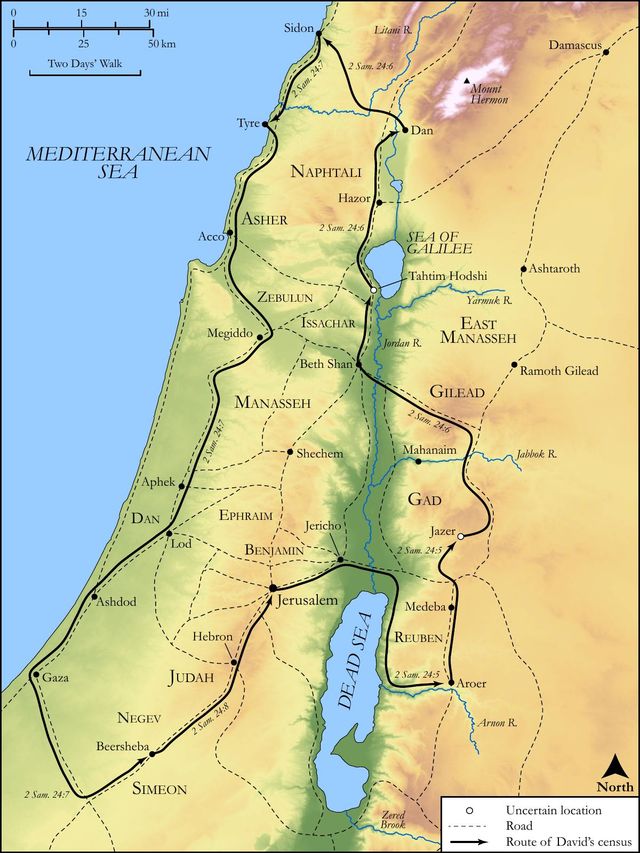
See on the biblical-era maps

Study this verse
Historical interpretation
Historical reception
1 surviving comment on this verse from the historical church.
And again, David, after he had commanded the people to be numbered, was smitten in heart, and said to the Lord: "I have sinned exceedingly, because I have commanded this, and now, O Lord, take away the iniquity of Thy servant, for I have transgressed exceedingly." And the prophet Nathan was sent again to him, to offer him the choice of three things, that he should select the one he chose—famine in the land for three years, or that he should flee for three months before his enemies, or mortal pestilence in the land for three days. And David answered: "These three things are a great strait to me, but let me fall into the hand of the Lord, for very many are His mercies, and let me not fall into the hands of man." Now his fault was that he desired to know the number of the whole of the people which was with him, which knowledge he ought to have left to God alone. And, we are told, when death came upon the people, on the very first day at dinner time, when David saw the angel smiting the people, he said: "I have sinned, and I, the shepherd, have done wickedly, and this flock, what hath it done? Let Thine hand be upon me, and upon my father's house." And so it repented the Lord, and He commanded the angel to spare the people, and David to offer a sacrifice, for sacrifices were then offered for sins; sacrifices are now those of penitence. And so by that humbling of himself he became more acceptable to God, for it is no matter of wonder that a man should sin, but this is reprehensible, if he does not recognize that he has erred, and humble himself before God.
Continue studying 2 Samuel 24:14 across the web’s major study libraries — every link below opens this exact verse, chapter, or book on the destination site.
Read & Compare
 BibleGatewayThis verse in more than 200 translations and 70 languages.
 Bible.comThe YouVersion reader — hundreds of translations, reading plans, and highlights.
 ESV.orgCrossway's official English Standard Version reader.
 NET BibleThe NET translation with 60,000+ translators' notes on every rendering decision.
 STEP BibleTyndale House's free study tool — original text, vocabulary, and scholarly resources.
 BibliaLogos Bible Software's free web reader.
 USCCBThe New American Bible (Revised Edition) with the U.S. bishops' study notes.
Commentaries
 BibleHub CommentariesDozens of classic commentaries on this verse, gathered on one page.
 StudyLightMore than 100 commentary sets — the largest collection on the web.
 BibleRefPlain-English commentary on what this verse means, verse by verse.
 Enduring WordDavid Guzik's free commentary on this chapter, widely used by Bible teachers.
 Bible Study ToolsVerse commentary alongside Greek and Hebrew study aids.
Original Language & Research
- BibleHub InterlinearThe verse word by word — original language, transliteration, and English.
- BibleHub LexiconEvery word's original-language definition and Strong's entry.
 Blue Letter BibleDeep-study tools — Strong's numbers, concordance, and word studies.
 SefariaThe Hebrew text with Rashi and centuries of Jewish commentary.
Sermons, Hymns & Audio


TrulyRandomVerse is not affiliated with these sites and doesn’t control their content. They’re linked because they’re genuinely useful.
Summary
In 2 Samuel 24:14, King David, facing the dire consequences of his sin in numbering Israel, expresses profound anguish and makes a pivotal decision. He chooses to submit to the direct hand of the LORD for punishment, rather than falling into the hand of man. This choice is rooted in David's deep theological conviction regarding God's boundless compassion, even in the administration of justice. The verse powerfully encapsulates David's desperate yet unwavering trust in God's character amidst the severe repercussions of his disobedience.
Context
ShowHideLiterary Context
This verse serves as the emotional and theological climax of the narrative in 2 Samuel 24. The chapter opens with the LORD's anger against Israel, which leads to David's census—an act deemed sinful, likely due to a motive of prideful reliance on military strength rather than divine provision. While 2 Samuel 24:1 states that the LORD incited David, 1 Chronicles 21:1 clarifies that Satan also played a role, highlighting the complex interplay of divine sovereignty and human responsibility in temptation. The prophet Gad is then sent by God to present David with three severe options for national punishment: seven years of famine, three months of fleeing before enemies, or three days of pestilence. David's response in this verse is a moment of profound theological reflection and agonizing decision, directly leading to the ensuing pestilence and David's subsequent act of atonement at the threshing floor of Araunah, which would later become the sacred site for the Temple, as recounted in 1 Chronicles 21.
Historical & Cultural Context
In ancient Israel, a census was not inherently sinful, as evidenced by the divinely commanded censuses conducted by Moses in Numbers 1 and Numbers 26. However, David's census here appears to have been undertaken without divine command or the proper ritual atonement (Exodus 30:12), strongly suggesting a motive of self-reliance, military pride, or a desire for personal glory rather than obedience or preparation for a divinely ordained task. Kings among the nations commonly took censuses to assess military strength or taxation potential, but for Israel, ultimate reliance was always to be on the LORD. The role of the prophet, like Gad, was crucial in holding the king accountable to God's law and communicating divine judgment or instruction. David's choice also reflects a cultural understanding of human rulers, who could be arbitrary, vindictive, and cruel, in stark contrast to the just yet merciful character of their covenant God.
Key Themes
ShowHideThis passage powerfully illustrates several profound theological themes. Firstly, the Consequences of Sin are starkly presented; even a king "after God's own heart" (Acts 13:22) faces severe repercussions for disobedience, affecting not only himself but the entire nation. Secondly, the theme of Divine Sovereignty and Justice is prominent, as God initiates the punishment, demonstrating His righteous governance over His people and His commitment to covenant faithfulness. Thirdly, and most significantly, the verse highlights the Greatness of God's Mercy in contrast to human judgment. David's choice underscores his deep understanding that while God's justice is certain and His discipline severe, His fundamental nature is one of immense compassion and unfailing love, even when administering painful discipline. This choice ultimately reaffirms David's Trust in God's Character, even in a desperate situation, preferring to be disciplined by a loving Father than to endure the unpredictable and often unforgiving whims of human adversaries.
Exposition and Analysis
ShowHideKey Word Analysis
ShowHideThe Hebrew word צָרַר (tsârar), from which "strait" is derived, conveys a profound sense of constriction, narrowness, or extreme distress. It describes a situation where one is hemmed in, experiencing intense pressure and difficulty, with no easy way out. David is not merely in a difficult position; he is in a truly desperate, agonizing predicament, a "tight spot" from which escape seems impossible, a direct consequence of his own sin. This word emphasizes the overwhelming nature of the choice and David's profound anguish.
The Hebrew word יָד (yâd) refers to the open hand, and metaphorically, it signifies power, authority, control, and means. In this context, "the hand of the LORD" and "the hand of man" represent the ultimate authority and power to administer judgment or mercy. David's choice is a profound declaration of where he believes ultimate power and just authority reside, and whose dominion he prefers to be under, recognizing the vast difference in their character and exercise of power.
The Hebrew word רַחַם (racham) is particularly rich in meaning, often appearing in the plural form to denote an abundance of compassion. It is fundamentally linked to the word for "womb" (rechem), suggesting a deep, visceral, and tender compassion, akin to a mother's profound, instinctive affection for her child. This emphasizes that God's mercy is not merely pity, but a profound, empathetic, and enduring tenderness, highlighting the depth and tenderness of God's compassion, even in the midst of administering judgment.
Verse Breakdown
ShowHide"And David said unto Gad"
This opening clause immediately establishes the direct and personal nature of the communication between the king and the prophet, highlighting the gravity of David's decision and his immediate, verbal response to the divine options presented. It underscores the weight of the moment and David's full engagement with the divine challenge.
"I am in a great strait"
David's raw and honest confession of his desperate predicament reveals his profound distress and the agonizing weight of the choice before him. This acknowledgment of his "tight spot" is a humble admission of his helplessness and the severe consequences brought about by his own sin, leaving him with no easy or desirable path.
"let us fall now into the hand of the LORD"
This is David's deliberate, decisive, and courageous choice. He actively chooses divine discipline, demonstrating a profound, albeit desperate, trust in God's character. He prefers to be disciplined directly by God, recognizing that even in judgment, God's hand is ultimately more just, more righteous, and more merciful than any human alternative.
"for his mercies [are] great"
This clause provides the theological rationale and the bedrock of David's decision. It is not a blind leap of faith but a reasoned choice based on his intimate knowledge and experience of God's character. David understands that while God is just and will punish sin, His fundamental nature is one of immense compassion, unfailing love, and redemptive purpose, even when administering severe discipline.
"and let me not fall into the hand of man"
This concluding phrase highlights the stark contrast David perceives between divine and human judgment. He understands that human judgment, often driven by revenge, caprice, limited understanding, or self-interest, would be far less merciful, more arbitrary, and ultimately more destructive and less redemptive than divine judgment. He trusts God's perfect justice and boundless compassion over the flawed and often cruel nature of human retribution.
Literary Devices
ShowHideThe verse employs several powerful literary devices that amplify its theological depth. Contrast is central, particularly in the stark juxtaposition of "the hand of the LORD" and "the hand of man," which highlights the fundamental difference between divine and human judgment. This contrast underscores David's profound theological insight into God's character, portraying God as infinitely more merciful than humanity. The phrase "fall into the hand of" functions as a potent Metaphor, signifying submission to the power, authority, and judgment of either God or humanity. It conveys the idea of being utterly subject to the will and actions of another, emphasizing the complete surrender involved in David's choice. David's declaration of being in a "great strait" could also be seen as Hyperbole, an exaggeration used to emphasize the extreme and overwhelming nature of his distress and the agonizing difficulty of his choice, underscoring the severity of his predicament.
Theological and Thematic Connections
ShowHide2 Samuel 24:14 offers a profound theological insight into the nature of God's justice and mercy. David's choice reveals a mature understanding that God, even in His righteous anger against sin, remains infinitely compassionate. His discipline, though painful, is ultimately redemptive, aimed at correction and restoration rather than annihilation. This contrasts sharply with human judgment, which is often tainted by self-interest, vindictiveness, or a lack of true understanding and power to truly restore. The verse underscores that true repentance involves not just acknowledging sin but also trusting in God's character to administer just and merciful consequences, finding solace in His great mercies even amidst the pain of discipline. It is a testament to the fact that even when we deserve judgment, God's nature is fundamentally merciful and compassionate, offering hope and the path to restoration.
Reflection and Application
ShowHideDavid's agonizing choice in 2 Samuel 24:14 provides a timeless lesson for believers navigating the consequences of their own actions or facing difficult life decisions. When we find ourselves in a "great strait," whether due to our own sin, the complexities of life, or the injustices of the world, David's example encourages us to turn directly to God. It reminds us that even when we deserve judgment, God's nature is fundamentally merciful and compassionate. We can trust His hand to be more just, more redemptive, and ultimately more loving than any human solution or punishment. Our comfort in affliction comes from knowing that His mercies are indeed great, offering hope and restoration even amidst correction. This verse calls us to cultivate a deep, abiding trust in God's character, believing that His discipline is always tempered by love and designed for our ultimate good, leading us to repentance and deeper reliance on Him. It challenges us to embrace His corrective hand, knowing that true healing and growth often come through submission to His perfect will.
Questions for Reflection
ShowHideFAQ
ShowHideWhy was David's census considered a sin, especially if God incited it?
ShowHideWhile 2 Samuel 24:1 states the LORD incited David, 1 Chronicles 21:1 clarifies that Satan also incited him. This highlights the complex interplay of divine sovereignty and human responsibility; God can permit or use evil for His purposes without condoning the evil itself. The sin was not merely the act of counting, but the motive behind it. Unlike the divinely commanded censuses in Numbers, David's census here appears to have been driven by a lack of trust in God's provision and protection, instead relying on the strength of his military numbers. It was an act of pride, a display of human might rather than dependence on the LORD, and it lacked the required atonement offering for numbering the people (Exodus 30:12).
How does David's choice to "fall into the hand of the LORD" demonstrate faith?
ShowHideDavid's choice demonstrates profound faith by acknowledging God's absolute sovereignty and His character as both just and merciful. He understood that human judgment is often arbitrary, cruel, and without true compassion or redemptive purpose, whereas God's judgment, though severe, is always tempered by His "great mercies" and aims for ultimate restoration and holiness. By choosing God's hand, David expressed a deep trust that even in discipline, God's ways are superior, more righteous, and ultimately more redemptive than any human alternative. It was a recognition that God's love underlies even His most severe acts of correction, as seen in passages like Hebrews 12:5-11, which teaches that the Lord disciplines those He loves for their good.
Christ-Centered Fulfillment
ShowHideDavid's desperate choice to "fall into the hand of the LORD, for his mercies are great" finds its ultimate and most profound fulfillment in Jesus Christ. David, a king and a man after God's own heart, still fell into sin, bringing judgment upon himself and his people. His choice highlights the profound truth that God's mercy is indeed boundless, even in the face of human failure and the administration of justice. In Christ, we see the full embodiment of this great mercy. The God whose "mercies are great" did not merely offer humanity a choice of judgment, but provided the ultimate solution to sin's "great strait." Instead of us falling into the hand of the LORD for judgment, the Lamb of God, Jesus Christ, willingly fell into the hand of the LORD on our behalf. He bore the full weight of divine judgment for our sins, so that by His stripes, we might be healed (Isaiah 53:5). God's great mercy is most clearly revealed in His willingness to send His Son to suffer the consequences we deserved, demonstrating His love for us while we were still sinners (Romans 5:8). Through Christ, we are invited not to fear falling into God's hand for judgment, but to embrace His hand of grace and forgiveness, finding refuge and redemption in the One who perfectly satisfied both God's justice and His great mercy (Ephesians 2:4-5).